Musée d'Orsay
From October 06th, 2026 to January 31st, 2027
In 2026, in order to mark the hundredth anniversary of the artist's death, the Musée d'Orsay is organising a major exhibition devoted to Mary Cassatt (1844-1926), in collaboration with the National Portrait Gallery, London and the Museum of Fine Arts, Boston. In France, this will be a long-awaited event: its national museums have never devoted a major exhibition to Mary Cassatt, an active member and pillar of the impressionist group. Her centenary provides an opportunity to examine the central place occupied by this prominent artist who, through talent and determination, succeeded in forging a unique identity in late 19th- and early 20th-century art history, on both sides of the Atlantic.
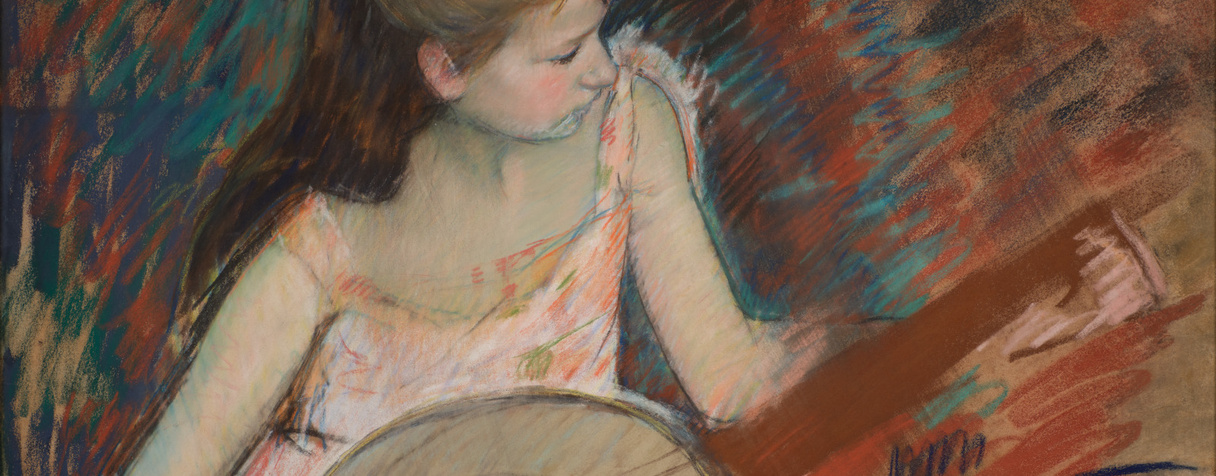
Mary Cassatt described herself as “American, American through and through”, but started off by grounding her art in the pictorial tradition of the old masters, which she studied during her visits to Europe, before becoming an essential figure in the impressionist movement in France, where she lived for no fewer than six decades. “I am independent!” she proclaimed, “I can live alone and I love to work”. Taking a chrono-thematic approach, the exhibition paints a new portrait of the artist, examining her art through the prism of the notion of independence, in which she took great pride and which was her guiding principle throughout her life.

Jeune fille au jardin (Girl in the Garden or Young Woman Sewing in a Garden), an oil-on-canvas work created between 1880 and 1882 by Mary Cassatt
At this stage of her career, in the early 1890s, Mary Cassatt's financial independence enabled her to become a landowner. Surrounded by extensive grounds, the château she acquired in Oise served as a backdrop for numerous outdoor scenes featuring women and children: radiant, vibrantly colourful works. Modern Woman, the most important commission the artist received, a monumental mural to decorate the Woman's Building at the 1893 World's Fair in Chicago, was a highlight in her career and a major milestone in the development of her body of work. This huge decoration, long since disappeared, will be evoked in the itinerary through a selection of prints and pastels relating to the mural, as well as via a film featuring a digital restoration of this gigantic work (4 x 18 metres), uniquely ambitious in size and subject alike. Her admirable set of “Ten Colour Prints” will also be studied in light of this new, remarkably experimental phase in her work and her progressive opinions on women's education.
Mary Cassatt's commitment to independence was not limited to her own career and artistic approach. A staunch supporter of women's fight for the right to vote, she encouraged her contemporaries to “work for suffrage, for it is the women who will decide the question of life or death for a nation.” In 1915, along with her friend Louisine Havemeyer, she organised an exhibition in New York on behalf of women's suffrage. The itinerary concludes with a small selection of Mary Cassatt's paintings featured in that exhibition, demonstrating how this pioneering artist's art and actions alike tended towards activism.
Curatorship
Paris
Caroline Corbeau-Parsons, Graphic Arts and Paintings Curator, Musée d'Orsay
Anne Robbins, Curator of Paintings, Musée d'Orsay
London
Sarah Moulden, Senior Curator of 19th Century Collections, National Portrait Gallery
Boston
Erica Hirshler, Croll Senior Curator of American Paintings, Museum of Fine Arts
Exhibition organised by the Musée d'Orsay, the National Portrait Gallery, London, and the Museum of Fine Arts, Boston.
Exhibition organised by the exceptional participation of la Bibliothèque nationale de France (BnF)
Also see:
Mary Cassatt: The Independent Impressionist
https://www.barnebys.com/blog/mary-cassatt-the-independent-impressionist
And