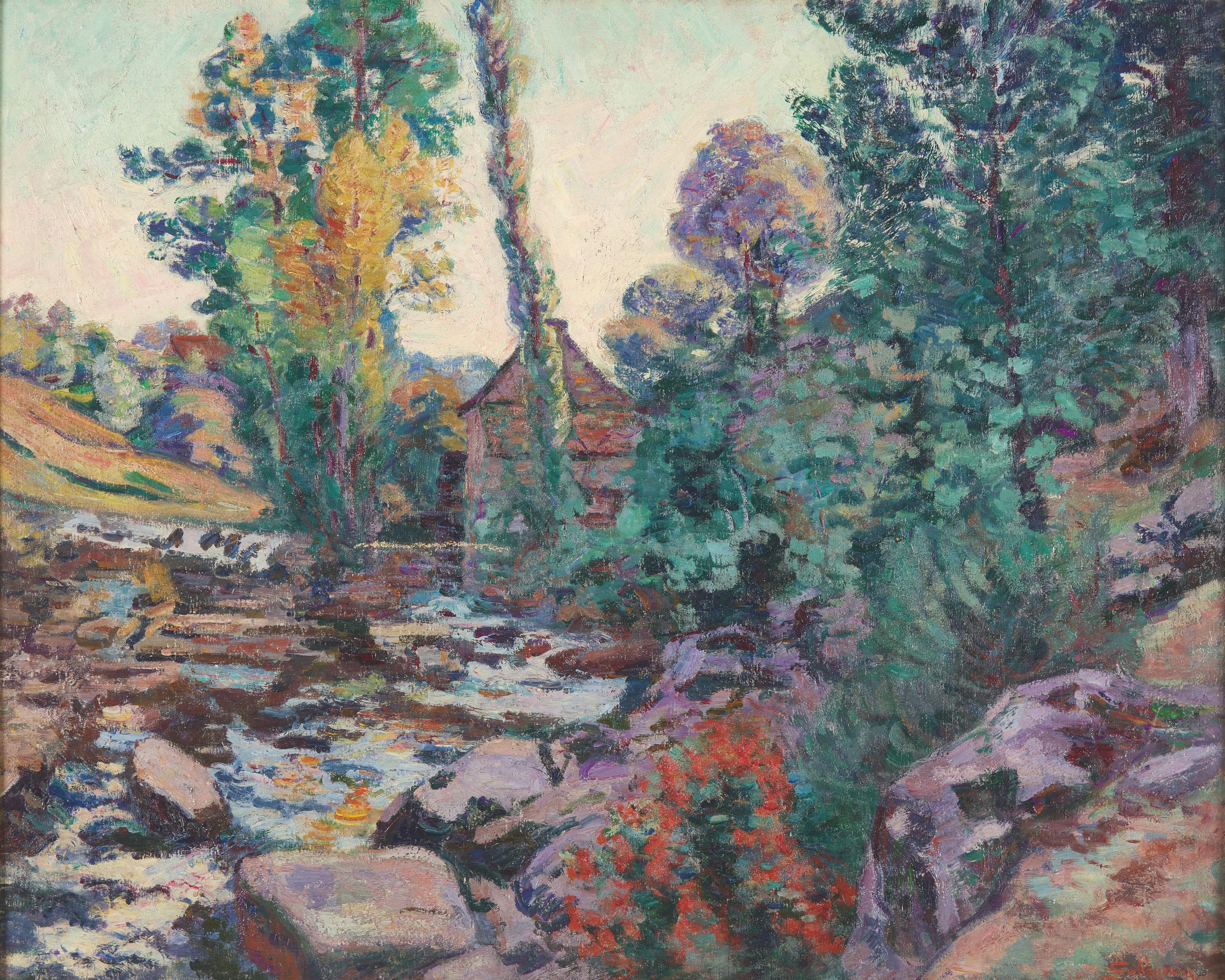
Image credit: Claude Lorraine, 'Les Bergeres Musiciens - Pastoral Landscape with Shepherds Playing Music by a River ', oil on canvas, c1637. From the Schroder Collection.o
The Holburne recently opened two new galleries, displaying works on long-term loan from the Schroder family collection. While the lower ground floor sparkles with Renaissance silver, a small but exquisite collection of paintings form the 17th-Century Gallery on the first floor.
An undoubted highlight, Pastoral Landscape with Shepherds Playing Music by a River was painted around 1637 by the renowned master of the ideal landscape, Claude Gellée – better known as Claude Lorrain, or simply Claude (1604/5–1682).
Claude is widely credited with pioneering landscape painting, emphasising harmony, light and classical serenity. His work had a profound influence on the development of landscape art, particularly in Britain; J.M.W. Turner even bequeathed two of his masterpieces to the National Gallery on the condition they hung beside Claude’s paintings.
Largely self-taught, Claude developed his style through close observation of nature and light, sketching outdoors from dawn to dusk to capture atmospheric effects with remarkable sensitivity. The countryside around Rome was scattered with ancient ruins, which he often incorporated in his poetic and idealised landscapes.
Pastoral Landscape with Shepherds Playing Music by a River is recorded in Claude’s Liber Veritatis—a book of ink-and-wash drawings where he meticulously reproduced each of his paintings, often noting the buyer and destination, which is housed at the British Museum. The annotations on the page reveal that this picture was painted for Etienne Gueffier (1576-1660), French envoy in Rome, c1637-8.
The painting was last publicly exhibited exactly 100 years ago, at the Palais des Beaux-Arts in Paris.
Dr Chris Stephens, Director of the Holburne said: “This painting represents the most important individual loan in the museum’s history. There are few – if any – works of this quality outside London. It is thrilling for the Holburne and for Bath to house a display of such international standing.”
The painting by Claude is displayed in the Holburne’s new 17th-Century Gallery, presenting highlights from a larger collection of 17th-century art assembled by Baron Bruno Schroder (1867–1940) and his wife between 1913 and 1928. Other works on display include portraits by Justus Sustermans (1597–1681) and Cornelis van der Voort (1576–1624); landscapes by Aert van der Neer (1603/4–1677) and Jan van Goyen (1596–1656); and an exquisitely decorated scagliola table attributed to Fistulator workshop, from the mid-17th century.
The world is turbulent and difficult. How fortunate that there are islands! Outside, in the open air, or inner imaginary ones that we can find just about anywhere – in our heads, at home or somewhere else. Art collections, particularly private ones, are islands of a special sort. Not governed by considerations of public accountability, they are subject to the highly personal criteria of the collector alone. Consequently, they provide a place of retreat, far from the world, that facilitates independent thinking in images.
To mark the hundredth birthday of Dieter and Hilde Scharf, Possibilities of an Island explores the passion for collecting shared by the couple and their daughter Julietta Scharf. It is the first presentation to show a substantial selection of those works that are not part of the holdings that were entrusted to the Nationalgalerie as a long-term loan and that have been on display in a dedicated building as “Sammlung Scharf-Gerstenberg” since 2008.
Building on the renowned collection put together by his grandfather Otto Gerstenberg (1848–1935), Dieter Scharf established a foundation in 2001, from which he selected a group of some 350 works for the Sammlung Scharf-Gerstenberg. His focus as a collector was on Surrealism, but he cast his net wide enough to include the movement's precursors and successors. Spread over the two floors, the galleries offer a broad panorama of fantastical art, ranging from works by Goya, Piranesi and Redon to Jean Dubuffet's Art Brut.
Surrealism and Beyond
Thematically, Possibilities of an Island goes beyond the expanded concept of Surrealism of the Sammlung Scharf-Gerstenberg. Setting the tone right from the outset are two emblematic floor pieces by the Swiss artist Kavata Mbiti: the white acrylic resin sculpture “Möglichkeiten einer Insel I” (“Possibilities of an Island I”), which lent its title to the exhibition, and, in stark contrast to it, the black three-part wooden sculpture, “Kiel” (“Keel”). While the former recalls the soft, fluid shapes dreamt up by Jean Arp or Hans Bellmer and seems to embody the idea of a self-generating and self-propelling semi-abstract form, the latter conjures up scary images of sharks, their dorsal fins emerging ominously from the water as they circle around an island.
But where there is danger, there is also hope of rescue or salvation – and indeed, the exhibition offers a whole archipelago of ‘possible islands’, each with its own theme. Subdivided into twelve chapters, it explores ways of countering the threats and impositions of everyday life through art: by escaping into idylls, into the private sphere or into another age, by putting together a visual world of our own, through complex systems, by fleeing into fantasy or by adopting an ironic attitude towards what we are most afraid of – death.
The exhibition presents a selection of some 150 paintings, watercolours, drawings, prints, sculptures and objects by celebrated artists such as Alfred Sisley, Auguste Renoir, Egon Schiele, Max Beckmann and Hannah Höch, as well as by somewhat less well-known creators of darkly fantastical art such as Alfred Kubin, Léon Spilliaert and Unica Zürn.
IMAGES
James Ensor (Ostend 1860 – Ostend 1949), The Capital Sins Dominated by Death, 1904 (Les péchés capitaux dominés par la mort / Die Todsünden, vom Tode beherrscht) From the series The Seven Deadly Sins. Etching, 15.8 × 24.9 cm (sheet) 9.8 × 15 cm (plate) Julietta Scharf Collection.
For the first time, the Scharf Collection, one of the most important private collections in Germany, will be presented on a large scale. The collection comprises predominantly French art of the 19th and 20th centuries, as well as contemporary international art.
The exhibition at the Alte Nationalgalerie showcases a selection of around 150 works, including outstanding pieces by Auguste Renoir, Pierre Bonnard, Edgar Degas, and Claude Monet, and invites visitors on a journey through the collection: from Goya and French Realism to the French Impressionists and Cubists, and on to contemporary art. A particular highlight is a selection of the complete prints by Henri de Toulouse-Lautrec, which are held in the collection.
The Scharf Collection is the direct successor to the important Berlin private collection of Otto Gerstenberg, which ranged from the beginnings of modernism with Goya to pioneers of the French avant-garde such as Gustave Courbet and Edgar Degas. His daughter, Margarethe Scharf, managed to save the majority of the collection despite significant losses during the Second World War. His grandsons, Walther and Dieter Scharf, each built their own collections upon the works bequeathed to them: Dieter Scharf focused on Surrealism. Since 2008, his collection has been on permanent loan to the National Gallery in Berlin-Charlottenburg as part of the Scharf-Gerstenberg Collection .
Walther Scharf and his wife Eve, along with their son René, further expanded the focus on French art. They acquired works by Claude Monet, Paul Cézanne, Pierre Bonnard, Henri Matisse, and Pablo Picasso. Today, René Scharf and his wife Christiane concentrate on contemporary art. Their interest lies particularly in the expansion of the medium of painting and the relationship between representational and abstract imagery. Against this backdrop, René and Christiane Scharf continue the family's collecting tradition into the present day with works by Sam Francis, Sean Scully, Daniel Richter, and Katharina Grosse.
Exhibition Texts
Painting Modern Life: Impressionism
Hardly any other artistic movement of the 19th century is as revered as French Impressionism. With
a swift application of thick swatches of paint and a new attention to light, colour, and atmosphere,
the “painters of modern life” (Charles Baudelaire) sought to capture the transience of the moment.
The Scharf Collection contains magnificent examples of this art. Otto Gerstenberg concentrated on
collecting French art, and Walther, Eve and René Scharf have continued with this focus.
For his landscapes, Monet was interested in the interplay of light and colour. In his paintings Steep
Cliffs near Dieppe (1897) and Waterloo Bridge (1903), which are both part of painting series, Monet
was investigating how his subject changed with the light.
Auguste Renoir was primarily dedicated to portraiture and depictions of society. His portraits of
women reflect the ideal of the modern, elegant Parisienne.
Edgar Degas was also famous for his depictions of women. He often showed them backstage or in
everyday situations, for example washing or combing their hair – usually unposed and observed from
a distance. His focus here was on light, posture and composition.
A generation later, Pierre Bonnard would reconnect with this intimacy and sensuality when depicting
his wife Marthe in the bathtub.
It can be said that no other painter of Post-Impressionism engaged with landscape painting as
radically as Paul Cézanne. In his works, he emphasizes the texture of the painting surface and the
basic shapes of pictorial elements. His experiments were groundbreaking for modernism.
Between Horror and Spectacle: Francisco de Goya
I
n the 19th century, interest in Spanish art grew in France. Many artists, such as Eugène Delacroix,
Edgar Degas and Honoré Daumier, were enthusiastic about Francisco de Goya, and interest in his art
also grew in Germany. Collectors in Berlin were eager to acquire Spanish art, and in this spirit Otto
Gerstenberg purchased drawings, watercolours and the four large series of prints by Goya:
Disparates, Caprichos, Desastres de la Guerra and Tauromaquia.
The bullfighting scenes in Tauromaquia fascinated Central European audiences, bringing them face to
face with the drama of this Spanish custom. The series was interpreted as both approving of the
national sport, which Goya held in high regard, but also as a critical depiction. Some identified
literary references, for example to Don Nicolas Fernández de Moratín’s history of bullfighting. And
some saw the bulls as representing Spanish resistance against the Napoleonic occupation.
This political dimension became even more evident in Desastres, which Goya began in 1810.
Although the artist did not explicitly reference the war of independence against France, the
connection is plain to see. Unsparingly, he shows the cruelty of war: death, torture, desperation and
hunger. The series was not published until forty years after Goya’s death because it was not
reconcilable with his role as a Spanish court painter who also had French clients.
Perceptive Observers: Art between Romanticism and Social Criticism
The decades prior to Impressionism were marked by a number of different artistic currents. Eugène
Delacroix is considered the key exponent of French Romanticism. The paintings of his in the
collection are characterized by the way in which they connect emotional intensity and political
symbolism. King Henry IV and Gabrielle d’Estrées (1826) shows the 16th century king and his lover
and political advisor Gabrielle d’Estrées at the French court.
The Barbizon School was an important, anti-academic artistic movement in France.
Beginning around
1830, painters such as Camille Corot focused on working in nature, en plein air. They contributed
significantly to changes in European art and influenced the development of Impressionism.
Gustave Courbet understood himself to be a realist painter. His involvement in the Paris Commune
uprising in 1871 brought him a prison sentence. He painted many of his still lifes in the Sainte-Pélagie
prison, where no live models were permitted.
Honoré Daumier was another socially critical artist. His paintings are often characterized by a satirical
treatment of social and political subjects. Using expressive strokes and a dark palette, he portrayed
the life of the working-class population. His sculptures of the series Les Parlementaires, with their
exaggerated facial features, caricature the French parliamentarians – a biting commentary on the
political elite of his time.
Prophet of Colour: Pierre Bonnard
When Pierre Bonnard began his art studies in Paris in 1888, the art world was at a turning point.
Many young artists were seeking new forms of expression and tended to resist academic traditions.
These artists also increasingly distanced themselves from Impressionism, which was enjoying
success. Bonnard, working with Édouard Vuillard, Maurice Denis and other like-minded artists,
founded the Nabis group, who – in reference to the Hebrew derivation of their name – understood
themselves as “prophets” of a new form of painting. They wanted to communicate more than visible
reality, instead putting a strong emphasis on expressing feelings and thoughts.
The Scharf Collection contains outstanding paintings by Bonnard, including his central work The Large
Bathtub, in which the artist portrays his wife Marthe, and Place Clichy, showing the bustling activity
on this square near his studio in Paris.
Pierre Bonnard’s work is a connecting point where the Scharf Collection and the collections at the
Nationalgalerie tie into and complement each other. The painting The Family of Claude Terrasse in
the Garden at the Nationalgalerie assumes a special position in the artist’s oeuvre. Not only is it the
largest work he had created up to that point, it is also one of his very few folding screens. Working
with an originally Asian piece of furniture, Bonnard was combining Eastern and Western painting
traditions, seen here in the planar composition of pictorial space and bodies and in the design of
fabrics and landscape inspired by Japanese ornamentation.
Pioneer of Modern Lithography: Henri de Toulouse-Lautrec
A significant part of the Scharf Collection is the body of prints – complete except for only very few
gaps – by Henri de Toulouse-Lautrec, which was acquired by Otto Gerstenberg. This is the largest
Toulouse-Lautrec collection worldwide.
Toulouse-Lautrec began working with the still young technology of lithography in 1891. Images could
be drawn directly on a stone and printed in large editions at low cost. His innovative formal language
made the artist a pioneer of modern lithography.
The French artist came from a wealthy, aristocratic family, but he turned his attention to the imagery
of the stage and the brothel, which were held in poor regard. It has been established that the artist
spent a good deal of time in Parisian brothels and even lived there for weeks. His lithographic
portfolio Elles in particular testifies to his empathetic view of the women who worked there. He
depicts them not in an eroticized way, but carrying out familiar, everyday activities.
From among his brothel works, a portrait-like sheet titled Clownesse Cha-U-Kao is particularly
striking. As a clowness, she was practicing a male-dominated profession and was stepping forward
self-confidently onstage as in life. Provocatively, Toulouse-Lautrec shows her with her legs spread
wide and gazing directly at the viewer.
Innovation in Poster Design:
Toulouse-Lautrec as a Graphic
Artist
Toulouse-Lautrec’s fame was earned through his posters. With their vibrant colours, they
advertised for concert cafés and variety theatres like the Moulin Rouge but also for books,
magazines, businesses and products. His designs were like none seen before: He worked with large
surfaces, curving lines, stark contrasts and a spraying technique. The first poster maker to show and
advertise specific stage artists, he portrayed the likes of La Goulue, Jane Avril and Aristide Bruant,
thus contributing to the cult of celebrity at the time.
Sometimes, the artist turned stars into an artistic subject in their own right. His depictions of the
dancer Loïe Fuller, for instance, have little in common with portraits: Instead of personal features, he
shows only her flowing fabrics moving in sweeping circles through colourful light. He applied
watercolours to these two-colour prints and completed them with an application of silver or gold
dust.
In addition to his abstract subjects, there are works that impart the atmosphere onstage and
backstage. Based on a painting, The Grand Theatre Box likely shows the profile view of Amande
Brazier, the owner of a popular lesbian bar, attending a performance with a prostitute. In the
neighbouring theatre box sits the driver of the Baron of Rothschild, whom the artist knew. The
person in the middle, rather than looking at the stage, gazes at the neighbouring theatre boxes. In
this way, the act of looking becomes itself a subject. Another aspect at work here is that the theatre
box is not only enjoyed by privileged members of the upper middle class, but also by strong
characters who stand at the edge of society.
Sharp Eyes and Biting Commentary: Toulouse-Lautrec as a Witness of His Time
Henri de Toulouse-Lautrec was an attentive observer of what was happening around him. The extent
to which he saw himself and his attentiveness as part of a tradition is evident in his design of the
cover for a new edition of Desastres de la Guerra, in which Goya had captured the horrors of war.
Toulouse-Lautrec designed a great number of advertisements, for example a poster for his friend the
photographer Paul Sescau. With a wink in his eye, the artist pokes fun at the new medium’s claim to
objective realism. With Toulouse-Lautrec, the photographer remains invisible, his model is turned
away from him and is wearing a face mask and a dress covered in question marks.
The skating figure of Misia Nathanson is staged in a similarly sophisticated manner. She was married
to the publisher of the art and literary magazine La Revue blanche, for whose covers she often posed.
The picture for the magazine La Vache enragée shows the titular “enraged cow” which, representing
revolutionary artists, chases a wealthy bourgeois man. However, in extreme cases, attacks on the
state order could end under the guillotine’s blade, as Toulouse-Lautrec illustrates in an
advertisement for the daily newspaper Le Matin. And Toulouse-Lautrec also designed the poster for
a book by the journalist Victor Joze, which portrayed Berlin – the “Babylon of Germany” – as both
militaristic and corrupt.
Fragmentations of Everyday Life: Cubism
After Impressionism, Cubism was the next groundbreaking innovation in modern art. With their
paintings and collages, Pablo Picasso, Georges Braque and later also Juan Gris had the most decisive
influence on this style. Henri Laurens, working in the medium of sculpture, shaped Cubism with
artistic expression of his own.
The goal of Cubism was to represent the multi-layered and multi-dimensional nature of reality by
deconstructing shapes and breaking them down to their basic geometric forms. In painting, this
resulted in works which show subjects from different viewing angles at the same time and which use
collaged materials to combine and connect different forms of reality. A significant example of this is
Picasso’s collage Guitar and Sheet Music.
Everyday objects like bottles, glasses, newspapers and playing cards were elevated to pictorial
subject matter. Fragmented in Cubist style, they offered new perspectives on worlds of the everyday
like cafés as social meeting points or the artist studio as a place of creativity. Following this first
phase marked by fragmentation, decomposition and systematic analysis, so-called Analytical Cubism,
artists experimented increasingly with joining surfaces and forms together: Exponents of Synthetic
Cubism include Juan Gris and Fernand Léger. As the latter had a great fondness of cylindrical shapes,
he was also referred to as a “Tubist”.
The ideas of Cubism had a decisive influence on conceptions of space, form and abstraction in
modernism.
Colour, Form and Gesture: Figuration and Abstraction after 1945
After 1945, art evolved in a tension between figuration and abstraction.
Sam Francis and Maurice Estève are prime examples of the development of abstraction after 1945. In
their bright and radiant pictures, colour itself becomes a vehicle of expression. Estève was among the
artists of the Nouvelle École de Paris who were very actively supported by the collector Walther
Scharf, who sometimes also sold their art. Scharf’s son René, who worked in New York for a long
time, complemented the collection’s French orientation with a North American perspective when he
added works by Sam Francis.
Since his relocation to Berlin, René Scharf and his wife Christiane have been expanding the collection
by adding contemporary works, including from Berlin’s art scene.
Through its sombre palette and the zebra head that is larger than life, Jonas Burgert’s Night Trick
evokes elements of the so-called Dark Romanticism of the late 19th century, which engaged with the
uncanny and the supernatural. The hybrid creatures seen in Katja Novitskova’s Earthware are also
located between reality and nightmare, while in Martin Eder’s work the cute and the monstrous
appear side by side. His Narcissus works with the ancient myth of the young man who falls in love
with his mirror image. Here, however, the youth is replaced by a cat, a subject that has been very
popular in social networks.
A Collection for the Future: Aspects of Contemporary Art
The artistic positions shown in this room are connected by material, movement, colour and form.
Gotthard Graubner described his cushion-like works as “colour-space bodies”. The deep impression
of colour they create is achieved through multiple paint applications on a highly absorbent fabric
surface. The painting shown here is one of the smaller works. All of Graubner’s cushion-like works
have in common that they walk the line between panel painting and object and create the
experience of pure colour.
Katharina Grosse was Graubner’s student at the art academy in Düsseldorf. She sometimes works
with very large surfaces – going across entire rooms, the roofs of houses and façades. With the two
paintings in the Scharf Collection, she moves within the confines of the painting surface, with the
paint applications and the paints themselves becoming the event.
Anselm Reyle works with applications of objects, foils and mirrors on the image area, extending it
into three-dimensional space. The functional and decorative materials he uses are elements taken
from consumer society. For Reyle, they become the material of his artistic contemplation about what
painting can be today.
The sculptor Tony Cragg shares with Graubner and Grosse his close connection to the Düsseldorf art
academy. He taught there and also served as its director for several years. Movement has always
played an important role in his sculptures, ensuing from his keen interest in natural structures and
processes of organic growth.
Portrait of a gentleman, three-quarter-length, in a black coat and cape with a black hat, his gloves in his left hand
Price realisedGBP 2,201,500
Estimate
GBP 1,200,000 – GBP 1,800,000
July 2025
FRANS HALS (ANTWERP 1582⁄3-1666 HAARLEM)
Portrait of Johannes Hoornbeeck (1617-1666), half-length, in black dress, holding a book
Important information about this lot
Price realisedGBP 693,000
Estimate
GBP 600,000 – GBP 800,000
The pair of Hals portraits hanging in Mr Albada Jelgersma's home. Frans Hals (1580/5-1666), Portrait of a Gentleman, Aged 37 and Portrait of a Lady, Aged 36, 1637. Oil on canvas, (both) 36⅝ x 27 in (93 x 68.5 cm). Estimate £8,000,000-12,000,000. Offered in The Eric Albada Jelgersma Collection Old Masters Evening Sale on 6 December 2018, as part of Classic Week, at Christie’s in London
While the paintings were on loan to The Fogg Museum at Harvard University, the renowned Hals scholar Seymour Slive observed that they are ‘outstanding, superlative works… in a near miraculous state of preservation.’ Their exceptional condition means that Hals’ fluid brushwork and subtly toned palette can be clearly appreciated.
An ‘imagined’ illustration of Eric Albada Jelgersma (1939-2018) surrounded by his collection
Eric Albada Jelgersma (1939-2018) was just one of several illustrious owners of the Hals pictures, which are said to be the finest pair of portraits by the artist remaining in private hands. During the 19th century they belonged to the family of Count de Thiènnes, who lived in Castle Rumbeke, one of the oldest renaissance castles in Belgium. In the 20th century they passed through the hands of Canadian railroad magnate and pioneering Impressionist collector William Cornelius Van Horne and the American diplomat J. William Middendorf II, before Jelgersma acquired them in 1996 from Robert Noortman, the Dutch art dealer and decade-long director of TEFAF art fair.
At that time Albada Jelgersma, a businessman from the south of Holland who had amassed a fortune in the supermarket wholesale industry, was well on his way to establishing his reputation as a connoisseur of 17th-century Dutch and Flemish masterpieces, acquiring works that covered each genre of Golden Age painting.
Christies 2024
FRANS HALS (ANTWERP 1582⁄3-1666 HAARLEM)
Portrait of a gentleman of the de Wolff family, possibly Joost de Wolff (1576⁄7-?after 1652), half-length