Wednesday, April 11, 2012

…isms: Unlocking Art’s Mysteries - Florence Griswold Museum Old Lyme, CT


…isms: Unlocking Art’s Mysteries
(Florence Griswold Museum 96 Lyme Street, Old Lyme, CT 06371 860-434-5542 through June 10, 2012 ) examines 100 works of American art and culture from the 18th to the 21st centuries to explain art movements and styles. The exhibition is perfect for non museumgoers as an introduction to these stylistic concepts. Seasoned art lovers will enjoy testing their knowledge and learning about the larger historical contexts that have informed artists’ work. The exhibition fosters a richer appreciation of familiar objects from the collection as well as introduces new acquisitions and selected loans.

While some “isms” began as official movements initiated by artists, many, such as Impressionism or Tonalism, acquired their names from critics who recognized new developments in art and coined terms to describe them. Occasionally, as in the case of Luminism, these labels were not assigned until a century later, when art historians discerned, in hindsight, qualities of light and mood shared by American landscape paintings of the mid-to-late nineteenth century.


The air of serenity, glassy water, and spiritual light effects in John F. Kensett’s Fort Dumpling, Rhode Island (1871) identify it as a Luminist painting. Some “isms” describe trends specific to the visual arts, such as Academicism. Other “isms,” such as Romanticism, reflect broad cultural trends that were explored not only in the visual arts, but also in literature, music, and theater. Often, works of art embody the characteristics of more than one “ism.” By asking how different works embody the traits of a particular “ism” this exhibition demonstrates that these stylistic categories are by no means rigid.

…isms: Unlocking Arts Mysteries
examines a range of “isms,” including Neoclassicism, Romanticism, Historicism, Luminism, Tonalism, Japonisme, Impressionism, Post-Impressionism, and Realism.

Neoclassicism is one of the most evergreen of the “isms.” As early as the fourteenth century, a desire to revive the excellence of Greek and Roman art, with its emphasis on figural sculpture, produced the cultural flourishing known as the Renaissance—the first episode of neoclassicism. In the late 1700s and early 1800s, a wave of political revolutions in Europe and America fostered an admiration for Greek democracy and Roman republicanism that encouraged a new round of neoclassicism. Early American architecture and decorative arts, like the examples in this exhibition, incorporate forms and motifs derived from classical forbears.

In the late nineteenth century, a more concentrated Renaissance Revival produced works like George deForest Brush’s neoclassical depictions of women and children. Styles, then, can emerge at a particular moment in time, but also reappear in subsequent eras, broadening and changing the definition of the “ism” each time. While examples of Tonalism and Impressionism can be seen in the gallery, visitors may investigate these two movements further in the Florence Griswold House, where two additional galleries display Tonalist and Impressionist paintings by members of the Lyme Art Colony.


In the 20th century, “isms” flourished with the birth of new art movements seeking to express the modern spirit. A diversity of approaches characterizes Modernist works, such as Harry Holtzman’s Red, Orange, Green, and Yellow. Holtzman’s abstract painting, a new acquisition, embodies an interest in line and color, a return to the fundamentals of art shared by many Modernist works. This exhibition seeks to prove that “isms” are dynamic concepts and that by identifying their traits we can develop a broader appreciation for artists’ stylistic decisions.

More isms:


Frederic E. Church, The Charter Oak at Hartford, ca. 1846. Oil on canvas.
Gift of The Hartford Steam Boiler Inspection and Insurance Company.

(Historicism)


Thomas Watson Ball, Chinese Twilight. Oil on canvas. Gift of the Trustees and
Director in honor of Tony and Sandy Thurston for their lasting devotion to the
Museum.
(Japonisme)


Harry Hoffman, Bridging the Lieutenant, ca. 1906. Oil on canvas board, 16 x 14 inches. Florence Griswold Museum, Gift of Mrs. Morris Joseloff
(Impressionism)

Saturday, April 7, 2012

America @ Work: New Deal Murals in New London and Beyond - Lyman Allyn Art Museum New London


Thomas Sergeant LaFarge
Aloft (Preparatory drawing for mural on East wall in New London Post Office)
20th Century
Charcoal on Paper
15 x 71 inches
Gift of Mrs. Thomas LaFarge


Lyman Allyn Art Museum's exhibition, America @ Work: New Deal Murals in New London and Beyond, is on view through June 9, 2012. The exhibition has been organized by Guest Curator Barbara Zabel, Professor Emeritus of Art History at Connecticut College.

The lobby of the New London Post Office on Masonic Street boasts remarkable murals painted in the 1930s. Hailed by Philip Eliasoph as “the Sistine Chapel of Connecticut,” these murals by New England artist Thomas La Farge (1904-1942) feature scenes of a crew at work on a whaling ship. La Farge’s murals were created under the auspices of the art projects of the New Deal, President Roosevelt’s comprehensive relief program designed to put Americans back to work during the Great Depression.

The Lyman Allyn Art Museum is fortunate to have in its collection the artist’s preliminary studies for the murals; these are the local inspiration for the exhibition. The aim of America @ Work: New Deal Murals in New London and Beyond is to bring attention to our often overlooked local treasures in the context of New Deal murals in other states. The government funded hundreds of murals in federal buildings across the country, typically providing artists with a list of topics pertinent to local history. The artists were then free to choose their own content. Thomas La Farge was quick to identify whaling as an apt theme for murals in New London, a city long known as the “Whaling City.” Other artists in the exhibition chose topics such as the cotton industry in North Carolina, corn harvesting in Georgia, onion farming in upstate New York, processing steel in Ohio, and pioneering and mining in Idaho.

Although the artists included in America @ Work: New Deal Murals in New London and Beyond are from distant corners of America, they share a focus on working Americans. More notably, they espouse an uplifting message of pride in American ingenuity and a belief that the country’s economic woes could be overcome through hard work—this in the face of the stark realities of life in America, a country suffering from significant hardship and unemployment during the Great Depression.

These works also resonate with today’s economic climate; the American population is again faced with economic challenges unheard of since the Great Depression. The government’s establishment of the New Deal art projects of the 1930s provides a provocative model of how to get America back to work while also enriching our cultural heritage.


Doris Lee
Cornfield (Preparatory drawing for mural Georgia Countryside, Summerville, Georgia, 1939)
1938
Pencil on Paper
15 ¼ x 18 ½ inches
Courtesy D. Wigmore Fine Art, Inc. and the Estate of Doris Lee


Charles Ward
Story of Cotton (Mural Study for Roanoke Rapids, North Carolina Post Office)
1937
Oil on Canvas
16 ½ x 24 ½ inches
Courtesy D. Wigmore Fine Art, Inc. and the Estate of Charles Ward

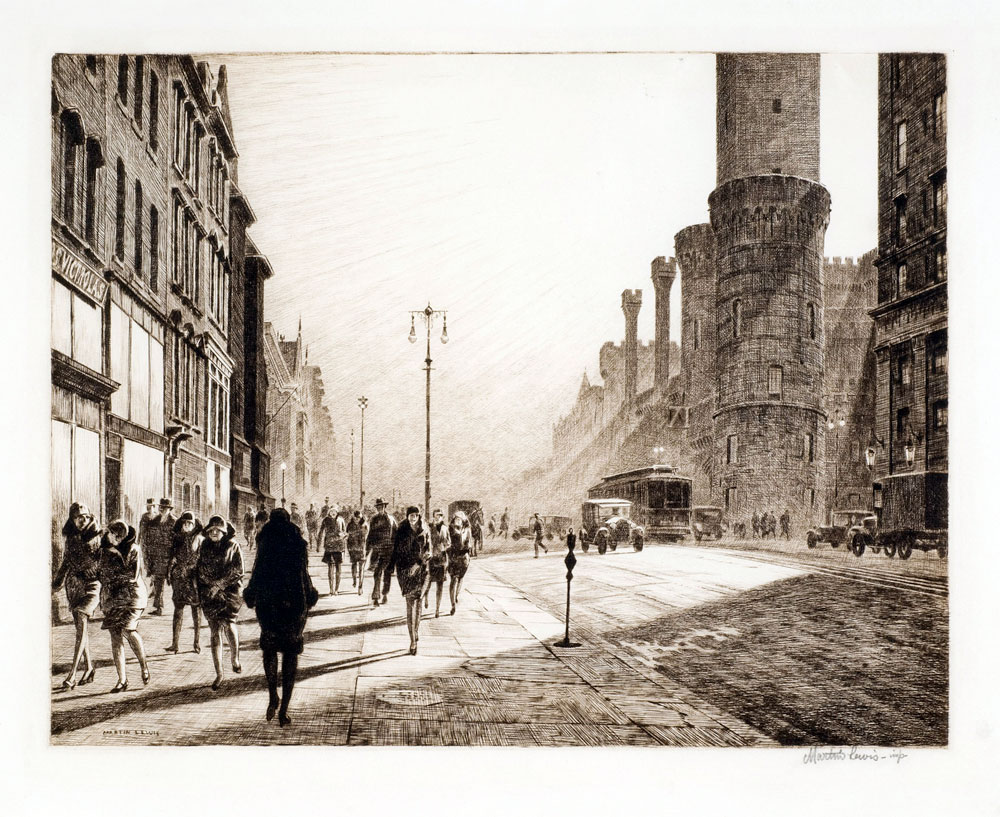
The Prints of Martin Lewis: From the Collection of Dr. Dorrance Kelly


Martin Lewis (1881-1962)
Little Penthouse,1931
Drypoint, 9 7/8 x 6 ¾ in.
Collection of Dr. Dorrance T. Kelly
© Estate of Martin Lewis

The Bruce Museum in Greenwich, Connecticut, presented the new exhibition The Prints of Martin Lewis: From the Collection of Dr. Dorrance Kelly from October 2, 2011, through February 19, 2012.

Recognized as one of the premier American printmakers of the first half of the 20th-century, Martin Lewis (1881-1962) left an indelible mark on the landscape of the art world. Although not as publicly well known as some of his contemporaries such as Edward Hopper, Lewis was a highly skilled printer who was greatly involved in the artistic scene of New York City during the 1920s and ‘30s. This exhibition features more than thirty etchings and several canceled plates by the artist from the private collection of Dr. Dorrance Kelly of West Redding, Connecticut.

The exhibition The Prints of Martin Lewis: From the Collection of Dr. Dorrance Kelly provided a brief biographical account of Lewis and showcases some of the artist’s best technical prints. Lewis was an acknowledged master of the intaglio techniques of printmaking, experimenting with multiple processes including etching, aquatint, engraving, mezzotint, and dry point.

In 1915 he produced his first documented etching, Smoke Pillar, Weehawken. Images like this one documented the scenes of everyday life as they played out in the thriving metropolis around New York City. Lewis portrayed all aspects of city life including dockworkers, skyscrapers, tugboats, and pedestrians – mostly the ladies. He produced magnificent prints that captured the energy, bustle, and occasional solitude of New York. With his move to Connecticut in 1932, Lewis investigated another topic through his printmaking: country life. This firmly entrenched Lewis as a prominent American scene artist, as his prints captured the intersection between the urban and rural environments and shed light on the slowly emerging suburban culture.

The Prints of Martin Lewis: From the Collection of Dr. Dorrance Kelly - Images


Martin Lewis (Australian, 1881-1962),

Bay Windows, 1929.

Drypoint and sandpaper ground, 11 ¾ x 7 7/8 in.

Collection of Dr. Dorrance T. Kelly

© Estate of Martin Lewis


Martin Lewis (Australian, 1881-1962),

Fifth Ave Bridge, 1928.

Drypoint, 9 7/8 x 12 in.

Collection of Dr. Dorrance T. Kelly

© Estate of Martin Lewis


Martin Lewis (Australian, 1881-1962),

Night in New York, 1932.

Etching, 8 3/8 x 8 7/8 in.

Collection of Dr. Dorrance T. Kelly

© Estate of Martin Lewis


Martin Lewis (Australian, 1881-1962),

Relics (Speakeasy Corner) , 1928.

Drypoint, 11 7/8 x 9 7/8 in.

Collection of Dr. Dorrance T. Kelly

© Estate of Martin Lewis


Martin Lewis (Australian, 1881-1962),

(Chance Meeting, 1940-41.

Drypoint, 10 ½ x 7 ½ in.

Collection of Dr. Dorrance T. Kelly

© Estate of Martin Lewis


Martin Lewis (Australian, 1881-1962),

Glow of the City, 1929.

Drypoint, 11 ¼ x 14 ¼ in.

Collection of Dr. Dorrance T. Kelly

© Estate of Martin Lewis


Martin Lewis (Australian, 1881-1962),

Late Traveler, 1949.

Drypoint, 9 7/8 x 11 7/8 in.

Collection of Dr. Dorrance T. Kelly

© Estate of Martin Lewis


Martin Lewis (Australian, 1881-1962), Politics, 1936.

Drypoint and sand ground, 9 ¾ x 10 5/8 in.

Collection of Dr. Dorrance T. Kelly

© Estate of Martin Lewis


Martin Lewis (Australian, 1881-1962),

Shadow Dance, 1930.

Drypoint and sandpaper ground, 9 ½ x 10 7/8 in.

Collection of Dr. Dorrance T. Kelly

© Estate of Martin Lewis


Martin Lewis (Australian, 1881-1962),

Windy Day, 1932.

Drypoint. 9 7/8 x 12 in.

Collection of Dr. Dorrance T. Kelly

© Estate of Martin Lewis


Martin Lewis,(Australian, 1881-1962), Grandpa Takes a Walk, 1935.

Drypoint and sand ground, 8 7/8 x 11 ¾ in.

Collection of Dr. Dorrance T. Kelly

© Estate of Martin Lewis


Martin Lewis (Australian, 1881-1962), Quarter of Nine, Saturday’s Children,

1929.

Drypoint, 9 7/8 x 12 7/8 in.

Collection of Dr. Dorrance T. Kelly

© Estate of Martin Lewis


Martin Lewis (Australian, 1881-1962),

Snow on the “El”, 1931.

Drypoint and sand ground, 14 x 9 in.

Collection of Dr. Dorrance T. Kelly

© Estate of Martin Lewis

Friday, April 6, 2012

Currier & Ives: Impressions of America - New Britain Museum of American Art


Currier & Ives, American Forest Scene/Maple Sugaring, 1856. Lithograph (after a painting by A.F. Tait), 18 11/16 x 27 in. Collection of Dorrance Kelly


Currier & Ives, A Midnight Race on the Mississippi, 1860. Lithograph (F.F. Palmer on stone from a sketch by H.D. Manning), 18 7/16 x 28 1/8 in. Collection of Dorrance Kelly

Nov. 12, 2011 - Apr. 29, 2012

Currier & Ives: Impressions of America will contain approximately twenty of Currier & Ives’ most iconic and highly-prized prints from the private collection of Dr. Dorrance Kelly.


Frequently referred to as the “Printers for the People,” Nathaniel Currier and James Merritt Ives took advantage of what was then the newly-invented process of lithography to make ownership of full-color images possible for the general public. Imported to the United State in the 1820s from Bavaria, lithography allowed for a quick and relatively cheap production of prints using limestone as the printing surface. With over 7,500 different images in existence, Currier & Ives lithographs accounted for three-quarters of the American print market. Capturing a wide array of themes—from daily news to homely genre scenes—they became some of the most popular and recognizable representations of life and times in America.


Included in the exhibition is the print “Awful Conflagration of the Steam Boat Lexington on Long Island Sound on Monday Evening January 13th, 1840,” the first commercial success of Nathaniel Ives after he opened the printing shop, N. Currier, in 1835. The depiction of the 1840 disaster secured N. Currier’s place in the newspaper industry. Recognizing the public’s thirst to have images widely available for consumption, the firm (renamed in 1857 when James M. Ives was made partner) quickly expanded its repertoire from strictly documentary works to artistic portraits, captures of daily life, landscapes, and scenes conveying the spirit of sports culture, technological progress, urbanization, and westward expansion.

Thursday, April 5, 2012

John Sloan's New York


Spring Rain, 1912, Oil On Canvas, 20 ¼ X 26 Inches, Delaware Art Museum, Gift Of The John Sloan Memorial Foundation, 1986

This is the first major traveling exhibition to focus on John Sloan's images of New York and the first since the 1970s to present significant scholarship on the artist. Comprised of paintings, drawings, prints, and photographs, the exhibition presents a nuanced view of the artist's years in the city and the city's effect on his art. Far from glamorizing emerging vertical vistas of skyscrapers, Sloan focuses instead on people, street life, elevated trains, public spaces, and the pedestrian experience. His work reflects his own experience as he walked the city's neighborhoods and observed human dramas played out in the streets and apartments. This exhibition draws on the abundance of material in its own collection, supplemented with loans of major Sloan works from both public and private collections. The Westmoreland is one of only 4 venues this exhibition will visit.

Seeing the City: Sloan's New York was organized by the Delaware Art Museum.

Other images featured:


John Sloan (1871–1951)
Self-Portrait in Gray Shirt, 1912
Oil on canvas, 35 x 24 inches
Delaware Art Museum, Gift of Helen Farr Sloan, 1980


John Sloan (1871–1951)
Washington Arch, 1923
Etching, plate: 8 x 5 inches
Delaware Art Museum, Gift of Helen Farr Sloan, 1963


John Sloan (1871–1951)
Red Kimono on the Roof, 1912
Oil on canvas, 24 x 20 inches
Indianapolis Museum of Art, James E. Roberts Fund, 54.55


John Sloan (1871–1951)
The Carmine Street Theater, 1912
Oil on canvas, 26 x 31 ¾ inches
Hirshhorn Museum and Sculpture Garden, Smithsonian Institution, Gift of the Joseph H. Hirshhorn Foundation, 1966. Photography by Lee Stalsworth.


John Sloan (1871–1951)
The City from Greenwich Village, 1922
Oil on canvas, 26 x 33 ¾ inches
National Gallery of Art, Washington, Gift of Helen Farr Sloan 1970.1.1
Image © Board of Trustees, National Gallery of Art, Washington


John Sloan (1871–1951)
Jefferson Market, 1917, retouched 1922
Oil on canvas, 32 x 26 1/8 inches
Courtesy the Pennsylvania Academy of the Fine Arts, Philadelphia, Henry D. Gilpin Fund 1944.10


Letter, John Sloan to Robert Henri, November 13, 1912
Ink on paper, 10 x 8 inches
John Sloan Manuscript Collection, Delaware Art Museum


John Sloan (1871–1951)
Woman Walking Past Construction Site, ca.1927
Photograph, 2 ½ x 3 ½ inches
John Sloan Manuscript Collection, Delaware Art Museum


John Sloan (1871–1951)
Wet Night, Washington Square, 1928
Oil on panel, 26 x 20 inches
Delaware Art Museum, Gift of the John Sloan Memorial Foundation, 1997


John Sloan (1871–1951)
Picture Shop Window, 1907-08
Oil on canvas, 32 x 25 1/8 inches
Collection of the Newark Museum, Gift of Mrs. Felix Fuld, 1925; #25.1163


John Sloan (1871–1951)
Three A. M., 1909
Oil on canvas, 32 x 26 ¼ inches
Philadelphia Museum of Art: Gift of Mrs. Cyrus McCormick, 1946, #46-10.1


John Sloan (1871–1951)
Rainbow, New York City, 1913
Oil on canvas, 20 x 24 inches
Cheekwood Museum of Art

Realism and Its Response in Pennsylvania Painting, 1900 - 1950


Malcolm Parcell (1896-1987), Portrait Of Helen Gallagher, 1943


Pennsylvania has held a prominent place in the advancement of American painting since the dynasty of the Peale family in the early decades of the 18th century. Exhibitions at the Pennsylvania Academy of the Fine Arts, the Philadelphia Museum of Art, and Carnegie Museum of Art, along with nationally recognized studio art programs at the Pennsylvania Academy of the Fine Arts and Carnegie Institute of Technology (now Carnegie Mellon University) played an important role in the American art scene in the opening decades of the 20th Century. This period in American art was an extremely energetic, creative and quickly changing one with artists addressing a barrage of new styles defined by abstraction and modernism.

In the late 19th and early 20th centuries, the instruction and works of such Pennsylvania artists as George Hetzel, Thomas Anshutz, and Thomas Eakins set the stage for Robert Henri, Henry Ossawa Tanner, and Mary Cassatt, each of whom became synonymous with a different movement in American realism, focusing on the city and modern life. These artists were closely followed by artists including Aaron Harry Gorson, Joseph Hirsch, Everett Shinn, and John Sloan, who continued an interest in urban life. N.C. Wyeth, Violet Oakley, and Maxfield Parrish were artists whose works focused on images from mythology, history and literature.

The introduction to American artists of modernist European painters such as Pablo Picasso, Henri Matisse, and Paul Cezanne, through exhibitions in New York, Pittsburgh and Philadelphia, brought Cubism, Abstraction, and Expressionism to the scene. These “isms” would stimulate new directions in American art, as explored through the works of William Baziotes, Morton Livingston Schamberg, and Charles Sheeler.

This exhibition thus brings together the work of Pennsylvania artists that, although stylistically varied, are firmly based upon the foundation of representational art. By celebrating the contributions of Pennsylvania artists and placing them and their work within the greater context of American art, Artists of the Commonwealth: Realism and its Response in Pennsylvania Painting, 1900-1950 will provide museum visitors with a rare opportunity to assess the direction of art at the opening of the 20th century.

Artists included in the exhibition:
William Baziotes (1912-)
Cecilia Beaux (1855 - 1942)
Arthur B. Carles (1882-1952)
Clarence Carter (1904-2000)
Mary Cassatt (1845-1926)
Fern Coppedge (1883-1951)
Virginia Cuthbert (1908-2001)
George Ericson, a.k.a. Eugene Iverd (1893-1936)
Daniel Garber (1880-1958)
William Glackens (1870-1938)
Aaron Harry Gorson (1872 - 1933)
Johanna K. W. Hailman (1871-1958)
Robert Henri (1865-1929)
Roy Hilton (1892 – 1963)
John Kane (1860-1934)
Albert King (1854-1945)
George Luks (1867-1933)
Norwood MacGilvary (1874 – 1949)
Violet Oakley (1874-1961)
Malcolm Parcell (1896-1987)
Maxfield Parrish (1870-1966)
Horace Pippin (1888-1946)
Hobson Pittman (1900-1972)
Joseph Plavcan (1908-1981)
Edward Redfield (1869-1965)
Samuel Rosenberg (1896-1972)
Walter Elmer Schofield (1867-1944)
Charles Sheeler (1883-1965)
Everett Shinn (1876-1953)
John Sloan (1871-1951)
Robert Spencer (1879-1931)
Walter Stuempfig (1914-1970)
Henry Ossawa Tanner (1859-1937)
A. Bryan Wall (1861-1935)
Christian Walter (1872-1938)
Everett Warner (1877-1963)
Franklin Watkins (1894-1972)
N.C. Wyeth (1882-1945)

American Scenery: Different Views in Hudson River School Painting


Homer Dodge Martin
Saranac Lake (Morning), ca. 1857
Oil on canvas


This spring The Blanton Museum is pleased to present American Scenery: Different Views in Hudson River School Painting, featuring 116 paintings from the Hudson River School, a loose collective of artists working in upstate New York from 1825-1875, whose works comprised America’s first native artistic style. Artists included in the Hudson River School, and represented in The Blanton’s presentation, are Thomas Cole, Jasper Francis Cropsey, Sanford Robinson Gifford, Asher B. Durand, Frederic Edwin Church, John Frederick Kensett, and John William Casilear, among others. Assembled from a single private collection, this touring exhibition is organized by the Westmoreland Museum of American Art in Greensburg, Pennsylvania.

This new exhibition features paintings by Hudson River School artists thematically arranged in pairs, series, and groups to emphasize certain collective ideas. These artists shared a belief in natural religion, the magnificence of nature, and, specifically, the significance of the fresh, untamed American scenery, which reflected our national character. Considered by many to be the first truly American school of painting, the Hudson River School flourished between 1825 and 1875.


Jasper Francis Cropsey
Lake George, 1877
Oil on canvas
Private collection


Founded in 1825 by Thomas Cole, the Hudson River School drew its inspiration from America’s landscape. Its artists shared a spiritual awe of nature and believed in the notion that the country’s untamed wilderness reflected aspects of its national character. American Scenery investigates the group’s shared aesthetic and philosophical principles and situates the paintings in the context of nineteenth-century American values.

The exhibition’s unique point of view stresses the artist’s eye, pairing and grouping paintings that explore the visual characteristics of particular sites, or that examine the subtle changes that can be observed during varied seasons, times of day, and weather conditions.