Thursday, April 18, 2013

Reflections on Water in American Painting:The Phelan Collection


Tracing the maritime and seaside history of America through 50 paintings, the exhibition Reflections on Water in American Painting also illustrates the different artistic trends that shaped American art. Ranging in date from 1828 to 1945, these paintings depict ship portraits, sailboats, warships, waterside towns, waterscapes, harbor scenes, industrial waterfronts, and beach life, capturing virtually every aspect of life on or in the water.

From its beginning, America's history has been intertwined with the oceans that bracket the continent and the rivers that cross it. Waterways opened the continent for exploration and the inland commerce that followed. The fall of rivers and the accessibility of natural harbor basins dictated the locations of many major cities. Artists represented in this exhibition, from the early 19th century to the mid 20th century, have taken inspiration from water, depicting not only its functional and practical side but also exploring its inherent beauty.

This exhibition at the Flint Institute of Arts from 4.6.13 to 6.16.13 documents evolving trends in transportation, and records economic shifts as inland maritime commerce slowly diminished in the wake of railroad expansion. Highlights of the exhibition include a rare 1828 painting by John S. Blunt of a U.S. Naval frigate,


John Blunt
American, 1798–1835
U.S.S. Constitution
oil on canvas, 1828
23 1/2 x 27 1/2 inches
Arthur J. Phelan Collection


James Bard's meticulously rendered Hudson River steamboat,


James Bard
American, 1815–1897
James A. Stevens, Hudson River Steamboat
watercolor and gouache on paper, 1873
19 x 41 inches
Arthur J. Phelan Collection


William Trost Richards' Breaking Waves:,


William Merritt Chase's beautiful study of the Arno River:,


and Reginald Marsh's cathedral-like rendering of a New Jersey railway bridge:


Lift Bridge, Jersey Marches,' by Reginald Marsh, 1936


This exhibition also includes commercial vessels on the Ohio and Mississippi rivers and the Great Lakes, an oceangoing tall ship in New York Harbor by Antonio Jacobsen and 20th century racing yachts by A. O. Fischer.

Other highlights of the exhibition are paintings by major American Impressionists, William M. Chase, Frank Benson’s marshland with more than 30 rising ducks, and Robert Vonnoh. It also offers many views of Connecticut seaside towns, whaling ports turned tourist meccas for artists and the wealthy. These range from Cos Cob’s Mianus River by Elmer MacRae, through scenes Old Lyme by Wilson Irvine and Willard Metcalf, to views of Mystic, by G. A. Thompson, Charles H. Davis and others.


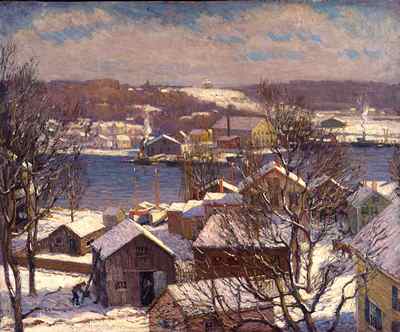
George Albert Thompson, Mystic River, Connecticut, 1915, oil on canvas, 25 1/4 x 30 1/4 inches


The subjects range from seascapes by A. T. Bricher and West Coast views of Lake Tahoe and the Columbia River, to life on the beach in the 20th century. A selection of industrial waterfront scenes from 20th Century modernists such as Preston Dickinson reflect the time when even artists celebrated the heights of American industry.

Reflections on Water in American Painting
is drawn from the collections of Arthur J. Phelan, well-known for his paintings depicting life in the American West. Phelan began collecting nautical paintings in the 1960s.

“I have built a number of collections that started with a chance acquisition of an artwork that reminded me of something in my past,” says Phelan. “This group of maritime and coastal scenes arises from time spent at my family’s summer home in Connecticut. Our house, between New London and the Connecticut River, was on the water. During World War II, I sailed small sloops at the point where Long Island Sound empties into the Atlantic and where large commercial sailing ships occasionally still passed by. Later, while at Yale [B.A. and M.A. in American history], I was never far from the Sound.”

Presented by Exhibits Development Group and organized with Arthur J. Phelan.


Aiden Lassell Ripley,
Beach Scene ca. 1935,
Images © Arthur J. Phelan


Anton Otto Fischer
American (1882–1962)
Summer Seas
oil on canvas, 1945
26 x 32 inches


Richard Babcock
American, 1887–1954
Industrial Waterfront - Great Lakes
oil on canvas, ca. 1930
33 x 25 7/8 inches
Arthur J. Phelan Collection


Charles McIlhenney
American, 1858–1904
Steamboat at Night, Mississippi River
oil on canvas, ca. 1885
24 x 20 inches
Arthur J. Phelan Collection


William R. Wheeler
American (1832–1894)
Great Lakes Marine Disaster
oil on canvas, ca. 1860
27.5 x 47.5 inches

Saturday, April 6, 2013

Goya. Light and Shade


Between 16 March and 24 June, 2012 visitors to the CaixaForum in Barcelona could see Goya: Light and Shade, a major exhibition devoted to the artist’s work organised by the Museo del Prado and Obra Social “la Caixa” as the result of a collaborative agreement signed by the two institutions last year.

The exhibition numbered 96 works, comprising 27 oil paintings, 44 drawings, 23 prints and 2 preparatory cartoons. They included works such as The Clothed Maja, The Parasol, Witches’ Flight (see Exhibit List below)


and I am still learning
, meaning that for the first time in thirty years a large and outstanding selection of Goya’s work from the Museo del Prado was presented in Catalonia.

The richness of the Prado’s holdings of Goya, which can almost be described as a separate museum within the Museum, allows for major exhibitions that fully reflect his oeuvre. A chronological presentation revealed all the facets of Goya’s art and the principal phases of his career. The exhibition ranged from his early years, in which his realist style contrasted with the elaborate Rococo of his contemporaries, up to the highly personal works produced in Bordeaux at the end of his life and encompassed the drama of the Peninsular War that marked a turning point in his career.

The exhibition was structured into fifteen self-sufficient sections that constitute short visual accounts which analyze many of the principal themes that recur throughout the artist’s oeuvre and reflect the social reality of the times in which Goya lived, defined by the monarchy and aristocracy and by intellectuals and friends of the artist.

Exhibit List

1. This is how I am. Self-portraits

1. Letter by Goya to Martín Zapater [2 August 1794?]
Ink on paper, 208 x 153 mm


2. Self-Portrait
Oil on canvas, 45.8 x 35.6 cm
1815

3. Preparatory drawing for Capricho 43 "Sueño 1. Universal Language. Drawn and engraved by Francisco de Goya in the year 1797. The author dreaming. His only intention is to banish harmful common bekiefs and to perpetuate with this work of caprichos the sound testimony of truth
Pencil and ink on paper, 24.7 x 17.2 cm
1797

2. Invention and Execution. Social critique in the tapestry cartoons


4. The Parasol
Oil on canvas, 104 x 152 cm
1777


5. Maja and Cloaked Men or Paseo de Andalucía
Oil on canvas, 275 x 190 cm
1777


6. The Rendezvous
Oil on canvas, 100 x 151 cm
1779 - 1780


7. Boys Climbing a Tree
Oil on canvas, 141 x 111 cm
1791 - 1792


8. Fair at Madrid
Oil on canvas, 258 x 218 cm
1778 - 1779
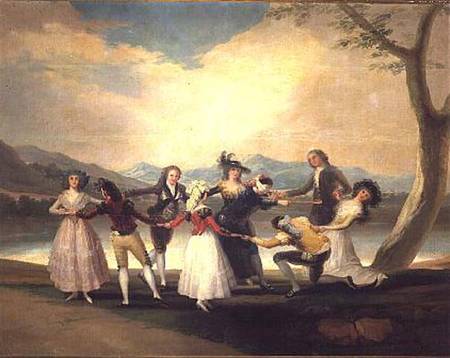


9. Blind Man's Buff
Oil on canvas, 41 x 44 cm
1788


10. Injured Mason
Oil on canvas, 268 x 110 cm
1786 - 1788

3. Lies and Infidelity. From the image of woman in the Sanlúcar Album to the private cabinet


11. The Straw Manikin
Oil on canvas, 267 x 160 cm
1791 - 1792

12a. Young woman sweeping. Album A, n.
Watercolour and Indian ink on paper, 17.2 x 10.1 cm
c. 1795

12b. Young woman arranging her hair. Album A, m.
Watercolour and Indian ink on paper, 17.2 x 10.1 cm
c. 1795

13a. Concert. Album B, 27
Watercolour and Indian Ink on paper, 23.5 x 14.5 cm
1796 - 1797

13b. Group of majas on the paseo. Album B, 28
Watercolour and Indian Ink on paper, 23.5 x 14.5 cm
1796 - 1797


14. Washerwomen
Oil on canvas, 218 X 166 cm
1779 - 1780


15. The Duchess of Alba and Her Dueña
Oil on canvas, 30 x 25 cm
1795

16. Preparatory drawing for Capricho 5] Sueño 19. The old women laugh themselves sick because they know he hasn't a bean
Watercolour and Indian ink on paper, 24.5 x 18.5 cm
1797 - 1798

17. Capricho 61. Volavérunt
Watercolour, 21.7 x 15.2 cm
1797 – 1798 / 1799 (first proof)

18. The Witches’ Flight
Watercolour on paper, 20.5 x 13.3 cm
1797 - 1798

19. Capricho 17. Well carried
Watercolour, 21.8 x 15.3 cm
1797 – 1798 / 1799 (proof)

20. Capricho 26. They already have a seat
Watercolour, 21.7 x 15.2 cm
1797 – 1798 / 1799 (first edition)


21. Clothed Maja
Oil on canvas, 95 x 190 cm
c. 1800 - 1807

4. Caricatures, Dreams and Caprices. Freedom and self-censorship in the creative process of the Caprichos

22a. Merry caricature. Album B, 63
Watercolour and Indian ink on paper, 23.2 x 14.2 cm
1796 - 1797

22b. She is waiting for him to come. Album B, 64
Watercolour and Indian ink on paper, 23.2 x 14.2 cm
1796 - 1797

23. Preparatory drawing for Capricho 13. Sueño 25. Dream of some men who were eating us up
Ink on paper, 24.2 x 16.7 cm
1797 - 1798

24. Capricho 13. They are hot
Etching, 21.6 x 15.4 cm
1797 - 1798

25. Capricho 13. They are hot
Etching, 21.6 x 15.4 cm
1797 – 1798 / 1799 (first edition)

26. Sueño 6. Proclamation of witches banning those under thirty however great their merit may be
Ink on paper, 23.1 x 15.3 cm
1797 - 1798

27. Preparatory drawing not executed in print. Proclamation of witches
Red watercolour on paper, 20 x 13.5 cm
1797 - 1798

28. Capricho 69. Blow
Watercolour, 21.3 x 14.8 cm
1797 – 1798 / 1799 (second edition)


5. Scenes of Asses. Satires on human behaviour in the Caprichos


29. Capricho 37. What if the pupil knows more?
Etching and watercolour, 21.5 x 15.3 cm
1797 - 1798

30. Preparatory drawing for Capricho 39. As far back as his grandfather
Watercolour on paper, 21.2 x 15.8 cm
1797 – 1798

31. Capricho 39. As far back as his grandfather.
Etching, 21.5 x 15 cm
1797 – 1798 / 1799 (second edition)

32. Capricho 38. Brabisimo
Etching, 21.7 x 15.1 cm
1797 – 1798 / 1799 (first edition)

33. Preparatory drawing for Capricho 42. Thou who canst not
Watercolour, 24.2 x 16.6 cm
1797 - 1798

6. Infernal gatherings. Witchcraft and irrationality in the Caprichos


34. The Witches’ Flight
Oil on canvas, 43.5 x 30.5 cm
1797

35. Capricho 64. Bon voyage
Watercolour, 21.7 x 15.2 cm
1797 - 1798

36. Capricho 59. And still they don't go!
Watercolour, 21.5 x 15.2 cm
1797 - 1798

37. Sueño 2. Witches Rehearsal
Etching, 21.4 x 15.1 cm
1797 - 1798

38. Capricho 62. Blowers
Etching, 20.7 x 15.1 cm
1797 – 1798 / 1799 (first edition)

7. From the monarch downward. The portrait as psychological study

39. The King Charles IV in Red
Oil on canvas, 127.3 x 94.3 cm
c. 1789


40. María Josefa de Borbón y Sajonia, Princess of Spain
Oil on canvas, 72 x 59 cm
1800

41. Francisco de Paula Antonio de Borbón y Borbón-Parma, Prince of Spain
Oil on canvas, 72 x 59 cm
1800

42. José Moñino y Redondo, Count of Floridablanca
Oil on canvas, 175 x 112 cm
1783


43. Don Gaspar Melchor de Jovellanos
Oil on canvas, 205 x 133 cm
1798


44. Manuela Goicoechea y Galarza
Oil on copper, 8.1 cm diameter
1805

45. Josefa Bayeu or Leocadia Zorrilla (?)
Oil on canvas,82.5 x 58.2 cm
1812 - 1814


46. Duchess of Abrantes
Oil on canvas, 92 x 70 cm
1816

8. Fatal Consequences. Goya’s tragic gaze


47. Preparatory drawing for Desastre 55. The worst is to beg
Pencil on paper, 17 x 21.8 cm
c. 1812

48. Desastre 55. The worst is to beg
Etching, 15.5 x 20.6 cm
1810 – 1815 / 1863 (first edition)

49. Preparatory drawing for Desastre 44. I saw this
Pencil on paper, 17.7 x 23.4 cm
1810 - 1815

50. Preparatory drawing for Desastre 50. Unhappy mother!
Paper, 17 x 21.9 cm
c. 1813

51. Desastre 11. They don’t want to
Etching, 16.1 x 21.1 cm
1810 – 1815 / 1863 (first edition)

52. Desastre 9. They don’t want to
Etching, 15.5 x 20.5 cm
1810- 1815 / 1863 (first edition)

53. Desastre 64. Carriot to the cementery
Etching, 15.5 x 20.6 cm
1810 – 1815 / 1863 (first edition)

54.Dead Fowl
Oil on canvas, 46 x 64 cm
1806

55. Desastre 22. This and more
Etching, 16 x 25 cm
1810 – 1815 / 1863 (first edition)

56. Desastre 18. Bury and be quiet
Paper, 16 x 23.5 cm
1810 – 1815 / 1863 (first edition)

9. A spectacle of misfortune. The critical vision of the Tauromaquia

57. The Novillada or Amateur Bullfight
Oil on canvas, 259 x 136 cm
1779 - 1780

58. Preparatory drawing for Tauromaquia. Another madness of his [Martincho's] in the same ring
Paper, 18.7 x 31.4 cm
1815

59. Preparatory drawing for Tauromaquia 27. The celebrated picador, Fernando del Toro, inciting the wild beast with his pique
Watercolour on paper, 18.7 x 31.7 cm
1815 - 1816

60. Preparatory drawing for Tauromaquia B. Horse thrown by a bull
Paper, 18.8 x 31.8 cm
1815

61.Tauromaquia 12. Weakening of the rabble with spears and other weapons
Etching, 25 x 35 cm
1816 (first edition)

62. Preparatory drawing for Tauromaquia 21. Dreadful incidents which occured in the front rows of the ring at Madrid, and death of the mayor of Torrejon
Paper, 18.5 x 30 cm
1815 - 1816

63. Tauromaquia 21. Dreadful incidents which occured in the front rows of the ring at Madrid, and death of the mayor of Torrejon
Etching, 24.5 x 35.5 cm
1816 (first edition)

10. Nightmares. Madness and the irrational in the Album C drawings


64. Another [Vision] in the Same Night. Album C, 40
Watercolour and ink on paper, 20.5 x 14.1 cm
1803 - 1824

65. The Third [Vision] in the Same [Night]. Album C, 41
Watercolour and ink on paper, 20.5 x 14.1 cm
1803 - 1824

66. The Fifth [Vision]. Album C, 43
Watercolour and ink on paper, 20.5 x 14.2 cm
1803 - 1824

11. Piety and Punishment. Images of religiosity and criticism


67. Immaculate Conception
Oil on canvas, 80 x 41 cm
1783 - 1784

68. Saints Justa and Rufina
Oil on panel, 45 x 29 cm
1817

69. Young Saint John the Baptist in the Desert
Oil on canvas, 105 x 90 cm
c. 1810

70. Dreams of a novice Witch
Paper, 21 x 16.6 cm

71. For wagging his tongue in a different way. Album C, 89
Watercolour on paper, 20.5 x 14.3 cm
1808 - 1814

72. It's better to die. Album C, 103
Watercolour and ink on paper, 20.4 x 14.2 cm
1808 - 1814

73. For discovering the motion of the earth. Album C, 94
Watercolour and ink on paper, 20.5 x 14.4 cm
1808-1814

12. Light in the Darkness. Vision of a mad world

74. Disparate 13. Way of flying
Etching, 24.5 x 36 cm
1816 - 1819

75. Falling Demon
Watercolour on paper, 22 x 32.5 cm
c. 1819

76. Preparatory drawing for Disparate 15. Clear folly
Watercolour on paper, 23.7 x 32.5 cm
c. 1815

77. Disparate 15. Clear folly
Watercolour, etching, 24.5 x 35.5 cm
1816 - 1819

78. Two figures pointing to a bright opening
Watercolour on paper, 22.2 x 31.6 cm
c. 1819

13. Grotesque Fables. Human follies and animal dreams in the Bordeaux Album G

79. Great folly. Album G, 9
Pencil on paper, 19.2 x 15.2 cm
1824 - 1828

80. Bad dream. Album G, a.
Pencil on paper, 19.1 x 15.1 cm
1824 - 1828

81. They spend their life with animals. Album G, 30
Pencil on paper, 19.2 x 14.8 cm
1824 - 1828

82. The flying dog. Album G, 5
Pencil on paper, 19 x 15 cm
1824 - 1828

83. The butterfly bull. Album G, 53
Pencil on paper, 19.4 x 15 cm
1824 - 1828

14. Amusement and Violence. Images of the human condition from the Bordeaux Album H

84. Monk guzzling from a large bowl. Album H, 63
Pencil on paper, 19 x 15.1 cm
1824 - 1828

85. Lay brother on skates. Album H, 28
Pencil on paper, 19.2 x 14.7 cm
1824 - 1828

86. Telegraph. Album H, 54
Pencil on paper, 19.1 x 15.2 cm
1825 - 1828

87. The enema. Album H, 42
Pencil on paper, 19 x 15.5 cm
1824 - 1828

88. Two big men fighting desperately. Album H, 38
Pencil on paper, 19 x 15.4 cm
1824 - 1828

15. I am still learning

89. Self-Portrait
Oil on canvas, 45.8 x 35.6 cm
1815

90. Desastre 1. Sad premonitions
Pencil on paper, 17 x 21.8 cm
c. 1812

91. C.17. This is how useful men end
Pencil on paper, 19 x 15.4 cm
1803 - 1824

92. Disparate 18. Funeral Folly
Etching, 24.5 x 35 cm
1816 - 1819 / 1863 [First edition]

93. Disparate 12. Merry Folly
Etching, 24.5 x 35 cm
1816 - 1819 / 1863 [First edition]

94. Two old peseant women dancing. Álbum H, 35
Pencil on paper, 19 x 14.8 cm
1824 - 1828

95. G. 54. I am still learning
Pencil on paper, 19 x 15.4 cm
1824 - 1828

96. Letter to Joaquín Ferrer. 20 December 1825
Pen, dark ink, 253 x 196 mm
1825

Friday, April 5, 2013

Bosch Bruegel Rubens Rembrandt Masterpieces of the Albertina


Bosch Bruegel Rubens Rembrandt Masterpieces of the Albertina 14 March to 30 June 2013

The graphics collection of the Albertina possesses a world class stock of Dutch drawings, the scope and quality of which make it possible to present the Dutch art of drawing in all its thematic, technical and stylistic diversity. A top-class selection of 150 works, including larger groups of works by Hieronymus Bosch, Pieter Bruegel the Elder, Maarten van Heemskerck, Hendrick Goltzius, Rembrandt, Anton van Dyck and Peter Paul Rubens were presented in a comprehensive exhibit in the spring of 2013.

Bosch, Bruegel, Rubens and Rembrandt are the names of four artistic personalities who impressively demonstrate what a wealth of exceptional talent the Netherlands was able to produce over centuries. This phenomenon is inseparably linked with the rise of a strip of land that was already characterised by an unrivalled golden age of economy, science and culture in the late Middle Ages as part of the Duchy of Burgundy. When, following the death of Charles the Bold in 1477, the Burgundian heartland fell to France and the "low countries" became a Hapsburg satellite state, this in fact brought about a stabilisation of the entirely favourable economic situation for this northern region. Even the declared disengagement of the by now Protestant north from the south, which remained true to the old faith, in 1580 was unable to slow down this rise in fortunes in either of the two territories. Although under the rule of governors of the Spanish Hapsburgs, the southern provinces, with the financial centre of Antwerp, were able to assert their status as a commercial centre of European calibre; the bourgeois-governed "Republic of the Seven United Netherlands", with its capital of Amsterdam, was a global trading nation for nearly a century, until the increasing rivalry between the Netherlands and England was decided in favour of the First British Empire.

This development was of the utmost importance for the fine arts. The Early Netherlandish painting of northern Burgundy, represented by Jan van Eyck or Rogier van der Weyden, had already stimulated generations of artists throughout Europe. While their era was still characterised by a strong sense of uniformity, Dutch art in the 16th century offers an entirely diverse appearance. The dialogue with antiquity and the Italian High Renaissance had been providing artistic impulses since the decades immediately following 1500. Thus, a series of local schools was established, each with their own stylistic tendencies and specialisation in particular themes and tasks, for example, the "Antwerp Mannerists", who concentrated on high quality ecclesiastical export items, making them competitive through the use of Italian elements. In addition to religious art, which, especially in the northern provinces, due to the Reformation and the Iconoclasm, was increasingly being placed in question, secular pictorial themes also developed. Landscape and genre art found their beginnings in the puzzling allegories of Hieronymus Bosch, reached a first pinnacle with Pieter Bruegel the Elder and ultimately dominated the rest of the century.

The development in the individual provinces progressed more or less uniformly until the end of the 16th century. However, with division into the Calvinist north and the Catholic south, the differences in Dutch and Flemish art became increasingly apparent. In the aristocratically governed south, a new field of activity opened up with the pictorial culture of the Counterreformation, especially in the area of large format altarpieces.

Flemish art of the Baroque period was soon dominated by Peter Paul Rubens, who would ultimately become the artistic authority in all of Europe. There, the demand for history painting, with its biblical, mythological and allegorical subjects, which were traditionally assigned the highest rank in the scale of themes, was highest. In contrast, secular art reached its zenith in the Protestant, bourgeois north. The pictorial world that developed there was completely unspectacular and most of its themes had previously been considered "unworthy of being painted". When one reads inventories from the time of Rembrandt, one encounters subjects like "een boerekermis" (country fair), "een blompotje" (small flower vase) or "een kind in de kackstoel" (a child on the "crap" chair). It appears as if the wealthy merchants, citizens and patricians of the rich north wished to see their way of life and their very own themes and problems, in short, themselves, immortalised. Genre paintings, sea pieces, landscapes, still life, interiors and portraits thus provide insight into the daily life of the bourgeoisie.

The broad diversification of the painting genres and themes also extended to technical practice. Besides painting, drawing also played an increasingly autonomous role. The uncomplicated use of paper and quill or pencil made it possible for the artist to capture quickly passing moments of inspiration, to process details until a perfect result was achieved or to draft minutely elaborate patterns. Due to the large number of techniques, functions and application areas, the works put to paper convey a much more differentiated image than painting. A large number of artists succeeded in both areas, and often in printed graphics as well. Rembrandt is the most prominent example of this. In contrast, some famous artists, Frans Hals or Jan Vermeer, for example, produced no or hardly any works on paper of note; on the other hand, a prominent list of exceptional talents can be compiled, including Roelant Roghman, Jan de Bisschop or Anthonie Waterloo, who were exclusively or primarily active as draughtsmen.

The Albertina possesses one of the world's most important collections of Netherlandish freehand drawings of the period extending from 1450 to 1650. The era of the "Flemish Primitives" is represented by individual, exceptional works from the circle around Jan van Eyck, Petrus Christus or Dirk Bouts, until the works of Hieronymus Bosch and Pieter Bruegel the Elder mark an initial high point of the select collection. The rest of the 16th century is represented with master drawings from Gossaert, Heemskerck or Goltzius. However, the focus of the collection is on Holland's "Golden" 17th century, with important works from Rembrandt and his school. The southern Netherlands, dominated by the house of Hapsburg, are represented by the most famous Flemish masters of their time: Peter Paul Rubens, Anton van Dyck and Jacob Jordaens.

The exhibit and


the catalogue

showed the extent to which the broad thematic spectrum of Dutch art of the 17th century, including landscapes, sea pieces, topographical views, portraits, rural genre scenes, still life, is still firmly rooted in the achievements of previous centuries. For more than two centuries, looking back at this important artistic tradition provided the inspiration for new artistic pinnacles.


Hieronymus Bosch
Tree man, around 1505
Pen with brown ink Albertina, Vienna


Peter Paul Rubens
Nicolas Rubens with coral necklace, around 1619
Black chalk, red chalk, accented with white chalk Albertina, Vienna


Pieter Bruegel the Elder
The Painter and the Patron, around 1565
Feder in Braun Albertina, Vienna


Rembrandt Harmensz. van Rijn
A young woman having her hair braided, mid-1630s
Pen with brown ink, pen with brown and grey ink (grey ink added later)Albertina, Vienna


Rembrandt Harmensz. van Rijn
Cottages under a stormy sky, around 1635
Pen with brown ink, brown and grey wash, white coating paint on brownish paper Albertina, Vienna


Anton van Dyck
The crucifixion of Peter, around 1620
Black chalk, brush with brown ink Albertina, Vienna


Rembrandt Harmensz. van Rijn
An Elephant, 1637
Black chalk Albertina, Vienna


Peter Paul Rubens
Rubens' son Nicolas with a red, felt cap, 1625-1627
Black and red chalk, wiped, accented with white chalk Albertina, Vienna


Pieter Bruegel the Elder
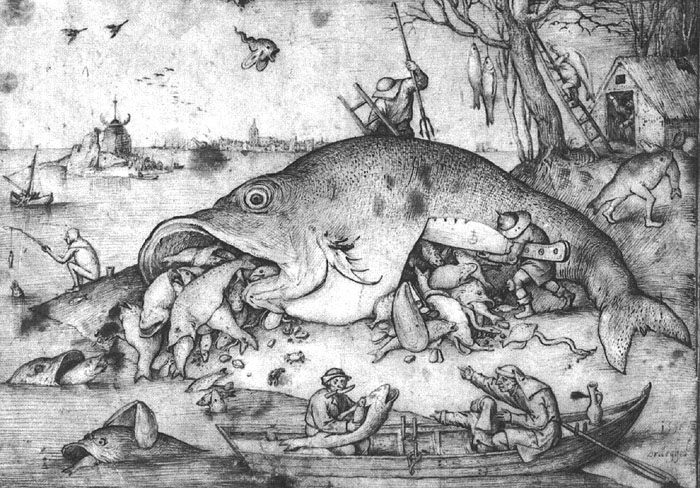
Big fish eat little fish, 1556
Pen and brush in grey and black, transfer lines Albertina, Vienna


Jacob de Gheyn II
Wooded landscape with man carrying lance and a barking dog, around 1603
Pen with brown ink over grey pencil Albertina, Vienna


Jan Gossaert
The Fall of Man, around 1520-1525
Pen with dark brown ink over tracing with black pencil (charcoal or chalk) Albertina, Vienna


Lucas van Valckenborch the Elder
Guard with a long beard, 1578/79
Water colour and coating paints Albertina, Vienna


Joachim Antonisz. Wtewael
The courting of Belgica (from the Belgica series), 1612
Pen with grey, grey-brown and black ink, washed, white coating paint
Albertina, Vienna

Thursday, April 4, 2013

Storied Past: Four Centuries of French Drawings from the Blanton Museum of Art


Aspiring painters in 17th- and 18th-century France dreamed of studying at Paris’s Académie Royale de Peinture et de Sculpture (Royal Academy of Painting and Sculpture), one of the leading cultural institutions of the time. Instructors at the Académie emphasized the importance of life drawing, because mastery of the human figure was a vital skill for the successful painter. The Cantor Arts Center presents a selection of important drawings from the Renaissance and the 17th and18th centuries, when the influence of the Académie was at its peak, as well as some exemplary non-academic works from the 19th century, in “Storied Past: Four Centuries of French Drawings from the Blanton Museum of Art.” The show runs July 3 through September 22.

The Blanton, located at the University of Texas at Austin, organized the exhibition of 55 drawings primarily from its Suida-Manning collection. “Storied Past” chronicles the development of drawing in France from 1500 to 1900, a period of rapid innovation, tumultuous social revolutions and striking changes in artistic styles. Specifically, the exhibition explores the evolution of narrative subjects favored by the French tradition, as well as artists’ changing engagement with materials and techniques.

Strongly represented are 17th- and 18th-century drawings, which range from gestural sketches to more finished compositions. These drawings were not only the products of the Académie’s life-drawing classes, but also its lectures on religious, classical and mythological subject matter. The exhibition also highlights 19th- and early 20th-century works by draftsmen who reacted against the academic tradition. These artists deliberately took a more realist approach in their visual style and choice of subjects, and chose to render scenes of everyday life so as to communicate the social, economic, and political changes that were transforming modern France.

Showcased are drawings by famously talented draftsmen—among them Nicolas Lancret (1690–1743), François Boucher (1703–1770), Jean-Baptiste Greuze (1725–1805), Théodore Rousseau (1812–1867) and Théophile-Alexandre Steinlen (1859–1923). Apart from exploring the expressive and technical range of French drawing, the exhibition presents new research by curators and conservators about individual works’ histories, issues of connoisseurship and sheds light on drawing as an intellectual process.

The Cantor also presents four other exhibitions of French art this summer, from 16th-century representations of Fontainebleau to 19th- and 20th-century prints by Edouard Manet (1832–1883), Odilon Redon (1840–1916) and Henri Matisse (1869–1954).


Theophile-Alexandre Steinlen À l’atelier, circa 1895.
Graphite on wove paper. Gift of Alvin
and Ethel Romansky, 1978.
Blanton Museum of Art.


Alexandre-Louis Leloir, Moroccan Girl, Playing a
Stringed Instrument, 1875. Watercolor, gouache
and graphite on ivory wove paper. 9 5/8 x 13
9/16 inches. Gift of the Wunsch Foundation, Inc.,
1983. Blanton Museum of Art.


Théodore Rousseau, A Marshy River Landscape, circa 1845. Charcoal
heightened with white chalk on pink laid paper. 9 3/16 x 16 15/16
inches. Gift of Mr. E. Wyllys Andrews IV, Charles and Dorothy Clark, Alvin
and Ethel Romansky, and the children of L. M. Tonkin, and University
purchase, by exchange, 2006. Blanton Museum of Art.


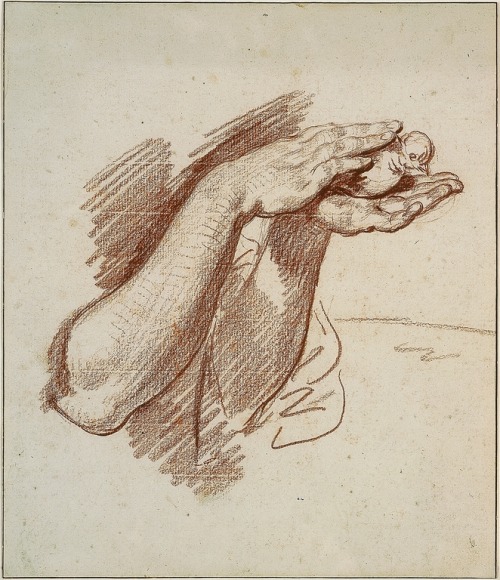
Jean-Baptiste Greuze, The Arms of a Girl Holding a Bird, circa
1765.Red chalk on cream laid
paper, laid down. The Suida-
Manning Collection. Blanton Museum of Art.


Henri-Joseph Hesse, Portrait of a Man,
1811. Brush with brown ink and white
heightening over traces of black chalk on
beige wove paper. 9 1/4 x 7 5/8 inches.
Archer M. Huntington Museum Fund, 1987,
1987.19. The Blanton Museum of Art.


Anonymous, Noah Leading the Animals
into the Ark, after Giovanni Benedetto
Castiglione, circa 1780. Brush with colored
oils on antique laid paper, laid down. 15 5/8 x
21 3/4 inches. The Suida-Manning Collection.


Charles-Antoine Coypel, France Thanking Heaven
for the Recovery of Louis XV, 1744. Black
and white chalks with brush and gray wash and
touches of red chalk on cream antique laid paper.
11 15/16 x 7 7/8 inches. Blanton Museum of Art,
Suida-Manning Collection.