Thursday, July 25, 2013

Georgia O’Keeffe and Ansel Adams: Natural Affinities


Georgia O’Keeffe and Ansel Adams: Natural Affinities,” on view at the Smithsonian American Art Museum Sept. 26 through Jan. 4, 2009, examined the friendship of two iconic artists who were attracted to the distinct landscapes of the American southwest and far west and committed to depicting its essence with modernist sensibilities. This exhibition, the first to pair these artists, celebrated their mutual appreciation of the natural world and reveals the visual connections between O’Keeffe’s paintings and Adams’ photographs.

“Natural Affinities” included 42 paintings by O’Keeffe from public and private collections and 54 photographs by Adams from the Center for Creative Photography in Tucson, Ariz., which holds the largest single collection of Adams’ work.

The exhibition was organized by the Georgia O’Keeffe Museum in Santa Fe, N.M. Independent scholar Anne Hammond selected the artworks for the exhibition with Barbara Buhler Lynes, curator at the Georgia O’Keeffe Museum and the Emily Fisher Landau Director of the Georgia O’Keeffe Museum Research Center. Eleanor Jones Harvey, chief curator at the Smithsonian American Art Museum, and Toby Jurovics, curator of photography, are the coordinating curators in Washington.

Georgia O’Keeffe (1887-1986) and Ansel Adams (1902-1984) met in Taos, N.M., in 1929 at the home of a mutual friend, Mabel Dodge Luhan. The two immediately became friends. The following year, they met again in New Mexico. Adams was there making photographs for his first book, “Taos Pueblo” published in 1930, and O’Keeffe was spending the first of many summers painting in New Mexico, which she made her permanent home in 1949.


In 1933, Adams traveled from California to New York for the first time and met O’Keeffe’s husband, Alfred Stieglitz, the influential photographer whose modern art galleries in New York City launched the careers of numerous American artists. Stieglitz presented an exhibition of Adams’ photographs in 1936 at his gallery, An American Place, which established the younger photographer as one of America’s leading modernists.

In 1937, O’Keeffe and Adams toured the southwest by car with a group of friends, visiting well-known archaeological sites including Canyon de Chelly. The following year, O’Keeffe visited Adams in Yosemite. Although their friendship lapsed in the 1940s as they pursued separate interests, the artists resumed regular correspondence in the 1950s. The artists last visited in person in 1981 when O’Keeffe, then 94, went to see Adams in Carmel, Calif., and Adams, then 79, visited O’Keeffe at her home in Abiquiu, N.M.

The paintings and photographs included in “Natural Affinities” explored the formal connections between O’Keeffe’s and Adams’ works. The artists often emphasized their subjects’ essential qualities, creating abstract images. For example, in


O’Keeffe’s “Abstraction White Rose” (1927)


and in Adams’ “Foam, Merced River, Yosemite Valley, California” (1951),

they depict their subjects extremely close-up so that any sense of the subject is lost to abstraction.

This also is evident in


O’Keeffe’s “The Black Iris” (1926)


and Adams’ “Leaves, Frost, Stump, October Morning, Yosemite National Park” (c. 1931).

O’Keeffe and Adams also frequently called attention to the abstract components of the southwestern landscape as can be seen in


O’Keeffe’s “Black Hills with Cedar” (1942)


and Adams’ “Ghost Ranch Hills, Chama Valley, Northern New Mexico” (1937).

Occasionally, comparisons between works by O’Keeffe and Adams highlighted their different approaches to the same subject, such as an adobe church near Taos.


In O’Keeffe’s “Ranchos Church No. 1” (1929),

the building becomes organic and seems to rise almost weightlessly from an expansive foreground.

In contrast, Adams underscores its monolithic solidity in his photograph


“Saint Francis Church, Ranchos de Taos, New Mexico” (c. 1929).

More images:


Ansel Adams, Winter Sunrise, the Sierra Nevada from Lone Pine, California, 1944, Gelatin silver print, 15-5/8 x 19-1/4", Collection Center for Creative Photography, University of Arizona, ©The Ansel Adams Publishing Rights Trust.


Ansel Adams, Moonrise, Hernandez, New Mexico,1941, Gelatin silver print, 15-9/16 x 19-11/16", Collection Center for Creative Photography, University of Arizona, ©The Ansel Adams Publishing Rights Trust.


Publication
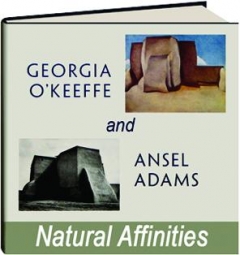


A fully illustrated catalog, published by Little, Brown and Company, features essays by Lynes, critic Richard B. Woodward and Sandra Phillips, senior curator of photography at the San Francisco Museum of Modern Art.

Tour

After its presentation in Washington, the exhibition traveled to the Norton Museum of Art in West Palm Beach, Fla. (Jan. 24–May 3, 2009) and the San Francisco Museum of Modern Art (June 6–Sept. 7, 2009).

Landscapes from the Age of Impressionism: French and American Artists


Landscapes from the Age of Impressionism, on view at the Akron Art Museum October 29, 2011 – February 5, 2012, offered a broad survey of landscape painting as practiced by leading French artists from Gustave Courbet to Claude Monet and their most significant American followers including Childe Hassam and John Singer Sargent. This exquisite exhibition of more than fifty paintings included many of the finest examples of French and American impressionist landscapes from the collection of the Brooklyn Museum as well as American impressionist paintings from the Akron Art Museum.

Among the earliest works in the exhibition were


Charles-François Daubigny's The River Seine at Mantes (1856)


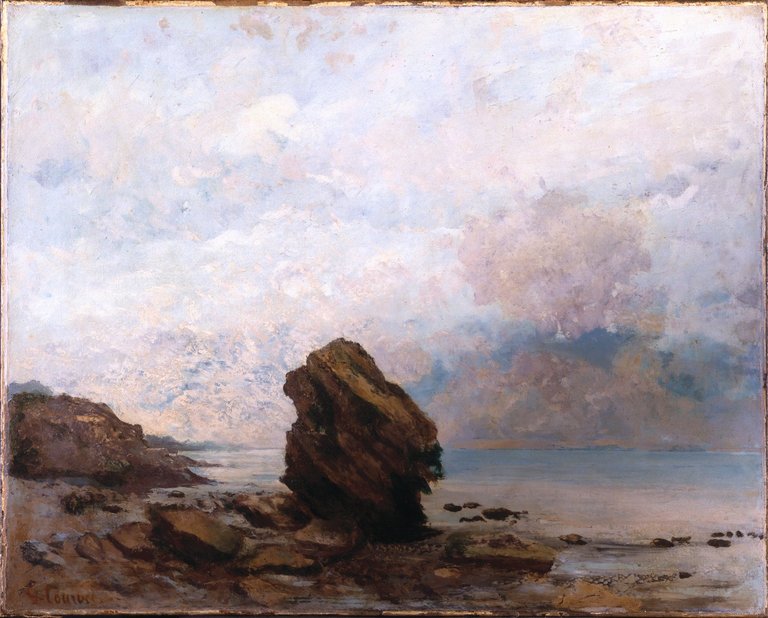
and Gustave Courbet's Isolated Rock (1862).

Both reveal the waning influence of the academic Beaux-Arts tradition, in which generalized landscapes served merely as background for historical or mythological scenes.

A new generation of artists, known as the Barbizon school, painted preparatory sketches directly from nature–en plein air–in the environs of Paris, setting the stage for impressionism’s dramatic assault on officially-sanctioned painting styles.

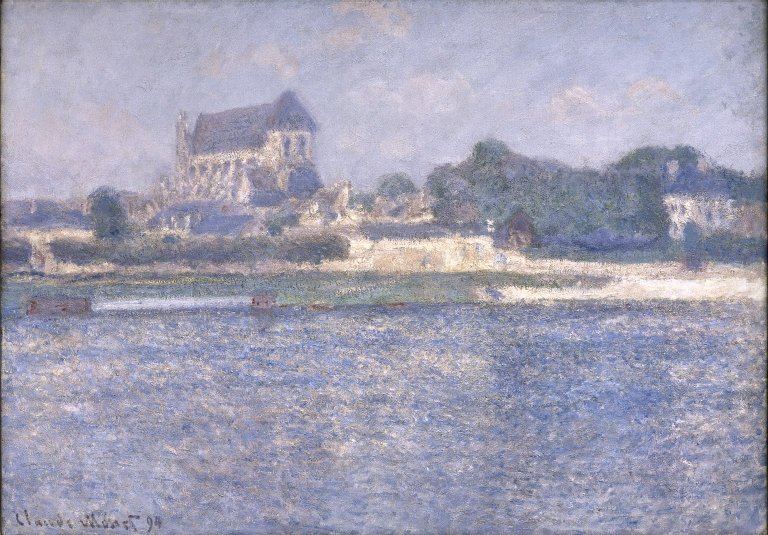
Impressionists Claude Monet, Camille Pissaro and Gustave Caillebotte painted highly elaborated "impressions"—the seemingly spontaneous, rapidly executed landscapes and cityscapes that prompted the name of their movement. Monet was represented in Landscapes from the Age of Impressionism with


Rising Tide at Pourville (1882),


Vernon in the Sun (1894)


and The Islets at Port-Villez (1897).

In the late 19th century, Americans who aspired to a career in painting typically trained at fine arts academies in Europe, especially Paris. While there, many American artists like Frederick Frieseke and Willard Metcalf were inspired by the light-filled canvases of leading impressionists to take their easels outdoors, sometimes setting up right next to a French mentor who could provide informal instruction.

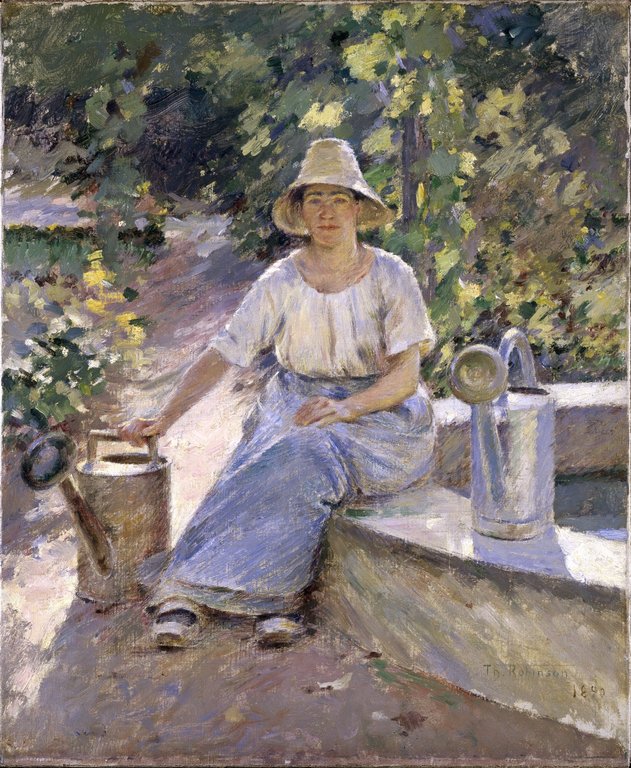
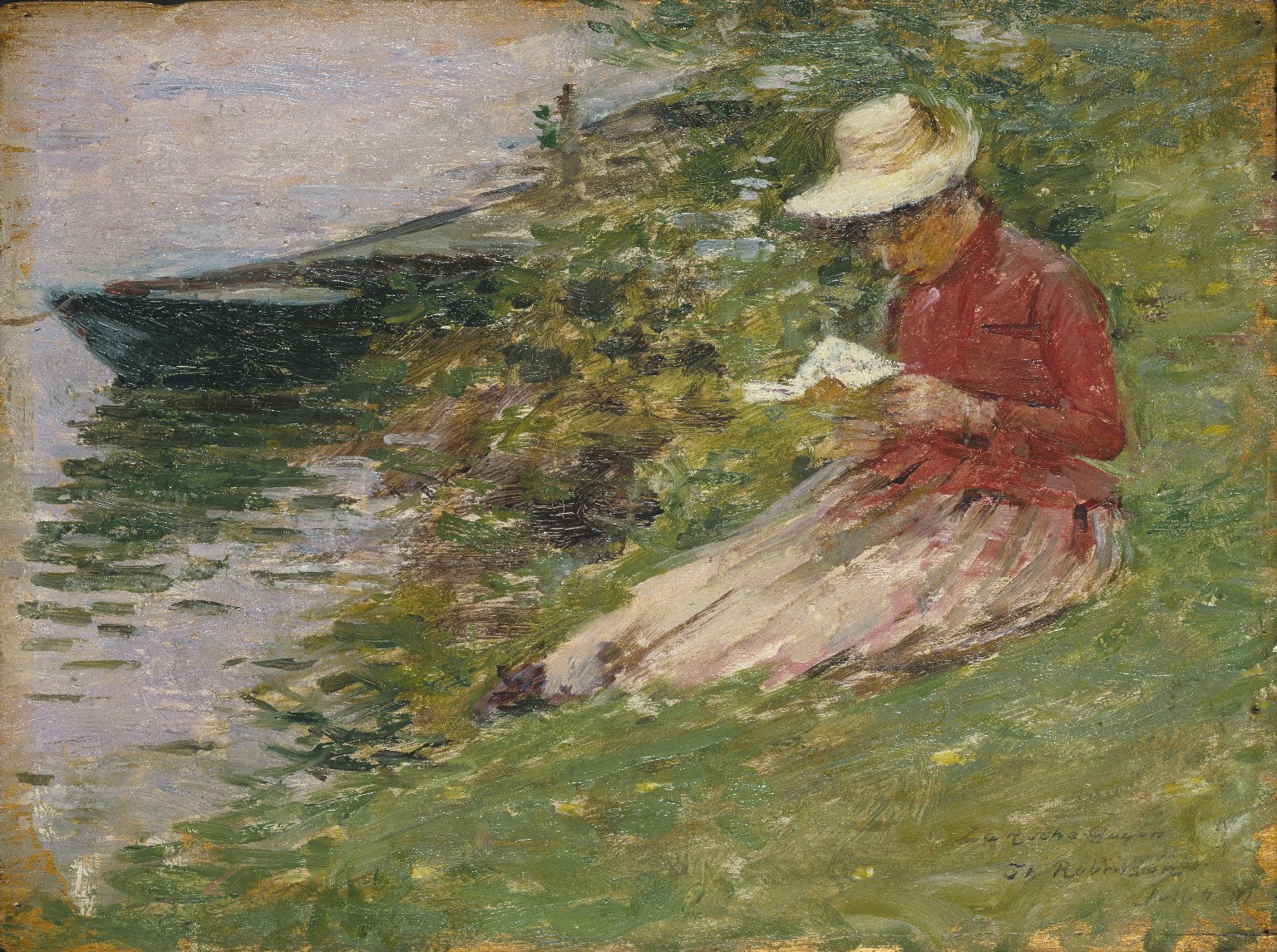
Theodore Robinson, represented in the exhibition by


The Watering Pots (1890)


and La Roche Guyon (1891),

established a warm friendship with Monet over the course of several summers spent in Giverny.

Back in America, simultaneous trends in depicting the beauty of rural areas untouched by industrialization and populated urban locales demonstrate the competing impulses of nostalgia for a simpler time and delight in the new modern era. In works such as


William Glackens's Bathing at Bellport, Long Island (1912),


Julian Alden Weir's Willimantic Thread Factory (1893)


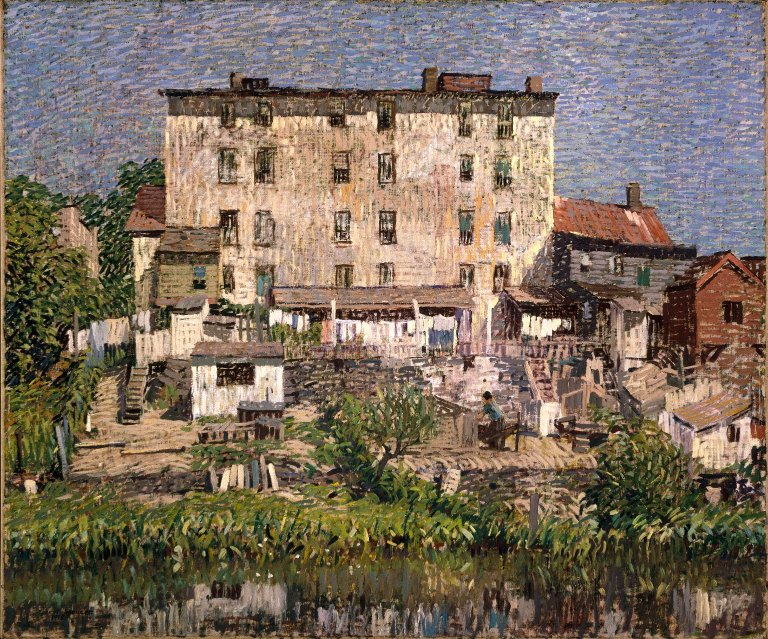
and Robert Spencer's The White Tenement (1913)

populated beaches, factories and tenements are given the same treatment as French Impressionist landscapes, painted with brilliant colors and lively, broken brushwork.

Impressionist works drawn from the Akron Art Museum’s collection included


Childe Hassam’s Bedford Hills (1908),


Frederick Frieseke’s Through the Vines (1908),


John Twachtman’s The Winding Brook (1887-1900),


Willard Metcalf’s Maytime (1909-1914)


and Julian Alden Weir’s White Oaks (1913).

Julian Alden Weir was a prominent American impressionist who was well represented in the exhibition with the early


A French Homestead (1878),

Willimantic Thread Factory (1893)(above) and the mature work White Oaks (1913), (above) which demonstrates how much the artist’s style evolved towards impressionism after he initially rejected it. When Weir first encountered impressionist paintings in France in 1877, he wrote, “I never in my life saw more horrible things.”

The American Willard Metcalf, a close friend and colleague of Weir, was often commended by contemporaries for his patriotic delight in depicting the New England landscape where he lived and worked. Maytime exemplifies Metcalf’s ability to render the character of the individual seasons through careful observation in nature of the transitory effects of light and color. Maytime, wrote Metcalf, “has always been a favorite of mine, in as much as I felt that I had succeeded in getting some of the elusiveness of that beautiful spring morning.”

The breadth of works included in Landscapes from the Age of Impressionism told the story of the development of French impressionism and its impact on American painting during a period when industrialization and technological advances were radically altering the face of the landscape, a phenomenon that artists responded to in highly personal ways. Artists forged strong relationships on both sides of the Atlantic through individual friendships, artist colonies and new artist groups, which afforded the artists a sense of community and belonging in a rapidly changing world.

This exhibition was organized by the Brooklyn Museum.

Book Reviews: German Art 1350–1600; Norman Rockwell

German Paintings in The Metropolitan Museum of Art, 1350–1600


"German Paintings in The Metropolitan Museum of Art, 1350–1600" is a spectacular exhibition catalogue by Maryan W. Ainsworth and Joshua P. Waterman. It features 315 illustrations in full color.

The book includes paintings made in the German-speaking lands (including Austria and Switzerland) from 1350 to 1600, including the towering figures of the German Renaissance—Albrecht Dürer, Lucas Cranach the Elder, and Hans Holbein the Younger—and many by lesser masters.

It is available here.

Excerpts:


" Hans Holbein the Younger (Augsburg 1497/98–1543 London). Benedikt von Hertenstein, 1517.

Viewed straight on, Hertenstein appears noticeably broader than he perhaps should, with an oversized left arm and hand. But, as we pass from left to right before the painting, he assumes more natural proportions and seems to project in a realistic manner out of his space into ours. As he engages us with his glance and we reach an angle of forty-five degrees opposite his image, we gradually experience the full force of Hertenstein's corporeal presence. The inscription becomes more prominent, and the authorship of the painting is featured. Holbein's striking effect of verisimilitude, in which the ideal image of the man is recognized only "in passing," calls attention to the transience of life—both Hertenstein's and our own.


Lucas Cranach the Younger (Wittenberg 1515–1586 Wittenberg). Nymph of the Spring, ca. 1545–50.

This small, astonishingly well-preserved painting shows a nude woman reclining on the grassy bank of a river, near a spring that issues from a rock formation. Looking toward the viewer, she identifies herself and offers a word of caution through the first-person Latin inscription at the upper right: "I, nymph of the sacred spring, am resting; do not disturb my sleep." The scene's open eroticism is heightened by the nymph's sultry, half-closed eyes; the red tinge of her cheeks, buttocks, elbows, knees, and feet; the transparent veil that meanders from head to foot, as if to guide the viewer's gaze along her body; and the bundled red dress, which evokes the thought of her disrobing. A bow and quiver hang in a nearby tree, signaling that the nymph belongs to the entourage of the huntress goddess Diana. A green parrot perched on the bow and two rock partridges in the grass probably serve as symbols of the Luxuria (lust) that is embodied by the nymph and called forth in the male viewer.

Norman Rockwell 332 Magazine Covers


Norman Rockwell 332 Magazine Covers By Christopher Finch Size: 11 x 13", 400 pages 332 full-color illustrations.

This beautiful album of Norman Rockwell's Saturday Evening Post covers, painted between 1916 and 1963. All of his Post covers are reproduced in splendid full color in this oversized volume, with commentaries by Christopher Finch, the noted writer on art and popular culture. It captures everyday events and historic moments in American history. 332 of these cover paintings, from beloved classics like "Marbles Champion" to lesser-known gems like "Feeding Time," are reproduced in stunning full color in this large-format volume, which is sure to be treasured by art lovers everywhere.

It is available here.

Selected images:


The Art Student Post Cover • April 16, 1955 plate 310


The Toss Post Cover • October 21, 1950 plate 290


Walking to Church Post Cover • April 4, 1953 plate 301


Fishing Post Cover • August 3, 1929 plate 144

Wednesday, July 24, 2013

19th-Century Masterworks: Ingres, David, Gericault, Delacroix, Rosetti, Blake,


Two hundred nineteen works by leading 19th-century American, British, and French artists from the legendary collection formed by Grenville L. Winthop (1864-1943) went on display at The Metropolitan Museum of Art on October 23, 2003. The exhibition, which marked the first time the collection has traveled since its bequest to Harvard in 1943, featured paintings, drawings, and sculptures by more than 50 artists, including William Blake, Edward Burne-Jones, Jacques-Louis David, Eugène Delacroix, Théodore Géricault, Winslow Homer, Jean-Auguste-Dominique Ingres, Gustave Moreau, Camille Pissarro, Auguste Renoir, Auguste Rodin, Dante Gabriel Rossetti, John Singer Sargent, and James Abbott McNeill Whistler. A Private Passion: 19th-Century Paintings and Drawings from the Grenville L. Winthrop Collection, Harvard University remained on view at the Metropolitan through January 25, 2004.

The exhibition was organized by the Fogg Art Museum, Harvard University, Cambridge, Massachusetts, in collaboration with Ville de Lyon, Musée des Beaux-Arts and Réunion des musées nationaux, the National Gallery, London, and The Metropolitan Museum of Art, New York.

In 1943 Grenville Lindall Winthrop bequeathed his entire collection of more than 4,000 works of art to his alma mater, Harvard College. During his life, he almost never lent objects from his collection to museums, and in keeping with his wishes, the works have always been at Harvard, available to students and scholars, rather than on loan to other institutions.

Over the course of four and a half decades, Winthrop assembled objects from almost every culture and historical period. In particular, no other collector could claim the depth of Winthrop's reach in both French and British art together. Rather than purchase already-formed collections of drawings, Winthrop was a pioneer in establishing a collection of works on paper, piece by piece.

Winthrop acquired more works by Jean-Auguste-Dominique Ingres than any other private collector of his day. The exhibition at the Metropolitan included 34 of Winthrop's Ingres, including


Raphael and the Fornarina (1814)


and Odalisque with the Slave (ca. 1837-40), as well as a number of drawn and painted portraits.

Other important French works included

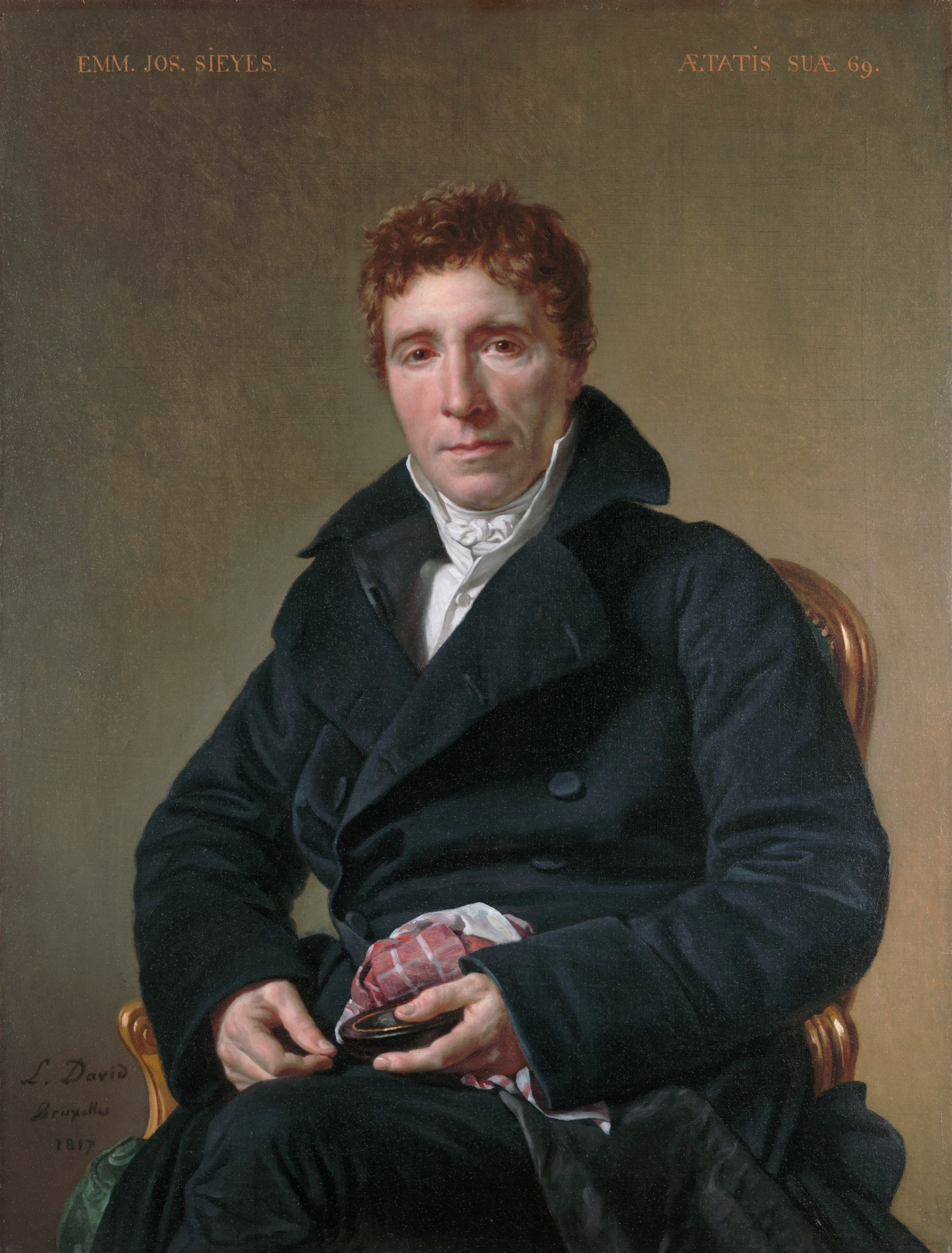
Jacques-Louis David's 1817 portrait of his friend and fellow revolutionary


Emmanuel Joseph Sieyès,

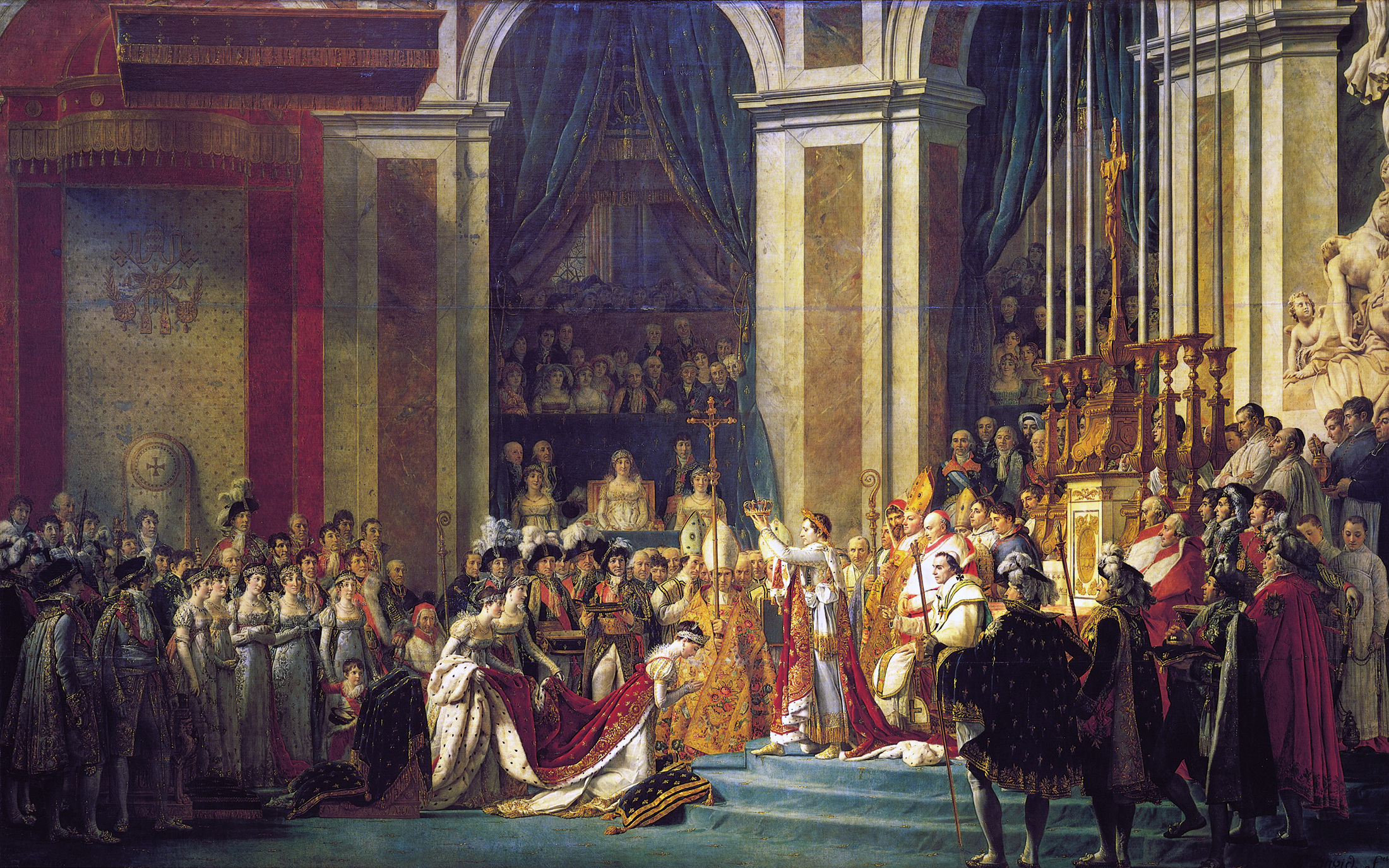
and sketchbooks containing more than 100 studies for David's monumental


Coronation of Napoleon I (Le Sacre).

Works by the French Romantic painters included

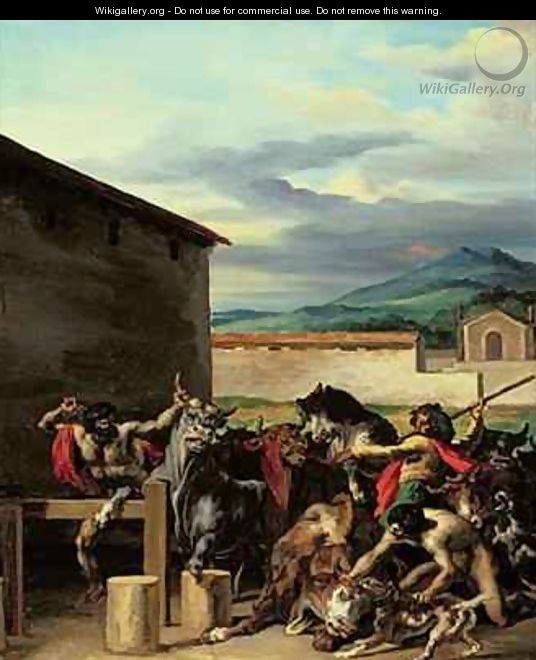
Théodore Géricault's


Cattle Market (1817)


and Postillion at the Door of an Inn (1822-23)


and Eugène Delacroix's A Turk Surrenders to a Greek Horseman (1856).

In addition to paintings by many of the leading French Impressionists and Post-Impressionists, the exhibition featured eleven sculptures by Auguste Rodin,


Dante Gabriel Rossetti's The Blessed Damozel (1871-78)


and a selection of Edward Burne-Jones's watercolors, Days of Creation (1875-76),

were among the important group of paintings and drawings by the British Pre-Raphaelites.

Winthrop assembled one of the finest collections of works by William Blake, represented here by one of artist's rare oil paintings,


Christ Blessing (ca. 1810),


Thy Sons and Thy Daughters Were Eating and Drinking Wine, (1821)


as well as by pages from his celebrated Book of Job (1821).

A great admirer of the progressive artists of 19th-century America, Winthrop owned a group of watercolors by Winslow Homer that included


Mink Pond (1891)


and Adirondack Lake (1892).

The expatriate American artists John Singer Sargent and James Abbott McNeill Whistler were represented in his collection as well; the former by five pictures, the latter by eight, including a shimmering


Nocturne in Blue and Silver (ca. 1871-72).

A Private Passion debuted at the Musée des Beaux-Arts, Lyon, in the spring of 2003. It then traveled to the National Gallery, London, before its appearance at the Metropolitan Museum.

The exhibition was organized by an international committee of curators coordinated by Stephan Wolohojian, Curator of Paintings, Sculpture, and Decorative Arts, Fogg Art Museum, Harvard University Art Museums. The exhibition will be installed at the Metropolitan by Gary Tinterow, Engelhard Curator of 19th-Century European Painting, with the assistance of Rebecca A. Rabinow, Assistant Research Curator.


Stephan Wolohojian edited the fully illustrated catalogue, which contains contributions by more than 60 specialists. The catalogue was published by The Metropolitan Museum of Art and distributed by Yale University Press.


Excellent Review with more images:


including:


"Café-Concert (À la Gaîté Rochechouart)," by George Pierre Seurat, conté crayon and white gouache on buff laid paper, 12 1/8 by 9 ¼ inches, 1887-8