The first major retrospective devoted to the virtuoso Netherlandish mannerist Hendrick Goltzius – one of the most versatile and accomplished figures in the history of art – was on display at The Metropolitan Museum of Art June 26 – September 7, 2003.
Hendrick Goltzius, Dutch Master (1558-1617): Drawings, Prints, and Paintings, an international loan exhibition of more than 160 works, spans the artist's entire career and demonstrates his legendary mastery of a remarkably wide range of media, subject matter, and styles – from extravagantly complex mythological scenes in prints, to sensitively observed studies from nature, to sumptuously colored oil paintings on canvas and copper. The exhibition remained on view at the Metropolitan through September 7, 2003.
Internationally acclaimed in his day as the leading artistic personality of the Netherlands, Goltzius's reputation was soon eclipsed by the achievements of the 17th-century painters of Holland's Golden Age. It is only in the last half-century that his pivotal importance as the supreme exponent of Netherlandish mannerism has been appreciated fully. It is less widely recognized that he was a pioneer in the rise of Dutch realism and classicism.
Roughly half of the exhibition was devoted to Goltzius's important activities as printmaker, and includes images such as the celebrated The Wedding of Cupid and Psyche, in which the mannerist love of artifice and exaggeration is most fully expressed. The group of 69 drawings in the exhibition features a number of his famous large-scale pen works – including the spectacular, seven-by-five-foot Venus, Ceres, and Bacchus – as well as postage-stamp-size portraits in metalpoint and some of the first realistic renderings of the Dutch landscape. The group of 13 oil paintings – a medium Goltzius took up only late in his career – was the largest ever assembled, and included the magnificent Danaë, notable for its jewel-like colors and unabashed observation of the female nude.
The exhibition was organized by the Rijksmuseum, Amsterdam, The Metropolitan Museum of Art, New York and the Toledo Museum of Art.
Born on the border between the Netherlands and Germany, Goltzius received his earliest training from his father, a glass painter. A fall into burning coals when he was still a child left his right hand crippled, making it impossible for him to extend his fingers fully. Nevertheless he showed a precocious aptitude for drawing, and around 1575 he became an engraver's apprentice. His primary task was to translate the painted and drawn designs of others into print, and he became a skilled imitator of various artistic styles. By the age of 19, Goltzius had settled in Haarlem and around 1595 he became deeply influenced by the art of Bartholomeus Spranger, an important practitioner of the newly fashionable mannerist style. Characterized by artifice and refinement, mannerism tended to exaggerate – and, at times, bizarrely distort – the idealizing art of the High Renaissance. About that time he began to develop a new style of engraving with exaggerated swelling lines, with which he could create stunning painterly effects as well as astonishing, almost kneadable, three-dimensionality. The ambitious young printmaker established a print business in Haarlem in 1582 that soon broke the monopoly on publishing prints in Northern Europe that had been controlled by publishers in Antwerp. His printing house was exceptional in that the design, execution, and publication of the prints all centered around making Goltzius's unique designs and techniques known throughout Europe. It became one of the largest and most successful of its day, and played a central role in the spread of the mannerist style.
Goltzius traveled to Italy in 1590-91 – now internationally famous, he traveled incognito to avoid being recognized. At the age of 32, he was beyond the stage where he needed to travel to Italy to learn about art; he meant instead to deepen his own artistry and see for himself the works that he had so often heard discussed around him and that he only knew from prints and drawings. His mannerist exaggerations had already begun to give way to more "classically" proportioned forms, but his work after this journey shows an even stronger influence of the Renaissance art that he saw in Italy by such masters as Raphael and Michelangelo. After his return to Haarlem, he began to produce a series of strikingly realistic landscapes and studies from nature. Nevertheless, the mannerist love of virtuoso display is still evident in the large-scale pen drawings and late prints that imitate – and were often mistaken for – the work of earlier 16th-century masters. In 1600, Goltzius began a new career as a painter in oils, most likely because of the greater prestige the medium conferred.
The exhibition was organized chronologically and thematically, with works grouped according to the various media, genres, and styles in which Goltzius excelled at successive stages in his career.
In his early prints, executed while the artist was still in his twenties, Goltzius favored moralizing subjects drawn from antiquity and the Bible. Among the finest of these is the series of four engravings depicting The Story of Lucretia:

The Banquet at the House of Tarquinius, or The Banquet of Turquinius Collatinus, engraving, c. 1578. References: Bartsch 104, Hirschmann 171, Strauss 17, only state. First of the series (of 4) The History of Lucretia.

Tarquinius and Lucretia, c. 1578
the Roman woman who chose suicide over dishonor, following her rape by the king's son. The attenuated forms and self-consciously graceful poses – even in moments of extreme violence – reveal the artist's early interest in mannerist modes of expression and his unique interpretations of traditional subjects.
By contrast, Goltzius's many early drawn and engraved portraits – another important source of fame and income for the young artist – are meticulous and wonderfully observed records of each sitter's appearance and personality. His drawing of a solemn-faced young boy, believed to be the artist's stepson,

Jacob Matham (ca. 1584, Teylers Museum, Haarlem),
is one of many portraits executed in the notoriously difficult and precise medium of metalpoint. Goltzius was one of the few artists to use this medium in the 17th century.
The exhibition featured a number of prints from the late 1580s, in which Goltzius's art develops in the direction of ever-increasing extremes of artifice, exaggeration, and complexity. An important catalyst was the work of the Flemish mannerist Bartholomeus Spranger, whose extravagant style Goltzius sought to emulate and then surpassed. One of the highlights of the exhibition was Goltzius's famous engraving, after a design by Spranger, of the
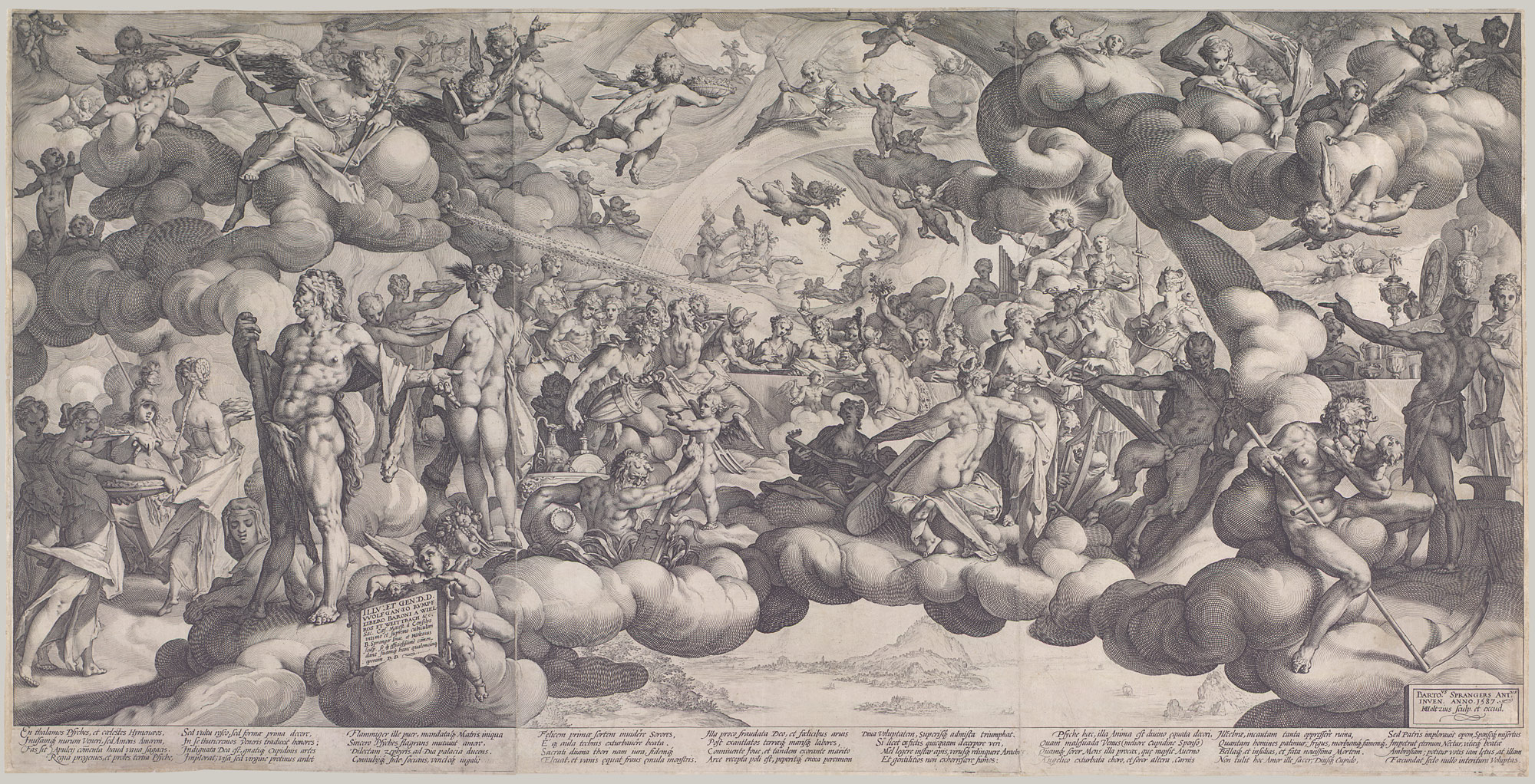 Wedding of Cupid and Psyche
 (1586-87, The Metropolitan Museum of Art),
a mannerist tour-de-force of some 80 sinuous women and powerfully muscled men cavorting among spiraling cloudbanks. The print was displayed alongside

Spranger's original drawing of the work (1586, Rijksmuseum, Amsterdam),
allowing visitors to study the ways in which Goltzius used his burin to heighten the swirling patterns and dramatic effects of light and shadow already present in the design.
Also from the so-called "Spranger years," but based on Goltzius's own designs, is the print series
the Roman Heroes (1586, Rijksmuseum, Amsterdam),

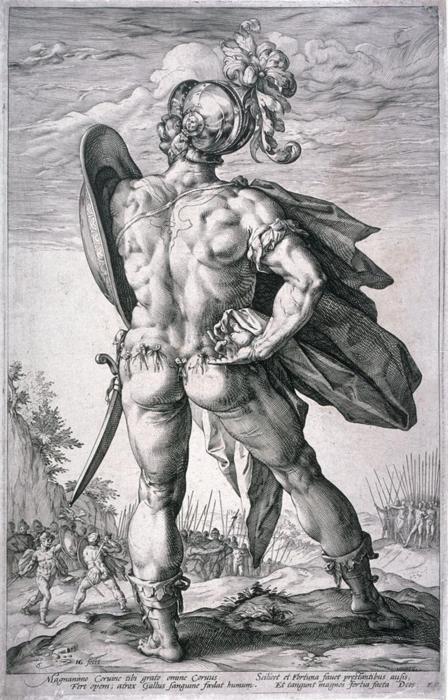

a group of ten impossibly brawny warriors, rendered with the astonishingly varied repertoire of intricate, swelling cross hatchings that is now the hallmark of his engraving style. Dedicated to Emperor Rudolf II, who became one of his most enthusiastic patrons, the series refers to the monarch's heroic achievements.
Goltzius's delight in dramatic foreshortening and ever more daring compositions is seen in
 The Four Disgracers (1588, The Metropolitan Museum of Art),
a series of engravings which shows the tumbling mythological figures of Tantalus, Icarus, Phaeton, and Ixion caught in mid-air.
Goltzius's engraving lines reach an extreme in this series in which each figure appears to be caught in a net of swelling and tapering lines.
Mannerist exaggeration reaches its most bizarre formulation in Goltzius's print of
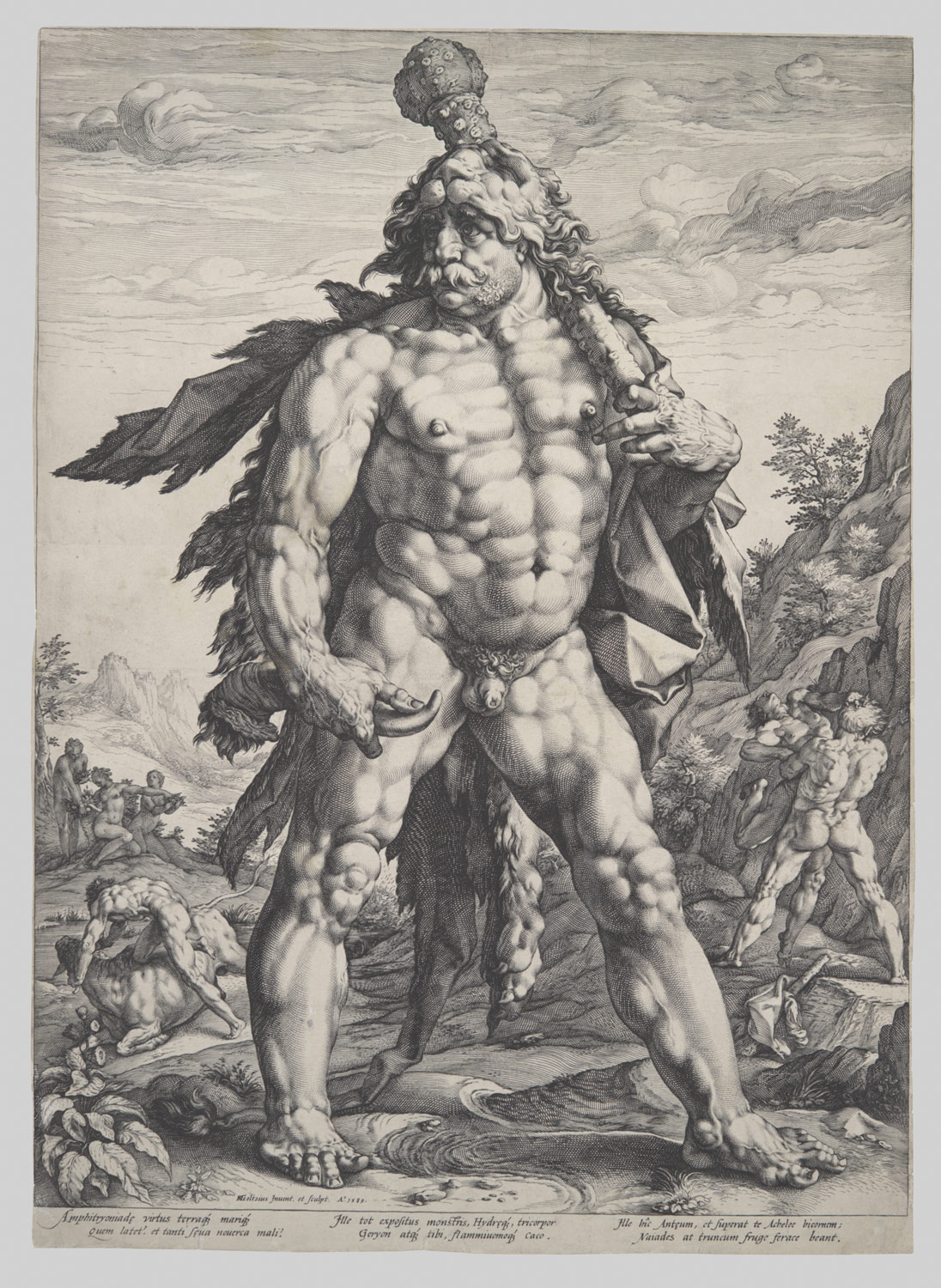 The Great Hercules (1589, The Metropolitan Museum of Art),
whose grotesque bundlings of muscles earned the image the Dutch nickname Knollenman, "bulbous man."
Goltzius's 1590-91 trip to Italy, though brief, had a profound and lasting influence on his work. The exhibition features a number of the artist's meticulous studies of the great monuments of classical antiquity and Renaissance sculpture, such as the

Farnese Hercules,
the Dioscuri,

the Belvedere Torso, and
Michelangelo's Moses
which informed his more classicizing, normative approach to the human form and served as sources for some of the massive figures in his later paintings.
Also on view was a group of portraits – including a dashing
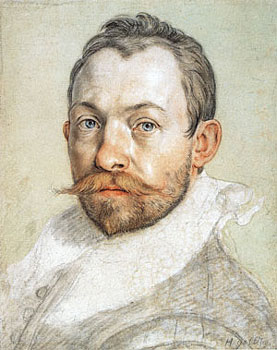
Self-Portrait (ca. 1590-92, Nationalmuseum, Stockholm) –
made during and just after the artist's trip to Italy. These boldly realistic images, life-sized and carried out in colored chalks, have no equivalent in the history of Dutch art, and may reflect the influence of contemporary Italian artistic practices.
A series of remarkably naturalistic plant and animal studies also postdates his Italian sojourn, and includes

his portrait-like chalk drawing of a monkey (ca. 1595-1600, Rijksmuseum, Amsterdam);
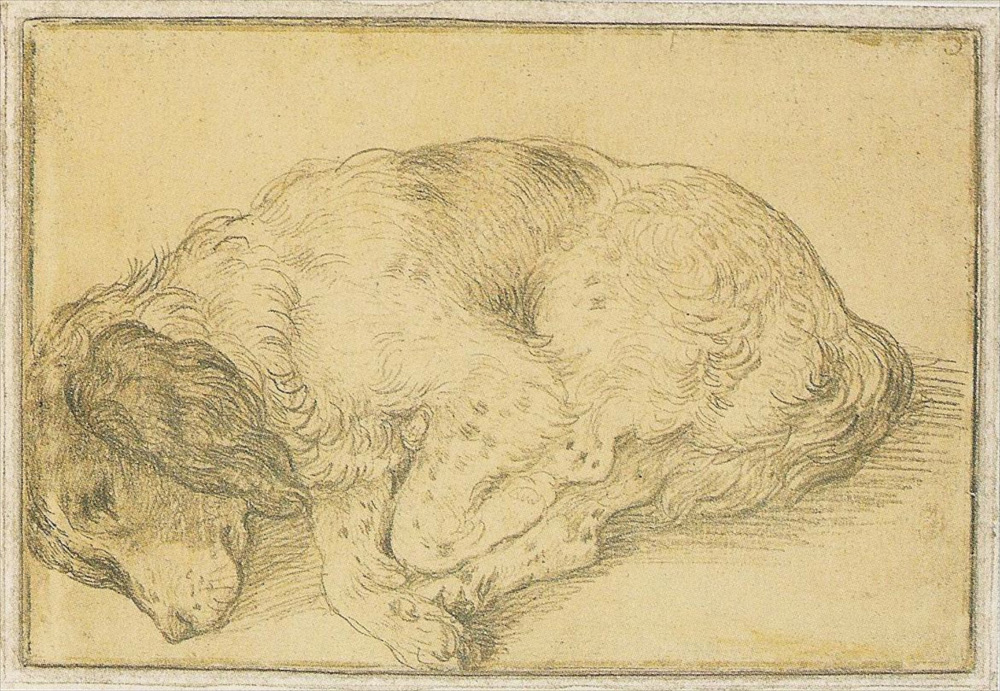
a metalpoint study of a spaniel (ca. 1597, Paris, Collection Frits Lugt, Fondation Custodia),
probably the artist's own dog, napping at his master's feet;
and his chalk and watercolor drawing of an oak tree (ca. 1597-99, Ashmolean Museum, Oxford). Goltzius and two other Haarlem artists were said to have created an academy to draw from life. "Studying from life" seems to have meant at the time an alternative to drawing from imagination – for example, drawing from sculptures and other works of art and not necessarily from live models. The casual pose and careful delineation of contours in
Goltzius's Seated Female Nude (ca. 1600, Harvard University Art Museums) suggests that it is one of the rare works from this period actually drawn directly from a nude model.
The trip to Italy, which took Goltzius through spectacular Alpine vistas, also seems to have inspired his first forays into the field of landscape drawing. Some of these works adhere to the Dutch tradition of "fantasy landscapes" inspired by the prints of Pieter Bruegel the Elder. However, he also produced sketches of the Haarlem countryside that are considered to be the first realistic depictions of Dutch scenery. As such, they look forward to the work of Rembrandt and other great Dutch landscapists of the Dutch Golden Age.
In dramatic contrast to these modestly scaled studies from nature are Goltzius's magnificent, oversize Penwercken ("pen works"), often executed on parchment or canvas, in which meshworks of swelling and tapering lines imitate the appearance of his signature "swelling groove" engraving style. Still mannerist in their self-conscious artifice and bravura display of technique for its own sake, these were highly coveted – and costly – collectors' items. The Holy Roman Emperor Rudolf II owned at least four.
The exhibition included what is undoubtedly Goltzius's most spectacular pen work, a scene of Venus attended by Bacchus and Ceres (1606 [?], State Hermitage Museum, St. Petersburg) that measures about seven by five feet. While work on the picture was underway, news spread of the seemingly impossible task Goltzius had set for himself. In a letter of 1605, also on display, the artist mentions that people are taking bets that he will fail. "None of these gossips understands what I am doing," he declares, "nor are they worthy to understand it." Known by its Latin title,

Sine Cerere et Baccho Friget Venus,
the work illustrates the maxim that without food (Ceres) and wine (Bacchus), love (Venus) grows cold.
(Compare another work by Goltzius:

Venus between Ceres and Bacchus)
The exhibition also included a pen work drawing of

Goltzius's own crippled right hand (1588, Teylers Museum, Haarlem),
clearly showing the claw-like fingers of his deformity. Signed with a grand flourish, it can be considered in a sense a self-portrait via the artist's widely recognized feature.

Youth with Tulip and Skull, Morgan Library, New York),
one of his last pen works, is also one of his most ambitious, incorporating an extraordinary range of hatching to suggest the varying textures of bone, petals and hair, as well as the plumes on the man's hat. Goltzius inscribed on a background wall a typically Dutch reminder of the brevity of life: QUIS EVADET / NEMO (Who can escape? No one).
The group of late prints on view, dating from 1592 to 1600, demonstrated the same virtuosity and love of showmanship, as well as remarkable powers of imitation and emulation. Goltzius was called by his friend and biographer Karel van Mander a Proteus in art, after the shape-shifting sea god.
In the Life of the Virgin (1593-94, Rijksmuseum, Amsterdam)

Adoration of the Magi, from the series "The Life of the Virgin,

The Holy Family and Saint John, Life of the Virgin

The Death of the Virgin, from the series "The Life of the Virgin"
a series of six engravings often referred to as his Meisterstiche ("masterpieces"), each scene is executed in the style of a different great master of the past.

The Circumcision
was apparently so convincing that it was taken by connoisseurs for an original by Albrecht Dürer, but Goltzius revealed his deception by including his own portrait in the background and setting the scene in St. Bavo, the local Haarlem church.
In 1600, at the age of 42, Goltzius gave up printmaking, the medium that had earned him great international recognition during the previous two decades, and began a new career as a painter in oils. To date, approximately 50 works in this medium are known, many only "discovered" in recent decades. The group of 13 on view here, the largest number ever assembled for an exhibition, offered the first comprehensive overview of this little-known aspect of his oeuvre.
His early
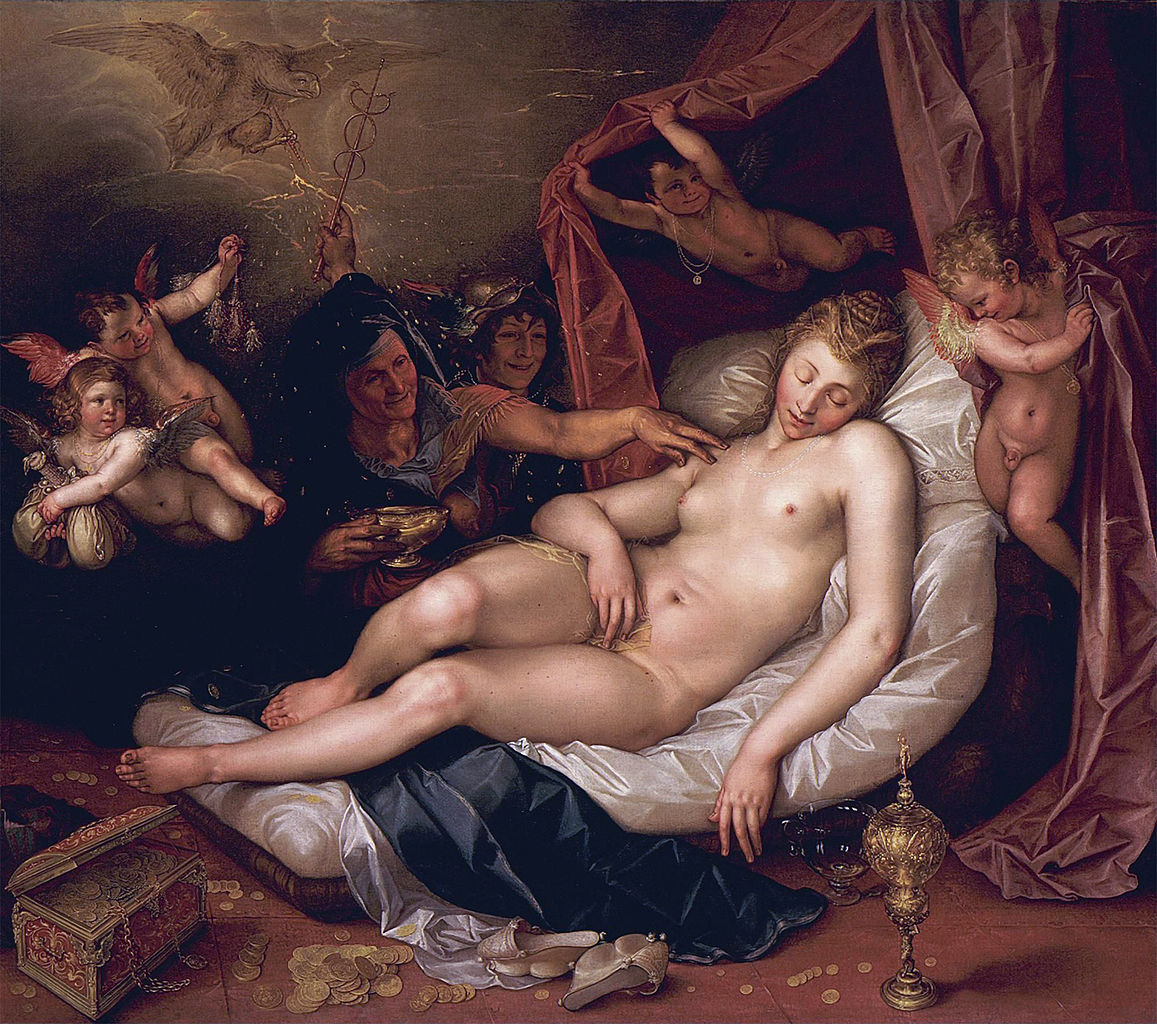
Danaë (1603, Los Angeles County Museum of Art)
was clearly intended as a demonstration piece to proclaim his skills, especially in the depiction of the female nude. Resting on gorgeously colored satin cushions, the sleeping figure of the princess Danaë extends nearly the entire width of the canvas. Her right hand, resting between her thighs, alludes to her impending ravishment by Jupiter, who appears directly above as a shower of gold.
Such unabashed eroticism becomes a common feature of many of Goltzius's paintings, such as his
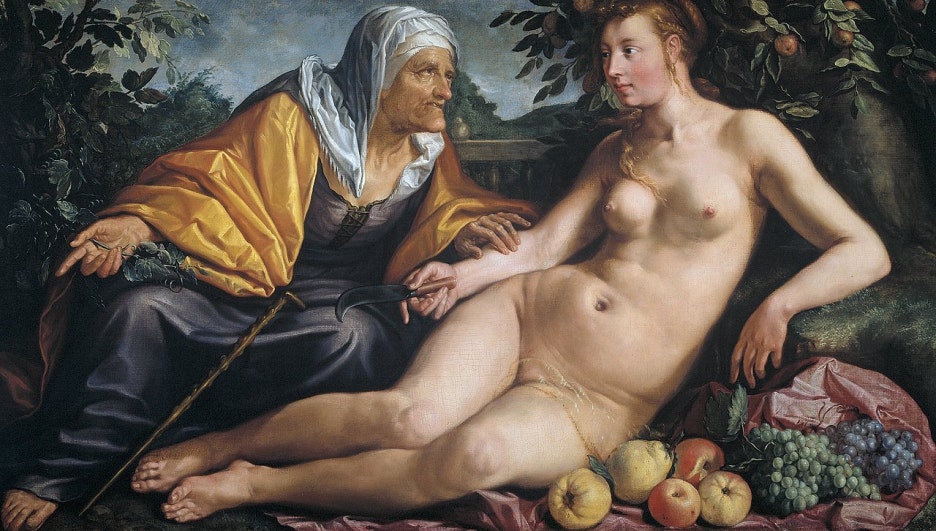
Vertumnus and Pomona (1615, The Fitzwilliam Museum, Cambridge)

and The Fall of Man (1616, National Gallery of Art, Washington, D.C.),
with its intertwining nude bodies of Adam and Eve.
The reasons for Goltzius's decision to concentrate on oil painting are not certain. As painters were ranked above printers in the artistic hierarchy of 16th-century Europe, it must have been born of this ambitious artist's desire to gain even greater respect among contemporaries and assure lasting fame.
The exhibition had already been on view at the Rijksmuseum, Amsterdam. Following its showing at the Metropolitan, the exhibition traveled to the Toledo Museum of Art, Toledo, Ohio (October 18, 2003-January 4, 2004).
The exhibition was organized by Jan Piet Filedt Kok, Head of the Department of Paintings, Huigen Leeflang, Print Curator, and Ger Luijten, Head of the Department of Drawings and Prints, Rijksmuseum, Amsterdam; Nadine M. Orenstein, Curator, and Michiel C. Plomp, Associate Curator, Department of Drawings and Prints, The Metropolitan Museum of Art; and Lawrence W. Nichols, Curator of European Painting and Sculpture before 1900, Toledo Museum of Art.
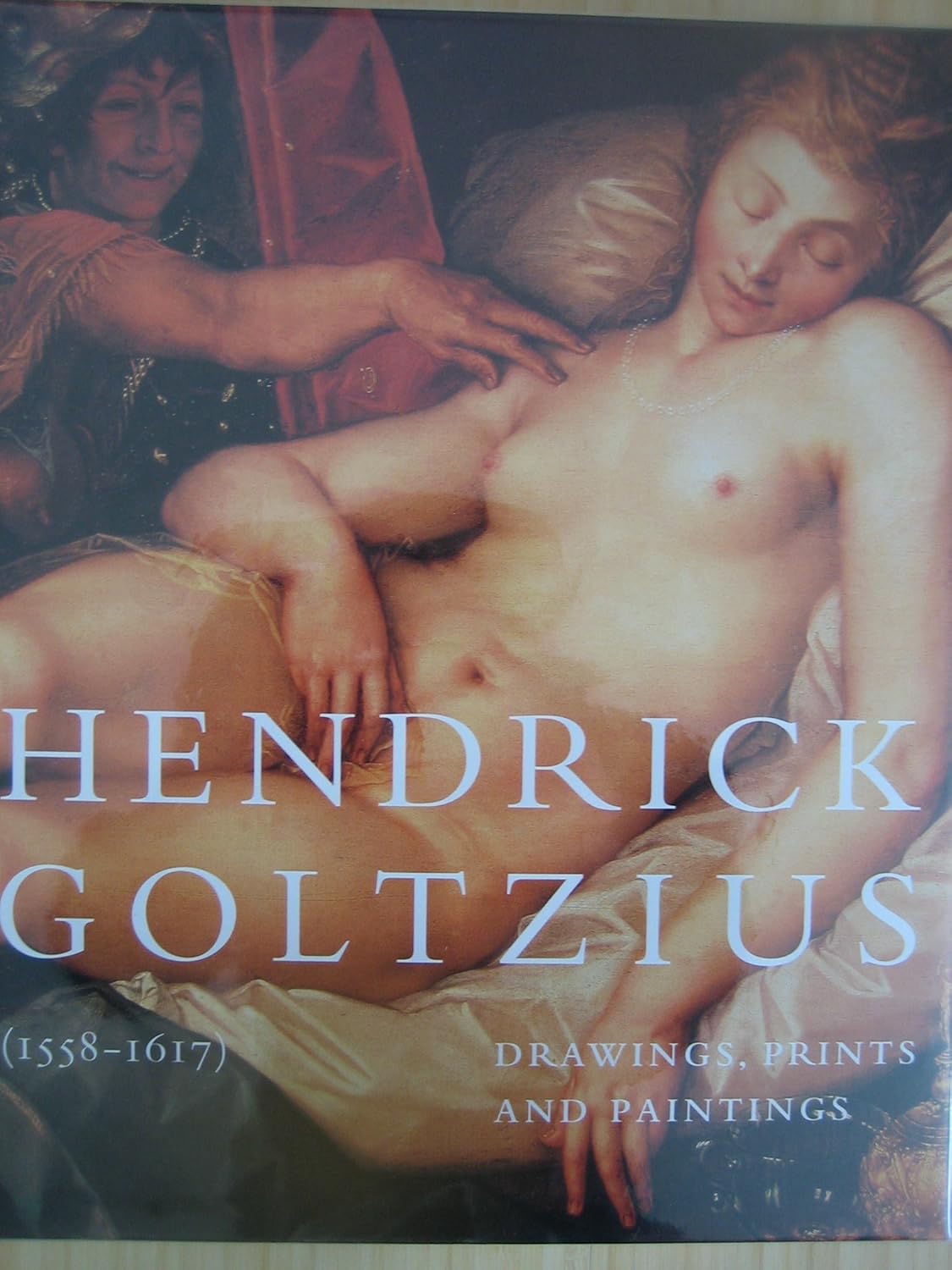
The exhibition was accompanied by a
fully illustrated catalogue edited by Huigen Leeflang and Ger Luijten, with contributions by Lawrence W. Nichols, Nadine M. Orenstein, Michiel C. Plomp, and Marijn Schapelhouman. The catalogue, available in a hardcover edition, is published by Waanders Publishers.