Wednesday, September 25, 2013

An American in Venice: James McNeill Whistler and His Legacy


An American in Venice: James McNeill Whistler and His Legacy from the Syracuse University Art Collection is an exhibtion on view at the Arkell Museum at Canajoharie, NY, through October 20, 2013.

In 1879 American artist James McNeill Whistler arrived in Italy with a commission from the Fine Arts Society of London to create twelve etchings of Venice. He had already gained international recognition for his paintings Symphony No 1: The White Girl and Arrangement in Grey and Black, No. 1: Portrait of the Artist’s Mother.

During his fourteen months in Venice the artist produced a body of prints that are among the most important of his career. The prints from Whistler’s Venice period are distinguished by the artist’s original approach to capturing the unique qualities of the canaled city and his innovative use of the etching process. His innovations in content, style and technique established a new model for artists of the late-nineteenth and early-twentieth centuries, and this legacy has unmistakably imbued the art of his followers.

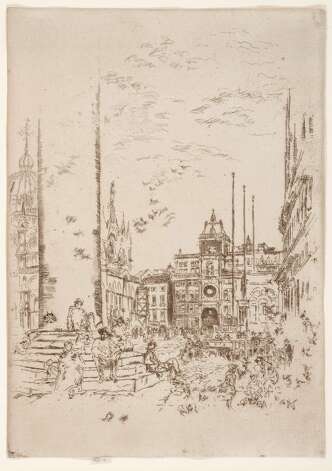
Whistler distinguished himself from the landscape artists who had preceded him in Venice by avoiding the city’s tourist sites. He set out to depict a “Venice of the Venetians,” seeking stimulation in the small canals and private courtyards of Venice’s lesser-known quarters. Familiar views and monuments, when they do appear in his art, are often in a hazy distance, seen from an unusual viewpoint, and are printed in reverse due to Whistler’s penchant for drawing his scenes directly on to the copper plate.


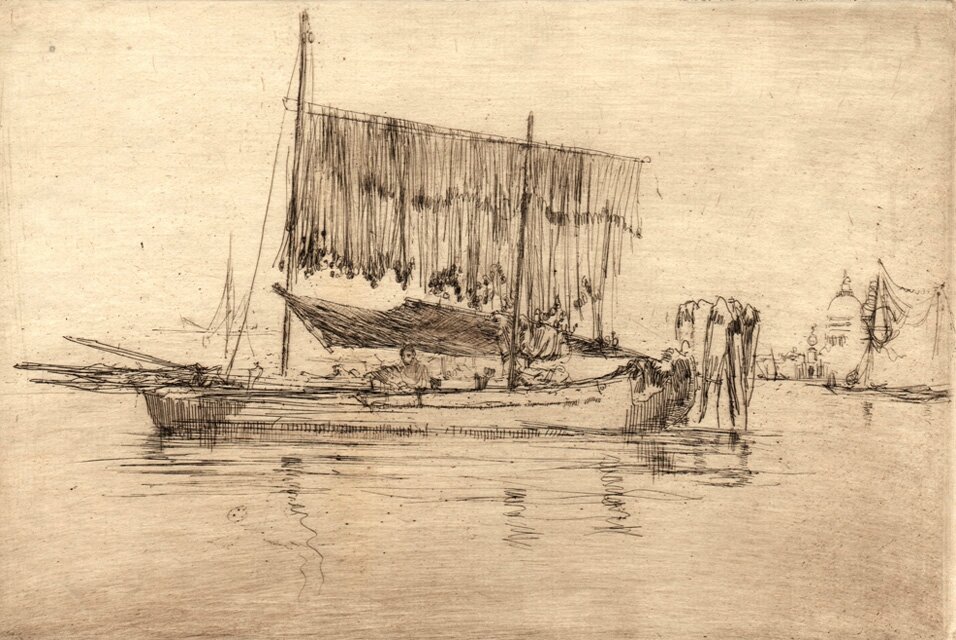
James McNeill Whistler, Fishing Boat, 1879-1880, etching on laid paper, Syracuse University


It was during his Venice period, as Whistler confessed to his follower Mortimer Menpes, that he discovered the secret of drawing: “I began first of all by seizing upon the chief point of interest. I would begin drawing that … elaborately, and then would expand from it … If by chance I did not see the whole …, I would not put it in. In this way the picture must necessarily be a perfect thing from start to finish.” The result was a central motif rendered in meticulous detail set within an environment which had been translated on to the plate with a minimum of lines. This left large, open spaces of water and sky which Whistler expertly manipulated in the printing process. Whistler selectively wiped the plate to create atmospheric effects in his surface inking. He also experimented with modern and antique papers and the different effect each created in the final printing.


James Abbott McNeill Whistler Piazzetta, c1879-1880 etching on laid paper 10 x 7 1/8 inches

Whistler’s innovations in this period established him as a master artist and had an acute effect on the art of his followers. While each artist expresses Whistler’s influence in his or her own way, the pervasiveness of Whistler’s impact is aptly described by his closest follower, Mortimer Menpes: "We followers saw things from Whistler's standpoint. If we etched a plate, we had to etch it almost exactly on Whistlerian lines. If Whistler kept his plates fair, ours were so fair that they could scarcely be seen. If Whistler adopted economy of means using the fewest possible lines, we became so nervous that we could scarcely touch the plates lest we should over elaborate."

This exhibit from the Syracuse University Art collection places eleven prints by Whistler from 1879-1880, alongside the work of his followers who were practicing in Italy in the late-nineteenth and early-twentieth centuries. The juxtaposition of these works allows the viewer to appreciate both Whistler’s innovations and the different ways in which his work affected that of the artists who followed him.


John Marin (1870-1953) Palazzo Dario, Venice, 1907, etching on wove paper Syracuse University Collection

The exhibition includes an etching of the Palazzo Dario, Venice by the modern artist John Marin along with works by Mortimer Menpes and Joseph Pennell.

The exhibition also includes remarkable etchings by artists whose reputations have faded over the years.

Whistler’s legacy lies in his far-reaching vision for both his medium and his subject which has made his art significant for a remarkably broad range of colleagues.

From an excellent review (worth reading) in the Times Union (images added):


The brisk repetition of line combined with clouds of ink at the top and bottom of


"Nocturne: Palaces"

suggest mist or rain. With the focus on the shadows at the intersection of two buildings on the canal, line is used economically as sides of buildings fade into the paper. With etching, any place that ink is on the plate results in darkened areas on the print, so the true color of the paper shows through only if the plate is wiped clean. Whistler made unique prints from the same plate by selectively wiping his plates to create atmosphere and contrast.

The show also includes 23 views of Venice by artists who followed Whistler.

Some of these artists depict the landmarks that Whistler avoided.


Minna Bolingbroke's "Venezia"

presents a classic view of a gondola in front of the domed skyline of the city.


Menpes captures the "Bridge of Sighs"

in a dramatic and detailed print that, for all his talk of emulating Whistler, is almost the opposite of Whistler's works in terms of use of line. Menpes consumes every bit of the page.

Whistler's followers didn't always confine themselves to Venice. Three artists approach the same subject in Florence, the Ponte Vecchio, the famed bridge with shops along its span, in different ways. Of the three,


Samuel K. Popkins' vertical take on the bridge best reflects Whistler's influence.


Marjorie Garfield


and Ernest David Roth

each take a more illustrative approach...

This traveling exhibition originated at Syracuse University — all the works are from the University Art Collection.

More images

Friday, September 20, 2013

Greenwich Historical Society new exhibition: The New Spirit and the Cos Cob Art Colony: Before and After the Armory Show,


Lauded as one of the most influential events in the history of American art, The International Exhibition of Modern Art in 1913—popularly known as the Armory Show—was the first large exhibition of modern art in the United States, and one that introduced astonished Americans to European 'avant-garde' artists such as Pablo Picasso, Henri Matisse and Paul Cézanne. Much has been written about the show, yet no exhibition to date has explored the direct effect that the Armory Show had on artists and their artistic production. But the Greenwich Historical Society is about to change that.

Beginning October 9, the Greenwich Historical Society will present "The New Spirit and the Cos Cob Art Colony: Before and After the Armory Show," which for the first time shows the direct impact of the Armory Show on the Cos Cob art colony artists.


A perfect complement to larger exhibitions in the metropolitan New York area inspired by the centennial of the Armory Show, this small yet critical exhibition at the Greenwich Historical Society highlights the extensive involvement of Cos Cob artists, such as Elmer MacRae and Henry Fitch Taylor, in producing the Armory Show, and brings to public attention several of the accomplished Cos Cob artists whose work has been rarely exhibited until now.

“This is the first exhibition to illustrate the Armory Show's direct influence on a group of artists, specifically the Cos Cob art colony," says Valerie Ann Leeds, curator of "The New Spirit." "Viewers will be able to compare artists' works from before and after the Armory Show and see to what degree they each embraced modernism as the movement became assimilated into the mainstream of American art."

The tightly focused exhibition is comprised of 40 works of art by 12 Cos Cob artists, including several works that were shown in the 1913 Armory Show, along with archival material and ephemera from the Greenwich Historical Society and private and museum collections. In addition to MacRae and Taylor, the show features artists D. Putnam Brinley, Childe Hassam, Ernest Lawson, Carolyn C. Mase, Frank A. Nankivell, Allen Tucker, J. Alden Twachtman, and J. Alden Weir. It also includes influential pioneering Impressionist artists, Theodore Robinson and John H. Twachtman, whose work was included in the Armory Show, but who had died years earlier.


One exceptional example of the Armory Show's influence on Cos Cob artists can be seen in the evolving work of Henry Fitch Taylor. Taylor's oil painting,


An Old Pasture (1893),

is typical of his landscapes of the time, which were inspired by the French Impressionism. Contrast this with two of Taylor's post-Armory Show paintings


Cubist Still Life (1913-4)


and Figure with Guitar II (1915),

both of which embrace the modernist spirit. "Clearly, it's no longer about representation, but rather about an exploration of form, color, space, and fragmentation," says Dr. Leeds.

The Armory Show also profoundly affected Elmer MacRae’s style. Created before the show,


Schooner in the Ice, View from the Bush-Holley House, Cos Cob, Connecticut

is impressionistic in its treatment of the view from the Bush-Holley House in mid-winter.


Japanese Iris (1914),

and


Still Life with Magnolias (1915)

painted one year after the show, reveals how MacRae has turned to a much more stylized treatment of his subject matter. Viewers will be able to see how the flowers have been simplified and negative spaces activated with strong shapes, decorative patterning, and bold color.

Also in the exhibition in Greenwich are a number of works by Childe Hassam, one of the most well known and prolific of the American Impressionists. His


Chicken Yard Back of the Holley House (1902)

is a light-dappled pastel depicting fields and ponds behind the Bush-Holley House.

Hassam, who had six works on display in the Armory Show, claimed no interest in modernism. However, the exhibition shows it indeed had some effect on him, as evidenced by his late flower still life as well as one of Hassam's rare painted frames on a late figurative composition in the show.

The archival material and ephemera on view include banners, buttons, posters, and postcards from the Armory Show as well as photographs of the artists. These materials help bring to life and document the important roles that Cos Cob artists played in the actual production of the Armory Show. MacRae and Taylor were two of the four artists who conceived the idea for the exhibition in 1911, and MacRae served as its treasurer; Brinley, Lawson, Tucker, and Weir were charter members of the Association of American Painters and Sculptors (AAPS), the organizing body of the Armory Show; and Brinley, Lawson, MacRae, Nankivell, Taylor, and Tucker all served on various committees.

Susan G. Larkin, former chair of the Greenwich Historical Society and author of The Cos Cob Art Colony: Impressionists on the Connecticut Shore, says that MacRae was much more involved with the Armory Show than he has previously been given credit for. "He was a central figure in the story, but was very modest and didn't trumpet himself. But others did and they wrote the history." Larkin has contributed an essay about MacRae for the catalogue of the coinciding Armory Show retrospective at The New-York Historical Society, which will be on view from October 11, 2013 through February 23, 2014.

“It is especially fitting for the Greenwich Historical Society to organize and mount this anniversary exhibition as it is a key repository for archival material from the Armory Show as well as a major holder of works by MacRae,” notes Dr. Larkin. MacRae was among the group of Cos Cob painters who gathered at the Historical Society's Bush-Holley House from the early 1880s until the 1920s, when it was run as a boardinghouse for artists and writers. Josephine and Edward Holley passed the house on to their daughter, Emma Constant Holley, following her marriage to MacRae in 1900.

The exhibition will complement related projects celebrating the Armory Show centennial being organized by other area institutions, such as the New-York Historical Society, the Archives of American Art, the Montclair Art Museum, the Heckscher Museum of Art, and the Phillips Collection, each of which focuses on a different aspect of this watershed event in the history of American art.


Pieces in Original Show

The original Armory Show, held at New York's 69th Regiment Armory on Lexington Avenue between 25th and 26th streets, included approximately 1,250 paintings, sculptures, and decorative works by over 300 European and American artists. Three works of art from the show are featured in the Greenwich Historical Society exhibition. Elmer MacRae's


Feeding the Ducks (1912)

is a Post-Impressionist oil of one of his twin daughters on the grounds of the Bush-Holley boardinghouse.

Allen Tucker's landscape,


Mount Aberdeen, Sunny Afternoon (1912),

depicts the glorious peaks of the imposing Australian mountain. The painting was featured on one of the Armory Show's announcement postcards (a number of which are also included in the Greenwich exhibition).

The third painting is J. Alden Twachtman's El Puente de Alcantara, Toledo [The Singing Bridge], which was painted circa 1912.

Pioneering Artists Who Passed Away Before the Armory Show

Also included in the Greenwich exhibition is artwork by two pioneering Cos Cob artists whose works were exhibited at the Armory Show as predecessors of modern art. Theodore Robinson, who visited Giverny and developed a close relationship with Claude Monet, was one of the first American artists to take up Impressionism in the late 1880s. His work


Autumn Sunlight (1888)

pictures a young woman leaning against a tree at the edge of the woods,
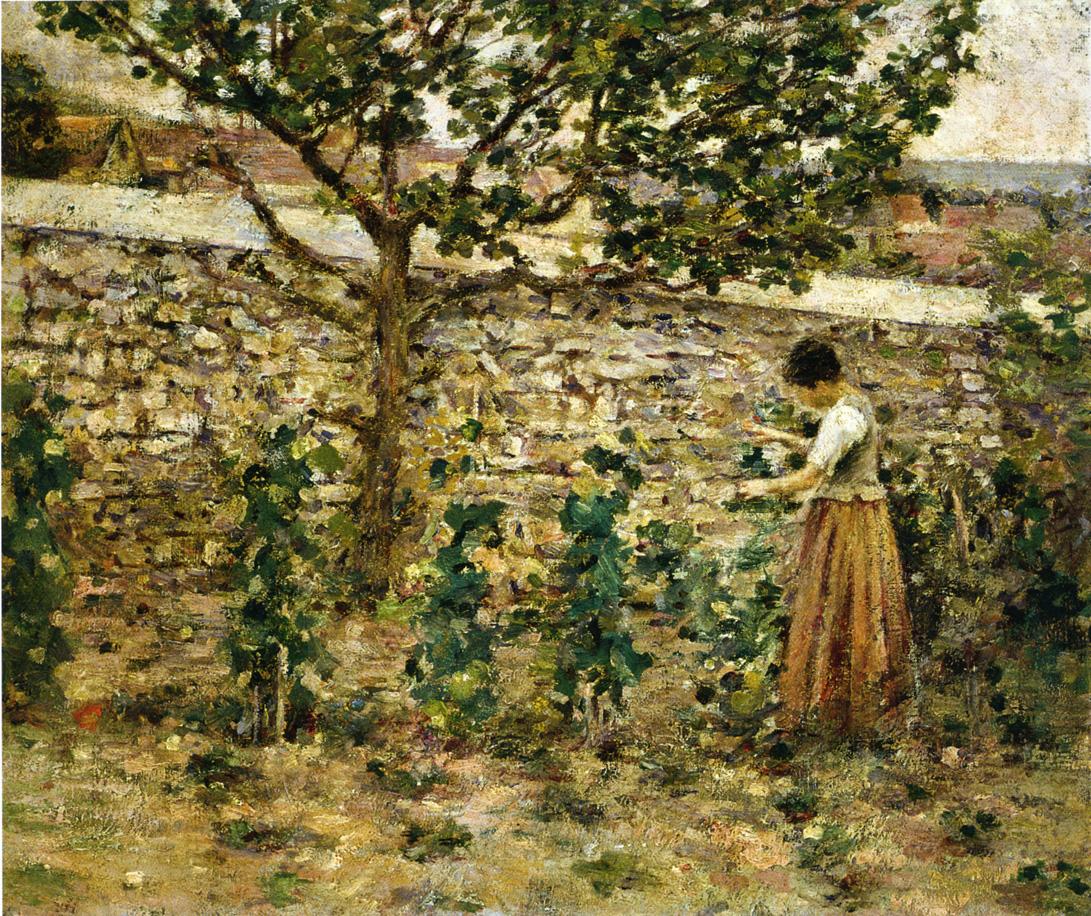


and In the Garden (c. 1889),

features a young woman tending plants in her garden.

John H. Twachtman, who trained in Munich and Paris, was among the forefront of the American avant-garde throughout his career. It is also notable that he taught summer classes at the Bush-Holley House during the heyday of the Cos Cob art colony. Work by Twachtman in the exhibition includes
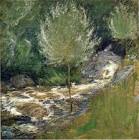


Horseneck Falls, Greenwich Connecticut (c. 1890–1900),

which depicts a waterfall on his own Greenwich property, and


Beach at Squam (1900),

a tranquil view of the shoreline.

Evident in both paintings are Twachtman's heralded experimental technique and innovative compositional style, which anticipated directions in 20th-century abstract painting.

Accomplished Cos Cob Artists Who Have Been Virtually Unknown Until Now

The Greenwich exhibition showcases important Cos Cob artists who have been virtually unknown until now. One example is Carolyn C. Mase, who was a student of John H. Twachtman and also traveled to France to study. Highly influenced by Renoir, Manet, and Monet,


Mase's Impressionist Harbor View (n.d.),

masterfully captures a rocky mountain overlooking ships in the harbor.

The show also brings attention to Frank A. Nankivell, an Australian-born artist and cartoonist who moved to New York in 1896. His Children on Rocks by Sea (c. 1900–20) displays a modernist bent in the handling of color, form, and dimension.

"The New Spirit and the Cos Cob Art Colony: Before and After the Armory Show," runs from October 9, 2013 through January 12, 2014, at the Greenwich Historical Society's Bush-Holley House and Museum Gallery, 39 Strickland Road, Cos Cob, CT. Hours are Wednesday through Sunday, from noon to 4 pm. Admission is $10 for adults, $8 for seniors and students, and free for members and children ages six and under. For further information, please call (203) 869-6899 or visit www.greenwichhistory.org.


Greenwich Historical Society Fall Lectures & Special Events

2013 Annual Meeting and Crooks Distinguished Lecture:

Culture Shock 1913: An Illustrated Lecture with Sara Fishko

It's 1913. The traditional culture of the 1800s is finally breaking apart in earnest. Big cities. More noise. Violence. Machines. And artists are responding by making jarring, Cubist paintings. Composers are writing thrusting, rhythmic, harshly dissonant music. The world seems shaky and uncertain, and there are riots and fistfights in the concert hall and at the ballet! At this year’s combined Annual Meeting and Crooks Distinguished Lecture, Sara Fishko of WNYC, New York Public Radio, will reflect on this astonishing moment in history.

You won’t want to miss this rare double feature that so aptly demonstrates what the Greenwich Historical Society is all about. A cocktail reception will take place prior to the meeting.

Edith and Roy B. Simpson have generously underwritten this event.

Thursday, September 19, 2013

Indian Harbor Yacht Club


710 Steamboat Road, Greenwich, CT

Reception begins at 6:00 pm. Program begins at 6:30 pm

Admission to reception and program: Members: $35, nonmembers $40

Reservations: www.greenwichhistory.org or 203-869-6899, Ext. 10

Lecture by Art Historian William Agee

In conjunction with the Greenwich Historical Society’s exhibition, The New Spirit and the Cos Cob Art Colony: Before and After the Armory Show, William Agee will provide a public lecture entitled The Big Show: A 100 Year Legacy.

William Agee received degrees from Princeton and Yale. He specializes in modern art in America from 1900- 1970. He has published numerous articles, catalogues and monographs in conjunction with exhibitions he has organized on Stuart Davis, Morgan Russell, Stanton Macdonald-Wright, Arthur Dove, John Marin, Morton Livingston Schamberg, Fairfield Porter, Ray Parker, Donald Judd, Sam Francis, Sandy Wurmfeld, Tony Smith, Alfred Jensen, and others. He has also done catalogues and organized exhibitions on aspects of modern art in America, such as modernism in the 1930s, and Dada in America He is currently preparing a book for Phaidon Press, Modern Art In America 1908-1968. He has taught at Hunter College for twenty-five years. He was awarded an endowed chair five years ago, the Evelyn Kranes Kossak Professor of Art History. Prior to Hunter, he held directorships in museums in Houston and California, and was a curator at The Museum of Modern Art and the Whitney Museum of American Art.


Tuesday, November 5, 2013, 7:30 pm

The New Spirit and the Cos Cob Art Colony will be open for viewing in the Storehouse Gallery before the program from 6:30 to 7:30 pm.

Greenwich Historical Society Vanderbilt Education Center

89 Strickland Road, Cos Cob, CT 06807

Members $10; nonmembers $15

Reservations: www.greenwichhistory.org or 203-869-6899, Ext. 10
Gauguin, Bonnard, Denis. A Russian Taste for French Art


From 14 September 2013 to 28 February 2014, the Hermitage Amsterdam will turn its attention to three great French artists of the late nineteenth and early twentieth centuries: Gauguin, Bonnard and Denis. In the years following the breakthrough of Impressionism, they went in search of new artistic paths. The elusive Paul Gauguin (1848–1903) was a shining example for the introverted Pierre Bonnard (1867–1947) and the theoretician Maurice Denis (1870–1943). Bonnard and Denis were briefly united with a few other artists (such as Valloton and Vuillars) under the name of Les Nabis, after the Hebrew word for ‘prophet’. These young artists explored fascinating new artistic paths. Unlike the Impressionists, who aimed primarily to capture the fleeting qualities of natural light, the Nabis emphasised colour, feeling, symbolism and imagination. Their work was quickly embraced in Paris, and in Moscow.

The wealthy Russian collector Ivan Morozov was soon charmed by their youthful talent, buying their work and offering them commissions. For instance, Morozov asked Denis to decorate the concert hall in his mansion in 1908. The exhibition will include a unique reconstruction of this exquisite interior, with seven paintings and six decorative panels: The Story of Cupid and Psyche.


Cupid in Flight is Stuck by the Beauty of Psyche, (first panel of the Story of Psyche, 1908)


Zephyr Carries Psyche to the Island of Bliss, (Second panel, 1908)


Psyche Discovers that Her Secret Lover is Cupid (third panel of the Story of Psyche, 1908)


The Vengeance of Venus, Opening the Box of Dreams of the Underworld, Sinks into Sleep, (Fourth panel, 1908)


In the Presence of the Gods, Jupiter Grants Psyche Immortality and Celebrates Her Marriage with Cupid, (Fifth panel, 1908)


Psyche's Parents Abandon Her on the Summit of the Mountain, (Sixth panel, commissioned by Ivan Morozov as an addition to the original five panels, 1909)


Cupid Carries Psyche to Heaven (Seventh panel, commissioned by Ivan Morozov as an addition to the original five panels, 1909)


Bonnard painted the monumental triptych


Méditerrannée


for the same collector. This work too will be on display in an illusionistic setting, with flat columns in front of the work enhancing the illusion of a Mediterranean view.

The work of the Nabis will be exhibited side by side with French paintings and drawings by their predecessors, contemporaries and immediate successors. With a small selection of sculptures by Auguste Rodin, Auguste Maillol and Paul Auguste Bartholomé, the exhibition will reveal the many facets of Paris’s flourishing artistic climate in the 1890s.

The term ‘Nabis’ was first used in 1889, by a group of young artists in search of a new approach to painting. They were studying together at the Académie Julian in Paris. The daring experimentalist Paul Gauguin became their inspiration, pointing them toward a new way of seeing and painting. The works on display were made between 1890 and the outbreak of the First World War.

Through their ‘flat’ style, initially lacking in traditional linear perspective, the Nabis – together with other avant-garde artists such as Van Gogh and Gauguin – opened the door to modern art. Their paintings in unmixed colours, making expressive use of form and coloration, paved the way to an art that was free and abstract. Their wide-ranging subject matter included city scenes, landscapes, religious themes, portraits and interiors. The Nabi painters used photography to test their compositional ideas, developing a photographic way of seeing. They also embraced the decorative painting of the Art Nouveau movement, making enormous decorative panels for their patrons’ buildings. In all these ways, they explored the artistic boundaries between high and low, fine and applied art.


Félix Vallotton, Woman at a Piano, 1904, oil on canvas, 43.5 x 57 cm
© State Hermitage Museum, St Petersburg


Félix Vallotton, Portrait of Georges Haassen, 1913, oil on canvas, 81.7 x 100.5 cm
Collectie Staatsmuseum de Hermitage, St.-Petersburg.


Félix Vallotton, Woman in a Black Hat, 1908, oil on canvas, 81.3 x 65 cm
© State Hermitage Museum, St Petersburg


Paul Gauguin, Sacred Spring: Sweet Dreams (Nave Nave Moe), 1894, oil on canvas, 74 x 100 cm
© State Hermitage Museum, St Petersburg


Édouard Vuillard, In a Room, 1899, oil on cardboard, pasted on panel, 52 x 79 cm
© State Hermitage Museum, St Petersburg


Pierre Puvis de Chavannes, Woman on the Beach, 1887, oil on paper, pasted on canvas, 75.3 x 74.5 cm
© State Hermitage Museum, St Petersburg


Édouard Vuillard, Children, 1909, tempera on paper, glued onto canvas, 84.5 x 77.7 cm
© State Hermitage Museum, St Petersburg


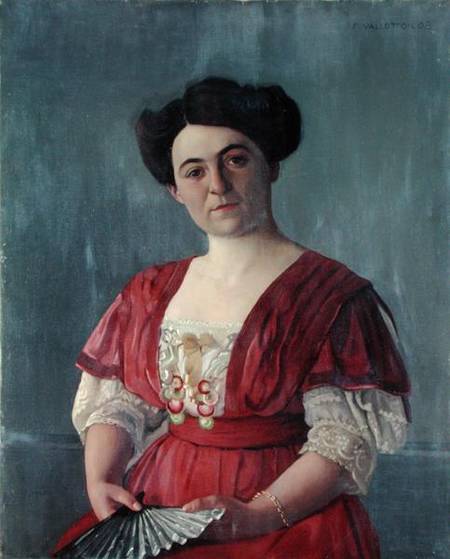
Félix Vallotton, Portrait of Madame Haasen, 1908
© State Hermitage Museum, St Petersburg


Odilon Redon, Woman Asleep beneath a Tree, 1900-1901
© State Hermitage Museum, St Petersburg


Thursday, September 19, 2013

Rembrandt. Landscape Etchings from the Städel Museum


Rembrandt Harmensz. van Rijn (1606–1669) is world famous to this day as a painter of exceptional portraits and history paintings. Yet there was another subject that also preoccupied him throughout his career: landscape. The Dutch painter addressed himself to this theme not so much in painting, but all the more intensively in drawing and printmaking. From 28 August to 24 November 2013, the Städel Museum will present this key aspect of his oeuvre in the exhibition “Rembrandt. Landscape Etchings from the Städel Museum”. The presentation in the gallery of the Department of Prints and Drawings will feature altogether sixty-two works from the holdings of the Frankfurt Museum, including fortysix Rembrandt etchings. The artist’s pure landscape etchings will be supplemented in the show by further works. The latter include etched Rembrandt self-portraits, early etchings in which landscapes are depicted in connection with history motifs such as “St Jerome in the Wilderness”


or the “Flight into Egypt”,

and depictions of Arcadian pastoral scenes which Rembrandt encountered with a perceptible sense of humour. Other prints likewise to be presented in the show – engravings, woodcuts and etchings by such artists as Pieter Bruegel the Elder (ca. 1525–1569) Domenico Campagnola (ca. 1500–1564), Hendrick Goltzius (1558–1616), Hercules Seghers (ca. 1590–ca. 1638) or Claude Lorrain (1600–1682) – will moreover place Rembrandt’s works into the context of his forerunners and contemporaries in the area of landscape in printmaking.

Rembrandt was not only a painter, but also the most prominent printmaker of his time. His etchings, which abound with special technical and artistic inventions, influenced art until well into the modern period, and have always been much sought after by connoisseurs and collectors. Rembrandt’s landscape etchings are among the rare prints by the artist. With only one exception, this workgroup is represented in the Städel Museum collection in its entirety. In view of the fact that he sold them reluctantly and produced only a relatively small number of proofs, the artist’s relationship to his landscape etchings seems to have been an exceptional and very personal one. The exhibition at the Städel Museum thus represents an invaluable opportunity to discover these precious works.

Rembrandt’s landscape etchings were carried out in two relatively brief phases – the first group between 1640 and 1645, and the second between 1648 and 1652. Around 1640, shortly after Rembrandt had purchased a stately house in Amsterdam and during the period in which his wife Saskia became severely ill and died, he began taking walks in the city’s immediate surroundings. He recorded his impressions en route in sketches which later served him in the studio for the conception of his etchings.

This direct study of nature was the point of departure for the etched landscapes. The latter, however, are not to be understood as topographically precise views. On the contrary, without exception, Rembrandt’s etchings are carefully calculated independent compositions. Even if some of the works depict real, locatable scenes (for example the


View of Amsterdam, ca. 1640/41),

others freely combine various views with one another, or merely hint at certain places. In the landscapes of the later phase, fantastic imaginary elements or those influenced by the landscape prints of other artists occasionally enhance Rembrandt’s pictorial world, as seen in the


Landscape with a Square Tower (1650)


or the Canal with a Large Boat and Bridge (1650).

On the one hand his landscapes have a typically Dutch quality about them – they take the everyday and commonplace as their point of departure –; on the other hand they are concerned primarily with specifically artistic issues and problems such as composition, the suggestion of breadth and depth, the reproduction of textures, and finally – and most especially – the representation of atmosphere and light. In his etchings Rembrandt explored nature’s myriad guises, for example foliage or plants, but also phenomena such as decaying old farmhouses


(The Omval, 1645;


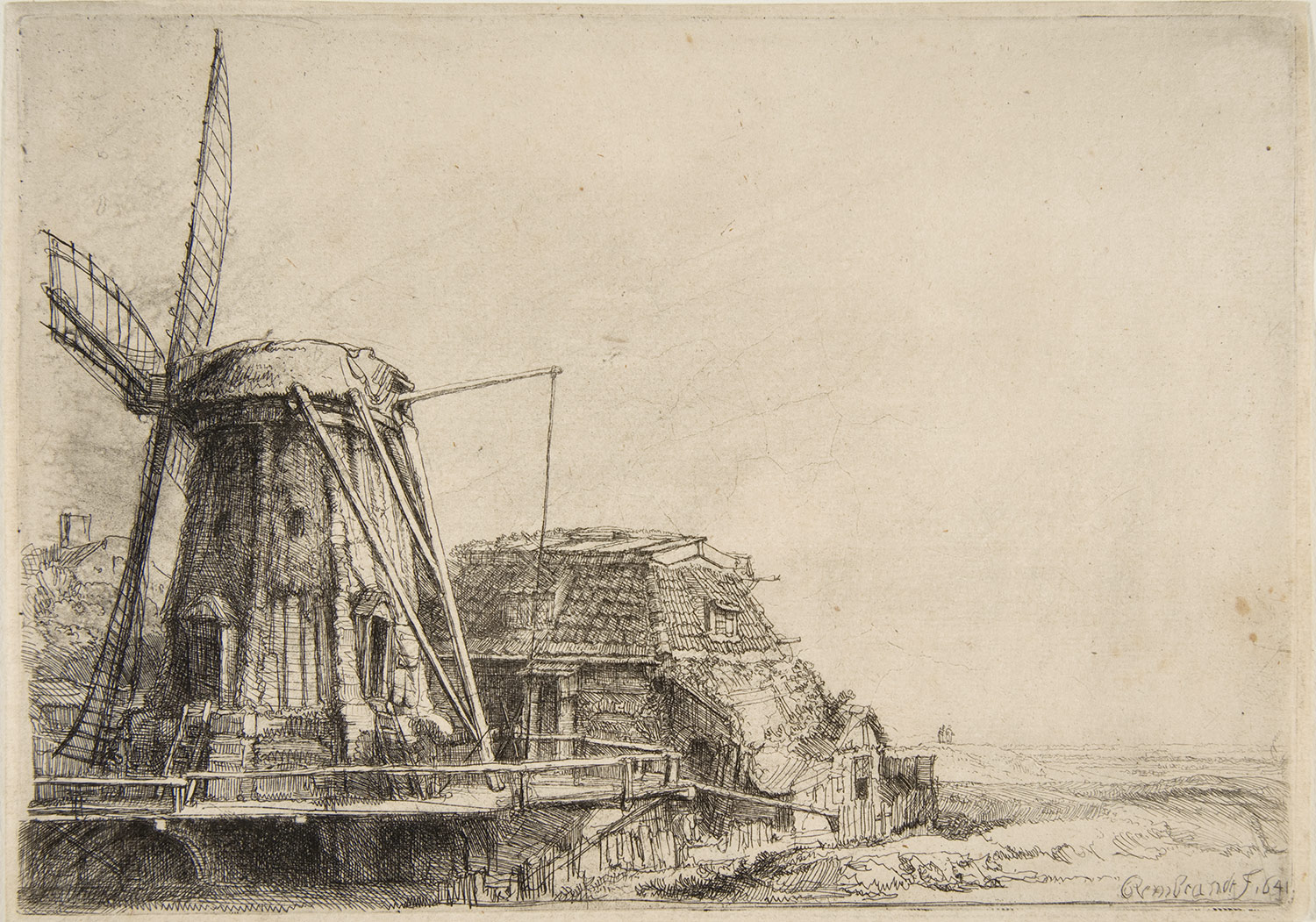
The Windmill,
1641).

Every landscape is essentially a section of reality. Yet Rembrandt’s works always seem to be informed by Creation in its entirety. This is well illustrated, for instance, in what is perhaps the artist’s most well-known landscape etching, the


Three Trees of 1643.

There we discover the tiny figure of a draughtsman in the wild, devoting himself to the grandiose play of the light pouring onto a wide and multifariously animated landscape.

Employing various graphic strategies – overlapping hatching, certain line patterns, the multiple biting of the plate, manipulations of the plate’s surface, the use of “plate tone” and drypoint accents as well as the virtuoso distribution of light and shade – Rembrandt succeeded in producing a rich spectrum of tangible and intangible visual values which condense to allow exceptionally intensive perception. When we immerse ourselves in the contemplation of Rembrandt’s landscapes, we gradually gain a sense of their fine nuances and inner vibrancy.

Particularly from 1650 onwards, in his quest for new means of expression in printmaking, Rembrandt began making use of the drypoint technique – in addition to etching – in a previously unknown manner. This graphic method, which involves the simple scratching of the plate with a sharply pointed utensil, creates irregular, difficultto- control effects and significantly reduces the number of well-wrought proofs. Previously used primarily for small corrections and enhancements to the acid-etched plate, for Rembrandt drypoint became a printmaking technique in its own right. His search for a balance between the classical “bitten” etching and drypoint led to the steadily increasing use of the latter in proportion to the former, and ultimately to prints executed exclusively in drypoint. With this method he achieved depictions with entirely new light effects. The etched landscapes, in which he focussed on nature’s visual complexities, evidently served Rembrandt as an important means of experimentation in printmaking.

All of the works to be displayed come from the Städel Museum’s Department of Prints and Drawings, which will accordingly present a small but artistically delightful excerpt from its rich holdings of drawings and prints – comprising altogether more than 100,000 sheets – within the framework of the exhibition. Among the department’s holdings is an extensive and qualitatively high-ranking group of Rembrandt etchings consisting of some 350 works. The Städel Museum’s etchings by this Dutch artist were already the subject of an exhibition of the Department of Prints and Drawings once before (“Rembrandt. The Etchings in the Städel”, 2003). At that time, a crosssection of the holdings was presented with the aid of approximately seventy selected examples. For the most part, the Rembrandt holdings date back to the institution’s beginnings and the private collection of its founder Johann Friedrich Städel (1728– 1816). Amassed in the second half of the eighteenth century, and in part in the early nineteenth as well, the group of Rembrandt works belonging to the Department of Prints and Drawings includes extremely rare and superb prints. A number of additional works were acquired over the course of the nineteenth, twentieth, and present centuries, for example the rare proof of the


Sleeping Dog (ca. 1640)

in 2007, likewise to be placed on view in the show “Rembrandt. Landscape Etchings from the Städel Museum”.


More images from the exhibition:


Rembrandt Harmensz. van Rijn (1606–1669) - Self Portrait Leaning on a Stone Sill, 1639


Rembrandt Harmensz. van Rijn (1606–1669) - St. Jerome Reading in an Italian Landscape, c.1635


Rembrandt Harmensz. van Rijn (1606–1669) - Six’s Bridge, 1645(597kB)


Rembrandt Harmensz. van Rijn (1606–1669) - Landscape with a Road along a Ditch, c.1652


Rembrandt Harmensz. van Rijn (1606–1669) - Landscape with Trees, Farm Buildings and a Tower, c. 1651


Rembrandt Harmensz. van Rijn (1606–1669) - Landscape with a Cottage and Haybarn, 1641


Rembrandt Harmensz. van Rijn (1606–1669) - The Windmill, 1641


Rembrandt Harmensz. van Rijn (1606–1669) - The Goldweigher’s Field, 1651(