Wednesday, October 16, 2013

Van Gogh Repetitions


This fall The Phillips Collection takes a fresh look at the artistic process of Vincent van Gogh (1853–1890). While recognized for the intensity and speed with which he painted, van Gogh also could work with careful deliberation, creating numerous versions of some of his most famous subjects. The first exhibition in Phillips Collection history devoted to the artist, Van Gogh Repetitions goes beneath the surface of some of his best-known paintings to examine how and why he repeated certain compositions during his 10-year career. More than 30 paintings and works on paper are on view at The Phillips Collection from Oct. 12, 2013, through Jan. 26, 2014.

The exhibition is the first to focus on van Gogh’s “repetitions”—a term the artist used to describe his practice of creating more than one version of a particular subject. He often began by sketching a person or landscape rapidly from life. Back in the studio, he would repeat the subject, reworking and refining his idea on a fresh canvas, in some cases many times. In contrast to the popular perception of van Gogh wielding his brush with wild abandon before nature, Repetitions shows how the artist was also methodical and controlled.

“This is a rare opportunity to get to know one of the world’s most recognizable artists in a fresh, new way,” said Dorothy Kosinski, director of The Phillips Collection. “He is such a beloved figure who has earned great renown, but there is still much more to be learned. Through a close examination of this fascinating but only partially understood aspect of his work, we can create a richer, more meaningful picture of his personal life and artistic production.”


Vincent van Gogh, The Large Plane Trees (Road Menders at Saint-Rémy), 1889. Oil on fabric, 28 7/8 x 36 1/8 in. The Cleveland Museum of Art, Gift of the Hanna Fund, 1947.
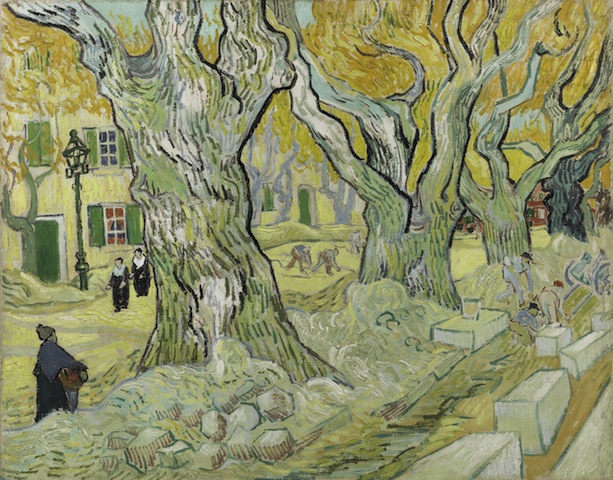


Vincent van Gogh, The Road Menders, 1889. Oil on canvas, 29 x 36 ½ in. The Phillips Collection, Washington, DC. Acquired 1949.


Van Gogh Repetitions
is inspired by The Road Menders (1889) in The Phillips Collection and a painting of the same subject, The Large Plane Trees (1889), in The Cleveland Museum of Art. The exhibition reunites the two masterpieces—never before seen together in Washington—and invites deep, focused study of the similarities and differences between them, revealing some surprising facts about van Gogh’s process and motivation.

ANALYSIS REVEALS THE ARTIST’S PROCESS

Examples from 13 of van Gogh’s repetitions will be on view, in some cases reunited for the first time in many years. The exhibition reveals the vitality and persistence of this method across van Gogh’s career in significant locales in the Netherlands and in France, including Paris, Arles, Saint-Rémy, and Auvers. It brings together portraits and landscapes from some of the world’s most renowned collections, including The Metropolitan Museum of Art and The Museum of Modern Art, New York; Museum of Fine Arts, Boston; Philadelphia Museum of Art; The Art Institute of Chicago; Kröller-Müller Museum, Otterlo; and the Van Gogh Museum, Amsterdam. The exhibition offers an exceptional opportunity to see masterpieces from the Musée d’Orsay, Paris, including


Vincent van Gogh, The Bedroom at Arles, 1889. Oil on canvas, 22 11/16 x 29 1/8 in. Musée d’Orsay, Paris. © RMN-Grand Palais / Hervé Lewandowski / Art Resource, NY


and L’Arlésienne (1888).

VAN GOGH AND THE PHILLIPS COLLECTION

Museum Founder Duncan Phillips first expressed his desire to acquire “examples of the inventive genius of van Gogh” in 1926. In 1930,


Vincent van Gogh, Entrance to the Public Gardens in Arles, 1888. Oil on canvas 28 1/2 x 35 3/4 in. The Phillips Collection, Washington, DC. Acquired 1930
(

—one of the first paintings by van Gogh in an American museum—entered the collection.

In 1949, Phillips acquired The Road Menders (1889) , which he ranked “among the best van Goghs,” and in 1952 added


House at Auvers (1890).

Phillips also purchased two van Gogh works on paper:


an etching of Dr. Gachet (1890)
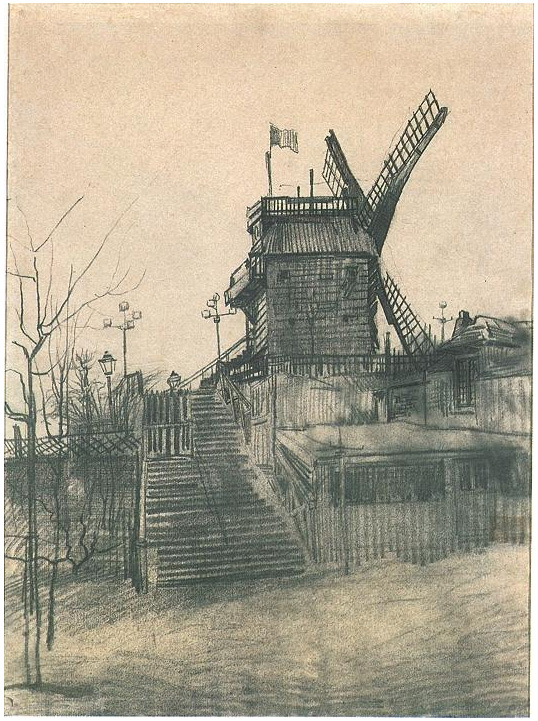


and a pencil and ink drawing of Moulin de la Galette (1887).


CATALOGUE
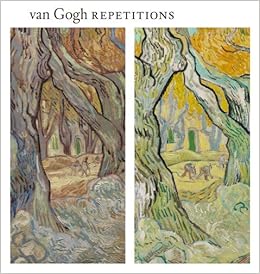


A beautiful and groundbreaking catalogue, published by Yale University Press in association with The Phillips Collection and The Cleveland Museum of Art, accompanies the exhibition. It features 125 color illustrations, including numerous examples of Vincent van Gogh’s repetitions along with related works and technical studies. Essays by Phillips Chief Curator Eliza Rathbone and Cleveland Curator of Modern European Art William Robinson consider the many unresolved issues and controversies surrounding van Gogh’s repetitions, exploring their origins, development, and meaning in van Gogh’s art. Analyses of specific paintings by Rathbone, Robinson, Phillips Head of Conservation Elizabeth Steele, and Cleveland Paintings Conservator Marcia Steele make use of technical and analytical examinations to understand how the artist worked.

ORGANIZATION

Van Gogh Repetitions is co-organized by The Phillips Collection, Washington, DC, and The Cleveland Museum of Art, Cleveland, Ohio. After opening at The Phillips Collection, it travels to The Cleveland Museum of Art where it is on view March 2 through May 26, 2014.

More info and images on multiples here

More images:


Vincent van Gogh, Weaver, 1884. Oil on canvas, 24 5/8 x 33 1/4 in. Museum of Fine Arts, Boston, Tompkins Collection—Arthur Gordon Tomkins Fund


Vincent van Gogh, Le Moulin de la Galette, 1886. Oil on canvas, 15 x 18 1/4 in. Nationalgalerie, Staatliche Museen, Berlin, Germany


Vincent van Gogh, Portrait of Camille Roulin, 1888. Oil on canvas, 16 x 12 3/4 in. Van Gogh Museum, Amsterdam


Vincent van Gogh, Portrait of Marcelle Roulin, 1888. Oil on canvas, 13 3/4 x 9 3/4 in. Van Gogh Museum, Amsterdam


Vincent van Gogh, L'Arlésienne (Madame Joseph-Michel Ginoux), 1888–89. Oil on canvas, 36 x 29 in. The Metropolitan Museum of Art, New York. Bequest of Sam A. Lewisohn, 1951


Vincent van Gogh, The Postman Joseph Roulin, February–March 1889. Oil on canvas, 25 5/8 x 21 1/4 in. Collection Kröller-Müller Museum, Otterlo


Vincent van Gogh, Portrait of Joseph Roulin, 1889. Oil on canvas, 25 3/8 x 21 3/4 in. The Museum of Modern Art, New York. Gift of Mr. and Mrs. William A. M. Burden, Mr. and Mrs. Paul Rosenberg, Nelson A. Rockefeller, Mr. and Mrs. Armand P. Bartos, The Sidney and Harriet Janis Collection, Mr. and Mrs. Werner E. Josten, and Loula D. Lasker Bequest (all by exchange). Digital Image © The Museum of Modern Art /Licensed by SCALA / Art Resource, NY


Vincent van Gogh, Madame Roulin Rocking the Cradle (La Berceuse), 1889. Oil on canvas, 36 1/2 x 29 1/2 in. Helen Birch Bartlett Memorial Collection. The Art Institute of Chicago


Vincent van Gogh, Lullaby: Madame Augustine Roulin Rocking a Cradle (La Berceuse), 1889. Oil on canvas, 36 1/2 x 28 5/8 in. Museum of Fine Arts, Boston. Bequest of John T. Spaulding
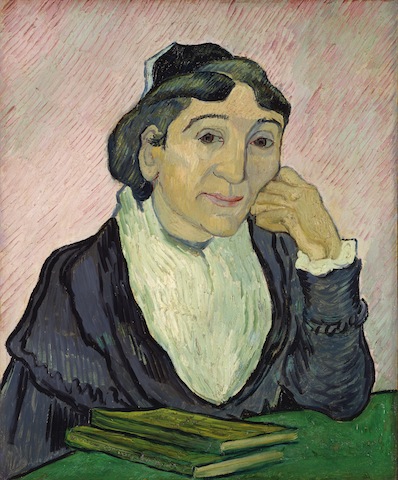


Vincent van Gogh, L’Arlesienne, 1890. Oil on canvas, 23 5/16 x 19 3/4 in. Rome, National Gallery of Modern Art. By permission of Ministero dei Beni, delle Attività Culturali e del Turismo
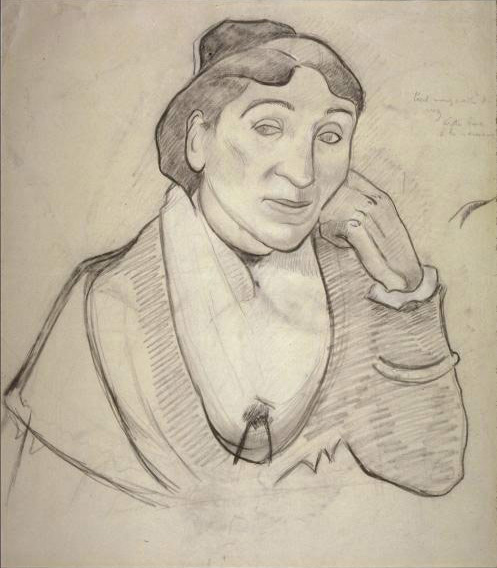


Paul Gauguin, L'Arlesienne, Mme. Ginoux (The Woman from Arles, Madame Ginoux), 1888. Colored chalks and charcoal with white chalk on wove paper, 22 1/16 x 19 3/8 in. Fine Arts Museums of San Francisco. Memorial Gift from Dr. T. Edward and Tullah Hanley, Bradford, Pennsylvania


Interesting analysis here.

Tuesday, October 15, 2013

Superb van Gogh and Renoir Paintings at the Currier Museum of Art


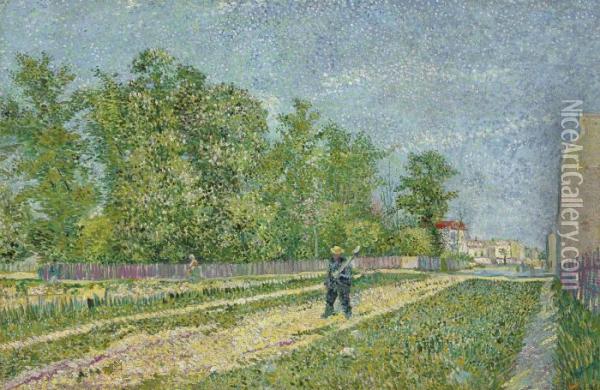
Two outstanding Impressionist paintings, Vincent van Gogh’s


Route aux confins de Paris, avec paysan portant la bêche sur l'épaule (Path on the outskirts of Paris, with a peasant carrying a spade) (1887)

and Pierre-Auguste Renoir’s


Femmes dans un Jardin (Women in a Garden) (1873)

are now on view at the Currier Museum of Art in Manchester, NH. The paintings are located in the European Gallery, next to the Currier’s Claude Monet impressionist painting,


The Seine at Bougival (1869).


The van Gogh painting features a peasant in a field near a country lane. The city of Paris is visible in the distance. The painting reveals how the work of contemporary impressionist and neo-impressionist artists living in Paris influenced van Gogh. After he arrived in Paris, van Gogh changed from the drab, dark colors of his Dutch subjects, mostly peasants laboring in the field, to a warmer palette and subject matter. During his two years there, van Gogh experimented with new styles, subjects and techniques. He applied small dots of paint that visually combine to create a vibrant and sunnier atmosphere. This style of painting—called pointillism—is most closely associated with artists Georges Seurat and van Gogh’s close friend, Paul Signac.

While many know Renoir as a figure painter, this work is essentially a landscape. In the deep shadows of the painting stands a woman in a blue dress holding a white parasol and a bunch of freshly picked flowers. Behind her is another woman painted more darkly, emerging from the darkness of the trees. The contrasting pigment and especially the brightly “lit” parasol, instantly draw your eye deeper down the pathway to where the women are standing. The painting was likely done in the summer of 1873 when Renoir went to stay with Claude Monet, who was living in Argenteuil, about five miles northwest of Paris. It was probably painted outside and is wholly impressionistic. The flowers, shrubs and both women are made up of small dabs of color, blurring the distinction between the people and nature. The paintings are on loan to the Currier until the end of January 2014.

General Information

The Currier Museum of Art is located at 150 Ash Street, Manchester, NH. Open every day except Tuesday. The Currier is an active participant in the Blue Star Museum Program, providing veterans and their immediate families with free general admission throughout the year. More information: www.currier.org

Monday, October 14, 2013

David Hockney: Early Reflections


David Hockney is considered to be one of the most influential artists of the 20th century. This new exhibition brings together a unique selection of paintings and prints, which chart the early development of this iconic British artist.

Featuring work from the Walker’s own collection, including Peter Getting out of Nick's Pool|, which won the John Moores Painting Prize| in 1967, together with key pieces from the Arts Council Collection and other loans, the exhibition explores Hockney’s early influences.

With almost 40 pieces on display, dating between 1960 to 1978, the exhibition is an insight into Hockney’s prodigious talent which was evident even as a student.

Through recurring obsessions such as the evolving references to his own homosexuality, depictions of the reflective qualities of water and his persistent return to portraiture, the exhibition reveals how his style, which flourished during the 1960s, had changed dramatically by the early 1970s.

Through the John Moores Painting Prize, the Walker Art Gallery was able to acquire one of Hockney’s most famous pictures,


'Peter getting out of Nick’s pool',1966, © David Hockney/Collection: Walker Art Gallery, National Museums Liverpool, when the artist won the prize in 1967 at the age of 30.

His experiences and the work he produced during the 1960s and ‘70s were instrumental in his success.

This exhibition highlights several themes within Hockney’s work: a growing confidence in expressing his homosexuality and in finding his own style, his skill as a draughtsman and printmaker, particularly seen in his responses to Constantine P Cavafy's poems; his obsession with capturing the properties of water; and lastly, portraiture, which has continued to play a central role in his output.

Themes

* In the Mood for Love - looks at some of the major early paintings that Hockney produced at the Royal College of Art (1959-62):


'Cliff,' 1962

* Picturing Poetry - explores Hockney’s interest in poetry and looks at how he was inspired by the poems of one of his favourite writers, Constantine P Cavafy.


David Hockney Portrait of Cavafy II 1966


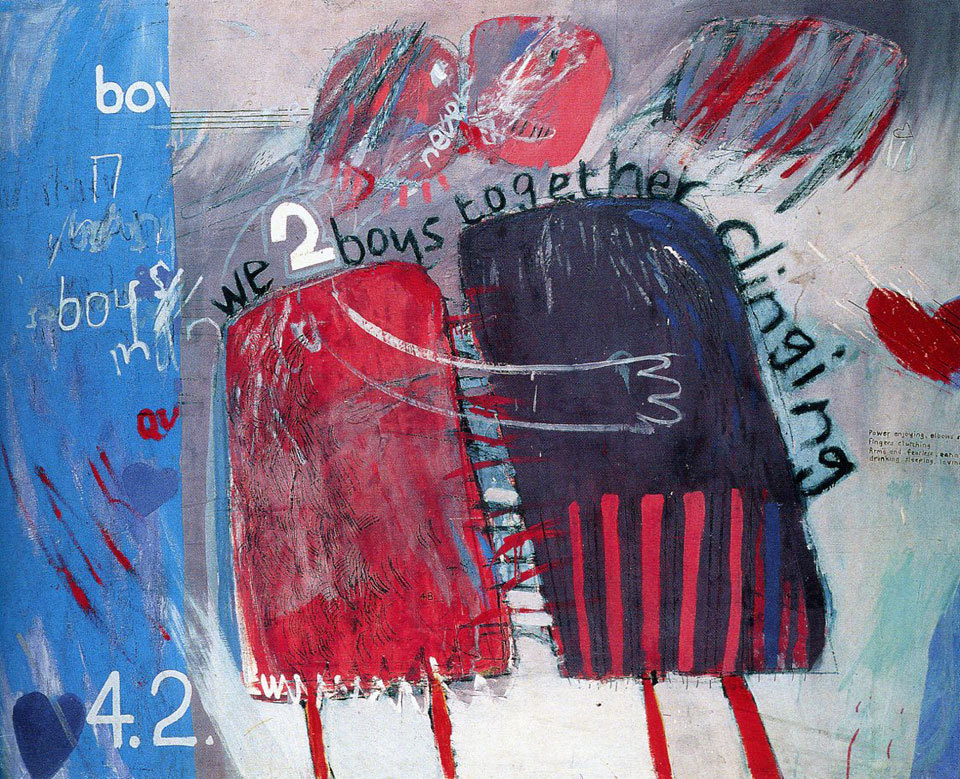
We Two Boys Together Clinging,
1961 (inspired by a Walt Whitman poem). © David Hockney. Collection Arts Council, London. Photo: Prudence Cuming Associates.

* On Reflection - shows a selection of Hockney’s water-themed paintings. Those of swimming pools are among his most renowned:


'Man in Shower in Beverly Hills', 1964 © David Hockney. Photo © Tate, London 2013


'Gregory,' 1974 © David Hockney/Arts Council Collection


* Familiar Faces - looks at Hockney's portraits, which include images of his friends.

David Hockney Biography

Born in Bradford in 1937, David Hockney studied painting at the Royal College of Art in London from 1959 to 1962. His stellar reputation was established while he was still a student; his work was featured in several of the annual Young Contemporaries exhibitions, one of which heralded the birth of British Pop Art. He progressed quickly along this path to become one of the world’s best known British artists.

He first came to America (New York) in 1961 but settled in Los Angeles soon after a visit in 1964. He is closely associated with southern California and has produced a large body of work there over many decades.

In recent years the artist has relocated to Bridlington, Yorkshire where his work has focused on documenting the rural landscape. The artist was elected a Royal Academician in 1991 and recently appointed a member of the Order of Merit by the Queen.

Friday, October 11, 2013

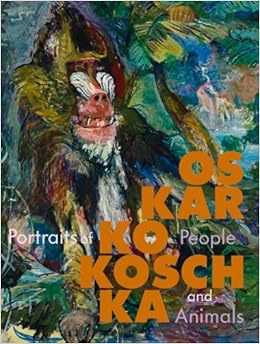
Oskar Kokoschka - Portraits of People and Animals


The exhibition entitled ‘Oskar Kokoschka - Portraits of People and Animals’ at the Museum Boijmans Van Beuningen, Rotterdam, 21 September 2013 - 19 January 2014 will take the visitor on a tour through the exceptional oeuvre and tempestuous life of the Austrian painter.

Gustav Klimt called him ‘the greatest talent of the younger generation’. This major retrospective brings together Kokoschka’s confrontational portraits more than half a century after his work was last exhibited in the Netherlands.

Visitors entering the large Bodon galleries in Museum Boijmans Van Beuningen will go back a century in time. Large advertising columns take the spectator back to the European city as it was at the start of the 20th century. The columns will introduce the eight themes of the exhibition, including the animal portraits and the political allegories. From Vienna, to Berlin, to Dresden: the confrontational portraits will introduce the visitor to the circle of famous writers, architects and politicians in which Kokoschka moved.

Vienna

In 1904, Kokoschka was admitted to the Kunstgewerbeschule in the Vienna of Sigmund Freud, Gustav Klimt and Hans Makart. Here, the painter rebelled against the established order. He painted models in movement, even though the decorative Jugenstil was the norm. Kokoschka exhibited his work at the Vienna Kunstschau exhibition, organized by Gustav Klimt. At the Kunstschau architect Adolf Loos discovered Kokoschka.

Kokoschka’s success was largely due to the modernist architect Loos. His circle of friends in Vienna’s intellectual and cultural elite became Kokoschka’s biggest clients. This resulted in his early portraits of people such as


publicist Karl Kraus


and publisher of the avant-garde magazine Herwarth Walden,

both of which can be seen in the exhibition.

He also obtained access to the soirées of the philanthropic Eugenie and Hermann Schwarzwald. Through Loos he became acquainted with the composers Arnold Schönberg, Anton Webern and Egon Wellesz. As up and coming artist in Vienna, Kokoschka came into contact with the work of Anton Romako and George Minne, but Edvard Munch, Vincent van Gogh and the objects from the Völkerkundemuseum also became important sources of inspiration for him.

At the age of twenty-six Kokoschka met the love of his life: Alma Mahle
r, the widow of the composer Gustav Mahler. She was a great source of inspiration during their three-year relationship. In addition to writing 400 love letters, he painted a portrait of Alma in the style of the Mona Lisa, three double portraits - one of which is included in the exhibition - and numerous prints and drawings. Soon after their relationship ended, Alma married the architect and founder of the Bauhaus, Walter Gropius. It took Kokoschka a long time to recover from the break-up; he even had a doll made in Alma’s likeness.

Kokoschka exhibited his work together with the art movement Der Blaue Reiter, to which Wassily Kandinsky and Franz Marc belonged.

In 1937, Kokoschka fled to England after the Nazis had confiscated four hundred of his works. Kokoschka ventilated his political position in paintings in which Hitler, Mussolini and the prime minister of the United Kingdom Arthur Neville Chamberlain play the leading role.

Kokoschka began to explore an individual path even during his studies at the Kunstgewerbeschule in Vienna. In the period dominated by Art Nouveau with an emphasis on ornament, he focussed on people. Kokoschka’s portraits show us how he viewed mankind and the world. In a television interview in 1966, Kokoschka said that he was interested in a ‘person’s aura in space’. He thought it was important to express the sitter’s psyche. He often made his models look older, as if he could see into the future. The result was that many clients did not buy their unflattering portraits. Kokoschka’s works are characterised by bold colours and dynamic brushwork. This is typical of Expressionism, a movement typified by exaggerated forms, bright colours and distorted reality.

In addition to numerous portraits of people, the exhibition also features more than twenty paintings of animals. Kokoschka was fascinated by animals, in which he often detected human characteristics. He painted the ‘Mandrill’ in London Zoo, outside public opening times. In the evening he was admitted to the zoo by zoologist Julian Huxley, brother of Aldous Huxley, the author of ‘Brave New World’. Rather than depict the monkey in his small cage with thick bars, Kokoschka shows it in its natural environment.


The exhibition is accompanied by a richly illustrated catalogue with essays by Beatrice von Bormann, Katharina Erling and Régine Bonnefoit. ISBN: 978-90-6918-267-4


Oskar Kokoschka, Mandrill, 1926, oil on canvas, 127 x 102 cm, Collection Museum Boijmans Van Beuningen. © Fondation Oskar Kokoschka, Vevey / 2013, ProLitteris.


Oskar Kokoschka, Double portrait of Hans Mardersteig and Carl Georg Heise, 1919, Collection Museum Boijmans Van Beuningen. © Fondation Oskar Kokoschka, Vevey / 2013, ProLitteris.


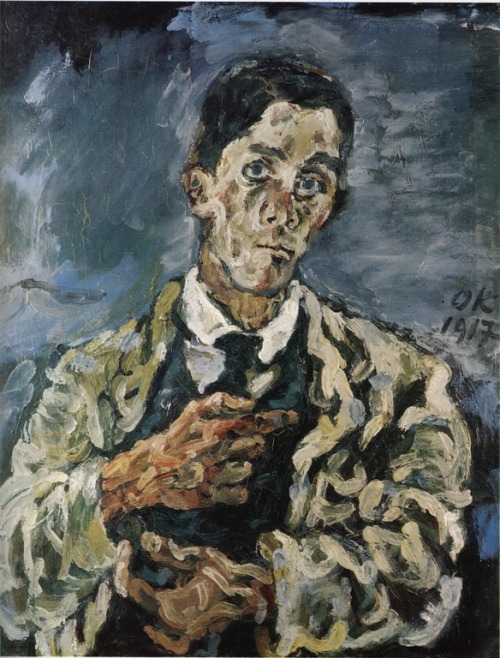
Oskar Kokoschka, Self-Portrait 1917, 1917, Oil on canvas, 79 x 63 cm, Collection Von der Heydt-Museum Wuppertal. © Fondation Oskar Kokoschka, Vevey / 2013, ProLitteris.


Oskar Kokoschka, Double Portrait Oskar Kokoschka and Alma Mahler, 1912-13, oil on canvas, 100 x 90 cm, Collection Museum Folkwang, Essen. © Fondation Oskar Kokoschka, Vevey / 2013, ProLitteris.


Oskar Kokoschka, The Power of Music, 1920. Coll. Vanabbemuseum, Eindhoven. Photo: Peter Cox.© Fondation Oskar Kokoschka, Vevey / 2013, ProLitteris.


Oskar Kokoschka, Auguste Forel, 1910, oil on cnavas, 70 x 58 cm. Collection Kunsthalle Mannheim. Photo: © Kunsthalle Mannheim, Cem Yücetas. © Fondation Oskar Kokoschka, Vevey / 2013, ProLitteris.


Oskar Kokoschka, Felix Albrecht Harta, 1909, Collection Hirshhorn Museum and Sculpture Garden, Smithsonian Institution, Washington, D.C., (...). © Fondation Oskar Kokoschka, Vevey / 2013, ProLitteris.


Oskar Kokoschka, Time, Gentlemen Please, 1971-71, oil on canvas, 130 x 100 cm. Collection Tate, Londen, purchase 1986. . © Fondation Oskar Kokoschka, Vevey / 2013, ProLitteris.


Oskar Kokoschka, Adolf Loos, 1909, 74 x 91 cm, Stiftung Preussischer Kulturbesitz, Staatliche Museen zu Berlin, Neue Nationalgalerie. © Fondation Oskar Kokoschka, Vevey / 2013, ProLitteris.


Oskar Kokoschka, Pietà (playbill for the Kunstschau Vienna), 1908, publ. 1909, Collection Museum der Moderne Salzburg. © Fondation Oskar Kokoschka, Vevey / 2013, ProLitteris.


LUCIAN FREUD


OCTOBER 8, 2013 - JANUARY 6, 2014

The Kunsthistorisches Museum, Vienna, presents an exhibition of
paintings by Lucian Freud (1922-2011), one of the most important
artists of the twentieth and twenty-first centuries, and a grandson of
psychoanalyst Sigmund Freud. It marks the first time that Lucian
Freud’s works have ever been shown in Austria.

The exhibition is a concise survey of 43 major paintings spanning
Freud’s entire 70-year working career, from an early wartime selfportrait
of 1943 to the final, unfinished painting that remained in his
studio at the time of his death in July 2011. It covers a range of
different genres, from portraits of his family, close friends, wives and
lovers, neighbours, fellow artists, aristocrats and working-class
associates, to still lifes, landscapes and – arguably his most sustained
and remarkable achievement – his own self-portraits.

Important loans have been made to the exhibition from museums
including The Metropolitan Museum of Art, New York; Tate, London;
the Hirshhorn Museum and Sculpture Garden, Washington D.C.; the
Ashmolean Museum, Oxford; the Art Institute of Chicago; and the
Museo Thyssen-Bornemisza, Madrid, in addition to others borrowed
from the artist’s most important private patrons in Europe and the
United States.

The selection of works was made with the close personal involvement
of the artist during the months prior to his death in July 2011, and
with his longtime assistant David Dawson. The exhibition allows the viewer
to trace the radical stylistic development of Freud’s painting across
several decades; from early works, painted in meticulous detail with
fine, sable hair brushes; through the 1950s, when he begins to paint
standing up with coarser, hog-hair brushes in a much looser style; his
first full naked portraits of the 1960s; and finally, in the latter part of
the exhibition, the monumental canvases of the 1980s and 1990s.

“While the Kunsthistorisches Museum is one of the most important
historical museums in the world, its commitment to the art of more
recent times is central to its curatorial and educational objectives”,
said Director General Sabine Haag. “It has long been an ambition of
the museum to present an exhibition of Lucian Freud, and – ten years
on from the groundbreaking exhibition ‘Francis Bacon and the
Pictorial Tradition’ – I am delighted that we have been able to bring so
many of Freud’s remarkable paintings to Vienna.”

“It was a privilege to work together on the preparations for this
exhibition with Lucian, and later with his assistant David Dawson”,
said curator Jasper Sharp. “I am just sorry that he did not live to see
his works in Vienna. We set ourselves the ambitious challenge of
bringing together the most important paintings of his entire career,
and are hugely grateful for the support of so many international
museums and private collectors who agreed to lend them.”

Presented within the Kunsthistorisches Museum, whose collections
span almost four thousand years from Ancient Egypt to the great
painters of the Middle Ages, Renaissance and Baroque, the exhibition
also provides a unique opportunity to consider and examine Freud’s
interest in the art of the past. Growing up in Berlin between the wars,
his childhood home was decorated with prints of Old Master
paintings and drawings by Dürer, Titian, and Pieter Bruegel the Elder,
including two seasonal landscapes from the Kunsthistorisches
Museum in Vienna, Hunters in the Snow and The Return of the Herd,
a gift to the young Lucian from his grandfather Sigmund.

Freud knew the collections of the Kunsthistorisches Museum well.
Among the works by his favourite artists – among them Franz Hals,
Hans Holbein, Rembrandt, Peter Paul Rubens, and Diego Velázquez,
in addition to Bruegel, Dürer and Titian – he was particularly fond of
Giovanni Bellini’s Young Woman at her Toilet, painted when the
artist was in his mid-eighties, one of Freud’s favourite depictions of the
female nude. Freud himself requested that his paintings be shown
apart from the historical collections of the museum, in order that
viewers should be encouraged to form their own associations between
the two bodies of work.

Highlights of the exhibition include


Girl with a White Dog (1950–51) (see all credits below)

from Tate;

an unfinished self-portrait from 1956 (being shown for only
the second time in the last 30 years);

Freud’s first full-length naked portrait


(Naked Girl, 1956,

from the collection of actor Steve Martin);

three remarkable portraits of Leigh Bowery


from the Hirshhorn Museum, Washington DC,

the Metropolitan Museum of Art, New York, and a US private collection;


Benefits Supervisor Sleeping,

which sold for $33.6m dollars at Christie’s New York in May 2008;

and his final masterpiece


Portrait of the Hound (2010–11)

which was left unfinished at the time of his death.

Several major paintings that were not included in the artist’s recent
2011 retrospective at the National Portrait Gallery, London, will also
be presented in Vienna: among them,


Wasteground with Houses, Paddington (1970–72),

Freud’s most remarkable landscape;

the still life Two Japanese Wrestlers by a Sink (1983–87) from the Art Institute
of Chicago; Naked Man, Back View (1991–92) from The Metropolitan
Museum of Art, New York;

and Freud’s largest and most ambitious self-portrait, the full-length naked


Painter Working, Reflection (1993),

from an American private collection.

Also included in the exhibition is a specially-commissioned film, 15
minutes in length, featuring previously unseen footage of Lucian Freud
during the weeks before his death in 2011 shot by his assistant David
Dawson. It includes moving footage of him painting on what turned
out to be his last day of work.

The exhibition is curated by Jasper Sharp, Adjunct Curator of Modern
and Contemporary Art at the Kunsthistorisches Museum, and will be
shown only in Vienna. Essays have been contributed to the
accompanying catalogue by renowned curators from the Musée du
Louvre, Paris, the Victoria & Albert Museum, London, the Neues
Museum, Berlin, the Metropolitan Museum of Art, New York,
Dulwich Picture Gallery, London, the Henry Moore Foundation, and
the Kunsthistorisches Museum, Vienna.

To accompany the exhibition, the Kunsthistorisches Museum has
organized a comprehensive programme of lectures, talks, film
screenings, and guided tours. In addition, the Sigmund Freud Museum
in Vienna will present concurrently an exhibition of photographs by
Freud’s assistant David Dawson titled “Lucian Freud: In Private”
(October 9, 2013 – January 6, 2014).

BIOGRAPHY - LUCIAN FREUD

Lucian Freud was born in Berlin in 1922, a grandson of Sigmund
Freud. His family moved to London in 1931, where he would live and
work for the rest of his life. He served in the British Navy during
World War II before committing himself to an artistic career.

Freud soon built a formidable reputation as one of the most
remarkable figurative painters of the twentieth century. His subjects,
many of whom were portrayed repeatedly over many years, included
his large family and circle of close friends, working-class associates
and blue-blooded aristocrats. Freud's work has been the subject of
major solo exhibitions at many of the world's most prestigious
museums, including the Tate, London, The Museum of Modern Art,
New York, the Centre Pompidou, Paris and the Museo Correr, Venice.
Lucian Freud died on 20th July, 2011.

Images, with credits


Lucian Freud (1922-2011)
Man with a Thistle (Self Portrait)
1946
Oil on canvas, 61 x 50,2 cm
London, Tate: purchased 1961, Inv. No. T00422
© The Lucian Freud Archive / The Bridgeman Art Library


Lucian Freud (1922-2011)
Girl in a Dark Jacket
1947
Oil on panel, 47 x 38,1 cm
Private Collection
© The Lucian Freud Archive / The Bridgeman Art Library


Lucian Freud (1922-2011)
Girl with a White Dog
1950-1951
Oil on canvas, 76,2 x 101,6 cm
London, Tate: purchased 1952, Inv. No. N06039
© Tate, London 2013


Lucian Freud (1922-2011)
Baby on a Green Sofa
1961
Oil on canvas, 56 x 62 cm
Trustees of the Chatsworth Settlement
© The Lucian Freud Archive / The Bridgeman Art Library


Lucian Freud (1922-2011)
Self Portrait
1963
Oil on canvas, 30,5 x 25,1 cm
London, National Portrait Gallery, Inv.-Nr. NPG 5205
© The Lucian Freud Archive / The Bridgeman Art Library


Lucian Freud (1922-2011)
Portrait of John Deakin
1963–1964
Oil on canvas, 30,2 x 24,8 cm
Private Collection
© The Lucian Freud Archive / The Bridgeman Art Library


Lucian Freud (1922-2011)
Naked Girl
1966
Oil on canvas, 61 x 61 cm
Collection of Steve Martin
© The Lucian Freud Archive / The Bridgeman Art Library


Lucian Freud (1922-2011)
Wasteground with Houses, Paddington
1970-1972
Oil on canvas, 167,5 x 101,5 cm
Private Collection
© The Lucian Freud Archive / The Bridgeman Art Library


Lucian Freud (1922-2011)
Portrait of Rose
1978-1979
Oil on canvas, 91,5 x 78,9 cm
Private Collection
© The Lucian Freud Archive / The Bridgeman Art Library


Lucian Freud (1922-2011)
Reflection (Self Portrait)
1985
Oil on canvas, 55,9 x 53,3 cm
Private Collection
© The Lucian Freud Archive / The Bridgeman Art Library


Lucian Freud (1922-2011)
Standing by the Rags
1988-1989
Oil on canvas, 168,9 x 138,4 cm
London, Tate; purchased 1990 with assistance from the Art
Fund, the Friends of the Tate Gallery and anonymous donors, T05722
© The Lucian Freud Archive / The Bridgeman Art Library


Lucian Freud (1922-2011)
Nude with Leg Up (Leigh Bowery)
1992
Oil on linen, 182,9 x 229 cm
Washington D.C., Hirshhorn Museum & Sculpture Garden,
Smithsonian Institution; Joseph H. Hirshhorn Purchase Fund, 1993
© The Lucian Freud Archive / The Bridgeman Art Library


Painter Working, Reflection
1993
Oil on canvas, 101,6 x 81,7 cm
Private Collection
© The Lucian Freud Archive / The Bridgeman Art Library
GDK 619735
Lucian Freud (1922-2011)


Benefits Supervisor Sleeping
1995
Oil on canvas, 151,3 x 219 cm
Privat Collection


Lucian Freud (1922-2011)
And the Bridegroom
1993
Oil on canvas, 231,8 x 196,2 cm
Lewis Collection
© The Lucian Freud Archive / The Bridgeman Art Library


Lucian Freud (1922-2011)
Portrait of the Hound
2011
Oil on canvas, 150 x 150 cm
Private Collection, Courtesy of Acquavella Galleries
© The Lucian Freud Archive / The Bridgeman Art Library