Saturday, November 23, 2013

Emil Nolde Exhibitions – Baden Baden and Vienna


Emil Nolde. The Splendor of Colors was the name of the large-scale summer
exhibition that was mounted at the Museum Frieder Burda, Baden – Baden, Germany from June 15 to October 13,2013. It is the first extensive presentation of Nolde’s works in southern Germany in many years.

It comprises about sixty oil paintings and twenty watercolors ranging from the beginning of his
artistic career to his late work. The exhibition was developed in collaboration with the Nolde
Foundation Seebüll and was curated by Manfred Reuther, the former director of the Nolde
Foundation.


Emil Nolde
Großer Mohn (rot, rot, rot) 1942
oil on canvas
73,5 x 89,5 cm
oil on canvas
Nolde Foundation Seebüll
© Nolde Foundation Seebüll, 2013

Emil Nolde (1867–1956) is one of the most important artists of Expressionism. The
comprehensive presentation features the principal themes of his creative work. Besides
landscapes, it includes figure paintings and portraits, religious motifs, as well as impressions
from his journey to the South Sea.


Emil Nolde
Streitgespräch "Ungemalte Bilder" 1938-1945
water color on paper
23,4 x 18 cm
Nolde Foundation Seebüll
© Nolde Foundation Seebüll, 2013

The lushly colored paintings reveal the complexity of Nolde’s lifeworld. What they all share is the
emotional power of color. Manfred Reuther: “From the beginning of his painterly work, Nolde’s
artistic development was the path to color as an ultimate means of expression, which he
increasingly mastered.” Nolde was convinced: “Colors were a joy to me, and I felt as if they loved
my hands.” His colorful paintings and watercolors testify to his affinity with nature and his search
for primal human states. Radiant red, dark blue, deep black, and intense lilac—these are some of
the expressive colors Emil Nolde used to paint romantic landscapes and dramatic seascapes.
“I love the music of colors.”


Emil Nolde
Hohe Sturzwelle 1948
oil on canvas
68,5 x 88,5 cm
Nolde Foundation Seebüll
© Nolde Foundation Seebüll, 2013


Manfred Reuther: “In Nolde’s artistic development, the phenomenon of color was not brought to
his attention from outside, was not prepared or guided by theoretical schools of thought; rather,
his distinct propensity for color was a natural, latent gift and qualitative inclination that he
possessed early on and which sought to evolve. Even as a child, the young Nolde was aware of
his inherent urge for pictorial composition and his special talent. He confided in the village
pastor that his secret desire was to become a painter. He recalls his first creative use of colors in
his autobiography: ‘In school, I painted over all of the pictures in my Bible story and even then
constantly lived in the joy of color.’


Emil Nolde
Am Weintisch 1911
oil on canvas
88,5 x 73,5 cm
Nolde Foundation Seebüll
© Nolde Foundation Seebüll, 201


In the difficult position of not having any appropriate materials, he found his own, attempting his
first paintings with elderberry or beet juice. His parents appear to have recognized their child’s
special longing, and he received the paint box he so eagerly desired for Christmas.”
Nolde dealt intensely with color studies during his years as a teacher at the Museum of Industrial
Art in St. Gallen. “I somewhat boldly sought to unite the most contradictory, the warmest and the
coldest—vermillion and indigo—on a white ground, and that was much too deliberate,” he reports.
“I tore up the sheet.” He began to experiment with colors in about 1903 by investigating the
effect of certain chemicals on wood and their chromatic changes. He was especially interested
in the relation between light and color.


Emil Nolde
Trollhois Garten, 1907
oil on canvas
73,5 x 88 cm
Nolde Foundation Seebüll
© Nolde Foundation Seebüll

For his painting, Nolde chose colors that occur in nature. By intensifying the color values he
observed in nature and placing them directly alongside one another in a painting, he succeeded
in heightening the expressiveness and brilliance of the color in such a way that its impact
extended far beyond impressions received in nature. “A color defines its neighboring color
through its radiance,” is how Nolde described his approach, “in the same way as in music a
sound attains its tonal effect from its neighboring sound.” He did not pursue a specific scheme
or a programmatic system; rather, in most cases the picture and its chromatic definition came
about during the painting process itself. Nolde is confident that “a painter does not need to know
much; it is fine if he can spontaneously paint as purposefully as he breathes, as we walks.” He
continues: “I therefore avoided any speculation in advance; a vague idea of color was sufficient,
the painting unfolded under the work performed by my hands.”


Emil Nolde
Tropensonne 1914
oil on canvas
71 x 104,5 cm
Nolde Foundation Seebüll
© Nolde Foundation Seebüll

Numerous Watercolors

In addition to his lushly colored oil paintings, Nolde’s numerous watercolors reflect his eagerness
to experiment. Manfred Reuther explains: “His painting with watercolors is characterized by
extraordinary diversity. The unique quality of watercolors accommodated his pursuit of
spontaneity and direct expression. He painted with a completely drenched, heavy brush in rapid,
fluid movements, attempting to switch off his inhibiting reason and primarily follow his instinct.
Pictures grew out of irregularities, spots, and dribbles. The painter sought to encounter and
achieve a union with the pictorial material with the directness of artisanry.”
The works on paper being presented in Baden-Baden include several from the Unpainted
Pictures series, watercolors that the artist completed in his studio in Seebüll “from his
imagination” during the period he was barred from painting.

Virgin Soil Remains His Home

Nolde traveled frequently and to distant places. He repeatedly visited Denmark, Switzerland, and
Italy for longer periods; toured Andalusia and Madrid in 1921; and in 1913–14 he traveled via
Moscow, Siberia, Korea, Japan, and China to the South Sea, where he participated in the
“medical-demographic German-New Guinea-Expedition” at the invitation of the “Imperial Colonial
Office.” Motifs from all of these worlds found entrance in his art. However, in his understanding
of himself as an artist, he remained connected with his home all his life. He believed the “primal
ground” of his artistry to be “deeply rooted in the soil of his immediate home. Even if my
knowledge and my longing for artistic growth and means of representation extend to the most
distant primeval regions, be it in reality, in my imagination, or in a dream—virgin soil remains my
home.”
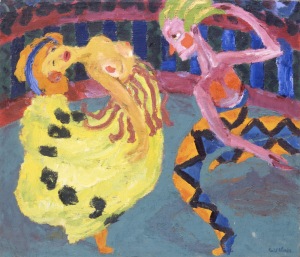


Emil Nolde
Tänzerin und Harlekin 1920
oil on canvas (burlap)
85,5 x 100 cm
Nolde Foundation Seebüll
© Nolde Foundation Seebüll

Emil Nolde loved flowers, and everywhere he spent time he laid out a garden. Whether blue
larkspur, red cornflowers, lilac irises, or yellow sneezeweed plants: the artist found inspiration in
the colorful floral splendor, and it served as a motif for numerous paintings of flowers and
gardens. In conjunction with this large-scale showcase exhibition, the Baden-Baden Department
of Parks has laid out four large flowerbeds along Lichtentaler Allee.


Emil Nolde, Frühling im Zimmer, 1904, 88,5 x 73,5 cm, oil on canvas. Nolde Foundation Seebüll, © Nolde Foundation Seebüll, 2013.

“The chromaticity of each flowerbed reflects that in one of the flower paintings by Emil Nolde
being presented in the exhibition. All of the beds have a wooden frame, like a picture frame. We
adapted their dimensions to the paintings’ formats and multiplied them sixfold,” explains Markus
Brunsing, Director of the Baden-Baden Department of Parks, who developed the concept for the
flowerbeds. However, the paintings were not reproduced in flowers one-to-one; rather, the
atmospheres of color are expressed with blossoms, painting in the park with the colors of
blossoms.

More images

Sixty different varieties and kinds of annual summer flowers were planted. Because Nolde uses
vibrant colors, these beds contain flowers in radiant red, orange, yellow, and blue, including
snapdragons, bluetops, begonias, garden cosmos, bluebells, poppies, garden heliotropes, sage,
and larkspur. This is the first time that the thematic aspect of an exhibition is being rendered in
nature using plants.

The exhibition catalogue, which includes illustrations of all the works, was published by the
Snoeck Verlag (Cologne).
___________________________________________________________________________________________________

Vienna: Emil Nolde - In Radiance and Colour , from Oct 25, 2013 until Feb 2, 2014 at the Osterreichische Galerie Belvedere, Vienna, Austria, shows major works from the collection of Stiftung Seebüll Ada und Emil Nolde, the Kunsthalle in Hamburg and other museums and private collections. They include landscapes, seascapes, portraits, Berlin scenes, religious pictures and fantasies, and high-quality series of watercolours and almost 50 sheets of Unpainted Pictures. The exhibition also features selected works by Austrian artists like Werner Berg, Herbert Boeckl, Oskar Kokoschka and Max Weiler, who took inspiration from Nolde’s colour explosions.


The show presents works from all of his creative periods, ranging from his early garden paintings informed by Impressionism, biblical subjects, and illustrations of legends to pastels painted in the South Seas, the Unpainted Pictures, which he conceived while he was forbidden to paint, and his famous late flower compositions. These works are complemented by a number of the artist’s prints, as well as selected works by such Austrian painters as Oskar Kokoschka and Herbert Boeckl, who drew their inspirations from Nolde’s art.


Around 1911/12, Nolde started developing his personal style. By way of the colourful Impressionism of his garden paintings made around 1907 and his religious subjects painted in 1910, exhibiting a new brilliance of colour and streaky brushwork, the artist arrived at a manner of painting that emphasized glowing, saturated colour fields and omitted detail. The large diversity of subject matter in his unmistakeable oeuvre includes grotesque fantastic creatures, ecstatic dancers, and scenes from Berlin nightlife, but also biblical subjects and Christian legends, as well as the landscape of his native Nordschleswig and atmospheric seascapes of the North and Baltic Seas. Nolde’s affinity with nature and his constant search for primitive authenticity prompted him to travel as far as New Guinea, where he hoped for inspiration removed from Western civilization.

Nolde’s direct approach to painting and his unique treatment of colour culminated in the immense Unpainted Pictures, painted in secreted because of the ban on painting imposed on him on 23 August 1941. Expelled from the Reichskunstkammer, he was forbidden from doing anything connected with the visual arts. This was a great shock for the painter, who like many other artists had originally welcomed the Nazi rise to power, hoping after the trauma of the First World War and the Treaty of Versailles that it would give Germany direction and restore its belief in itself. Between 1938 and 1945 he painted over 1,300 small watercolours and gouaches with invented, mostly fantastic imagery, in his studio in Seebüll, of which almost 50 are being shown in the Lower Belvedere. In doing so, he created faces, figures and fantastic half-man, half-animal creatures from accidental splashes of paint. He also painted landscapes from memory, including blood-red seas or rocky shores dipped in lapis lazuli.
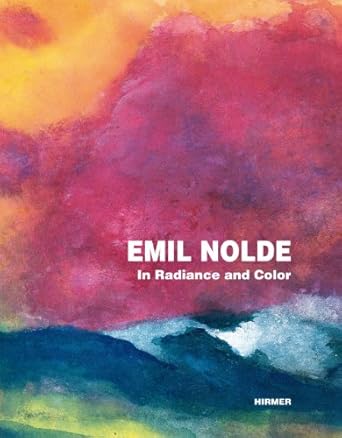


Emil Nolde: In Radiance and Colour: Catalogue of the Exhibition in Wien / Österreichische Galerie Belvedere


Friday, November 22, 2013

Turner and the Sea


Turner and the Sea
National Maritime Museum
22 November-21 April 2014


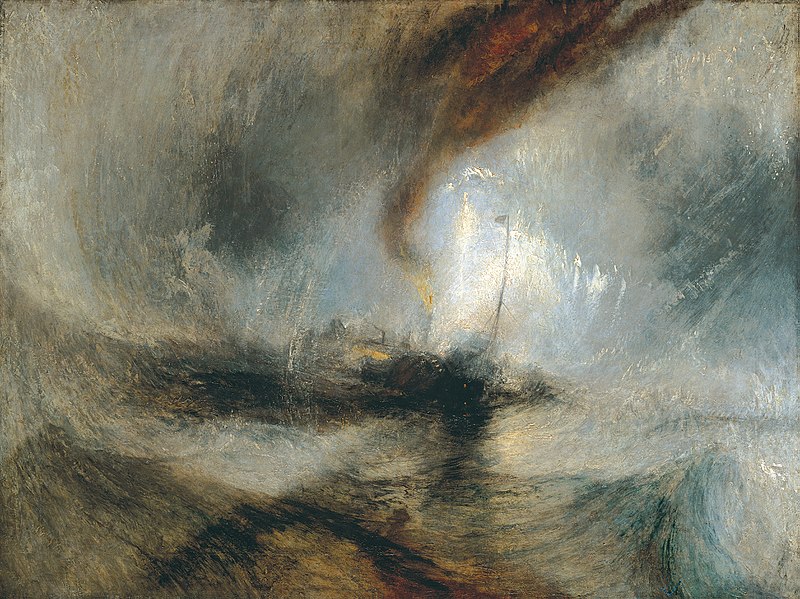
p>Opening on 22 November 2013, Turner and the Sea at the National Maritime Museum is the first full-scale examination of J.M.W Turner’s lifelong fascination with the sea. Dramatic, contemplative, violent, beautiful, dangerous and sublime – the sea was the perfect subject to showcase Turner’s singular talents, and the 120 pieces on display include some of the most celebrated paintings of the artist’s long career.


The extraordinary quality of the works gathered together for Turner and the Sea confirms his status as the pre-eminent painter of water, and demonstrates his unique ability to represent the elemental power of the sea. The exhibition features items on loan from some of the world’s most prestigious artistic institutions including: The National Gallery, Tate, Yale Center for British Art, British Museum, Metropolitan Museum of Art, Royal Collection Trust, Calouste Gulbenkian Foundation, Lisbon and National Gallery of Art, Washington.


From his transformative Royal Academy paintings of the late 1790s and early 1800s to the unfinished, experimental seascapes he produced towards the end of his life, more than half of Turner’s artistic output depicted maritime subjects. It should come as no surprise that a man who spent much of his life along the coastlines of Britain and Europe, who spent days fishing the river Thames, and who reportedly had himself lashed to the mast of a ship to better paint a storm at sea, captured this subject so often and with such evocative mastery. Nonetheless, the sheer volume of material Turner created in his quest to depict the sea is remarkable.


The Fighting ‘Temeraire’ (1839),


Snow Storm – Steam-Boat off a Harbour’s Mouth (1842),


Staffa, Fingal’s Cave (1832), ‘


Now for the Painter’ (1827),


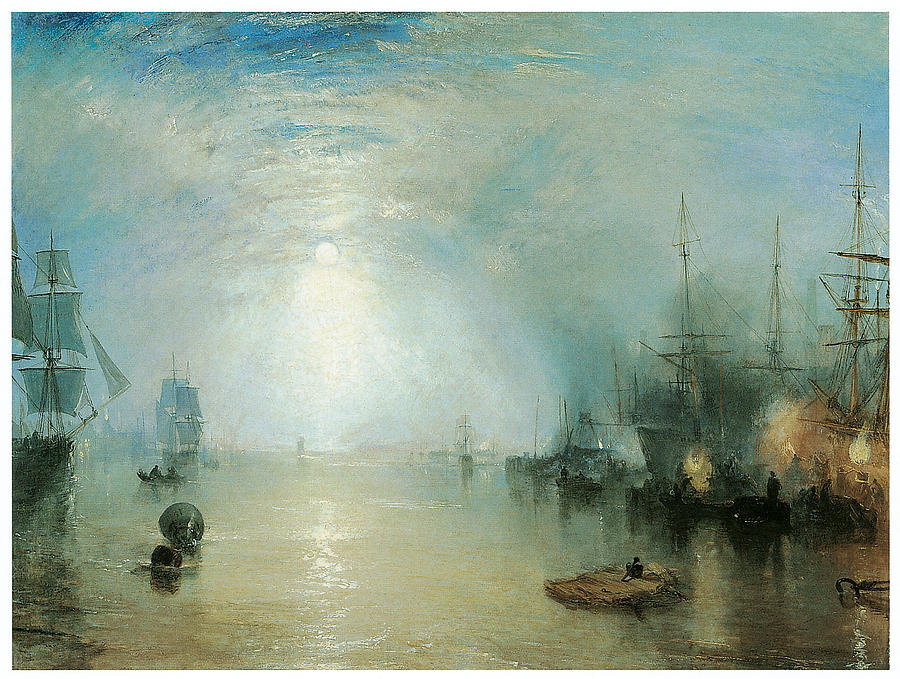
Keelmen Heaving in Coals by Moonlight (1835),

Whalers (c.1845)


and Calais Pier (1803)

will all be shown, alongside works by other major British and European artists, including Willem van de Velde, Claude-Joseph Vernet, Thomas Gainsborough, Nicholas Pocock, John Constable and Richard Parkes Bonington. Turner and the Sea re-evaluates the compelling appeal of the sea for Turner and his contemporaries, and gives visitors the opportunity to see the ways in which he responded to the art of the past, while challenging his audiences with a new and exciting maritime vision.


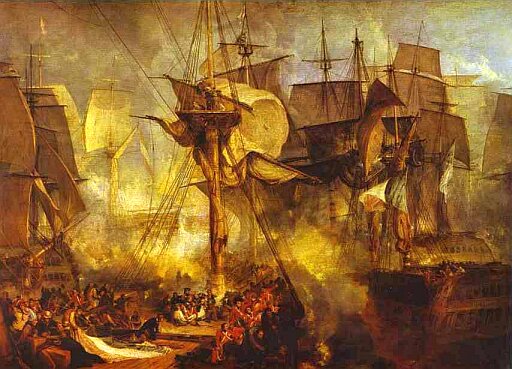
Further highlights include: Turner’s largest painting and only royal commission,


The Battle of Trafalgar (1824),

one of the jewels in the National Maritime Museum’s fine art collection;


Fishermen at Sea,

the first oil painting Turner exhibited at the Royal Academy;


The Wreck of a Transport Ship (c.1810),

not seen in London since 1970s,

displayed alongside


The Shipwreck (1805)

and Calais Pier – (above)

the first time these three storm paintings have been shown together;


and The Wreck Buoy (1849),

Turner’s last exhibited marine painting.


Encompassing oils, watercolours, prints and sketches, the exhibition follows Turner’s progression from newly-elected Royal Academician to one of the country’s most celebrated artists. While his style changed considerably, his virtuoso showmanship remained a dazzling constant. Turner and the Sea examines the artist’s new and often unexpected response to the prestigious history of European marine painting, as well as the relish with which he competed with other artists of his generation, ultimately leaving them in his wake as he took his work in a new, uninhibited and innovative direction.


Having begun by responding to the artists of the 17th century at the start of his career, the works from the end of Turner’s life seem almost as if they could come from the 20th century. As he left behind the rules and conventions of maritime art, dividing critics and public alike, Turner created a unique vision of the overwhelming power of nature – the final stage in a lifelong engagement with the sea.


Turner and the Sea is accompanied by a richly illustrated catalogue authored by exhibition curators Christine Riding and Richard Johns. Published in November 2013, the catalogue will explore and celebrate Turner’s lifelong fascination with the sea, while also setting his work within the context of marine painting in the 19th century. Also entitled Turner and the Sea, the catalogue will be published by Thames and Hudson.


Wednesday, November 20, 2013

Rubens, van Dyck and the Flemish school of painting: Masterpieces from the collections of the Prince of Liechtenstein


On November 5, the “Rubens, van Dyck and the Flemish school of painting: Masterpieces from the collections of the Prince of Liechtenstein” exhibition at the National Museum of China in Beijing was officially opened in the presence of various representatives from the Princely House of Liechtenstein. LGT Group is the main sponsor of the exhibition, which runs until February 15 and showcases 100 works of Flemish art from the 16th and 17th centuries.

The “Rubens, van Dyck and the Flemish school of painting: Masterpieces from the collections of the Prince of Liechtenstein” exhibition marks the first time that an impressive selection of masterpieces from the Princely Collections of the House of Liechtenstein has gone on show in China. The exhibition contains Flemish paintings, prints and tapestries from the 16th and 17th centuries, including works by pioneers from the initial heyday of Flemish painting, such as Quentin Massys and Jan de Cock, as well as the Brueg(h)el family of artists. Also featured are paintings by the two main exponents of Flemish art, Peter Paul Rubens and Anthonis van Dyck, including 11 portraits by Van Dyck, such as


The Portrait of Maria de Tassis


and Portrait of a Genoese Nobleman.

The exhibition also draws a thread from them to their successors, tracing the development of painting in the southern Netherlands throughout the 16th and 17th centuries.

Ruben's studies, oil painting and tapestry of Mars and Rhea Silvia are displayed side by side to show the process behind the masterpiece.


Peter Paul Rubens, Detail from "Mars and Rhea Silvia", c. 1616/17
© LIECHTENSTEIN. The Princely Collections, Vaduz-Vienna


Rubens' portrait of his 5-year-old daughter, Portrait of Clara Serena Rubens, is another highlight of this exhibition, with the vivid details and touching expression of the child's face.


Peter Paul Rubens, "Portrait of Clara Serena Rubens"


Peter Paul Rubens, "Portrait of Ian Vermoelen"


Peter Paul Rubens, "The Conversion of St Paul"


Peeter Neeffs, the Younger (1620-1675), Detail from "Interior View of Antwerp Cathedral",
HOHENBUCHAU COLLECTION, © LIECHTENSTEIN. The Princely Collections, Vienna


Pieter Brueghel the Younger, Detail from "The Numbering at Bethlehem", 1607
© LIECHTENSTEIN. The Princely Collections, Vaduz-Vienna


Jan Brueghel the Elder, Detail from "Landscape with young Tobias", 1598 *
© LIECHTENSTEIN. The Princely Collections, Vaduz-Vienna


400 years of collecting

The Princely Collections are the result of over 400 years of continuous art collection by the Princely Family of Liechtenstein. They include masterpieces of European art and are regarded as one of the most significant private collections in the world today. The foundations for the Princely Collections were laid back in 1600 by Prince Karl I. Since then, the Princely House has demonstrated its expertise in strategically supplementing, carefully consolidating and expanding its collections over the generations. It continues to pursue an active acquisition policy to this day.

Fifth stop on the Asian tour

From November 5, 2013 to February 15, 2014, art lovers and enthusiasts have the chance to catch a glimpse of the impressive masterpieces from the Princely Collections on display at the National Museum of China. This is the fifth stop on the Collections’ tour through Asia - last year the works featured in a guest exhibition at the National Art Center in Tokyo, and this year they have already been on show at the National Museum of Singapore, the Museum of Art in Kochi and the Kyoto Municipal Museum of Art. The masterpieces will go on display again in March 2014, this time at the China Art Museum in Shanghai.

William Blake’s World: “A New Heaven Is Begun”


William Blake’s World: “A New Heaven Is Begun”—the subtitle a quote from Blake referring to the significance of his date of birth—was on view at the Morgan Library from September 11, 2009, to January 3, 2010. In the Morgan’s first exhibition devoted to Blake in two decades, former director Charles Ryskamp and curators Anna Lou Ashby and Cara Denison assembled many of Blake’s most spectacular watercolors, prints, and illuminated books of poetry to dramatically underscore his genius and enduring influence.

The show included more than 100 works. Among the many highlights were two major series of watercolors, rarely displayed in their entirety. The twenty-one watercolors for Blake’s seminal illustrations for the Book of Job (or illustrations with texts clarified here)—considered one of his greatest works and revealing his personal engagement with biblical texts—were created about 1805–10. Also on view were twelve drawings illustrating John Milton’s poems L’Allegro and Il Penseroso, executed about 1816–20. Both series were undertaken for Blake’s principal patron, Thomas Butts.

Visionary and nonconformist William Blake (1757–1827) is a singular figure in the history of Western art and literature: a poet, painter, and printmaker. Ambitiously creative, Blake had an abiding interest in theology and philosophy, which, during the age of revolution, inspired thoroughly original and personal investigations into the state of man and his soul. In his lifetime Blake was best known as an engraver; he was later recognized for his innovations across many other disciplines.


WILLIAM BLAKE

The son of a London haberdasher and a religious dissenter, Blake studied the Bible privately with his family. He was educated at home and well read as an adult. This intellectual curiosity was coupled with a keen perception of the political and social world, finding expression in his artistic independence as well as the complex mythology he constructed in response to the age of revolution in which he lived. This mythology centered around the figure of “Urizen,” an authoritarian, kinglike figure who represents rulers both sacred and profane, with whom other characters representing independence and artistic creativity must interact.

Blake was trained as an engraver. His skill was often applied to reproducing designs of his fellow students and teachers at the Royal Academy. Blake engraved his own works as well, and painted for Academy shows, wrote poetry, and engraved illustrations for books issued by the radical publisher Joseph Johnson. He was also active within the Soho/Covent Garden artistic community. Although Blake explored many artistic disciplines, he continued to work throughout his life in the medium for which he was trained, engraving.

As a result of a dream conversation with his dead brother Robert in 1787, Blake developed a new method of engraving relief plates. By using a special coating for copper plates, he was able to combine reverse script with illustrative details. With this inventive technique, he created


Songs of Innocence in 1789

and embarked on a major productive period that saw the creation of


The Marriage of Heaven and Hell (1790),


Visions of the Daughter of Albion (1793)

Continental Prophecies:


America (1793),


Europe (1794),


and the Song of Los (1795).

While living in Lambeth in the 1790s––across the river but still within walking distance of the artistic and literary center of London––he created small runs of the illuminated books, which were printed on speculation or for a few patrons.

EXHIBITION HIGHLIGHTS

In addition to the superlative watercolor series—

twenty-one illustrations to the Book of Job:


including:


William Blake (1757–1827)
Behemoth and Leviathan, ca. 1805–10
[Book of Job, no. 15]
Pen and black and gray ink, gray wash, and watercolor, over faint indications in pencil, on paper
10 1/16 x 7 3/4 inches (272 x 197 mm)
Purchased by Pierpont Morgan, 1903; 2001.77

and twelve designs illustrating Milton’s L’Allegro


and Il Penseroso

—other important drawings were on display, including


Fire (ca. 1805),

which addresses the subject of war. The more fully expressed Continental Prophecies, a series of three illuminated books, further showcase Blake’s talents as a visual artist and his passionate interest in politics.

Blake supported himself with his engravings, and a selection of his prints— many of which are extremely rare impressions—documents this important aspect of his production. A magnificent example of Blake’s largest print, touched with watercolor by the artist, depicts


Chaucer’s Canterbury Pilgrims.

With this work the artist hoped for commercial success, something he was unable to secure in his lifetime.

Among Blake’s crowning achievements as a visual artist and poet are his illuminated books, such as Songs of Innocence and of Experience: Shewing the Two Contrary States of the Human Soul (ca. 1794). These works, which also showcase his exceptional technical skills, reflect medieval manuscript illumination and the interrelationship between word and image. Also on view was the only dated copy of Blake’s dramatic The Marriage of Heaven and Hell.

Shedding light on the artistic milieu surrounding Blake are a number of works by friends and contemporaries, including drawings by younger artists such as John Linnell (1792–1882) and members of a group that assembled around Blake and called themselves the Ancients. Also represented are works by painters such as Samuel Palmer (1805–1881) and Henry Fuseli (1741–1825).


DRAWINGS

William Blake (1757–1827), “Behemoth and Leviathan,” from Illustrations, for the Book of Job, (ca. 1805–1810), no. 15 in, the set of 21 drawings for his patron Thomas, Butts, Pen and black ink, gray wash, and watercolor,, over traces of graphite, Purchased by Pierpont Morgan, 1903; 2001.77

William Blake (1757–1827), “Mirth,” from John Milton’s L’Allegro, no. 1 in the set, of 6 drawings created for his patron Thomas Butts, Watercolor, over traces of black chalk, Purchased with the assistance of the Fellows with the, special support of Mrs. Landon K. Thorne and Mr., Paul Mellon, 1949; 1949.4:1

William Blake (1757–1827), Fire, ca. 1805, Pen and black and gray ink, gray wash, and, watercolor, over traces of graphite, Gift of Mrs. Landon K. Thorne, 1971; 1971.18

William Blake (1757–1827), “Melancholy” from John Milton’s Il Penseroso,, no. 1 in the set of 6 drawings created for his, patron Thomas Butts, Watercolor, over traces of black chalk, Purchased with the assistance of the Fellows, with the special support of Mrs. Landon K., Thorne and Mr. Paul Mellon, 1949; 1949.4:7

William Blake (1757–1827), “The Sun at His Eastern Gate” from John, Milton’s L’Allegro, no. 3 in the set of 6 drawings, created for his patron Thomas Butts, Watercolor, over traces of black chalk, Purchased with the assistance of the Fellows with, the special support of Mrs. Landon K. Thorne, and Mr. Paul Mellon, 1949; 1949.4:3,

PRINTED BOOKS

William Blake (1757–1827), The Marriage of Heaven and Hell, Lambeth, 1790, Copy F, printed ca. 1794, plate 3, Gift of Mrs. Landon K. Thorne, 1973; PML 63935,

Edward Young (1683–1765), The Complaint, and the Consolation; or Night Thoughts, London: Printed by R. Noble for R. Edwards, 1797, Copy K, Designed and engraved by William Blake; hand colored, possibly by Blake and his wife., Gift of Mrs. Landon K. Thorne, 1973; PML 63943

ENGRAVINGS

William Blake (1757–1827), Joseph of Arimathea Among the Rocks of, Albion, [London]: Engraved by W. Blake …,, 1773, Engraving, second state, c. 1810–, 1820, Purchased as the gift of the Thorne, Family and Fellows Fund in memory, of Mrs. Landon K. Thorne, 1976;, PML 77019.9

William Blake (1757–1827), Designs for Robert John Thornton’s, third edition of The Pastorals of Virgil, Four wood engravings printed from, one block, London: J. McGowan for Rivington, [and others], 1821, Purchased by Pierpont Morgan,, 1906; PML 9948.24,

William Blake (1757–1827), Illustrations of the Book of Job: Invented and engraved by, William Blake, 1825, London: Published … by

William Blake … [1826]., Plate 21, “So the Lord blessed the latter end of Job, more than the beginning” State A, Gift of Mrs. Landon K. Thorne, 1973: PML 63939,

Alex Katz Exhibition


The Mattatuck Museum in Waterbury, CT has announced the opening of ALEX KATZ: Selections from the Whitney Museum of American Art, a solo exhibition of works by one of America’s most honored living artists, on Sunday, December 8, 2013.

The exhibition, which remains on view through March 16, 2014, draws upon the Whitney’s extensive holdings of art by Alex Katz and includes the brilliantly-colored portraits of family and friends that are a hallmark of the artist’s career as well as early landscapes and collages.

Since 1951, Katz's work has been the subject of more than 200 solo exhibitions and nearly 500 group exhibitions throughout this country and internationally. His many credits include two honorary doctorate degrees, a Lifetime Achievement Award from the National Academy Museum in New York, a Philip Morris Distinguished Artist Award from the American Academy in Berlin, and the Cooper Union for the Advancement of Science and Art’s Annual Artist of the City Award.

Katz was born in Brooklyn in 1927 and grew up in the St. Albans section of Queens. His Russian-born parents shared a deep interest in the arts. At Cooper Union’s School of Art, Katz was trained in modern art theories and techniques, later earning a scholarship for summer study at Maine’s Skowhegan School for Painting and Sculpture. He has said that his experience of painting plein air at Skowhegan gave him “a reason to devote my life to painting.”

In New York during the 1950s, resisting the dominant abstractionism of the time, Katz associated with other figurative painters, among them Larry Rivers and Fairfield Porter. Toward the latter part of the decade, his work evolved towards greater realism. Katz became increasingly interested in portraiture with monochrome backgrounds, painting his friends and family and especially his wife and muse, Ada. Influenced by panoramic films and billboard advertising during the 1960s, Katz began creating large-scale paintings, often depicting dramatically cropped faces in a style that was to become his artistic signature. The power of Katz’s portraits, said Dana Miller, Curator, Permanent Collection, of the Whitney Museum of American Art, “…comes from their color and their scale.”

The Mattatuck Museum will offer several programs in conjunction with the exhibition including a film screening of Alex Katz: What About Style? on Thursday, December 12, 2013 at 5:30 p.m. This 56-minute video by filmmaker and art critic Heinz Peter Schwerfel captures Katz laboring over a 32-foot painting, The Black Brook. For details on this and other events, visit www.MattatuckMuseum.org/events.

This exhibition was organized by the Whitney Museum of American Art, New York.

Excellent review of the shoe at its previous locale.

Images from the exhibition:


Alex Katz, b. 1927. The Green Cap, (1985). Wood block, Sheet (Irregular): 17 11/16 x 24 1/8in. (44.9 x 61.3 cm). Whitney Museum of American Art, New York; purchase, with funds from the Print Committee 87.17 Art © Alex Katz / Licensed by VAGA, New York, N.Y. Digital Image © Whitney Museum of American Art, N.Y.


Alex Katz, b. 1927 Lincolnville Beach, 1956. Oil on canvas, 48 3/16 x 70 5/16in. (122.4 x 178.6 cm). Whitney Museum of American Art, New York; gift of the artist 88.49 Art © Alex Katz / Licensed by VAGA, New York, N.Y. Digital Image © Whitney Museum of American Art, N.Y.


Alex Katz, b. 1927 The Red Smile, 1963. Oil on canvas, 78 7/8 x 115in. (200.3 x 292.1 cm). Whitney Museum of American Art, New York; purchase, with funds from the Painting and Sculpture Committee 83.3 Art © Alex Katz / Licensed by VAGA, New York, N.Y. Photograph by Bill Orcutt


Alex Katz, b. 1927 Eli, 1963. Oil on canvas, 73 5/8 x 95 5/16in. (187 x 242.1 cm). Whitney Museum of American Art, New York; gift of Mr. and Mrs. Herbert Fischbach 64.37 Art © Alex Katz / Licensed by VAGA, New York, N.Y. Photograph by Sheldan C. Collins


Alex Katz (b 1927), “Swamp Maple II,” 1970, lithograph, Whitney Museum of American Art, New York; gift of the artist and Brooke Alexander, Inc. Art ©Alex Katz / Licensed by VAGA, New York, N.Y. Digital Image ©Whitney Museum of American Art, N.Y.


Alex Katz (b 1927), Day Lily II, (1969), Lithograph, 20 3/4 x 28 inches. Whitney Museum of American Art, New York; Purchase 70.32. Art © Alex Katz/ Licensed by VAGA, New York, NY


More images here