Friday, December 27, 2013

Of Heaven and Earth: 500 Years of Italian Painting from Glasgow Museums


Showcasing the outstanding achievements in Italian art from the Middle Ages to the Italian Renaissance and through the 19th century, this exhibition covers a vast scope of artistic genres and mindsets by some of the most influential Italian painters in history. It also highlights the outstanding collection of Glasgow Museums, one of the finest collections of Italian art in Northern Europe.


Antonio Balestra, "Justice and Peace Embracing," ca. 1700, oil on canvas, 42 x 55 1/4 in. Photo courtesy American Federation of Arts.

"Of Heaven and Earth" is organized into five chronological sections -- Fourteenth and Fifteenth Centuries: Tradition and Discovery; The Sixteenth Century: Toward a New Beauty; The Seventeenth Century: Rhetoric and Realism; the Eighteenth Century: Age of Elegance; and The Nineteenth Century: Patriotism and Genre.


Sandro Botticelli, The Annunciation, ca. 1490–95. Tempera on panel. Glasgow Museums; Bequeathed by Archibald McLellan, 1854.


After closing Nov. 17, 2013 at the Oklahoma City Museum of Art, the traveling show Of Heaven and Earth: 500 Years of Italian Painting from Glasgow Museums moved to the Art Gallery of Alberta, Edmonton, Canada (Dec. 13 to March 9); then the Everson Museum of Art, Syracuse, N.Y. (April 17 to July 13); Milwaukee Art Museum, Wisc. (Oct. 1 to Jan. 4, 2015); and Santa Barbara Museum of Art, Calif. (Feb. 6, 2015 to May 3, 2015).

In a previous incarnation, the same show, known as Bellini, Botticelli, Titian: 500 Years of Italian Art was on display at Compton Verney, Warwickshire, until 23 June 2013.


"Landscape with St. Jerome," circa 1610, by Domenichino. Photo provided by American Federation of Arts

From a review of the Oklahoma show: (link and image added)

The prestigious exhibition is full of colorful stories in the form of masterworks by the likes of Giovanni Bellini, Sandro Botticelli, Domenichino, Francesco Guardi and Salvator Rosa.

The works range from a golden-hued 1500 masterpiece depicting Christ and the Magi to Francesco del Cairo’s tragic 1645-1650 portrait “Death of Cleopatra” to


Luigi Garzi’s dramatic rendering of the Roman legend of the “Sacrifice of Marcus Curtius.”

It’s also the first time patrons can see one of the Scottish collection’s finest and most popular Italian paintings, Titian’s early 1500s masterwork “Christ and the Adulteress,” in a more complete way.


"Christ and the Adulteress," circa 1508-10, by Titian. Photo provided by American Federation of Arts

At some point, 12 to 20 inches and a full-length figure of a man were cut out of the composition. For the first time, the exhibit reunites the larger painting with a fragment of the missing piece titled “Head of a Man,” which the museum purchased in 1971.


From a review of the Compton Varney show:

Don't miss

Two large-scale paintings by the Neapolitan master of atmospheric landscapes, Salvator Rosa.


The ‘Virgin and Child’, 1488, by the great Giovanni Bellini, celebrated for its serenity and the imaginative use of colour and ‘The Annunciation’ 1493, by Botticelli notable for the artist’s revolutionary use of mathematical perspective which gave the architecture of the paintings the impression of three dimensional depth.


"Archangel Michael and the Rebel Angels," circa 1592-93, by Cavaliere d'Arpino. Photo provided by American Federation of Arts


More images and credits:

(above)
Sandro Botticelli
The Annunciation (c.1490-1495)
Oil, tempera and gold leaf on walnut panel
© CSG CIC Glasgow Museums Collection


Giovanni Bellini
Madonna and Child (c.1480-1485)
Tempura and oil on panel
© CSG CIC Glasgow Museums Collection


Bartolomeo Veneto
Sta Catherine (c.1520)
Oil on panel
© Glasgow City Council (Glasgow Museums) 2012


Titian
Head of a Man (c.1508-10)
Oil on canvas
© CSG CIC Glasgow Museums Collection


Andrea Casali
Triumph of Galatea (c1740-65)
Oil on canvas
© CSG CIC Glasgow Museums Collection


Luiga da Rios
Overlooking a canal (1886)
Oil on canvas
© CSG CIC Glasgow Museums Collection


Francesco Guardi
View of San Giorgio Maggiore, Venice
(c.1760)
Oil on canvas
© CSG CIC Glasgow Museums Collection


Federico Andreotti
The Violin Teacher (c.1875-1890)
Oil on canvas
© CSG CIC Glasgow Museums Collection

Thursday, December 26, 2013

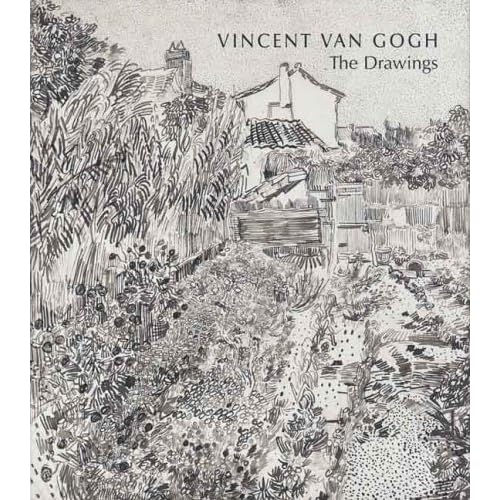
Vincent van Gogh: The Drawings


The first major exhibition in the United States ever to focus on Vincent van Gogh's extraordinary drawings appearedt The Metropolitan Museum of ArtOctober 18 – December 31, 2005. Vincent van Gogh: The Drawings — comprising 113 works selected from public and private collections worldwide, including an exceptional number of loans from the Van Gogh Museum in Amsterdam — will reveal the range and brilliance of the artist's draftsmanship as it evolved over the course of his decade-long career. Generally over-shadowed by the fame and familiarity of his paintings, Van Gogh's more than 1,100 drawings remain comparatively unknown although they are among his most ingenious and striking creations. Van Gogh engaged drawing and painting in a rich dialogue, which enabled him to fully realize the creative potential of both means of expression. A group of paintings was exhibited alongside the related drawings.


Van Gogh's pen-and-ink Self-Portraits (1887), at the Metropolitan Museum of Art.
(Photo: Van Gogh Museum, Amsterdam (Vincent Van Gogh Foundation/Courtesy of the Metropolitan Museum of Art, New York))


The exhibition was jointly organized by The Metropolitan Museum of Art, New York, and the Van Gogh Museum, Amsterdam.

Exhibition Organization and Content

Retrospective in scope, Vincent van Gogh: The Drawings traced the artist's successive triumphs as a draftsman, first in the Netherlands and later in France, highlighting the originality of his invention and the striking continuity of his vision. Among the works exhibited were an early series of large-scale views of the garden at his father's vicarage drawn by Van Gogh in March 1884. Distinctive for their melancholy grandeur and regarded as the high point of his early work as a draftsman, drawings from this ambitious suite, including two versions of the Winter Garden in contrasting horizontal and vertical formats, will be reunited in the present show.

Van Gogh produced most of his greatest drawings and watercolors during the little more than two years he spent working in Provence. Compositions created in Arles (February 1888–May 1889) form the central portion of the exhibition, bracketed by earlier and later works.

Largely self-taught, Van Gogh believed that drawing was "the root of everything." His reasons for drawing were numerous. At the outset of his career, he felt it necessary to master black and white before attempting to work in color. Thus, drawings formed an inextricable part of his development as a painter. There were periods when he wished to do nothing but draw. Sometimes, it was a question of economics: the materials he needed to create his drawings — paper and ink purchased at nearby shops and pens he himself cut with a penknife from locally grown reeds — were cheap, whereas costly paints and canvases had to be ordered and shipped from Paris. When the fierce mistral winds made it impossible for him to set up an easel, he found he could draw on sheets of paper tacked securely to board.

Van Gogh used drawing to practice interesting subjects or to capture an on-the-spot impression, to tackle a motif before venturing it on canvas, and to prepare a composition. Yet, more often than not, he reversed the process by making drawings after his paintings to give his brother and his friends an idea of his latest work. Over a three-week period, between mid-July and early August in 1888, he reproduced some 30 of his paintings in pen-and-ink drawings, which he sent to two artist friends, Émile Bernard and John Russell, and to his brother Theo.

A number of these highly stylized presentation drawings were on view. The New York venue of the exhibition uniquely featured multiple renditions of key motifs: Boats at Sea, Saintes-Maries-de-la-Mer and Arles: View from the Wheat Fields. Each of Van Gogh's paintings of these subjects was shown with three pen-and-ink répétitions. Never before seen together, these dossiers offered a fascinating glimpse of Van Gogh's successive re-interpretations — through line — of vibrant color compositions.

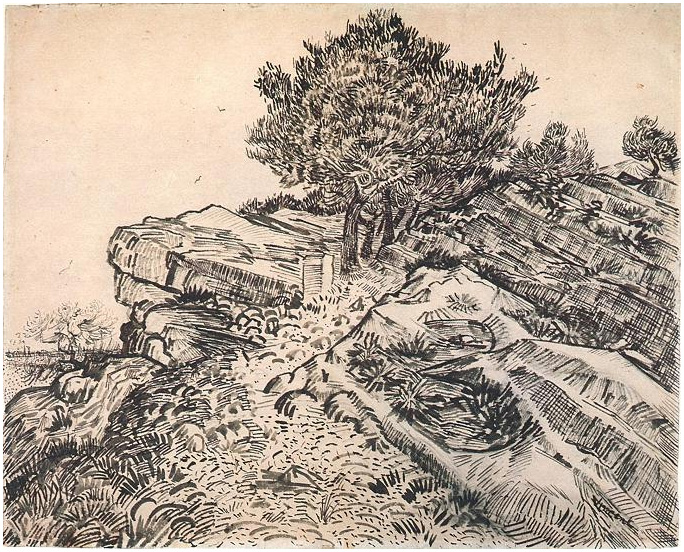
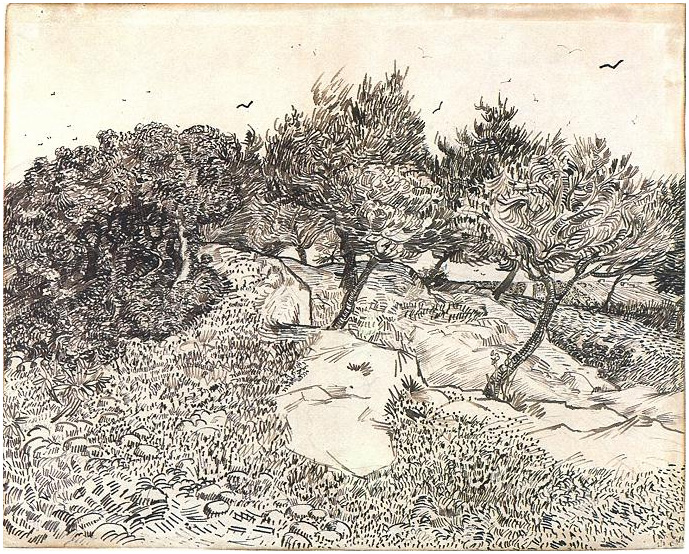
Several important series of drawings, including the sweeping landscapes he composed atop Montmajour, were featured. The artist regarded the Montmajour suite of six drawings, which range from elaborate panoramic vistas of the countryside to spirited views of the rocky mountain slopes with their windblown trees, as his greatest achievement as a draftsman. These landscapes were exceptionally reunited for this exhibition. In addition, a number of portraits and figure studies were on view, including a rare self-portrait, one of only two such drawings known.

Van Gogh's dialogue between drawing and painting was most fully realized while he was working in Arles and in nearby Saint-Rémy. Several paintings from this period will be exhibited alongside related drawings. In a splendid grouping, the oil


Harvest in Provence of ca. June 12, 1888

— very seldom lent by the Van Gogh Museum — were shown with a brilliant preparatory watercolor and a dazzling pen-and-ink drawing Van Gogh made after his painting.

From a NY Times review (images added):


Montmajour
Vincent van Gogh
Drawing, Pencil, pen, reed pen, and ink on paper
Arles: July, 1888
Van Gogh Museum


Olive Trees, Montmajour
Vincent van Gogh
Drawing, Pencil, pen, reed pen, and ink on paper
Arles: July, 1888
Van Gogh Museum


Hill with the Ruins of Montmajour
Vincent van Gogh
Drawing, Pencil, pen, reed pen, and ink on paper
Arles: July, 1888
Van Gogh Museum


Made with a scratchy reed pen on large sheets of Whatman paper, his Montmajour drawings come about two-thirds of the way through the survey of van Gogh's drawings now at the Metropolitan Museum of Art. They translate sky, rocks and plains into a swarm of swirls, dots, jabs and scratches. Foaming, cable-knit patterns imply the heaving gusts of wind rustling olive branches and bending gnarled olive trunks; whispery, microscopic speckles, endless numbers of them, mimic the quality of dull light on receding fields as they evaporate into the horizon. You can even sense color - the dark brown of the earth, the yellow and lilac fields and gray-blue sky - in van Gogh's black and white.

Fascinating review (excerpt):


Vincent van Gogh, Cottage Garden 1888 reed pen, quill, and ink over graphite on wove paper, 24 x 19-1/4 inches Private Collection, Courtesy Metropolitan Museum of Art

In the drawing Cottage Garden the limited number of marks Van Gogh used to create this compelling rendering of observed facts grace it with a seductive vibratory energy. He uses a variety of circles, curved lines, straight lines, and dots to delineate a frothy mass of flora and fauna, open sky with bright sunlight coursing through it, and fences and houses. By playing sparse areas off of busy areas in a breathtakingly rhythmic way he suggests a three dimensional space. Like a number of Impressionist painters Van Gogh loved to challenge himself by trying to render large patches of organic forms that avoid specificity and were constantly reconfigured by the elements, wind especially.
More interesting reviews here AND here


The exhibition was accompanied by a fully illustrated catalogue by Ms. Ives, Ms. Stein, Mr. van Heugten, and Ms. Vellekoop. Published by The Metropolitan Museum of Art and distributed by Yale University Press, the publication will be available in hard- and softcover editions in the Museum's book shops. This catalogue represents the first fully illustrated and documented study of Van Gogh's drawings. The four curators explore the enduring questions that surround Van Gogh's works as a draftsman: their manufacture; their artistic precedents; the significance of the artist's drawings to his development as a painter; and their contribution to Modernism. The catalogue presents a wealth of information essential to present and future Van Gogh scholarship.

More images;;


Vincent van Gogh, La Crau from Montmajour
, a brown ink drawing over black chalk
Arles, France, AD 1888


Rubens, Van Dyck & Jordaens


From 17 September 2011 to 16 March 2012, the Hermitage Amsterdam presented a stunning selection from the Flemish art collection of the Hermitage in St. Petersburg. With 75 paintings and about 20 drawings, this definitive survey will include numerous masterpieces by the three giants of the Antwerp School – Peter Paul Rubens, Anthony van Dyck, and Jacob Jordaens – accompanied by the work of well-known contemporaries.

Peter Paul Rubens (1577–1640) was a special focus of the exhibition, represented by 17 paintings and many drawings. Rubens was the most accomplished and influential Flemish painter of the seventeenth century. At the same time, he was known as a charming aristocrat, diplomat, and collector, and his workshop was a smoothly operating business. He was a legend in his day, a homo universalis. Both Rubens’s religious and his secular works illustrate his unequalled talent. One of his masterpieces is the famous


Descent from the Cross (c. 1618),

which depicts Christ’s suffering with compelling drama. This painting has never before been sent out on loan.

The exhibition also examined Rubens’s influence and followers in detail, devoting particular attention to the elegant and refined portraits of his greatest pupil, Anthony van Dyck (1599–1641). Around 1638, Van Dyck painted
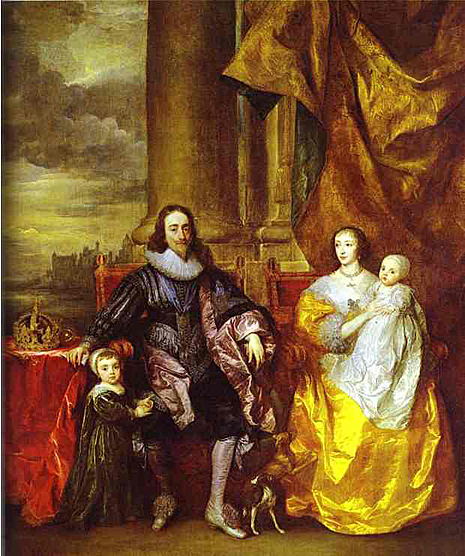


King Charles I of England and his wife, the French princess Henrietta Maria.

By that time, he had been serving as the king’s court painter for several years and had been knighted Sir Anthony.

The third great master of the Flemish school, Jacob Jordaens (1593–1678), did not study with Rubens but was influenced by him. His impressive paintings invite viewers to share in his exuberant Flemish joie de vivre. Even his history paintings have a Flemish ambiance.

Chirping birds, freshly killed game and floral bouquets grace the still lifes of Frans Snijders, while David Teniers the Younger was renowned for his genre pieces of everyday life. The exhibition also featured a touching family portrait of Cornelis de Vos and many other major paintings by Flemish masters, displayed in their full glory.

It was the first time that this superb collection was shown in the Netherlands. Many of these paintings were acquired by Catherine the Great in the eighteenth century. They belonged to world-class collectors such as Pierre Crozat and Heinrich von Brühl, whose collections Catherine purchased in their entirety. Most of them were commissioned by churches and secular patrons in Antwerp and other European cities, and were produced against the backdrop of the Eighty Years’ War and the Counter-Reformation. This Catholic movement, a reaction to the Reformation, encouraged both churches and private individuals to commission sacred art on a large scale. The epic Baroque style of Rubens and his contemporaries made an excellent propaganda tool for the Catholic church, the aristocracy and the wealthy bourgeoisie.

Antwerp, strategically located at the mouth of the Scheldt estuary, prospered and flourished as never before in the early sixteenth century. Within a few decades, the port had become a powerful commercial metropolis and the most important centre of the arts north of the Alps. The city's meteoric rise to prominence acted as a powerful magnet, not just for merchants, but also for painters and other highly skilled craftsmen. It was the leading place in the Netherlands for ambitious young artists to keep abreast of the latest trends in art. Many of the artists who lived and worked in Antwerp in the sixteenth century came from elsewhere. Some, such as Jan Gossaert (from Maubeuge) and Lucas van Leyden (from Leiden), were active in Antwerp for a limited period of time. Others, such as Anthonis Mor (also known as Antonio Moro, from Utrecht) and Hans Vredeman de Vries (from Friesland), travelled around Europe throughout their lives in search of new artistic challenges, but used Antwerp as their base.

The city's remarkable concentration of outstanding artists boosted the pace of innovation and accelerated the dissemination of new approaches. Inventive painters went in search of new possibilities, and studied Italian examples. Their compositions became more harmonious, and their figures acquired more natural anatomical features. Classical architectural elements and ornamental motifs inspired by Italian examples were introduced. The fierce rivalries among Antwerp's painters will undoubtedly have fostered specialisation. Many of what was later labelled ‘typically Dutch’ – realistic landscapes, still lifes, and scenes from everyday life – originated in Antwerp. The enormous demand led to a vast output of art of variable quality: paintings were produced in ever larger numbers, from the most expensive commissions to cheap bulk-produced items, both for the domestic market and for export to Italy, Spain, and South America. Copies of paintings by popular masters were also turned out in growing numbers.

Besides the great masters, Antwerp was home to a large number of minor or anonymous painters who were highly skilled in their craft.

Quinten Massijs (1456 or 1466-1530) – who was born in Leuven, where he may have been trained by Dirk Bouts − was the city's first famous artist. Together with his contemporary Joos van Cleve (c. 1485-c. 1540) he forged a bridge between the late mediaeval tradition and the sixteenth-century Renaissance. In many respects, Massijs exemplified the new artistic age. Although he mainly painted religious works, he also ventured into moralistic genre scenes and animated portraits, which testify to a new view of human nature. Massijs introduced natural movements into his portraits through his portrayal of hands, which often speak a humanist, rhetorical sign language, and he was also one of the first to pay attention to characterisation in his sitters. In 1517 he produced the oldest known portrait of Erasmus.


Quinten Massijs (1466-1530), Portrait of Desiderius Erasmus, 1517
Royal Collection, Her Majesty Queen Elizabeth II

In addition, a number of grotesque tronies by Massijs have been preserved. These reflect familiarity with the character sketches of Leonardo da Vinci, with whom he evidently shared the Renaissance interest in human physiognomy. A telling indication of Massijs’s fame is the fact that copies were soon being made after his work, by artists including Rubens.

Besides Massijs and Van Cleve, two other history painters determined the appearance of Antwerp’s art in the first half of the sixteenth century: Pieter Coecke van Aelst (1502-1550) and Jan van Hemessen (c. 1500-after 1575.

The Aalst-born Coecke was a homo universalis: painter, architect and designer of prints, stained glass and tapestries, but best known, perhaps, as the translator of the architecture books by the Italian architect Sebastiano Serlio. With this work, Coecke did much to promote the dissemination of the Renaissance in northern Europe.

In the 1520s, Jan van Hemessen, who was born in Hemiksem near Antwerp, travelled to Italy, where he became acquainted with the art of the Italian Renaissance. The most innovative part of his oeuvre consists of genre-like biblical scenes, such as
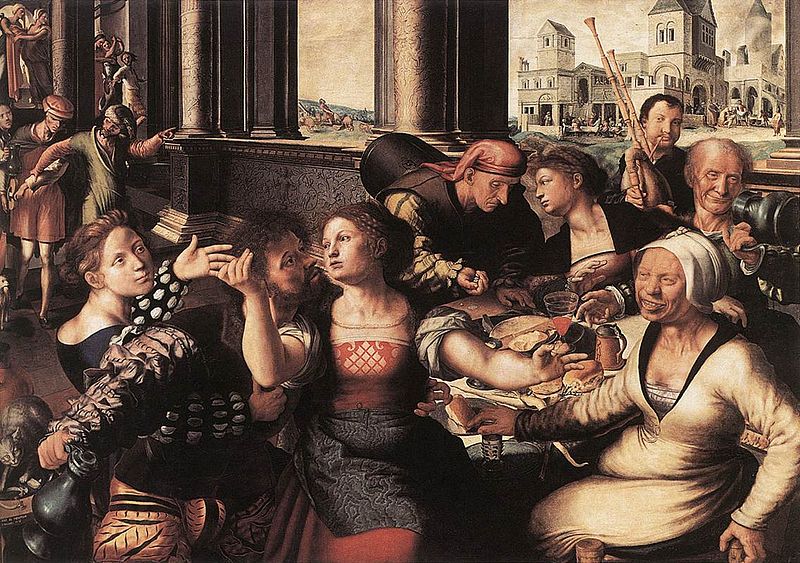


The Prodigal Son

Van Hemessen’s unconventional compositions, with vigorously modelled figures filling the entire picture, were extremely bold for their time.


Jacob Jordaens also produced genre paintings. Particularly popular were his scenes of the


Feast of the Epiphany (‘The king drinks’)

and of


‘As the old sing, so pipe the young’,

a proverb he took from the work of Jacob Cats, and which Jan Steen would interpret in his own way over two decades.

In some genres, like marine and architectural painting, Antwerp never attained the heights achieved in the Northern Netherlands. The oblique ‘momentary’ glimpses of church interiors that Gerard Houckgeest and Emanuel de Witte had introduced to Delft around 1650, with immense feeling for light and space, appear to have escaped the attention of Antwerp’s architecture painters. Other genres did not develop in Antwerp at all. For instance, local painting had nothing equivalent to the simple interiors with one or more figures, such as those painted in Delft by Pieter de Hooch and Johannes Vermeer. But there was also a genre that was exclusive to Antwerp: art cabinet or kunstkamer scenes. In one of the most beautiful examples, the owner displays the pièce de resistance of his collection –

Quinten Massijs’s Madonna and Child

– to prominent guests, while Rubens explains the work of his illustrious predecessor. Among those present we recognize Anthonie van Dyck and Frans Snijders: Antwerp knew its star painters. At the same time, this work gives a superb picture of the wealth and extraordinary versatility of the Antwerp school of painting in the sixteenth and seventeenth centuries.

Credits and additional images:


1. Peter Paul Rubens (1577–1640) and workshop, The Descent from the Cross, c. 1618, Oil on canvas. 297 x 200 cm
© State Hermitage Museum, St Petersburg

2. Peter Paul Rubens (1577–1640) and workshop, Venus and Adonis, c. 1614, Oil on panel. 83 x 90.5 cm
© State Hermitage Museum, St Petersburg

3. Abraham Janssens (1575–1632), Cephalus and Procris, 1610–20, Oil on canvas. 112 x 165 cm
© State Hermitage Museum, St Petersburg


4. Peter Paul Rubens (1577–1640), Christ Wearing the Crown of Thorns (Ecce Homo), c. 1612, Oil on panel. 125.7 x 96 cm
© State Hermitage Museum, St Petersburg


5. Peter Paul Rubens (1577–1640) and Frans Snyders (1579–1657), The Union of Earth and Water (Scheldt and Antwerp), c. 1618–21, Oil on canvas. 222.5 x 180.5 cm
© State Hermitage Museum, St Petersburg


6. Frans Snyders (1579–1657) and Jan Boeckhorst (1604–1668), Cook in the Larder, 1635–37, Oil on canvas. 171 x 173 cm
© State Hermitage Museum, St Petersburg


7. Pauwel (Paul) de Vos (1591/92 or 1595–1678), Dogs Fighting, 1620–40, Oil on canvas. 115.5 x 172.5 cm
© State Hermitage Museum, St Petersburg

8. Anthony van Dyck (1599–1641), Portrait of Sir Thomas Wharton, 1639, Oil on canvas. 217 x 128.5 cm
© State Hermitage Museum, St Petersburg

9. Michiel Sweerts (1618–1664), Portrait of a Young Man (Self-portrait?), 1656, Oil on canvas. 114 x 92 cm
© State Hermitage Museum, St Petersburg

10. Cornelis de Vos (1584–1651), Self-portrait with his Wife, Susanna Cock, and Children, 1634, Oil on canvas. 185.5 x 221 cm
© State Hermitage Museum, St Petersburg

11. Jacob Jordaens (1593–1678), Saints Paul and Barnabas at Lystra, c. 1616, Oil on canvas. 149 x 253 cm
© State Hermitage Museum, St Petersburg

12. Gerard Zeghers (1591–1651), Peter's Denial, c. 1620–24, Oil on canvas. 122.5 x 160.5 cm
© State Hermitage Museum, St Petersburg

13. Hendrick van Balen (1575–1632) and Jan Brueghel I (Velvet Brueghel, 1568–1625), Venus and Cupid, 1600, Oil on canvas. 190 x 148 cm
© State Hermitage Museum, St Petersburg

14. Jacob Jordaens (1593–1678) and Andries Daniels (?) (c. 1580 – after 1602), The Virgin and Child in a Garland of Flowers, c. 1618, Oil on panel. 104 x 73.5 cm
© State Hermitage Museum, St Petersburg

15. Alexander Adriaenssen (1587–1661), Fish, 1643, Oil on canvas. 59.5 x 85 cm
© State Hermitage Museum, St Petersburg

16. Jan Fyt (1611–1661), Dead Game and Hunting Dog, 1655–60, Oil on canvas. 93.5 x 120 cm
© State Hermitage Museum, St Petersburg

17. Workshop of Peter Paul Rubens, The Adoration of the Magi, c. 1620, Oil on canvas. 235 x 277.5 cm
© State Hermitage Museum, St Petersburg


18. Jacob Jordaens (1593–1678), Allegorical Family Portrait, 1650–55, Oil on canvas. 178.4 x 152.3 cm
© State Hermitage Museum, St Petersburg

19. Jacob Jordaens (1593–1678), Self-portrait with Parents, Brothers and Sisters, c. 1615 (partially repainted 1635–45), Oil on canvas. 175 x 137.5 cm
© State Hermitage Museum, St Petersburg

20. Anthony van Dyck (1599–1641), Family Portrait, c. 1619, Oil on canvas. 113.5 x 93.5 cm
© State Hermitage Museum, St Petersburg


21. Theodoor Rombouts (1597–1637), A Game of Cards, 1625–30, Oil on canvas. 143 x 223. 5 cm
© State Hermitage Museum, St Petersburg

22. David Teniers II (1610–1690), Duet, 1640–45, Oil on canvas (transferred from panel in 1825). 24.7 х 19.5 cm
© State Hermitage Museum, St Petersburg

23. Pauwel (Paul) de Vos (1591/92 or 1595–1678), Still Life with Dead Birds and a Lobster, 1640–60, Oil on canvas. 121 x 181 cm
© State Hermitage Museum, St Petersburg

24. Frans Snyders (1579–1657), Concert of Birds, 1630–50, Oil on canvas. 136.5 x 240 cm
© State Hermitage Museum, St Petersburg

25. Anthony van Dyck (1599–1641), Portrait of Nicolaas Rockox, 1621, Oil on canvas. 122.5 x 117 cm
© State Hermitage Museum, St Petersburg


26. Jacob Jordaens (1593–1678), Cleopatra's Feast, 1653, Oil on canvas. 156.4 x 149.3 cm
© State Hermitage Museum, St Petersburg

27. Jan Brueghel I (Velvet Brueghel, 1568–1625), Wooded Landscape (The Rest on the Flight into Egypt), 1607, Oil on panel. 51.5 x 91.5 cm
© State Hermitage Museum, St Petersburg

28. Jan Wildens (1586–1653) and Hans Jordaens III (c. 1595 – c. 1643), Christ on the Road to Emmaus, c. 1640, Oil on canvas. 123 x 168 cm
© State Hermitage Museum, St Petersburg


29. David Teniers II (1610–1690), Group Portrait of the Oude Voetboog Guild on the Grote Markt, Antwerp, 1643, Oil on canvas (transferred from canvas in 1871). 133 х 184.5 cm
© State Hermitage Museum, St Petersburg

30. Frans Snyders (1579–1657), Fruit in a Bowl on a Red Cloth, 1640–50, Oil on canvas (transferred from panel). 59.8 x 90.8 cm
© State Hermitage Museum, St Petersburg

31. Peter Paul Rubens (1577–1640), Mercurius Abituriens, 1634, Oil on panel. 76 x 79 cm
© State Hermitage Museum, St Petersburg

32. Peter Paul Rubens (1577–1640), Portrait of Charles de Longueval, 1621, Oil on panel. 62 x 50 cm
© State Hermitage Museum, St Petersburg

33. Peter Paul Rubens (1577–1640), Study of the Head of a Youth Looking Up, 1615–16, Charcoal and black chalk on grey paper; laid down. 34 x 27 cm
© State Hermitage Museum, St Petersburg

34. Peter Paul Rubens (1577–1640), Landscape with a Dam, c. 1635, Black chalk, gouache and tempera; laid down. 43.5 x 59 cm
© State Hermitage Museum, St Petersburg

35. Peter Paul Rubens (1577–1640), The Rubens Vase, before 1626, Pen and brown ink, brown wash, over black chalk; laid down. 20.1 x 14.8 cm
© State Hermitage Museum, St Petersburg

36. Peter Paul Rubens (1577–1640), Bust of 'Seneca' in Profile, c. 1605, Black and white chalk on brownish-grey paper; laid down. 26.5 x 21.3 cm
© State Hermitage Museum, St Petersburg

37. Peter Paul Rubens (1577–1640), The Descent from the Cross, before 1612, Pen and brown ink, brown wash, over a black chalk sketch; laid down. 43.5 x 38 cm
© State Hermitage Museum, St Petersburg

38. Anthonie van Dyck (1599–1641), Portrait of the Painter Cornelis Schut, 1628–36, Black chalk, brown wash; incised along the contours. 23 x 18 cm
© State Hermitage Museum, St Petersburg

39. Jacobs Jordaens, Study of the Head of a Young Woman, c. 1640. Black and red chalk, 16 x 14.1 cm
© State Hermitage Museum, St Petersburg

40. Peter Paul Rubens, The Damned at the Last Judgment (after Michelangelo), 1601–2. Black and red chalk on paper, 47 x 72 cm
© State Hermitage Museum, St Petersburg

41. Peter Paul Rubens, Study of the Head of a Young Girl, 1635–40. Black, white and red chalk, laid down, 21 x 18 cm
© State Hermitage Museum, St Petersburg

More images here


Tuesday, December 24, 2013

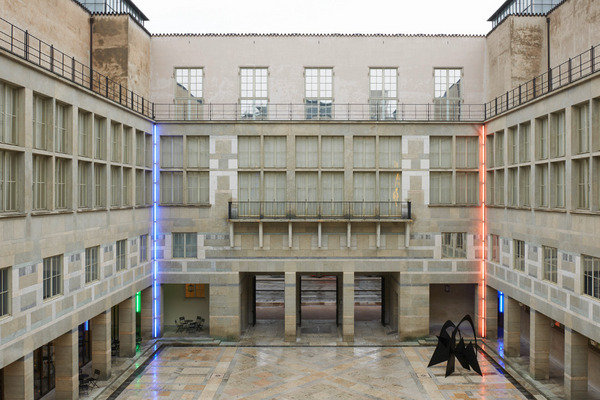
Piet Mondrian - Barnett Newman - Dan Flavin


The Kunstmuseum Basel : 08 September 2013 – 19 January 2014


Piet Mondrian, Barnett Newman, and Dan Flavin are three eminently important modernist artists and representatives of three different generations. They dedicated themselves to abstract art, but each did so under very different spiritual and social premises. The exhibition unites three selfcontained solo presentations. The chronological arrangement highlights revealing analogies as well as contradictions between the oeuvres—an organic panorama of artistic developments emerges, bristling with energy.

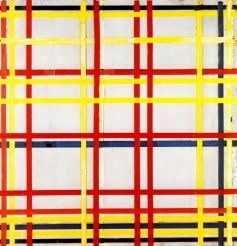
The point of departure is marked by dense painted panels, almost icons, that Piet Mondrian (1872–1944) created in Paris starting in 1919. The artist limited himself to the use of horizontal and vertical lines and the three primary colors red, yellow, and blue as well as the non-colors black, white, and gray. Mondrian called his form of abstraction “New Plasticism” and explored its application to all domains of life, aiming to reveal the “pure vision of the universal”. In a programmatic assessment of Mondrian’s art,

Barnett Newman (1905–1970) said that its representative illustration of the mathematical equivalents of nature transported the beholder into a world of flawless sensory lucidity. Newman wanted to release color from its compositional subordination and all other principles. This liberating expansion of color into sometimes gigantic pictorial formats aimed to convey a metaphysical exaltation Newman suggested with the term “sublime”.

Dan Flavin (1933–1996) decided in the early 1960s to eschew painting and sculpture. He adopted a factual stance and made his light installations by combining off-the-shelf _ fluorescent tubes. The repetitive use of these elements is firmly committed to everyday life and industrial production; despite the magic of light they radiate, his works negate the overarching metaphysical dimension that unites Mondrian and Newman.

The Kunstmuseum Basel has central works by all three artists. These familiar pieces form the backbone of the exhibition, complemented by carefully selected signicant loans from important museums and private collections in Europe and the United States.


Piet Mondrian - Tableau 3


Piet Mondrian


Barnett Newman - Chartres


Barnett Newman - The Name


Dan Flavin - untitled (in memory of Urs Graf), 1972/1975

The Renaissance and The Dream


Bringing together around eighty works by celebrated Renaissance artists, from Hieronymus Bosch to Veronese, and including Dürer and Correggio, this exhibition at the Musée du Luxembourg from October 9, 2013 to January 26, 2014 gives us an insight into the golden age of the representation of dreams. It takes us, from the moment of sleep to the moment of wakening, through dreams and nightmarish visions, and invites us to give free rein to our imagination, to lose ourselves in the disturbing images of dreams.

The exhibition is organised by the Réunion des musées nationaux – Grand Palais and the Soprintendenza del Polo Museale Fiorentino.

Dreams during the Renaissance have an extraordinary importance. For thinkers and scientists men by dreaming escape from their bodies and can enter into a relationship with the divine or malefic powers of the hereafter.

This idea fascinates then the artists of the Renaissance, but how to depict which cannot be shown? According to the subject, the periods and the countries, they brought to this question very different answers, which the exhibition " The Renaissance and dream " confronts.

Bringing together around eighty works by celebrated Renaissance artists, from Hieronymus Bosch to Veronese, and including Dürer and Correggio, the exhibition gives us an insight into the golden age of the representation of dreams. It takes us, from the moment of sleep to the moment of wakening, through dreams and nightmarish visions, and invites us to give free rein to our imagination, to lose ourselves in the disturbing images of dreams.


From a wonderful review:


One marvel of the exhibition is


Raphael’s The Vision of a Knight (c. 1504),

which depicts a young knight’s dream in which he is forced to chose between two fair maidens, one representing virtue and the other pleasure. It is a moral allegory, hinging on the dangers of lust and temptation.


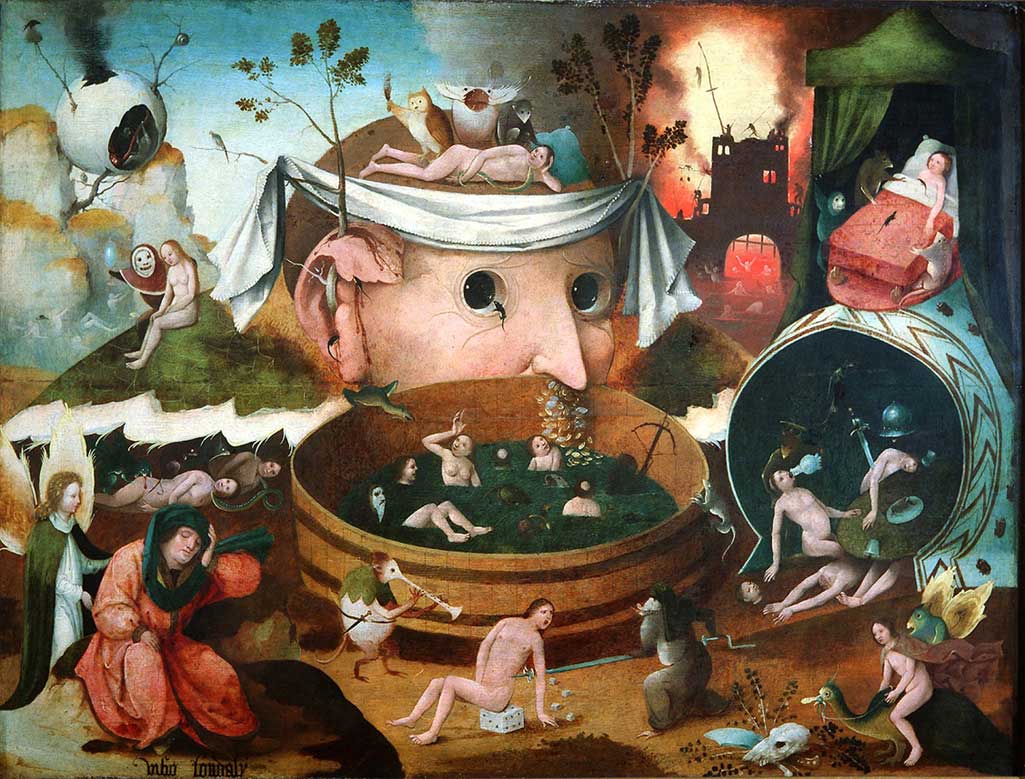
The Vision of Tondal Attributed to the School of Hieronymus Bosch

Dreaming as a chance to reflect on sin is a recurring theme. The potency of conscience seems to follow the soul on its journey to a higher realm. This can be seen in The Vision of Tondal, attributed to the School of Hieronymus Bosch. Tondal, the protagonist of Marcus of Cashel’s illuminated manuscript, dreams that he experiences the punishments of sinners and the rewards of the good, as presented in the Bible. The painting asserts that punishment and reward are always in measure with the actions performed, an allusion itself to Dante’s idea of the Contrapasso.

The exhibition concludes logically with ‘dawn and the awakening’. If sleep is close to death then awakening is close to resurrection. A highlight here is


Battista Dossi’s The Morning: Aurora with Horses of Apollo,

which represents the excitement and perhaps relief of the new day.

An excellent review of the show in its earlier incarnation at the Pitti Palace in Florence


From another excellent review:


Most extraordinary of all is Lorenzo Lotto’s “Sleeping Apollo” from the Museum of Fine Arts in Budapest, from around 1530. In this scenario, the god has been overcome with sleep in a Parnassian grove and, taking advantage of his slumbers, the Muses have ripped off all their clothes — left scattered on the ground at Apollo’s feet along with their scrolls, books, musical instruments and an armillary sphere — and taken to the neighboring meadow, where they can be seen dancing and cavorting, stark naked, with girlish glee.

The angel over Apollo’s head could conceivably indicate that this singular scene is in some way related to Marsilio Ficino’s notion of “vacatio animae,” the theory that during sleep the soul temporarily vacates the body and becomes free of earthly bonds, but here given a uniquely playful spin.

Another landscape by Lotto,


“The Dream of the Young Girl,”

from Washington, opens the next section of the exhibition. This exquisitely painted pastoral vision features a recumbent young girl being showered by a hovering cupid with a stream of flowers, which pour down on her like a shining white waterfall from above, while a female satyr hides behind a tree, watching with amusement the lolling figure of an inebriated satyr at the girl’s feet. The cupid and satyrs seem invisible to the girl and may be part of her dream, but as with the artist’s “Sleeping Apollo” the picture defies any definitive interpretation.


Still another interesting review:


Along with works from local and Italian museums are a remarkable number of excellent loans: the Dosso Dossi Allegory with Pan from the Getty Museum and the Raphael Vision of a Knight from London’s National Gallery particularly stand out.


One could almost miss the undisputed star of the exhibit, Lorenzo Lotto’s small panel of the Allegory of Chastity, from the National Gallery of Art in Washington (ca. 1506). To see this enigmatic painting in person is truly a dream, for no reproduction contains sufficient detail and number of colours to render its delicacy. A woman sleeps against a laurel tree trunk in a landscape and, above, a putto showers her with tiny white flowers. Representing Chastity, she is contrasted by a satyr couple on either side in the foreground—a satyress spying on a drunken and aroused satyr who attempts to get the last drops out of a jug. Look at the treatment of light in this painting, which could be either dusk or dawn. I vote for morning, because Lotto creates the most calming, soft light that seems to just come up from the horizon, starting to brighten the leaves on the trees in the right of the painting, which seem almost afire. Meanwhile, the detail of the tiny white flowers, each petal a daub with a little paintbrush, was added last of all, and is so incredibly delicate.

Images from the exhibition:


The Night (1553–55), Michele di Ridolfo del Ghirlandaio


Paris Bordone, Vénus endormie et Cupidon, Venise, collection G. Franchetti


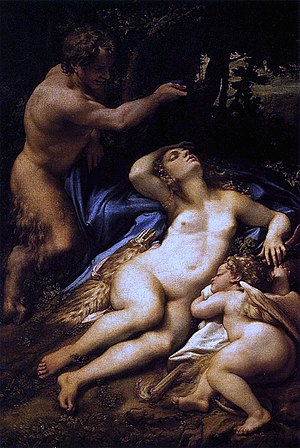
Venus and Cupid with a Satyr (c. 1528) by Antonio Allegri da Correggio.


Philipp II's Dream by El Greco


More images here