Monday, March 10, 2014

Beyond The Visible: The Art Of Odilon Redon


Museum of Modern Art
October 30, 2005–January 23, 2006

http://www.moma.org/exhibitions/2005/odilon_redon.html


Caught between description and dream, the felt and the imagined, French artist Odilon Redon, whose career bridged the nineteenth and twentieth centuries, transformed the natural world into nightmarish visions and bizarre fantasies. Closely allied with the Symbolist movement, Redon offered his own interpretations of literary, biblical and mythological subjects; created a universe of strange hybrid creatures; and presented landscape in a singular way: we see grinning disembodied teeth, smiling spiders, melancholic floating faces, winged chariots, unfamiliar plant life, and velvety black or colored swirls of atmosphere. With a recent gift from the Ian Woodner family, The Museum of Modern Art is now the site of the most significant body of the artist's work outside France, and this book will showcase the full range of Redon's varied oeuvre--charcoal "noirs," luminous pastels, richly textured canvases, literary collaborations and experiments in printmaking--and will illuminate the hold his particular kind of Modernism has had on both twentieth-century and contemporary artists.

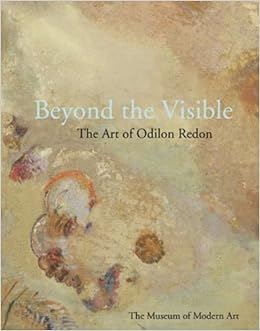
Catalogue


Beyond The Visible: The Art Of Odilon Redon

From a review: (images  added)


Odilon Redon, "The Teeth"

French artist Odilon Redon’s (1840-1916) dark world of the fantastic, featuring figures that Gauguin referred to as "imaginary beings" and not "monsters," will be inhabiting MoMA for another month, offering holiday cheer to those seeking respite from shopping crowds everywhere. The bulk of this exciting retrospective of the Decadent Symbolist is his bizarre drawings, "noirs" that feature lonely figures amid bleak landscapes. A large severed head is carried on a platter in

"Descent into Hell."


In "Eye-Balloon,"

an enormous eyeball in the shape of a hot-air balloon floats through gray skies, its only passenger a head on a plate.


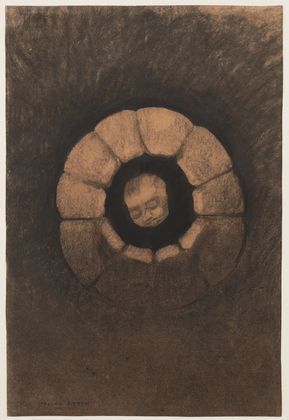
A child’s face looms in the shaft of a dark well in "The Well."


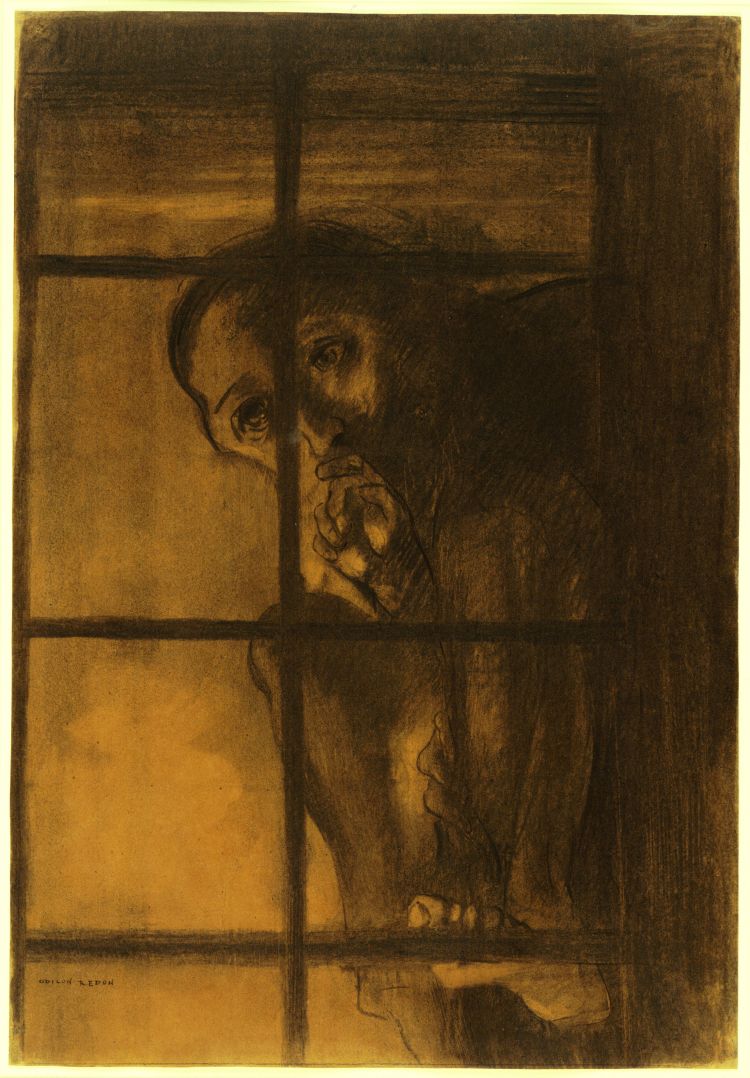
Look closely at the figure’s fingers and feet in "The Convict."


The minute hand in the ominous "The Masque of the Red Death" is a feather brushing away time.

Get up close to "The Teeth" (above) to see how Redon scraped the canvas to create the halo of light around the chattering dentoids.

It wasn’t until the turn of the century that Redon began brightening his works, using pastels, watercolors, and colored wove paper. He continued his techniques of wiping, stumping, incising, erasing, and smudging to create such abstract drawings as


"Roger and Angelica"


as well as the quasi-religious "The Window,"


and the garishly purple "Woman with Flower Corsage."

The earliest painting on view is


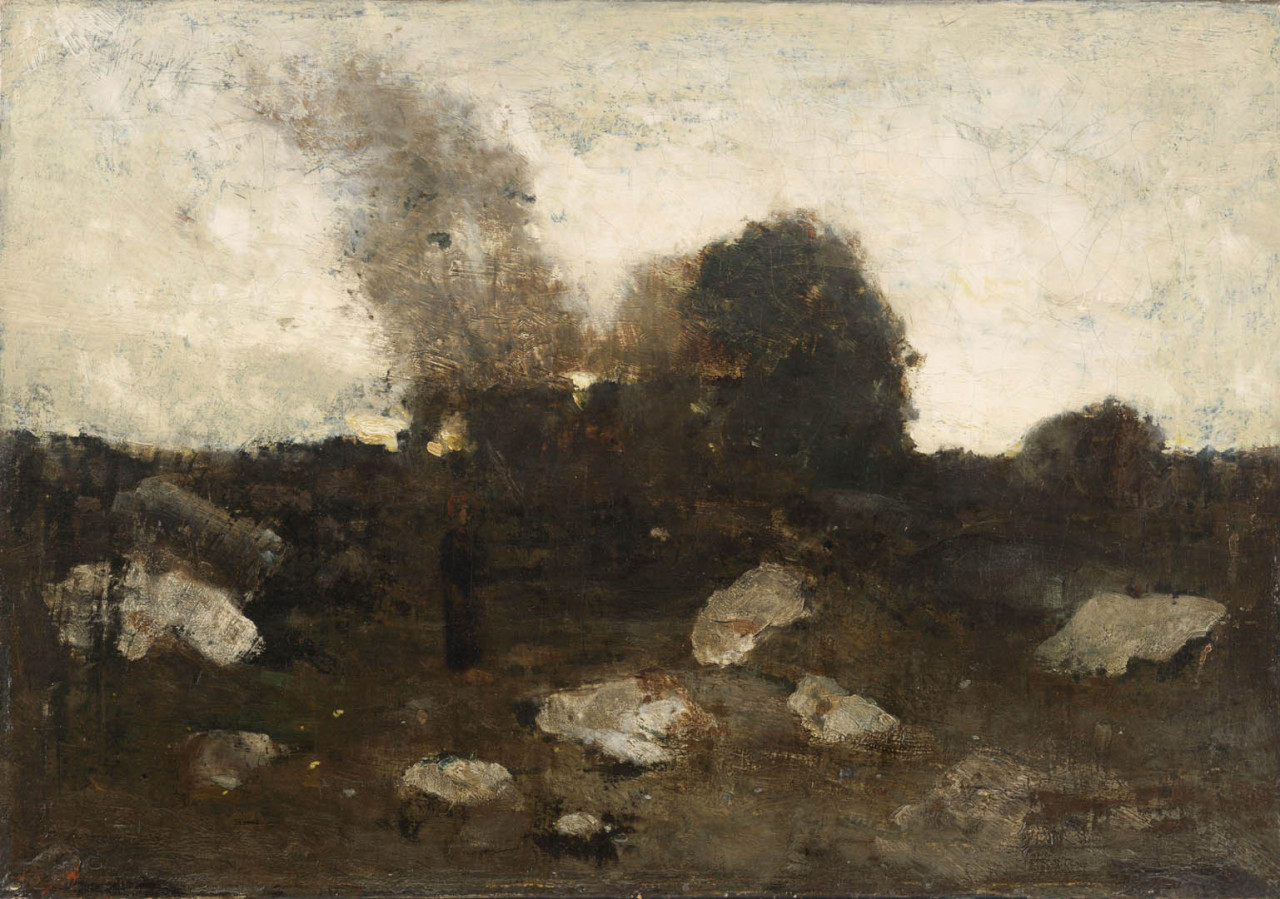
1872’s "Landscape at Daybreak,"

a postapocalyptic image of desolation.


In "The Black Sun,"

two faceless people walk through the desert, a sun with a gloomy face looking down from above.


"Green Death" spins out of a coiled snake.


The canvas itself becomes a character in "Underwater Vision."

The exhibition also features fabulous prints, many of which Redon did for illustrated books. Among our favorites are


"The Misshapen Polyp Floated on the Shores, a Sort of Smiling and Hideous Cyclops" from THE ORIGINS,

the six lithographs that comprise HOMAGE TO GOYA:


"Everywhere Eyeballs Are Ablaze" from the first of several series on THE TEMPTATION OF SAINT ANTHONY,


and the sideshow-esque "And He Had in His Right Hand Seven Stars: and Out of His Mouth Went a Sharp Two-edged Sword" from THE APOCALYPSE OF SAINT JOHN

as well as such cool one-offs as

"The Egg,"

"The Spider,"

"The Haunting,"

and "The Reader";
in the latter, the light seeping through the window forms a kind of spiderweb.
Dark but not disturbing, this welcome Redon tribute will bring out the Goth in you.

Nice article

Georgia O’Keeffe: Abiquiu Views


The Georgia O’Keeffe Museum has announced a series of presentations featuring works inspired by Georgia O’Keeffe’s two residences in Northern New Mexico. The first of these exhibits, “Georgia O’Keeffe: Abiquiu Views,” opened in Santa Fe on February 7, 2014. It features more than a dozen images of the cottonwoods that grow along the Chama River, a subject she painted repeatedly from the late 1940s through the 1950s, with other views from her home and studio at Abiquiu. Over the course of the year, the Museum will explore O’Keeffe’s use of her residence as a source for her artwork. The exhibits include her original studio worktable, arranged with her art materials and personal effects. Subsequent presentations in April, May, and September will focus on her garden, the iconic patio with the black door, and the landscape surrounding her home at Ghost Ranch.


Georgia O’Keeffe, Cottonwood Tree in Spring, 1943, Oil on canvas, 30 x 36 (76.2 x 91.4). Georgia O’Keeffe Museum, Gift of The Burnett Foundation. © Georgia O’Keeffe Museum

Georgia O’Keeffe owned two adobe Pueblo Revival homes in the high-desert plateau of Northern New Mexico. She split her time between the two residences, spending summer and fall at the Ghost Ranch, purchased in 1940, and winter and spring and at her four-acre residence in the village of Abiquiu, purchased in 1945. O’Keeffe painted the views from the homes, but the structures themselves were also an outlet for her aesthetic expression; over the course of the more than four decades that she lived in these residences, her modern sensibility informed the way she shaped and inhabited the spaces of her homes.


c. 1952 oil: Cottonwoods

By bringing together paintings inspired by her residences, some seen for the first time in many decades, this series of exhibitions examines the significance of the homes as part of her artistic practice. “In addition to her artwork, the Museum holds O’Keeffe’s New Mexico homes and contents as part of its extended collection,” said Carolyn Kastner, curator of the Georgia O’Keeffe Museum. “Her homes and the way she lived in them comprise two of her greatest creative efforts, conceived and perfected to suit her artistic practice.” The exhibitions complement the recent Museum publication, Georgia O’Keeffe and Her Houses: Ghost Ranch and Abiquiu.

Related article


Matisse: Life in Color, Masterworks from the Baltimore Museum


Venues

The Indianapolis Museum of Art October 13, 2013-January 12, 2014
Minneapolis Art Institute February 23, 2014 – May18, 2014
San Antonio Museum of Art June 14, 2014 – September 7, 2014

Matisse: Life in Color, Masterworks from the Baltimore Museum of Art features almost fifty paintings and sculptures and thirty works on paper spanning six decades of Henri Matisse’s prolific career.

As one of the most influential artists of the twentieth century, Henri Matisse (French, 1869-1954) fundamentally altered the course of modern art with his stylistic innovations. Across a succession of stylistic periods, Matisse aimed to discover the “essential character of things” through art that expressed balance and serenity. He experimented throughout his career with abandoning conventional perspective and form in favor of dramatically simplified areas of pure color, flat shapes and decorative patterns.

The majority of the artwork in Matisse: Life in Color, Masterworks from the Baltimore Museum of Art come from the renowned Cone Collection, formed by Baltimore sisters Dr. Claribel Cone and Miss Etta Cone. Noted for their enduring dedication to modernism, the sisters assembled one of the largest private collections of the work of Matisse in the world.

From landscapes to nudes, still lifes to interiors, the exhibition’s varied and vivid works explore the shifts in Matisse’s style over time—with a crowd-pleasing emphasis on his popular early paintings.

Highlights include


Purple Robe and Anemones (1937),


Two Girls, Red and Green Background, Interior, Flowers and Parakeets (1924),

and the artist’s book Jazz.

Matisse: Life in Color, Masterworks from the Baltimore Museum of Art also features milestones of Matisse’s career including


The Pewter Jug (1917)


Large Seated Nude (1922-29),


Striped Robe, Fruit, and Anemones, 1940, The Baltimore Museum of Art: The Cone Collection, formed by Dr. Claribel Cone and Miss Etta Cone of Baltimore, Maryland (1950.263)© 2013 Succession H. Matisse / Artists Rights Society (ARS), New York


Large Reclining Nude, 1935

Large Reclining Nude is one of Matisse’s most compelling paintings of the 1930s and an
important work in the transition to his late painting style and to his paper cutouts. He
worked on the painting for several months and documented the stages of its evolution
through photographs. Matisse progressively flattened the image, striving for a balance
between the sinuous arabesques of the figure and the regular grid pattern of the
background.


The Yellow Dress, 1929-1931

In 1929, Matisse was in the midst of a painting block. His production fell off sharply, and
he left a number of paintings unfinished. He began The Yellow Dress in September 1929,
but he struggled for another two years to bring it to a satisfying conclusion as he sought
to achieve a balance between modeled form and outline. Matisse simplified and enlarged
the figure and the dress as the painting progressed, transforming the domestic subject
into something monumental and timeless.


Seated Odalisque, Left Knee Bent, Ornamental Background and Checkerboard, 1928

After seeing an exhibition of Islamic art in Munich in 1910, Matisse became intrigued by
the decorative aesthetics of Near Eastern and North African cultures. Following a trip to
Morocco in 1912–13, images of women in North African costume begin to appear in his
work. The strong patterning of the carpets and textiles dominates this painting.

From a review of the Indianopolis show
:
Per the exhibition title, Matisse wasn't an artist overly enamored with earth tones. But, for Matisse, it was never just about the color. Take a look at his painting,


"Ballet Dancer Seated on a Stool,"

which starts with a bored looking woman wearing a tutu with a white skirt. The skirt is dotted with clumps of dried white paint set against a deep blue background. If the white shock of the skirt resembles at all a splash in the water, then the clumped paint is the foam. The bored, abstracted face of the ballet dancer is far from the center of attention. The tutu pops off the canvas, and the wavelets of paint, rising above the canvas, have a sculptural quality...


More images from the exhibition:


Young Woman at the Window, Sunset

1921


The Cowboy (Jazz Plate XIV) -1947-


Henri Matisse Marie-Jose in a yellow dress (III) 1950 colour lift-ground aquatint (black with four colors)

ABOUT HENRI MATISSE

Henri Matisse (French, 1869–1954) was one of the most influential artists of the 20th century and perhaps the most universally beloved. His stylistic innovations fundamentally altered the course of modern art. In a career spanning six decades, his achievements in painting, sculpture, drawing, graphic arts, book illustration and paper cutouts earned the acclaim of collectors, critics, his contemporaries, and generations of younger artists.

Matisse trained as a lawyer before developing an interest in art. He moved to Paris to study painting in 1891 and eventually
became a fixture of the bohemian Montmartre neighborhood where Picasso, Mondrian, and others worked. He followed the traditional academic path, first at the Académie Julian and then at the École des Beaux Arts, before discovering a dynamic contemporary Parisian art scene. He began to experiment with a variety of styles to create his own pictorial language. In 1905, he exhibited at the Salon d’Automne with André Derain, and their shockingly bold experiments
using color to structure their paintings earned them the derisive nickname “Les Fauves” (Wild Beasts).

He experimented throughout his career with abandoning conventional perspective and form in favor of dramatically simplified areas of pure color, flat shapes and decorative patterns. Across a succession of stylistic periods, Matisse aimed to discover the “essential character of things” through art that expressed balance and serenity.


Relted exhibition:

Matisse from SFMOMA
November 9, 2013 – September 7, 2014


Henri Matisse, La Conversation (The Conversation), 1938. Oil on canvas. SFMOMA, Bequest of Mr. James D. Zellerbach. 93.149. © 2013 Succession H. Matisse / Artists Rights Society (ARS), New York

Henri Matisse, Young Woman in Pink (La Jeune Femme en Rose), 1923. Oil on canvas. Fine Arts Museums of San Francisco, memorial gift from Dr. T. Edward and Tullah Hanley, Bradford, Pennsylvania. 69.30.134. © 2013 Succession H. Matisse / Artists Rights Society (ARS), New York.


Celebrating the Bay Area’s long standing enthusiasm for Henri Matisse, Matisse from SFMOMA traces four decades of the artist’s career—from his early, Cézanne-inspired still lifes to his richly patterned and brightly colored figural paintings made in the 1920s and 1930s.

This intimate exhibition features 23 paintings, drawings, and bronzes from the internationally acclaimed collection of works by Matisse at the San Francisco Museum of Modern Art (SFMOMA), joined by two paintings and two drawings from the Fine Arts Museums of San Francisco’s own important Matisse holdings.

Matisse’s Dancers
November 14, 2012 through February 24, 2013

The Baltimore Museum of Art presented an intimate exhibition of more than 30 dance-themed prints, drawings, and sculptures by the great French artist Henri Matisse. On view from November 14, 2012 through February 24, 2013, Matisse’s Dancers spanned three decades of the artist’s career— from sculptures created in 1909-11 to delicate drawings of dancers sketched in 1949. The centerpiece of the exhibition was a rarely shown series of 11 transfer lithographs of a dancer/acrobat moving through various positions that evolve into an abstraction of reality, movement, and shape. These prints, drawn as lithographs in 1931-32, but published after Matisse’s death, are among the most eloquent examples of the artist’s way of seeing. The BMA has the largest and most significant collection of works by Matisse in the world.

The 1931-32 lithograph series was made around the same time as the famous Dance mural in the Barnes Collection, recently unveiled in Philadelphia. During this period, Matisse made an enormous change in his work, turning to more simplified and structured compositions. The contrast can be seen in an earlier series of prints of dancers from 1926-27. These dancers are not working, but are lounging immobile on couches and chairs like his more familiar odalisques. Two later series of drawings from 1949 show Matisse’s continuing abstraction of movement.

In addition to the prints and drawings, Matisse made sculptures of dancers to explore the challenges of capturing movement in three dimensions. Two early Matisse sculptures of dancers and the BMA’s great Serpentine sculpture by Matisse will be exhibited along with works by a previous generation of artists who were equally fascinated with dancers, Auguste Rodin and Edgar Degas.

MATISSE AT THE BALTIMORE MUSEUM OF ART

The Baltimore Museum of Art has the largest and most significant collection of works by Henri Matisse in the world with approximately 1,500 works, including oil paintings, sculptures, prints, drawings, books, textiles, and a ceramic vessel, as well as 220 drawings, prints, and copper plates from the artist’s first illustrated book, Poésies de Stéphane Mallarmé.

Upside Down Lady (1930) from French poet Stéphane Mallarmé's book 'Poésies'.

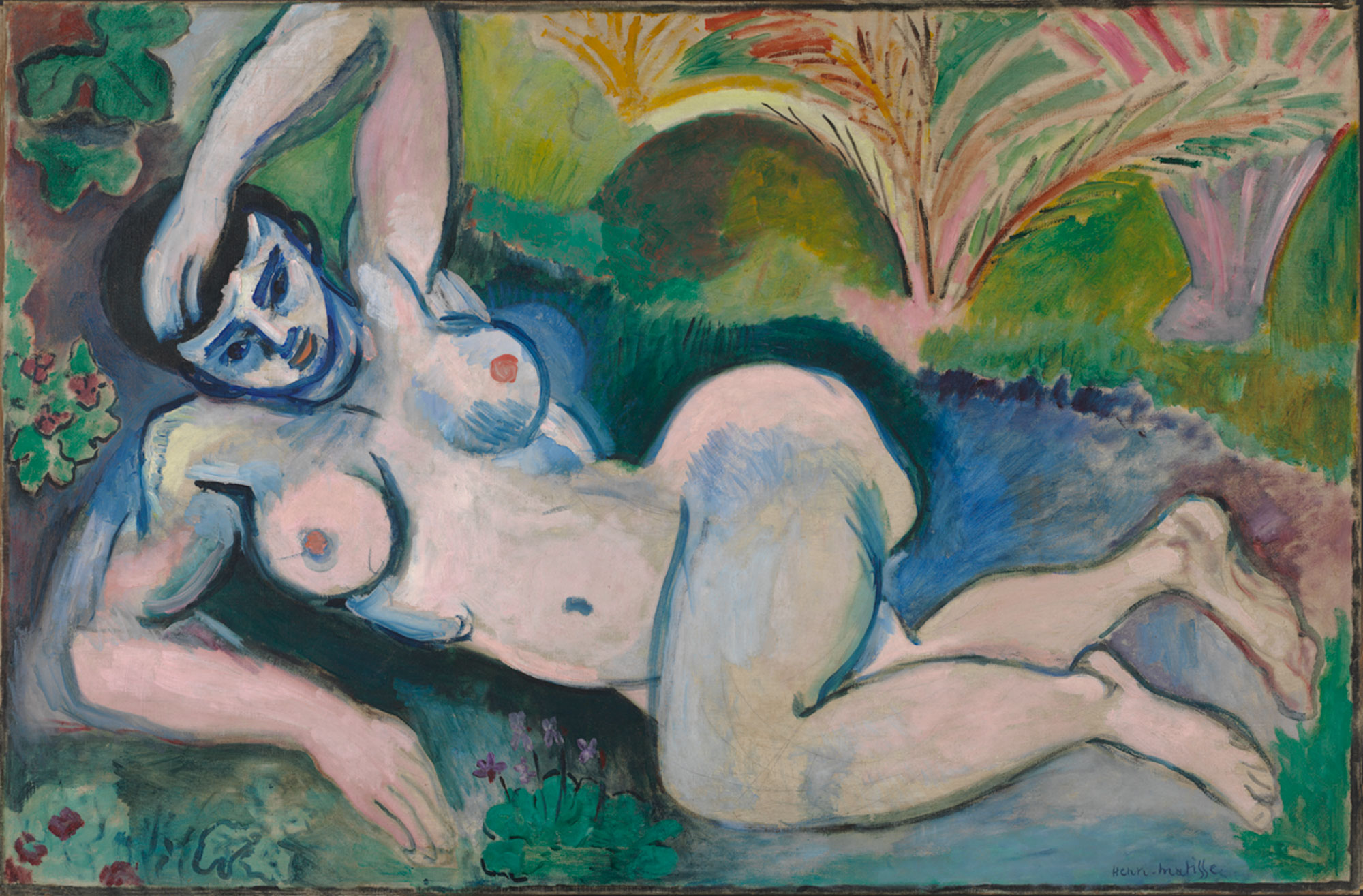
This extraordinary collection began with a gift of 500 Matisse works from Baltimore sisters Claribel and Etta Cone, who had visited the Paris studios of Matisse and Pablo Picasso in the early 20th century and began forming one of the world’s greatest collections of modern art. Over the course of nearly 50 years, they assembled an exceptional collection of approximately 3,000 objects, which were displayed in their Baltimore apartments. Etta Cone met Matisse in 1906, and her initial purchase of several drawings marked the beginning of a life-long passion for his art that continued throughout his career. With masterworks such as


Matisse’s Blue Nude (1907)

competition among museums for The Cone Collection began as early as 1940, but Claribel insisted that it go to The Baltimore Museum of Art if “the spirit of appreciation for modern art in Baltimore became improved.” The collection came to the BMA upon Etta’s death in 1949, and has been on view since 1957. The collection has been the subject of exhibitions at prestigious museums around the world and celebrated in Baltimore with redesigned and expanded galleries that include a dynamic touch-screen virtual tour of the apartments where the Cone sisters lived with their remarkable collection. In recent years, the BMA has conducted ground-breaking research on Matisse’s sculpture and organized major traveling exhibitions with accompanying catalogues on Matisse’s sculpture and prints.
Saturday, March 8, 2014

The Art of the Louvre’s Tuileries Garden


Venues

Atlanta’s High Museum of Art from Nov. 3, 2013 to Jan. 19, 2014,
Toledo Museum of Art, Toledo, Ohio Feb. 13 – May 11, 2014
Portland Art Museum in Portland, Oregon from June 14 – Sept. 28, 2014.


The Art of the Louvre’s Tuileries Garden will present more than 100 paintings, photographs, drawings and sculptures exploring the art, design and evolution of Paris’ famed Tuileries Garden and its impact on such artists as Édouard Manet, Camille Pissarro, Childe Hassam and many others.

Marie Antoinette, Napoleon Bonaparte and King Louis XIV each reveled in the perfectly manicured grounds of the Tuileries Garden at different points in history. Today, more than 10 million visitors stroll through the famous Parisian park annually. And from Feb. 13 – May 11, 2014, the Toledo Museum of Art will bring this remarkable urban space to life stateside with the major international exhibition The Art of the Louvre’s Tuileries Garden, organized by the High Museum of Art, Atlanta, the Portland Art Museum, Oregon and the Toledo Museum of Art, with the special collaboration of the Musée du Louvre.

The majority of the works, most never before exhibited in the United States, will be on loan from the vast collections of the Louvre, with some from the Musée Carnavalet, the Palace of Versailles, other museums and private lenders.

“Our collaboration with the Louvre is a splendid moment for both institutions,” said TMA Director Brian Kennedy. “It’s a wonderful opportunity to celebrate the Louvre’s history and to enable our audience to see works of art they would otherwise have to travel to Paris to view. It will bring a bit of the magic of the Tuileries to Toledo.”

TMA’s Libbey Court and Canaday Gallery will dramatically showcase more than 100 works related to the garden and palace of the Tuileries, including large-scale sculptures created between the 17th and 20th centuries by such noted artists as Antoine Coysevox and Aristide Maillol. There will also be more than two dozen paintings (including six by Impressionist artists), architectural models, historic and recent photographs, a tapestry and prints. The unique collection will offer an opportunity to see a slice of the garden that inspired everyone from Impressionist Camille Pissarro to photographer Henri Cartier-Bresson.

The Tuileries has a long and storied history. Originally commissioned in 1564 by dowager queen Catherine de Medici, it combined a magnificent palace and an extensive formal garden. In the mid-17th century Louis XIV (the “Sun King”) ordered its expansion and extraordinary embellishment. André Le Nôtre (1613 – 1700), designer of the renowned gardens of Versailles and Vaux-le-Vicomte, ingeniously designed and realized the grand project.

In part, the exhibition celebrates the career of Le Nôtre—generally regarded as the greatest landscape architect in European history—on the 400th anniversary of his birth. His design for the Tuileries Garden richly combined magnificent vistas, lawns, fountains, hedges, pathways, flowerbeds, terraces and wooded areas, all of the ensemble embellished with sculpture.

Residents of the famous Tuileries Palace included several French kings—Louis XIV, Louis XV, and Louis XVI—as well as Marie Antoinette and Napoleon Bonaparte. While the palace was internationally noted for its elegance and royal associations, an uprising of 1871 saw it gutted by fire. The palace lay empty and desolate until 1883, when the government of the Third Republic ordered its demolition. Today, a lawn connecting the westernmost pavilions of the Louvre marks its original site. Prints, vintage photographs and a scale model will trace the history, grand style and ghostly presence of the historic structures.

The Tuileries Garden—now integrated with the magnificent courtyard of the Louvre and featuring more than a hundred sculptures and three art galleries—remains the largest green space in the heart of Paris. This special exhibition at TMA will provide a rare opportunity to experience a small part of this monumental French hallmark.

This special exhibition is co-organized by the High Museum of Art, Atlanta, the Toledo Museum of Art and the Portland Art Museum, Oregon, with the exceptional collaboration of the Louvre.


Pissarro, Place du Carrouse Paris


Hassam,  Tuileries Gardens


Chavet,  Le Louvre de Napoleon III 


Pissarro, The Tuileries Gardens on a Winter Afternoon

Richard Estes’ Realism


Richard Estes’ Realism” is the most comprehensive exhibition of Estes’ paintings ever organized. A master of contemporary realism, Estes is primarily known as a painter of the urban landscape. The exhibition features nearly 50 paintings from Estes’ first mature New York City facades from the late 1960s to panoramic views of Manhattan and other cities and natural sites around the world. 


Richard Estes, Double Self-Portrait, 1976, oil on canvas, 24 x 36 inches, The Museum of Modern Art, New York. Mr. and Mrs. Stuart M. Speiser Fund, 1976. © Richard Estes, courtesy Marlborough Gallery, New York. Digital image © The Museum of Modern Art/Licensed by SCALA/Art Resource, NY

Jointly organized by the Smithsonian American Art Museum and the Portland Museum of Art in Portland, Maine, the artworks in “Richard Estes’ Realism” are selected by Patterson Sims, an independent curator, and Jessica May, curator of contemporary and modern art at the Portland Museum of Art. Virginia Mecklenburg, chief curator at the Smithsonian American Art Museum, is coordinating the exhibition in Washington, D.C. The exhibition will be on view at the Portland Museum of Art from May 22 through Sept. 7 and at the Smithsonian American Art Museum from Oct. 10 through Feb. 8, 2015. 


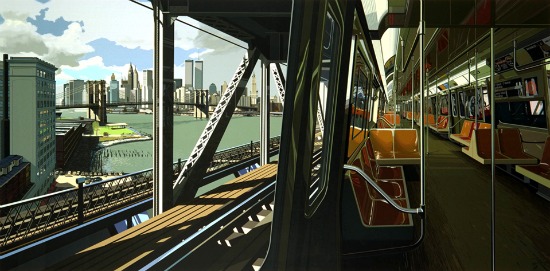
  D Train, by Richard Estes. Photo courtesy of the American Art Museum.  

The exhibition explores the full range of Estes’ career as a painter. Widely acknowledged as a pioneering practitioner of photorealism, Estes’ sharply focused technique goes beyond the photographic to create complex constructions of light, reflection and perspective. Paintings in the exhibition balance Estes’ interest in cities with his explorations of the Maine coast and the woods on Mount Desert Island, where he has spent part of each year since the late 1970s. Most recently, Estes turned from luminous sunlit scenes to nocturnal images of New York City. Several of Estes’ rare portraits also are included in the exhibition. 


Ten Doors, 1972 Richard Estes Smithsonian American Art Museum (Washington, DC)

Estes’ compositions—amalgamations of the multiple photographs he takes for each composition—are dramatic and complex to the point of ambiguity. He layers and merges multiple viewpoints to create dense and detailed scenes. Though figures are often present in his work, they are—like most passersby in public spaces—anonymous and uncommunicative. His seemingly effortless technical finesse captures the intricate geometries of the city, the subtle contours and nuanced tones of natural landscapes and the shimmering fluidity of water. Estes’ realism is a compelling record of the appearance of urban and natural environments in the late 20th and early 21st century.

About the Artist

Born in 1932 and raised in central Illinois, Estes studied at the School of the Art Institute of Chicago from 1952 to 1956. In 1959, he moved to New York City, where he has lived ever since. For several years, he worked in commercial publishing and advertising as a paste-up, layout and illustration artist. In the mid-1960s, Estes began to paint from his own photographs, developing paintings that are rooted in Dutch, Venetian and American representations of urban architecture. In 1978, the Museum of Fine Arts in Boston organized the first major career survey of his work, which was followed by his 1991 retrospective at the Portland Museum of Art in Maine. Estes is considered the foremost practitioner of the international group of artists known loosely as photorealists and has been celebrated for more than 45 years as one of the premier painters of American cityscapes.

Publication

“Richard Estes’ Realism” is accompanied by a catalog with essays on Estes’ by Sims and May. The book also includes a detailed chronology by independent art historian Helen Ferrulli. It is published by the Portland Museum of Art and the Smithsonian American Art Museum, and distributed by Yale University Press.

Credit

“Richard Estes’ Realism” is organized by the Smithsonian American Art Museum and the Portland Museum of Art, Maine. 

More images:

Nice site

Nice site #2

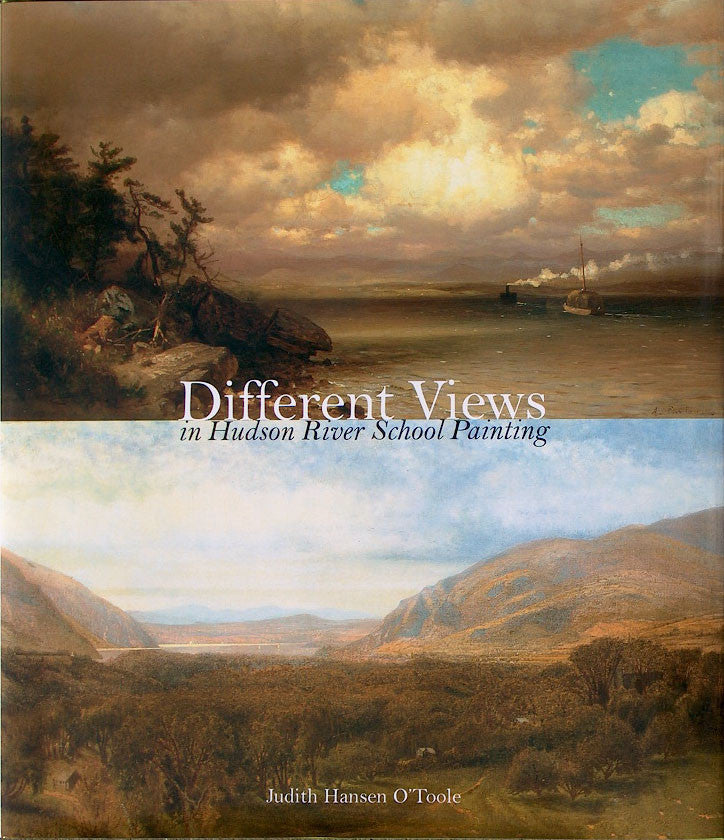
American Scenery: Different Views of Hudson River School Painting

Venues

Westmoreland Museum of American Art, Greensburg, Pennsylvania. August 7 - October 23, 2005
Samuel Dorsky Museum of Art at the State University of New York at New Paltz. February 4-May 14, 2006
Everhart Museum, Scranton 2007
Museum of the Shenandoah Valley, Winchester, VA, Oct 2010 - Jan 2011
Reading Public Museum, Reading PA . February 19-June 5, 2011

Blanton Museum of Art at The University of Texas at Austin.  February 26–May 13, 2012


American Scenery: Different Views of Hudson River School Painting, featuried116 paintings from the Hudson River School, a loose collective of artists working in upstate New York from 1825-1875, whose works comprised America’s first native artistic style.


Thomas Prichard Rossiter (1818-1871) Niagara Falls, 1858 Oil on canvas, 13 1/2 x 24 inches Private collection 

Artists included in the Hudson River School, and represented in exhibition, are Thomas Cole, Jasper Francis Cropsey, Sanford Robinson Gifford, Asher B. Durand, Frederic Edwin Church, John Frederick Kensett, and John William Casilear, among others.


John William Casilear (1811-1893), Niagara Falls, 1872, oil on canvas, 13 x 23 inches, private collection, courtesy of Westmoreland Museum of American Art, Greensburg, Pennsylvania;

Assembled from a single private collection, this touring exhibition is organized by the Westmoreland Museum of American Art in Greenburg, Pennsylvania.


Sanford Robinson Gifford, A Lake Twilight, 1861, oil on canvas, private collection
(courtesy of Westmoreland Museum of American Art)


Founded in 1825 by Thomas Cole, the Hudson River School drew its inspiration from America’s landscape. Its artists shared a spiritual awe of nature and believed in the notion that the country’s untamed wilderness reflected aspects of its national character.


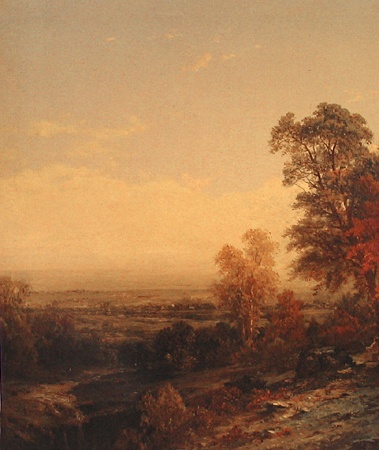
Jervis McEntee (1828-1891), Indian Summer, 1862, oil on canvas, 10 x 18 inches, private collection, courtesy of Westmoreland Museum of American Art, Greensburg, Pennsylvania;


American Scenery
investigates the group’s shared aesthetic and philosophical principles and situates the paintings in the context of nineteenth-century American values. The exhibition’s unique point of view stresses the artist’s eye, pairing and grouping paintings that explore the visual characteristics of particular sites, or that examine the subtle changes that can be observed during varied seasons, times of day, and weather conditions.


Considered by many to be the first truly American school of painting, the Hudson River School flourished between 1825 and 1875 and celebrated the vast natural resources of the American landscape just prior to the industrialization that forever changed that landscape. The movement was embraced by three generations of artists who shared common principles which united them as a school despite their individual differences in style. Primary among these was a belief in natural religion, a deep admiration for the magnificence of the land, and a keen interest in the direct observation of nature. Most importantly was an awareness of the fresh, untamed American scenery as reflective of the optimism and independence of our character as a young nation. The style was not geographically confined to the Hudson River region, however, and


 Thomas Cole's Sunset at the Arno (1837),


paired with Frederic Church's Ruins at Baalbek (1868)

were selected to compare approaches to the landscape outside of the region.

The exhibition investigates the practice of how Hudson River School artists created pairs, series, and groupings of landscape paintings that are thematically related and intended to be viewed together. Visitors are encouraged to compare and contrast how different generations of artists interpreted the majestic American landscape. Influenced by the ever-changing landscape around them, artists and works in the exhibition are organized according to nine themes, including Times of Day; Weather Conditions, Atmosphere, and Mood; Man's Impact on Nature; The Machine in the Garden.

The purpose of the exhibition is to revive the public's ability to appreciate nineteenth-century American landscape painting and to provide insight into the iconographical base that gives it greater meaning in order to more fully comprehend its achievement. This will also bring about a deeper understanding of the profound reaction our forefathers experienced when encountering the extraordinary natural bounty of America and how it was attuned to the buoyant hopes they held for their lives in this new nation.


The exhibition was accompanied by a fully illustrated catalogue published by Columbia University Press and includes full-color reproductions of all 114 paintings in the exhibition, an essay, a complete checklist, and descriptions of each pairing and grouping of paintings. The catalog's essay traces the tradition of pairs and series of paintings beginning with the medieval books of hours, through to Nicholas Poussin and Claude Lorraine whose paintings were known to and influenced the early painters of the Hudson River School. The school's founder, Thomas Cole painted in series in order to communicate his narrative themes, whose complicated imagery could not be accommodated in a single painting. Later artists of the school used other, more subtle methods of imbuing their landscapes with meaning, including using a set iconography that was known both to the artists and to their audience and included natural cycles such as seasons and times of day, light effects caused by weather, and the positioning of trees and animals within the landscape.

Nice review

Images from the exhibition


James McDougal Hart
1828-1901
On the Farmington River, 1862
Oil on canvas
19 x 32 inches


William McDougal Hart

1823-1894
Sunset in the Valley, 1870
Oil on canvas
14 x 23 _ inches


Jasper Francis Cropsey
1823-1900
On the Susquehanna, 1877
Oil on canvas
12 x 17 _ inches


Asher Brown Durand
1796-1886
Woodland Interior, c. 1855
Oil on canvas
20 x 16 inches


Sanford Robinson Gifford
1823-1880
A Lake Twilight, 1861
Oil on canvas
16 x 28 inches


John William Casilear
1811-1893
Autumn Landscape with Fisherman, c. 1865-
1870
Oil on canvas
12 _ x 10 inches


Martin Johnson Heade
1819-1904
White Mountain Landscape, Mount Washington,
1871
Oil on canvas
9 x 15 _ inches