Christie’s TheArt of the Surreal Evening Sale on
Tuesday 2 February 2016 comprises 42 lots by a total of 16 different
artists, the broadest array to be offered to date. The sale is led by The Stolen Mirror a technical tour-de-force by Max Ernst and one of the artist's finest works (estimate: £7-10 million). Now in its 16th
year, this much anticipated and unique annual standalone surreal sale
features further highlights by Pablo Picasso, Wilfredo Lam, René
Magritte, Joan Miró and Salvador Dali. Christie’s overall evening of
Impressionist, Modern and Surrealist Art on 2 February has a total
pre-sale estimate of £87.3 million to £129.1 million.
These Evening sales open a week of five Impressionist, Modern and
Surreal art sales at Christie’s King Street and South Kensington, across
media and price points. With estimates starting from £300 up to £10
million the sales present new and established collectors with a wealth
of opportunities to acquire and celebrate examples by masters of the
period.
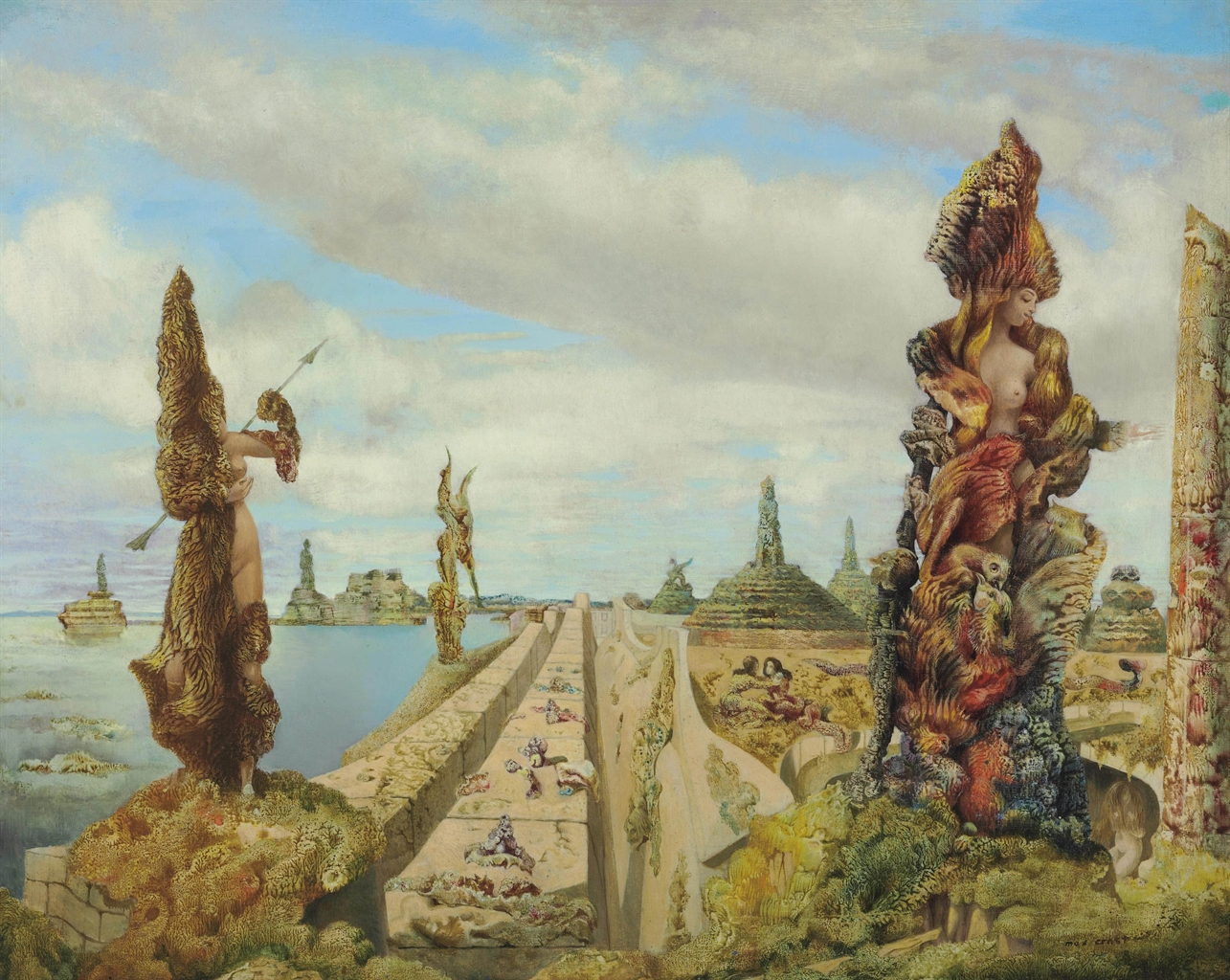
A museum quality work and the cover lot of the sale, The Stolen Mirror by Max Ernst (1891-1976) is a surrealist technical tour-de-force,
highly autobiographical and one of the artist's finest works (estimate:
£7-10 million). This dream-like landscape was painted in 1941 at the
pinnacle of Ernst’s oeuvre, when he was using the decalcomania technique
of manipulating paint which he picked up from Oscar Dominguez. Many
Surrealists tried the technique though Ernst was the only one to adapt
decalcomania in a sustained manner to painting in oils on canvas. Rarely
employing it as an end in itself, but rather as a means to create the
unexpected, he became a master of the technique and achieved a
remarkable degree of control over a fundamentally unpredictable process.
The current record for a work by the artist, realising £10,283,175/
$16,322,500 at Christie’s in 2011, this painting once belonged to Edward
James, one of the foremost early collectors of Surrealist art; it was
later re-acquired by Ernst’s son Jimmy Ernst and descended through the
family to the estate of Edith Dallas Ernst, from which it was last sold. Previous sale: http://www.christies.com/lotfinder/paintings/max-ernst-the-stolen-mirror-5493627-details.aspx
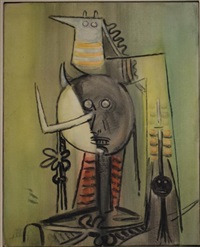
Infused with a sense of drama and mystery, Chant de la Forêt
by Wifredo Lam (1902-1982) captures the dark and enigmatic power of the
Cuban landscape and stimulates the imagination in its suggestion of the
presence of unseen forces, hidden in the depths of the forest
(estimate: £1.3-1.8 million). Fusing vegetative forms with sharply
angled shapes, the artist creates a hybrid creature, part animal, part
plant and part mystical being. Its hybridity simultaneously referencing
Surrealist thought, the indigenous landscape of Lam’s homeland, and the
unique elements of the Afro-Cuban culture which survived there. Painted
in 1946, Chant de la Forêt was created following Lam’s return
to Cuba after almost two decades living in Europe. This homecoming
prompted an extraordinary breakthrough in the artist’s work, as he
reconnected with his cultural roots. Hinting at a presence beyond the
conscious world, this work elegantly fuses the unique spiritual elements
of the Cuban culture with its distinctively lush landscapes to achieve a
bold new approach to Surrealism.
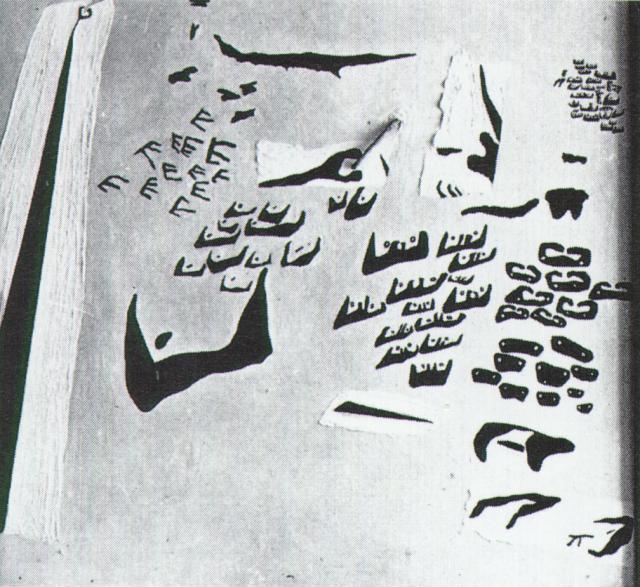
Throughout much of 1928 Salvador Dali was greatly preoccupied with
ideas about anti-art, the establishing of a new-objectivity and the
exploration of what his new Catalan friend Joan Miró had recently
defined as ‘the assassination of painting’. Fishermen in the Sun
is the finest of a unique, distinctive and very rare series of six
relief-paintings made during this period in which Dali pioneered a
completely new stylistic direction in his work; of these six paintings,
four now reside in museums including the Fundación Gala-Salvador Dal,
Figueras and the Reina Sofía, Madrid (estimate: £700,000-£1,000,000).
In 1928, Dali embarked on a unique series of works that made use of
real, tactile, three-dimensional materials and reduced his already
amorphous and anamorphic forms to two-dimensional semi-abstract cyphers
that simultaneously suggested many different things at once. His aim was
to move beyond all the old ideas of painting while widening the
revelatory potential of his art to speak directly to man’s unconscious
mind. As Fishermen in the Sun highlights, Dali forged a series
of radically new psychic landscapes that, with their suggestions of an
atemporal sandy plain of strange hallucinatory possibility stretching
out beneath a strip of empty blue sky, lay the foundations for the
dramatic, hyper-realist paintings that he began his Surrealist career
with in 1929.
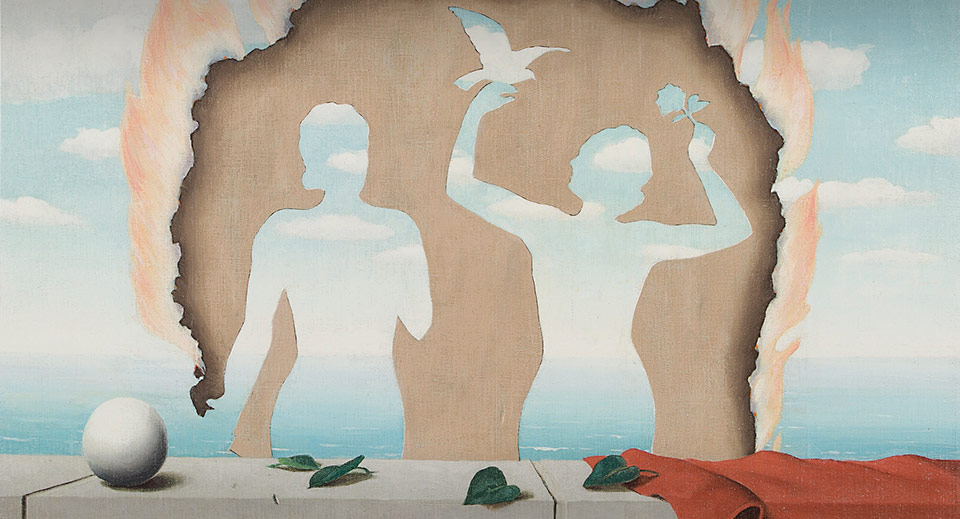
Painted in 1942, Mesdemoiselles de l'Isle Adam by René
Magritte (1898-1967) showcases the layers of wit, beauty, mystery and
subversion that characterised the greatest of his pictures from the
period (estimate: £2-3 million). It is telling that this picture has had
such a distinguished history: after remaining in Magritte's hands for
around a decade, it was acquired by his friend Justin Rakofsky, before
entering the collection of Gustave Nellens, the owner of the casino at
Knokke-le-Zoute, Belgium, which was decorated with monumental murals by
Magritte. As with the greatest of Magritte's works, this paintingplays with the viewer's preconceptions of art, and therefore of life. Mesdemoiselles de l'Isle Adam
dates from a crucial watershed in Magritte's life when, in a bold
response to the Second World War which had engulfed Magritte, his work
moved toward a lighter and brighter approach.
Painted in March 1968, Femme et oiseaux dans la nuit (Woman
and Birds in the Night) by Joan Miró (1893-1983) is a major large-scale
painting of one of the artist’s favourite subjects, made for an
important travelling retrospective exhibition of his work held at the
Fondation Maeght in Saint-Paul-de-Vence, the Antic Hospital de la Santa
Creu in Barcelona and the Haus der Kunst in Munich between 1968 and 1969
(estimate: £3-5 million). Of all these venues, it was Miró’s exhibition
in Barcelona, his first in Spain for over fifty years, which was to
prove the most lastingly important as it led directly to the
establishment of the Miró Foundation there seven years later. Femme et oiseaux dans la nuit is
one of several paintings on the poetic theme of women, birds and the
night that Miró made in the mid-1960s, at a time when he was pursuing
the joint influences of recent American painting and of Japanese
calligraphy on his own uniquely poetic, instinctive and gestural style
of painting.
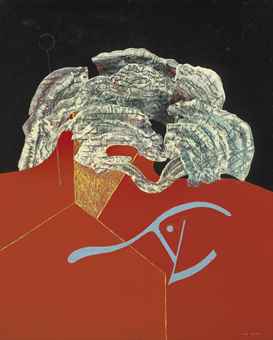
At auction for the very first time, having been hidden in a distinguished private collection for over half a century, Fleurs coquilles sur fond marin,
1928, by Max Ernst (1891-1976) is a large red and black ‘shell-flower’
painting in which the artist presents a mysterious but also distinctly
natural landscape of the kind that had distinguished his early frottage
works in his famous graphic series Histoire Naturelle (estimate:
£600,000-900,000). A colourful and also highly painterly combination of
flat, abstract and geometric form with broad grattage scrapings of paint
used to form two amorphous but strangely organic structures reminiscent
of shells, flowers and geological rock formations, Fleurs coquilles sur fond marin is a work that invokes a strange, abstract world full of biological magic and possibility.
Featuring three works from The Fiterman Collection all by Joan Miró, The Art of the Surreal Evening Sale includes Tête, Paysage, Constellation
(1974, estimate: £600,000-900,000, pictured page 1), one of a series of
bold, free and dramatic paintings that the artist created in the early
1970s. Included in one of the largest retrospectives of Miró’s work held
at the Grand Palais in Paris in 1974, this work employs some of the
most central and iconic themes and pictorial motifs of Miró’s career –
namely, the head of a figure, stars and a nocturnal landscape – and
portrayed them with a dramatic simplicity and expressive power. Also
offered for sale are a pair of Miró’s groundbreaking experiments with
found objects and sculpture, including Femme et oiseau (1967,
estimate: £700,000-1,000,000), one of the first of a pivotal series of
painted bronze sculptures that Miró began of the same year. Another
major work L’Oiseau au plumage rougeâtre annonce l’apparition de la femme éblouissante de beauté (The Russet-feathered Bird Announces the Apparition of the Dazzlingly Beautiful Woman),
(1972, estimate: £300,000-500,000) soars from the ground at over two
metres tall and illustrates the artist’s playful and inventive
imagination, revealing his ability at envisioning birds and human
figures from an amalgamation of seemingly incongruous, quotidian and
natural objects.
As curving planes and facets of flattened monochrome colour collide
and coalesce across the surface of the canvas, a surreal visage emerges
in the striking Arlequin by Pablo Picasso (1881-1973) from 1926 (estimate: £1.5-2.5 million). Depicting two profiles of a face simultaneously, Arlequin
is one of a series of split, biomorphic portraits that Picasso created
while spending the summer on the French Riviera, and marks a major shift
in the artist’s style as he left behind the rotund Neo-Classical
goddesses that had graced his work of the early 1920s, and began
painting darker, psychologically intense and dramatic subjects that
exude a surreal, often disquieting quality. Painted with a stark
palette, Arlequin has a compelling intensity, portraying with a
striking economy of means, a labyrinthine depiction of the human face.
Picasso’s art at this time appeared in some ways to align with the aims
of the Surrealists; he shunned reality in his painting and unleashed his
emotions to convey a psychological, subconscious and dramatic raw
emotional response to life.
Overall, the sale presents surrealist works by a total of 16 artists,
including further works by: Andre Masson; Giorgio de Chirico; Hans
Bellmer; Man Ray; Oscar Dominguez; Paul Klee; Peter Rose Pulham; Victor
Brauner; Wols; and Yves Tanguy.
Christie’s Impressionist & Modern Art Evening Sale on Tuesday 2 February 2016 will present works by leading artists of the late 19th and 20th century. The saleincludes
50 lots which trace the rich variety and breadth of revolutionary
movements from the period, from Impressionism, to early Modernism,
Cubism, Colourist works and Expressionism; presenting a selection of
celebrated, museum quality works - many of which are coming to the
market for the first time in generations - with attractive estimates at
all price ranges. This sale opens a week of five Impressionist, Modern
and Surreal art sales at Christie’s King Street and South Kensington.
With estimates starting from £300 up to £10 million, the auctions
present new and established collectors with a wealth of opportunities to
acquire rare and seminal examples by masters of the period.
The Impressionist & Modern Art Evening Sale
is led by a self-portrait by Egon Schiele painted when the artist
reached creative maturity in 1909 (estimate: £6-8 million); one of Marc
Chagall’s most romantic paintings of the 1920s, Les mariés de la Tour Eiffel (estimate:
£4.8-6.8 million); the largest of a series of four works Paul Cézanne
created at the home of legendary Impressionist collector Victor Chocquet
(estimate: £4.5-6.5 million); Le moteur, 1918, which dates to
one the most important periods of Fernand Léger’s career (estimate: £4-6
million); a still life by Pablo Picasso from 1937, painted on the eve
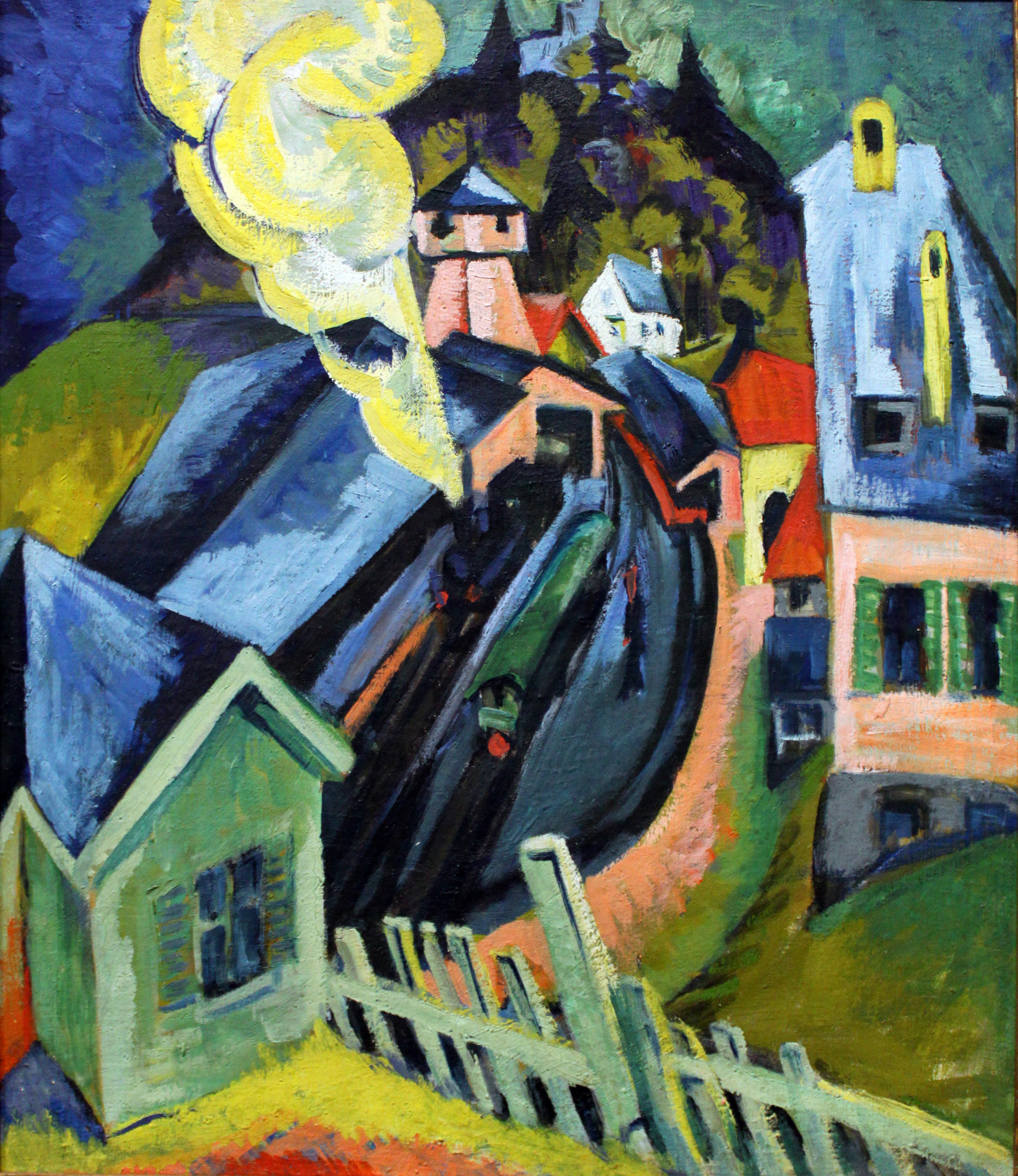
of Guernica (estimate £4-6 million); a rare oil Chrysanthemum by Piet Mondrian (estimate: £1.6-2.4 million); and Bahnhof Königstein,
1916, a major painting by Ernst Ludwig Kirchner from the artist’s last
truly expressionist period, from the collection of the industrial
chemist Dr Carl Hagemann (estimate: £1.5-2 million).
Ferme en Normandie, été (Hattenville),
1882, by Paul Cézanne (1839-1906) is being offered at auction for the
first time in almost 20 years, having been acquired by the present owner
in 1997 (estimate: £4.5-6.5 million). This is the largest of a series
of four works that Cézanne created during a summer break at the home of
his friend, the legendary impressionist collector Victor Chocquet, in
Hattenville, Normandy. Chocquet, one of the first champions and earliest
collectors of Impressionism, was also the first owner of this painting;
it remained in his collection until his death. Painted at a time when
Cézanne was reaching artistic maturity, this work exemplifies a crucial
moment in the artist’s career, illustrating his move from Impressionism
towards his own distinctive and highly influential ‘constructed’ style.
Rather than a fleeting depiction of a transitory moment, this is a
carefully considered and constructed composition, which transforms the
landscape into a timeless, enduring image, qualities which lay at the
very heart of Cézanne’s artistic practice. Constantly striving for the
best means to capture the beauty, grandeur and structure of the world
around him, Cézanne invented a whole new way of looking and painting
nature, opening the door for a generation of subsequent artists.
Selbstbildnis mit gespreizten Fingern(Self-Portrait with Spread Fingers) by
Egon Schiele (1890-1918) was painted in 1909, a breakthrough year when
Schiele reached creative maturity (estimate: £6-8 million). Although
only nineteen years old, Schiele’s prodigious talent had already
asserted itself to the point where he had become recognised by Gustav
Klimt among others, as one of the greatest hopes for the future of
Austrian art. An important early work, this painting reveals Schiele
already beginning to move beyond the dominant influence of his mentor
Klimt towards a new, more existentially aware expressionist art. With
its self-conscious depiction of the artist’s features emerging from a
typical gold-ground Secessionist background this work was an
announcement of Schiele’s arrival into the contemporary art world of
Vienna - a new character taking the stage. Schiele’s first self-portrait
oil made for public display, it is a clear statement of how Schiele saw
himself as working ‘through’ or ‘by way’ of Klimt and the Seccession,
towards a newer more transcendent style of his own. Previous sale: http://www.christies.com/lotfinder/AAA/AAA-4860121-details.aspx
Offered from the collection ofthe industrial chemist Dr Carl Hagemann, Bahnhof Königstein, 1916,
is a major painting by Ernst Ludwig Kirchner (1880-1938) deriving from
the artist’s very last truly expressionist period shortly before he left
Germany for good, in 1917, to convalesce in Switzerland (estimate:
£1.5-2 million). This is one of a rare and important group of paintings
that Kirchner made in and of the landscape around Königstein in the
Taunus region near Frankfurt, where he had been ordered to enter a
sanatorium after being discharged from the army in September 1915. Bahnhof Königstein
is one of the first of Kirchner’s paintings to have been bought by Carl
Hagemann, an important friend, patron and life-long supporter of the
artist and his work. Priced originally at 600 marks, this painting was
the most highly priced oil that Kirchner sold to his new patron in 1916.
A letter from Kirchner to Hagemann written in September 1916 reveals in
what high regard Kirchner held this particular painting and how
important Hagemann’s patronage was during this critical time of upheaval
for the artist.
Dating from one of the most important periods of Fernand Léger’s (1881-1955) career, Le moteur
was painted in May 1918, just months after the artist had resumed
painting following his discharge from the army (estimate: £4-6 million).
Taking as its subject a gleaming, multipartite, modern engine, Le moteur
is one of the first of a group of visionary works that marks the
beginning of Léger’s renowned ‘mechanical period’, which would come to
define his art of the years following the First World War. Keen to
embrace modernity in all its varied forms, Léger deified the machine
during this period, using a fragmented, dynamic pictorial vocabulary
with which to depict it. With its riotous explosion of bold colour,
frenzied interlocking and overlapping forms and jubilant patterns and
texture, Le moteur is a glorious example of this series of
works: a vibrant emblem of the industrialised and modernised post-war
era that so enthralled the artist.
Acquired over 30 years ago, Les mariés de la Tour Eiffel
by Marc Chagall (1887-1985) is one of the artist’s most romantic
paintings of the 1920s, celebrating the love between the artist and his
wife, Bella, as they entered a new phase of security and contentment in
their lives (estimate: £4.8-6.8 million). Painted in 1928, the work
features a double portrait of the couple as they tenderly embrace in the
shadow of the Eiffel Tower. Their daughter Ida floats through an open
window, which acts as a fluid boundary between the interior and exterior
world, as she delivers a bouquet of flowers to the pair. Around the
figures, a panoramic view of Paris reveals the gaiety of the city in the
1920s. Executed during a period of professional prosperity and personal
comfort, the painting celebrates the strength of the familial bond
between Chagall, his wife and their daughter, and the joy they felt
together, as a family, in the pulsating and dynamic city of Paris in the
twenties. The artist’s renewed happiness is reflected in the vivid,
radiant hues employed, introducing sparkling shades of violet, green,
mauve, blue, red and yellow to the composition, to achieve a complex
interplay of colours across the canvas.
Painted in oil, Chrysanthemum
by Piet Mondrian (1872-1944), is a particularly rare example of the
artist’s floral studies which were predominantly executed in
watercolour, gouache, charcoal or pencil (estimate: £1.6-2.4 million).
Hailed as one of the most pioneering artists in the development of
nonrepresentational geometric abstraction, Mondrian also painted
naturalistic flower paintings throughout his career, from as early as
1898 and continuing until 1938. Mondrian’s poetic and representational
depiction of solitary flowers form a fascinating visual counterpart to
his works of pure abstraction. Depicting one of Mondrian’s favourite
flowers, Chrysanthemum is rendered with exquisite and delicate
detail. For Mondrian, flowers not only provided an opportunity for the
scrupulous observation of form, but with their symbolic iconography,
also served as a means for the artist to explore a range of deeper
spiritual concerns.
Nature morte by Pablo Picasso
(1881-1973) was painted in 1937 (estimate £4-6 million), on 26 April,
the very day that the Basque town of Guernica was bombed, killing over a
thousand people; an atrocity which fuelled Picasso’s outrage over war
and inspired his iconic mural Guernica. An angular, sophisticated and poetic still life, the apparent whimsy of Nature morte,
which only hints at Picasso’s anxieties of war, marks the end of an
entire period of Picasso’s work before a change of direction that would
leave its mark on the artist for a long time. Stars are glowing in the
night sky, while in the foreground a pipe and book lie alongside a drink
and a candelabra, hinting at the passing of an evening of solitary
pleasures, both of the mind and of the body. Christie’s Impressionist,
Modern and Surreal Evening sales in February 2016 will present a wealth
of 9 works by Picasso, spanning almost every period of his oeuvre, from
his Blue Period, to Analytical and Synthetic Cubism, Surrealism in the
1920s, alongside works from war period and later.
After enthralling visitors at
the Metropolitan Museum of Art for the last two years,
Orazio Gentileschi’s
Danaë will grace Sotheby’s New York to lead the Master Paintings Evening
Sale on 28 January 2016 (estimate $25/35 million). This undisputed
masterpiece is one of the most important Italian Baroque paintings to come to
market since World War II, and Sotheby’s is honored to have the privilege to
handle a work of this magnitude. The painting will be exhibited in New York 30
October – 11 November, followed by exhibitions this fall in Los Angeles, Hong
Kong and London.
Commissioned in 1621 by the
nobleman Giovanni Antonio Sauli for his palazzo in Genoa, this fantastic oil on
canvas captures a scene from the myth of Danaë in which the daughter of King
Acrisius of Argo is spirited away to a secret chamber to dissuade all male
suitors from falling in love and impregnating the beauty. While mere mortals
are deterred, Jupiter, God of the Sky and Thunder, is not — he catches a
glimpse and promptly falls in love with the princess, materializing in her
bedroom as a shower of gold coins. In Gentileschi’s rendering, Jupiter’s
arrival is announced by Cupid who pulls back the curtains to reveal Danaë in
all her exquisiteness.
The Sauli series was amongst Gentileschi’s most
important commissions and also includes a Penitent Magdalene, in a New York
private collection, and a Lot and his Daughters, in the J. Paul Getty Museum,
Malibu.
A figurehead of the Italian
Baroque period, Orazio Gentileschi began his career in Rome where he, like many
others of his time, worked in close proximity with Roman and visiting artists.
By 1600, a young artist by the name of Caravaggio was a constant companion,
whose friendship translated to great artistic influence. In his later years,
Gentileschi became known as one of the most talented and distinct Caravaggesque
painters, a trait that he passed along to his daughter, the most celebrated
female artist of the 17th century, Artemesia Gentileschi. The
use of color, sensuality and splendor portrayed in Danaë draws together the
Caravaggesque naturalism and Gentileschi’s masterful skill as a Baroque
painter.
While the subject matter is
not one unique to Gentileschi, the variance in textures showcases the artist’s
extraordinary ability to depict beauty and light. The nuanced treatment of the
satin, linen and metals, combined with the refined composition of the overall
setting, results in a sumptuous work of art and a dynamic representation of one
of the defining moments of early seventeenth-century painting. A true highlight
of Gentileschi’s oeuvre, Danaë is one of — if not the most — important Baroque
paintings to come to public auction in decades.
"Venetian Painting in Honor of David Rosand,” will open on January 11th, 2016 at the Otto Naumann Gallery, 22 East 80th Street in New York. More than thirty important works of the Renaissance, Baroque, and Rococo periods -- many never before seen publicly-- will be on view for this milestone event.
Tiziano Vecellio, called Titian (Pieve di Cadore, ca. 1488- Venice 1576) St. Sebastian Oil on Canvas, 74 3/4 x 37 3/4 inches (190x96 cm) Robert Simon Fine Art
While the exhibition will feature paintings from the fourteenth to the eighteenth centuries, the focus will be on the 1500s, the period most studied by Professor Rosand in his many books and publications. Featured artists include Carpaccio, Giovanni Bellini, Palma il Vecchio, Titian, Tintoretto, Paolo Veronese, and Jacopo Bassano.
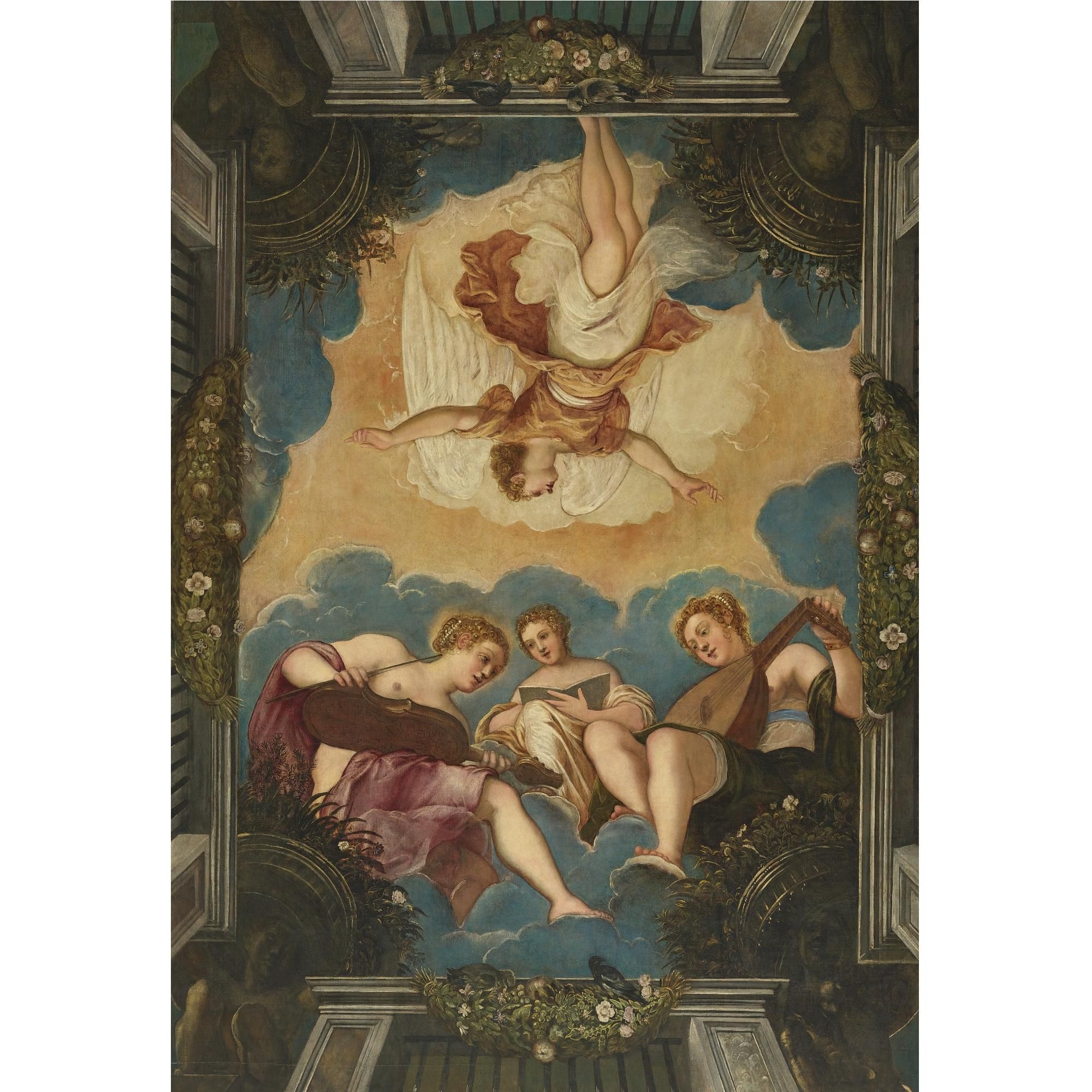
Tintoretto's "Allegory of Music"
Other sixteenth-century paintings to be exhibited are by Palma il Giovane, the subject of Professor Rosand’s doctoral dissertation, Bonifazio Veronese, and Paris Bordone. Later Venetian paintings include significant works by Amigoni, Bambini, Guardi, Diziani, and Bernardo Bellotto. All paintings will be for sale.
Bernardo Bellotto (Venice 1722-1780 Warsaw) Architectural Capriccio with a Self-portrait in the Costume of a Venetian Nobleman, c. 1762-65 Oil on canvas, 61 1/2 x 44 1/4 inches Otto Naumann, Ltd.
David Rosand received his undergraduate and graduate education at Columbia, earning his Ph.D. in 1965. He was on the faculty there from that time until his death in August 2014, when he held the title of Meyer Schapiro Professor of Art History Emeritus. His impact on students at Columbia and in the field of Venetian Studies has been enormous –through his teaching, his groundbreaking publications on Venetian art, and his studies on the making of art spanning all periods.
Palma il Vecchio (Bergamo, ca. 1480 - 1528 Venice) A Shepherd and Two Women Oil on panel, 27 1/4 x 37 1/4 inches (Robert Simon Fine Art, New York)
The exhibition will be held at Otto Naumann, Ltd., 22 East 80th Street, in New York City. Gallery hours during the exhibition will be Monday to Friday from 10 a.m. to 5 p.m. with special Saturday openings from 11 to 4 on January 16, 23, and 30.
Financial Times review:
Of particular note is a stunning Bellotto for $12m. “Bellotto is one of the greatest proponents of the vedute, or view paintings, who ever lived,” says Otto Naumann. “He literally greets us in the painting itself and graciously presents us with the product of his vivid mind and deft hand.”
Other works include a saucy Vecchio entitled Shepherd and Two Women ($3m, third picture) and a portrait of Saint Sebastian by Titian ($4.5m).
There is also a glorious Niccolò Bambini ($385,000) of the three Graces that “offers an abundance of flesh and decorative zip,” says Naumann. “According to ancient myth, all charity and pleasantry came to mortals with the aid of the singing, frolicking Graces. By way of Bambini’s brush their presence imparts benevolence and gracefulness to the ordinary pleasures of life.”
Nolde visited Hamburg regularly on his travels around Germany. He was
fascinated by the bustling activity of the harbour and was also
impressed by the wind and weather in the Hanseatic city, which for him
represented the primal forces of life and nature. In 1910 he spent
several weeks here, staying at the modest hotel Unter den Vorsetzen in
the St. Pauli district. Nolde captured his immediate impressions of his
surroundings in over a hundred works produced in rapid succession during
this time. The majority of these are in the collection of the Nolde
Foundation Seebüll, and are now being presented in the city where they
were created, alongside works from the holdings of the Hamburger
Kunsthalle and loans from a number of public and private collections.
Exhibitions of Emil Nolde’s work have been held in Hamburg since 1907,
and it was here that he also found his first supporters: private
individuals and museums began to collect his work. Nolde and his wife
Ada established close relationships with important figures in the city’s
art scene such as Gustav and Luise Schiefler, Paul and Martha Rauert,
Rosa Schapire, Alfred Lichtwark and Gustav Pauli. The current exhibition
also examines the close relationship between work, life, art and
society at that time, the impact of which can still be felt today.
The exhibition is accompanied by a fully illustrated
catalogue includes scholarly essays and a foreword by Helmut Schmidt,
the patron of this notable exhibition.
Nolde in Hamburg has been organised in collaboration with the Nolde Foundation Seebüll and will only be shown at the Hamburger Kunsthalle.
Curator: Dr Karin Schick; curatorial assistance: Anna Heinze.
Work and Leisure in American Art comprises
over 60 paintings, sculptures, photographs, and works on paper that explore the
universal themes of labor and leisure in America from the 18th century to the
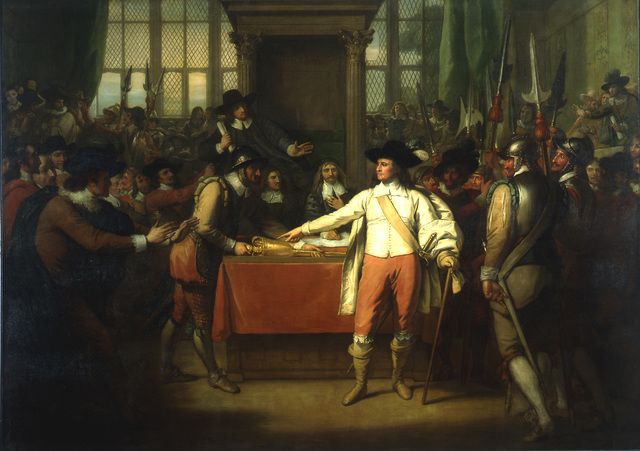
present day. The works on view range chronologically from Benjamin West’s
exposure of political corruption in the painting
Oliver Cromwell Dissolving the Long Parliament (1782)
to scenes of
industrial and urban labor in the 20th century by Thomas Hart Benton,
Stuyvesant Van Veen, and others. Their rural counterparts are seen in the wood
engravings of Winslow Homer from the 1870s, as well as the prints of Clare
Leighton in the 1930s, the cotton pickers of William Gropper in 1952, and
others. In her three prints entitled Executive
Tower, West Plaza, 1982, Ida Applebroog features self-absorbed
business people, as she explored issues of contemporary urban identity in terms
of isolation, alienation, and dehumanization.
Images
of leisure in the exhibition encompass children at play, with Eastman Johnson’s
Sketch for In the Hayloft,” c.
1877–78,
Homer’s See Saw, Gloucester,
Massachusetts, 1874,
Winslow
Homer (1836-1910)
Seesaw – Gloucester, Massachusetts, 1874
Wood engraving
Sheet: 9 x 14 in. (22.9 x 35.6
cm)
Montclair Art Museum: Gift
of Elaine and Julian Hyman, 2002.18.4
and Currier and Ives’ American Homestead-Spring (1869),
Currier
& Ives
Ives,
James Merritt, American, 1824-1895
Currier,
Nathaniel, American, 1813-1888
American Homestead – Spring, 1869
Hand-colored
lithograph
Montclair
Art Museum: Gift of George Raimes Beach, 1989.52
and
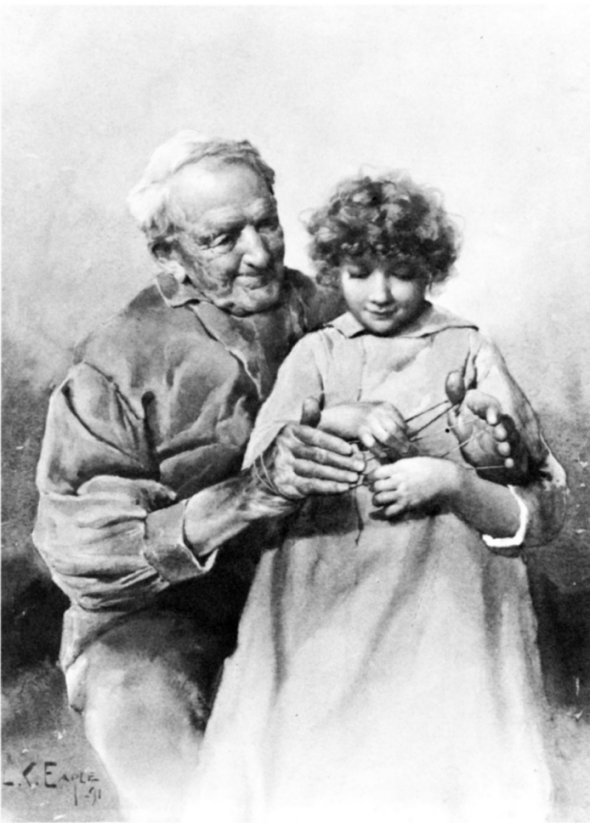
Montclair art colony artist Lawrence Earle’s version of the popular string game
Cat in the Cradle (1891).
Lawrence Earle
Cat In The Cradle
Media: Watercolor
Signed: Lower Left
L C EARLE '91
Size: 25 1/2" x 18"
Collection of the Montclair Art
Museum
The
theme of sports is represented by various works, including images of horse
racing at Saratoga by Winslow Homer, as well as Jon Corbino’s Race Track (1936) and golf in 1932 by
Orrin White, based in Pasadena, California.
The beach and
bodies of water as the locus for leisure activities is featured in the 19th-century
work of Winslow Homer, as well as the early 20th-century artists Jane Peterson
and Hayley Lever, with Justine Kurland providing a contemporary perspective in
her photograph
Frog Swamp(Covington, Louisiana), 2001.
Justine Kurland (b. 1969)
Frog Swamp (Covington, Louisiana), 2001
Satin laminated C-print, Ed.
4/6
Montclair Art Museum: Gift
of Patricia A. Bell, 2004.17.1
Courtesy of the artist and Mitchell-Innes
& Nash.
Another section of the exhibition is
devoted to images of music and dance, ranging from late 19th-century works by
Arthur B. Davies and Charles E. Proctor to the era of the 1940s as seen in
Hilde Kayn’s Swingtime (1945) and Weegee’s photograph Calypso (At a Club in Harlem) (ca. 1944).
Irving Couse’s early 20th-century painting Indian
Courtship featuring a flute-playing Native American also relates to
the themes of friendship and romance,
as evidenced in other works in the
exhibition, including Navajo painter Harrison Begay’s (1917–2012) Old Friends Meeting (n.d.), John Ahearn’s
monumental sculpture of a man from the Bronx and his dog, Toby and Raymond (1986), as well as Andy
Warhol’s small 1972 photo album of his friends and associates, some of whom
starred in his movies.
Photographs of
urban life and leisure range from John Sloan’s Bonfire Snow (ca. 1919)
to works by Garry Winogrand and Joel
Meyerowitz in the 1960s, to Faith Ringgold’s monumental quilt Tar Beach 2 (1990) and Dawoud Bey’s
beer-drinking Smokey, 2001.
Their more suburban, domestic counterparts can be found in the works of
Will
Barnet (Old Man’s Afternoon, 1947),
Roger Brown’s print of television-watching people, Talk Show Addicts (1993),
Surrealism: The Conjured Life
presents more than 100 paintings, sculptures, drawings, and photographs
that demonstrate the deep currents that Surrealism sent through the
international art world—and especially through Chicago—since its
emergence in the first half of the twentieth century. A global movement
that encompassed a wide number of art forms, including film, theater,
poetry, and literature, Surrealism came of age with poet André Breton’s
formal declaration in 1924. This deeply emotional and psychological art
form flourished in the 1930s and 1940s—turbulent times of economic
instability, rapidly changing social mores, and war.
Chicago collectors brought the European visual arts aspect of
Surrealism to their hometown. Joseph and Jory Shapiro and Edwin and
Lindy Bergman traveled to Europe, where they met members of the
Surrealist group including Paul Delvaux, Matta, and Magritte, piquing
their interest in this “art of the irrational.” Mary and Earle Ludgin
collected in depth the works of eccentric American painter Forrest Bess.
These arts patrons were among the founders of the MCA, and when the
museum began collecting in the mid-1970s, they donated major works by
those we now consider “classical” Surrealists, forming an early and
continuing collection strength.
These artworks also proved inspirational
to generations of Chicago-based artists, from the immediate postwar
group dubbed the Monster Roster to the Hairy Who and others, a further
expression of the continuing lure of “the conjured life” that results in
strange, often magical, and sometimes disturbing, imagery.
Though often framed as a largely historical movement, the freedom
afforded by Surrealism to explore both formal issues—including
experimenting with new materials and techniques—and personal expression
has continued to inspire artists to the present day. Thus besides
presenting works by the founders of the movement, the surrealist
tendency is traced in two other groupings: Surrealist-related works from
the 1950s to the present, and Chicago connections.
Artists including
Balthus, Leonora Carrington, and Dorothea Tanning round out the
presentation of the classical Surrealists. Major international
contemporary artists such as Lee Bontecou, Mark Grotjahn, Wangechi Mutu,
Cindy Sherman, and Francesca Woodman represent the stylistically
diverse Surrealist-related grouping. Chicago-based artists on view
include Gertrude Abercrombie, Leon Golub, Jim Nutt, Christina Ramberg,
and H. C. Westermann.
The exhibition highlights one of the most traditional values in the visual arts: looking. All of the artworks that populate The Conjured Life
bear close scrutiny, both in observing and exploring the subject matter
and noting the various visual strategies and formal means, from the
straightforward representation of Magritte to the low-relief plaster
technique of Max Ernst; from the shamanistic deer skin, wood, and felt
used by Jimmie Durham to the full-size rubber life raft cast in bronze
by Jeff Koons.
The exhibition is curated by Lynne Warren, Curator at the Museum of Contemporary Art Chicago.