Tuesday, February 16, 2016

Mauritshuis Exhibition: In and Out of Storage


 The store rooms of the museum are off limits to the public. This might make you curious. What paintings are stored there? How did they end up there? Why aren’t they hanging in the museum? And do they really hold unknown treasures, as is often thought to be the case? 4 February - 8 May 2016 the exhibition In and Out of Storage answers these questions and, for the first time, acquaints visitors with this invisible part of the collection of the Mauritshuis.

Mauritshuis Collection

The collection of the Mauritshuis is not only coherent and manageable in size, but also quite visible. Of the approximately 850 pieces in the collection, some 250 are on permanent display in the Mauritshuis itself, another 150 are exhibited in the Prince William V Gallery, and an additional 150 are on long-term loan to museums in the Netherlands and abroad. Only 300 artworks – not many, in comparison with other collections – are kept in storage. Even so, it’s a pity that these store-room pieces are seldom if ever on view.

Tentoonstelling: Hoogte- en dieptepunten uit het depot
Exhibition: In and Out of Storage. Foto: Ivo Hoekstra

Behind the scenes

Visitors to the exhibition will gain access to the inner workings of the Mauritshuis, where storage - the repository for items in the collection that for various reasons cannot be displayed to the public – plays a key role. The paintings selected for this exhibition will illuminate this aspect of museum practice. A representative selection of twenty-five paintings will be presented in groups. The central question is always: why are those works not on display in the galleries?

Quality

The Mauritshuis has high standards with regard to the quality of the works exhibited, owing to the limited space in the museum and the fact that the collection contains so many first-rate pieces. Paintings that would be displayed without a second thought in other museums are forced to remain in storage, because there’s simply no room for them in the Mauritshuis. They are often used as spares, the so-called reserve bench; they make an appearance when an artwork in the permanent display is sent for conservation or given on loan to an exhibition. Some artists are so well represented in the collection that a choice must be made. A good example is the productive landscape painter Jan van Goyen, by whom the Mauritshuis owns no fewer than eight works, only one of which is currently considered good enough to hang in the museum. Five Van Goyens, including the work normally on display, are included in the exhibition, so that visitors may decide for themselves if they agree with the curator’s choice.

Some paintings never leave storage, because they are hardly worth seeing. In some cases, we don’t even know how they even came to be in the collection. Now and then a donation or bequest allows a work to slip in that the museum would really rather not have.


Anonymous (Northern Netherlands)
Old Man with Tankard and Pipe, c.1660-1670? Oil on panel
Gift of L. Nardus, Arnouville 1906
31 x 24.5 cm
Inv.nr. 701

An Old Man with Tankard and Pipe by an anonymous Dutch painter of the seventeenth century was donated in 1906 by the charismatic, but deceitful art dealer Leo Nardus, who probably intended, through this and other gifts, to build up a good relationship with the Mauritshuis. However, the panel cannot be said to enrich the collection.

Royal Mistake

Sometimes a celebrated purchase later reveals itself to be a ‘royal’ mistake. In 1821 King William I acquired a collection for the Royal Cabinet of Paintings Mauritshuis that included works by great masters such as Raphael, Titian and Velázquez. Unfortunately it turned out to be a collection of inferior works that would quickly be sold on. One of the few paintings that did remain in the Mauritshuis was a highly optimistic attribution to Raphael.


Anonymous (Italy)
Female Figure (A goddess?), c.1500-1550? Oil on leather (later mounted on canvas) Acquisition, 1821
67.5 x 51.3 cm
Inv.nr. 349


This Female Figure is now thought to be the work of an anonymous Italian artist and the painting has not left storage for many years. The artwork had initially been selected for this exhibition to illustrate a low point in our holdings, but it suddenly proved to be much more interesting than expected. In fact, technical research has shown – to the delight of specialists in this field – that it is one of the earliest surviving examples of a figure piece on gilt leather.

Misfits

The heart of the Mauritshuis’s collection consists of Dutch and Flemish paintings of the fifteenth through the eighteenth centuries. Artworks that do not fit into this core area usually remain in storage, even if they are of high quality. This is the case, for example, with  


Bury, Friedrich
Amor Triumphant, in or before 1806
Oil on canvas
Gift of Queen Frederika Louise Wilhelmina, wife of King Willem I, before 1837
152 x 121 cm
Inv.nr. 272

Amor Triumphant by the German painter Friedrich Bury, a beautiful example of early nineteenth-century classicism. Also, It might come as a surprise to many visiting the exhibition that a piece by the famous American artist Andy Warhol (1928-1987) is among the art from the store rooms. It is a portrait of Princess Beatrix, the former Dutch queen. In 1987, this silk-screen print was hung in the underground entrance lobby. The artwork was not only a modern way of complying with the practice of hanging a portrait of the ruling monarch in a government building, but also a reference to the royal provenance of many of the paintings in the museum’s collection. In 2000, a passageway was created in this place to facilitate the flow of visitors, with the result that the portrait ended up in storage – many years before the queen’s abdication.


Too Large

The Mauritshuis was built as a private residence, not as a museum. This explains the intimate character of the rooms, where there is little space for large works. Apart from a few exceptions, such as Paulus Potter’s The Bull, the collection therefore consists of paintings of modest dimensions.
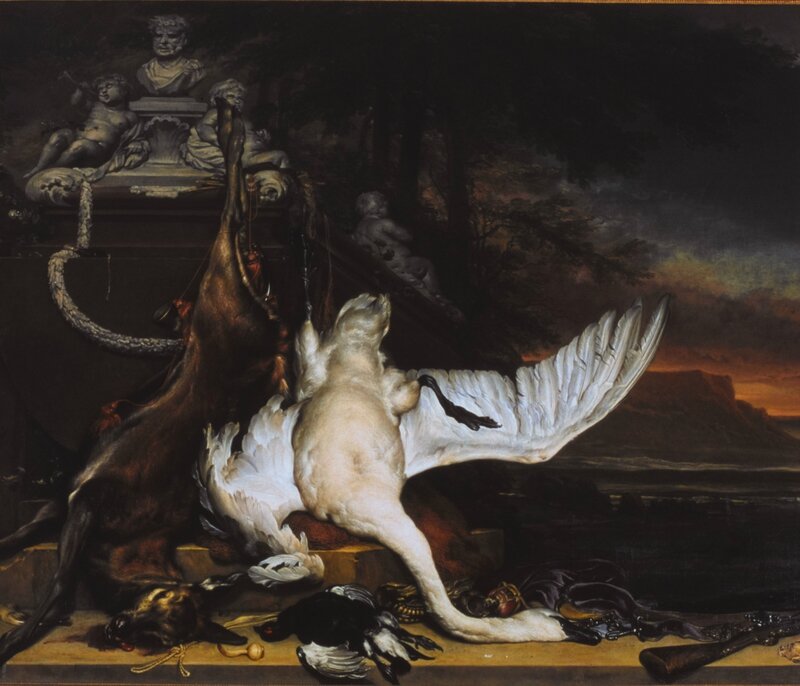


Weenix, Jan
Dead Swan, c.1700-1719 Oil on canvas Acquisition, 1821
245.5 x 294 cm

In 1821, however, the museum acquired a monumental still life of a dead swan by Jan Weenix. At the time, it was praised by the seller as a worthy pendant to The Bull. In those days it was common to hang paintings close together, arranged according to size. But ideas about presentation have changed since then, and Weenix’s dead swan has not been on display for some time, owing to lack of space. The Mauritshuis is therefore looking for another museum that can accommodate this oversized canvas, since it has long been museum policy to give works on long-term loan to institutions with more suitable places to show them.

Too Many

Not only their format but also their number can influence the decision whether to hang artworks or keep them in storage. Between 1611 and 1624, the Hague painter Jan van Ravesteyn and his studio produced twenty-four portraits of officers in the army of the stadholder, Prince Maurits. The series was completed with a twenty-fifth portrait, executed by the otherwise unknown painter Fransise de Goltz. Since the seventeenth century, the series had hung in Honselaersdijk Palace, one of the stadholder’s country estates. The portraits ended up – but not all at the same time – at the Mauritshuis, where they initially lay gathering dust in the attic, until they were rediscovered in 1875. Because there were so many of them, they have never been exhibited as a series in the Mauritshuis. In the course of the twentieth century, a number of these portraits were given on long-term loan to other museums and government institutions. Of those remaining in the Mauritshuis, only two are normally on display. This is regrettable, since there are few surviving examples of such an extensive portrait series. For the first time since the eighteenth century, all of the officers have been called up for active duty in ‘Prince Maurits’s army’ – for the duration of the exhibition.

Tentoonstelling: Hoogte- en dieptepunten uit het depot
Exhibition: In and Out of Storage. Photo: Ivo Hoekstra

Poor condition

Behind the scenes at the museum, the store rooms are indispensable as a repository of paintings that cannot be shown to the public for various reasons: because they are totally lacking in quality, for example, or just not quite good enough, or unsuited to the collection, or too large or too numerous. Another reason for keeping paintings in storage: their poor or problematic condition, however the store room does not have to be a cul de sac. After restoration, for example, some paintings can be reinstated at in the permanent presentation.

An example of a painting in poor condition is the Portrait of a Man by the painter Karel Slabbaert of Zeeland. It hung in less than ideal conditions for many years in the then Dutch East Indies. Among other problems, the extreme climate caused the painting’s paint layer to crack dramatically. Any restoration of this panel would have had to be quite invasive, and anyway, there were other priorities, so we decided several years ago only to conserve and not to restore this painting – at least for the time being.

Front and Back

A masterly example of modern framing techniques has made it possible to put the colourful painting The Baptism of the Chamberlain of Queen Candace of Ethiopia on display once again. It is painted on a large panel consisting of six horizontal planks. The wood had warped over time and the panel, which no longer fitted its frame, had been standing on its side in storage for fifteen years. several years ago, our conservators put it into a new frame with the help of the Belgian panel expert Jean-Albert Glatigny. How they managed this can be seen at the exhibition, where both front and back of the panel are visible. Meanwhile we also learned more about the makers of the painting. It used to be attributed to the German artist Hans Rottenhammer, but it is probably a collaborative work by the Flemish painters Hendrik van Balen and Jan Brueghel the Younger, in which Van Balen painted the figures and Brueghel executed the landscape.

Surprises


Bol, Hans
Imaginary Landscape with St. John on Patmos,
1564
Watercolour on canvas
Acquisition with the support of Rembrandt Association and Prins Bernhard Cultuurfonds, 1972


A trawl through the works in storage sometimes even offers up surprises for the curators, who are very familiar with the collection. Some paintings that were removed from public display and subsequently disappeared from view now appear to fit in beautifully with the permanent presentation. Imaginary Landscape with Saint John on Patmos, painted by the Flemish artist Hans Bol in 1564, is thought to be one of the earliest landscapes in large format. With the recent acquisition of a mountainous landscape by Paul Bril and a flower still life by Ludger tom Ring the Younger, the Mauritshuis now has more examples of sixteenth-century predecessors of such genres as landscape and still life, which were to become very popular in the seventeenth century. This led to the decision to frame this exceptional painting by Hans Bol after all, so after the exhibition it can be returned to the permanent display.


Velde, Esaias van de
Merry Company in a Park, 1614 Oil on panel
Acquisition, 1873
28.5 x 40 cm
Inv.nr. 199


Merry Company in a Park of 1614 by Esaias van de Velde, a painter active in Haarlem, is now also available for a place in the museum. Its yellowed layer of varnish had made it unfit for display, but its splendid colours and fluent brushwork are clearly visible again, since its recent restoration. During the restoration, research carried out on the materials and technique revealed that Esaias van de Velde had made quite a few changes while painting. For example, the old woman at left, behind the chair, was initially planned as an elegantly dressed young woman, and the standing woman in the yellow dress was first holding a bird rather than a fan.


Visitors’ Choice

The Mauritshuis has carefully selected fifty-two artworks for the exhibition, but one space will be left vacant when it opens its doors on 4 February. We are leaving the choice of painting to be taken from storage and displayed in the empty spot to our visiting public.  We will use social media outlets to ask: What would you choose? Which painting do you think deserves to be brought out of storage?
There will be three rounds of voting, each with a choice of six paintings. The first round will be open until 7 February. The painting that receives the most votes will be put on display in the exhibition space in mid-February. Voting will continue and the public will then be able to choose another work to be put on display.. In total there will be three public favourites on display for the duration of the exhibition (until 8 May). The painting with the most votes overall will take a spot in the Mauritshuis’s permanent exhibition. Voting can take place via www.mauritshuis.nl/visitors-choice or via the iPad in the exhibition.
Publiekslieverling
Visitors’ Choice. Photo: Ivo Hoekstra

Master of the Salomon triptych,
Triptych with the Life Story of Solomon, in or after 1521
Oil on panel
Bequest of Jonkheer Jacob de Witte van Citters, The Hague, 1876
107.5 x 77 cm
 

Monday, February 15, 2016

Paint the Revolution: Mexican Modernism, 1910-1950


Paint the Revolution: Mexican Modernism, 1910-1950
October 25, 2016-January 8, 2017

The Philadelphia Museum of Art, in partnership with the Museo del Palacio de Bellas Artes in Mexico City, will present a landmark exhibition that takes a new and long overdue look at an extraordinary moment in the history of Mexican art. Paint the Revolution: Mexican Modernism, 1910-1950 will explore the rich and fascinating story of a period of remarkable change. It will be the most comprehensive exhibition of Mexican modernism to be seen in the United States in more than seven decades and will feature an extraordinary range of images, from portable murals and large and small paintings to prints and photographs, books and broadsheets. In this country, Paint the Revolution, will be seen only in Philadelphia before traveling to Mexico City in 2017.

Timothy Rub, The George D. Widener Director and CEO, Philadelphia Museum of Art, stated: “The contributions of Mexico during this period are central to the development of modern art, and yet its achievements have been largely understood through the work of a small group of great talents, among them Diego Rivera, José Clemente Orozco, and David Alfaro Siqueiros, along with Frida Kahlo and Rufino Tamayo. In this exhibition, visitors will be introduced to these artists through the presentation of many of their finest works, but also, and more importantly, to the broader panorama of Mexican art during this period and the historical context in which the visual arts played an enormously important role. We are especially grateful for our partnership with the Museo del Palacio de Bellas Artes, without which it would not be possible to have organized an exhibition of such depth.”

Miguel Fernández Félix, Director of the Museo del Palacio de Bellas Artes, stated: “The exhibition will present this fascinating story in unprecedented detail and will benefit from the work of a young generation of scholars who have broken new ground in their research. Together with the Philadelphia Museum of Art, which has long been dedicated to the acquisition and display of modern Mexican art, we are pleased to expand the public’s understanding of this important era, including its broader connections to both Europe and the United States. Visitors will witness a spectacular range of work by artists who are well known in Mexico but who will become fresh discoveries for most Americans.”

Paint the Revolution spans four momentous decades. It will begin by surveying modern art in Mexico City during the revolutionary decade of the 1910s, clearly demonstrating that while many artists engaged with international avant-garde styles, such as Impressionism, Symbolism, and Cubism, they also infused their work with facets of ancient and modern Mexican culture. The exhibition will also explore the artistic experimentation and social idealism of the early post-Revolutionary period, when painters rallied to support the government’s program of national reconstruction and there was growing international recognition of Mexico’s cultural importance. It will also consider the principal avant-garde groups—such as the Stridentists and the Contemporaries—active in Mexico City during this period who pursued alternative directions in post-revolutionary culture, turning away from folkloric and historical subjects and focusing on themes of modern urban life.

In the 1920s and 1930s the development of a vibrant support network and a robust market for modern art in the United States drew Mexican artists northward. The exhibition will follow a number of Mexican painters during their American sojourns, highlighting images with both Mexican and U.S. themes, and focusing on works that dramatized the encounter between south and north, between Hispano- and Anglo-America. Paint the Revolution will conclude with the renewal of socially and politically oriented art in Mexico from the mid-1930s through the aftermath of the Second World War.

The exhibition takes its title from an essay called Paint the Revolution by the American novelist John Dos Passos who traveled to Mexico City in 1926-27 and witnessed the murals created by Diego Rivera that celebrate the ideals of the Mexican Revolution. In order to represent Mexican muralism and share with visitors masterpieces by Rivera, Orozco, and Siqueiros, the exhibition will present in digital form three important murals created by these three artists—often called los tres grandes (the three great ones)—in Mexico and the United States.

This exhibition is curated by a team of specialists including Matthew Affron, the Muriel and Philip Berman Curator of Modern Art; Mark A. Castro, Project Assistant Curator, European Painting, Philadelphia Museum of Art; Dafne Cruz Porchini, Postdoctoral Researcher, Colegio de México, Mexico City; and Renato González Mello, Director of the Institute for Aesthetic Investigation, National Autonomous University of Mexico.

Matthew Affron stated: “Paint the Revolution will touch on all aspects of modern art in Mexico. Though the mural painting tradition remains that country’s best-known contribution to modernism in the visual arts, it is part of a much broader story. Artists were innovating in every possible medium, including painting, sculpture, printmaking, and photography. Their work cut across all classifications, from the epic to the lyric. Visitors to the exhibition will find many surprises.”

Location
Dorrance Special Exhibition Galleries, Philadelphia Museum of Art

Itinerary
Paint the Revolution will travel to the Museo del Palacio de Bellas Artes, Mexico City, in 2017.

Publication
Paint the Revolution will be accompanied by an exhibition catalogue, published in English and Spanish editions, which offers a comprehensive treatment of Mexican art during four decades that transformed the country’s cultural life and marked its emergence as a widely watched center for modern art. Published jointly by the Philadelphia Museum of Art and the Museo del Palacio de Bellas Artes (with the English version distributed by Yale University Press), this richly illustrated publication will present full-color reproductions of the works in the exhibition as well as fourteen essays that contain a wealth of new research, by Mexican and U.S. scholars, on mural and easel painting, printmaking, photography, film, and architecture; diverse artists’ groups; and the involvement of the Mexican state in culture during this rich period. It promises to become the text of record for this subject.

Images in the Exhibition:


Peasants, c. 1913. David Alfaro Siqueiros, Mexican, 1896 ‑ 1974. Pastel on paper, Museo Nacional de Arte, INBA


Sunrise Over the Mountains, c. 1916. Dr. Atl (Gerardo Murillo), Mexican, 1875 ‑ 1964. Atl color on cardboard, Museo Regional de Guadalajara, INBA


Portrait of Martín Luis Guzmán, 1915. José Diego María Rivera, Mexican, 1886‑1957. Oil on canvas, Fundación Televisa Collection 


Liberation of the Peon, 1931. José Diego María Rivera, Mexican, 1886 ‑ 1957. Fresco, Philadelphia Museum of Art, Gift of Mr. and Mrs. Herbert Cameron Morris, 1943, © 2014 Banco de México Diego Rivera Frida Kahlo Museums Trust, Mexico, D.F./Artists Rights Society (ARS), New York


Zapata, 1931. David Alfaro Siqueiros, Mexican, 1896 ‑ 1974. Lithograph, Philadelphia Museum of Art, Purchased with the Lola Downin Peck Fund from the Carl and Laura Zigrosser Collection, 1976. © Artists Rights Society (ARS), New York / SOMAAP, Mexico City


Proletarian Hand, 1932. Leopoldo Méndez, Mexican, 1902- 1969, Wood engraving, Philadelphia Museum of Art, Gift of Anne d'Harnoncourt in memory of Sarah Carr d'Harnoncourt, 2003


My Dress Hangs There ( Mi vestido cuelga ahi), 1933‑1938. Frida Kahlo, Mexican, 1907‑1954. Oil and collage on masonite, Colección FEMSA


George Gershwin in a Concert Hall, 1936. David Alfaro Siqueiros, Mexican, 1896–1974, Oil on canvas, Harry Ransom Center, The University of Texas at Austin


Mexico City, 1949. Juan O’Gorman, Mexican, 1905‑1982. Tempera on masonite, Acervo CONACULTA ‑ INBA, Museo de Arte Moderno

Friday, February 12, 2016

Rhythm and Roots: Dance in American Art


Detroit Institute of Arts March 20-June 12, 2016

Denver Art Museum  July 10–Oct. 2, 2016
Crystal Bridges Museum of American Art in Arkansas October 22, 2016-January 16, 2017

Rhythm and Roots: Dance in American Art will present how artists, dancers and choreographers helped form the artistic identity of dance in America. The exhibition will feature about 90 paintings, photographs, sculptures and costumes relating to American dance from 1830 to 1960.


Rhythm and Roots: Dance in American Art will showcase works by American artists from the 19th and 20th centuries, focused on addressing the first influences in American dance, how it evolved over time and how the distinct traditions of American dance came to be. The exhibition will also use objects to demonstrate the dialog between visual artists, dancers and choreographers. Multi-media features such as video, music and interactive spaces will bring to life the dynamic spectacle of motion and performance through art.

Rhythm and Roots: Dance in American Art introduces how dance evolves from the private sphere to the public stage, showcasing new American dances and dance in the club.

The exhibition brings together the greatest nineteenth-century American artists including John Singer Sargent, Winslow Homer, and Mary Cassatt; spotlights the superstars of the Harlem Renaissance including Aaron Douglas, William Johnson, and James Van Der Zee and features the artists who shaped the aesthetics of modern dance including Isamu Noguchi, Jasper Johns, and Andy Warhol.  
The exhibition includes 19th-century paintings that portray dances from America’s diverse communities, from the sacred dances of indigenous North Americans to Irish jigs and Spanish flamencos; paintings that show class distinctions, from the refined quadrille to a sidewalk tarantella; pastoral fantasies of expressive dances performed outdoors; paintings from the turn of the 20th century featuring international female superstars; works by Harlem Renaissance artists who challenged negative stereotypes and sought to create and sustain a vibrant cultural identity; and modern objects that demonstrate a fluid dialogue between visual artists, dancers and choreographers.
- See more at: http://www.dia.org/calendar/exhibition.aspx?id=5396&iid=#sthash.76BMEUJM.dpuf
The exhibition explores the concept of the stage through artists’ historic fascination with and depiction of performers. Pieces featuring iconic American dancers such as Isadora Duncan, Katherine Dunham, Fred Astaire and Josephine Baker are included in the exhibition, as well as Spanish dancer Carmencita Dauset Moreno and Russian ballerina Anna Pavlova painted by American artists.

The exhibition brings together the greatest nineteenth-century American artists including John Singer Sargent, Winslow Homer, and Mary Cassatt; spotlights the superstars of the Harlem Renaissance including Aaron Douglas, William Johnson, and James Van Der Zee and features the artists who shaped the aesthetics of modern dance including Isamu Noguchi, Jasper Johns, and Andy Warhol.  
The exhibition includes 19th-century paintings that portray dances from America’s diverse communities, from the sacred dances of indigenous North Americans to Irish jigs and Spanish flamencos; paintings that show class distinctions, from the refined quadrille to a sidewalk tarantella; pastoral fantasies of expressive dances performed outdoors; paintings from the turn of the 20th century featuring international female superstars; works by Harlem Renaissance artists who challenged negative stereotypes and sought to create and sustain a vibrant cultural identity; and modern objects that demonstrate a fluid dialogue between visual artists, dancers and choreographers.
- See more at: http://www.dia.org/calendar/exhibition.aspx?id=5396&iid=#sthash.76BMEUJM.dpuf
The exhibition concludes with the convergence of artistry between visual artists and dancers where individuals like Diego Rivera and Andy Warhol collaborated with dance companies such as the American Ballet.

“The relationship between two forms of creative expression, dance and art, and the boundless commotion of rhythm and movement is captured through this dance exhibition,” said Daneo. “The artists’ ability to capture fleeting moments through a painting or a sculpture and their fascination with this subject will show how dance as an art form was and still is a vital part of American life and a constant source of inspiration.”

Rhythm and Roots: Dance in American Art has been organized by the Detroit Institute of Arts.


John Singer Sargent, 1890, oil on canvas. Paris, musée d'Orsay. RF7 46


Joseph Henry Sharp, 1893-1894, oil on canvas. Cincinnati Art Museum, Museum Purchase, 1894.10


John Singer Sargent, 1878, oil on canvas. Crystal Bridges Museum of American Art, Bentonville, Arkansas


Robert Cozad Henri, 1919, oil on canvas. Gift of the Sameric Corporation in memory of Eric Shapiro


Salome Dancer

Robert Cozad Henri, 1909, oil on canvas. Mead Art Museum, Amherst College, Museum Purchase,1973.6


The Bear Dance

Willliam Holbrook Beard, ca. 1870, oil on linen. Courtesy of The New-York Historical Society, Gift of Enoch G. Megrue, 1942.108


Arthur Frank Mathews, ca. 1917, oil on canvas. Collection of the Oakland Museum of California, Gift of Concours d'Antiques, the Art Guild. A66.196.24


Everett Shinn, 1943, oil on canvas. The Westmoreland Museum of American Art, Greensburg, PA ,Gift of the William A. Coulter Fund. 1958.35


William Sidney Mount, 1845, oil on canvas mounted on wood. The Long Island Museum of American Art, History &Carriages. Gift of Mr. and Mrs. Ward Melville, 1950


Frank Myers, 1926, oil on canvas. The Irvine Museum


William H. Johnson, ca. 1941, oil on paperboard. Smithsonian American Art Museum, Gift of the Harmon Foundation. 1967.59.611


William Merritt Chase, 1890, oil on canvas. The Metropolitan Museum of Art, Gift of Sir William Van Horne. 1906.06.969


George Catlin Mandan O-kee-pa Ceremony, 1832, oil on canvas. Smithsonian American Art Museum, Gift of Mrs. Joseph Harrison, Jr., 1985.66.505


Thomas Cowperthwaite Eakins, 1877, oil on canvas. National Gallery of Art, Washington, Collection of Mr. and Mrs. Paul Mellon, 1985.64.16


George Caleb Bingham, 1846, oil on canvas. National Gallery of Art, Washington. Patrons' Permanent Fund. 2015.18.1


Thursday, February 11, 2016

Van Gogh’s Bedrooms


Van Gogh’s Bedrooms Features Thirty-six Paintings, Drawings, and Illustrated Letters by the Artist Accompanied by an Interactive Digital Experience

Vincent van Gogh’s painting of his bedroom in Arles is arguably the most famous chambre in the history of art. So important was this composition that Van Gogh made three distinct versions and considered it his finest painting. Now, for the first time in North America, all three versions of the painting will be together in an exhibition titled Van Gogh’s Bedrooms at the Art Institute of Chicago.

Opening on February 14, 2016, the exhibition is the first ever dedicated to the Bedroom paintings,
presenting an in-depth study of documentary, scientific, and physical evidence pertaining to all three versions. Beginning with Van Gogh’s early canvases of cottages and birds’ nests, the show explores the artist’s use of the motif of home as a haven, creative chamber, and physical reality. 


Enhancing the exploration of the artist’s artworks and his longing for a place of his own are several engaging interactive technologies designed in partnership with Bluecadet. 

A digitally enhanced reconstruction of his bedroom allows visitors the chance to experience the physical reality of the space that so inspired him, while other enriching digital components bring to light significant recent scientific research on the three Bedroom paintings. 

An illustrated exhibition catalog with a lead essay from Gloria Groom, Chair of European Painting and Sculpture and David and Mary Winton Green Curator, will be published by the Art Institute of Chicago in partnership with Yale University Press. 


Vincent van Gogh. The Bedroom. 1889. The Art Institute of Chicago, Helen Birch Bartlett Memorial Collection.


Vincent van Gogh. Self–Portrait. 1887. The Art Institute of Chicago, Joseph Winterbotham Collection.


Vincent van Gogh. The Bedroom, 1889. Musée d'Orsay, Paris, sold to national museums under the Treaty of Peace with Japan, 1959.


Vincent van Gogh. The Bedroom, 1888. Van Gogh Museum, Amsterdam (Vincent van Gogh Foundation).


Vincent van Gogh. Eugène Boch. 1888. Musée d'Orsay, Paris, legacy of Mr. Eugène Boch, 1941.


Vincent van Gogh. Gauguin’s Chair. 1888. Van Gogh Museum, Amsterdam (Vincent van Gogh Foundation).


Vincent van Gogh. The Lover (Portrait of Lieutenant Milliet). Late September-early October 1888. KM 102.392. Kröller–Müller Museum, Otterlo, The Netherlands.


Vincent van Gogh. Van Gogh's Chair, 1888. The National Gallery, London, Bought, Courtauld Fund, 1924.


Vincent van Gogh. A Pair of Boots. 1887. The Baltimore Museum of Art, The Cone Collection, formed by Dr. Claribel Cone and Miss Etta Cone of Baltimore, Maryland, BMA, 1950.302. Photography by: Mitro Hood.


Vincent van Gogh. Parisian Novels. 1887. Private Collection.


Vincent van Gogh. The Poet’s Garden. 1888. The Art Institute of Chicago, Mr. and Mrs. Lewis Larned Coburn Memorial Collection.


Vincent van Gogh. Madame Roulin Rocking the Cradle (La Berceuse) 1889. The Art Institute of Chicago, Helen Birch Bartlett Memorial Collection.


Vincent van Gogh. Corridor in the Asylum. 1889. The Metropolitan Museum of Art, Bequest of Abby Aldrich Rockefeller, 1948.


Vincent van Gogh. Thatched–Roofed Cottages of Jorgus. 1890. Private Collection.


Vincent van Gogh. Self–Portrait. 1889. National Gallery of Art, Washington, Collection of Mr. and Mrs. John Hay Whitney.