Saturday, April 23, 2016

Degas: A New Vision


National Gallery of  Victoria  24 June  – 18 September 2016
 
In June 2016, an exhibition of one of the world’s most loved artists, Edgar Degas, will  open to the public. The  world - first exhibition Degas: A New Vision  will offer the most  significant international survey of Degas’ work in decades, presenting more than 200  works which showcase the artist’s talent in a new light; not only as a great master of  painting, but also as a master of drawing, printmaking, sculpture and photography. The National Gallery of Victoria and The Museum of Fine Arts, Houston, will each stage this major retrospective, which has been developed by both institutions in association with Art Exhibition s Australia.   

 Rehearsal hall at the Opera, rue Le Peletier, 1872, by Edgar Degas. (Musée d'Orsay, Paris)

Degas: A New Vision will provide audiences with a rare  experience to truly  be immersed in the creativity and originality of  his art, giving visitors a deeper and richer understanding of his brilliance.’ Degas: A New Vision  will be presented  thematically,  grouping together the subjects which Degas continually returned to throughou t his career, including not only his famous ballet scenes but also arresting portraits, the nude, horse - racing, the social world of Parisian nightlife, and  women at work and leisure. 


Edgar Degas The Arabesque 1877 oil and essence, pastel on canvas, Musée d’Orsay, Paris, Lemoisne 418 (RF 4040) © Musée d’Orsay, Dist. RMN-Grand Palais /Patrice Schmidt

The exhibition will also explore the great technical, conceptual and expressive freedoms that  Degas achieved in his later years, and reveal his experiments with a range of mediums including sculpture and photography. This approach will emphasize Degas’ obsessive and highly creative working methods, and allow visitors to  enjoy the development of Degas’ art from its beginnings. 


Edgar Degas, The little fourteen-year-old dancer 1879–81, bronze with cotton skirt and satin ribbon, 99.0 cm (height), Museu de Arte de São Paulo, Assis Chateaubriand, Donated by Alberto José Alves, Alberto Alves Filho and Alcino Ribeiro de Lima (426 E)

Degas was fascinated by aspects of modern life  – voraciously painting Paris’ dance halls and cabarets, cafés, racetracks,  opera and ballet stages. He also s tudied the simple, everyday gestures of working women: milliners, dressmakers, and  laundresses. He was drawn to explore movement that was precise and disciplined, such as that of racehorses and ballet dancers, and absorbed a diverse range of influences from Japanese prints to Italian Mannerism.


Edgar Degas, The song rehearsal 1872–73 oil on canvas 81 x 64.9 cm Dumbarton Oaks Research Library and Collection, Washington D.C

 BIOGRAPHY 

Edgar Degas was born in 1834 into a wealthy banking  family. Unlike many of his contemporaries, his family were  supportive of his artistic talent and desire to become an artist. Degas resisted being  labelled an ‘Impressionist’ yet  was at  the core of the movement’s most important manifestations. Classically trained, Degas initially aspired to be a painter of historical narratives. 
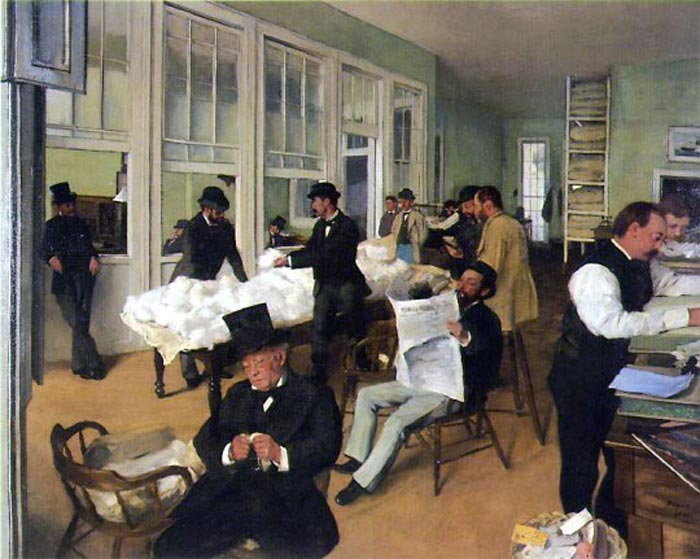

Edgar Degas, A cotton office in New Orleans 1873 oil on canvas 73 x 92 cm Musée des Beaux-Arts de Pau Lemoisne 320, © RMN-Grand Palais / Michèle Bellot / Madeleine Coursaget

As he matured, however, he made the depiction of daily life the central focus of his art. He was  drawn primarily to the human figure engaged in movement and work, sketching on the spot then working up his finished  compositions indoors in his studio. 

Degas’ obsession with the theatre and ballet in particular enabled him to explore his fascination with artificial light, which set him apart from the other  Impressionists who preferred to work out - of - doors capturing the transient effects of natural daylight. Degas absorbed many diverse influences, from Japanese prints to Italian  Mannerism, and reinterpreted them in innovative ways. 

Degas obsessively revisited and experimented with his favourite  themes which saw him fashion varied and unusual vantage points and asymmetrical framing. His depictions of ballet  dancers alone number in the hundreds. Such endeavours helped him to achieve the innovative and distinctive style which  will be explored in Degas: A New Vision. 

Degas served in the Franco - Prussian War of 1870 – 71 and began to experience  eyesight deterioration by the late 1880s. He increasingly took up sculpture as his eyesight weakened. In his later years, he  w as preoccupied with the subject of women bathing unselfconsciously and developed an expressive use of colour and line  that may have arisen due to his deteriorating vision. 

Degas continued working to as late as 1912. He died five years later in  1917, at the age of eighty – three.

More images

GAUGUIN’S WORLDS


EXHIBITION: 15.04. – 28.08.2016

Paul Gauguin (1848–1903) cannot be ignored. Not in the realm of art history, nor at Glyptoteket, which is home to one of the world’s finest collections of the artist’s work. This spring’s special exhibition adds new layers to the story of this French artist, presenting his experimental explorations of ‘the primitive’.


Wide scope

Featuring more than seventy works spanning every media employed by the artist, the exhibition offers an overview of Gauguin’s wide-ranging life’s work while also focusing on particular highlights. The exhibition traces Gauguin’s unwavering endeavours to build and express his very own concept of ‘the primitive’; a concept that cuts across different cultures and geographical locations.

‘The primitive’

Gauguin’s stubborn pursuit of the primitive in the face of personal and financial difficulties was not fuelled by an interest in ethnographic matters, but sprang from an artistic vision. A vision that took on its own distinctive form across different cultures, ages and religions, making no concessions to established norms for artistic creativity and use of media. The exhibition explores the journey that led towards Gauguin’s personal, original artistic idiom. This includes the physical travels that took him to Denmark, Brittany, Arles, Martinique and Polynesia, but also the inner voyage where he constantly, his mind fuelled by countless different impressions and sources, invented and reinvented the primitive in imaginary worlds.

Gauguin’s prism

 Gauguin’s world of motifs and imagery draws on many sources of inspiration, but always relates to the primitive as a concept. As the exhibition shows, Gauguin’s take on ‘the primitive’ can be understood as something universal, something eternally rooted in human nature, but also as a carefully managed artistic brand that blends fiction and reality at every turn. Despite garnering only limited acclaim in his own day, Gauguin was very aware of tapping into his own era’s fascination with the ‘New’ world, even if he always captures that world through a deeply personal and complex prism.

A well-rounded collection

The exhibition demonstrates the huge potential inherent in Glyptotekets’ collection. Most of the works on view come from the museum’s own collection, supplemented by carefully selected loans – some major highlights, others curiosities – from other museums and private collections. With its clear narrative and themed presentations, the exhibition covers Gauguin’s work from his early years to his late production. It also documents his immense appetite for working with different media and materials. Here visitors will find paintings, prints, drawing, ceramics, woodcarvings and rarely-seen examples of Gauguin’s furniture and jewellery design.

This event is based on the exhibition “Gauguin – Tales from Paradise”, which Glyptoteket curated in the autumn of 2015 for MUDEC – Museo delle Culture in Milan.


Paul Gauguin
Hyrdepige fra Bretagne
Breton Girl  1889
Oil on canvas 71.5 x 90.5 cm
Ny Carlsberg Glyptotek


Paul Gauguin
Liggende tahitikvinder
Reclining Tahitian Women 1894
Oil on canvas 60 x 98 cm
Ny Carlsberg Glyptotek


Paul Gauguin
Tahitikvinde med en blomst
Tahitian Woman with a Flower 1891
70,5 x 46,5 cm
Olie på lærred/Oil on canvas
Ny Carlsberg Glyptotek


Paul Gauguin
Skøjteløbere i Frederiksberg Have
Skaters in Frederiksberg Gardens 1884
65 x 54 cm
Olie på lærred/Oil on canvas
Ny Carlsberg Glyptotek


Paul Gauguin
Portræthoved i uglaseret stentøj af kvinde fra Martinique med hovedtørklæde
Portrait-Head in unglazed Stoneware of Martinique Woman with Kerchief 1887-88
22,5 x 13 x 17,5 cm
Uglaseret stentøj, dekoreret med lervælling /Unglazed stoneware, decorated with slip
Ny Carlsberg Glyptotek


Paul Gauguin
Pape moe
Pape moe (Mysterious Water) 1894
81,5 x 62 x 5 cm
Egetræ, bemalet /Oak, painted
Ny Carlsberg Glyptotek


Paul Gauguin
Landskab fra Tahiti
Landscape from Tahiti 1893
49 x 54 cm
Olie på lærred /Oil on canvas
Ny Carlsberg Glyptotek

Friday, April 22, 2016

Edvard Munch and the Sea


Edvard Munch and the Sea, will be on view exclusively at Tacoma Art Museum April 9 through July 17, 2016. This is your opportunity to dive deep into Munch’s powerful works, rarely exhibited in the Pacific Northwest, with26of his exceptional prints and a key painting. TAM has brought these dynamic works to Tacoma from major institutions across the country, including the National Gallery of Art, the Metropolitan Museum of Art, Museum of Modern Art, deYoung Museum, Los Angeles County Museum of Art and from private collectors.

While he’s best known for his iconic work The Scream, Munch explored a host of other subjects. This exhibition focuses on the sea as a profound element in his work. He used the sea as the subject of landscapes, as a backdrop for human interactions, and as a metaphor for love, longing, grief, joy, and other tumultuous emotions.

He sought to live and work by the sea, often painting outdoors in the Norwegian landscape. 

The Honorary Norwegian Consul Kim Nesselquist connected TAM’s curators with art collector Sally Epstein, who has amassed the largest private Munch print collection outside of the Munch Museumin Oslo, Norway.A core group of the prints in the exhibition are from her collection. Epstein’s persistent interest in Munch took her to his homeland multiple times as she sought to learn more about the artist and his work.Af ascinating person in her own right, Epstein has lectured on Munch at the National Gallery and other institutions. 

A leading artist of the expressionist and symbolist movements, Munch often used the sea to convey emotions and moods. His depictions of women are complex as well, revealing his experiences with relationships, loss and griefin scenes played out on rocky shores and sinuous coastlines. 

Munch was a person who experienced life intensely, who felt deeply, and his images reflect that. These are very strong images with many layers of meaning, Neutralia for example isn’t just two women happily picking apples in the springtime. It is about joy in nature, but it is more importantly a political statement. There is a boat in the background being overwhelmed by waves, a ship going down, which represents Europe. He’s telling us that he was not happy that Norway remained neutral in World War I, going on with daily life,while the rest of Europe was struggling.

In 2012, Munch’s famous 1895 pastel The Scream became the world’s most expensive work of art ever auctioned (at the time)at Sotheby’s. Although The Scream won’t be on view,the print Angst features the same setting –the Åsgårdstrand pier at sunset –and mask-like fraught faces. Both images are raw expressions of Munch’s lifelong battles with anxiety and loneliness. Several other prints in the exhibition include elements of The Scream, as Munch liked to work and rework the same motifs. 

TAM has also arranged to have on view


Andy Warhol’s 1984 screen print tribute The Scream(after Munch). 

Munch was a master printmaker, advancing new techniques and mastering all aspects of his craft.TAM has highlighted the Northwest’s passion for printmaking innumerous exhibitions and the Munch exhibition continues the museum’s interest in exploring the artistry of printwork. By his own estimations, the prolific Munch created some 30,000 impressions of his prints. This exhibition reflects the vast influences of Edvard Munch on printmakers and artists today.


Image Credits: 


Edvard Munch(1863-1944), Neutralia (Girls Picking Apples), 1915. Color lithograph, 22½ × 2013/16inches. Memorial Art Gallery of the University of Rochester: Marion Stratton Gould Fund, 72.12. © 2016 Artists Rights Society (ARS), New York.


Edvard Munch(1863-1944), Angst, 1896. Color lithograph, 16½ × 15 inches. Epstein Family Collection, EFC061.0. Photo by Philip Charles.© 2016 Artists Rights Society (ARS), New York.


Edvard Munch(1863-1944), On the Waves of Love, 1896. Lithograph, 12¼× 16½ inches. Epstein Family Collection, EFC073.0. Photo by Mark Gulezian. © 2016 Artists Rights Society (ARS), New York.


Edvard Munch (1863-1944), Summer Evening, 1895. Aquatint and drypoint, 9¾ × 12½ inches.
National Gallery of Art, Washington, Rosenwald Collection, 1994, 1994.14.53. © 2016 Artists Rights Society (ARS), New York.


Edvard Munch (1863-1944), Attraction II, 1896. Lithograph, 1911/16 × 25⅜ inches (sheet). National Gallery of Art, Washington, Gift of the Epstein Family Collection, 2013, 2013.10.1. © 2016 Artists Rights Society (ARS), New York.

Joan Miró. La forza della materia

The Fundació Joan Miró organizes in Milano, Italy, the exhibition Joan Miró. La forza della materia, a show that brings together a total of 114 works by the artist.

<iframe width="560" height="315" src="https://www.youtube.com/embed/9i2Ogq2qfPE" frameborder="0" allowfullscreen></iframe>


Joan Miró. La forza della materia highlights the will of Miró of  reaching the purity of art by  exploring beyond conventional painting. The show illustrate the constant experimentation with techniques ,  media and  different procedures that led him  to the development of a  new culture of matter. Under the direction of Rosa Maria Malet, the  Fundació Joan Miró in  Barcelona organizes this exhibition, which has sixty - six works  from  its collection. The show  includes paintings, drawings , sculptures  and  graphic works made between 1931 and 1981 . The exhibition will be open from March 25 to September 11, 2016 at  the MUDEC, Museo delle Culture, Milano, Italy.

"Matter ,  the instrument gives me the technique , a means to  give life to one thing [ ...]  In my painting ,  a small line with a thick shape at the end is a surprise . I'm as  surprised [... ]  More than the picture itself , what counts  is what brings out  into the air ,  what  diffuses . " With these words , collecte d by  Yvon Taillandier in an interview in 1959 at Xxe Siècle , Joan  Miró reflects on the importance of experimentation with matter in his  work and on the freedom and its creation effects in various media .

Joan Miró. La forza della materia includes a broad  representation of this  experimentation with matter, through 114 works of their funds and private collections,  presented in four rooms. In the first one, paintings and drawings from 1931 and 1944  are exhibited, most of which produced under the influence of  the Spanish Civil War and  World War II. Thus, these works synthesize the tragedy of this period and show the new  symbolic language that Miró configured.

The move of Joan Miró in 1956 to Palma de Mallorca, where his friend, the  architect Josep Lluís Sert, had designed a studio , is the starting point of the exhibits in  the second room .  The paintings of this space show how Miró, with the desire to reach an increasingly anonymous artistic expression ,  releases his gesture. At maturity of his  career, a  continuin g interest in matter and its possibilities lead him to work with profusion bronze sculpture ,  also represented in this room. Miró uses the lost - wax process to give life to new beings by the assembly of objects, mainly from natural and popular environment.

The third room presents a series of works of the seventies in which Miró continued questioning the ultimate meaning of the painting without ever leaving it. W ith  the intention of removing all illusory elements of his painting , he underwent it to the  most unorthodox practices  - for example,  burning the canvases - while uses or reuses the  most unusual medias, wood , sandpaper, paintings  pompier  style , etc.  Destroying and creating both , the artist  provokes the viewer and questions the economic value of the  artwork .

The last section of the exhibition focuses on the sculptural and graphic works of Miró , modalities  with immense technical possibilities enhanced by collaborative work with artisans .  In this room are remarkable his works with carborundum  - an  artificial abrasive made from  powder of carbon and silicon - ,  that allows him to  enrich the matter  and enhance the line of the engravings .  In each of these disciplines , Joan  Miró challenges the technique  seeking the freedom of expression that he  achieved with  painting.

Joan Miró. La forza della materia is organized by the Fundació Joan Miró in  Milano, Italy at the MUDEC, Museo delle Culture, a cent er dedicated to the  interdisciplinary research on the world cultures. Taking inspirations from the civic  ethnographic collections and in partnership with our communities, MUDEC intend to  create a place where to dialogue on contemporary themes by the medium o f visual,  performing and sound art, design and costume.


Joan Miró Personnages et oiseau Figures and bird 1937 Indian ink and watercolour on paper 25 x 32 cm Private collection


Joan Miró Personnages, oiseau, étoiles Figures, bird, stars 1942 Pencil, watercolour, gouache, Indian ink  and pastel  on paper 66 x 51 cm Private collectio


Joan Miró Femme au clair de lune Woman by moonlight 1970 Gouache, Indian ink and wax  crayon on paper 99 x 61 cm  Fundació Joan Miró, Barcelona


Joan Miró Poème Poem 1974 Oil on canvas 130 x 97 cm Private collection


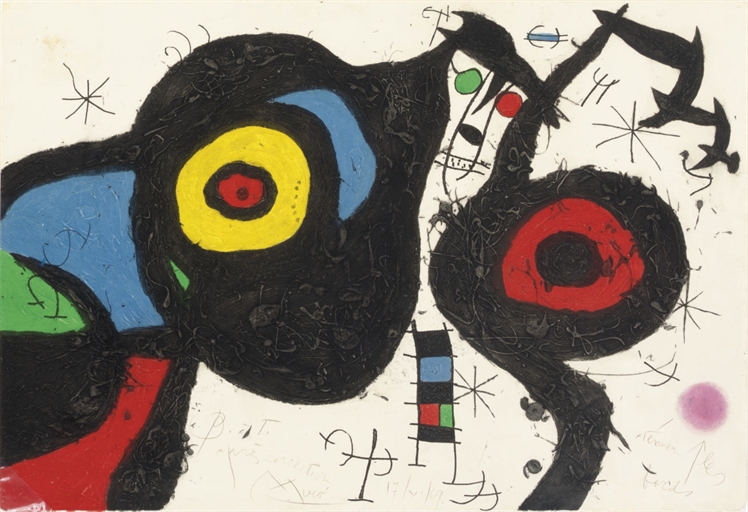
Joan Miró Les Deux Amis Two friends 1969 Etching, aquatint and carborundum 71,5 x 106,5 cm Fundació


Joan Miró Pantagruel 1978 Etching, aquatint, carborundum and  grattage 10 6,8 x 74,7 cm Fundació Joan Miró, Barcelona


Joan Miró Mambo 1978 Etching and aquatint 114,3 x 73,9 cm Fundació Joan Miró, Barcelona


CHRISTIE’S IMPRESSIONIST AND MODERN ART EVENING SALE ON MAY 12: Monet, Picasso, Modigliani, Magritte, Kahlo, Braque, Matisse, Renoir


Christie’s Impressionist & Modern Art Evening Sale on May 12 will feature an exceptional selection of 52 works by the most revered artists of the early 20th century. Led by outstanding paintings by Monet, Picasso, and Modigliani, many of which have not been on the market for decades, including Frida Kahlo’s dream like love scene of Dos Desnudos en el bosque.


Le bassin aux nymphéas by Claude Monet (1840-1926) (estimate: $25,000,000-35,000,000) leads the sale and belongs to the artist’s most popular and arguably influential series, which lent inspriation to generations of subsequent artists in the twentieth century. This work is part of a sequence of 14 paintings that Monet most likely began in the spring or summer of 1918 and finished by late 1919, when he dated and sold the canvas to the Impressionist dealer Galerie Bernheim-Jeune in 1919. It was then bought by Henri Canonne, a Parisian pharmaceutical tycoon and major collector of Impressionism in 1928. Canonne owned more than forty paintings by Monet, including seventeen canvases from the Nymphéas series. The painting has been in the present collection for 20 years.


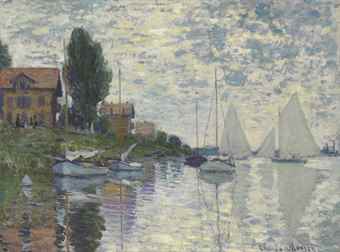
Monet’s Au Petit-Gennevilliers (estimate: $12,000,000-18,000,000), belongs to another celebrated series from Monet’s early career, when he painted various scenes of Argenteuil in 1874. The site itself is widely linked with the birth of Impressionist painting and provided endless inspiration for Monet and the other impressionists at that time. This painting will be on the market for the first time since 1899. It was purchased by the famed American collector Henry Osborne Havemeyer in 1901 and has remained in the family ever since.


Also featured is Amedeo Modigliani’s (1884-1920) Jeune femme à la rose (Margherita) (estimate: $12,000,000-18,000,000) painted in 1916. This portrait is a quintessentially modern painting of the female figure painted in Modigliani’s signature style- with a patrician long neck and oval face, large eyes and small, red lips. Here he adds the uncoventional, and alluring adornment of a rose in the subject’s décolletage, further heightening her seductive allure. It is the finest of a series of three paintings from 1916 recorded by Ambrogio Ceroni that takes a dark haired and brown-eyed young woman as its subject. It has been suggested that the model is the artist’s older sister Margherita.


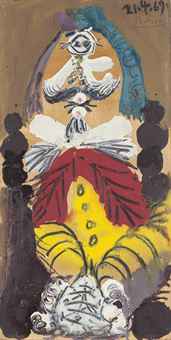
Highlighting the modern section is Pablo Picasso’s (1881-1973) Homme assis, 1969 ( estimate: $8,000,000-12,000,000) from the Collection of Kenneth and Susan Kaiserman. The colorful portrait of an exuberant swordsman derives from the critical group of Picasso’s famed late mousquetaire works and was exhibited at the famous 1970 Avignon exhibition at the Palaisdes Papes.

The sale also showcases important works on paper by Picasso from the Francey and Dr. Martin L. Gecht Collection, including


La Minotauromachie, 1935 (estimate: $2,000,000-3,000,000),


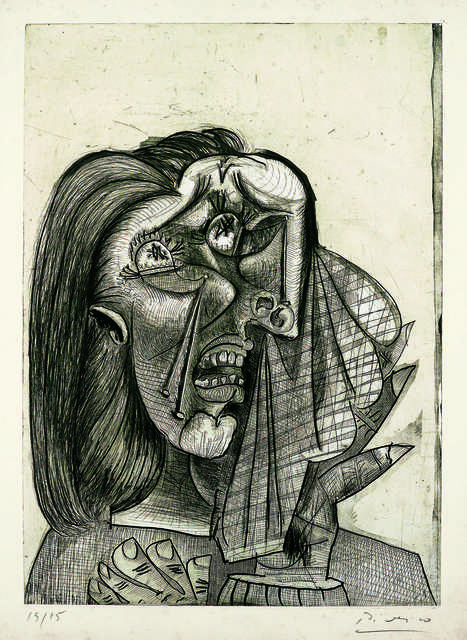
La Femme qui pleure, 1937, (estimate: $1,800,000-2,500,000),


and La Femme au Tambourin, 1939 (estimate: $800,000-1,200,000).


The sale presents Frida Kahlo’s (1907-1954) Dos desnudos en el bosque (La tierra misma), 1939, (illustrated left, estimate: $8,000,000-12,000,000). This small and exquisite surrealist painting depicts a dreamlike scene between two nude women in a forest alluding to Kahlo’s sexuality and identity. Gifted by the artist to Dolores del Río, the celebrated Mexican and American actress from the 1920s, the painting was last seen at market in 1989. This masterpiece has been both highly published and exhibited and last shown at Frida Kahlo: Art, Garden, Life at The New York Botanical Garden, May-November 2015.


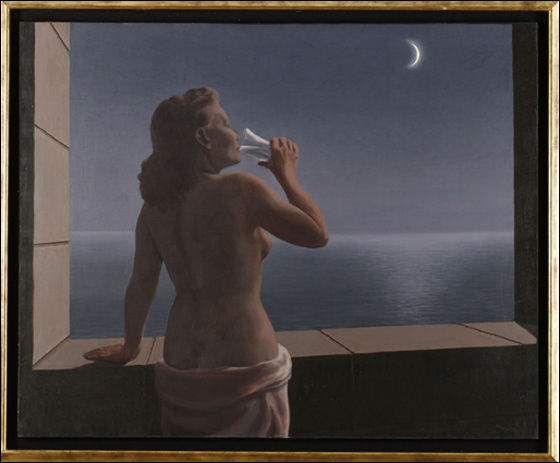
Works by René Magritte (1898-1967) are led by Les profondeurs du plaisir, painted in 1947 (estimate: $4,500,000-6,500,000), a work that Magritte considered one of his masterpieces. The idea for this painting came to Magritte when his wife Georgette stood and looked out the window one summer evening.


Another painting by Magritte is L’explication, 1962 (estimate: $1,000,000-2,000,000), from a series where he locates the mystery in ordinary objects—the bottle morphs into a carrot.


On a related theme, Femme-bouteille, executed circa 1941 (estimate: $500,000-800,000) is from a series of works where Magritte transformed bottles into other objects--a nude woman with her hair cascading down the back of the bottle. The first owner of the present bottle was the surrealist artist Paul Delvaux who acquired the work from Magritte. The present owner acquired the work at auction in 1972.

Magritte at Auction: History
Part II

Other celebrated artists in the sale include works from The Ducommun Family Collection. Their collection includes


Georges Braque’s (1882-1963) Mandoline à la partition (Le Banjo), 1941, (estimate: $7,000,000-9,000,000) one of Braque’s greatest late career still-lifes;

and Henri Matisse’s (1869-1954) Nu couché III, conceived in Nice in 1929 and cast in 1931, (estimate: $1,000,000-1,500,000), an early cast from the edition of 10.  Both works have been in same American collection for over forty years.

Leading a selection of several works by Pierre Auguste Renoir (1841-1919), 


Madame de Galéà, la méridienne painted in 1912 (estimate: $8,000,000-12,000,000) is a sumptuously clad and bejeweled Madeleine de Galéa, the great love of the legendary modern pictures dealer Ambroise Vollard. This is one of the largest paintings from Renoir’s late career and has been in a private collection since 1984.

Two further works by the artist from The MGM Resorts International Collection include Femme en bleu, painted in 1909 (estimate:$1,000,000-1,500,000),

and La Balayeuse, painted in 1889 (estimate: $1,000,000-1,500,000).

Renoir at auction

Thursday, April 21, 2016

NATIONAL PORTRAIT GALLERY STAGES FIRST MAJOR EXHIBITION OF PICASSO PORTRAITS FOR TWENTY YEARS


The National Portrait Gallery is to stage a major exhibition of portraits by Pablo Picasso (1881-1973) this autumn.

Picasso Portraits (6 October 2016-5 February 2017),  in association with the Museu Picasso, Barcelona, will include over 75 portraits by the artist in all media, ranging from well-known masterpieces to works that have never been shown in Britain before.


Daniel-Henry Kahnweiler, autumn 1910 by Pablo Picasso, 1910; Art Institute of Chicago
   Copyright: Succession Picasso/DACS London, 2016; 2015 Estate of Pablo Picasso/Artists Rights Society (ARS) New York

The latter include the extraordinary cubist portrait from 1910 of the German art dealer and early champion of Picasso’s work, Daniel-Henry Kahnweiler, loaned by the Art Institute of Chicago;


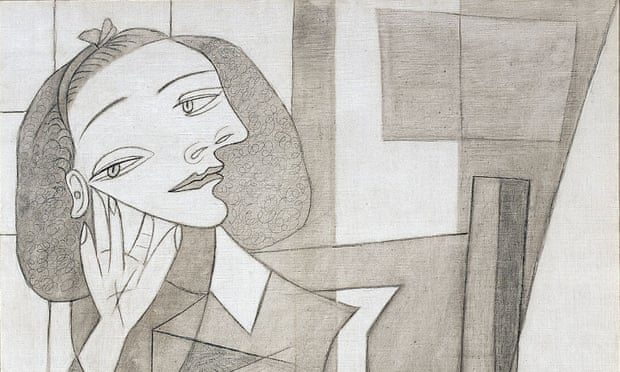
and from a private collection the exquisite portrait executed in 1938 of Nusch Eluard, acrobat, artist and wife of the Surrealist poet Paul Eluard.


 Woman in a Hat (Olga) by Pablo Picasso, 1935; Centre Pompidou, Paris. Musée national d’art modern  Copyright: Succession Picasso/DACS London, 2016 Photo: Centre Pompidou, MNAM-CCI, Dist. RMN-Grand Palais/Rights reserved;

All phases of the artist’s career will be represented, from the realist portraits of his boyhood to the more gestural canvases of his old age. It is the first large-scale exhibition devoted to his portraiture since Picasso and Portraiture at the Museum of Modern Art, New York and the Grand Palais, Paris in 1996.


Portrait of Olga Picasso by Pablo Picasso, 1923; Private Collection  Copyright: Succession Picasso/DACS London,  2016; 

Because Picasso did not work to commission and depicted people in his intimate circle, he enjoyed exceptional freedom as a portraitist and worked in different modes as well as many different styles. Formal posed portraits coexisted with witty caricatures, classic drawings from life with expressive paintings created from memory reflecting his understanding of the sitter’s identity and character.
The exhibition includes a group of revealing self-portraits as well as portraits and caricatures of Picasso’s friends, lovers, wives and children.  Guillaume Apollinaire, Carles Casagemas, Santiago Rusiñol, Jaume Sabartés, Jean Cocteau, Igor Stravinsky, Fernande Olivier, Olga Picasso, Marie-Thérèse Walter, Dora Maar, Lee Miller, Françoise Gilot and Jacqueline Picasso are among the people visitors will encounter.  Complementing these images of Picasso’s intimates are portraits and caricatures inspired by artists of the past – Velázquez and Rembrandt among them – with whom he identified most closely.

The Museu Picasso, Barcelona is lending most generously to the National Portrait Gallery.  Other lending institutions include: the British Museum; Tate;  Fitzwilliam Museum, Cambridge; Musée national Picasso, Paris; Centre Pompidou, Paris;  Musée national d’art moderne de la ville de Paris; Museum Berggruen, Berlin; Fondation Hubert Looser, Zurich; The Museum of Modern Art, New York; The Solomon R. Guggenheim Museum, New York; Art Institute of Chicago; Philadelphia Museum of Art and the National Gallery of Iceland.  The exhibition also benefits from important loans from the artist’s heirs and other private collectors.

The copiously illustrated catalogue provides an original, broadly based account of Picasso’s portraiture and analysis of every work on display.  Among the issues explored in detail are the artist’s sources of inspiration, differences between his approach to portraying men and women, and the complex motivation behind his switches of mode and style and defiance of representational norms.

Picasso Portraits is curated by Elizabeth Cowling, Emeritus Professor of the History of Art at the University of Edinburgh.  Her publications include Picasso: Style and Meaning  (2002) and Visiting Picasso: The Notebooks and Letters of Roland Penrose (2006). She has co-curated several exhibitions, including Picasso Sculptor/Painter (1994), Matisse Picasso (2002–3), and Picasso Looks at Degas (2010–11). 


From The Guardian:


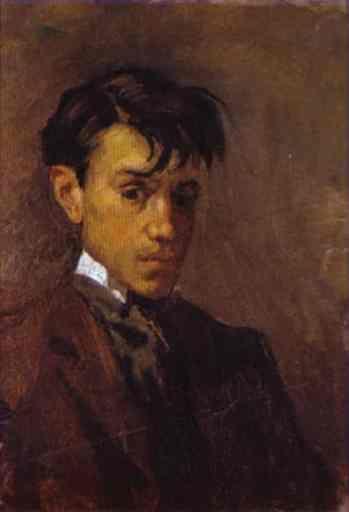
In one portrait a young Pablo Picasso paints himself as a well-dressed teenager in the 19th-century realist tradition;


Self Portrait 1972, 
in another, aged 90, he has a cartoonish skull looking like a boulder about to topple from the mountain.

“It is a remarkable work, looking in the mirror and looking death in the face,” said art historian Elizabeth Cowling of Self Portrait 1972,which will be part of a major exhibition at the National Portrait Gallery this autumn.
The work, from a private collection, is in stark contrast to the self-portrait Picasso painted in 1896, aged 14. That polarity of styles will feature over and again in what is the first major exhibition of Picasso portraits for 20 years...


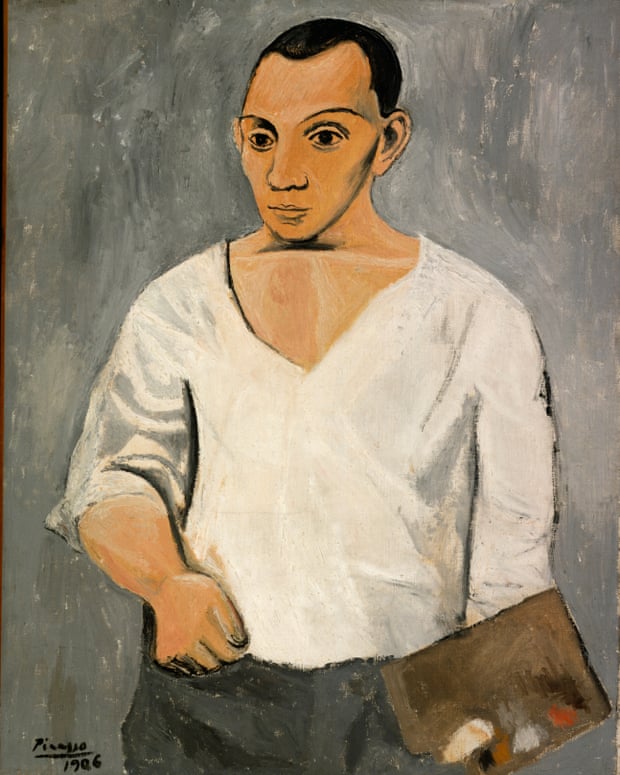
 Self-Portrait with Palette by Pablo Picasso, 1906.
Facebook Twitter Pinterest
 Self-Portrait with Palette, 1906. Photograph: Succession Picasso/DACS

Friday, April 15, 2016

Edgar Degas: A Strange New Beauty


With the major exhibition Edgar Degas: A Strange New Beauty, The Museum of Modern Art brings new focus to Hilaire-Germain-Edgar Degas’s (French, 1834–1917) extraordinary and rarely seen monotypes and their impact on his wider practice. On view March 26 through July 24, 2016, it is the first exhibition in the U.S. in nearly 50 years to examine these radical, innovative works—and MoMA's first monographic exhibition of the artist.

Edgar Degas: A Strange New Beauty features approximately 120 monotypes along with some 60 related works, including paintings, drawings, pastels, sketchbooks, and prints. Organized by Jodi Hauptman, Senior Curator, Department of Drawings and Prints;with Karl Buchberg, Senior Conservator;and Heidi Hirschl, Curatorial Assistant, Department of Drawings and Prints, The Museum of Modern Art;and Richard Kendall, independent art historian and curator. MoMA is the sole venue for the exhibition.

A towering figure in 19th-century art, Degas is best known as a painter and chronicler of the ballet. Yet his work as a printmaker reveals the true extent of his restless creativity, as he mixed techniques with abandon in his studio and shared recipes with colleagues for producing unconventional effects.

The monotype process involves drawing in black ink on a metal plate that was then run through a press, typically resulting in a single print. Captivated by the medium’s potential, Degas made more than 300 monotypes during two discrete bursts of activity, from the mid-1870s to the mid-1880s, and again during the early 1890s. Taking the medium to new and radical ends, Degas abandoned the academic drawing of his youth, inventing a new repertoire of mark-making that included wiping, scraping, scratching, fingerprinting, and rendering via removal. Enigmatic and mutable forms, luminous passages emerging from deep blackness, and a heightened sense of tactility characterize the resulting works.

The freedom Degas found in such techniques is an important theme of the exhibition, and the presentation links his efforts in monotype—the way he moves the printer’s ink with ease across the slick metal plate, resulting in a more liberated form of description—to works in other mediums.

Edgar Degas: A Strange New Beauty unfolds chronologically, from Degas’s introduction to monotype in the 1870s through his enthusiastic embrace of the medium. The exhibition offers a sense of his immersion, discoveries, experiments, and innovations, and investigates the broader consequences of his engagement with monotype.

Modern Life

For Degas, who was always searching for new means to describe new subjects, monotype proved to be the perfect medium to capture the essential features of modern urban life. 

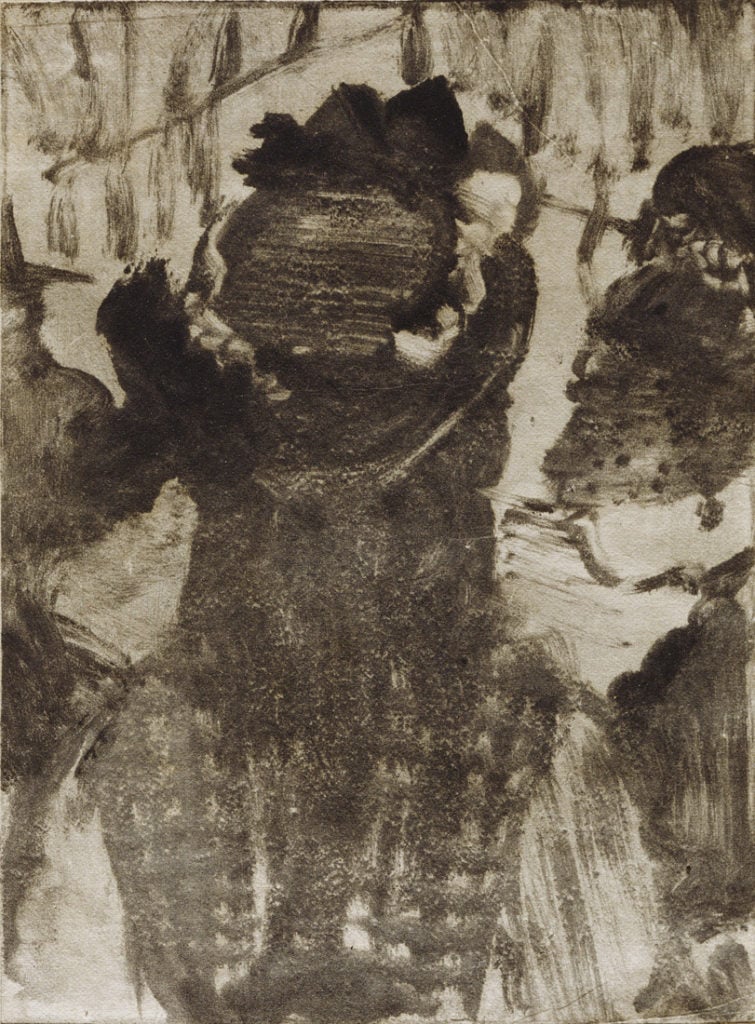
The exhibition highlights Degas’s views of passers by on city streets, their faces blurred 


(Heads of a Man and a Woman, c. 1877–80),

and bustling street scenes as figures cross paths 


(On the Street, 1876–77),

 along with signs of the era’s industry and commerce


(Factory Smoke, 1877–79),

the repetitive and arduous labor of Ironing Women (c. 1877–79),

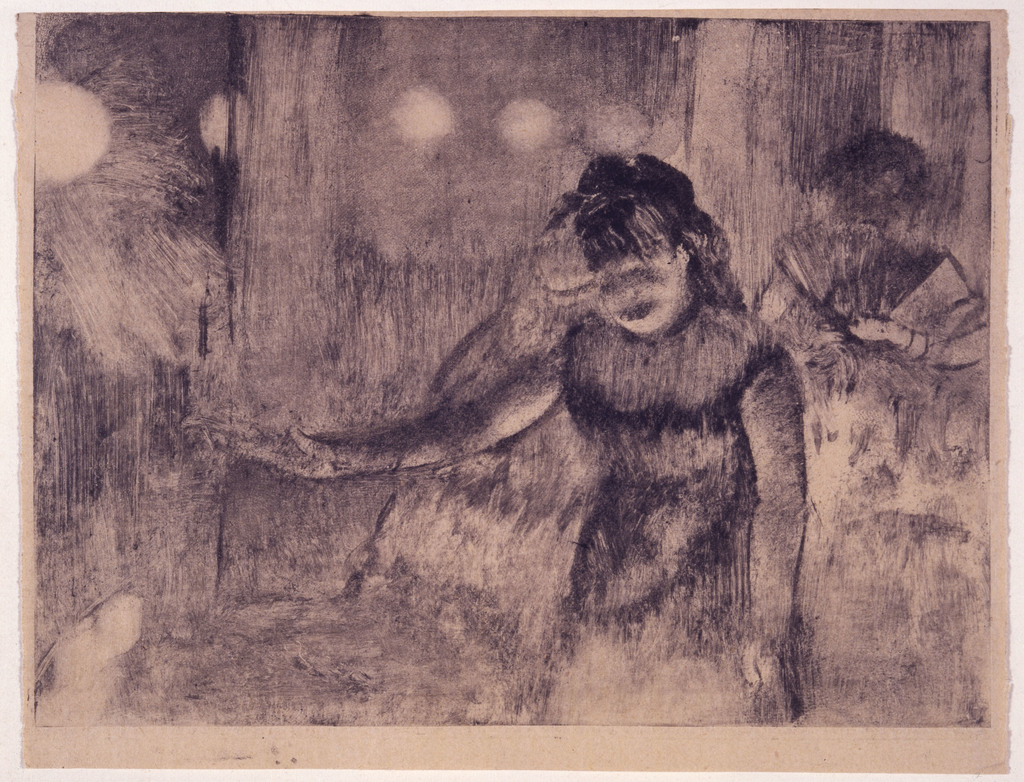
and the costumes of women lingering scandalously solo at cafés 


(Young Woman in a Café, c. 1877).

Of Degas’s urban subjects in monotype, it was the ballet and the café concert that offered the perfect melding of subject and means. In these works, Degas focused on fundamental aspects of the modern experience in an era of expanded entertainment, illumination, and motion. Degas once said that drawing dancers was just “a pretext for rendering movement,” a pictorial challenge that monotype gave him the means to address.

While Degas’s images of the ballet take place on the stage as dancers leap into the air, as seen in


Pas battu (c. 1879),

they reflect the velocity and tempo of city life. For late-19th-century urban dwellers experiencing the advent of 24-hour lighting, the city was always illuminated—and always in motion.

Degas used the technical possibilities of the monotype to foreground the lighting of the ballet and café concert—gaslight and the new electric light. In works like


Dancer Onstage with a Bouquet (c. 1876) 


or Café Singer (c.1877–78),

footlights transform the performer’s body, catching the translucency of tutus or turning faces into masks.

In his café scenes, lighting is endlessly refracted in the theater’s mirrors and gilded architecture, creating an enchanted spectacle. 

In Backstage at the Ballet 


 and in the Brothel

Degas used small scale plates to portray the backstage at the ballet and the interiors of brothels in monotype.


The exhibition includes a group of illustrations for The Cardinal Family, a collection of stories about theamorous adventures of two young ballerinas, written by Degas’s friend Ludovic Halévy. Much of the action takes place backstage or in the theater’s wings, and Degas depicts the flurry and flux of backstage spaces by deploying gestural marks and smudges to suggest hustle and bustle, reflections in mirrors, and kaleidoscopic swirls of legs and arms, and by cropping bodies with the plate’s edge to imply motion. Seen together, these monotypes show Degas’s ever-active eye shifting from long views to close-ups, focusing on the empty centers of waiting rooms, and pressing close to the dancers as if taking on the vantage point of their male admirers.

Although Degas’s illustrations were not used for the book’s initial publication, they demonstrate that narrative was a springboard for experimentation.

Degas’s monotypes depicting prostitutes in brothel interiors are also on view in the exhibition—including several owned by Pablo Picasso—to explore how and why Degas treated this subject in monotype. For Degas, monotype served this subject in key ways: his gestural marks convey a space of flux and financial exchange, and his free brushwork encouraged caricature. The addition of pastel on some monotypes allowed Degas to further describe these scenes. Degas’s  


Two Young Girls 


and Waiting for the Client (both c. 1877–79) 

portray women sitting unselfconsciously and inelegantly, apparently unconcerned about prospective clients, who in contrast often appear unsure of themselves, apprehensively looking in from the margins.


Bathers 

Degas’s most daring application of monotype is in his depictions of female bathers in intimate settings. In these works, he deploys radical compositional and technical innovation, portraying private acts of washing and grooming and dramatically illuminating bodies and surroundings. Degas contorted these bathers into awkward, unusual, and seemingly impossible poses. Degas’s renderings are tactile, rough, and unresolved, with ambiguous contours blurring distinctions between body and environment. 

Degas created these images primarily by subtraction—laying down a curtain of ink on the plate, he drew by removal, conjuring an image out of darkness by wiping the ink away with a process that has come to be known as the “dark-field” technique. Broadening his tool kit, he used brushes with dry, hardened bristles to create striated patterns, a hard-pointed implement to incise into the ink, sponges or cloths to dab or smoothly move the ink around, his hands to sculpt his subjects, his thumb and palm prints to impress texture, and his fingernails for contour, all of which can be seen in The Fireside (c. 1880–85), one of Degas’s largest monotypes. In focusing on how Degas uses monotype, the exhibition calls attention to the way this medium allows the artist to access and express private moments in a deeply visceral way.

Landscapes

After a hiatus of several years, Degas returned to producing monotypes in 1890. Followingan excursion though the Burgundy region of France, Degas sought to capture the experience of the landscape. Using oil paint instead of black printer’s ink, he created a series of abstract landscapes—exemplified by MoMA’s  


Forest in the Mountains (c. 1890)

 —that are among the most radical works of their time. Inspired by experience or imagination, these landscapes allude to the natural world or conjure meteorological effects, while undermining any sense of the earth’s solidity and stability.The use of oil paint in monotype was a key innovation, introducing color as well as an element of unpredictability:the fluid paint ran under the pressure of the press, and Degas experimented with rollers, cloths, fingerprints, and coarse wiping. 


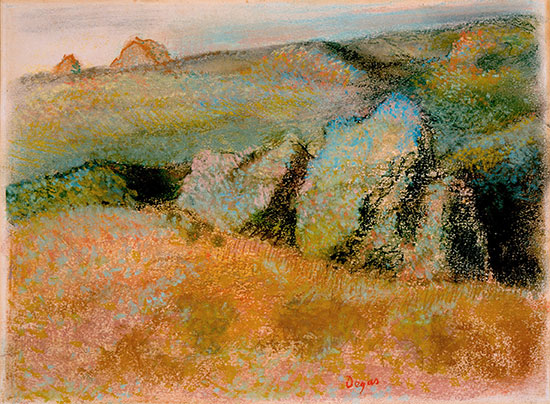
 On top of these washes of color, Degas often added pastel for emphasis—as seen in his 


1892 Landscape with Rocks (Paysage avec rochers)

highlighting particular geologic formations or adding in hedges or  trees,resolving his indistinct compositions into landscapes that took familiar and more recognizable form. Degas exhibited a group of these works at a Paris gallery in 1892, where they were enthusiastically received as examples of Symbolism, a trend in art and literature of that time, which rejected the industrialized world and its faith in scientific progress in favor of the fantastic, mystical, and dreamlike.

Consequences

The exhibition shows how Degas’s monotype practice impacted his works in other mediums. Degas’s experiments with the essential qualities of monotype—repetition and transformation, mirroring andreversal, tone and tactility—enriched his working drawing and painting. Understanding that something singular can spark multiple variations and that an image can always be reworked, revised,and recrafted, his approach—especially in his last decades—was characterized by his unceasing pursuit and modification of key subjects across mediums. Degas traced, inverted, and recombined figures into different arrangements, applying pastel or charcoal on paper, or layering oil paint on canvas to further transform his subjects. The resulting chains of images representing ballerinas and bathers demonstrate how Degas saw iteration as an end in itself rather than a series of steps toward something final or finished.

The lessons of monotype also encouraged a new freedom, leading to a more liberated handling of charcoal, pastel, and oil paint and the visible presence of fingerprints. Degas also incorporated many compositional strategies first seen in his dark-field bathers, using his own fingerprints to render figures or their environments and depicting the body in unusual and seemingly impossible positions. The layered washes of the landscape monotypes in particular provoked a productive reliance on tone, resulting in ambiguous and amorphous grounds.

In his monotypes, Degas is at his most modern, capturing the spirit of urban life, depicting the body in daring ways, liberating drawing from tradition, and engaging the possibilities of abstraction. Whether focused on method or theme, Degas’s insistent searching resulted in what the poet Stéphane Mallarmé saw as “a strange new beauty.” Reflecting a spirit of relentless invention and restless improvisation, a deep curiosity about the behavior of materials, a penetrating eye, an affinity for strategies of repetition and seriality, and an incisive understanding of the history of art, Degas’s efforts in monotype not only bridge the fin de siècle, but look forward to developments in the 20th century and beyond.


PUBLICATIONS:

The exhibition is accompanied by a fully illustrated catalogue edited by Jodi Hauptman, with essays by Carol Armstrong, Jonas Beyer, Kathryn Brown, Karl Buchberg, Hollis Clayson, Samantha Friedman, Richard Kendall, Laura Neufeld, Stephanie O’Rourke, Raisa Rexer, and Jill de Vonyar. The publication presents approximately 120 monotypes alongside related works in other mediums, and explores the creative potency of Degas's rarely seen monotypes and their impact on his widerpractice. 224 pages, 230 illustrations. Hardcover.

The exhibition is also accompanied by a new children’s book, What Degas Saw, written by MoMA assistant curator Samantha Friedman,with illustrations by Cristina Pieropan and reproductions of artworks by Degas. The story looks at the world through the artist’s eyes as he walks through the streets of Paris, and provides insight into his creative process. What Degas Saw encourages young readers to carefully observe their surroundings and to create their own art about the people and places around them. 40 pages, illustrated throughout. 
Excellent review with lots of images

 Good review