Wednesday, December 21, 2016

Frida Kahlo at The Dali

The Dali Museum in St. Petersburg, FL
December 17, 2016  through April 17, 2017.

An exhibition of Frida Kahlo’s paintings and drawings, together with her personal photograph collection, will open to the public at The Dali Museum in St. Petersburg, FL on December 17, 2016 and continue through April 17, 2017. Kahlo’s works have achieved monumental importance in art and popular culture. Her dreamlike work suggests that love and suffering create a new sense of beauty. Kahlo’s art and storied life stir immense public interest.

Frida Kahlo at The Dali will be Florida’s first solo exhibition showcasing the extraordinary career and life of the acclaimed 20th century artist. The exhibit will feature a collection of more than 60 Kahlo pieces including 15 paintings, seven drawings and numerous personal photographs from the celebrated female artist and influential icon. The exhibition will extend outdoors where a special collection of flowers and plants representative of those in Kahlo’s own garden at Casa Azul, her home in Mexico, will grace the grounds of the Museum’s Avant Garden.

Co-organized by The Dali and the Museo Dolores Olmedo in Mexico City and featuring the Vicente Wolf photographic collection, the exhibition is an intriguing exploration of the life of Kahlo, her striking artwork and her fascinating psyche. Together with the exclusive photographs of family, friends and lovers, the exhibition gives a complete view of Kahlo’s world along with the joys, passions and obsessions of this remarkable artist.

“With her dreamlike images, Kahlo has stirred huge public interest beyond the traditional art audience. In a way, Kahlo created a persona that serves as a contemporary feminine ideal – both tender and fierce,” said Dali Museum Executive Director, Dr. Hank Hine. “Much like Dali, she constructed an eccentric identity through the iconography in her paintings and then dressed and carried herself as the personality she created in her art. Painting by painting, she becomes a heroic figure of struggle and perseverance.”

Kahlo and Dalí each created artistic autobiographies and their personalities loom behind their paintings, generating a presence that both shapes and overshadows their works of art. While Kahlo largely rejected the term ‘Surrealism’ and felt that her works were as real as her life, Andre Breton, known as the founder of Surrealism, took great interest in her work and described her painting as ‘a bomb wrapped in a ribbon.’ “It’s a natural fit for The Dali to present an exhibition of Frida Kahlo.” said Kathy Greif, Chief Marketing Officer of The Dali. “We’ve been broadening the scope of our exhibitions, presenting works from famed artists and icons like Warhol, Picasso and Walt Disney – all whom have a connection to Dali– but this is the first renowned female artist to grace our halls in some time, we are honored to share Kahlo’s incredible art and complex life story with the world.”

Frida Kahlo at The Dali
has been co-organized by The Salvador Dali Museum, St. Petersburg, FL and the Museo Dolores Olmedo, Mexico City. The exhibit also features works from the Vicente Wolf photographic collection. Frida Kahlo at The Dali is curated for The Dali by Dr. Hank Hine and Dr. William Jeffett.


Frida Kahlo, Autorretrato con changuito (Self Portrait with Small Monkey), 1945 Oil on Composite Board. Collection Museo Dolores Olmedo, Mexico City © 2016 Banco de Mexico Diego Rivera and Frida Kahlo Museums Trust, Mexico, D.F./Artists Rights Society (ARS), New York


Frida Kahlo, Retrato de Alicia Galant (Portrait of Alicia Galant), 1927 Oil on Canvas. Collection Museo Dolores Olmedo, Mexico City © 2016 Banco de Mexico Diego Rivera and Frida Kahlo Museums Trust, Mexico,D.F./Artists Rights Society (ARS), New York


Frida Kahlo, 1945 [seated next to a lithographic stone of Diego Rivera’s 1930 self-portrait, Casa Azul]. Photograph by Lola Álvarez Bravo, ©1995 Center for Creative Photography, University of Arizona Foundation. Vicente Wolf Photography Collection.

More images

From a very interesting article (image added):

In fact, for this exhibition the gallery is divided into parts, one of which features Kahlo’s work that parents might not want their children to experience. One is a painting titled


"A Few Small Nips” showing a dead woman lying naked on a bed with a man standing over her. The woman’s body is covered with knife wounds. Blood spills onto the floor and even onto the frame of the painting. It was, Jeffett said, Kahlo’s response to a news story about domestic violence.

Read more here: http://www.bradenton.com/entertainment/arts-culture/article121418743.html#storylink=cpy


Saturday, December 17, 2016

TURNER’S MODERN AND ANCIENT PORTS: PASSAGES THROUGH TIME


The Frick Collection
February 23 through May 14, 2017


J.M.W. Turner
Harbor of Dieppe: Changement de Domicile, exhibited 1825, but subsequently dated 1826
Oil on canvas
68 3/8 x 88 3/4 inches
The Frick Collection, New York Photo: Michael Bodycomb


J.M.W. Turner 
Cologne, the Arrival of a Packet-Boat: Evening, exhibited 1826 Oil on canvas
66 3/8 x 88 1/4 inches
The Frick Collection, New York
Photo: Michael Bodycomb\


J.M.W. Turner, Shields, on the River Tyne, for The Rivers of England, 1823, watercolor on paper, © Tate, London 2016 


Exploring a turning point in the career of Britain’s greatest land- and seascape painter of the nineteenth century, a major exhibition at The Frick Collection will illuminate Joseph Mallord William Turner’s (1775–1851) distinctly modern approach to the theme of the port. Opening in winter 2017, Turner’s Modern and Ancient Ports: Passages Through Time centers around the Frick’s grand-scale Harbor of Dieppe and Cologne, both painted by the artist in the mid-1820s, and unites them for the first time publicly with a closely related yet unfinished work from Tate, London, that depicts the harbor of Brest, in Brittany. 

This trio of port scenes is accompanied by more than thirty of Turner’s oil paintings, watercolors, sketchbooks, and prints, among them other contemporary views of France, Germany, and England, as well as imagined scenes set inancient Carthage and Rome. A longstanding subject in art, the port is a space of arrival and departure that links the city interior and the open water beyond, evoking a sense of journey and the passage of time. Whether portraying the ancient world or encapsulating contemporary life in a specific region, Turner returned to this time-honored theme to explore the relationship of past and present and, conscious of his own place in history, showcase his artistic innovations, chief among them his dazzling treatment of light and color.
Comments Susan Galassi, “As with so many of our exhibitions, this show is built around major works in our collection and provides the occasion to bring fresh perspectives through new scholarship and engaging programming. 

The Frick’s harbors of Dieppe and Cologne, purchased more than a hundred years ago by Henry Clay Frick, are restricted from travel and have not been exhibited elsewhere for the past century. We are thrilled to provide our audiences insight into Turner’s masterful technique and process by reuniting the Frick’s ports, which themselves have never before been the focus of an exhibition, with a third harbor scene from the Tate on a similar scale, along with other port scenes—both imagined and set in the present—in oil and watercolor that reveal how the artist developed this subject over time.” 

Turner’s Modern and Ancient Ports: Passages through Time was organized by Susan Grace Galassi, Senior Curator, The Frick Collection; Ian Warrell, independent curator and Turner specialist; and Joanna Sheers Seidenstein, Anne L. Poulet Curatorial Fellow, The Frick Collection. It will be accompanied by a catalogue published with Yale University Press.

TURNER AND TRAVEL 

The central decades of Turner’s career coincided with political, technological, and cultural developments that created a new context for his depictions of ports. With Napoleon’s decisive defeat at Waterloo in 1815, a new era of tourism began. Travel restrictions between England and France that had been in place since 1797 were lifted, and contact with the Continent was renewed. British artists, writers, and the public at large crossed the Channel in droves to rediscover the continent and to see how their neighbors had fared during the interim. English ports that had only recently served as the country’s defensive borders were now being transformed into commercial hubs and seaside resorts. The advent of the steamboat and high speed carriages as well as improved roads made travel easier and more accessible to a larger segment of the population, including the middle class. A market developed for images of the picturesque sights that travelers had seen or planned to visit. As an insatiable traveler and the foremost topographical artist of the period, Turner was well equipped to meet this demand. On his extensive trips through the British Isles and, after 1817, the Continent, Turner filled notebooks with sketches of land formations, architecture, ships, and people in regional costumes at both work and play.

THE FRICK COLLECTIONS DIEPPE AND COLOGNE 

During these years, Turner moved beyond the idealized naturalism and earth-toned palette that had gained him acclaim to a new form of poetic topography. As fusions of land-, sea-, and townscapes, ports offered fertile ground for experimentation and innovation in both oil and watercolor. Turner’s focus turned increasingly to the representation of light and color, a preoccupation that continued to the end of his career. In the 1810s, he seized on the new high-keyed colors that had just become available—chrome yellow and chrome orange—applying them, with other light-colored hues, to canvases primed with white to create works of surprising (and, for the time, shocking) luminosity. During his first trip to Italy, in 1819, he experienced firsthand the warm glowing tones of the southern climate, which contributed to the increased brilliance of his paintings, a direction that the public and critics found disturbingly unnatural and eccentric. 

The Frick Collection’s Harbor of Dieppe: Changement de Domicile can be seen as a major statement of Turner’s direction in the mid-1820s. For this marine view depicting the everyday life of the French port city, Turner adopts the grand scale traditionally reserved for historical or religious subjects. He borrows his compositional scheme from the renowned harbors of Claude Lorrain, placing his work in an artistic lineage with the master who set the standard for the motif. In Dieppe, as in many of Claude’s ports, two “arms”—comprised of piers, buildings, boats, and people—reach out from a vanishing point on the horizon to embrace a central body of water that extends to the bottom edge of the painting. The mirror image of the sun’s orb and reflections of the boats are suspended in the water’s ruffled surface. A pale-blue sky takes up more than half of the canvas, in which Turner gives priority to light and water over solid substance. 
Working from sketches made on two trips to Dieppe, in 1821 and 1824, and drawing from memory and imagination, Turner filled his sun-drenched vista with a cast of some two hundred figures who interact in scenes of daily life: moving house, lounging aboard ships, and jostling each other in the broad streets as they go about their business. At the right, a row of meticulously rendered eighteenth-century houses lining the quay (most still standing today) serves as the backdrop for Turner’s loosely rendered vision of the town’s teeming life and spectacular setting. On the horizon at the vanishing point of the painting, the tower and dome of the church of St. Jacques, Dieppe’s spiritual center, anchors the scene, set off by the sun’s radiance. 

In Dieppe, Turner transcended the limits of topographical representation to present his subjective view of the place. When the painting debuted at the Royal Academy, both critics and the public were quick to point out that its golden atmosphere had little or nothing to do with the temperate climate of northern France and its characteristic gray skies. To one critic, Dieppe was as “vicious a specimen...of mingled truth and falsehood.” Turner also took poetic license by excluding any sign of the transformation the town was then undergoing from a sleepy fishing port to a modern resort, with tourists arriving by steamboat, presenting instead a nostalgic, idealized vision of the port that was on the verge of disappearing.
In Dieppe’s companion piece, Cologne, the Arrival of a Packet-Boat: Evening, Turner turns his attention to the historic city and pilgrimage center on the banks of the Rhine, replacing the sun-filled harbor in Dieppe with an evening scene in which life appears suspended in time. The deep recession of space that characterizes Dieppe is blocked in Cologne by the two packet boats that approach the shore. The Claudian reference of the former work is replaced here by allusion to the peaceful, domestic river scenes of the Dutch masters, in particular, Aelbert Cuyp. Light again establishes the emotional register of the painting, conveying a mood of reverie through the diffused, shimmering pink and violet tones that fill the water and expansive sky and collect around the spire of the church of Gross St. Martin, the highest point in the painting. Carefully delineated foreground details, such as the abandoned fishing apparatus half submerged in water, the peasant women lugging lumber, and the lone dog drinking at the water’s edge, as well as the defensive medieval walls and towers that bar entry into the city, contribute to a sense of frozen time. Yet, encroaching on the shore aboard the packet boat, about to disrupt the spell, is a lively band of tourists in fashionable attire, ambassadors from the modern world. The contrast of past and present, often subtly evoked in Turner’s harbor scenes, is represented here as two vastly different spheres on a collision course. 

As is the case with Dieppe, Turner’s view of Cologne is nostalgic, emphasizing the grandeur of the past. In his painting, he kept the city’s medieval face intact, although a number of its walls and towers had been torn down over the course of his visits to make way for the expansion and modernization then underway. Here too, Turner’s exaggerated tonal range met with hostility from critics, one of whom complained of the “glitter and gaud of colors” while conceding that it is “impossible to shut our eyes to the wonderful skill, and to the lightness and brilliance which he has effected.” 
UNITING THREE RELATED SCENES 

Dieppe and Cologne will be presented at the Frick with a third monumental port, The Harbor of Brest: The Quayside and Château. This scene, approximately the same size as the Frick canvases, was most likely painted between 1826 and 1828, but was left unfinished. Identified in 1997 by Ian Warrell, the exhibition’s co-curator, as a view of the Breton city, this work has long been connected with the Frick paintings, although they have never before been exhibited together. Recent technical analysis carried out by Rebecca Hellen, Painting Conservator at the Tate, revealed that the grounds of the three canvases were prepared in the same way
and that the same type of paint was used in all of them, confirming that the paintings were conceived and developed as a series. 

The Harbor of Brest presents an unparalleled opportunity to observe Turner’s painting process arrested in a molten state. Large masses of diluted blue, orange, brown, and yellow oil establish the major forms of the composition, creating a glowing effect similar to that of watercolor. In parts of the canvas, crowds of figures and boats and buildings are given definition through modeling in light and dark. Further work would have brought Brest up to the level of finish of the Frick paintings. Left in this state, the canvas, with its luminous blurred forms, seems to anticipate the less resolved and more abstracted character of Turner’s later work. 

ANCIENT PORTS IMAGINED 

Following Dieppe, Cologne, and Brest, Turner returned to the motif of the port in the late 1820s, now as a setting for subjects from the ancient world. The theme of the rise and decline of civilizations had long preoccupied Turner, and his second trip to Italy, in 1828, reinvigorated his love of antiquity. The three ancient ports included in the exhibition complement his modern views, works rooted in on-the-spot observation of the setting and local populace and filtered through the artist’s imaginative recollection. In his classical harbors, accounts from ancient history, literature, and myth are the departure points for the works, which Turner filled with details of everyday life that lend the scenes the immediacy of his modern ports. 


J.M.W. Turner, Regulus, exhibited 1828, reworked and exhibited 1837, oil on canvas, © Tate, London 2016
In Regulus, painted and exhibited during his second trip to Italy, in 1828, then reworked and shown again in London in 1837, Turner depicts an episode from the life of a third- century Roman general, Marcus Atilius Regulus, a model of stoic virtue and self-sacrifice. According to literary sources, the Roman general, captured by the Carthaginians, was sent to Rome to negotiate a treaty. On failing to do so, he kept his vow to return to Carthage, where his eyelids were cut off and he was forced to stare at the sun until blinded, before being executed. Here, as in Dieppe and Brest, the glaring sun and its reflection in the water occupy the center of the
painting, with figures grouped along the sides and in the foreground. Within the scene, the hero is reduced to a few pale brush strokes and displaced to the right side of the canvas—nearly impossible to find. Through this imaginative conceit, Turner forces the viewer to confront head on the painting’s blazing light while searching for the protagonist, taking up the position in front of the sun that Regulus himself endured. In Regulus, Turner not only defies the norms of history painting, but makes use of the classical narrative to slyly respond to criticisms of his work, which had been described as “blinding” and “almost [putting] your eyes out.”

WATERCOLOR AND OIL, A DIALOGUE 

Turner’s lifelong obsession with the representation of light and atmosphere found an ideal outlet in watercolor, a medium to which he brought an array of unconventional methods to create heightened visual effects. In his atmospheric water-filled scenes of ports, medium and motif formed a perfect union. Whereas his experimental mid- career oils were met with controversy, his watercolors were universally praised. Turner’s watercolors, many of which were made for British topographical serial print publications, celebrated the country’s richness of notable sights. They provided him with a steady source of income and earned him widespread recognition as the greatest contemporary watercolor artist. Working alternately in oil and watercolor and often treating the same subject in both, Turner deliberately blurred distinctions between the two mediums, enriching each with aspects of the other. In some of his watercolors, for example, he employed the same compositional structures as in his grand-scale canvases, while in his oils he achieved a sense of transparency usually associated with watercolor. To some of his vociferous critics, Turner’s monumental port scenes in oil were essentially blown-up watercolors.


The exhibition includes some two dozen watercolors depicting picturesque ports on the British coast and up
and down its rivers, as well as images from northern France and the Rhineland, along with a selection of
prints. Showcasing the diversity and beauty of the English landscape and seascape, Turner depicted every
type of port: naval strongholds, fashionable resorts, industrial harbors, anchorages in major cities, and
remote river landings, some seen from the shore and others looking back from the water. He embellished
his images with historical references and allusions to contemporary issues and expressed an often ambiguous attitude to the “progress” of industrialization. 


J.M.W. Turner
Dover Castle from the Sea, for Marine Views, 1822 Watercolor and gouache on paper
15 15/16 x 23 5/8 inches
Museum of Fine Arts, Boston
© 2017 Museum of Fine Arts, Boston

In Dover Castle from the Sea, Turner takes as his subject one of England’s oldest and most strategically important ports, the departure point for the cross-Channel ferry service. He plunges the viewer into the scene as if on board a ship in the foreground, pitching and heaving in roiling waves as it attempts to make shore. Other wind-tossed fishing boats arrive and depart, while townspeople spill over the piers. In a characteristic pairing of past and present, Turner includes in the flotilla of sail boats a steam-powered ferry, a symbol of modernization cutting a steady path through the waves and trailing a plume of sooty smoke. Presiding over this maritime scene is Dover’s ancient castle and fortifications atop its white cliffs, a reference to England’s enduring power. 


J.M.W. Turner
Shields, on the River Tyne, for The Rivers of England, 1823 Watercolor on paper
6 1/16 x 8 1/2 inches
© Tate, London 2016
In Shields, on the River Tyne, painted for a print series, Turner again makes use of a Claudian composition, evoking the weight of tradition and Arcadian subject matter for his extraordinary night scene, emphatically set in the present of England’s industrial hub in the northeast . The full moon, reflected in water, serves as a spotlight that allows for the around-the-clock labor of workers shoveling coal onto small boats that carry it to the waiting ships for transport to manufacturing centers. Competing with the moon’s eerie brilliance is the burning glow of an industrial furnace at right, set against the overall blue tonality of the painting. Turner’s pitting of man against nature within the setting of a modern port is made all the more eloquent through the unfamiliar, almost surreal, beauty he achieves in his watercolor, charting new aesthetic territory. With this small work, like the other mid-career oils and watercolors included in the show, Turner expanded the boundaries of landscape art, leaving behind strict adherence to naturalistic representation for a more poetic treatment of light and color that gave form and meaning to a world transforming before his eyes. 
 

PUBLICATION 


In the accompanying catalogue, the Frick paintings and a wide selection of works by Turner from the 1820s and 1830s, depicting both modern and ancient harbors, are examined in various contexts. Drawing from contemporary travel accounts, literary and visual sources, and critical reviews, as well as new technical analyses of Turner’s work, the five essays present a fresh perspective on the middle years of the artist’s career. The book features essays by the show’s curators as well Gillian Forrester, Senior Curator of Prints and Drawings, Yale Center for British Art; and Rebecca Hellen, Conservator of Paintings, Tate Britain. Among the topics addressed are the radical changes in the social and economic structures of Britain in the first half of the nineteenth century; the rediscovery of the Continent by the British after Waterloo following two decades of war with France; the rise of mass tourism; Turner’s involvement in producing watercolors for various print series; and the interconnection between his manner of painting in various media. Published by Yale University Press in association with The Frick Collection.

.

OIL PAINTINGS


J.M.W. Turner
Harbor of Dieppe: Changement de Domicile, exhibited 1825, but subsequently dated 1826
Oil on canvas
68 3/8 x 88 3/4 inches
The Frick Collection, New York Photo: Michael Bodycomb


J.M.W. Turner 
Cologne, the Arrival of a Packet-Boat: Evening, exhibited 1826 Oil on canvas
66 3/8 x 88 1/4 inches
The Frick Collection, New York
Photo: Michael Bodycomb\


J.M.W. Turner
Ancient Italy—Ovid Banished from Rome, exhibited 1838 Oil on canvas
37 1/4 x 49 1/4 inches
Private collection


WATERCOLORS


J.M.W. Turner
Cologne from the River, 1820
Watercolor on paper
12 1/8 x18 1/4 inches
Seattle Art Museum; Gift of Mr. and Mrs. Louis Brechemin (70.70)
Photo Paul Macapia


J.M.W. Turner
Sun-Rise: Whiting Fishing at Margate, for Marine Views, 1822 Watercolor on paper
16 3/4 x 25 1/2 inches
Private collection


J.M.W. Turner
Dover Castle from the Sea, for Marine Views, 1822 Watercolor and gouache on paper
15 15/16 x 23 5/8 inches
Museum of Fine Arts, Boston
© 2017 Museum of Fine Arts, Boston


J.M.W. Turner
Shields, on the River Tyne, for The Rivers of England, 1823 Watercolor on paper
6 1/16 x 8 1/2 inches
© Tate, London 2016 


J.M.W. Turner
Grenoble Bridge, ca. 1824
Transparent and opaque watercolor with scraping over traces of graphite
20 7/8 x 28 1/4 inches
The Baltimore Museum of Art; Purchase with exchange funds from Nelson and Juanita Greif Gutman Collection (BMA 1968.28)
Photo Mitro Hood 


J.M.W. Turner
Brighthelmston, Sussex, for Picturesque Views on the Southern Coast of England, ca. 1824
Watercolor on paper 5 3/4 x 8 3/4 inches
Royal Pavilion & Museums, Brighton & Hove; Purchased 2012 with assistance from The Heritage Lottery Fund, the Art Fund and the Royal Pavilion & Museums Foundation (FA104132)


J.M.W. Turner
Devonport and Dockyard, Devonshire, for Picturesque Views in
England and Wales, ca. 1825–29
Watercolor and gouache, with scratchwork, on cream wove paper
11 3/4 x 17 5/16 inches
Harvard Art Museums/Fogg Museum; Gift of Charles Fairfax Murray in honor of W. J. Stillman (1903.49)
Imaging Department © President and Fellows of Harvard College 


J.M.W. Turner
Mont-St-Michel, Normandy, for The English Channel, ca. 1827 Watercolor on paper
7 x 10 1/16 inches
The Hecksher Family Collection
Image courtesy Fine Arts Museums of San Francisco
Photo: Randy Dodson 


J.M.W. Turner
The Harbor of Brest: The Quayside and Château, ca. 1826–28 Oil on canvas
68 x 88 inches
© Tate, London 2016


J.M.W. Turner
Ehrenbreitstein, ca. 1832
Watercolor on paper
11 5/8 x 17 1/8 inches
Bury Art Museum (BUYGM.0115.1901)
© Bury Art Museum, Greater Manchester, UK


J.M.W. Turner
Regulus, exhibited 1828, reworked and exhibited 1837 Oil on canvas
35 1/4 x 48 3/4 inches
© Tate, London 2016


Thursday, December 15, 2016

American Modernism The Shein Collection

National Gallery of Art
May 16, 2010, to January 2, 2011
 
The American avant-garde played an important role in the creation of a modernist visual culture on both sides of the Atlantic in the first decades of the twentieth century. Many American artists resided in Paris during these years. There they encountered firsthand the innovations of their contemporaries Henri Matisse and Pablo Picasso, whose radical experiments in color and form epitomized modernism in Europe.

In the United States modernism initially found its strongest expression in the eclectic activities of the group of artists, writers, and critics who gathered around the photographer Alfred Stieglitz at his gallery "291" in New York. The full scope of the modernist movement became evident in 1913 with The International Exhibition of Modern Art, known as the Armory Show. This display of well over a thousand American and European paintings and sculptures introduced the American public to cubism, abstraction, and other recent artistic developments.

The twenty works by nineteen artists that form the Shein Collection offer a concise, nuanced account of the first American avant-garde. The various shifting, intersecting alliances of the early modernist period are represented, including the painters associated with Stieglitz such as Arthur Dove, Marsden Hartley, John Marin, and Georgia O'Keeffe; practitioners of New York Dada such as Duchamp and Man Ray; the synchromists or color painters, Patrick Henry Bruce and Stanton Macdonald-Wright; precisionists such as Charles Demuth, Morton Schamberg, and Charles Sheeler; and the transatlantic modernists, Bruce, Duchamp, Man Ray, and John Storrs. Looking at the history of early American modernism through the lens of the Shein Collection offers a timely opportunity to consider the contributions made by American artists during the advent of modernism a century ago.


Marsden Hartley, American, 1877–1943, Pre‑War Pageant, 1913, oil on canvas, 100.3 x 81 cm (39 1/2 x 31 7/8 in.), Collection of Deborah and Ed Shein
 
Stanton Macdonald‑Wright, American, 1890–1973, Still-Life Synchromy, 1917, oil on canvas, 56.4 x 76.2 cm (22 1/8 x 30 1/4 in.), Collection of Deborah and Ed Shein


  Patrick Henry Bruce ,   American, 1881–1936 ,   Painting (Still Life), c. 1919 ,   oil and pencil on canvas ,   59.7 x 93.7 cm (23 1/2 x 36 7/8 in.) ,   Collection of Deborah and Ed Shein 


Max Weber ,   American, 1881–1961 ,   The Fisherman, 1919 ,   gouache on canvas ,   58.7 x 43.2 cm (23 1/8 x 17 in.) ,   Collection of Deborah and Ed Shein


Charles Demuth ,   American, 1883–1935 ,   End of the Parade: Coatesville, Pa., 1920 ,   tempera and pencil on board ,   50.5 x 40 cm (19 7/8 x 15 3/4 in.) ,   Collection of Deborah and Ed Shein 


Georgia O'Keeffe ,   American, 1887–1986 ,   Dark Iris No. 2, 1927 ,   oil on canvas ,   81.3 x 53.3 cm (32 x 21 in.) ,   Collection of Deborah and Ed Shein


Arthur Dove, American, 1880–1946, Sunrise I, 1936, wax emulsion on canvas, 63.5 x 88.9 cm (25 x 35 in.), Collection of Deborah and Ed Shein


John Marin ,   American, 1870–1953 ,   The Written Sea, 1952 ,   oil on canvas ,   55.9 x 71.1 cm (22 x 28 in.) ,   National Gallery of Art, Washington, Gift of Deborah and Ed Shein


Charles Sheeler ,   American, 1883–1965 ,   Composition around White, 1959 ,   oil on canvas ,   76.2 x 83.8 cm (30 x 33 in.) ,   Collection of Deborah and Ed Shein


Stuart Davis, American, 1892–1964, Unfinished Business, 1962, oil on canvas, 91.5 x 114.3 cm (36 x 45 in.), Collection of Deborah and Ed Shein

JACOB LAWRENCE’S FAMED MIGRATION SERIES


The Phillips Collection
October 8, 2016- January 8, 2017


This fall, all 60 panels of the masterwork The Migration Series by renowned African American 20th- century artist Jacob Lawrence will be on display at The Phillips Collection in People on the Move: Beauty and Struggle in Jacob Lawrence’s Migration Series

A powerful visual epic, The Migration Series (1940–41) documents the historic movement of millions of African Americans from the rural South to the urban North more than a century ago. Reuniting 30 panels owned by the Phillips with 30 panels on loan from the Museum of Modern Art, Lawrence’s complete series will be on display beginning October 8, 2016, and will run until January 8, 2017.


Jacob Lawrence, The Migration Series, Panel no. 1: During World War I there was a great migration north by southern African Americans, 194041. Casein tempera on hardboard, 12 x 18 in. The Phillips Collection, Washington, DC, Acquired 1942 © The Jacob and Gwendolyn Knight Lawrence Foundation, Seattle / Artists Rights Society (ARS), New York
This exhibition builds on the museum’s rich and meaningful history with the artist over the course of decades in exhibitions and internationally recognized educational initiatives. 
Since the time Duncan Phillips first acquired the odd-numbered panels of Lawrence’s series in 1942, The Migration Series has remained a cornerstone of our permanent collection and a force in our educational work with international communities,” said Director Dorothy Kosinski. 

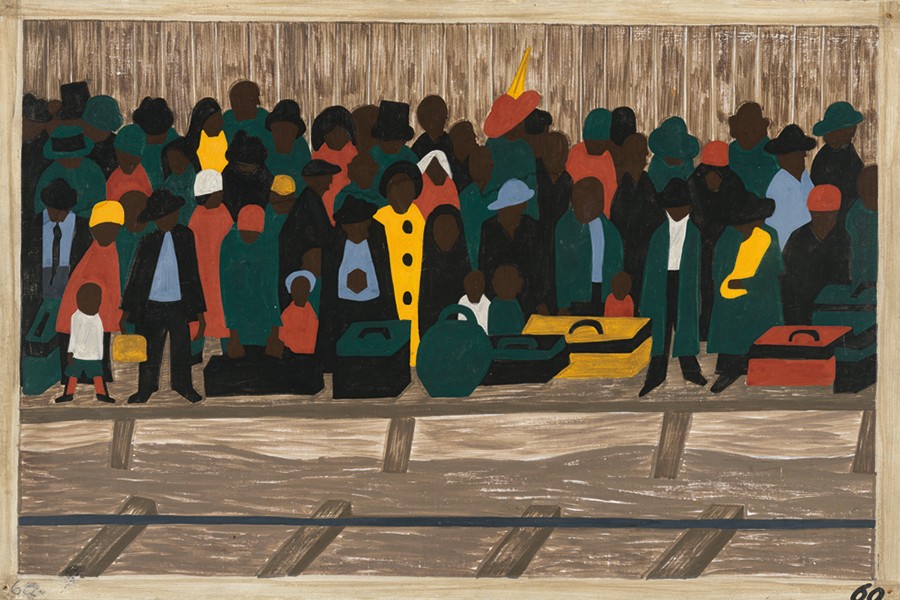
In panel 60 of The Migration Series, Lawrence leaves us with the message, And the migrants kept coming,’” said curator Elsa Smithgall. During a time when record numbers of migrants are uprooting themselves in search of a better life, Lawrence’s timeless tale and its universal themes of struggle and freedom continue to strike a chord not only in our American experience but also in the international experience of migration around the world.” 
“While Jacob Lawrence’s masterpiece was created more than 70 years ago, it continues to resound powerfully with the global plight of migrants today. I look forward to the Phillips continuing its leadership role in using The Migration Series to stimulate dialogue and reflection on global challenges in the 21st century.” 


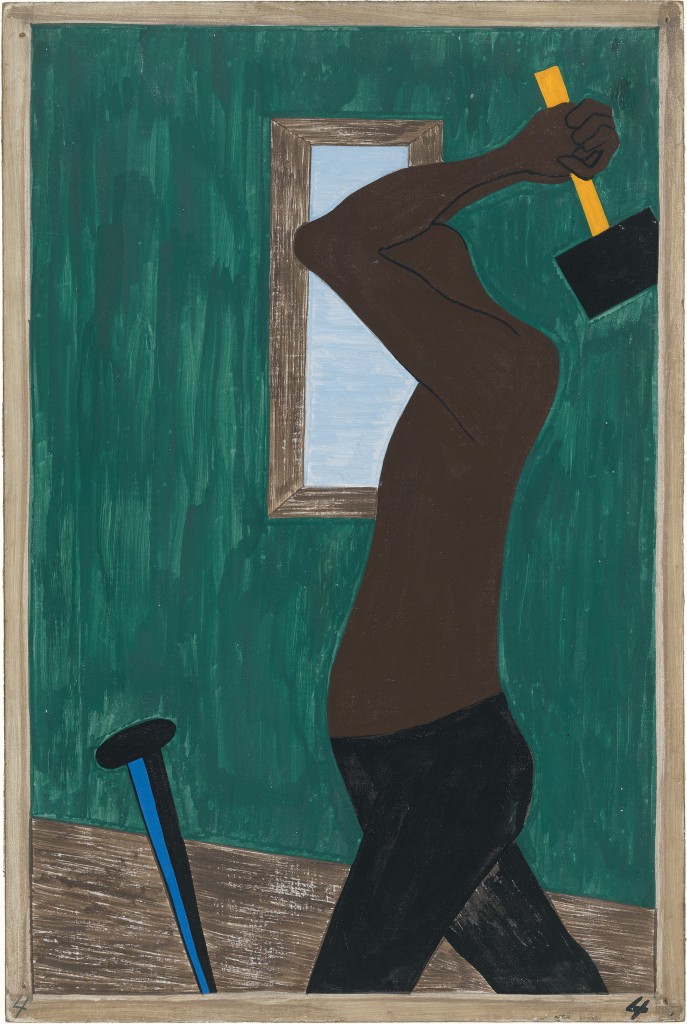
Jacob Lawrence, The Migration Series, Panel no. 4: All other sources of labor having been exhausted, the migrants were the last resource., 1940–41. Casein tempera on hardboard, 12 x 18 in. The Museum of Modern Art, New York. Gift of Mrs. David M. Levy © The Jacob and Gwendolyn Knight Lawrence Foundation, Seattle / Artists Rights Society (ARS), New York

Jacob Lawrence, The Migration Series, Panel no. 9: They left because the boll weevil had ravaged the cotton crop., 1940–41. Casein tempera on hardboard, 12 x 18 in. The Phillips Collection, Washington, DC, Acquired 1942 © The Jacob and Gwendolyn Knight Lawrence Foundation, Seattle / Artists Rights Society (ARS), New York


Jacob Lawrence, The Migration Series, Panel no. 11: Food had doubled in price because of the war., 1940–41. Casein tempera on hardboard, 12 x 18 in. The Phillips Collection, Washington, DC, Acquired 1942 © The Jacob and Gwendolyn Knight Lawrence Foundation, Seattle / Artists Rights Society (ARS), New York


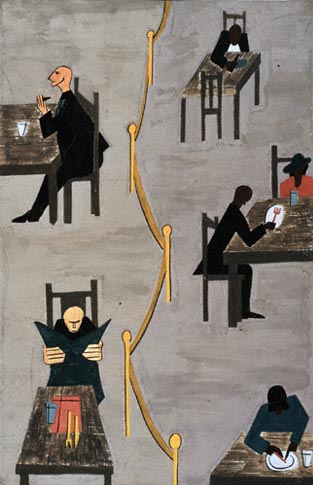
Jacob Lawrence, The Migration Series, Panel no. 19: There had always been discrimination., 1940–41. Casein tempera on hardboard, 12 x 18 in. The Phillips Collection, Washington, DC, Acquired 1942 © The Jacob and Gwendolyn Knight Lawrence Foundation, Seattle / Artists Rights Society (ARS), New York


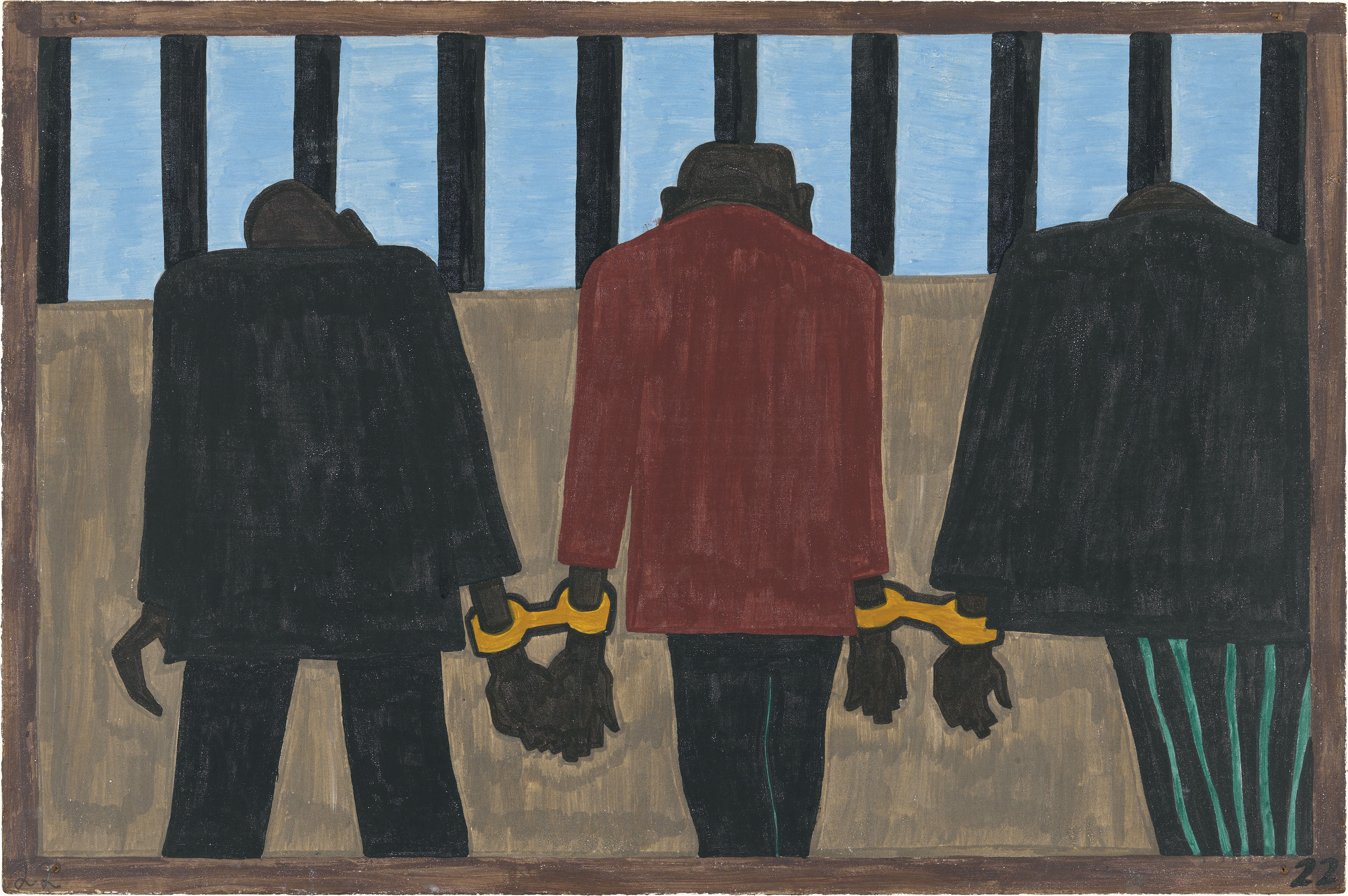
Jacob Lawrence, The Migration Series, Panel no. 22: Migrants left. They did not feel safe. It was not wise to be found on the streets late at night. They were arrested on the slightest provocation., 1940–41. Casein tempera on hardboard, 12 x 18 in. The Museum of Modern Art, New York. Gift of Mrs. David M. Levy © The Jacob and Gwendolyn Knight Lawrence Foundation, Seattle / Artists Rights Society (ARS), New York


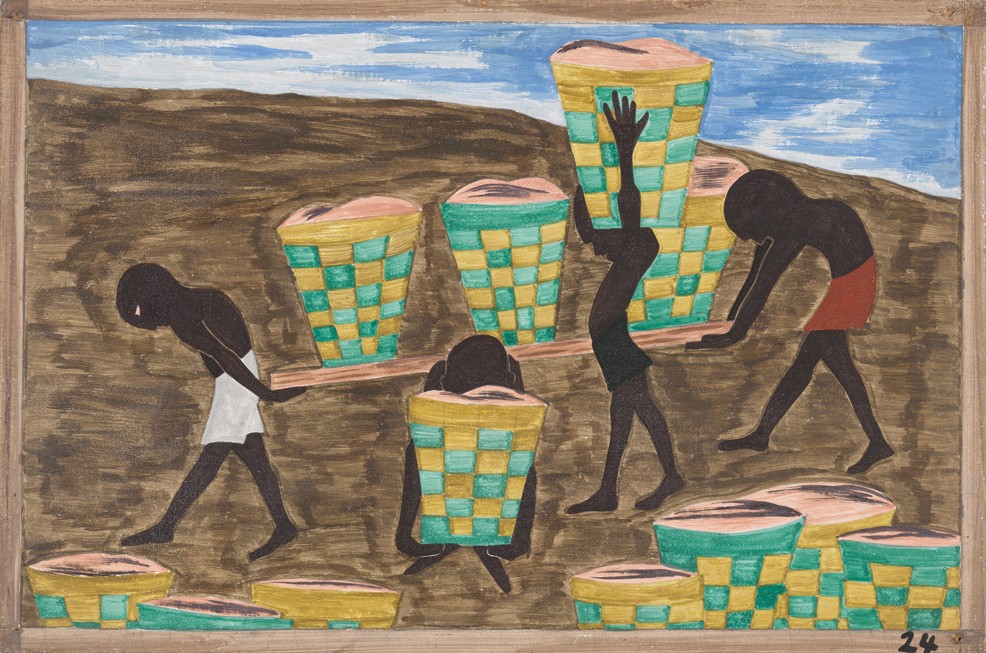
Jacob Lawrence, The Migration Series, Panel no. 24: Their children were forced to work in the fields. They could not go to school., 1940–41. Casein tempera on hardboard, 12 x 18 in. The Museum of Modern Art, New York. Gift of Mrs. David M. Levy © The Jacob and Gwendolyn Knight Lawrence Foundation, Seattle / Artists Rights Society (ARS), New York

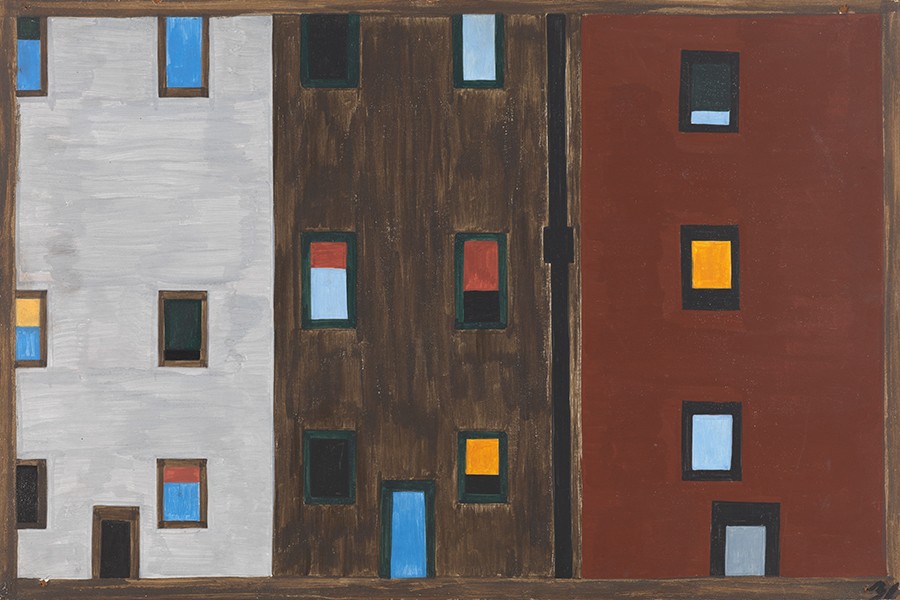
Jacob Lawrence, The Migration Series, Panel no. 31: The migrants found improved housing when they arrived north., 1940–41. Casein tempera on hardboard, 12 x 18 in. The Phillips Collection, Washington, DC, Acquired 1942 © The Jacob and Gwendolyn Knight Lawrence Foundation, Seattle / Artists Rights Society (ARS), New York


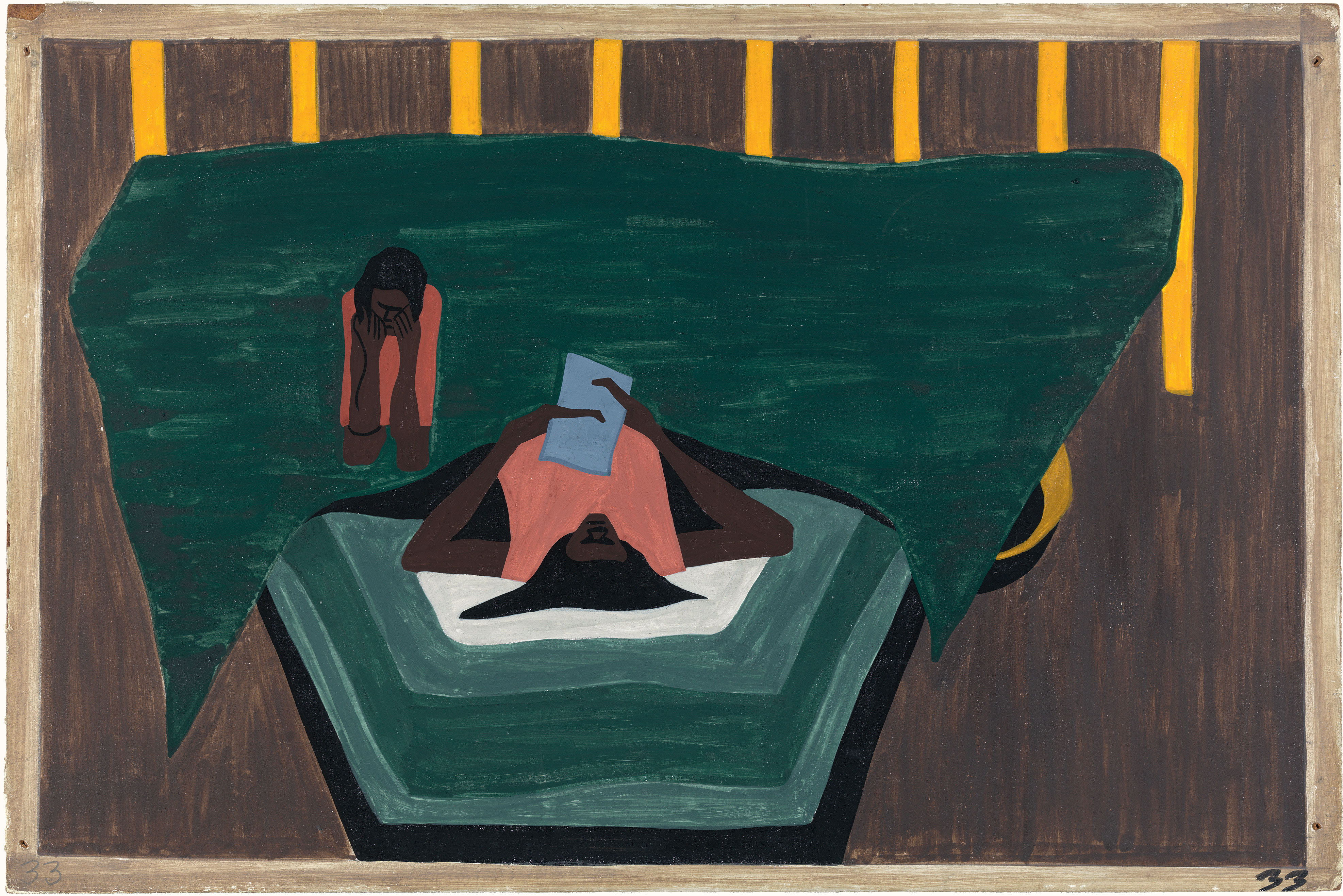
Jacob Lawrence, The Migration Series, Panel no. 33: Letters from relatives in the North told of the better life there., 1940–41. Casein tempera on hardboard, 12 x 18 in. The Phillips Collection, Washington, DC, Acquired 1942 © The Jacob and Gwendolyn Knight Lawrence Foundation, Seattle / Artists Rights Society (ARS), New York


Jacob Lawrence, The Migration Series, Panel no. 37: Many migrants found work in the steel industry., 1940–41. Casein tempera on hardboard, 12 x 18 in. The Phillips Collection, Washington, DC, Acquired 1942 © The Jacob and Gwendolyn Knight Lawrence Foundation, Seattle / Artists Rights Society (ARS), New York


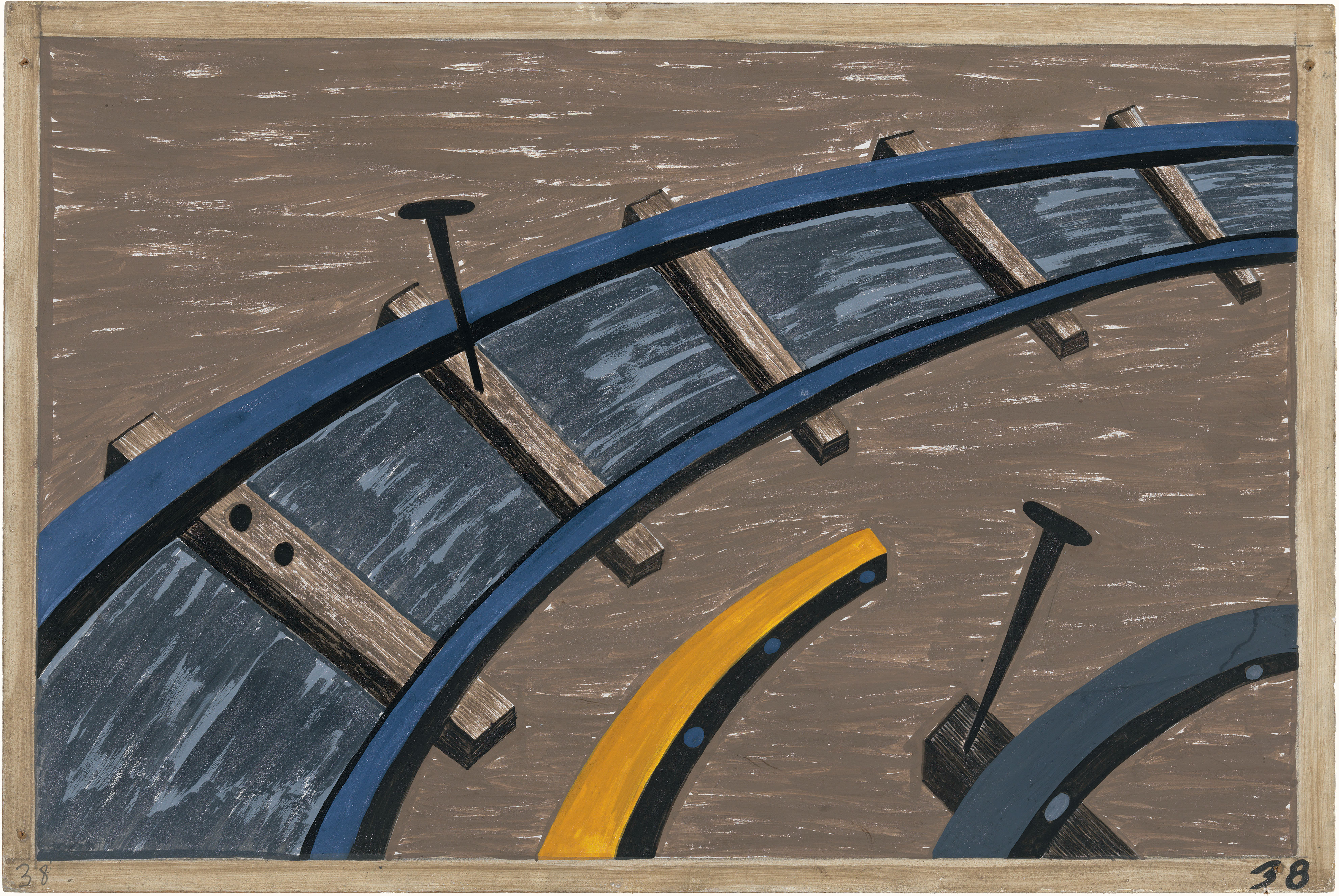
Jacob Lawrence, The Migration Series, Panel no. 38: They also worked on the railroads., 1940–41. Casein tempera on hardboard, 12 x 18 in. The Museum of Modern Art, New York. Gift of Mrs. David M. Levy © The Jacob and Gwendolyn Knight Lawrence Foundation, Seattle / Artists Rights Society (ARS), New York


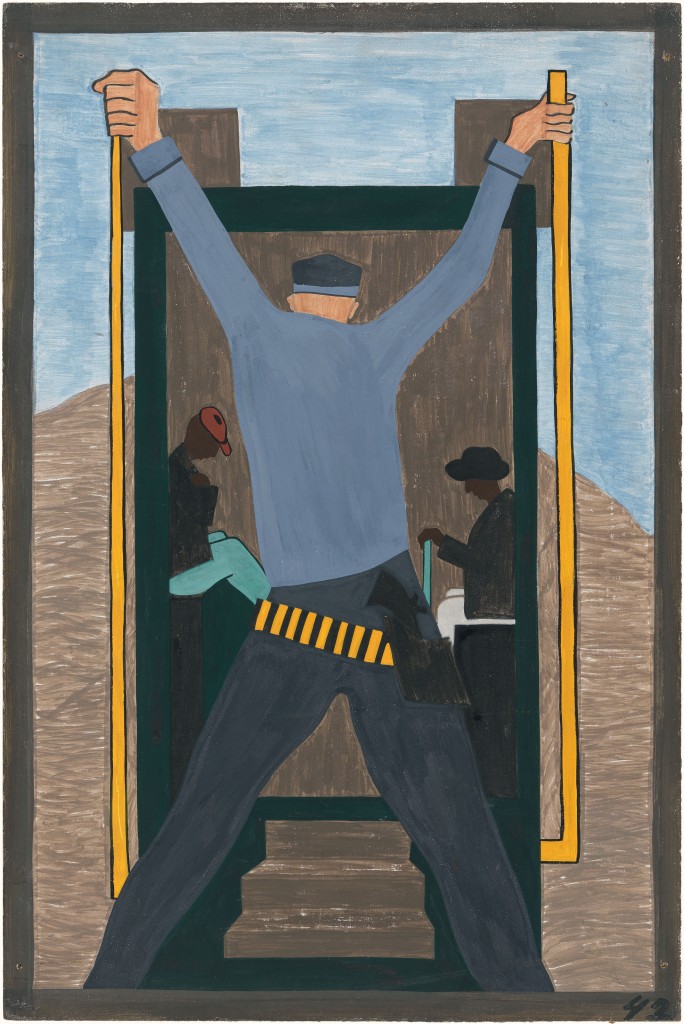
Jacob Lawrence, The Migration Series, Panel no. 42: To make it difficult for the migrants to leave, they were arrested en masse. They often missed their trains., 1940–41. Casein tempera on hardboard, 12 x 18 in. The Museum of Modern Art, New York. Gift of Mrs. David M. Levy © The Jacob and Gwendolyn Knight Lawrence Foundation, Seattle / Artists Rights Society (ARS), New York


Jacob Lawrence, The Migration Series, Panel no. 45: The migrants arrived in Pittsburgh, one of the great industrial centers of the North., 1940–41. Casein tempera on hardboard, 12 x 18 in. The Phillips Collection, Washington, DC, Acquired 1942 © The Jacob and Gwendolyn Knight Lawrence Foundation, Seattle / Artists Rights Society (ARS), New York

Jacob Lawrence, The Migration Series, Panel no. 46: Industries boarded their workers in unhealthy quarters. Labor camps were numerous., 1940–41. Casein tempera on hardboard, 12 x 18 in. The Museum of Modern Art, New York. Gift of Mrs. David M. Levy © The Jacob and Gwendolyn Knight Lawrence Foundation, Seattle / Artists Rights Society (ARS), New York


Jacob Lawrence, The Migration Series, Panel no. 49: They found discrimination in the North. It was a different kind., 1940–41. Casein tempera on hardboard, 12 x 18 in. The Phillips Collection, Washington, DC, Acquired 1942 © The Jacob and Gwendolyn Knight Lawrence Foundation, Seattle / Artists Rights Society (ARS), New York


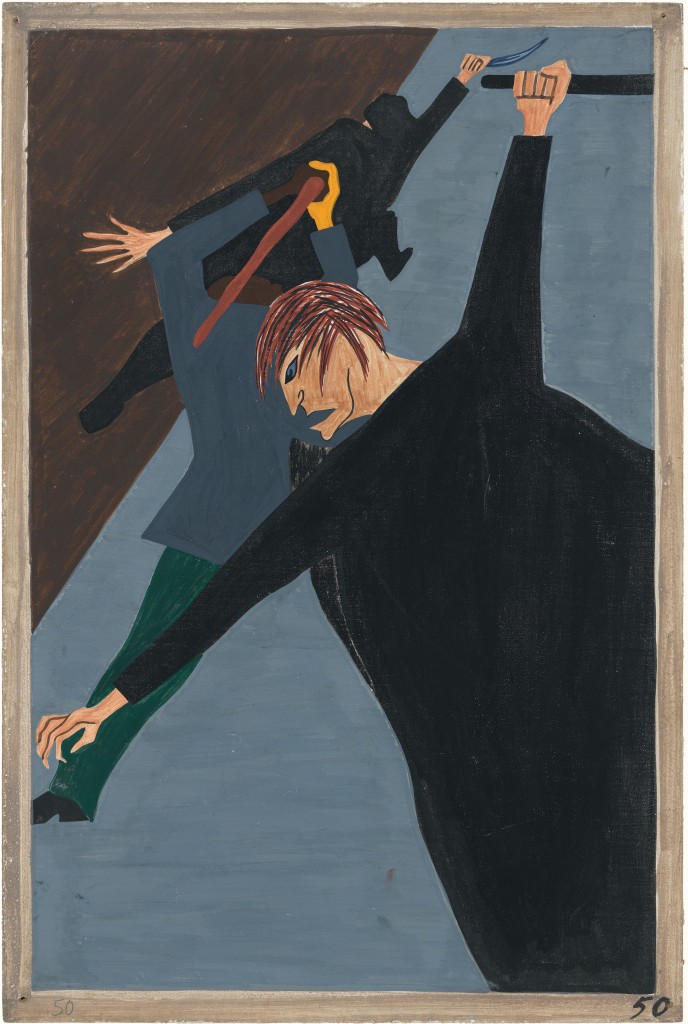
Jacob Lawrence, The Migration Series, Panel no. 50: Race riots were numerous. White workers were hostile toward the migrant who had been hired to break strikes., 1940–41. Casein tempera on hardboard, 12 x 18 in. The Museum of Modern Art, New York. Gift of Mrs. David M. Levy © The Jacob and Gwendolyn Knight Lawrence Foundation, Seattle / Artists Rights Society (ARS), New York

Jacob Lawrence, The Migration Series, Panel no. 51: African Americans seeking to find better housing attempted to move into new areas. This resulted in the bombing of their new homes., 1940–41. Casein tempera on hardboard, 12 x 18 in. The Phillips Collection, Washington, DC, Acquired 1942 © The Jacob and Gwendolyn Knight Lawrence Foundation, Seattle / Artists Rights Society (ARS), New York

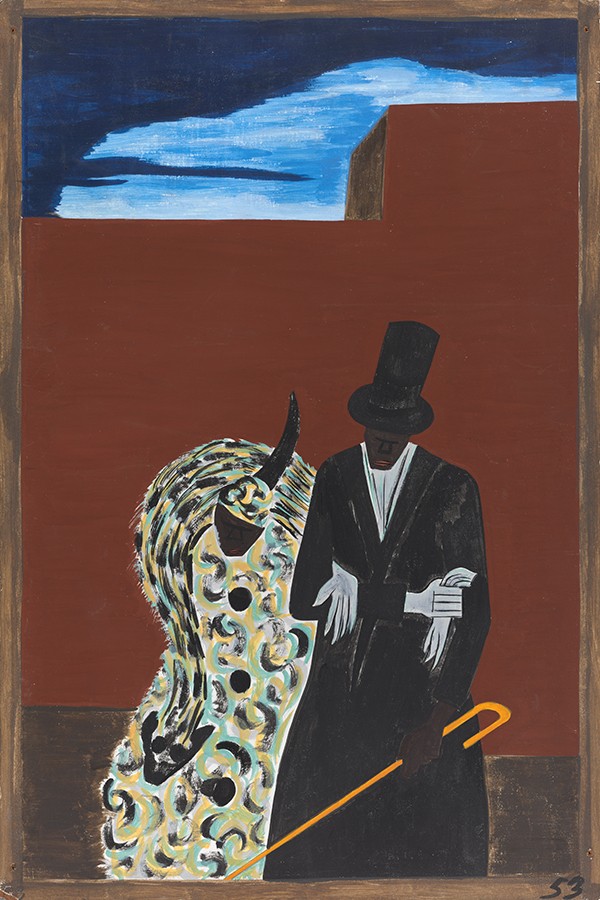
Jacob Lawrence, The Migration Series, Panel no. 53: African Americans, long-time residents of northern cities, met the migrants with aloofness and disdain., 1940–41. Casein tempera on hardboard, 12 x 18 in. The Phillips Collection, Washington, DC, Acquired 1942 © The Jacob and Gwendolyn Knight Lawrence Foundation, Seattle / Artists Rights Society (ARS), New York


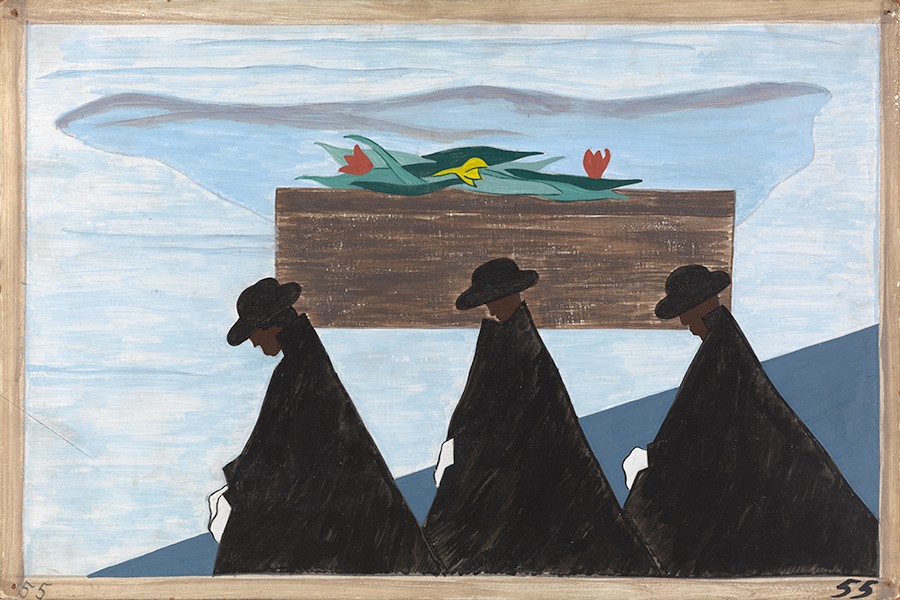
Jacob Lawrence, The Migration Series, Panel no. 55: The migrants, having moved suddenly into a crowded and unhealthy environment, soon contracted tuberculosis. The death rate rose., 1940–41. Casein tempera on hardboard, 12 x 18 in. The Phillips Collection, Washington, DC, Acquired 1942 © The Jacob and Gwendolyn Knight Lawrence Foundation, Seattle / Artists Rights Society (ARS), New York


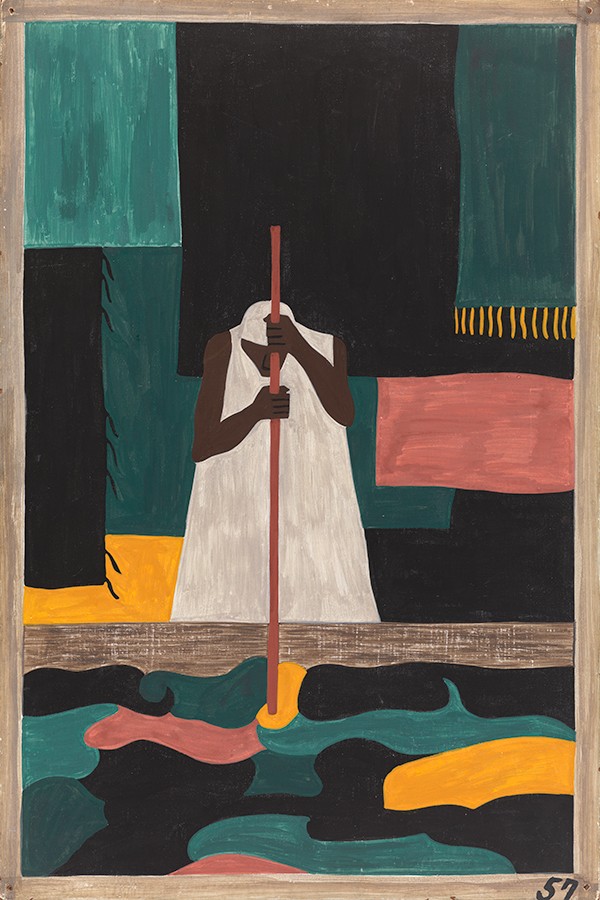
Jacob Lawrence, The Migration Series, Panel no. 57: The female workers were the last to arrive north., 1940–41. Casein tempera on hardboard, 12 x 18 in. The Phillips Collection, Washington, DC, Acquired 1942 © The Jacob and Gwendolyn Knight Lawrence Foundation, Seattle / Artists Rights Society (ARS), New York


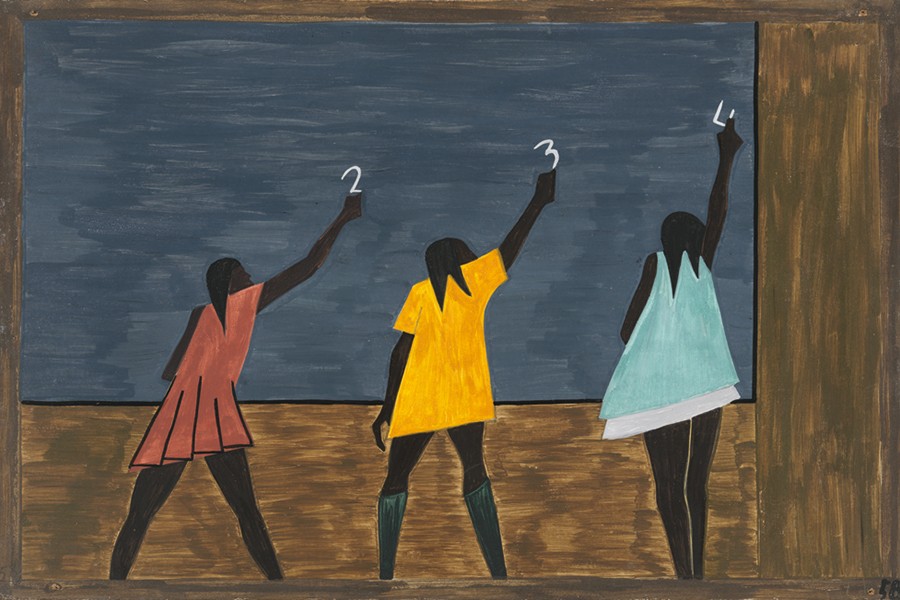
Jacob Lawrence, The Migration Series, Panel no. 58: In the North the African American had more educational opportunities., 1940–41. Casein tempera on hardboard, 12 x 18 in. The Museum of Modern Art, New York. Gift of Mrs. David M. Levy © The Jacob and Gwendolyn Knight Lawrence Foundation, Seattle / Artists Rights Society (ARS), New York


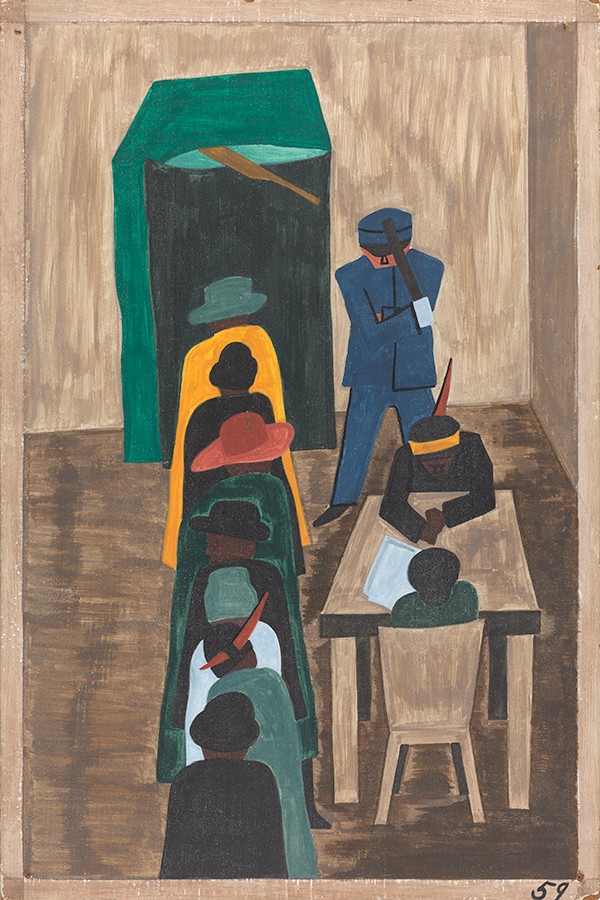
Jacob Lawrence, The Migration Series, Panel no. 59: In the North they had the freedom to vote., 1940–41. Casein tempera on hardboard, 12 x 18 in. The Phillips Collection, Washington, DC, Acquired 1942 © The Jacob and Gwendolyn Knight Lawrence Foundation, Seattle / Artists Rights Society (ARS), New York

Jacob Lawrence, The Migration Series, Panel no. 60: And the migrants kept coming., 1940–41. Casein tempera on hardboard, 12 x 18 in. The Museum of Modern Art, New York. Gift of Mrs. David M. Levy © The Jacob and Gwendolyn Knight Lawrence Foundation, Seattle / Artists Rights Society (ARS), New York