Wednesday, December 27, 2017

Jongkind & friends

Dordrechts Museum
29 October 2017 to 27 May 2018 


Johan Barthold Jongkind (1819-1891) was a key figure in nineteenth century European painting. He was a linking pin in the development of modern painting and quite rightly a true pioneer of Impressionism. Working from the Dutch, realistic tradition, Jongkind gave the initial push to Impressionism in France. He was born in the Netherlands, but most of his life he lived in France where he became friends with artists such as

 https://katevents.files.wordpress.com/2017/12/2017-dordts-museum-jongkind-06.jpeg
 Jongkind and friends

Monet, Sisley, Boudin, Daubigny and Pissarro. Dordrechts Museum dedicates an impressive exhibition to the work of Jongkind and several of his well-known artist friends.


Eye opener
Jongkind painted cityscapes and in particular coastal and river sceneries. His apt observations of nature and his direct, loose way of painting were an eye opener to the French artists. Camille Pissarro, for instance, was one of the first to mention Jongkind as a model: “Landscapes without Jongkind would have a completely different view.”


Claude Monet, Le Port de Trouville, 1870, Szépmu”vészeti Múzeum/Museum of Fine Arts Budapest.


Claude Monet said that Jongkind had told him how to look: “He took care of the education of my eyes” and Eduard Manet called him ‘the father of the modern landscape’. His work was dearly loved by the French audience.


Jongkind’s Le Port de Dordrecht 1869 courtesy of Dordrechts Museum

Picturesque Dordrecht
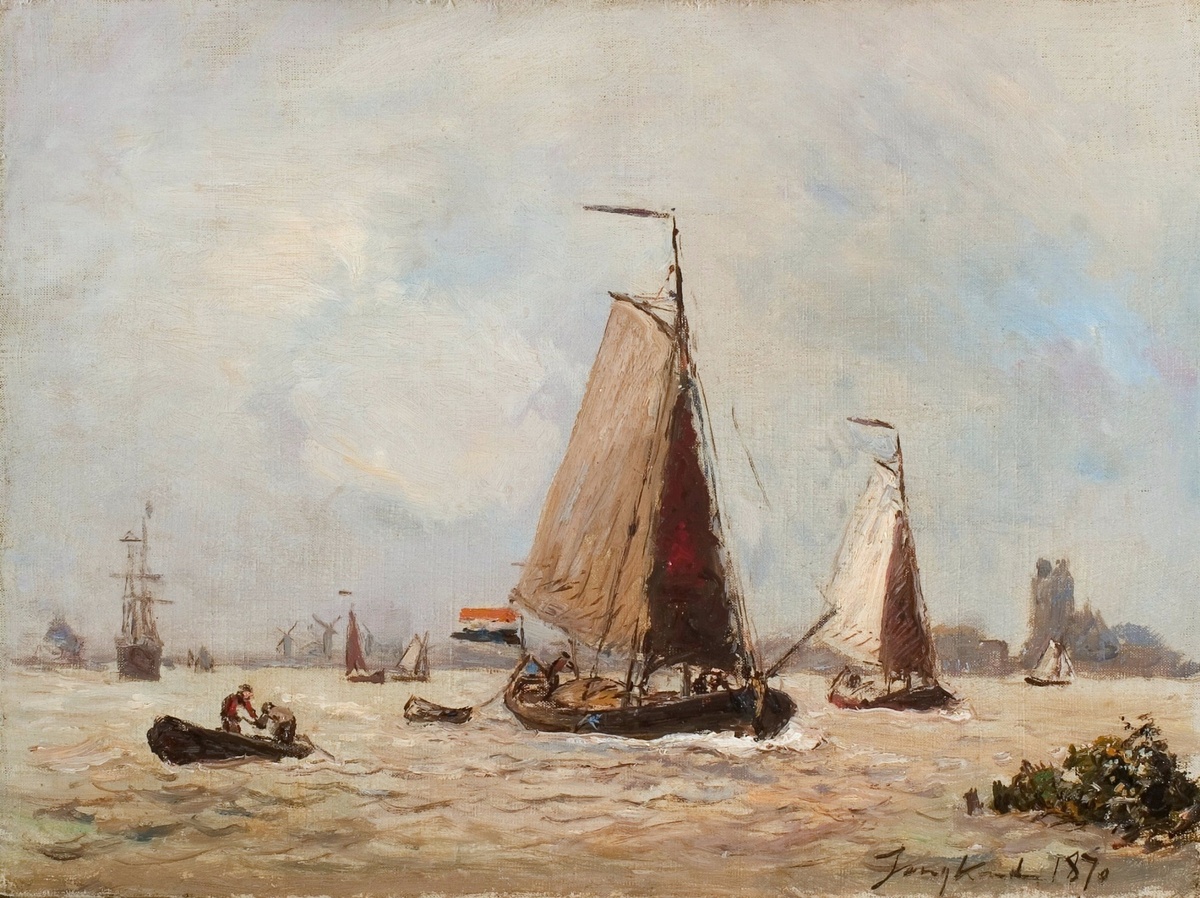
Jongkind frequently returned to the Netherlands, where he painted the harbours of Rotterdam and Dordrecht and the Dutch polder landscape. Especially his clair de lune paintings, landscapes with moonlight, were very popular in France. Jongkind thought Dordrecht ‘the most beautiful city of the Netherlands’ and urged other French artists to visit the picturesque city.


Johan Jongkind (1819-1891), Sailing boats near Dordrecht, 1870, Oil on canvas, Dordrechts Museum 
 

Exhibition
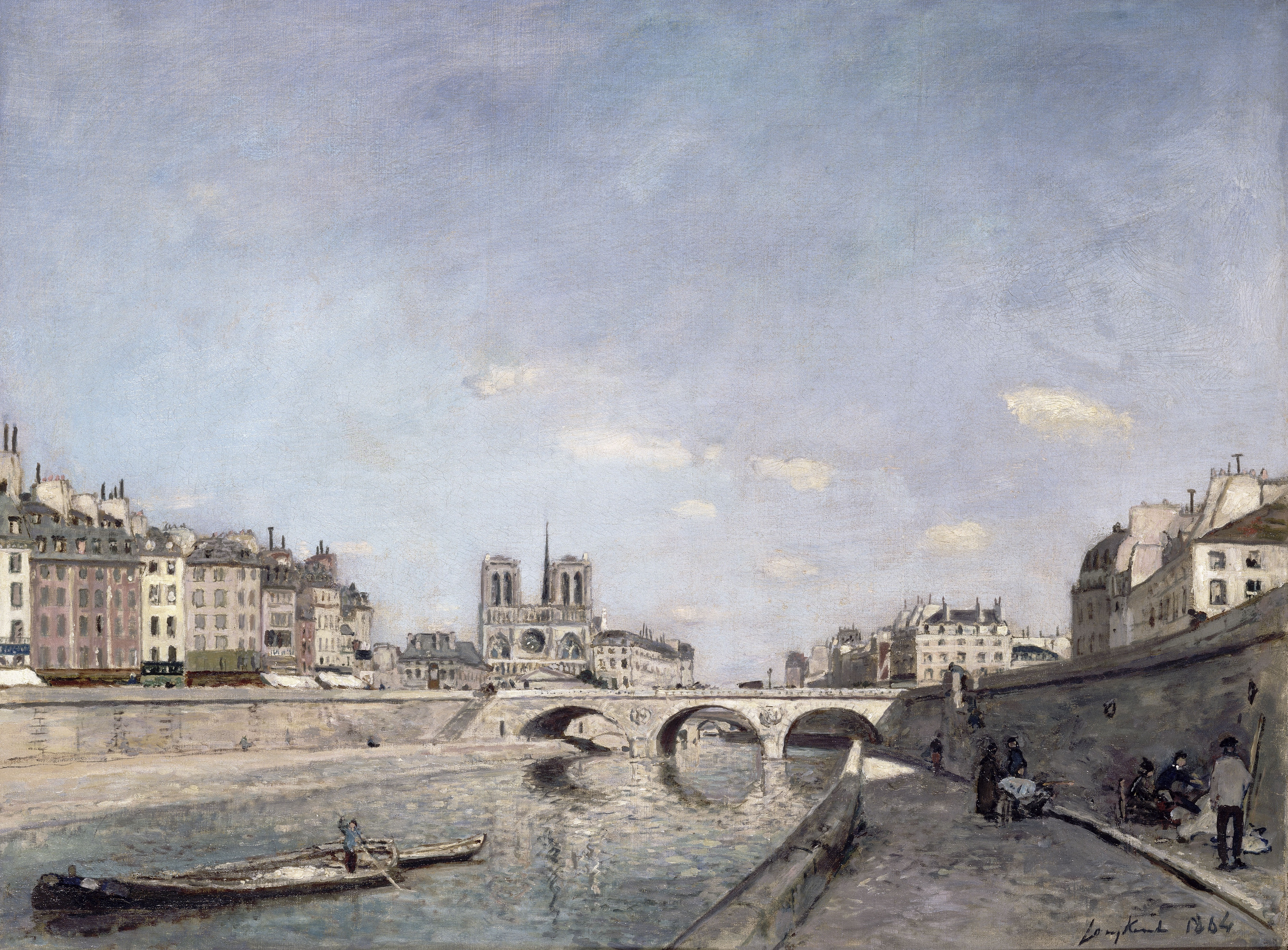
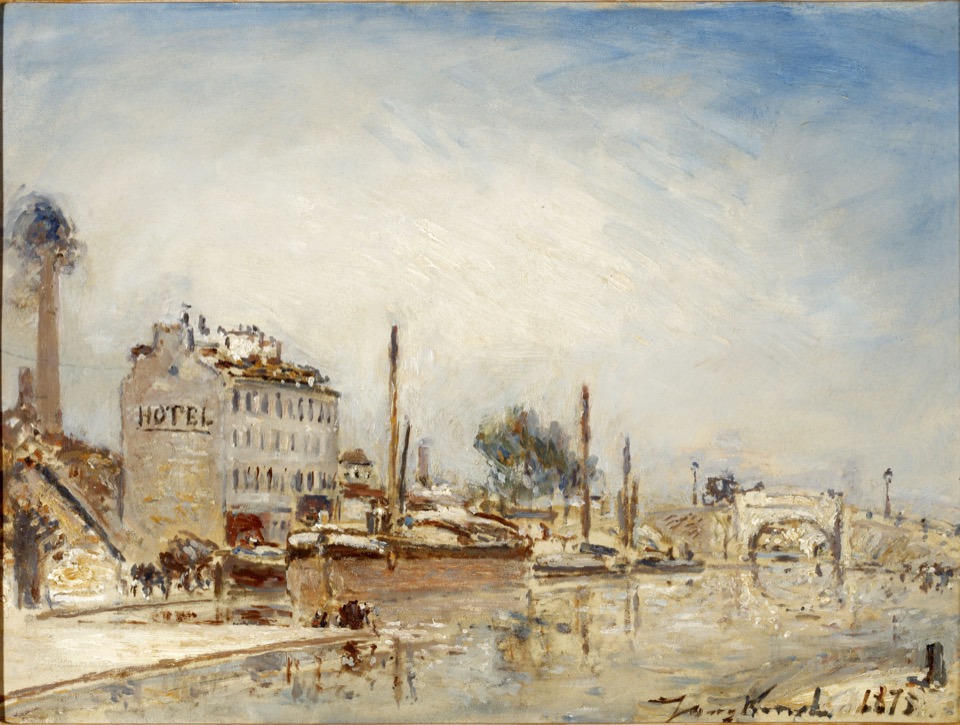
The Dordrechts Museum presents paintings by Jongkind in combination with the works of befriended artists, including several key Impressionist artists. Themes of the exhibition are Jongkind’s early years in The Hague, his years at the Normandy coast and his time in Paris. Of course Jongkind’s paintings of his beloved Dordrecht and surroundings will be on display.

 https://katevents.files.wordpress.com/2017/12/johan_barthold_jongkind_the_seine_and_notre-dame_in_paris.jpg

Johan Jongkind (1819-1891), The Seine and Notre-Dame in Paris, Oil on canvas, Dordrechts Museum 

Moreover, a modest selection of watercolour paintings shows the virtuosity of his quick and to the point brushstrokes. Many of the works on display will be exhibited for the first time in the Netherlands. Several of the works come from private collections.

https://seeallthis.com/wp-content/uploads/2017/08/Jongkind-1875-Le-canal-Saint-Martin-Paris-klein.jpg
The exhibition Jongkind & friends runs from 29 October 2017 to 27 May 2018 in the Dordrechts Museum. This year, the Dordrechts Museum celebrates its 175th anniversary and as such is one of the oldest urban museums in the Netherlands.

https://www.centrumdordrecht.nl/wp-content/uploads/2017/01/Jongkind-and-friends.jpg

Tuesday, December 26, 2017

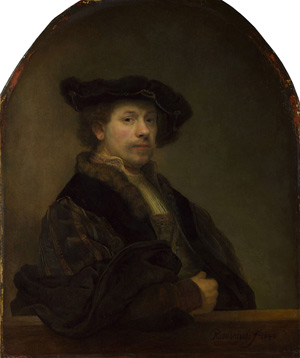
Rembrandt’s ‘Self Portrait at the Age of 34’ on loan from The National Gallery, London

Norton Simon Museum
December 8, 2017 - March 5, 2018

Rembrandt’s ‘Self Portrait at the Age of 34’ on loan from The National Gallery, London

Self Portrait at the Age of 34, 1640, Rembrandt van Rijn (Dutch, 1606-1669), oil on canvas, 102 x 80 cm, © The National Gallery, London

The Norton Simon Museum presents an installation of Rembrandt’s striking Self-Portrait from 1640, on loan from The National Gallery, London this winter season. Titled Self Portrait at the Age of 34, the painting captures the image of the artist in his middle age: affluent, self-confident and wise. Its installation at the Norton Simon Museum marks the first time the painting has been on view in the U.S.

This is part of a loan exchange program between the Norton Simon Museum and the National Gallery that began earlier this year, with the London installation of

 https://i.pinimg.com/736x/93/9e/81/939e81dd52223444e09ed899ca0aa13f--mar%C3%ADa-magdalena-catholic-art.jpg


the Museum’s The Repentant Magdalene, after 1660, by Guido Cagnacci.

Self Portrait at the Age of 34 will be installed in the Museum’s 17th-century art galleries, alongside the Simon’s own collection of Rembrandt paintings: 

https://upload.wikimedia.org/wikipedia/commons/c/c6/Rembrandt%2C_Portrait_of_a_Bearded_Man_in_a_Wide-Brimmed_Hat_%28probably_Pieter_Seijen%29%2C_1633%2C_Norton_Simon_Museum%2C_Pasadena.jpg


Portrait of a Bearded Man in a Wide-Brimmed Hat from 1633,  

https://upload.wikimedia.org/wikipedia/commons/6/6d/Portrait_of_a_boy_by_Rembrandt.jpg

Portrait of a Boy, ca. 1655–60,

https://upload.wikimedia.org/wikipedia/commons/b/b8/Rembrandt_self_portrait_1636-38.jpg

and the artist’s Self-Portrait, ca. 1636–38, executed only a few years earlier than the National Gallery’s.


About ‘Self Portrait at the Age of 34’
The age-old tradition of self-portraiture was enthusiastically embraced by Rembrandt van Rijn (Dutch, 1606–1669). Indeed, he was his own favorite model. Astonishingly, he recorded his own image roughly 100 times altogether in his paintings, prints and drawings, posing himself for formal portraits, but also capturing himself grimacing or smiling and even depicting himself as a saint. His youthful self-portraits of the 1620s divulge some mild self-examination, as well as a budding self-awareness as an artist; those produced during the 1630s reveal both a jaunty flamboyance and later a self-confident-but-world-wise painter who becomes more soulful as the decade progresses; and those produced in the last two decades of his life treat age with raw honesty and deep introspection.

Rembrandt’s Self Portrait at the Age of 34 captures the ambitious artist at the height of his talents and fame, but also as a man who has endured the highs and lows of life. By 1639, he was living in the luxurious comfort of his new home in the Breestraat in Amsterdam, and was commanding the attention of aristocratic patrons. He had also felt the loss of several family members, including three infant children in the span of five years. He would lose his wife, Saskia, only two years later. In the London painting, Rembrandt’s self-assurance is reinforced by his steady gaze and comfortable pose, with his right arm leaning on the parapet, declaring his possession of not only that ledge, but his rightful place as one of the most sought-after artists of the moment. The pose would be imitated by many of his Dutch students and colleagues, perhaps unaware of the various precedents that had inspired Rembrandt himself.
Rembrandt’s Inspiration
https://i.pinimg.com/originals/70/5a/b0/705ab0fef5c52952724fd54e31fa47ba.jpg
The presence of Raphael’s stunning 1515 Portrait of Baldassare Castiglione (now at the Louvre) in the April 1639 sale of property owned by the wealthy Flemish merchant Lucas van Uffelen was certainly not the first instance of a work by an Italian master in the Netherlands. Rembrandt himself came to own artworks attributed to Jacopo Bassano, Annibale Carracci, Giorgione, Michelangelo, Palma Vecchio and Raphael. But the Van Uffelen sale is notable as being one of the most well-attended auctions in the first half of the 17th century, drawing locals and foreigners alike to bid exceptionally high prices for the high-quality contents of the auction.

https://www.pubhist.com/works/07/large/7268.jpg

We assume that it was on this occasion that Rembrandt made his now-famous sketch of Raphael’s Portrait of Baldassare Castiglione that was on the auction block, annotating his drawing with not only the record price at which the painting was eventually sold (3,500 guilders), but also the enormous sum for the total proceeds of the estate sale (59,456 guilders). By this date, the highest figure paid to Rembrandt for one of his single-figure pictures was about 600 guilders, so witnessing the sale of a 125-year-old painting by one of the most treasured Italian Renaissance artists must have made an impression on the already-successful 33-year-old. His attention to this sale, and the Raphael portrait in it, is one of several instances that show that he was looking back to classical roots and seeking out the successful formulas of his predecessors.

As a native of Holland who never travelled outside his homeland, Rembrandt had nonetheless found a connection with Italian art from the previous century. His simple, quick sketch of Raphael’s Portrait of Baldassare Castiglione (now at the Albertina in Vienna) is an important key to understanding the genesis of Rembrandt’s Self Portrait at the Age of 34, signed and dated 1640. By this time, the artist had gained tremendous fame and had already received the commission to paint the colossal scene of the Night Watch (for which he would be paid 1,600 guilders). His lively sketch of the Castiglione portrait would lead to the creation of an etching in the same year, and ultimately a painting in the next, but rather than repeat the image of Castiglione, the figure morphs into Rembrandt’s own visage — he depicted himself as a distinguished and flourishing artist at the peak of his career, dressed in 16th-century garb.

About the Installation
During its residency at the Norton Simon Museum, Self Portrait at the Age of 34 will be viewed from the vantage point of Rembrandt’s works executed between 1630 and 1640 from the Simon collection. Hanging alongside earlier and later examples of Rembrandt’s paintings, as well as a number of his students’ works, the breadth of the artist’s painterly technique even within this decade can be examined.

Such is the case of the Portrait of a Bearded Man in a Wide-Brimmed Hat from 1633, now thought to depict Pieter Sijen (1592–1652), a wealthy Mennonite merchant. This is a pure portrait, not a tronie (or anonymous figure/type), but one depicting the stark, undecorated rigors of this religious group. The bearded man’s kindly stare and regard for the artist/viewer is consistent with Rembrandt’s other male portraits of the period, most of them directly addressing the viewer and revealing the depth of the sitter’s personality.

Compare this with the Simon’s tronie by Jan Lievens, Rembrandt’s studio partner in Leiden: 

 https://i.pinimg.com/736x/9d/a2/10/9da210742944b9c3b406c3f3ca5b57ed--oeuvres-turban.jpg

Young Man with Red Beret, ca. 1629–1630, is a character study that is magical and mysterious, underscored by the feather and the exotic, diaphanous shawl draped over his shoulders. But the Lievens is clearly not meant to be a pure portrait and is set apart from the mature, soul-searching meditations that Rembrandt produces in the later 1630s.

The London Self Portrait at the Age of 34, as well as the Simon’s own Self-Portrait from around 1636–1638, mark the artist’s full development in a personal as well as a professional sense. His growth during the portentous years 1630–1640 can be traced by the new frown line on his brow, his distinguished clothing and the keen, almost melancholic eyes that he himself saw as he gazed into a mirror.

To complement the installation, the Museum is organizing a small installation of examples from the extensive Simon collection of Rembrandt prints that were executed in the same decade as this special loan. This display, titled Rembrandt: Prints ‘of a Particular Spirit, will contain several self-portraits by Rembrandt from this period, including the etching and drypoint from 1639 that served as a prelude to the London Self Portrait at the Age of 34.
Saturday, December 23, 2017

William Eggleston: Los Alamos


The Metropolitan Museum of Art.
 February 14–May 28, 2018


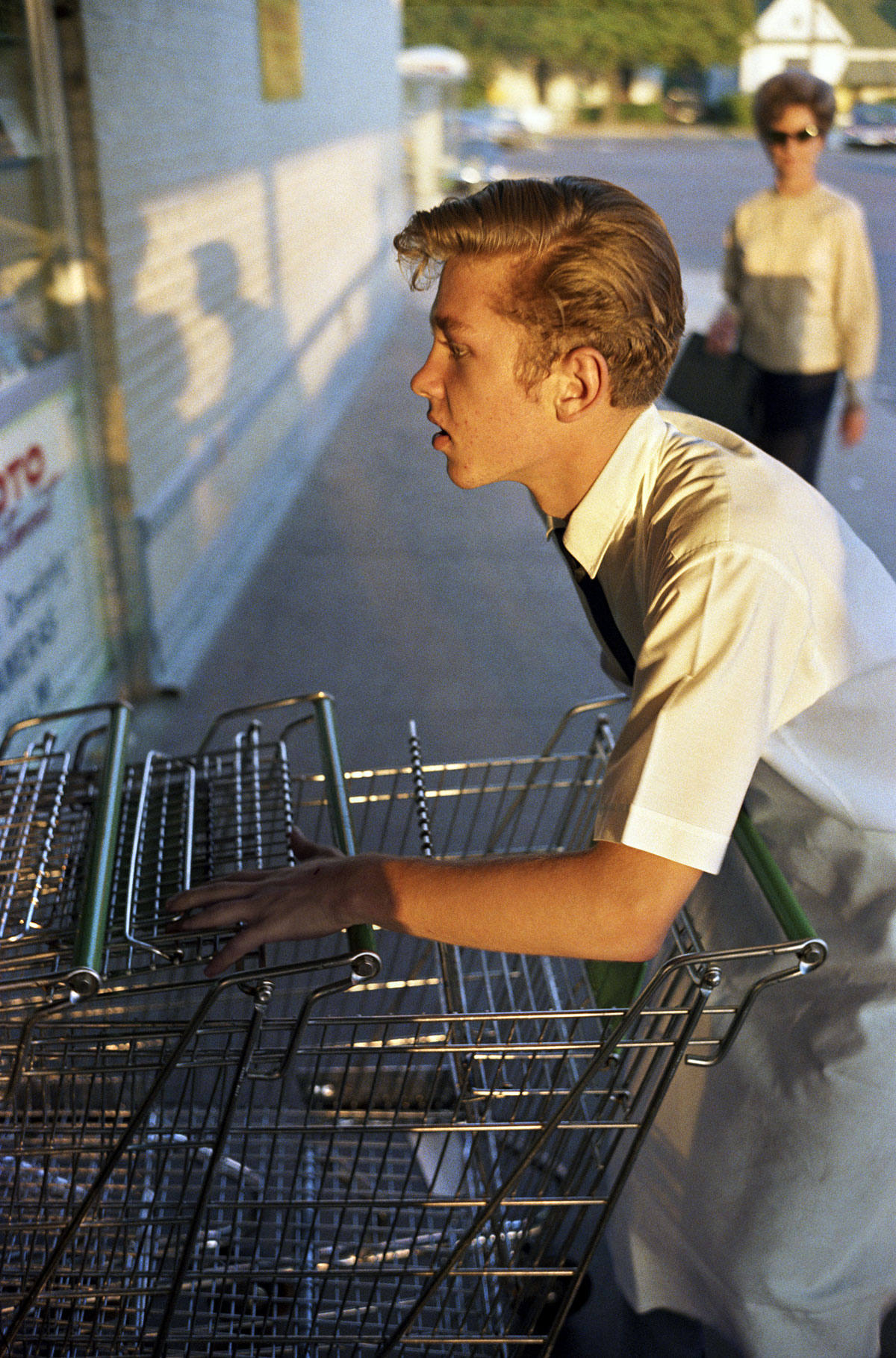
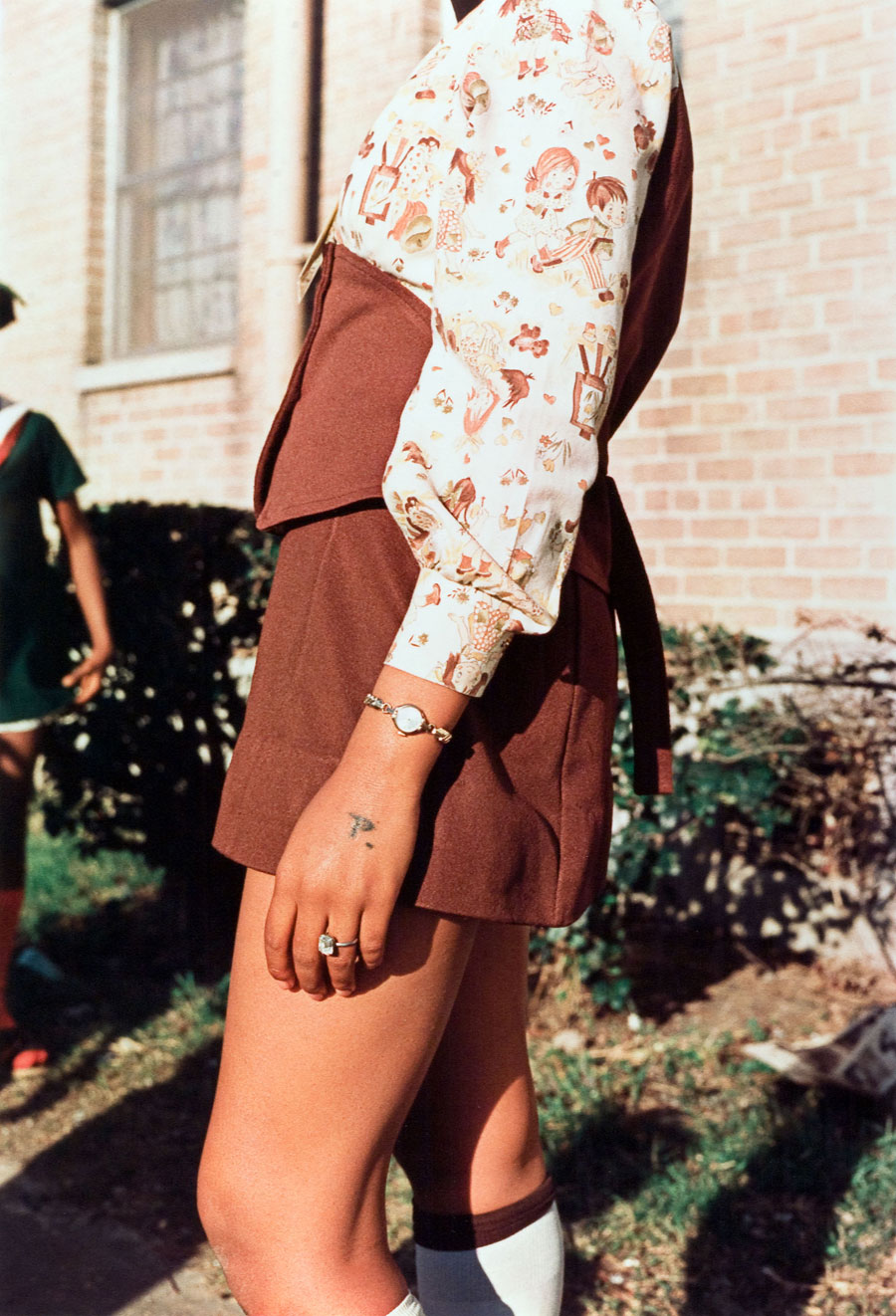
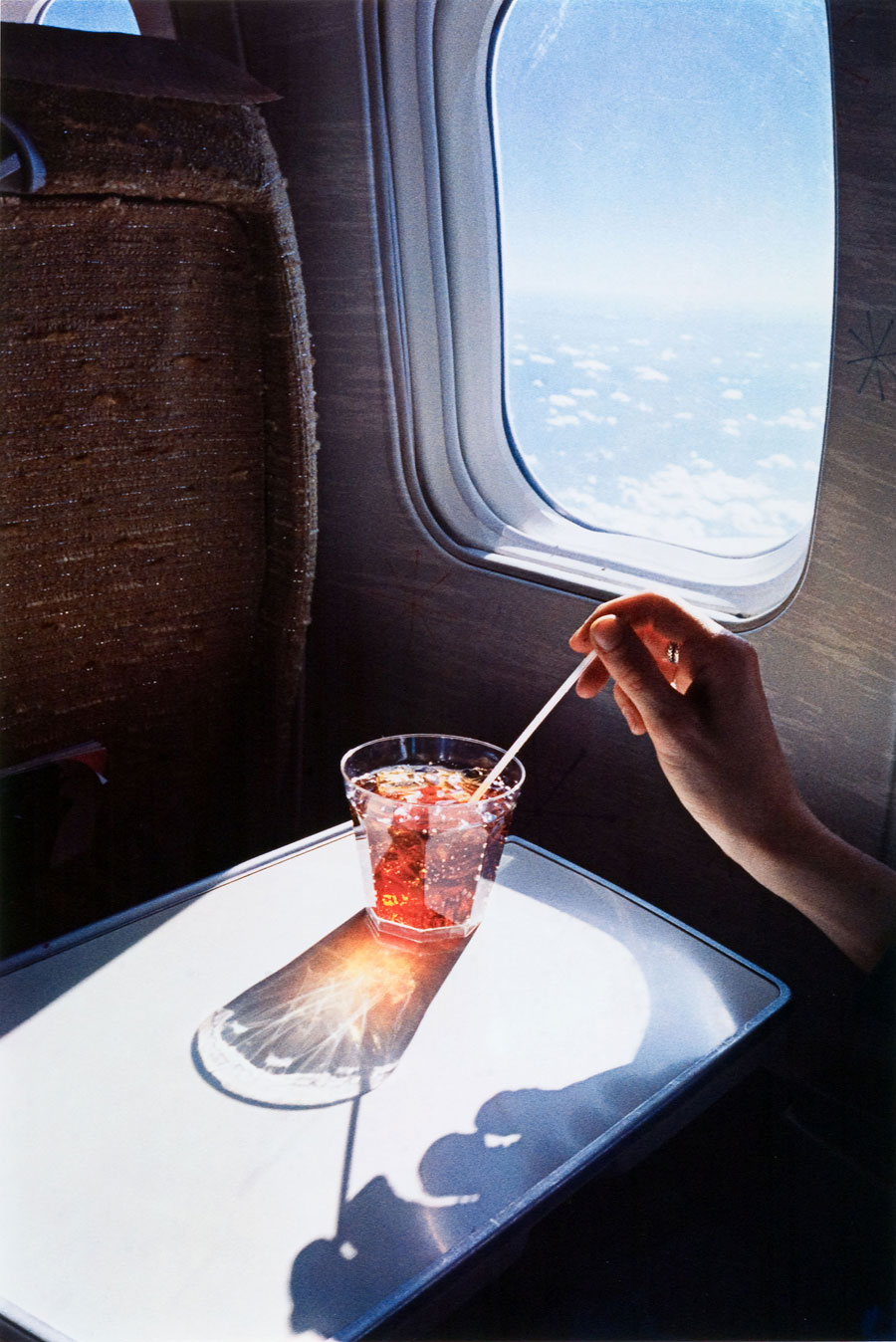
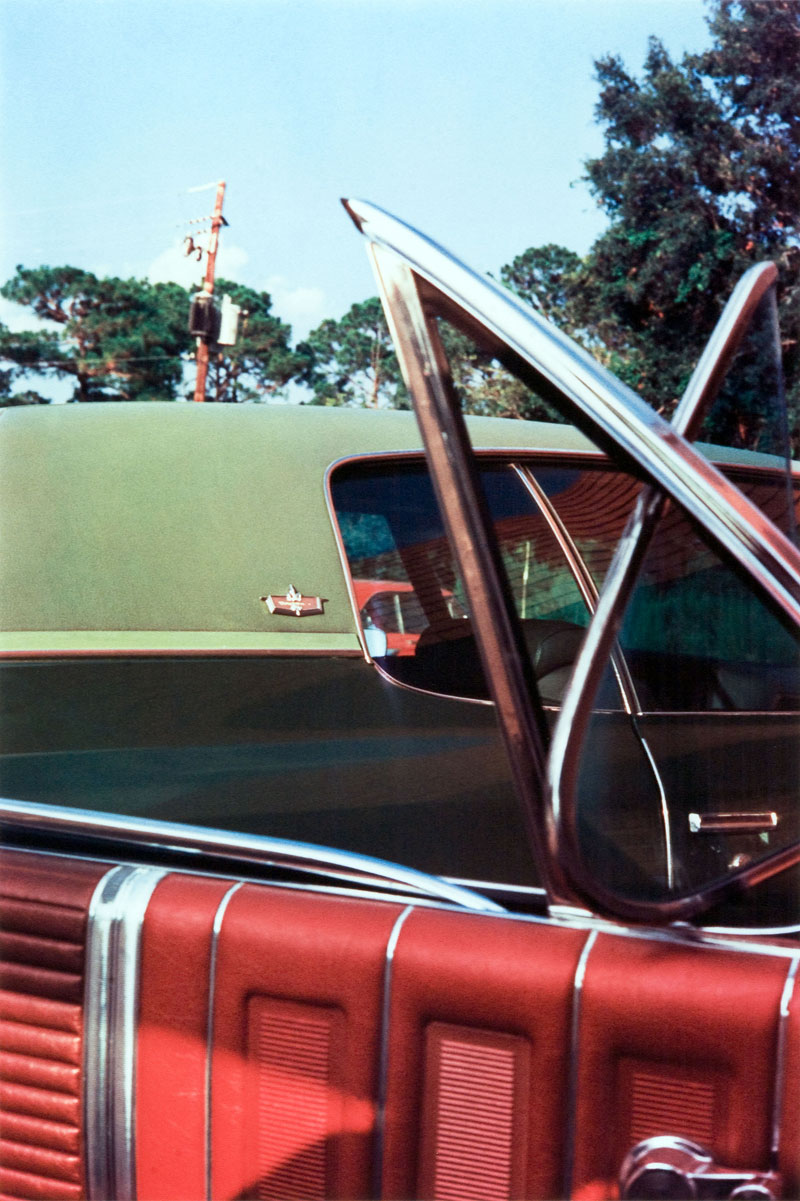
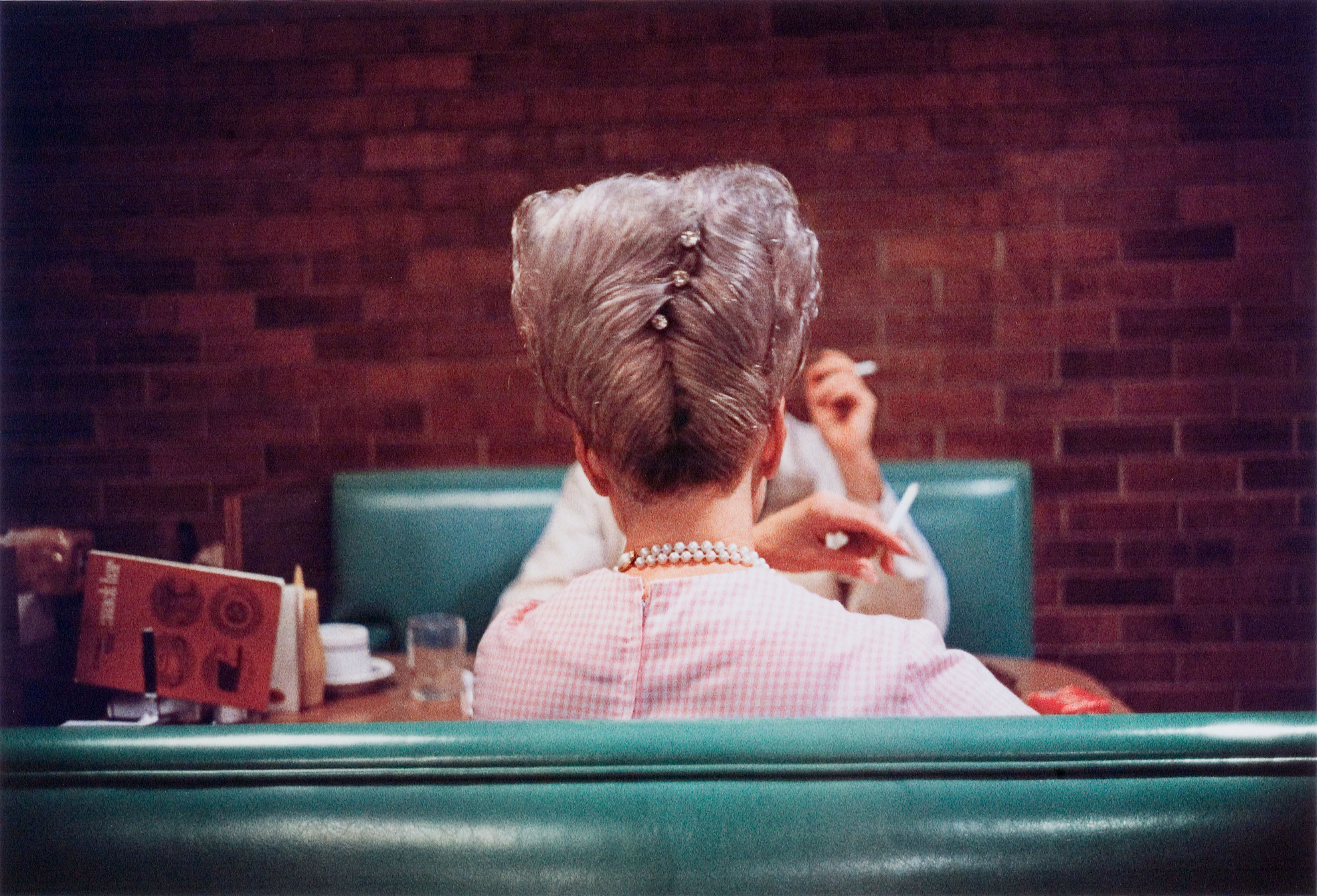
The American photographer William Eggleston (born 1939) emerged in the early 1960s as a pioneer of modern color photography. Now, 50 years later, he is widely considered its greatest exemplar. Opening February 14 at The Metropolitan Museum of Art, the exhibition William Eggleston: Los Alamos features a landmark gift to the Museum from Jade Lau of the artist's most extraordinary portfolio, Los Alamos, comprising 75 dye-transfer prints from color negatives made between 1965 and 1974. The exhibition marks the first time the series will be presented in its entirety in New York City.

William Eggleston. 'Untitled, 1965' (Memphis Tennessee)

William Eggleston
Untitled
n.d.
from Los Alamos, 1965-68 and 1972-74 (published 2003.) 1965-68 and 1972-74.
Dye transfer print, 17 ¾ x 12 inches (45.1 x 30.5 cm.)
Private collection.
© Eggleston Artistic Trust, courtesy of Cheim & Read, New York.

Los Alamos includes the artist's first color photograph—Untitled, Memphis, 1965—a study of a young clerk pushing a train of shopping carts at a supermarket in Memphis, Tennessee. The image takes full advantage of the chromatic intensity of the dye-transfer color process that, until Eggleston appropriated it in the 1960s, had been used primarily by commercial photographers for advertising and product photography. 

The exhibition includes lush color studies of the social and physical landscape of the Mississippi Delta region, which remains the artist's home, as well as studies made during numerous road trips with his friends Walter Hopps and Dennis Hopper—to New Orleans, New Mexico, Las Vegas, Los Angeles, and elsewhere. On these journeys, the artist explored the awesome and, at times, raw visual poetics of the American vernacular.

Eggleston named this extensive body of work—which comprises some 2,000 photographs—after the famous government research facility in New Mexico where atomic weapons were developed. Driving past the Los Alamos National Laboratory in 1973, he turned to Hopps, smiled, and said, "You know, I'd like to have a secret lab like that myself." As Hopps later wrote, the "title cloaks with some irony Eggleston's ostensible subjects, found in a vast American terrain, yet acknowledges his belief in the aesthetic consequences of his private quest."

Los Alamos is the work of an idiosyncratic artist whose influences are drawn from disparate but surprisingly complementary sources—from Walker Evans and Henri Cartier-Bresson in photography to Bach and the late Baroque in music. As much as Eggleston was influenced by various sources, he, too, has proved influential. His inventive photographs of commonplace subjects now serve as touchstones for generations of artists, musicians, and filmmakers—from Nan Goldin to David Byrne, the Coen brothers, and David Lynch. 

The exhibition will also include as a counterpoint a small suite of Eggleston's rarely seen black-and-white photographs from the mid-1960s to the early 1970s that the artist made concurrently with Los Alamos. Eggleston commented to his friends that he thought his photographs were "parts of a novel I'm doing"—one of the artist's most seductive and now renowned comments on his aesthetic practice and ambition.


William Eggleston
Untitled
n.d.
from Los Alamos, 1965-68 and 1972-74 (published 2003.) 1965-68 and 1972-74.
Dye transfer print, 17 ¾ x 12 in (45.1 x 30.5 cm.)
Private collection.
© Eggleston Artistic Trust, courtesy Cheim & Read, New York.


William Eggleston
Untitled
n.d.
from Los Alamos, 1965-68 and 1972-74 (published 2003.) 1965-68 and 1972-74.
Dye transfer print, 17 3/4 x 12 in. (45.1 x 30.5 cm.)
Private collection.
© Eggleston Artistic Trust, courtesy Cheim & Read, New York.


William Eggleston
Untitled
n.d.
from Los Alamos, 1965-68 and 1972-74 (published 2003.) 1965-68 and 1972-74.
Dye transfer print, 17 3/4 x 12 in. (45.1 x 30.5 cm.)
Private collection.
© Eggleston Artistic Trust, courtesy Cheim & Read, New York.


 https://whitmanhansonphoto.files.wordpress.com/2012/11/eggleston_untitled_los_alamos_1965-1974.jpg
William Eggleston, Untitled, n.d., from Los Alamos, 1965-68 and 1972-74

https://i.pinimg.com/474x/82/73/c2/8273c27f120d38a7d55a537e99d7ff4a--william-eggleston-documentary-photography.jpg

 William Eggleston, “Untitled,” from “Los Alamos, 1965-68 and 1972-74,” dye-transfer print. Private collection, Los Angeles | © Eggleston Artistic Trust

William Eggleston: Los Alamos is organized by Jeff L. Rosenheim, Joyce Frank Menschel Curator in Charge in the Department of Photographs at The Metropolitan Museum of Art.

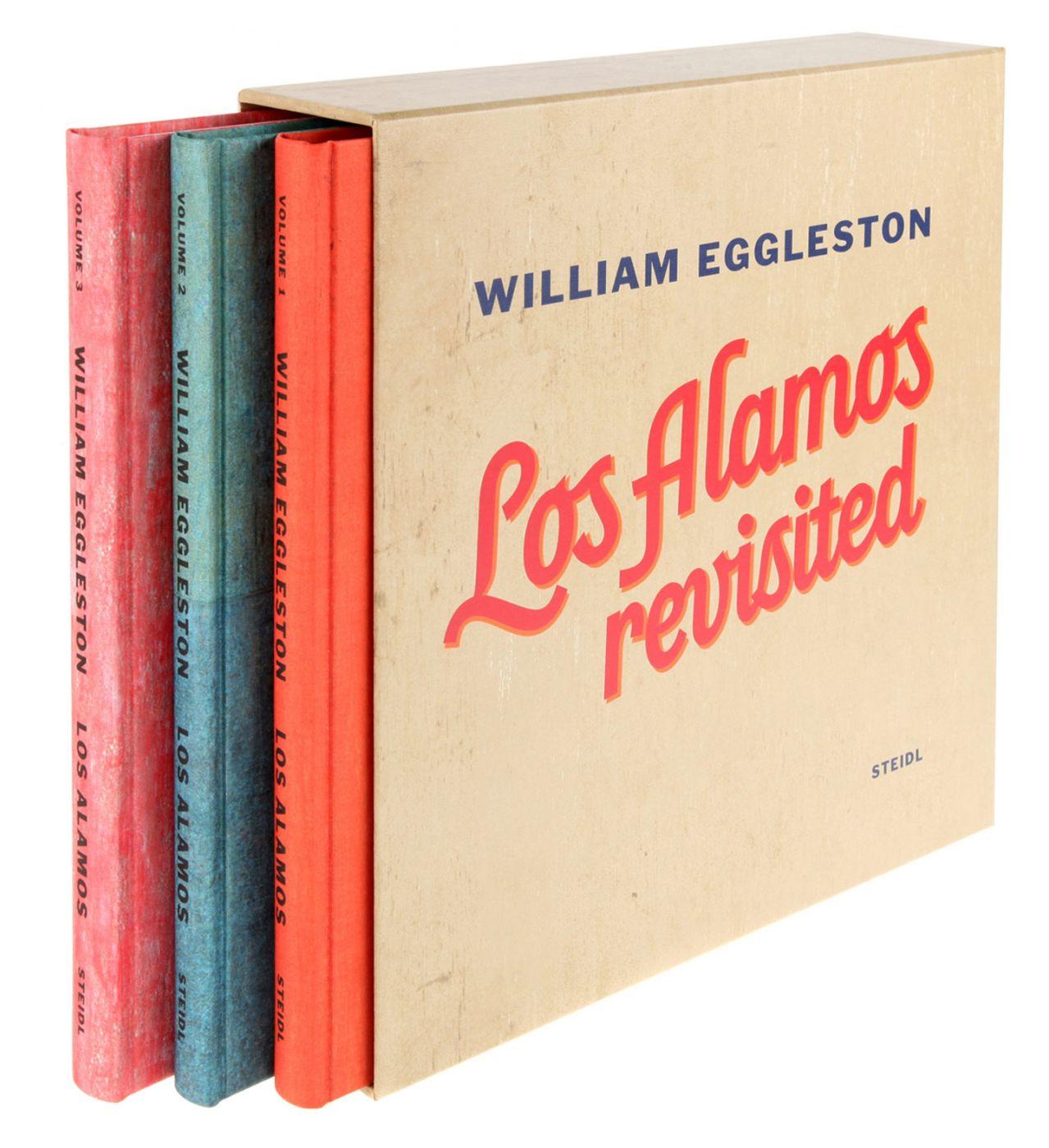
Book and more images


William Eggleston: Los Alamos Revisited (Three Volume Set)

EGGLESTON, William, WESKI, Thomas

ISBN 10: 3869305320 / ISBN 13: 9783869305325
Published by Steidl Verlag, Göttingen, Germany, 2

Friday, December 22, 2017

GRANT WOOD: AMERICAN GOTHIC AND OTHER FABLES

Whitney Museum of American Art
March 2 through June 10, 2018
The upcoming Grant Wood retrospective at the Whitney Museum of American Art will reassess the career of an artist whose most famous work, American Gothic—one of the most indelible emblems of Americana and perhaps the best-known work of twentieth-century American art—will be making a rare voyage from the Art Institute of Chicago for the occasion. Organized by Whitney curator Barbara Haskell, with senior curatorial assistant Sarah Humphreville, this exhibition is Wood’s first museum retrospective in New York since 1983 and only the third survey of his work outside the Midwest since 1935. It will be on view in the Whitney’s fifth-floor Neil Bluhm Family Galleries from March 2 through June 10, 2018.
Grant Wood (1891–1942) achieved instant celebrity following the debut of  

https://upload.wikimedia.org/wikipedia/commons/c/cc/Grant_Wood_-_American_Gothic_-_Google_Art_Project.jpg
 
Grant Wood, American Gothic, 1930. Oil on composition board, 30 3⁄4 x 25 3⁄4 in. (78 x 65.3 cm). Art Institute of Chicago; Friends of American Art Collection 1930.934. © Figge Art Museum, successors to the Estate of Nan Wood Graham/Licensed by VAGA, New York, NY. Photograph courtesy Art Institute of Chicago/Art Resource, NY
American Gothic at the Art Institute of Chicago in 1930. Until then, he had been a relatively unknown painter of French-inspired Impressionist landscapes in Cedar Rapids, Iowa. His relatively short mature career, from 1930 to 1942, spanned a tormented period for the country, as the United States grappled with the aftermath of an economic meltdown and engaged in bitter debates over its core national identity.

What emerged as a powerful strain in popular culture during the period was a pronounced reverence for the values of community, hard work, and self-reliance that were seen as fundamental to the national character, embodied most fully in America’s small towns and on its farms. Wood’s romanticized depictions of a seemingly more innocent and uncomplicated time elevated him into a popular, almost mythic figure, celebrated for his art and promotion of Regionalism, the representational style associated with the Midwest that dominated American art during the Depression.
As Barbara Haskell has noted,
 “The enduring power of Wood’s art owes as much to its mesmerizing psychological ambiguity as to its archetypal Midwestern imagery. An eerie silence and disquiet runs throughout his work, complicating its seemingly bucolic, elegiac exterior. Notwithstanding Wood’s desire to recapture the imagined world of his childhood, the estrangement and isolation that came of trying to resolve his loyalty to that world with his instincts as a shy, sexually closeted Midwesterner seeped into his art, endowing it with an unsettling sadness and alienation. By subconsciously expressing his conflicted relationship to the homeland he professed to adore, Wood created hypnotic works of apprehension and solitude that may be a truer expression of the unresolved tensions of the American experience than he might ever have imagined, even some seventy-five years after his death.”
Grant Wood: American Gothic and Other Fables brings together the full range of Wood’s art, from his early Arts and Crafts decorative objects and Impressionist oils through his mature paintings, murals, works on paper, and book illustrations. The exhibition reveals a complex, sophisticated artist whose image as a farmer-painter was as mythical as the fables he depicted in his art.
“This exhibition is an interrogation—not a reification—of stereotypes, values, and reputations,” writes Adam D. Weinberg, the Whitney’s Alice Pratt Brown Director, in his foreword to the exhibition catalogue. Rather than celebrating a nostalgic American past that never was, the exhibition is “a quest to understand how a remarkable artist created mythic images, images that are not as unequivocal or as unambiguous as some might think or, yet, as some might wish…What one discovers, looking deeply into Wood’s paintings, is that, for all their apparent clarity and precision of style, in the best of them what is depicted is not at all straightforward. The images put forth are often conflicting and ambiguous. They reveal a collision of amplified meanings, sublimated feelings, and layered evidence.”
Wood began his career as an Arts and Crafts decorative artist. Even after he shifted to fine arts, he retained the movement’s ideology and pictorial vocabulary. To it, he owed his later use of flat, decorative patterns and sinuous, intertwined organic forms as well as his belief that art was a democratic enterprise that must be accessible to the average person, not just the elite.

Wood’s training in the decorative arts began early. He studied at the Handicraft Guild in Minneapolis for two summers after graduating from high school before moving to Chicago to join the Kalo Arts and Crafts Community house. In 1914, he opened the Volund Crafts Shop with a fellow craftsman and began to exhibit his jewelry and metalwork in the Art Institute of Chicago’s prestigious decorative arts exhibitions.

Despite this recognition, commercial success eluded him and he closed the shop and returned to Cedar Rapids in 1916 to begin his painting career. The decision did not mean the end of his work in decorative arts, however, as is evident from the 1925 Corn Cob Chandelier included in the exhibition and the 1928 stained-glass window he designed for Cedar Rapids’ Veterans Memorial Building, replicated at half-scale in the exhibition.

Even after the success of American Gothic, he continued designing objects for popular use. His Spring Plowing fabric design, armchair and ottoman, Steuben glass vase, eight book covers and illustrations for two books—all made after 1930—are also included in the exhibition.
At the start of his career, Wood believed in the cultural superiority of Europe, as did many other Americans. Consequently, he went abroad four times between 1920 and 1928 for a total of twenty-three months, primarily studying the work of the French Impressionists, whose loose brushwork he used in the first two decades of his career to paint what he later called “Europy-looking” subjects. His assimilation of the style served him well; by the early 1920s, he was the city’s leading artist, selling his paintings to its residents and executing commissions in a variety of styles according to the given project’s needs. Three of Wood’s commissioned paintings, along with examples of his Impressionist works, are included in the exhibition.
By the late 1920s, Wood had come to believe that American art needed to break free from Europe and that the emergence of a rich American culture depended on artists expressing the specific character of their own regions. For him, it was Iowa, whose rolling hills he used as the background for his earliest mature portraits. In Europe, he had admired Northern Renaissance painting by artists such as Hans Memling and Albrecht Dürer. His realization that the hard edge precision and meticulous detail in their art could convey a distinctly American quality, especially suggestive of the Midwest, became the foundation of his mature style.
Wood brought to his portraits and landscapes his belief that democratic art necessitated universal and timeless story telling. He achieved this in his portraits by painting types rather than individuals and by including images that suggested something about the life and character of the depicted subject. He left these images intentionally ambiguous, making the stories they suggest so enigmatic that they defy ready explanation; they are puzzles to be deciphered by viewers based on their individual attitudes and predilections.
Wood believed that people are psychologically formed in the first twelve years of life and that everything they experience later is tied up with those childhood years. He often spoke of the experiences of his early years on his family’s farm as “clearer than any I have known since.” Not surprisingly, his landscapes do not depict Midwestern farm life in the 1930s, but instead, portray his idealized memories of the 1890s farm he lived on as a young boy before moving to Cedar Rapids with his family following the death of his father.

His desire was not so much to celebrate a world that was becoming extinct as to recapture the idyllic, re-imagined dream world of his own childhood. In his hands, the Midwestern farm became an Arcadian fantasy of undulating, swollen shapes and decorative embellishments whose tumescent abundance was sufficiently polymorphous to be read as both masculine and feminine. Yet Wood unconsciously challenged this evocation of sensuality and fecundity by employing rigid geometries, shellac-like surfaces and sharp, unnatural light that yielded landscapes that appear curiously still, a dollhouse world of estrangement and solitude.
Wood’s hard edge style and nostalgic subject matter made him one of America’s most revered artists during the 1930s, with a host of artists around the country imitating his art, especially his murals. Seen as paradigmatic images of prosperity and shared purpose, these works served as models for the scores of murals commissioned by President Franklin Roosevelt’s New Deal art programs during the Depression. With their subdued colors and monumental, frozen figures, Wood’s murals evoke the early Renaissance art of Fra Angelico and Giotto that he had admired in Europe. Examples of all of Wood’s murals, both realized and unrealized, will be in the exhibition, including a projected film of his two large-scale PWAP murals at Iowa State University at Ames.
The rise of fascist powers in Europe in the late thirties turned Wood’s attention to the fate of democracy. Worried that America might be vulnerable to outside aggression, he set out to inspire the public to defend the country in case of attack by rekindling national pride. To do so, he planned to depict a series of American folktales, highlighting their fictional aspect to avoid the chauvinism associated with fascism. The first was Parson Weems’s tale of George Washington as a child confessing to having chopped down his father’s cherry tree. The growing crisis in Europe shifted Wood’s focus. Faced with Nazi victories over the Allies in the first years of World War II, he accelerated his efforts to awaken the country to what it stood to lose by depicting what he called the “simple, everyday things that make life significant to the average person.” He completed only two works in the series—Spring in the Country and Spring in Town—before his death of pancreatic cancer on February 2, 1942, two hours before he would have turned fifty-one.

CATALOGUE


,
The exhibition catalogue, Grant Wood: American Gothic and Other Fables
includes a major reconsideration of Wood by Barbara Haskell, an extensive narrative chronology, and essays by Glenn Adamson, senior scholar at the Yale Center for British Art; Eric Banks, a New York–based writer and critic; Emily Braun, Distinguished Professor of 20th Century European and American Art at Hunter College and the Graduate Center, City University of New York; Richard Meyer, the Robert and Ruth Halperin Professor in Art History at Stanford University; and Shirley Reece-Hughes, Curator of Paintings and Sculpture at the Amon Carter Museum of American Art, Fort Worth. Generously illustrated, this volume includes several works published here for the first time, as well as new photography of other paintings. The essays contextualize Wood’s work within a much larger art historical framework than has previously been considered and address such topics as the artist’s literary influences, the role of his sexuality in his paintings, and the parallels between Wood’s work and Surrealism, Neue Sachlichkeit, Precisionism, Art Deco design, and the Arts and Crafts movement. The book is published by the Whitney Museum of American Art, and distributed by Yale University Press.

CURATORIAL CREDIT

This exhibition is organized by Barbara Haskell, curator, with Sarah Humphreville, senior curatorial assistant, Whitney Museum of American Art.


Grant Wood, Daughters of Revolution, 1932. Oil on composition board, 20 x 40 in. (50.8 x 101.6 cm). Cincinnati Art Museum; The Edwin and Virginia Irwin Memorial 1959.46


Grant Wood, Spring Turning, 1936. Oil on composition board, 18 1⁄4 x 40 1⁄8 in. (46.4 x 101.9 cm). Reynolda House Museum of American Art, Winston-Salem, North Carolina; gift of Barbara B. Millhouse 1991.2.2. © Figge Art Museum, successors to the Estate of Nan Wood Graham/Licensed by VAGA, New York, NY. Image courtesy Reynolda House Museum of American Art, affiliated with Wake Forest University


Grant Wood, Spring in Town, 1941. Oil on wood, 26 x 24 1⁄2 in. (66 x 62.2 cm). Swope Art Museum, Terre Haute, Indiana 1941.30. © Figge Art Museum, successors to the Estate of Nan Wood Graham/Licensed by VAGA, New York, NY


Grant Wood, Parson Weems’ Fable, 1939. Oil on canvas, 38 3⁄8 x 50 1⁄8 in. (97.5 x 127.3 cm). Amon Carter Museum of American Art, Fort Worth, Texas 1970.43. © Figge Art Museum, successors to the Estate of Nan Wood Graham/Licensed by VAGA, New York, NY


Grant Wood, Saturday Night Bath, 1937. Charcoal on paper, 24 1⁄16 x 26 15⁄16 in. (61.1 x 68.4 cm). Museum of Fine Arts, Houston; gift of Dr. Jack Tausend in memory of Mary Nesbit Tausend 2004.1603. © Figge Art Museum, successors to the Estate of Nan Wood Graham/Licensed by VAGA, New York, NY


Grant Wood, The Midnight Ride of Paul Revere, 1931. Oil on composition board, 30 x 40 in. (76.2 x 101.6 cm). The Metropolitan Museum of Art, New York; Arthur Hoppock Hearn Fund, 1950. © Figge Art Museum, successors to the Estate of Nan Wood Graham/Licensed by VAGA, New York, NY. Image © The Metropolitan Museum of Art, New York; courtesy Art Resource, NY


Grant Wood, Boy Milking Cow, 1932. Oil on canvas, cut out and mounted on fiberboard, 71 1⁄4 x 63 1⁄4 in. (181 x 160.7 cm) framed. Coe College, Permanent Art Collection, Cedar Rapids, Iowa; gift of the Eugene C. Eppley Foundation. © Figge Art Museum, successors to the Estate of Nan Wood Graham/Licensed by VAGA, New York, NY. Photograph by Mark Tade, 2005


\


Thursday, December 21, 2017

Botero: a dialogue with Picasso


Hôtel de Caumont in Aix-en-Provence
24 November to 11 March 2018

80 masterpieces of Botero and Picasso!

The exhibition « Botero, dialogue avec Picasso » (« Botero: a dialogue with Picasso »), which will be held at the Hôtel de Caumont in Aix-en-Provence from 24 November 2017 to 11 March 2018, will present the Colombian master’s rich oeuvre from a unique perspective, which explores his artistic affinities with Pablo Picasso. Sixty works by Botero (oils, works on paper, and sculptures) will be complemented by twenty major works by Picasso, originating from the collections in the Musée National Picasso-Paris and the Museo Picasso in Barcelona.

Despite very different origins, lives, and careers, the two great artists share common geographical and cultural points of reference. In his youth, Fernando Botero (born in 1932) took an interest in the work of Pablo Picasso (1881–1973); he admired his rich palette and the monumentality and sensuality of the forms. But Botero particularly admired Picasso’s ‘nonconformism’ (sic). In both artists’ works, the distortion of the human body and volumes corresponds to a resolutely subjective view of reality. It also reflects a radically modern approach in the history of figurative art, which is at the root of each artist’s unique artistic language.

The respective careers of Botero and Picasso are characterised by a fundamental questioning of painting and art. At the Hôtel de Caumont, the exhibition ‘Botero, dialogue avec Picasso’ (‘Botero: a dialogue with Picasso’) provides an overview of the themes they tackled in their work, as visitors move from one room to the next : 

- Portraits and self-portraits,
- The influences of the masters who preceded them in the history of art,
- Still lifes,
- Nudes,
- Representations of major historical and political events,
- Bullfighting,
- The world of the circus,
- Music and dance.

Among the major works are Botero’s diptych  


After Piero della Francesca (1998), 

http://foto.ilsole24ore.com/Editrice/ILSOLE24ORE/QUOTIDIANO_INSIDE_ITALY/Online/MediaCenter/Gallery/2015/PIERO_DELLA_FRANCESCA/img_PIERO_DELLA_FRANCESCA/01_FRANCESCA_700-525.jpg

(model:   Portrait of Federico da Montefeltro. Tempera on panel. Uffizi Gallery, Florence)

the monumental  

https://i.pinimg.com/originals/45/89/66/45896629a6f0c4d9c8d1738c0bfbd631.jpg

Pear (1976),  

https://d32dm0rphc51dk.cloudfront.net/RXZGiYSihQTdSNgdTd--kg/larger.jpg


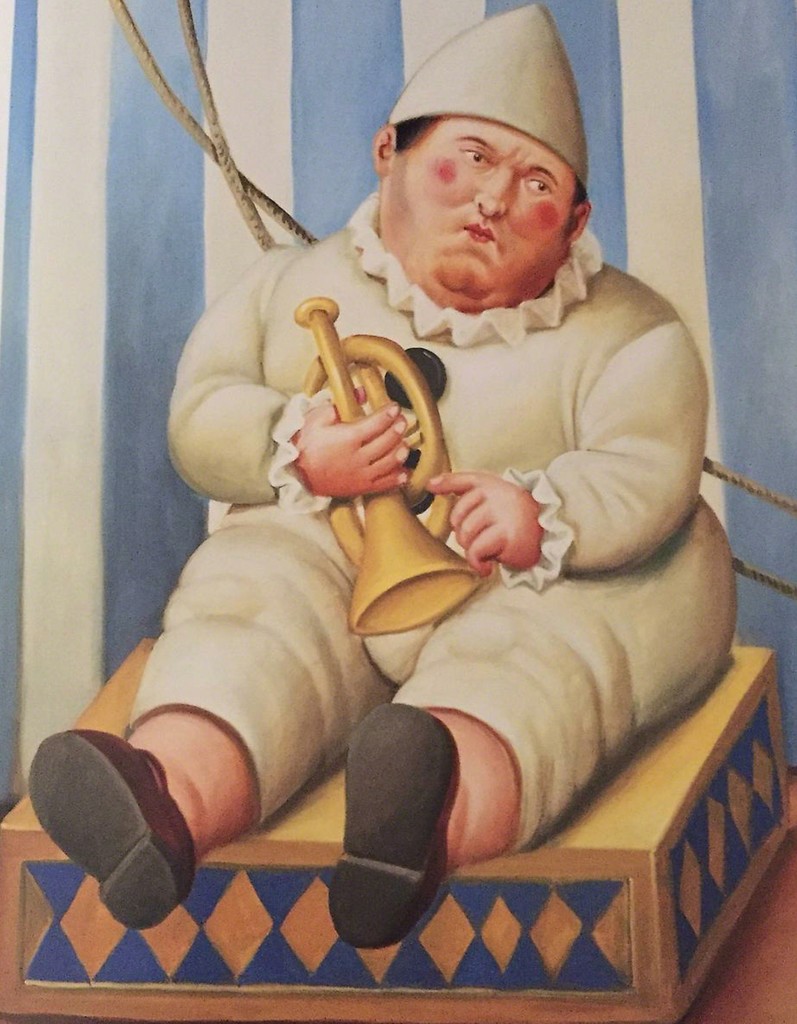
Pierrot (2007), 

http://www.abc.es/Media/201210/08/botero7--644x862.JPG

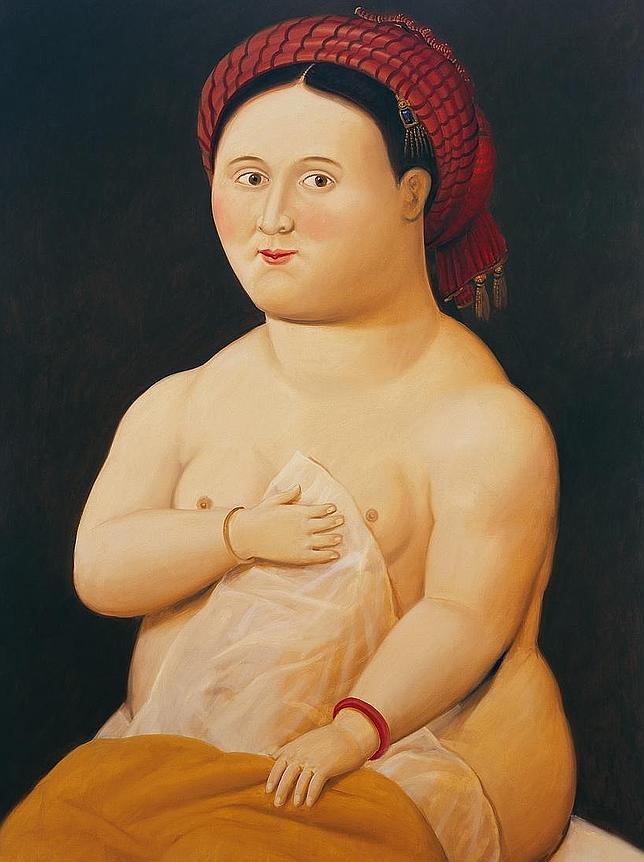
and La Fornarina, After Raphael (2008); 

 http://www.dailyartdaily.com/wp-content/uploads/2016/10/Fornarina.jpg

(model: Rafael Santi, La Fornarina, Galleria Nazionale d'Arte Antica, 1518–1520)

https://www.pablopicasso.org/images/paintings/acrobat.jpg

and also The Acrobat (1930),

https://i.pinimg.com/originals/4a/5c/c5/4a5cc584833632be8638d6ee7b447ed1.jpg


 The Village Dance (1922),

https://www.pablopicasso.org/images/paintings/massacre-in-korea.jpg

 and Massacre in Korea (1951) by Pablo Picasso, 
https://www.pablopicasso.org/images/paintings/las-meninas.jpg

and his interpretation of Velázquez’s Las Meninas (1957).

http://images.mentalfloss.com/sites/default/files/styles/mf_image_3x2/public/l54j4lkj.png?itok=hMy0YN_8&resize=1100x740
(Model: Museo del Prado "Las Meninas, or The Family of Philip IV" 1656)

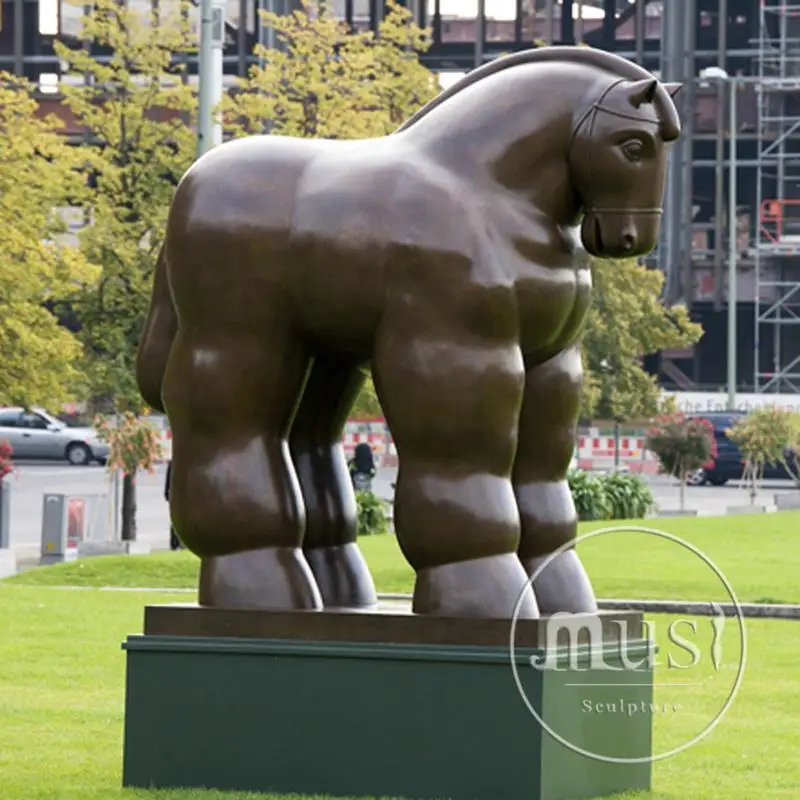
In addition to the paintings, the exhibition will present several sculptures by Botero, including his imposing 

https://sc01.alicdn.com/kf/HTB1ZITaQpXXXXc8aXXXq6xXFXXXd/Bronze-Factory-Abstract-Fernando-Botero-Reproduction-Horse.jpg

Horse (1999), and twenty drawings by the two artists. A medium that was widely used by the two artists, the drawings will enable visitors to discover a less well-known aspect of Botero’s oeuvre and a more personal side of his artistic work.