Wednesday, May 15, 2019

A Passion for American Art: Selections from the Carolyn and Peter Lynch Collection


Peabody Essex Museum 
May 11 through December 1, 2019
The Peabody Essex Museum (PEM) presents the debut exhibition of an outstanding collection of American painting, furniture, and decorative arts that was assembled by philanthropists, Carolyn and Peter Lynch, over the course of fifty years. A Passion for American Art: Selections from the Carolyn and Peter Lynch Collection takes visitors on the personal collecting journey of a couple that shared an extraordinary life together.

Through travel, exploration, and intellectual curiosity, the Lynches amassed a broad-ranging collection that includes spectacular, classic furniture from Boston, New York, and Philadelphia; paintings by Childe Hassam, Martin Johnson Heade, Winslow Homer, and John Singer Sargent; works by modern furniture master Sam Maloof; and pottery by Otto and Gertrud Natzler.

Also featured are three significant works by Georgia O’Keeffe, Childe Hassam, and J.O.J. Frost that were recently donated to PEM by Peter Lynch in memory of his late wife, Carolyn Lynch. By embracing an organic approach to collecting and by freely integrating multiple subjects, time frames and media, the Lynches created lively conversations about artistic creativity, regional styles, and evolving traditions in America. A Passion for American Art is on view at PEM from May 11 through December 1, 2019.

This jewel-box exhibition celebrates the couple’s abiding love of nature and of American history through 120 works of decorative art, 36 pieces of furniture, 35 paintings and sculptures, and 10 Native American artworks. The majority of the works are pristine examples of American creativity from the 18th and 19th centuries – an era when many artists echoed the latest styles and forms from Europe while also striving to express new American ideals, beliefs, and regional tastes.

Publication: 

Passion for American Art : Selections from the Carolyn and Peter Lynch Collection - (Hardcover)


Published by the Peabody Essex Museum, the major 224-page publication, A Passion for American Art: Selections from the Carolyn and Peter Lynch Collection, celebrates the outstanding examples of American painting, furniture, decorative arts, and Native American art from the Carolyn and Peter Lynch collection. This luxuriously illustrated book traces the couple’s growth as collectors, their cultural and aesthetic affinities and their relationships with artists and fellow collectors. Writer Jeanne Schinto offers a profile of the Lynches and a view into how the collection expresses the couple’s distinctly American sensibility. PEM’s Carolyn and Peter Lynch Curator of American Decorative Art, Dean Lahikainen, shares an introduction to the collection and a series of short essays by PEM curators explore how the Lynches combined diverse works in the living spaces of their homes. The exhibition catalog will be available this spring at pemshop.com.


pressrellynchfull002.jpg#asset:12982


"This exhibition allows us to marvel not only at the range of American traditions and creativity but also appreciate how collecting can amplify a sense of place and express aesthetic and intellectual values,” says Lahikainen.

PHILANTHROPISTS AND ART LOVERS

Best known for heading Fidelity’s Magellan Fund, the best performing mutual fund in the world, Peter Lynch is also a major philanthropist. Together, the couple established the Lynch Foundation in 1988 to support nonprofit organizations in the greater Boston community. For many years, Carolyn served as a PEM Trustee and Overseer and helped found the museum’s American Decorative Arts Committee. In 2014, the Lynch Foundation generously created an endowment for the PEM’s robust changing exhibition program.

A Passion for American Art features three works given to PEM’s American art collection by Peter Lynch in memory of his late wife. These include Marblehead folk artist J.O.J. Frost, American Impressionist painter Childe Hassam, and American master Georgia O’Keeffe. PEM has presented solo exhibitions in recent years of both Hassam’s and O’Keeffe’s works.

Pressrelfull004

Frost’s 1925 panoramic masterwork, an oil on fireboard painting, called The March into Boston from Marblehead, April 16, 1861: There Shall Be No More War, is of exceptional quality and scale. The local and national histories referenced in the painting, coupled with the highly-detailed, large-scale panoramic narrative scene, has broad appeal. The painting is poignantly autobiographical, capturing Frost’s childhood memory of watching his father alongside other Marblehead men depart on foot to Faneuil Hall in Boston to enlist in the Civil War.

presslynchfull005.jpg#asset:12987

A key loan in PEM’s 2016 exhibition, American Impressionist: Childe Hassam and the Isles of Shoals, Hassam’s 1911 painting East Headland, Appledore, Isles of Shoals is a masterpiece within Hassam’s Appledore oeuvre. East Headland is the first major American impressionist picture, and the first Hassam, to enter PEM’s collection. The work also holds special significance to the Lynch family as Peter took Carolyn to Appledore as a birthday surprise to see the island and the site depicted in this painting.
Presslynch006Gok

Georgia O’Keeffe, Cedar and Red Maple, Lake George, 1921. Oil on canvas. Peabody Essex Museum, Gift of Peter S. Lynch in memory of Carolyn A. Lynch. © Peabody Essex Museum. Photography by Bob Packert.
 In Cedar and Red Maple, Lake George, 1921, O’Keeffe’s treatment of natural forms and unconventional contours resulted in a modernist painting that abstracts, combines, and layers the landscape in ways that – at the time – were unprecedented in American art. The small but vivid canvas is characteristic of her aesthetic responses to the Lake George landscape. This gift dramatically bolsters PEM’s expanding and diversifying collection of works by women and by modern artists.


Martin Johnson Heade, Orchid and Hummingbirds near a Mountain Lake, about 1875-90. Oil on canvas. Collection of Carolyn A. and Peter S. Lynch. Photography by Bob Packert/Peabody Essex Museum.

Freeman’s American Art and the Pennsylvania Impressionists June 19


Freeman’s has again artfully curated another strong sale for June, consisting of nearly 160 lots and replete with many sought after artists. Many of the usual suspects will make an appearance in both the American Art and the Pennsylvania Impressionists categories, including William Glackens (1870-1938), Martin Lewis (1881-1962), Joseph Stella (1877-1946) and Charles Burchfield (1893-1967), as well as Fern Coppedge (1883-1951), Edward Redfield (1869-1965), Walter Schofield (1867-1944), and Mary Elizabeth Price (1877-1965). In addition, the sale will feature various, renowned artists including Walter Palmer (1854-1932) and Hugh Breckenridge (1870-1937).


An undoubted highlight of the auction is an important and dramatically composed painting by Newell Convers Wyeth (1882-1945) entitled “The Huge Monster Soon Came in Sight, Part of His Body Appearing Above the Waves and Part Concealed” (Angelica and the Sea-Serpent) (lot 85). Originally created as an illustration for Thomas Bulfinch’s The Legends of Charlemagne, which was published in 1863 and was an iconic collection of European fables and legends from the Middle Ages. The lot boasts compelling provenance, having been gifted by the artist to his friend Ralph Graves, whom he met in Washington, D.C. while working on a series of murals for National Geographic, and has remained in the same family ever since. According to the present owner, it is “by far the best and most dramatic painting” of the series NC Wyeth created for the publication.


Another exciting highlight of the sale is a beautiful portrait by Cecilia Beaux (1855-1942) of one of the artist’s childhood friends, entitled “Ethel Page as Undine” (lot 19). 

Another exciting highlight of the sale is a beautiful portrait by Cecilia Beaux (1855-1942) of one of the artist’s childhood friends, entitled “Ethel Page as Undine” (lot 19). This painting is Beaux’s second of three depictions of Ethel Page; the other portraits are in the collections of the Philadelphia Museum of Art and the National Museum of Women in the Arts in Washington, D.C. Page, who came from an affluent Philadelphia family and is a direct descendent of Roger Williams (the founder and first governor of Rhode Island) is shown here, dressed for a formal gala event and depicted as Undine, the mythological water nymph. The work is one of the artist's most successful paintings, for which Beaux won a Mary Smith prize from the Pennsylvania Academy of the Fine Arts, and garnered Beaux considerable fame. The work is deeply inspired by James Abbott McNeill Whistler (1834-1903) and the Aesthetic Movement.

Well represented in the sale, as always, are the Pennsylvania Impressionists.


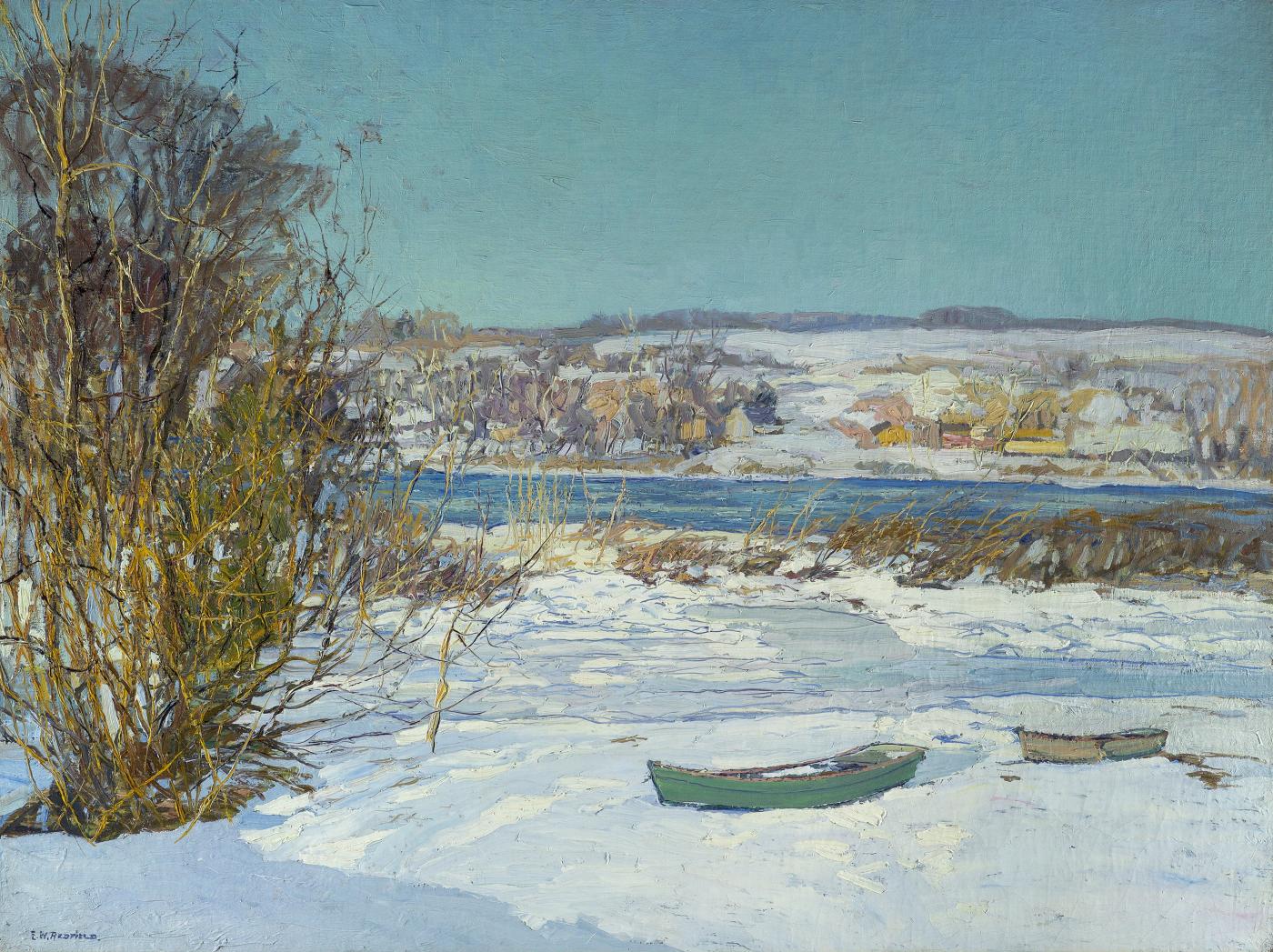
Most notable is a serene winter scene (lot 121) by Edward Willis Redfield; “The Frozen Creek” was completed in Point Pleasant and originally in the collection of the artist’s granddaughter.


Additional highlights count Daniel Garber’s (1880-1958) “Cobb’s Creek” (lot 154),

 a Walter Elmer Schofield painting entitled “Road to the Moors”, which was painted in England and was previously in the collection of Mrs. Whitney, wife of the head of J.P. Morgan (lot 134).

Moreover, the sale will offer a number of works by renowned female Pennsylvanian artists, counting five paintings by Fern Coppedge (lots 114, 126, 127, 144, 159), including a charming spring scene and an impressive representation of the Grist Mill in Bucks County. In addition, a beautiful, screen-like floral still life by Mary Elizabeth Price, painted with gold and silver leaf, along with two other works by the artist, will round out the category (lot 146).

The sale will offer several excellent watercolors, including

 ANDREW WYETH (american 1917–2009) "FROZEN WASH" Signed (twice) 'Andrew...

 an Andrew Wyeth (1917-2009) called “Frozen Wash” (lot 89), as well as an enticing group of more modern works, including several gouaches by Burchfield (lots 70-74) and a “mystical” watercolor by Stella (lot 76). Additionally, there are several noteworthy still life lots, including works by Herman Dudley Murphy (1867-1945) (lots 20 & 21) and John F. Peto (1854-1907) (lot 18).

Sotheby’s American Art auction in New York 21 May 2019


Sotheby’s American Art auction in New York on 21 May 2019 is led by Edward Hopper’s Central Park scene, Shakespeare at Dusk (estimate $7/10 million), as well as significant examples by American icons such as Norman Rockwell, Grant Wood, Georgia O’Keeffe, and Mary Cassatt. Highlights from the auction are now on view in Sotheby’s newly expanded and re-imagined New York galleries, with the full exhibition of all works opening on the 17th
 
EDWARD HOPPER’S SHAKESPEARE AT DUSK 


 Edward Hopper, Shakespeare at Dusk. Estimate: $7/10 Million. Courtesy Sotheby's. 

Following the sale of Edward Hopper’s seminal Two Comedians last November, Sotheby’s is  offering yet another outstanding work by the artist: Shakespeare at Dusk (estimate $7/10 million). Set in Central Park, this scene belongs to Hopper’s celebrated series of New York cityscapes—a subject matter he explored early in his career while studying under Robert Henri and continued until his death in 1967. Painted in 1935, the work was previously held in the collection of John J. Astor VI, prominent socialite and son of Colonel John Jacob Astor IV, who tragically died in the sinking of the Titanic in 1912

A lifelong lover of poetry and prose, Hopper overtly references the profound influence of literature on his emotional response to specific times of day, particularly the evening in Shakespeare at Dusk. The poems that he quoted, often as explanations for his own art, frequently focus on the mood of duskits sense of mystery, anxiety, and eros born out of the varying effects of light and shadow.
Shakespeare at Dusk depicts two statues cloaked in shadow near a deserted southern end of the Central Park Mall, which is illuminated by the vibrant afterglow of sunset on the horizon. In the foreground, Hopper presents John Quincy Adams Ward’s full-standing sculptural portrait of the celebrated playwright William Shakespeare, with his head bowed in contemplative thought. The inclusion of identifiable modern skyscrapers beyond the park is exceedingly rare in Hopper’s oeuvre and the present work is one of only a few New York scenes where the exact physical location is clearly apparent. 

MILTON AVERY’S TWO FIGURES ON BEACH 


Painted in 1950, Two Figures on Beach belongs to a remarkably innovative and productive period of Milton Avery’s celebrated career, and exemplifies the distinctive blend of realism and abstraction that defines his most admired aesthetic (estimate $1.2/1.8 million). Here, Avery reinvents the traditional art historical motif of the reclining female form through his distinctive and thoroughly modern vision, in a scene that emanates leisure and tranquility. 

JACOB LAWRENCE’S THE CARPENTERS 


Recently discovered by Jacob Lawrence scholars, The Carpenters will appear at auction for the first time after being held in the family of its original owners, who purchased it from The Downtown Gallery soon after it was completed in 1946 (estimate $500/700,000). Executed following Lawrence’s military service during the Second World War, the work demonstrates the artist’s profound interest in the depiction of African American workers and labor, particularly in the post-war years. Lawrence would return to the subject of carpenters again in the late 1960s, placing it among the most persistent themes in his body of work. 


MARY CASSATT’S DEPICTION OF MOTHERHOOD 


Painted in 1914, Young Mother in a Floppy Hat and Green Dress with Her Child Outdoors epitomizes Mary Cassatt’s unmatched ability to capture the timeless bond between a mother and her child, a subject that accounts for one-third of her oeuvre (estimate $1.5/2.5 million). While Cassatt’s work from the 1870s reflected her interest in the experience of modern women in Parisian society, by the 1880s, her emphasis began to shift from the public to the private domains of women’s lives. In Young Mother in a Floppy Hat and Green Dress with Her Child Outdoors, Cassatt embraces a new visual language in order to convey the quiet, intimate moments spent within the domestic realm including simple, daily interactions between mothers and their children. 

ALL THAT IS GLORIOUS AROUND US: PROPERTY FROM AN IMPORTANT AMERICAN COLLECTOR 


A stunning selection of ten 19th century landscapes emerging from a private American collection are led by Sanford Robinson Gifford’s A Lake Twilight (estimate $1.2/1.8 million). Painted in 1861, the work is a dramatic depiction of the nation’s landscape at the brink of the Civil War. 

Additional highlights from the group include  
 

Frederic Edwin Church’s Ruins at Baalbek (estimate $1/1.5 million),  


and Thomas Cole’s Sunset on the Arno (estimate $600/800,000). 


NORMAN ROCKWELL’S CHRISTMAS HOMECOMING 

 
A selection of three works by Norman Rockwell on offer include his preliminary study for the painting Christmas Homecoming, which appeared on the cover of the 25 December 1948 edition of The Saturday Evening Post (estimate $400/600,000). The work is the only image in the artist’s oeuvre in which all members of his immediate family appear and are portrayed as themselves. Rockwell's wife, Mary, embraces their eldest son, Jarvis, as he arrives home for the holidays with Christmas presents in hand, while the artist, his middle son Tom, and youngest son Peter appear in the background. Rockwell’s friends and fellow artists, Grandma Moses and Mead Schaeffer, are also rendered as family members. One of Rockwell's favorite models, Sharon O'Neil, appears twice as a set of twins in the immediate foreground.

Sotheby's July 3 Old Master Evening Sale


 J.M.W. Turner, Landscape with Walton Bridges. Estimate: £4-6 million. Courtesy Sotheby's
A rare, late work by Britain’s favourite artist, J.M.W. Turner, will be unveiled in Moscow ahead of its sale at Sotheby’s Old Master Evening Sale on 3 July. One of an important group of works painted by the artist in the last ten years of his life, Landscape with Walton Bridges, comes to the market for the first time in over 35 years with an estimate of £3-4 million.

One of the preeminent figures that mark the pages of history – like da Vinci, Darwin, Picasso or Einstein – who changed the way we see and think about the world, Turner is an artist rooted in the aesthetic philosophy and culture of his time. Perpetually engaged with the art of both his predecessors and contemporaries, he was at the same time possibly the first ‘modern’ painter; who directly inspired the Impressionism of the nineteenth century, and presaged the Abstract Expressionism of the twentieth.

Seemingly inspired by a sense of sheer delight in the working of paint, Turner’s visionary, experimental late works produced from the 1830s until his death in 1851 are considered to be the artist’s supreme achievement, and the pictures upon which his artistic significance ultimately rest. Essentially explorations of the effects of light, Turner created the works for himself, rather than for exhibition or for sale, retaining them for the development of his art. With their bold application of colour, their treatment of light and their deconstruction of form, these late works revolutionised the way the painted image was perceived. Applying the techniques he perfected in watercolour to the use of oil, with successive layering of translucent colour thinly applied to the surface, which imbue his canvases with a rich, hazy light, Turner gave his works a potency and power that had never been achieved before, and has seldom since.

This series of late works was inspired by compositions found in the Liber Studiorum, the series of engraved views Turner had published earlier in his career, around 1810-11. The central motif - Walton Bridges - is also one that the artist had treated twice before in oils, in 1806 and 1807. Clearly a subject with significant meaning to him, in this work he sets the bridge in an idealised, Italianate landscape of his own imagining.

Julian Gascoigne, Sotheby’s Old Master Paintings specialist commented: “This spectacular series of late oil paintings, in which Turner fondly revisits and reworks motifs long cherished in his mind, show a great artist late in his career, with his reputation established and his financial needs met, freed from the demands of public exhibition and the constraints of his critics. Vigorously and freely painted, with an emphasis on colour and light, rather than structure and form, he is exploring the possibilities of his medium and painting for himself, not for public consumption. Nearly two centuries later, however, seen through the lens of the Impressionism and Abstract Expressionism that would follow in the 19th and 20th centuries, we recognise them as the first seeds of an idea, from which would be born modern art.”

One of a very small handful of late works to ever have left Turner’s studio, and therefore not included in the Turner Bequest at Tate Britain, Landscape with Walton Bridges was given to his landlady and partner in later life, Sophia Booth, with whom the artist had lived in Margate and London during the last years of his life. The work is now the only one of this group of ten or so proto impressionist late pictures inspired by the Liber Studiorum left in private hands.

In 1887 the painting was acquired by the great American financier and collector Junius Spencer Morgan and spent the next hundred years as one of the jewels in the crown of the celebrated Morgan Collection in New York.

Landscape with Walton Bridges was unveiled  in Moscow alongside


Pieter Brueghel the Younger’s Winter Landscape with a Bird Trap (estimate: £1.5 – 2 million)

https://upload.wikimedia.org/wikipedia/commons/e/e6/Gerard_Dou_-_Penitent_Magdalene_Karlsruhe.jpg

and Gerrit Dou’s The Penitent Magdalene (estimate £800,000 – 1.2 million) from Sotheby’s Old Master Evening Sale on 3 July, and works from the forthcoming Russian Paintings sale in London on 5 June and the Impressionist and Modern Art Day Sale in New York on 15 May.

Landscape with Walton Bridges will also be exhibited at Sotheby’s New York (18 – 21 May) and Sotheby’s Hong Kong (28 – 30 May).

Tuesday, May 14, 2019

Picasso’s Women: Fernande to Jacqueline A tribute to John Richardson

Gagosian, 980 Madison Avenue, New York

May 3–June 22, 2019

I am perhaps a painter without style. 
—Pablo Picasso
Gagosian, in partnership with members of the Picasso family, is pleased to present Picasso’s Women: Fernande to Jacqueline, an exhibition of paintings and sculptures that attests to the central role and influence of the many women in Picasso’s life. It has been organized in honor of the gallery’s late friend and colleague, Sir John Richardson.


Pablo Picasso, Buste de femme (Dora Maar), 1940. Oil on canvas, 29 1/8 x 23 5/8 in, 74 x 60 cm © 2019 Estate of Pablo Picasso/Artist Rights Society (ARS), New York. Pho

 
In the early 1960s, Richardson was planning to write a study of Picasso’s portraits and spent hours with the artist, poring over reproductions of his works. As Picasso spoke about the complexities of his pictorial thinking—pointing out, for example, that a portrait of Dora Maar might also contain elements referring to her romantic predecessor Marie-Thérèse Walter, and her successor Françoise Gilot—Richardson began to believe that a detailed biographical treatment of Picasso’s portraiture would close a notable gap in Picasso scholarship. Decades later he would sit down to write what would become the monumental multivolume biography, A Life of Picasso.


 Pablo Picasso, Portrait de femme profil gauche sur fond vert et brun, 1939 Oil on canvas 28 3/4 x 23 5/8 in 73 x 60 cm © 2019 Estate of Pablo Picasso/Artist Rights Society (ARS), New York. Photo: Maurice Aeschimann. Courtesy Gagosian.


Maar once told Richardson that when a new woman entered Picasso’s life, everything changed: the art, the house, the poetry, even the dog. And yet, Maar’s observation is a bit misleading, for within the era of each successive muse, Picasso never settled on a singular style. Rather, in penetrating Picasso’s imagination, each woman served as a catalyst for experiments in color and form that would continue to change as the contours of the relationship shifted. It is through this process that Picasso’s work was constantly reinvented and renewed.
Picasso was as eclectic in his choice of muse as he was in style: the bohemian Fernande Olivier; disciplined Olga Khokhlova; blonde Venus Marie-Thérèse; passionate artists Dora and Françoise; Sylvette David, the young woman with a high ponytail; and Jacqueline Roque, the devoted, romantic beauty. Picasso’s portraits of these women express psychological insights, as well as the drama that only profound intimacy can reveal. He depicts each, as Leo Steinberg has argued, not how she presents herself to the world, but how she feels inside. These women invoke poetry, beauty, war, and poverty, ingeniously reflecting the spirit and reality of the changing times. Not merely mute muses, Fernande and Françoise published memoirs; Olga and Marie-Thérèse kept extensive archives of photographs and letters over decades; Dora gave interviews to researchers and documented Picasso’s work and private life in photographs. Picasso’s women are as essential to our understanding of the artist and his oeuvre as they were instrumental in his creative life.

Initiatives in Arts and Culture's (IAC) 24th Annual American Art Conference


In New York, American art is the focus from Friday, May 17 to Saturday, May 18, 2019, with an arts industry conference at Bonhams, 580 Madison Avenue. Tickets here.

 
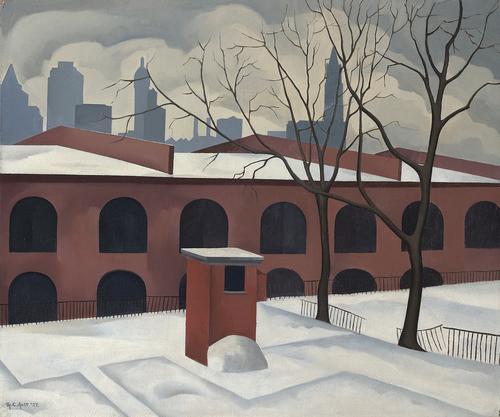
View from Brooklyn, 1927, by George Ault (1891-1948). The Jan T. and Marica Vilcek Collection, Promised gift to The Vilcek Foundation
© The Vilcek Foundation


Initiatives in Arts and Culture's (IAC) 24th Annual American Art Conference will explore the myth, mystique and artistry that cement a work's status as a "masterpiece" of American art. Key elements include taste of the times and its documentation, as well as history's evolving judgment often recorded in the words of the artists' themselves. This consideration explores the birth and role of nostalgia as a force on American art and the celebration of which constitutes that American myth. Participants will also consider the lampooning and glorification of American art in which the ordinary becomes extraordinary, and the extraordinary is elevated into the Pantheon.

Receptions, viewings, and book signings complement formal talks and panels. View the schedule here.

Among confirmed participants are:
  • Amanda C. Burdan, Curator, Brandywine River Museum of Art;
  • Heather Campbell Coyle, Chief Curator, Delaware Art Museum;
  • R. Ruthie Dibble, Curator, Chipstone Foundation;
  • Vincent Di Girolamo, Assistant Professor, History at Baruch College, City University of New York;
  • Jennifer R. Henneman, Associate Curator, Petrie Institute of Western American Art (PIWAA), Denver Art Museum;
  • Ethan W. Lasser, Theodore E. Stebbins Jr. Curator of American Art, Head, Division of European and American Art, Harvard Art Museums;
  • Angela Miller, Professor, Art History and Archaeology Department, Washington University in St. Louis;
  • Ariel Plotek, Curator of Fine Art, Georgia O'Keefe Museum in Santa Fe, New Mexico;
  • Andrew Schoelkopf, co-founder and partner, Menconi + Schoelkopf;
  • Rebecca Shaykin, Associate Curator, The Jewish Museum, where she is curating a forthcoming exhibition on art dealer Edith Halpert;
  • Paul Staiti, Alumnae Foundation Professor of Fine Arts at Mount Holyoke;
  • Marin R. Sullivan, director, Harry Bertoia Catalogue Raisonne and co-curator, Harry Bertoia: Sculpting Mid-Century Modern Life, a forthcoming retrospective scheduled to open at the Nasher Sculpture Center (2020);
  • Jan and Marica Vilcek, Cofounders and Chairman Vice Chairman, The Vilcek Foundation;
  • Farris Wahbeh, Benjamin and Irma Weiss Director of Research Resources, Whitney Museum of American Art.
Tags:

Monday, May 13, 2019

Christie’s American Art May 22


Christie’s has announced that The Michael Scharf Family Collection will lead the American Art sale on May 22. Considered one of the finest collections of American Modernism, this impressive group of twenty-eight paintings offers a strong representation from the Stieglitz Circle with works by Georgia O’Keeffe, Marsden Hartley, and Arthur Dove, as well as exceptional early explorations into abstraction by artists including Max Weber and Charles Green Shaw.
 
Michael Scharf began his collection of American Modernism in 1972 when he purchased Arthur Dove’s Parabola and began to study the artist and his contemporaries. His collecting habits, however, were founded during his childhood with serial collections of stamps, porcelain pugs, early editions of Elizabethan plays and British literature, and early sixteenth-century Hebrew books printed in Constantinople.

Michael Scharf comments, “The more I studied, the more I came to believe Arthur Dove, Georgia O’Keeffe, Max Weber, Marsden Hartley, and John Marin were important artists who were responsible for instigating a transformation in the development of Modern American art. Also, the purchase of Parabola caused a bee to land in my bonnet. The bee stung me into activity, and a burning interest developed. Thus the Collection was born.”

Eric Widing, Deputy Chairman, American Art, Christie’s remarks, “Over many decades, Michael Scharf assembled an authoritative collection which represents, in depth, the emergence of modernism in America. Among its highlights are masterworks by many of the best-known American artists of the early twentieth century: Arthur Dove, Marsden Hartley, Georgia O’Keeffe, Max Weber and dozens of others. Some works are among the earliest American abstractions, others explore nature and still others touch upon diverse subjects such as the city, music, and mystical and symbolic imagery. It is a justly celebrated collection.” 


Leading the collection is Georgia O’Keeffe’s Inside Red Canna, 1919, which is arguably the artist’s earliest depiction of a magnified flower in oil (estimate: $4,000,000-6,000,000). A triumph of American Modernism, the work is the culmination of a series of a small watercolors and oil paintings of cannas O’Keeffe created between 1918 and 1919. Of this group, Inside Red Canna is the largest in scale and is one of the most compositionally complex paintings within O’Keeffe’s early oeuvre. The painting was included in O’Keeffe’s watershed 1923 retrospective exhibition at Anderson Galleries, organized by her dealer and future husband Alfred Stieglitz, which launched the artist to her iconic status.


Arthur G. Dove’s River Bottom, Silver, Ochre, Carmine, Green, circa 1923 (estimate: $3,000,000-5,000,000), is among the most important works by the artist to come to the market and reflects Dove’s deep connection to the American landscape and his fascination with water. In this view looking down onto a riverbed, Dove creates an amorphous exploration of color, line and form, pushing representation of nature to the edge of abstraction.


Marsden Hartley’s Abstraction (estimate: $4,000,000-6,000,000) was created in 1912-13 during a pivotal period of his career in Europe and embodies one of the artist’s most experimental and boldest abstract statements of his oeuvre. Building upon his musical ‘intuitive’ works of late 1912, and anticipating the politically and personally entrenched wartime German Officer paintings, Abstraction veritably vibrates with the intellectual and spiritual energy of one of the greatest visionaries of early twentieth-century art.

The collection also features seminal artists of early abstraction including one of the first shaped canvases ever painted in America by Charles Green Shaw, Plastic Polygon, 1937 (estimate: $250,000-350,000). Other collection highlights include works by Oscar Bluemner, Max Weber and Konrad Cramer, among others.

The American Art sale on May 22 is comprised of 88 lots and distinguished by rare and fresh to the market paintings, many with important provenance. The American Art online auction opens for bidding May 15-22 and features works from some of the most noteworthy American artists of the 19th and 20th centuries, from Milton Avery, Edward Hopper, and Andrew Wyeth to Asher B. Durand and George Inness, with estimates starting under $5,000. All lots will be on view in Christie’s Rockefeller Center galleries from Saturday, May 18-21.


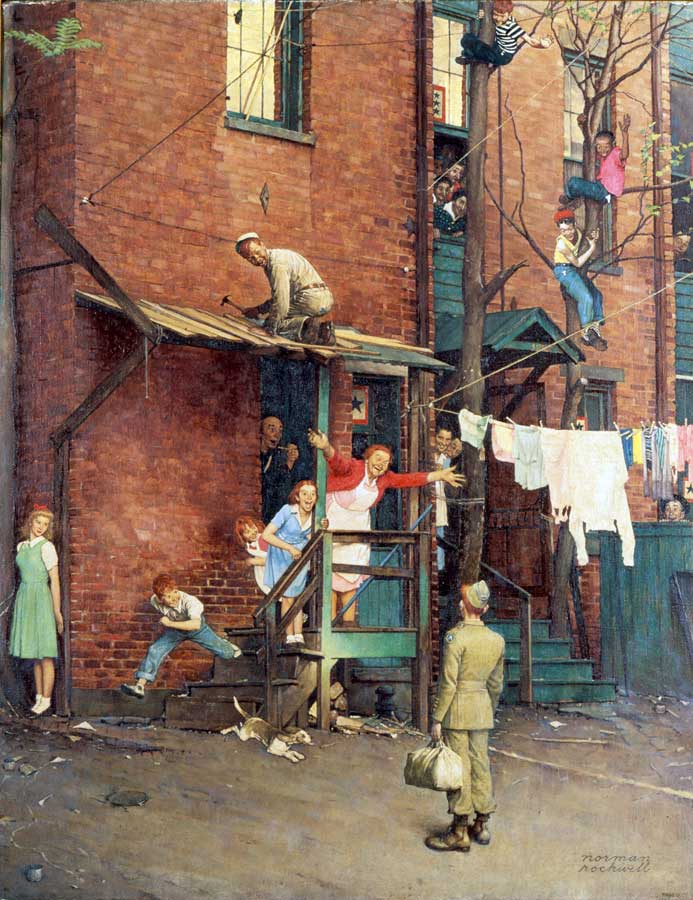
The top lot of the American Art sale is Norman Rockwell’s famed Saturday Evening Post cover The Homecoming, which was printed for the May 26, 1945 issue, just eighteen days after the end of World War II (estimate: $4,500,000–6,500,000). The timely and emotional image tells the story of a young soldier arriving home, where family, neighbors and even a love interest rush to greet him with ecstatic joy. The work was described by Post editor Ben Hibbs as “the finest cover Norman has done; in fact, I have always felt that it is the greatest magazine cover ever published.” 

Another fine example from the group of American Illustration in the sale is N.C. Wyeth’s painting for the novel Deerslayer, titled "She foundChingachgook studying the shores of the lake, the mountains, and the heavens..." (estimate: $700,000-1,000,000).


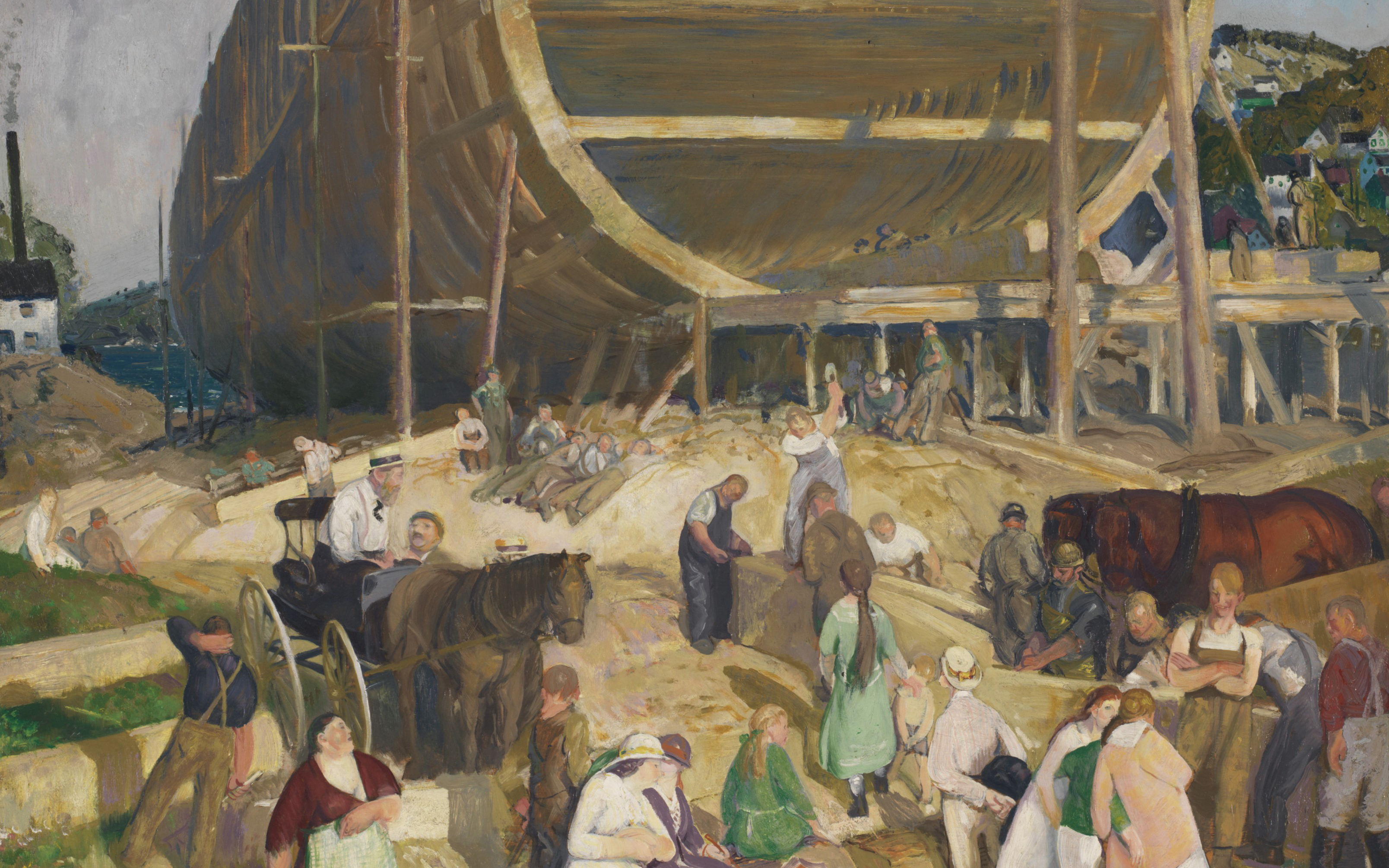
Among the strong selection of American Modernist works is Shipyard Society by George Bellows (estimate: $4,000,000-6,000,000), which is offered by the Virginia Museum of Fine Arts to support future acquisitions.  Painted in Camden, Maine, in 1916, Shipyard Society shows two of the most famed themes of Bellows’ career; the struggle of man versus the sea along the coast of Maine, and a focus on a realistic depiction of all levels of society.


Additional American Modernist highlights include Edward Hopper’s Windy Day which is sold to benefit The Prospect Hill Foundation and depicts the White River in Vermont with the adept handling of watercolor and keen understanding of light for which the artist’s works on paper are best known (estimate: $1,000,000-1,500,000).

The auction includes iconic Impressionist works, including a Cos Cob interior by Childe Hassam recognized by scholars as the best of its type, a pastel example of William Merritt Chase’s famed Shinnecock, Long Island, landscapes, and a John Singer Sargent sketch after the artist’s masterwork El Jaleo in the Isabella Stewart Gardiner Museum. 

Stellar examples by the Hudson River School include works by Sanford Gifford, John Frederick Kensett and Albert Bierstadt. A strong group of Western works includes examples by Alfred Jacob Miller, Henry Farny and Taos Society artists such as Walter Ufer. The sculpture selection is led by an Augustus Saint-Gaudens once owned by Stanford White, as well as exceptional models by Gaston Lachaise, Elizabeth Catlett and Herbert Haseltine.