Largely drawn from the Norton’s permanent collection, this
exhibition addresses ideas about the body and its symbolic and societal
implications in modern Latin American cultures. The Body Says, I Am a Fiesta presents
paintings, photography, sculpture, and works on paper by artists active
in Latin America and the United States between the 1930s and 2010s such
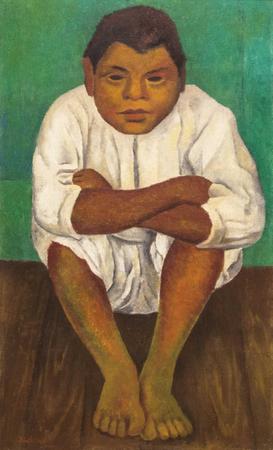
as Diego Rivera
(shown: El Amigo de Frida, 1931),
Ana
Mendieta, Rufino Tamayo, and María Magdalena Campos-Pons. Collectively,
the artworks explore differing approaches to figural representation to
exemplify the universal elements of the body as well as the external
forces acting upon it.
The exhibition’s title also recognizes these external factors and
originates from a book of short stories and folklore by Uruguayan
journalist, writer, and novelist Eduardo Galeano (1940-2015). The book, Walking Words,
includes a recurrent sequence of maxims Galeano called “Windows” and
his “Window on the Body” illustrates the conflicting ways institutions
regard, study, exploit, and extol the human body:
“The church says: The body is a sin. Science says: The body is a machine. Advertising says: The body is a business. The body says: I am a fiesta.”
National Gallery of Art, Washington, DC September 29, 2019 through January 26, 2020
In a major new
exhibition opening this fall, the National Gallery of Art will examine
the beauty and depth of pastel, tracing its rich history from the
Renaissance to the present day. The Touch of Color: Pastels at the National Gallery of Art will
feature some 70 exquisite examples drawn entirely from the Gallery’s
permanent collection, including many works never before exhibited. The Touch of Color opens on September 29, 2019, and continues through January 26, 2020.
“The Touch of Color
is a chance for our visitors to experience the marvelous qualities of
pastel in the hands of great artists,” said Kaywin Feldman, director,
National Gallery of Art. “The Gallery’s pastel collection is remarkably
deep, with nearly every major period in the medium’s long, full history
represented. The strength of the collection gives us a rare opportunity
to present an exhibition of this scope and significance.”
Exhibition Organization
The exhibition is organized by the National Gallery of Art, Washington.
About the Exhibition The Touch of Color: Pastels at the National Gallery of Art examines
how artists through the centuries adopted different techniques and
approaches to pastel, experimenting with this colorful and versatile
medium to achieve exciting, often unexpected effects. With a single
stroke of a pastel stick, the artist applies both color and line. The
line can be left intact or smudged to create passages of velvety tone.
Finished works range from the richly illusionist pastel “paintings” of
the 18th century to the diaphanous sketches and colorful abstractions of
the 19th and 20th centuries.
The origins of pastel date to the Renaissance and are linked with
colored chalk, a naturally occurring substance mined in a limited range
of colors. Pastel is formed using powdered pigment and a binding medium.
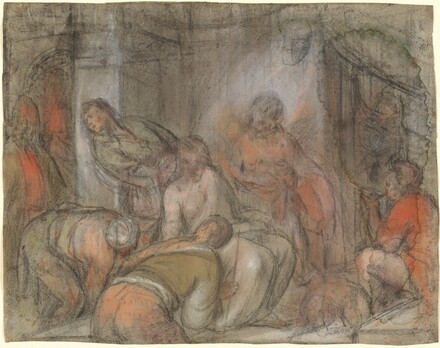
The exhibition opens with a section on this early period, including
preparatory sketches by Federico Barocci and Jacopo Bassano who used
pastel and colored chalk to plan the distribution of light and color in
their studies for oil paintings.
Artists found pastel ideal for
depicting the soft textures of human skin and sumptuous fabric. Early
18th-century artists such as Rosalba Carriera used the medium almost
entirely for highly finished portraits. Carriera’s studio in Venice
became a tourist attraction as aristocrats on the Grand Tour visited to
commission portraits or admire the examples on view. Two of her works—Allegory of Painting (1730s) and Sir John Reade, Bart. (1739) are featured in the exhibition.
By
the mid-18th century, French pastelists had reached unprecedented
levels of technical brilliance. Foremost among them was Maurice-Quentin
de La Tour, whose portrayal of his teacher, Claude Dupouche (c.
1739), exemplifies his dazzling skill. La Tour was renowned for his
ability to mimic textures ranging from the glint of metal to the glow of
satin and for the immediacy of his portraits, which appear to capture
his sitters in mid-conversation. Several French women, including
Adélaïde Labille-Guiard, followed Rosalba’s example and became
successful pastelists.
The craze for pastels spread to Britain
where it was fueled by travelers as they arrived home from the Grand
Tour with portraits by Rosalba or Hugh Douglas Hamilton, who is
represented here by the spectacular full-length Frederick North, Later Fifth Earl of Guilford
(1780s). Artists such as John Russell later marketed smaller and more
intimate pastels to middle-class patrons. Pastel was perfect for
portraits: as a dry medium, it was faster, cleaner, and more portable
than oil paint; fewer sittings were required and artist could easily
travel to patron. Finished works, their entire surfaces coated with
velvety pastel, were considered paintings rather than drawings. Although
nearly all pastels from this period are portraits, this section
includes a pair of rare still lifes by Antoine Berjon, acquired by the
Gallery earlier this year.
Pastel fell out of favor early in the
19th century. When artists returned to it later in the century, they
broke with traditional approaches. Among the most influential figures
was Jean-François Millet, represented in the exhibition by two drawings
from the 1860s. The muted colors and expressive hatching of his pastoral
scenes represented a radical departure from the meticulous “paintings”
of the previous century. Millet’s work helped to inspire an
international pastel revival. Pastel’s immediacy appealed to plein-air
artists as well as to the impressionists.
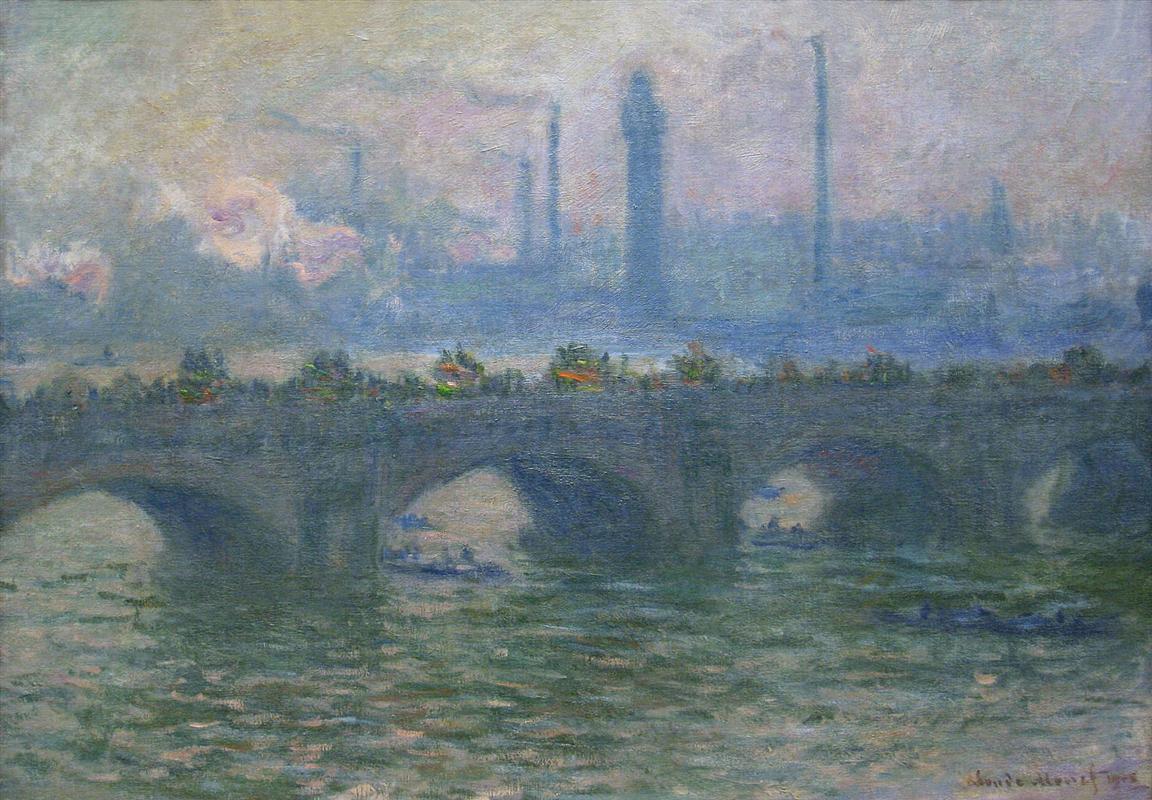
Claude Monet’s Waterloo Bridge
(1901) is one of a series made to study the effects of winter fog on
the Thames.
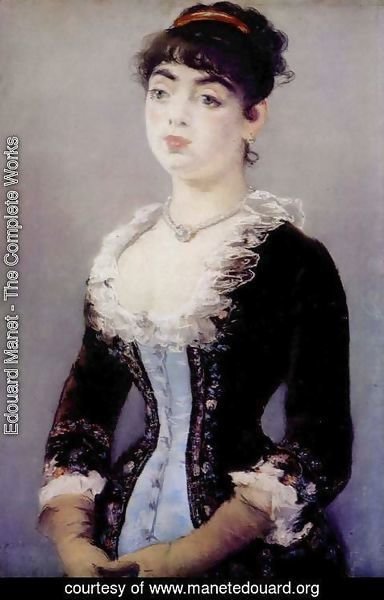
Edouard
Manet
Madame
Michel-Lévy
,
1882
pastel
on canvas
overall:
74.2 x 51 cm (29 3/16 x 20 1/16 in.)
framed:
98.4 x 74.3 cm (38 3/4 x 29 1/4 in.)
National
Gallery of Art, Washington, Chester Dale Collection
Edouard Manet used pastel mainly for portraits, such as Madame Michel-Lévy
(1882). The Gallery is particularly rich in the works of Edgar Degas,
one of the most creative pastelists. Degas experimented with a wide
range of wet and dry techniques and sometimes combined pastels with
printmaking, as in Café Concert (1876/1877). Among his other works included here is the breathtaking Young Woman Dressing Herself (1885). Mary Cassatt, Camille Pissarro, and Paul Gauguin are all represented in this section of the exhibition.
The
dual role of pastel as a medium for both painting and drawing inspired
new enthusiasm in the works of American artists of the late 19th
century. James McNeill Whistler’s ethereal colored sketches of Venice,
such as The Palace; white and pink (1879/1880), show how pastel
lends itself well to providing highlights of color to subjects sketched
in simple lines of graphite or ink. William Merritt Chase and his
followers, in contrast, embraced a more painterly approach.
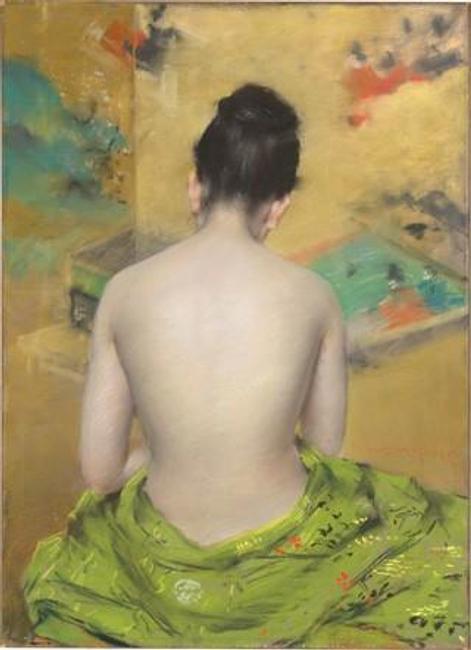
William
Merritt Chase Study of Flesh Color and Gold, 1888 pastel on paper
coated with mauve-gray grit (on strainer) overall: 45.7 x 33 cm (18 x 13
in.) National Gallery of Art, Washington, Gift of Raymond J. and
Margaret Horowit
In Study of Flesh Color and Gold (1888), Chase took full advantage of the lush texture of pastel by blending it into passages of seamless tone.
By
the 20th century pastel had broken free of the expectations of earlier
centuries. Artists turned to its intense color and soft opacity in
countless different ways. Some 20th-century artists experimented only
briefly with pastel before turning to other media, and The Touch of Color
includes rare pastels by Käthe Kollwitz, Henri Matisse, and Roy
Lichtenstein. Jasper Johns sometimes uses pastel to explore the themes
of earlier paintings, as in Untitled (from Untitled 1972) (1975/1976). Finally, in the latest work in the exhibition, Breach
(2009), G. Daniel Massad uses this fragile medium to depict crumbling
autumn leaves and to evoke his recurring theme of the passage of time.
Exhibition Curators
The exhibition is curated by Stacey Sell, associate curator,
department of old master drawings, National Gallery of Art, and Kimberly
Schenck, head of paper conservation, National Gallery of Art.
Henri
Matisse
Woman
with Exotic Plant
,
c. 1925
pastel
on wove paper coated with sawdust
overall:
66.1 x 51.4 cm (26 x 20 1/4 in.)
framed:
90.1 x 76.2 x 8.2 cm (35 1/2 x 30 x 3 1/4 in.)
National
Gallery of Art, Washington, Chester Dale Collection
Object
ID: 5197-013
Jacopo
Bassano
The
Mocking of Christ,
1568
colored
chalks on blue laid paper
overall:
41.3 x 52.5 cm (16 1/4 x 20 11/16 in.)
National
Gallery of Art, Washington, Andrew W. Mellon Fund
Everett
Shinn
Over
the Audience,
1934–1940
pastel
on blue laid paper
overall:
28.5 x 37.5 cm (11 1/4 x 14 3/4 in.)
National
Gallery of Art, Washington, Bequest of Julia B. Engel
Object
ID: 5197-021
Everett
Shinn
Fifth
Avenue Bus, 23rd Street and Broadway,
1914
pastel
and charcoal on paperboard
overall:
48 x 65 cm (18 7/8 x 25 9/16 in.)
National
Gallery of Art, Washington, Bequest of Julia B. Engel
Object
ID: 5197-022
Mary
Cassatt
The
Black Hat,
c. 1890
pastel
on tan wove paper
overall:
61 x 45.5 cm (24 x 17 15/16 in.)
National
Gallery of Art, Washington, Collection of Mr. and Mrs. Paul Mellon
Camille
Pissarro
A
Peasant Girl in a Straw Hat
,
c. 1892
pastel
over black chalk on laid paper
overall:
60.4 x 34.8 cm (23 3/4 x 13 11/16 in.)
National
Gallery of Art, Washington, Gift of Evelyn Stefansson Nef and Mr. and Mrs.
James T. Dyke
Object
ID: 5197-035
Odilon
Redon
Saint
George and the Dragon
,
1880s and c. 1892
charcoal
and pastel on tan wove paper
overall:
53.7 x 37.5 cm (21 1/8 x 14 3/4 in.)
National
Gallery of Art, Washington, Gift of GTE and the New Century Fund
Object
ID: 5197-037
Jean-Baptiste
Greuze
The
Well-Loved Mother
,
1765
pastel
with colored chalks and stumping on light golden-brown laid paper
overall:
44 x 32.2 cm (17 5/16 x 12 11/16 in.)
National
Gallery of Art, Washington, New Century Fund
Object
ID: 5197-039
John
Singleton Copley
John
Temple
,
1765
pastel
on tan laid paper mounted on canvas (on strainer)
overall:
59.7 x 40 cm (23 1/2 x 15 3/4 in.)
National
Gallery of Art, Washington, Patrons' Permanent Fund
George
Luks
Breadline,
1900
pastel
on paperboard
board
(sight): 48.26 x 73.66 cm (19 x 29 in.)
National
Gallery of Art, Washington, Corcoran Collection (Estate of Susie Brummer)
11
S e p t e m b e r 2 0 19 – 2 F e b r u a r y 2 0 2 0
This autumn, Tate Britain will present the largest survey of
work by William Blake (1757-1827) in the UK for a generation. A visionary painter, printmaker
and poet, Blake created some of the most iconic images in the history of British art and has remained an inspiration
to artists, musicians, writers and performers worldwide for over two centuries. This ambitious exhibition will
bring together over 300 remarkable and rarely seen works and rediscover Blake as a visual artist for the 21st century.
Tate Britain will reimagine the artist’s work as he intended it to be
experienced. Blake’s art was a product of his tumultuous times, with revolution, war and
progressive politics acting as the crucible of his unique imagination, yet he struggled to be understood and
appreciated during his life.
Now renowned as a poet, Blake also had grand ambitions as a visual artist and envisioned
vast frescos that were never realised. For the first time,
The Spiritual Form of Nelson Guiding Leviathan c.1805-9
and The
Spiritual Form of Pitt Guiding Behemoth c.1805 will be digitally enlarged and projected onto the gallery wall
on the huge scale that Blake imagined. The original artworks will be displayed nearby in a restaging of Blake’s
ill-fated exhibition of 1809, the artist’s only significant attempt to create a
public reputation for himself as a
painter. Tate will recreate the domestic room above his family hosiery shop in which the show was held, allowing visitors to
encounter the paintings exactly as people did in 1809.
The exhibition will
provide a vivid biographical framework in which to consider Blake’s life and
work. There will be a focus on London,
the city in which he was born and lived for most of his life. The burgeoning
metropolis was a constant inspiration
for the artist, offering an environment in which harsh realities and pure
imagination were woven together. His
creative freedom was also dependent on the unwavering support of those closest
to him, his friends, family and patrons.
Tate will highlight the vital presence of his wife Catherine who offered both
practical assistance and became an
unacknowledged hand in the production of his engravings and illuminated books. The exhibition will showcase a series of
illustrations to
and a copy of the book The
complaint,and the consolation Night
Thoughts 1797, now thought to be coloured by Catherine. Blake was a staunch
defender of the fundamental role of art in society and the importance of
artistic freedom. Shaped by his personal
struggles in a period of political terror and oppression, his technical
innovation, and his political
commitment, these beliefs have inspired the generations that followed and
remain pertinent today.
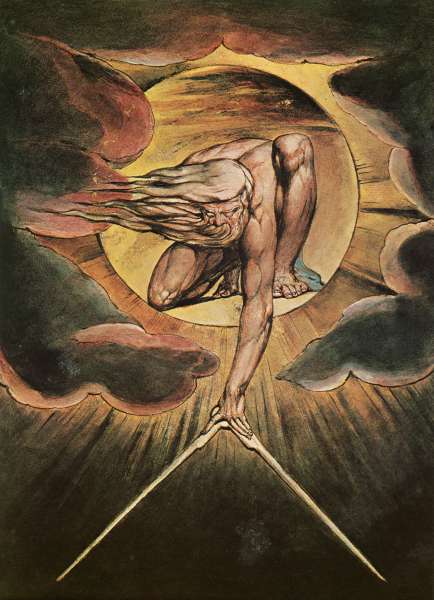
William
Blake (1757-1827)
'Europe'
Plate i: Frontispiece, 'The Ancient of Days'
1827
Etching
with ink and watercolour on paper
232
x 120mm
The
Whitworth, The University of Manchester
William
Blake (1757-1827)
Catherine
Blake
1805
Graphite
on paper
286
x 221 mm
Tate.
Bequeathed by Miss Alice G.E. Carthew 194
William
Blake (1757-1827)
Albion
Rose
c.
1793
Colour
engraving
250
x 211 mm
Courtesy
of the Huntington Art Collections
William
Blake (1757-1827)
Capaneus
the Blasphemer
1824-1827
Pen
and ink and watercolour over pencil and black
chalk,
with sponging and scratching out
374
x 527 mm
National
Gallery of Victoria, Melbourne
William
Blake (1757-1827)
The
Ghost of a Flea
c.1819
Graphite
on paper
200
x 153 mm
Private
Collection
William
Blake (1757-1827)
Jerusalem,
plate 28, proof impression, top design
only
1820
Relief
etching with pen and black ink and
watercolour
on medium, smooth wove paper
111
x 159 mm
Yale
Center for British Art (New Haven, USA)
William Blake, Newton, 1795–c.1805, color print, ink and watercolour on paper, Tate
William
Blake (1757-1827)
Pity
c.1795
Colour
print, ink and watercolour on paper
425
x 539 m
Tate
Tate Britain’s
exhibition will open with Albion Rose c.1793, an exuberant visualisation of the
mythical founding of Britain, created in
contrast to the commercialisation, austerity and crass populism of the times. A
section of the exhibition will also be
dedicated to his illuminated books such as Songs of Innocence and of Experience
1794, his central achievement as a
radical poet. Additional highlights will include a selection of works from the
Royal Collection and some of his best-known paintings including Newton 1795-c.1805 and Ghost
of a Flea c.1819-20. This intricate work was inspired by a séance- induced
vision and will be shown alongside a rarely seen preliminary sketch. The
exhibition will close with The Ancient
of Days 1827, a frontispiece for an edition of Europe: A Prophecy , completed
only days before the artist’s death.
William
Blake will be curated by Martin Myrone, Lead Curator pre-1800 British Art, and
Amy Concannon Assistant Curator, British
Art 1790-1850. The exhibition will be accompanied by a catalogue from Tate
Publishing.
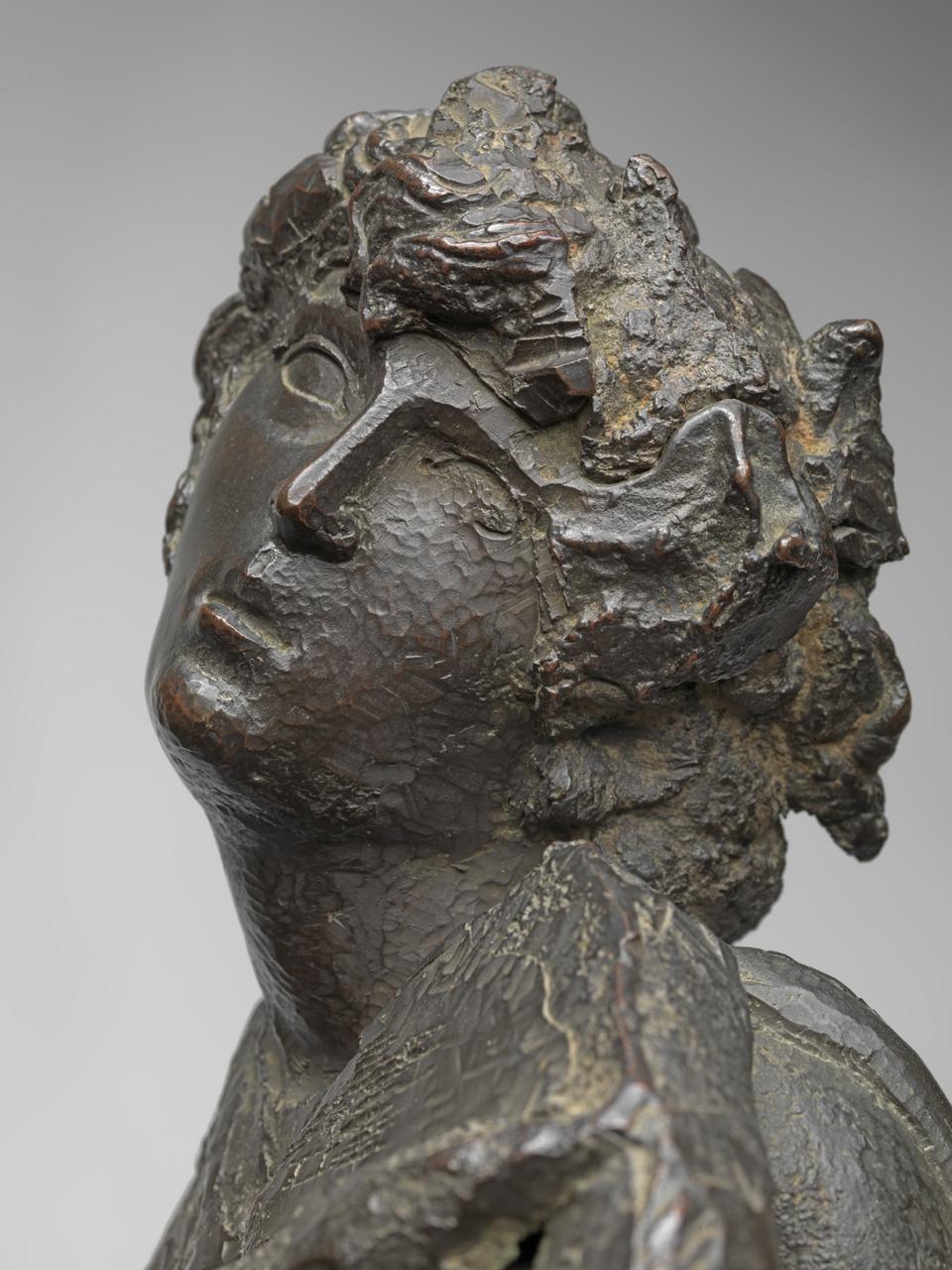
Bertoldo di Giovanni,
Hercules on Horseback (detail), ca. 1470–75, bronze, Galleria Estense, Modena,
Su concessione del Ministero per i Beni e le Attività Culturali - Archivio
fotografico delle Galleria Estense; photo: Valeria Beltrami
This fall, The Frick Collection presents the first exhibition devoted to the Renaissance
sculptor Bertoldo di Giovanni (ca. 1440–1491). It shines a long-overdue light on
the ingenuity and prominence of the Florentine artist, who was a student of
Donatello, a teacher of Michelangelo, a favorite of Lorenzo de’ Medici, and an
active collaborator with many other artists. By uniting nearly his entire extant
oeuvre—more than twenty statuettes, reliefs, medals, a life-sized statue, and a
monumental frieze never before shown outside of Italy—the show demonstrates the
artist’s creative process and ingenious design across media, his engaging
lyrical style, and especially, the essential role he played in the development
of Italian Renaissance sculpture. Indeed, Bertoldo was one of the earliest sculptors
since antiquity to create statuettes in bronze, an art form that became
ubiquitous in prestigious collections during the fifteenth century and thereafter.
The exhibition was organized by Aimee Ng, Curator; Alexander J. Noelle, Anne L.
Poulet Curatorial Fellow; and Xavier F. Salomon, Peter Jay Sharp Chief Curator,
with the assistance of Julia Day, Conservator.
Comments Salomon, “The
Frick is the only institution outside of Europe thatowns a statuette by Bertoldo,
and we have long desired the opportunity to study and present this artist’s
work in great depth. We are thrilled that the resulting monographic display—on
view only in New York—will finally bring into focus Bertoldo’s unique position
at the heart of the artistic and political landscape of fifteenth-century
Florence. Mostappropriately our team has enjoyed working on this project in
partnership with that city’s esteemed Museodel Bargello.”
The catalogue that
accompanies Bertoldo di Giovanni: The Renaissance of Sculpture in Medici
Florence is the most substantial publication ever produced on the artist.
A PIVOTAL FIGURE
RECONSIDERED IN HIS OWN LIGHT
Initially, Bertoldo developed
his skills under the aegis of Donatello, inheriting his models and, upon the
master’s death, completing the pulpits that were commissioned to adorn the
Basilica of San Lorenzo in Florence. Bertoldo went on to gain the life-long
patronage and friendship of the state’s de facto ruler, Lorenzo de’ Medici,
eventually moving into the Medici palace and creating numerous objects for his
patron, some of which were designed as propagandistic tools. Bertoldo was even
appointed the custodian and curator of Lorenzo’s famed garden of antiquities
near San Marco, where he instructed the gifted pupils studying the relics, one
of whom was Michelangelo, whose creative genius flourished under the master’s guidance.
His legacy, however, was largely written out of history by Michelangelo, who
fashioned his own identity as a self-taught artist divinely blessed with
ability.
Michelangelo’s
biographers, including the art historian Giorgio Vasari, reduced Bertoldo’s
role significantly, mentioning him only in passing while focusing more
extensively on the pioneering creativity of Donatello, the magnificent
patronage of the Medici family, and the staggering genius of Michelangelo. Modern
scholarship, as a result, has largely followed this precedent. The exhibition
and catalogue offer a comprehensive exploration of Bertoldo’s work,
reconsidering the sculptor’s associations with Donatello, Lorenzo, and
Michelangelo, which are central to his narrative. These relationships, however,
are reframed, thereby allowing Bertoldo to be appreciated in his own right, his
artistic identity no longer overshadowed but, rather, enhanced by his
connections to three of the most important figures of the Renaissance.
OBJECTS CHART
A CAREER OF COMMISSIONS
ACROSS ITALY
AND BEYOND
While many of the sculptor’s
contemporaries, including Sandro Botticelli and Andrea del Verrocchio, were
also frequently patronized by the Medici family, Bertoldo was Lorenzo’sfavorite.
By the end of his life, Bertoldo was known as his patron’s “familiar” and
traveled with him as part of his retinue—serving as an entertainer, confidant, and
designer—and valued for much more than his sculptural output. Hewas granted a
place in Lorenzo’s household, eventually dying in the Medici villa at Poggio a
Caiano before completingthe monumental frieze forits facade. Some of the
bronzes on display in the exhibition were originally designed for the Medici
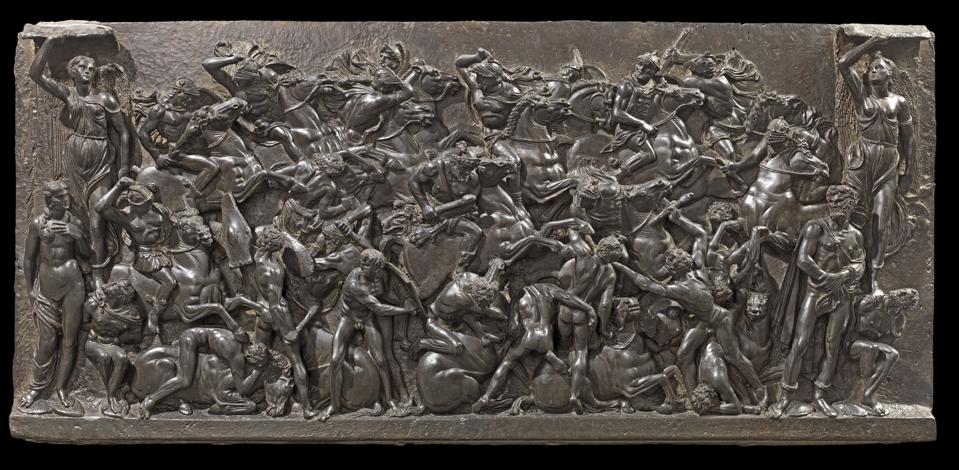
palace, commissioned by Lorenzo himself, including the famous Battlerelief(illustrated
on page 4). While Lorenzo was Bertoldo’s most illustrious patron, the sculptor
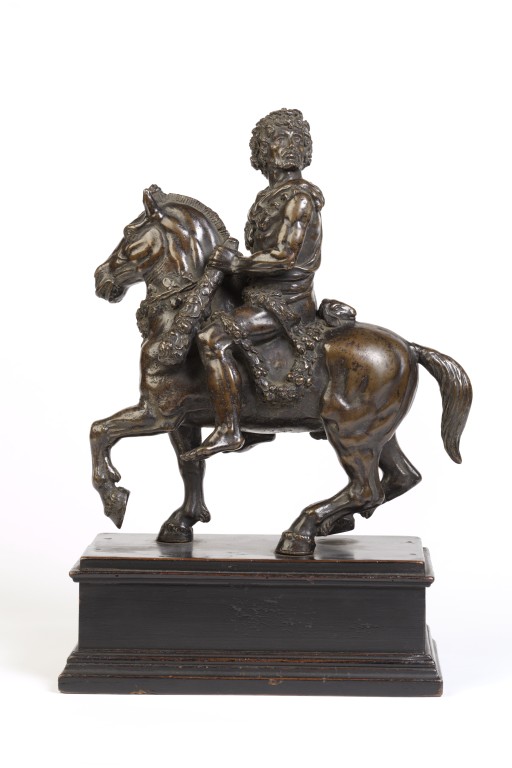
received commissions from other leading figures. The Hercules on Horseback statuette
for example, was probably cast for Ercole Id’Este, Duke of Ferrara, perhaps in celebration
of his marriage to the princess of Naples. The objects included in the
exhibition chart Bertoldo’s commissions from Rome to Padua, and even as far
afield as Constantinople, revealing his significant network of patrons.
CREATIVE PROCESS
REVEALED BY DESIGN ACROSS MANY
MEDIA
Bertoldo’s artistic
production in wood, metal, and terracotta is reconsidered, exploring the
innovation of the sculptor’s work across media revealing both his versatility
as well as his ability to create a unified style, mediated through diverse
scale, media, and hands. The objects shed light on his creative process—the
development of a sculpture from idea to design to production—which has puzzled
scholars for the past century. While certain stylistic elements unify his
artistic output, the various materials used necessitated different approaches
for their fabrication. It is clear, through documents and inscriptions as well as
technical analysis conducted for the exhibition, that Bertoldo—not known to
have had a workshop of his own—enlisted other artists to help transform his
models into artworks. By bringing these sculptures together, the exhibition
elucidates hisrole as a designer, modeler, and collaborator.
The majority of
Bertoldo’s sculptural production falls into three categories: statuettes,
reliefs, and medals. In many media, Bertoldo demonstrated his witty, lyrical
style that combined iconographic innovation with the use of motifs from ancient
sources. The resulting visual language is both instantly recognizable as an invention
by Bertoldo, yet layered with classical resonance.
The Shield Bearer, purchased
in 1916 by Henry Clay Frick along with fifty Renaissance bronzes from the
holdings of the late J.P. Morgan, is displayed publicly for the first time with
its pendant from Vienna’s Liechtenstein: The Princely Collections. Reunited,
the two Shield Bearers reveal Bertoldo’s combination ofimagery associated with
the fantastical fauns of the Arcadian forest, the ancient hero Hercules, and
the medieval fable of the monstrous “wild man.” The two statuettes present
multivalent identities, corresponding neither to each other nor to any established
iconography, thereby facing the viewer with an intriguing game of identification
designed to beguile the learned Renaissance mind.
The Bellerophon
Taming Pegasus displays Bertoldo's engagement with antique texts as he
transformed the words of the ancient poet Pindar into his own version of the
myth. Heralded by modern scholars as one of the most beautiful small bronzes
ever produced, the sculpture is signed in Latin “Bertoldo modeled me; Adriano
[Fiorentino] cast me.”The bronze is thus a prime example of Bertoldo's artistic
collaboration in which he provided the design and model yet other hands
physically cast his sculptures. The Bellerophon, when compared to the other
five statuettes on view, serves as a cardinal point for examining Bertoldo’s
deft detailing of the surfaces of his bronzes, illustrating a consistency of
intricate marks that unite the appearance of such works.
The five bronze
reliefs displayed in the exhibition include scenes from the life of Christ to
mythological festivities. They range in size from diminutive and intimate to
the grand, arresting vision of a melee presented in the Battle, Bertoldo’s
largest bronze, which, according to modern scholars, is "the most
important of [Bertoldo’s] surviving works."
The Battle is an
imaginative reconstruction of a severely damaged ancient sarcophagus. He intentionally
departed from the traditional depiction of Romans fighting Barbarians, which is
clearly delineated on the sarcophagus, and instead fashioned a scene of
organized chaos in which the figures attack one another in seemingly endless
combinations, with no underlying logic or allegiances. The central figure,
adorned with the lion skin and club of Hercules as well as the helmet of
Hermes, presents an identity that is as conflated and unclear as the battle
itself. Bertoldo conceived of the relief with an unfixed narrative, thereby encouraging
discussion amongst the viewers who attempted to discern its subject.
Bertoldo is known to
have designed six medals, the prime examples of which are included in the
exhibition. All of the medals demonstrate the sculptor's adept ability to
present the convincing likeness of the sitter on the obverse accompanied by an
inventive allegorical scene or incredibly detailed historical event on the
reverse, an impressive feat given the relative nascence of this medium.
The Pazzi Conspiracy
medal, however, reveals Bertoldo's ability to revolutionize the art form derived
from ancient currency. Unlike any other medal, this work collapses obverse and
reverse, fusing portraiture, allegorical figures, and historical depictions
together. The medal recounts the attempted coup led by the Pazzi family against
the Medici brothers, Lorenzo and Giuliano, in 1478. Each side shows the bust of
one brother hovering above his fate during the attack on holy ground in the Florentine
cathedral, flanked by allegorical figures that underline the tragedy of
Giuliano's murder and the celebration of Lorenzo's deliverance from harm.
Commissioned by Lorenzo himself as part of a propagandistic campaign of interrelated
artwork and literature, the innovative medal provided a visual component to the
commentaries, poems, and elegies produced by the prominent writers in the
Medici circle in response to the event. This double-portrait medal, intended to
shock, was distributed across Europe to garner support for Florence, which was
embroiled in war with the Pope, Rome, and Naples as a result of the
assassination.
The largest sculpture
Bertoldo designed was the terracotta frieze for the portico of the Villa Medici
at Poggio a Caiano. Spanning over fifteen meters long and located directly above
the main entrance, the frieze originally adorned the facade of Lorenzo's
country villa. The monumental frieze is presented in its entirety in the
exhibition, marking the first time that all five sections have traveled beyond
Tuscany. The narrative divisions align with the architecture of the villa
itself, designed by Giuliano da Sangallo, although the precise interpretation
of the imagery continues to elude scholars. It is generally assumed that the composition
is either an allegory of time or an allegory of the journey of the soul, based
on ancient texts. It is almost certain that this complex iconography drawn from
antique sources was devised by a humanist in the Medici circle as a celebration
of Lorenzo and his personal motto “Time Returns.” Bertoldo would have worked closely
with both his patron and the poet who provided the underlying structure of each
scene. He also collaborated closely with numerous artisans to produce the frieze
itself; while the design of the overall composition ascribes to Bertoldo’s
style, the varying execution of the figures indicates that multiple hands were
employed to mold, fire, and glaze the terracotta.
Through the reunion
and reconsideration of Bertoldo’s oeuvre, this exhibition seeks to redefine the
sculptor by celebrating his distinct style and notable achievements, allowing
him to step out of the shadow of Donatello, Lorenzo, and Michelangelo. Bertoldo
is presented as an active and influential participant at the nexus of art and
politics in Florence. He was a pioneer in the new mediums of bronze statuettes
and portrait medals, an innovative designer who found inspiration in classical
models yet created his own unique iconography, and a collaborative partner who
worked for, with, and instructed some of the most important sculptors of both
the Early and High Renaissance. The statuettes, reliefs, medals, statue, and
frieze on display reveal Bertoldo's striking ingenuity; it is clear why Lorenzo
selected the sculptor as his favorite and why his designs were celebrated as “immortal.”
ABOUT THE PUBLICATION
A fully illustratedcatalogue of the exhibition featuring contributions from a team of international
scholars, will accompany the exhibition and is available in the museum shop.
This book, published in association with D Giles Ltd, London, is by far the
most substantial text on Bertoldo ever produced. 300 color illustrations.
Bertoldo di Giovanni Shield
Bearer, ca. 1470–80Gilt bronze H 8 7/8 inches The Frick Collection, New York Photo:
Michael Bodycomb
Bertoldodi Giovanni Hercules on Horseback, ca. 1470–75BronzeH
10 3/4 inches Galleria Estense, ModenaSu concessione del Ministero per i Beni e
le Attività Culturali -Archivio fotografico delle Galleria Estense;photo:Carlo
Vannini
Bertoldo
di Giovanni and collaborators Frieze for the Portico of the Medici Villa at Poggio
a Caiano (detail), ca. 1490 Glazed terracotta22 7/8 x 571 1/4 inches Villa
Medicea di Poggio a Caiano, Polo Museale della ToscanaGabinetto Fotografico
delle Gallerie degli Uffizi
Bertoldo di GiovanniOrpheus(detail),ca. 1471BronzeH 17 1/8
inchesMuseo Nazionale del Bargello, FlorenceSu concessione del Ministero per i
beni e le attività culturali; photo Mauro Magliani