Saturday, July 8, 2023

EDVARD MUNCH: TREMBLING EARTH


CLARK ART INSTITUTE

JUNE 10-October 15 

Museum Barberini, Potsdam, Germany

November 18, 2023–April 1, 2024

Munch Museum (MUNCH), Oslo, Norway

 April 27–August 24, 2024


The Clark Art Institute presents the first exhibition in the United States to consider how the noted Norwegian artist Edvard Munch (1863–1944) employed nature to convey meaning in his art. Munch is regarded primarily as a figure painter, and his most celebrated images (including his iconic The Scream) are connected to themes of love, anxiety, longing, and death. Yet, landscape plays an essential role in a large portion of Munch’s work. Edvard Munch: Trembling Earth considers this important, but less explored aspect of the artist’s career. The Clark is the sole U.S. venue for the exhibition which opens on June 10 and is on view through October 15, 2023. Organized in collaboration with the Museum Barberini, Potsdam, Germany and the Munch Museum (MUNCH), Oslo, Norway, the exhibition is presented in Potsdam from November 18, 2023–April 1, 2024, and in Oslo from April 27–August 24, 2024.

“This fascinating exhibition provides a fresh opportunity to explore the range and depth of Edvard Munch’s art,” said Olivier Meslay, Hardymon Director of the Clark. “Although many people make immediate associations and assumptions regarding Munch’s work, this exhibition offers a considerably different look at the artist that encourages us to expand our understanding and deepen our appreciation of his exceptional talents. For the Clark, the opportunity to explore Munch’s perceptions of nature against the backdrop of our own beautiful natural setting is particularly compelling.”

The exhibition is organized thematically to show how Munch used nature to convey human emotions and relationships, celebrate farming practice and garden cultivation, and explore the mysteries of the forest even as his Norwegian homeland faced industrialization. 

Trembling Earth features seventy-five objects, ranging from brilliantly hued landscapes and three stunning self-portraits, to an extensive selection of his innovative prints and drawings, including a lithograph of The Scream. The exhibition includes more than thirty works from MUNCH’s world-renowned collection, major pieces from other museums in the USA and Europe, and nearly forty paintings, prints, and drawings from private collections, many of which are rarely exhibited.

“This exhibition draws on new research to offer a fresh perspective on Munch’s career,” said Jay A. Clarke, Rothman Family Curator of Prints and Drawings at the Art Institute of Chicago. “Alongside depictions of death, existential torment, and troubled relationships, Munch also created imagery reflecting his knowledge of science, showing his embrace of pantheism, and a deep reverence for nature.” Clarke led the curatorial project for the Clark and began early work on the exhibition when she served as its Manton Curator of Prints, Drawings, and Photographs from 2009–2018.


ABOUT THE EXHIBITION

This exhibition introduces Munch’s lesser-known landscape paintings and considers his iconic figural images from a new perspective, by focusing on how his rendering of nature animated his chosen narratives.  In paintings of the Oslo Fjord shoreline and the Baltic coast of Germany, Munch explored changes brought about by increased tourism, partially the result of health reform initiatives extolling the virtues of outdoor activity. Munch developed his own pantheistic worldview that connected human biology, plant life, and the solar system. Munch’s fascination with humankind’s interaction with the earth and the impact of one on the other can be seen in a selection of landscape-rich prints, drawings, and paintings from the 1890s to the 1940s.

“It is with great pride that the MUNCH Museum participates in this substantial exhibition of Edvard Munch's art, where the public can gain insight into his strong relationship to nature. It is also a great pleasure to participate in a network of skilled professionals from the U.S., Germany, and Norway, collaborating to bring forward new knowledge about one of Norway's greatest artists. I am sure that the exhibition and the insightful catalogue that accompanies all three venues will be well received by the public,” said Tone Hansen, director of MUNCH. “MUNCH is a museum for modern and contemporary art, and manages and preserves the legacy of Edvard Munch for an international public. An exhibition series like this one demonstrates the importance of Munch’s work, the value of collaboration, and the importance of new research and insight.”

Ortrud Westheider, director of the Museum Barberini said: “Munch’s works are still unsurpassed in their emotional expressiveness and overwhelming modernity, and for good reason: for many people, his art is a symbol of their own feelings. With the first exhibition devoted exclusively to Munch’s landscape depictions, we are opening up a facet of his oeuvre that has hitherto been little represented, and the dramatic weather conditions in his paintings take on a special urgency, especially against the backdrop of the looming climate catastrophe.”

IN THE FOREST 

Munch’s depictions of forests include emotional encounters between couples, children approaching dense woods, and scenes of Norway’s logging industry. In prints of the 1890s and 1910s, such as 


Ashes I (1896) 
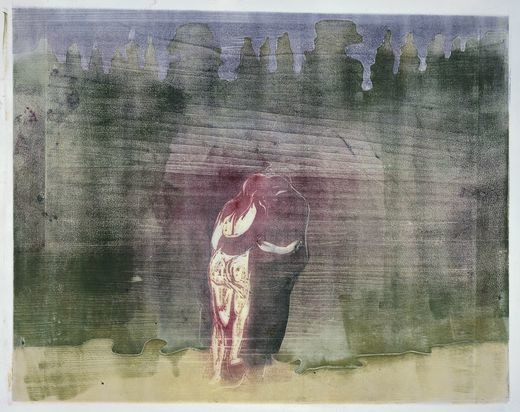
1897


1915

and Towards the Forest (1897 and 1915), 

a dense thicket of wood often served as a backdrop for scenes of impending liaisons or extinguished love. In his diaries and other writings, the artist suggested the woods as a place where love could either collapse or prompt intimacy. 
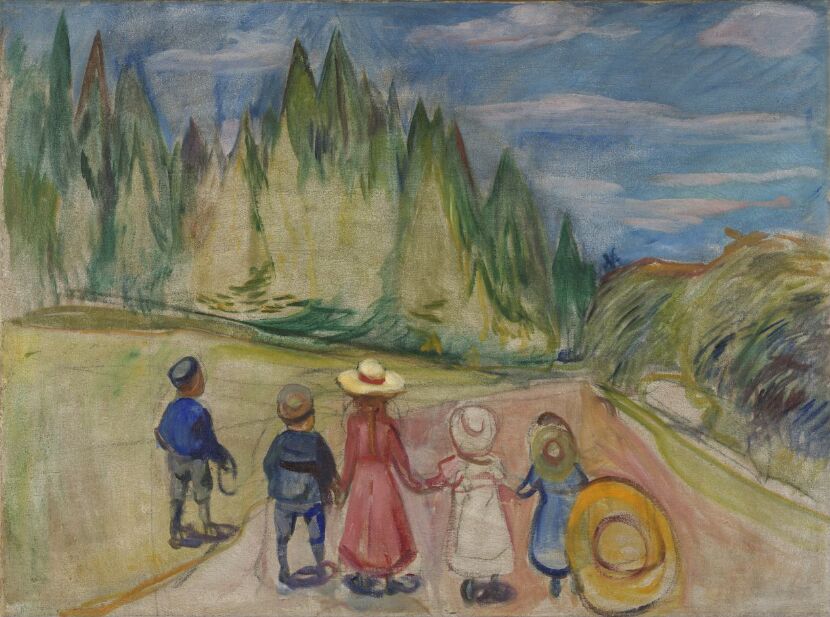


The Fairytale Forest (1927–29), one of a number of works on this theme painted from 1901 through the late 1920s, shows small children walking towards an imposing forest. The claustrophobic depiction of children surrounded by towering dark spruces is heightened by the acid-green colors, the differences in scale, and the anthropomorphic shape of the trees, whose branches resemble a gaping mouth. 
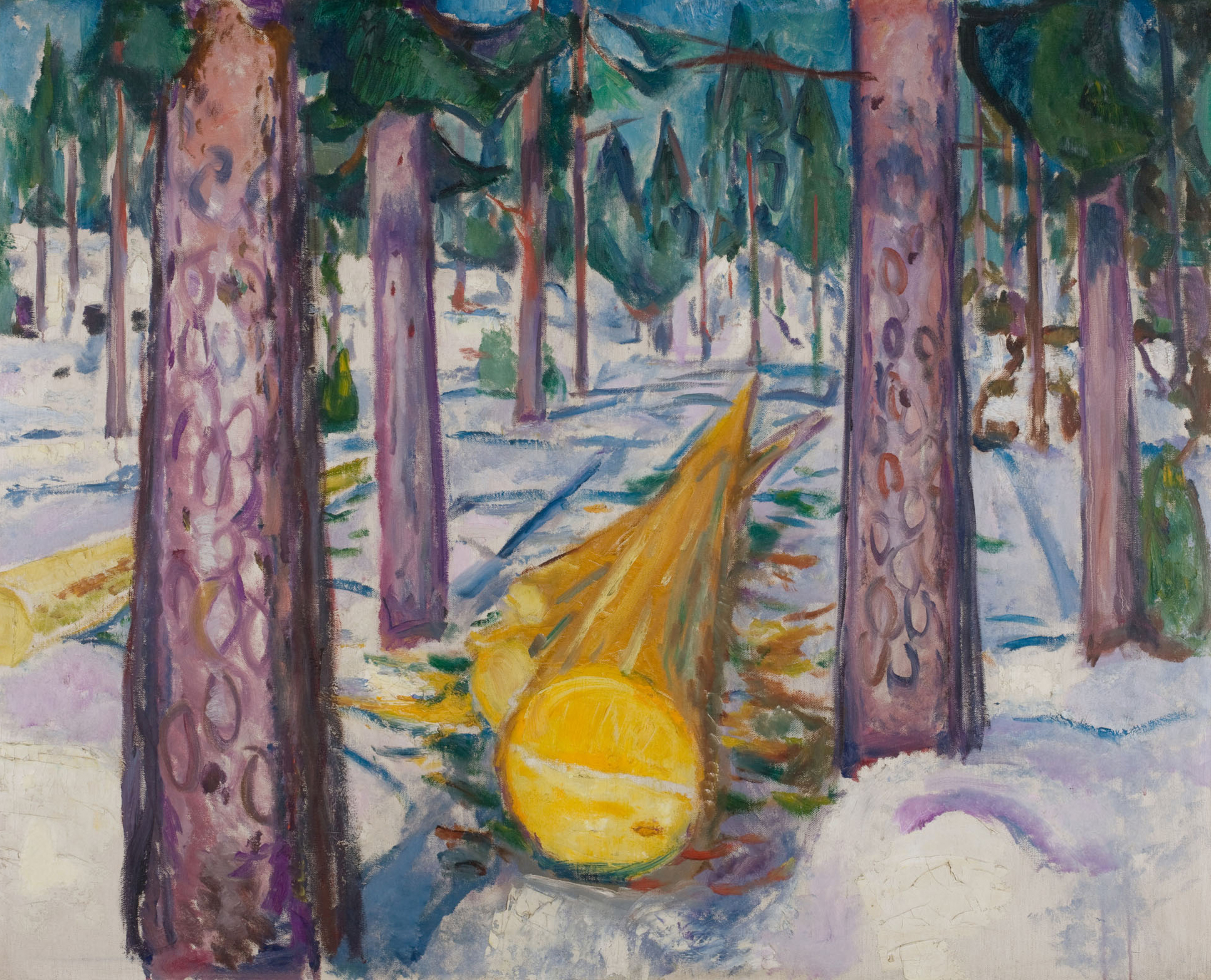
Edvard Munch, The Yellow Log, 1912, oil on canvas. Munchmuseet, MM.M.00393, © Artists Rights Society (ARS), New York. Photo: Munchmuseet 

The Yellow Log (1912) 


and The Logger (1913) draw attention to both the growth of trees and destruction of Norway’s forests. The Yellow Log depicts a group of felled trees in a dense forest, the brightly-hued large central tree dramatically disappearing into the vanishing point of the canvas. The surrounding trunks are shaded purple with dark, cellular-shaped circles demarcating their bark and emphasizing the life force within them. 

CULTIVATED LANDSCAPE

Munch’s paintings of cultivated landscapes could be seen as reactions against the intense urbanization and modernization that occurred during his lifetime. In particular, farming subjects demonstrate Munch’s quest for alternatives to the alienating conditions of city life. During a time when Norwegian agriculture was undergoing modernization and mechanization, Munch preferred to depict traditional small-scale farming practices, celebrating the farmer’s “simple” way of life, as in 


The Haymaker (1917).  
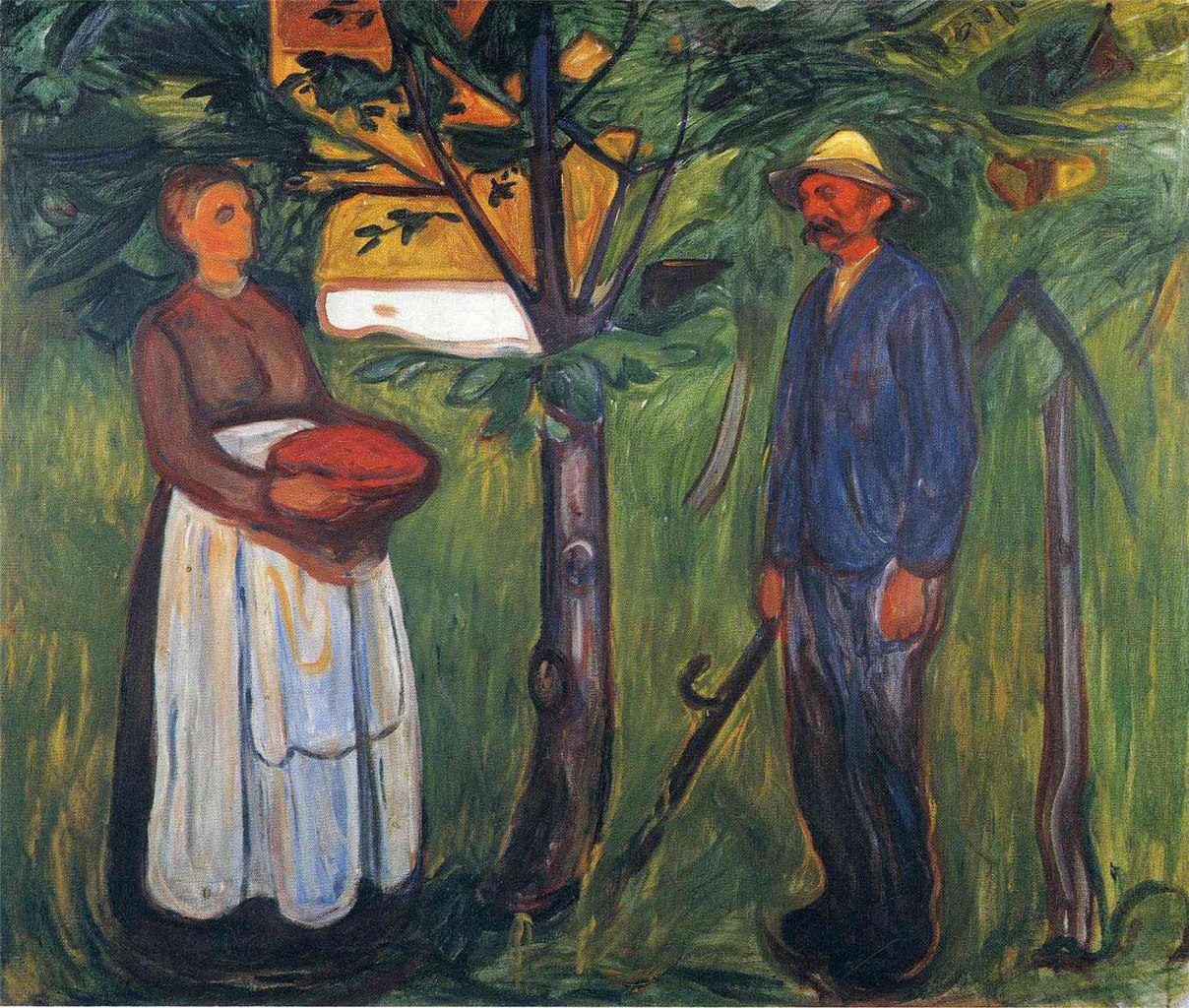


shows a male and female laborer posed on either side of a tree, suggesting a harmony between the sexes.  

The artist drew inspiration from the fertile coastal area around the Oslo Fjord, where he rented or owned properties in locations such as Åsgårdstrand, Kragerø, and Hvitsten. Reflecting a horticultural boom in Norway, Munch created flower and kitchen gardens, planted fruit trees and kept animals such as hens, ducks, and horses at his various homes. The artist’s final property at Ekely, on the outskirts of Oslo, included a productive garden where he planted vegetables during World War I to supply his family and friends with fresh produce. He later let the gardens run wild, with trees dripping with fruit, as featured in 


Apple Tree in the Garden (1932–42). 


In Woman with Pumpkin (1942) Munch pairs the woman with the lush abundance of the garden.

The artist regarded his gardens and fields as places of refuge overflowing with life. They can also be understood as liminal zones between nature and civilization. In a notebook, Munch described the female figures who populate his paintings of gardens as “brightly dressed women from the city.” The formally dressed woman who appears in 


Girl Under Apple Tree (1904) seems out of place in the verdant setting, and perhaps signals the contemporary expansion of tourism in the resorts around the Oslo Fjord. 

STORM AND SNOW

Munch’s fascination with metamorphosis, together with his faith in nature’s cyclical renewal, led him to depict each season with reverence. Climate anxiety at the beginning of the twentieth century involved very different concerns to those that preoccupy us today. The prevalent fear was not that temperatures would rise, but that the earth would be engulfed by a new Ice Age. As an avid newspaper reader, Munch would have been aware of this trend, although his depictions of snow and ice are not overtly pessimistic. His paintings of snowy landscapes celebrate the mystery and wonder of Norway’s long, dark winters. The large-scale evening vistas, painted in hues of white and blue, feature starry night skies and sturdy pine trees impervious to the bitter cold. The snowcapped forests, townscapes, and moonlit winter skies in paintings such as 


White Night (1900–01)


 and Starry Night (1922-24) convey a sense of quiet awe. 

Starry Night depicts a magnificent frozen landscape beneath the starlit canopy of a night sky. The perspective is from the artist’s veranda at his home in Ekely, where he looked out over the winter landscape of his fields and garden, contemplating the sky that arches over the distant lights of the city. 

Munch also depicted extreme weather events during the warmer months, as in 


The Storm 
(1893) 


and Stormy Landscape (1902–03), allowing him to explore tumultuous conditions like waving trees and swirling clouds. For all his awareness of humankind’s imprint on nature and interconnectedness with the universe, Munch’s paintings of snow, storm, and ice present nature as a force that is ultimately beyond human control. 

ON THE SHORE

The shoreline was an important motif for Munch, as he lived on or near the Oslo Fjord coast much of his adult life. Munch depicted its curving shoreline in his paintings, drawings, and prints from the 1890s through the 1930s. It became a recurring theme, one he identified with the “perpetually shifting lines of life.” In some depictions, the shoreline itself was the subject, as in 


Summer Night by the Beach
 (1902–03), and in others it was a backdrop amplifying human emotion, as in 

Two Human Beings, the Lonely Ones (1899). The coastline featured most prominently in Munch’s works depicting themes of melancholy, human isolation, and physical separation. 

One narrative theme that employed the shoreline was that of a man and woman parting from one another. 


Separation II (1896) focuses closely on a couple, showing only their heads, shoulders, and the shoreline winding between and behind them. The woman faces the water and strands of her hair, echoing both the waves and curving shore, flow towards the man, her tresses touching his head and shoulder, and settling near his heart. The man, eyes closed and head turning away from the water, seems defeated yet inextricably connected to the woman.

Another frequent subject the artist set on the shoreline was a dejected man or woman facing the water. While the figure was most often male, Munch’s Melancholy II (1898) woodcut depicts a woman. The woman throws her head into her hands with hair cascading downwards. Her red dress, with the anthropomorphic shape of an open mouth, echoes the curving shoreline, its borders emphasized by the black background. By setting depictions of separation, attraction, and loneliness against the winding and jagged coast of the fjord, Munch infused his pictures with vitality and emotion. 

CYCLES OF NATURE 

Munch’s artistic practice was affected by his overlapping interests in philosophy, religion, and the natural sciences. Although raised in a staunchly Christian household, in adulthood Munch’s religious views were shaped by scientific theories of Darwinian evolution and Monism, a philosophical belief that all existence is unified: animal, vegetal, and terrestrial. The position of humans as part of a cosmic cycle is a recurrent theme in his art, one often associated with the image that has become synonymous with modern anxiety, 


The Scream
 (1895). 


A lithograph of the artist’s most celebrated work—one of about only thirty made—is on view in the exhibition. 

The Scream has generally been interpreted as an outward expression of an interior mental state. Seen alongside 
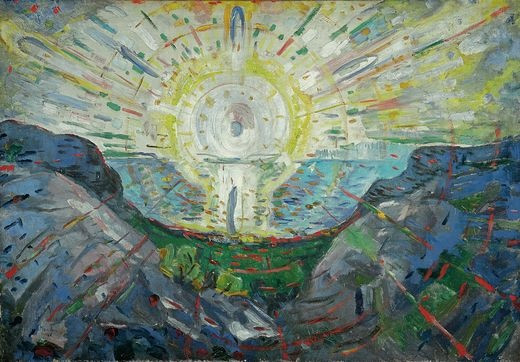

The Sun (1912), however, its connection to the universal force of nature becomes more evidentIn The Scream, a figure confronts the viewer with staring eyes and mouth agape. Even more importantly, the figure is depicted as part of the churning, trembling landscape behind. The rhythm of the lone figure’s swaying body continues into the pulsating landscape. Nature is alive, like a human being, and they mutually impact each other. The German inscription included on the lithograph translates to “I felt the great scream through nature.” 

Munch’s long-standing fascination with the existential meaning of nature culminates in the motif of the sun. Painted with magnificent energy, the beams of light of The Sun (1912) are rendered in strong hues of orange, yellow, white, and green, piercing the earth below, infusing the rocks, water, and soil with energy.  In related works, the artist linked humankind to nature and the cosmos with images of people stretching upwards towards the sun, a symbol of life and enlightenment. 

Several works depict the cycles of nature directly, for example in the form of rotting bodies that provide nourishment to sprouting plants. In his 1896 drawing 


Metabolism (Life and Death), plants with anthropomorphic features grow out of the corpse of a woman. In the background, a pregnant woman is surrounded by plants and trees. The sun’s rays shine upon her body, nourishing the baby growing within her as well as the surrounding plants. They suggest that the boundaries between humanity and nature are blurred—we do not stand outside the cycle of nature, we are part of it. There are no clear distinctions between internal and external, material and non-material, living and dead.

CHOSEN PLACES

Throughout his life, specific geographic sites impacted Munch and his artistic production. These places where Munch lived and worked for periods of time became protagonists in his paintings, prints, and drawings, distinct with their own visual characteristics and inspired narratives.

In his paintings of Åsgårdstrand, the Norwegian village where Munch spent many of his summers, the artist depicted the rocky, curving shoreline when looking away from the village, as in 


Beach (1904).  He also looked inland, shifting his focus to young girls and women standing on the town’s pier in front of the Kiøsterud Manor, one of the grandest buildings in the town. One of Munch’s most iconic and repeated motifs is 


Girls on the Bridge


From 1902 to 1935, the artist created twelve paintings and four print compositions featuring groups of girls or women standing on the pier during the summer, surrounded by the water in which a giant linden tree is reflected.

Munch spent an intense period from 1907 to 1908 in Warnemünde, on the northern coast of Germany, where he sought water cures and rest for his frayed nerves just prior to being hospitalized for alcoholism and a nervous breakdown. Here, he created 
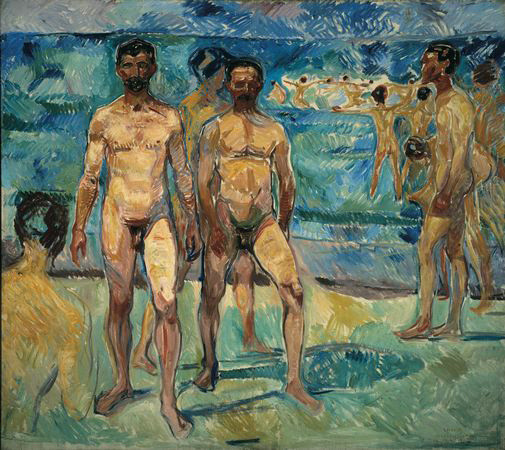


Bathing Men (1907–8), which became the central panel in a series of five known as 
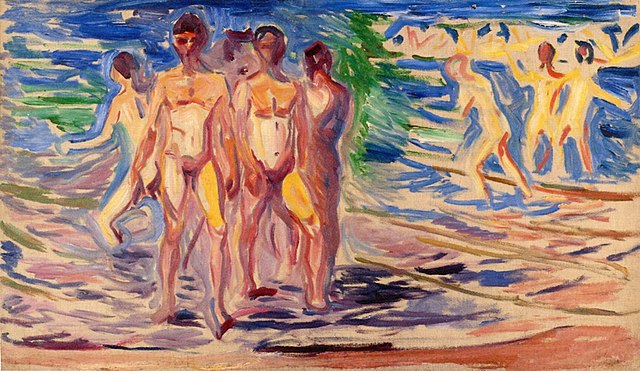


The Ages of Man. Bathing Men depicts a group of nude, muscular middle-aged men walking toward the viewer, playing in the waves, and strolling along the shore. The scene is one of healthful vitality. 

In 1910, Munch bought property on the Oslo Fjord in Hvitsten, where he created bathing scenes and built outdoor studios for his monumental works. As Munch embraced the healing effects of sun and the outdoors, his color palette brightened, as in works like Bathing Man (1918). In this period, his contemporaries began to perceive the artist as happier: at peace with himself and at one with nature. 


Catalogue


The exhibition also marks the publication of Edvard Munch: Trembling Earth, a 248-page catalogue with contributions by Ali Smith, Jay A. Clarke, Jill Lloyd, Trine Otte Bak Nielsen, and Arne Johan Vetlesen. 


The book is published by MUNCH, Oslo, Norway and distributed by Yale University Press, New Haven. 


A thought-provoking volume on Munch’s often neglected depictions of nature, this richly illustrated catalogue provides a multifaceted perspective on Munch’s images of the natural world, exploring the Norwegian artist’s landscapes, seascapes, and existential environments in light of his own time and ours.


Monday, July 3, 2023

, THE SLIP: The New York City Street That Changed American Art Forever - Book


In mid-twentieth-century New York, on an obscure little street on the tip of Manhattan, a group of artists changed American art forever.


In this exquisite biography, art historian and critic Prudence Peiffer captures a defining moment in American art: when Robert Indiana, Ellsworth Kelly, Agnes Martin, James Rosenquist, Delphine Seyrig, Lenore Tawney, and Jack Youngerman lived and worked together in creative community and transformed the art world.


In the 1950s and 60s, Coenties Slip—an obscure little street at the lower tip of Manhattan overlooking the East River—was home to a group of extraordinary, then-struggling artists: Robert Indiana, Ellsworth Kelly, Agnes Martin, James Rosenquist, Delphine Seyrig, Lenore Tawney, and Jack Youngerman. For just over a decade, this cobblestone street of dilapidated warehouses would serve as the unlikely site of eclectic and influential works of art and spark a singular moment of community and creativity.


In her riveting new group biography, THE SLIP: The New York City Street That Changed American Art Forever (Harper, $35.00; Hardcover; ISBN 10: 0063097206; on-sale: August 1, 2023), art historian and critic Prudence Peiffer pays homage to the crucial street that inspired this extraordinary group of artists and captures a singular moment of time and place that changed the course of American art.


As friends and inspirations to one another, these artists created a unique community for unbridled creative expression and experimentation. It was on the Slip that Ellsworth Kelly honed his unique style of hard-edge, minimalism, and Color Field painting; his once-lover Robert Indiana changed his surname from “Clark” to “Indiana”—and thus came into his own being as an artist—and developed sculptures from scavenged materials and paintings about the literary and maritime history of the neighborhood; James Rosenquist explored the role of advertising and consumer culture in art and society; painter Jack Youngerman and actress Delphine Seyrig lived and worked with their infant baby, after following Kelly from Paris to forge their own artistic visions; and Agnes Martin and Lenore Tawney—transplants from New Mexico and Chicago respectively—made singular impressions on the art world with abstract paintings (Martin) and fiber arts (Tawney).


In telling the story of these artists, Peiffer also captures a singular moment of New York City history.  Despite Coenties Slip’s obscurity, the entire history of Manhattan was inscribed into its cobblestones—one of the first streets and central markets of the new colony, built by enslaved people, with revolutionary meetings at the tavern just down Pearl Street; named by Herman Melville in Moby Dick and site of the boom and bust of the city’s maritime industry; and, in the artist’s own time, a development battleground for Jane Jacobs and Robert Moses. THE SLIP’s history is entwined with that of the artists and their art—radical and varied work that was made from the wreckage of the city’s many former lives.


THE SLIP is a not only a highly ambitious historical account of New York in the mid-twentieth century and a biography of seven major artists at a pivotal time, but it shows us the profound role of place in creativity: how we are shaped by our environment, and how in turn it shapes our work.


Above all, for the first time ever, THE SLIP chronicles a breakthrough moment in American art and offers us an inspiring model for future creative communities.


Prudence Peiffer is an art historian, writer, and editor, specializing in modern and contemporary art. She is Managing Editor of the Creative Team at MoMA, New York. She received her PhD from Harvard University. Following a postdoctoral fellowship at Columbia University, she was a SeniorEditor at Artforum magazine from 2012-2017, and Digital Content Director at David Zwirner in 2018.

Her writing has appeared in the New York Times, New York Review of Books, Artforum, and Bookforum, among other publications.


THE ARTISTS FEATURED IN PRUDENCE PEIFFER’S THE SLIP


Robert Indiana was an American artist whose work drew inspiration from signs, billboards, and commercial logos. He is best known for his series of LOVE paintings, which became an iconic emblem of the Pop movement: MoMA’s annual Christmas card and an American postage stamp. He and Ellsworth Kelly were lovers for a time when they lived on the Slip.


Ellsworth Kelly was an American painter, sculptor, and printmaker associated with hard-edge painting, Color Field painting, and minimalism, often employing bright colors. He served in the army during WWII, and studied art in Paris on the G.I. Bill, yet his own unique style came to fruition during his time on the Slip.


Born on a farm in rural Saskatchewan, Canada, Agnes Martin immigrated to the United States in 1932 in the hopes of becoming a teacher, and then moved to Taos, New Mexico. While still in NM, her abstract paintings attracted the attention of renowned New York gallerist Betty Parsons (gallerist to most of the artists on the Slip) who convinced her to join her roster and move to New York in 1957, where she lived on the Slip.


James Rosenquist was an American artist and one of the main proponents of the Pop art movement who was profoundly influenced by his work as a commercial, billboard artist. In his large pieces, including President Elect featuring an image of John F. Kennedy, and created while living on the Slip, he explored the role of advertising and consumer culture in art and society.


Delphine Seyrig was a Lebanese-born French actress, activist, and film director. She came to prominence in Alain Resnais's 1961 film “Last Year at Marienbad,” and later acted in films by Francois Truffaut, Luis Buñuel, Marguerite Duras, Fred Zinneman, and Chantal Akerman. She was married to artist Jack Youngerman whom she met in Paris and then moved to NYC with him and their infant son Duncan to live and work on the Slip.


Lenore Tawney was an American artist known for her groundbreaking work in fiber arts (her experimentation with open-warp techniques took weaving to an entirely new level), as well as for her drawings, collages, and assemblages. She moved to NY from Chicago at the age of fifty, a widow who never remarried, and lived in a series of lofts, artworks in their own right, in the South Street Seaport area where she interacted with the rest of the Slip artists.


Artist Jack Youngerman, known for his large, exuberant sculptures and paintings, grew up poor in Kentucky, and then studied art on the G.I. Bill in Paris where he met American artist Ellsworth Kelly. The two of them soaked in all the art, architecture, design, and history they could before moving back to the States to forge their own artistic visions. Jack met Delphine Seyrig in Paris, and they followed Kelly a few years after to live and work on the Slip.


Christie’s Old Masters Part I Sale, London 6 July


Spanning six centuries of European art, the July Old Masters Part I Sale includes a rich array of paintings, sculpture and illuminations across a multitude of themes.

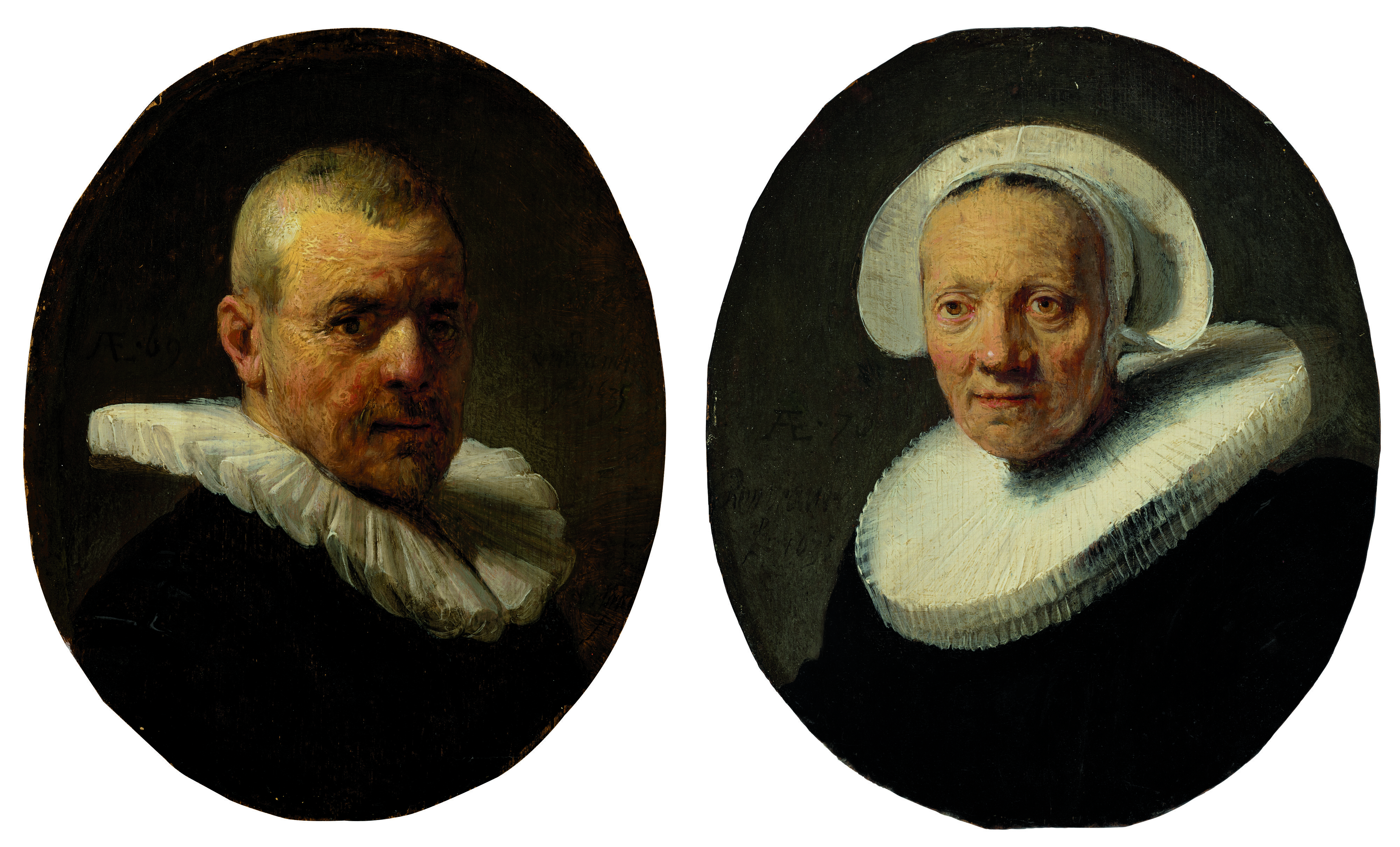
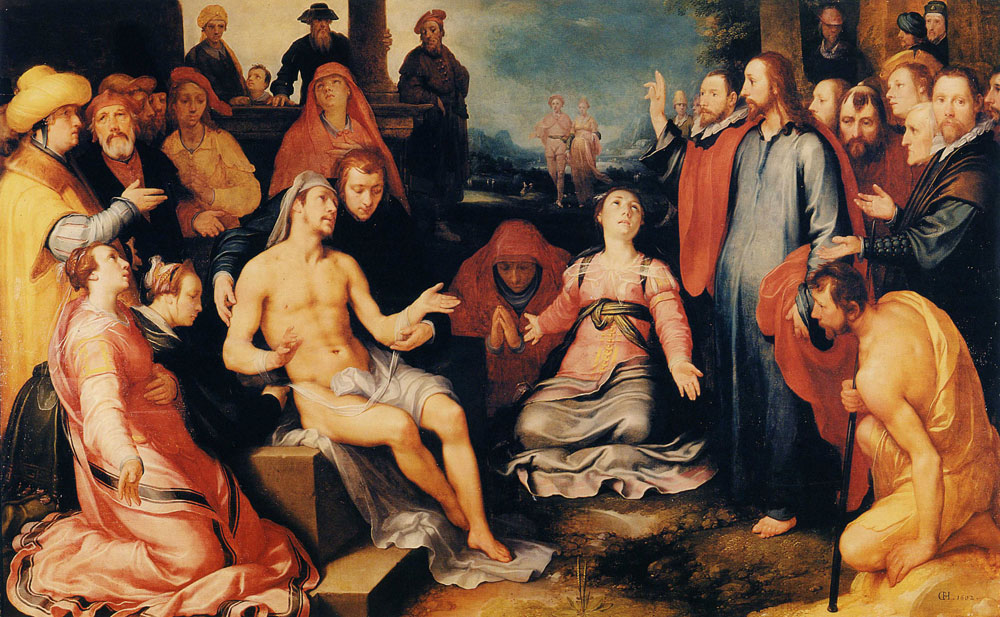
Highlights include the landmark rediscovery of Rembrandt’s Portrait of Jan Willemsz. van der Pluym and Jaapgen Carels, both rare and intimate portrayals of relatives of the artist and the last known pair of portraits by Rembrandt to remain in private hands. It also includes a masterpiece of Northern Mannerism in


Cornelis van Haarlem’s The Raising of Lazarus; 

a phantasmagorical vision of Hell in one of Jan Breughel the Elder’s finest examples of his famous Hell landscapes; a beautifully elaborate market scene of bountiful produce by Joachim Beuckelaer; a completely unpublished and unknown canvas by Michael Sweerts, perhaps his greatest picture on the theme of the artist’s studio; and a remarkable panel of The Entombment of Christ by El Greco, the intimate size of a cabinet picture, expressed with the grandeur and brilliant colouring for which El Greco was renowned.

THE LAST PAIR OF PORTRAITS BY REMBRANDT TO REMAIN IN PRIVATE HANDS

Re-discovered after two centuries in a UK collection 

Christie’s Old Masters Part I Sale, London 6 July

During Classic Week

Rembrandt Harmensz. Van Rijn (Leiden 1606-1669 Amsterdam)

Portrait of Jan Willemsz. van der Pluym (circa 1565-1644) and

Portrait of Jaapgen Carels (1565-1640)

7.7/8 x 6.1/2 in. (19.9 x 16.5 cm.)

Estimate: £5,000,000-8,000,000

London – Christie’s is proud to announce a landmark re-discovery of the last known pair of portraits by Rembrandt to remain in private hands, which will be highlights in the Old Masters Part I Sale on 6 July, during Classic Week London (estimate: £5,000,000-8,000,000). Exceptionally rare, the portraits of Jan Willemsz. van der Pluym (circa 1565-1644) and Jaapgen Carels (1565-1640), signed and dated 1635,  are intimate portrayals of relatives of the artist and provide a unique insight into Rembrandt’s activity as a painter within his inner circle. With a virtually unbroken line of provenance, these pictures were acquired at Christie’s by an ancestor of the present owners almost two centuries ago and have remained completely unknown to scholars ever since. They return to Christie’s now after an extensive scholarly investigation and scientific analysis undertaken at the Rijksmuseum.  

Small in scale and painted from life with Rembrandt’s characteristic virtuosity, these pictures offer a tender portrayal of a dignified, elderly couple who were related to the artist. The pictures will tour to New York, where they will be on public view from 10 to 14 June, and Amsterdam from 21 to 24 June, ahead of returning to London for the Classic Week pre-sale exhibition in London, on view from 1 to 6 July.

Henry Pettifer, International Deputy Chairman, Old Master Paintings, Christie’s commented: “This is one of the most exciting discoveries we have made in the Old Masters field in recent years and we are delighted to bring this pair of portraits by Rembrandt to auction this summer, almost 200 years after they were last seen in public.  Painted with a deep sense of humanity, these are amongst the smallest and most intimate portraits that we know by Rembrandt, adding something new to our understanding of him as a portraitist of undisputed genius.” 

THE SITTERS

The sitters, wealthy Leiden plumber Jan Willemsz. van der Pluym (circa 1565-1644) and his wife Jaapgen Carels (1565-1640), were intimately connected with Rembrandt. The Van der Pluyms were a prominent family in Leiden, with their son Dominicus van der Pluym marrying Cornelia van Suytbroeck, the daughter of Rembrandt’s uncle on his mother’s side, Willem van Suytbroeck. Dominicus and Cornelia had one child, the artist Karel van der Pluym, who is thought to have trained with Rembrandt and included the artist’s only surviving heir, Titus, in his will. Karel’s uncle Willem Jansz van der Pluym also sat for Rembrandt's most finished portrait drawing. In 1635, the year these portraits were painted, Jan Willemsz. van der Pluym and Jaapgen Carels acquired a garden next to that of Rembrandt’s mother in Leiden.

PROVENANCE

The portraits have a remarkable, virtually unbroken line of provenance.  They remained in the family of the sitters until 1760, when they were sold at auction in Amsterdam after the death of their great-great grandson Marten ten Hove (1683-1759). From there they passed to  the collection of Count Vincent Potocki (circa 1740-1825) in Warsaw, before briefly entering the collection of Baron d’Ivry in Paris in 1820 and then James Murray, 1st Baron Glenlyon (1782-1837), who put them up for sale at Christie’s on 18 June in 1824, lot 76, listed as: ‘Rembrandt – very spirited and finely coloured’, where they were acquired. For the last two centuries they have remained in the same private UK collection. 

CHRISTIE’S AND REMBRANDT

Christie’s holds the world auction record for Rembrandt, which was set in 2009 when Portrait of a Man with Arms Akimbo sold for £20,201,250. In 2016, Christie’s facilitated one of the most important private sales in history with two masterpieces by Rembrandt Van Rijn secured for the Louvre & the Rijksmuseum.


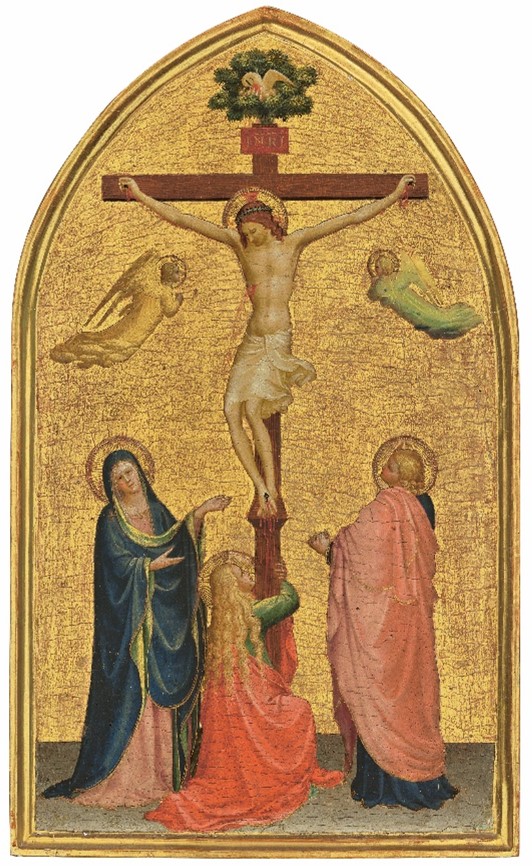
Guido di Piero, Fra Giovanni da Fiesole, posthumously known as Fra Angelico (Near Vicchio, circa 1395/1400-1455, Rome)

The Crucifixion with the Virgin, Saint John the Baptist and the Magdalen at the Foot of the Cross

tempera on gold-ground poplar panel, arched, the original engaged frame regilded

25.1/8 x 15 in. (59.7 x 34.2 cm.)

Estimate: £4,000,000-6,000,000 


The Crucifixion with the Virgin, Saint John the Baptist and the Magdalen at the Foot of the Cross, a pioneering early work by Fra Angelico – one of the greatest and most influential masters of the early Florentine Renaissance – will be a highlight in the Old Masters Part I Sale on 6 July, during Classic Week London (estimate: £4 million - 6 million). This panel was discovered and published by Francis Russell, Christie’s UK Deputy Chairman, in the Burlington Magazine in May 1996 (issue CXXXVIII, pp. 315-7). The discovery sparked widespread interest among scholars. Fra Angelico was one of the first painters to learn the lessons of contemporary sculpture and this work presents the market with his significant evolution in painted perspective: depicting the cross straight on in correct, logical, perspective without the false addition of showing the depth of the right cross post that was standard at the time. The work conveys emotional expression and poignancy that is amplified by the exemplary original condition of the figures which, having not been cleaned in recent times, provide the 21st century viewer with a remarkable chance to experience the artist’s wonderful sense of colour. It is thought to have been acquired by the 2nd Lord Ashburton who died in 1864 and has subsequently passed by descent. Pictures of this calibre very rarely come to the market. It will be on public view in New York from 10 to 14 June, before returning to London for the Classic Week pre-sale exhibition in London, on view from 1 to 6 July.

Francis Russell, Christie’s UK Deputy Chairman, commented: “It was a thrilling moment when I realised I was in the presence of an early masterpiece by Fra Angelico. This panel exemplifies his deep religious conviction. Intensely personal, it also expresses his understanding of the revolutionary achievement of the great Florentine sculptors of his time. The tenderness with which Christ is depicted is matched by the raw emotion of the Virgin and the pathos of the kneeling Magdalen clinging to the Cross, the thickness of which is revealed by the position of her arms. Every gesture is perfectly weighed. The sensitivity of the painter’s use of colour is evident in the way the blood both of Christ and the pelican above is matched in the robe of the Magdalen. With Fra Angelico nothing was accidental.”

FRA ANGELICO

Upon taking his vows as a Dominican friar in the small town of Fiesole outside Florence, Guido di Piero adopted the name Fra Giovanni da Fiesole. As a painter, the friar was unrivalled. Giorgio Vasari described him as having ‘a rare and perfect talent’ and his impact on Renaissance Florentine painting, and indeed the History of Art, cannot be overstated. His piety and modesty earned him the posthumous name ‘Fra Angelico’ or ‘Beato Angelico’ (‘Blessed Angelic One’) and in 1982, Pope John Paul II proclaimed his beatification, formally recognising the painter’s dedication to God during his lifetime.

THE PIONEERING CHARACTER OF THE DESIGN

Originally the centre of a devotional triptych commissioned by an unknown patron, the exact date of this panel is not known, but it has been placed in the period between circa 1419 and 1424, by the six scholars who have written about it. It has a significant place in the development of Florentine quattrocento painting. It is not known whether the patron who commissioned this work was aware of its pioneering character of the design.

The perspective of the cross is straight on to the viewer minus any false perspective showing the right hand side of the post, which was a standard element in paintings at the time, evidenced by the work of innumerable masters from Cimabue, Ugolino di Nerio, Simone Martini and Pietro Lorenzetti, to Giotto, Bernardo Daddi and Lorenzo Monaco to whose ‘school’ this Crucifixion was formerly attributed. Fra Angelico’s ‘frontal’ treatment of the Cross in this panel demonstrates what has been long understood: the artist was keenly aware of the work of revolutionary Tuscan sculptors of the early Quattrocento, such as Ghiberti and Brunelleschi. This is further demonstrated in Saint John the Baptist’s cascading mantle (attire) which appears to have been ‘modelled’ in sculptural terms. Art historian Diane Cole Ahl has also noted that the Saint’s features and stance were probably inspired by Ghiberti’s bronze trial piece of 1401-3 for the Sacrifice of Isaac (Florence, Bargello).

With a single exception (the intimate double-sided roundel in the Museo do San Marco), all Fra Angelico’s many subsequent depictions of the Crucifixion, including the twenty frescoes executed by him or under his supervision in the cells at San Marco, were to show the Cross in correct perspective. Many painters, however, continued to adhere to the earlier pattern for some time, particularly in more remote regions.

Fra Angelico used colour for compositional purposes in this panel - with pink, deep blue, greens and red echoed across the attire of the figures and beyond, presenting a fascinating symmetry of colour, subtly deployed to bind the panel with the wings of the triptych. The artist’s wonderful chromatic sense can still be experienced thanks to the remarkable condition of the figures; the timbre (tones and character) illustrates the artist’s personal taste, while the colours of the Virgin’s robes and the Magdalen’s dress were determined by convention.


El Greco (1541-1614) 'The Entombment of Christ'. Estimate: £6,000,000 – £8,000,000

In a stark landscape, with the three crosses of Golgotha silhouetted against the sky, the artist gathers crowds of mourners around the body of Christ as he is lowered into the tomb, while the Magdalene and Virgin Mary, together with a group of female attendants, grieve. ⠀

Dating to relatively early in El Greco's career, it was probably painted shortly after his arrival in Rome and shows the influence of his Venetian and Roman periods, encapsulated by the inclusion of a portrait of Titian in the centre of the panel – who had a profound impact on the artist – in the guise of Joseph of Arimathea.⠀