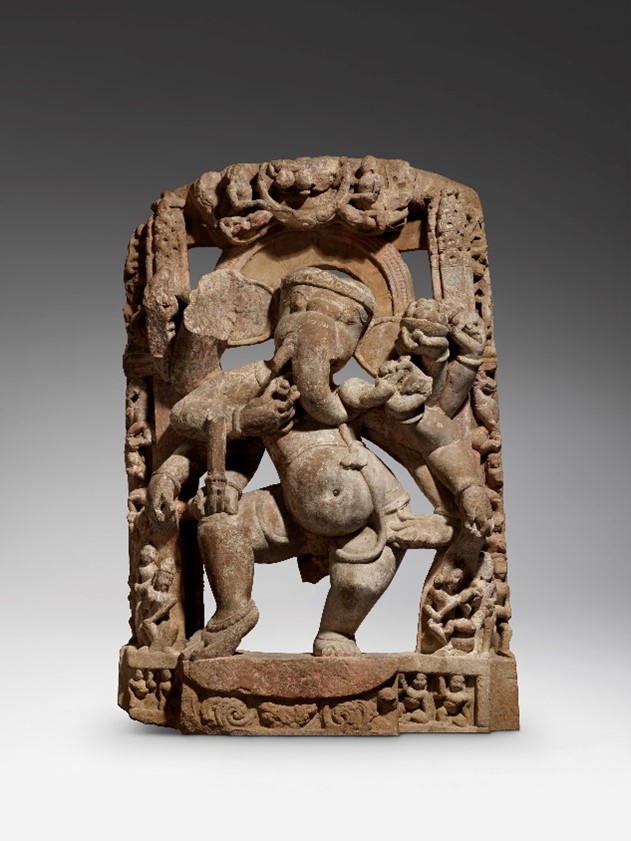
Monumental Pale Pink Sandstone Stele of Dancing Ganesha, India, Madhya Pradesh, 10th-11th Century (estimate: £600,000-900,000)
London – Presented as a series of auctions across Christie’s London and Paris salerooms, The Sam Josefowitz Collection will showcase the incredible breadth of one of the most carefully assembled and revered collections of the last half century, ranging from Antiquities to Post-Impressionism, and from Rembrandt to Les Nabis and Giacometti furniture. Masterpieces from The Collection of Sam Josefowitz: A Lifetime of Discovery and Scholarship, an Evening Sale taking place in London on 13 October, will be comprised of 38 lots that represent the unrivalled scale and breadth of Sam’s scholarship and passions. Following an international tour of highlights, the works will be on view in London from 6 to 13 October.
Félix Vallotton: A New Benchmark at Auction for the Artist
Sam Josefowitz was a renowned collector of Vallotton’s works, and four works by the artist will be offered between London and Paris. Last seen as a highlight of the Royal Academy’s Vallotton exhibition in 2019, Cinq heures depicts a couple in close embrace, entwined together on a red armchair, and is one of only two of the iconic series Intérieurs avec figures remaining in private hands. The lot is estimated at £3,000,000-5,000,000 and is poised to set a new auction record for the artist. Painted in the last year of the artist’s life, Paysage à Marcillac (1925, estimate: £600,000-900,000) is a testament to Vallotton’s singular vision that is at once a poetic elegy and a dreamlike expanse. Un soir sur la Loire (1923, estimate: £600,000-900,000) completes the group of works by the artist being offered in London.
Akseli Gallen-Kallela: Rare Oil by Finnish Modernist Poised to Set New Artist Auction Record
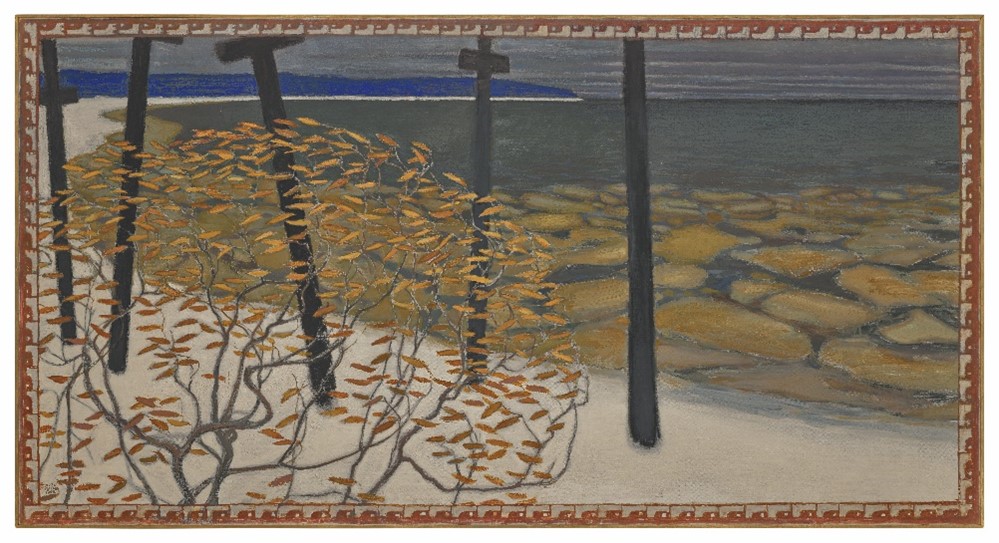
One of the most recognisable works from the National Gallery’s 1900: Art at the Crossroads exhibition in 2000, Akseli Gallen-Kallela’s Autumn - Five Crosses: A preliminary work for the fresco in the Jusélius Mausoleum (1902, estimate: £800,000-1,200,000, illustrated above) is a masterpiece that combines Art Nouveau with Symbolism, and was acquired by Sam Josefowitz from Christie’s in 1985. Previously owned by the Wittgenstein family for over 80 years, the rare landscape is expected to set a new benchmark for the artist at auction. The large-scale oil is an example of how Gallen-Kallela transferred landscape into a monumental form and was commissioned for Jusélius Mausoleum, a neo-gothic octagonal building that was built in the graveyard of Käppärä, in Pori, between 1898 and 1903.
Kees van Dongen: An Exceptional Grouping
The Josefowitz family were close friends of Kees van Dongen, and the artist was commissioned to paint several members of the family. An exceptional grouping of works by the artist is led by his monumental La Quiétude (1918, estimate: £3,000,000-5,000,000). Against a steel-grey ground, two figures lie entwined, their bright bodies painted midnight blue and siren red. Around them is an entire menagerie including twinned songbirds, a drowsy dog and a monkey. Nuages, ou Guus van Dongen et sa Fille Dolly portées aux Nues (1905, estimate: £900,000-1,400,000) is a striking and rare scene of domestic intimacy from the artist’s Fauve period, the landscape towards the lower edge clearly a homage to fellow Dutch artist Van Gogh. Composed of large daubs of vibrant pigment, here Van Dongen painted his wife with their new-born daughter at her breast. La Porte Dauphine (circa 1923, estimate: £600,000-900,000) captures the bon ton of the French capital, shown in their finest fashions strolling along the Avenue du Bois de Boulogne, today known as the Avenue Foch.
Paul Gauguin: An Intimate Portrait
Painted in 1884, Clovis endormi (estimate: £3,000,00-5,000,000) is a transformative portrait of the artist’s son. Foreshadowing the radical course Paul Gauguin had started to chart, moving away from the en plein air landscapes that had thus far dominated his œuvre, Gauguin began to explore the nascent threads of what would later be termed Symbolism. This work has been widely exhibited since the late 1880s due to its pioneering nature and personal subject matter, and was most recently seen in London in the Gauguin: Portraits exhibition at the National Gallery in 2019.
Aristide Maillol: A Museum Quality Rarity
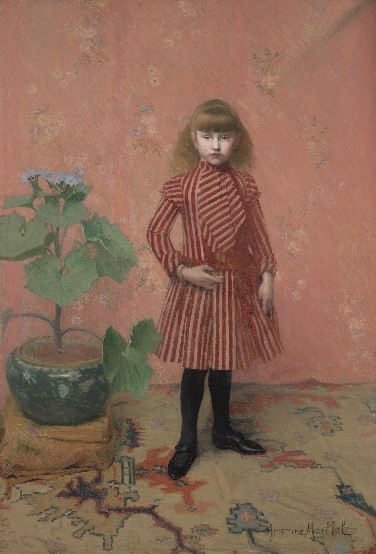
Sam Josefowitz was always drawn to the combination of incredible quality with absolute rarity. This is demonstrated by Aristide Maillol’s life-size Portrait de Mademoiselle Jeanne Faraill (1888-89, estimate: £800,000-1,200,000, illustrated far below, right). Very few oils were painted by the artist before he chose to focus on his sculptural practice. Acquired by Sam in 1962, and most recently exhibited in the Musée D’Orsay’s retrospective of the artist in 2022, the work is deservedly positioned to set a new auction record for a painting by the artist.
Diego Giacometti: Personal Commissions and Rare Models in an Outstanding Presentation
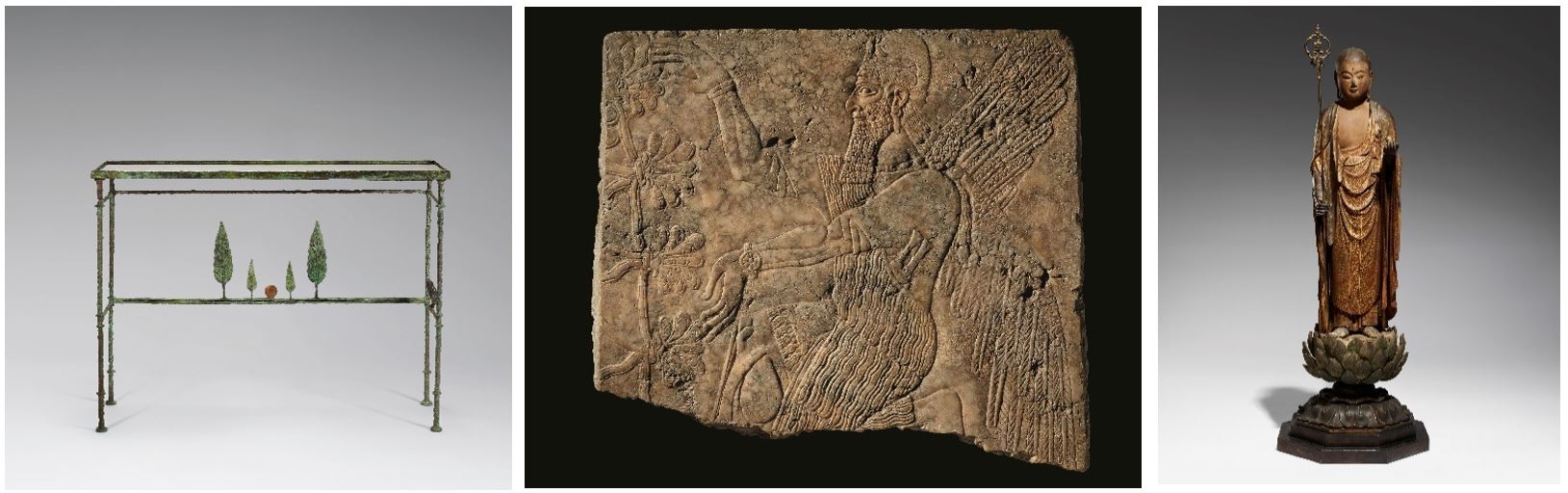
Several members of the Josefowitz family knew Diego Giacometti personally and visited his studio, spending hours chatting and looking at various pieces, often accompanied by a glass of wine. The auctions include several rare models, including Grande table basse à deux plateaux aux grenouilles (conceived circa 1978; this example cast circa 1983, estimate: £900,000-1,400,000), a low table commissioned for the family home in Lausanne. La console ‘Hommage à Böcklin’ (conceived circa 1978; this example cast in 1980, estimate: £2,000,000-3,000,000, illustrated below, left) showcases Diego’s mastery of composition and narrative, conjuring a poetic scene within the elegant lines of a console table through a select grouping of simple, refined elements. These exquisite examples are presented alongside La paire de fauteuils pommeaux de canne (conceived circa 1969, estimate: £300,000-500,000), La table carcasse (conceived circa 1978; this example cast the same year, estimate: £250,000-400,000), Table aux caryatides (conceived circa 1976; this example cast circa 1980, estimate £300,000-500,000) and La table berceau aux renards (conceived circa 1975; this example cast in the early 1980s, estimate: £400,000-600,000). A group of works by the artist of this quality and rarity has not been seen at auction since the sale of the collection of Hubert de Givenchy at Christie’s Paris in 2017.
Gustave Caillebotte: Five Magnificent Paintings
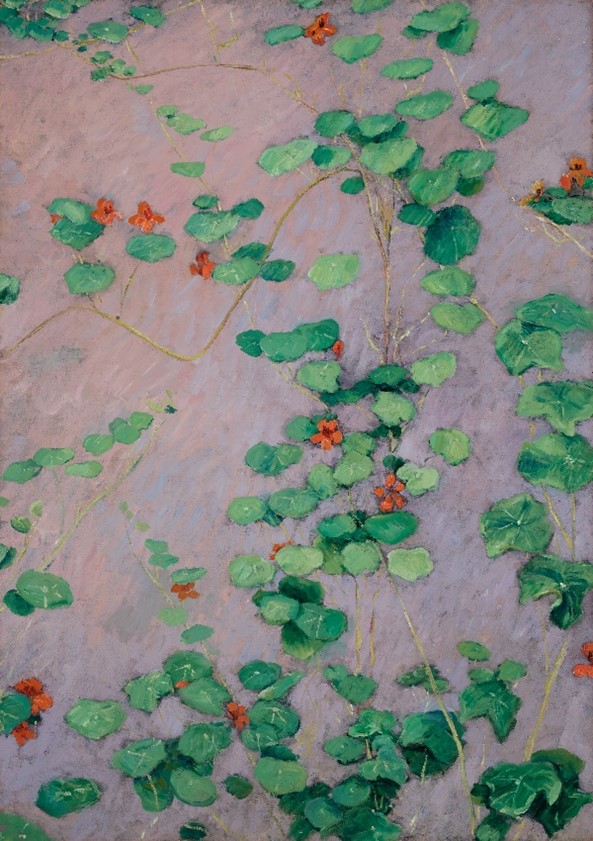
Sam Josefowitz was one of the first collectors to appreciate the unique genius of Caillebotte, and at one point owned 20 works by the artist. The breadth of the artist’s oeuvre is represented by five paintings. Gustave Caillebotte’s Portrait d’Eugène Daufresne lisant (1878, estimate: £1,000,000-1,500,000), included in the Fourth Impressionist Exhibition, captures the artist’s evolving politics of social representation. Capucines (1892, estimate: £900,000-1,400,000, illustrated top left) reimagines the landscape genre, here, there is no earth or sky, but rather simply a lattice of greenery. The composition recalls his close friend Claude Monet’s depictions of his garden at Giverny and was included in the Royal Academy’s 2016 exhibition Painting the Modern Garden: Monet to Matisse. Three further paintings are presented: Trouville, la plage et les villas (1882, estimate: £700,000-900,000), Verger aux pommiers en fleurs, Colombes (1883, estimate: £550,000-800,00) and a charming portrait of his brother’s pet greyhound Le chien ‘Paul’ (circa 1886, estimate: £400,000-600,000).
Asian Artworks: The Eye of an Inveterate Traveller
Sam Josefowitz was an inveterate traveller, and those travels would often lead to prestigious local galleries, or museums, that then cultivated an interest in the rarest works of art from the cultures of those regions. The Assyrian sculptures are among the most remarkable antiquities surviving from ancient Western Asia. Acquired at auction by Sam in London in 1968, An Assyrian Gypsum Relief of a Winged Genius Reign of Ashurnasirpal II, Circa 883-859 B.C. (estimate: £2,500,000-4,000,000, illustrated above, centre) depicts a winged Apkallu before the Sacred Tree, and was originally positioned in the Eastern suite of The Northwest Palace of King Ashurnasirpal in Room I. A Wood Sculpture of a Standing Jizo Bosatsu (Bodhisattva Kshitigarbha) Japan, Kamakura Period (13th Century), Dated 24th Day of the Ninth Month of the Fourth Year of the Shoo Era (1291), signed Hogen Intan (estimate: £2,000,000-4,000,000, illustrated above right) was acquired by Sam on a business trip to Japan in 1962, and was most recently on long term loan at The Metropolitan Museum of Art. That the name of its sculptor, Intan, is identified underscores its clear art historical significance, marking it as one of the most noteworthy early Japanese sculptures to come to auction in a generation. Once owned by the important Japanese artist Umehara Ryuzaburo and also recently on long-term loan at The Metropolitan Museum of Art, A Wood Sculpture of a Standing Female Shinto Deity, Japan, Late Heian Period (11th-12th Century) (estimate: £400,000-600,000) is one of the most compelling Shinto sculptures to come to auction. Formerly owned by the New York-based Abstract Expressionist collector Sam Heller, a Monumental Pale Pink Sandstone Stele of Dancing Ganesha, India, Madhya Pradesh, 10th-11th Century (estimate: £600,000-900,000, illustrated page one, right) is impressively carved with large areas in openwork, and portrays the Hindu god, Ganesha, the Remover of Obstacles and India’s most beloved deity. A Monumental Gilt-Bronze Figure of Buddha, Thailand, u-thong style, 14th-15th century (estimate: £150,000-250,000) is a monumental image of Buddha. Larger than life-sized, it is a paragon of Southeast Asian metal-casting and an exemplary example of the rare and elegant U-Thong corpus of Thai Buddhist images.
Rembrandt: A Remarkable Private Collection
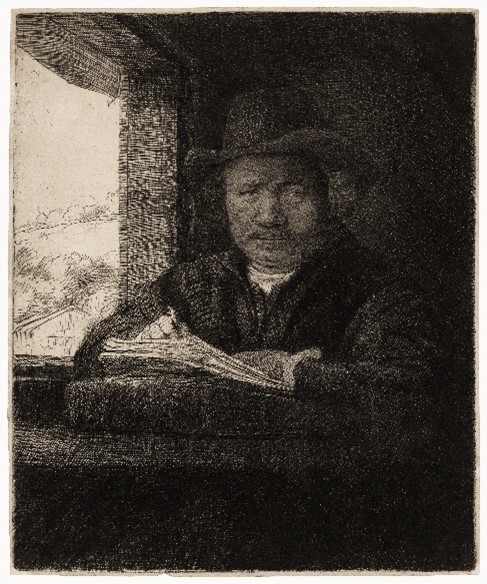
The name Sam Josefowitz is synonymous with collecting the very rarest and finest prints by Rembrandt, and he would obsessively assemble one of the most comprehensive collections of the 20th century. The sale of the collection will deservedly start with the iconic Self-Portrait etching at a Window (1648, estimate: £80,000-120,000, illustrated above, left) described by the Rembrandt scholar Christopher White as ‘undoubtedly the greatest and most searching’ of Rembrandt’s self-portraits. Further Rembrandt prints will be offered in London in December 2023.
The Sam Josefowitz Collection: Schedule of Key Sales in 2023
- Masterpieces from the Collection of Sam Josefowitz: A Lifetime of Discovery and Scholarship, London, 13 October 2023
- La Collection Sam Josefowitz: Vente du Soir, Paris, 20 October 2023
- La Collection Sam Josefowitz: de l’Ecole de Pont-Aven jusqu’à l’Art Moderne, Paris, 21 October 2023
- La Collection Sam Josefowitz: Dessins et Gravures de l’Ecole de Pont-Aven Online, Paris, 12 to 25 October 2023
- Old Masters Evening Sale, London, 7 December 2023 - The Sam Josefowitz Collection: Graphic Masterpieces by Rembrandt van Rijn, London, 7 December 2023
For further information about The Sam Josefowitz Collection, please read Christie’s online features
Jackson Pollock’s Composition with Red Strokes was executed in 1950 during the peak of his extraordinary creative output and is a central work to the artist’s oeuvre, demonstrating his new technique (estimate in the region of $50 million). It was these startling, original and accomplished paintings that, in Willem de Kooning's phrase, finally 'broke the ice' for American painting, completely revolutionizing it and in the process reshaping the entire history of 20th century art. The diverse, virtuosic and carefully controlled markmaking in Composition with Red Strokes represents the variety, subtlety and mystery that Pollock had achieved in his new language of paint. Displaying a fascinatingly dense, intricate and animated abstract surface, Composition with Red Strokes is one of the richest, most engaging and successfully resolved of all these famous works. Other works made by Pollock in this key period are held at the Museum of Modern Art, the Metropolitan Museum of Art, and the National Gallery of Art.
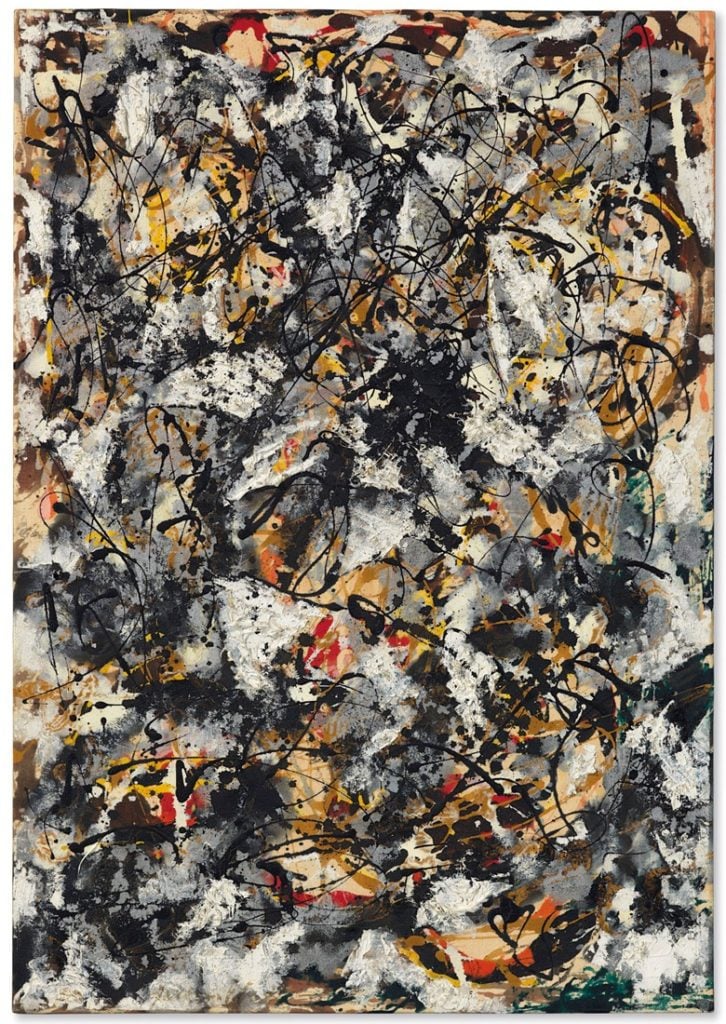
JACKSON POLLOCK (1912-1956) Number 31 signed and dated ‘Jackson Pollock 49’ (upper left) oil, enamel, aluminum paint and gesso on paper mounted on Masonite 31 x 22 ½ in. (78.7 x 57.2 cm.) Executed in 1949. Estimate on request; in excess of $45 million
Christie’s has announcethat Jackson Pollock’sNumber 31, 1949 will lead the 20thCentury Evening Sale taking place 12 May 2022 at Rockefeller Plaza (Estimate on request; in excess of $45 million). Painted in 1949, the work is among the richest and most powerful examples of Pollock’s celebrated drip paintings, standing as an icon from a seminal moment in the development of twentieth-century art. It has been featured in a number of important exhibitions, including the 1967 Jackson Pollock MoMA retrospective in addition to the 1998 retrospective mounted at MoMA and The Tate. Held in the same private collection for over two decades, the work is incredibly fresh to market.
Pollock executedNumber 31during a flurry of brilliant artistic activity during the end of 1949. The work was subsequently exhibited with Pollock’s new dealer Betty Parsons later that year where critics described the exhibition as “the best painting he has yet done.”Number 31will tour to Christie’s Los Angeles where it will be on view from 19 – 22 April before returning to New York ahead of the sale.
Alex Rotter, Christie’s Chairman of 20thand 21stCentury Art,remarks,“In the late 1940s, Pollock’s drip paintings categorically redefined how we understand art. This moment saw the art world’s center of gravity shift for the first time away from the museums and galleries of Paris and into the streets of New York. With his revolutionary new technique, Pollock effectively upended the existing framework of traditional painting practices. True drip paintings were—and still are—the ultimate in mid-century Americanavant-garde,and are rare to come across in the secondary market.Number 31is a superb example. It is a fantastic, frenetic combination of rich hues—straight from the paint can. It stands as a brilliant demonstration of Pollock’s rigor and effusiveness and we are thrilled to feature it as the top lot in Christie’s 20thCentury Evening Sale this Spring Marquee Week.”
Essentially an unknown artist in the early 1940s, Pollock first began exploring his now infamous drip painting technique in 1948. By the latter half of 1949, Pollock had found himself catapulted to success as a result of the popularity of this body of work, with paintings acquired by five major museums and 40 prominent private collections. By the time he createdNumber 31, Pollock had truly mastered the process. Pollock created only thirteen of these drip paintings on paper in 1949—each then mounted onto Masonite, composition board or canvas. Only eight of these display the gleaming, metallic paint employed inNumber 31, one of the fullest and most opulent compositions of the group.
Property from a Renowned Private New York Collection
WILLEM DE KOONING (1904-1997)
Untitled XXI
signed ‘de Kooning’ (on the reverse)
oil on canvas
Painted in 1977.
70 x 80 in. (177.8 x 203.2 cm.)
Estimate on Request
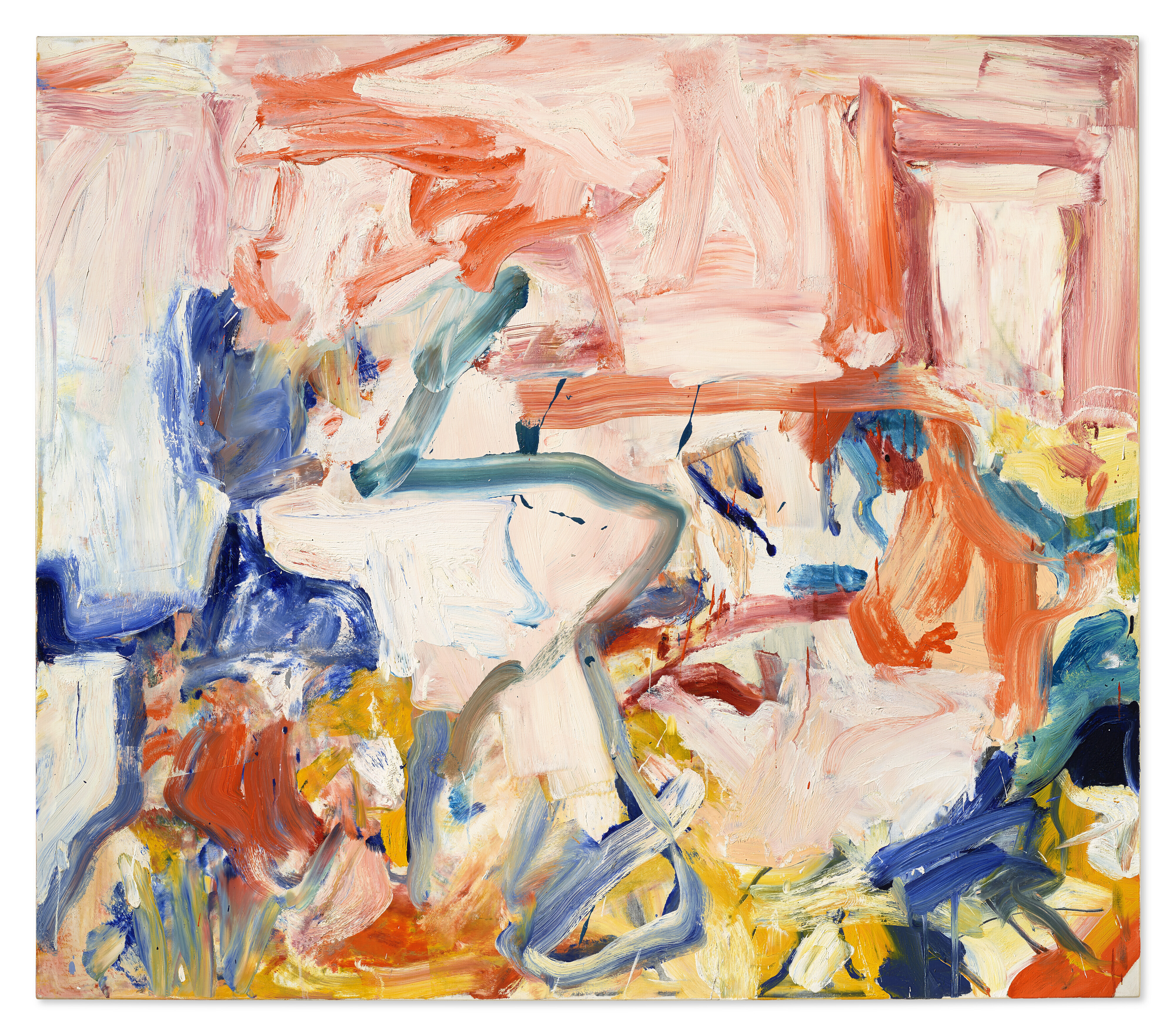
Christie's will offer Willem de Kooning's Untitled XXI as a leading highlight in the 20th Century Evening Sale taking place during Spring Marquee Week at Rockefeller Plaza (Estimate on Request; in excess of $20 million). Untitled XXI is fresh to the market, having been in the same important private collection for more than 30 years. This spring presents buyers with a rare opportunity to acquire a de Kooning of exceptional quality and significance.
Untitled XXI was painted in de Kooning’s studio in East Hampton in 1977, a historic year when he turned out a group of radiant, large-scale abstractions that had a new level of mastery about them. Art historians regard 1977 as a highpoint of his career, his annus mirabilis, or “miraculous year,” as the British critic David Sylvester wrote. The art market has confirmed that view: three of de Kooning’s top four highest prices achieved at auction were for paintings from 1977.
Untitled XXI is a singularly compelling work. At first it looks like a glowing abstraction, with ribbons of color twisting against a pearly white ground. But if one looks closely, intimations of landscape and the female figure become apparent. Untitled XXI might be called a retrospective of sorts, encapsulating in a single painting everything that de Kooning had achieved in the decades before. Here we find an ecstatic combination of gestural abstraction and the light of East Hampton, much of it rendered in the sumptuous pink-and-white palette for which he is famous.
Barrett White, Christie’s Executive Deputy Chairman, Post-War & Contemporary Art, remarks, “This vibrant 1977 canvas by Willem de Kooning stands as a triumph of his career. With thick winding strokes of jewel-toned pigment, de Kooning successfully combines the passionate brushwork that characterized his New York paintings of the ‘50s with the serenity his work acquired after he moved to East Hampton. Contemplative and joyful all at once, this luminous canvas represents the very best of de Kooning.”
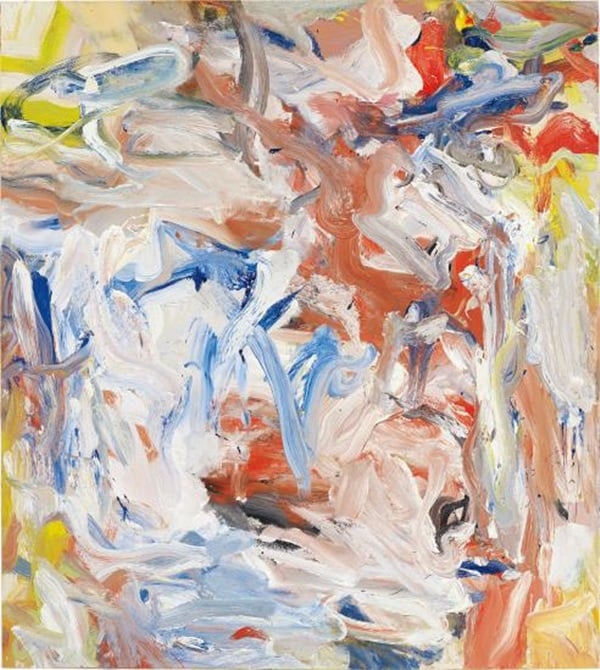
Willem de Kooning Untitled X Oil on canvas 77 by 88 in. Executed in 1975 Estimate $8/12 million.Courtesy Sotheby's.Willem de Kooning’s Untitled X, a stunning example from the group of works created in 1975 that marked the artist’s transition from a period of radical experimentation to the lush abstracts which are among his most celebrated and sought after works today;
This May, Sotheby’s will present bold masterworks from the 1980s by David Hockney and Willem de Kooning from the collection of prominent Los Angeles collectors and philanthropists Morris and Rita Pynoos as highlights of the Contemporary Evening Sale in New York. Leading the selection is David Hockney’s monumentalSelf-Portrait on the Terrace(estimate $8/12 million) from 1984, a deeply personal painting that expands on the artist’s best-known and definitive works and captures the spirit of Los Angeles.
Willem de Kooning’s Woman as Landscape is a tour-de-force of 20th century painting (estimate in the region of $60 million). Executed at the height of the artist’s career in 1955, this large-scale canvas belongs to a small group of works that are well positioned among the most powerful paintings in American art. Measuring over five and a half feet tall, Woman as Landscape is a heroic painting that encompasses the painterly bravado and radical use of color that singled out de Kooning as a leader of the Abstract Expressionist movement, and one of the pre-eminent painters of his generation. The shocking female forms sensationalized the art world, energizing and scandalizing in equal measure, but his vivid brushwork came to represent the dramatic shift in art that occurred in the postwar years, a change that would alter the course of art history. Now firmly established as part of the 20th century art historical canon, many of de Kooning’s Woman paintings form the cornerstones of major international museum collections and as such, Woman as Landscape is one of the only paintings from this important period of the artist’s career to remain in private hands.
Among the Post-War Highlights is Willem de Kooning’s Untitled XVIII, 1976. Distinguished by its lavishly painted surface and riotous palette, Untitled XVIII epitomizes de Kooning’s last great cycle of “pastoral” paintings that ushered forth from the artist in a final flourish between the years 1976 and 1977. Widely considered to be among his best work, these large-scale landscapes—with Untitled XVIII a seminal example—evoke the bucolic splendor of the artist’s East Hampton studio at Springs. In exuberant strokes of effervescent, translucent paint, de Kooning captures and distills the essence of the seaside hamlet. Penetrated by an inner glow, the painting evokes the specific character of North Atlantic light, making it a harmonious ballet of color, form and gesture. Having featured in the seminal debut of de Kooning’s “pastoral” paintings at the Solomon R. Guggenheim in 1978, Untitled XVIII belongs to a select group of only about twenty paintings that the artist deemed worthy of exhibition, in what would be his first solo museum show in New York in nine years. Estimate: $8-12 million.
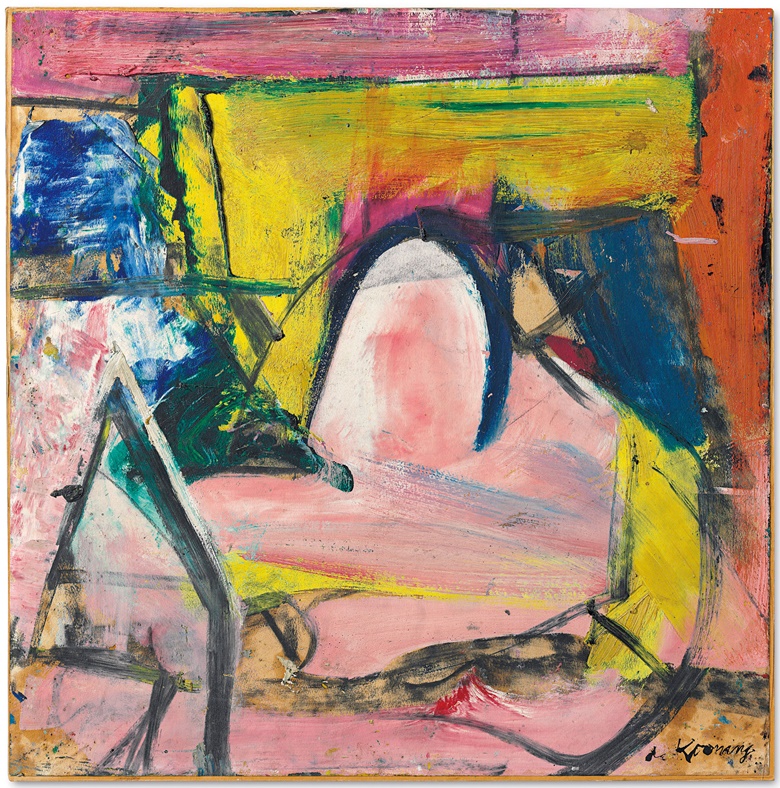
Willem de Kooning, Composition I, 1955. Oil on paper laid down on board. 23 x 22¾ in (58.4 x 57.7 cm). Estimate: $4,000,000-6,000,000. This work is offered in the Post-War and Contemporary Art Evening Sale on 15 November at Christie’s in New York
William de Kooning’s Composition I, 1955 – is an incredibly important transitional work for the artist. Already heralded, along with Jackson Pollock, as one of the leaders of the Abstract Expressionist movement, de Kooning did not merely re-create his successes, but continued to push himself to innovate, transform, and adapt his artistic practice throughout his lifetime. Composition I serves as a snapshot into the artist’s constant striving for a new vision - in it de Kooning is mid-process in navigating from his bold, frenetic Woman paintings to a style that more closely resembles the genre of landscape. The fleshy pinks interplay with sinewy, supple blues and delicate yellows, create a dynamic painting that is at once wholly abstract and yet curiously representational. Its sublimity is echoed in the masterwork from this period, Easter Monday, which de Kooning began in 1955 and completed in 1956. Easter Monday now hangs in permanent place at the Metropolitan Museum of Art, steps away from Jackson Pollock’s masterpiece Autumn Rhythm (Number 30), 1950.
Christie’s will present Willem de Kooning’s 1977 masterpiece, Untitled XXV, in its November 15 Evening sale of Post-War and Contemporary Art in New York. Estimated in the region of $40 million, Untitled XXV comes to the auction market for the first time since setting the world auction record for any example of Post-War Art in the very same saleroom exactly ten-years ago to the date.
Brett Gorvy, Chairman and International Head of Post-War and Contemporary Art, remarked: “Untitled XXV is an unequivocal Abstract Expressionist tour de force. We are very proud to be unveiling this work in London, where the extraordinary international presence of the Royal Academy’s Abstract Expressionist show has been so well received. Untitled XXV is a pinnacle picture from one of the most remarkable years in de Kooning’s career. Its vivid colors and painterly dynamism come together to form a totality of expression, resulting in a consummate example of the artist’s approach to abstraction.”
Untitled XXV comes from a remarkable series of large canvases that de Kooning made in a sudden burst of activity in the mid-1970s. In the spring of 1975, a comparatively long stretch of painterly inactivity for the artist suddenly came to an end. In a flood of creativity that lasted until 1978, de Kooning found himself once again reveling in the act of painting. Fresh and re-vitalized by his recent exploration into sculpture and rejuvenated by an ever-deepening love affair with a young woman, Emilie Kilgore, de Kooning was able to sustain this output for a period of nearly four years. "I made those paintings one after the other, no trouble at all," he said. "I couldn't miss. It's a nice feeling. It's strange. It's a man at a gambling table (who) feels that he can't lose. But when he walks away with the dough, he knows that he can't do that again.”
These years are now viewed by critics as the apex of de Kooning’s painterly oeuvre, and 1977 a particular highpoint amongst them. The celebrated critic, David Sylvester called this year de Kooning’s annus mirabilis, writing that the works from 1977 “belong with the paintings made at the same age by artists such as Monet and Renoir and Bonnard and, of course, Titian.”
The artist’s surroundings are often attributed in part to the fruitfulness of this period. When he had first moved to the Springs on Long Island, de Kooning had enjoyed the unique landscape of the area and this in many ways had entered and informed his work. However, in the mid-'70s he became increasingly preoccupied with his immediate environment, its light and topography as well as, in particular, the wateriness of the landscape around a spot called Louse Point.
At Louse Point, de Kooning spent hours observing the water and its effects. He became captivated by the shimmering surface of water and its ability to reflect and merge the imagery of the land, sky, figures and itself in a constantly shifting abstract surface of color and form. It was this mercurial effect that he began again to try to emulate in his paintings, attempting to translate these relationships into the equally fluid but more materially substantial and plastic medium of paint.
Untitled XXV is a joyous and heavily material painterly expression. Layer after layer of painted form and color is built up and overlaid within the square canvas to maintain a dynamic and tenuous balance. Somehow rooted in nature yet seemingly absent of any figurative appearance, the painting articulates a landscape of painterly form brought alive with a sense of the human through the length and scale, as well as the emotive power of the artist's vigorous brushwork and twisted painterly gesture.
Untitled XXV sold for the first time at Christie’s New York on November 15, 2006. At the time, it realized $27,120,000, setting a world auction record for both the artist and for any post-war work of art sold at auction.
The current auction record for Willem de Kooning is now held by Untitled VIII, 1977, which was sold for$32,085,000 Phillips sales of 20th Century & Contemporary Art in New York will be led by
Willem de Kooning’s Untitled XXVIII, 1977.
Rendered in creamy yellows, crisp whites and sky blues, the work perfectly captures the artist’s absorption in the natural world of Springs, East Hampton, New York. The painting is estimated to sell for $10 million to $15 million.
Willem de Kooning spent his entire artistic career exploring the lustrous tactility of oil paint—pushing, pulling and scraping paint in search of the perfect moment, one of balanced tension and retention. The mid-1970s saw de Kooning produce a body of work that captured his absorption in the natural world of Springs, East Hampton, New York. Untitled XXVIII, 1977 seizes a glimpse of the landscape in an inspired attempt to hold onto the temporal chaos of the sand, wind, and sky. It fuses the anthropomorphic and the natural, the abstracted landscape containing incipient human shapes. The underpinning of every canvas, every visceral brush stroke, whether figural or natural, reveals de Kooning’s impulsive painterly actions. De Kooning’s life-long affair with his landscape is undeniable throughout the 1950’s and 60’s, culminating with this miraculous series of landscapes of 1977 in which the present lot is included.
DAVID HOCKNEY, SELF-PORTRAIT ON THE TERRACE
The Hockney paintings in the Pynoos Collection mark some of the most important moments, people and projects in Hockney’s life. The group is led by his monumental oil on canvas Self-Portrait on the Terrace from 1984 (estimate $8/12 million). Acquired from André Emmerich Gallery that same year, Self-Portrait on the Terrace has remained in the esteemed collection of Morris and Rita Pynoos for over 35 years. Self-Portrait was included in Hockney’s critical 1988-89 retrospective, which travelled from the Los Angeles County Museum of Art to the Metropolitan Museum in New York and to the Tate in London.
The present work features Hockney’s signature vibrant blue terrace most celebrated subject: the swimming pool. The inclusion of Hockney’s iconic swimming pool lends greater poignancy to Self-Portrait on the Terrace – for Hockney, swimming pools represented the fantasy of California he had dreamed of before he left the United Kingdom for the first time in the early 1960s. A pivotal work by an artist at the height of his powers, the present painting shows Hockney at his most compositionally and technically fearless yet showcases a vulnerable moment in Hockney’s oeuvreand personal life. Returning to the breakthrough double portrait format that the artist pioneered in the late 1960s and early 1970s, self-portraits on canvas by Hockney from this period are rare. The present work is one of just two major works of himself with Gregory Evans, Hockney’s close friend and frequent model during the time the painting was created.
After working with Hockney as a studio assistant and model, and after almost a decade as his partner, there was a marked shift in their relationship as Evans sought his independence and focused on his own career. Simultaneously, Hockney felt the need to prioritize his work over his personal life. The present work represents this turning point – a portrait reflecting the exceptionally difficult challenge of this separation. Hockney’s face is depicted twice: once downcast, turned away from Evans, and second, silhouetted in a wistful glance back towards his recumbent lover. This painting is rare among Hockney’s oeuvre, depicting such an intense moment of personal conflict while representing the ever-present dichotomy between his personal and studio life.
The Self-Portrait also incorporates the expansive ‘theatre set’ of his canyon home – particularly relevant given Hockney’s extensive work with opera productions over the preceding decade. Hockney’s 1981 design for Metropolitan Opera’s French “Triple Bill” Parade featured his vivid evocation of Maurice Ravel’s L’Enfant et les Sortileges. The vibrating blue and red garden scene at the end of the piece inspired Hockney to later paint his terrace surrounding his Hollywood Hills garden in similar fashion, using colored lighting to enhance the visual impact. The first Hockney painting purchased by the couple was his 1981 Ravel’s Garden with Night Glow (estimate $800,000-$1,200,000), and was conceived to dramatically transform under theatrical lighting, inspired also by Hockney’s stage design for this memorable Metropolitan Opera production.
DAVID HOCKNEY, IAN WATCHING TELEVISION
Painted in 1987 – the year of Hockney’s 50th birthday – Ian Watching Television embodies a pivotal moment in the artist’s oeuvre, when he reached his full maturity in his Cubist exploration of portraiture (estimate $1.8/2.5 million). Marking the artist’s only portrait from the late 1980s to appear at auction in the last ten years, Hockney also included Ian Watching Television in his 1988-89 retrospective. This work also demonstrates the influence of Hockney’s great artistic hero, Pablo Picasso. The 1980s retrospective at the Museum of Modern Art reinvigorated his belief that Cubism marked the turning point in pictorial representation, and Hockney was a pioneer in advocating for Picasso’s later work as some of the most inventive and remarkable elements of his practice.
Ian Watching Television presents the opportunity to join Hockney in his joyful studies of physics and art, Cubism and modern photography. As well as reflecting Hockney’s enduring fascination with Picasso’s Cubist innovations, Ian Watching Television speaks directly to his life-long study of what the artist referred to as “methods of depiction”, and the profound influence of changing cultural visual mediums, with the television dominant at that time. Hockney evokes the light-emitting mesmerism of television, and the blankness of its mass media appeal. Through repositioning of the legs and sneakers, a body sinking into the ballooning red chair and the anchor of a hand-held burning cigarette, Hockney playfully suggests the experience of movement and time while watching television.
In the early to mid-1980’s Hockney had experimented with joining photos together to create a series of memorable composite images with multiple views. Capitalizing on this era of photographic work, including composite images of Falconer, this breakthrough painting brilliantly introduces a physically dynamic collage of poses into the art of cubist-style portraiture.
The present work depicts Ian Falconer, Hockney’s longtime collaborator and former partner who served as a frequent model and muse throughout this explorative period. Introduced by the artist’s close friend and groundbreaking curator Henry Geldzahler at a party, Hockney and Falconer immediately formed a strong bond. Drawn into Hockney’s creative orbit, Falconer moved to Los Angeles to be with him, and attended the Otis Art Institute while working in his studio. By August 1983, their romance dissipated, however the pair remained close. Hockney invested trust and confidence in this young artist, inviting Falconer to work with him on many of his stage design projects during the ‘80s and ‘90s. Falconer would go on to provide creative direction for opera and theatre productions around the world, illustrate numerous covers for The New Yorker, and become a renowned children’s author and illustrator, creating the highly successful Olivia children’s book series.
WILLEM DE KOONING, STOWAWAY
In their collection of works by Willem de Kooning, Morris and Rita selected superb examples in a diverse range of media and across three decades. Together, these works comprise a deft overview of de Kooning’s singular oeuvre. The selection is led by de Kooning’s Stowaway from 1986: a rare example from the artist’s final decade, the large-scale paintingprovides a personal look into his artistic journey while referencing his own past and identity as a stowaway voyaging to New York (estimate $6/8 million). After acquiring the work directly from the artist in 1987 and remaining in the Pynoos Collection ever since, Stowaway will appear at auction for the first time this May. Painted exactly six decades after de Kooning first set foot on American soil, Stowaway offers a rare and extraordinary glimpse into the pivotal beginning of the artist’s life in America. Born in Rotterdam in 1904, de Kooning was entranced by the prospect of America’s far-away shores. Eventually, this dream came to fruition: while studying art at the Academie van Beeldende Kunsten en Technische Wetenschappen in Rotterdam, de Kooning met Leo Cohan, a fellow artist who had already traveled to America as a waiter on merchant marine ships. In order to return to America, Cohan needed money to pay union dues, and agreed to smuggle de Kooning aboard his next departure in exchange for the required twenty-five dollars. De Kooning borrowed the money from his father, and Cohan and de Kooning set-off on the S.S. Shelley. On August 15, 1926, de Kooning disembarked in Newport News, Virginia, and subsequently traveled to New York – the city where he would, over the following decades, paint some of the most iconic masterworks of the Twentieth Century. Executed on a grand scale with the finesse of an artist at the height of his powers, Stowaway is a superb example of the unique painterly method de Kooning applied to his compositions of the 1980s. One of only a few 1980s abstract paintings which de Kooning titled, de Kooning faces his own mortality in Stowaway, reflecting on his career and painting a jubilant celebration of the early turning point in his life which brought him to New York - the epicenter of the art world and the genesis of Abstract Expressionism.
Additional works by Hockney highlight the collection, including Henry, the first Hockney drawing acquired by the Pynoos’ which depicts curator Henry Geldzahler (estimate $100/150,000). Additional works from the Pynoos Collection will be offered throughout the spring, including Hockney’s Blue Pot of Purple Flowers (estimate $1.2/1.8 million); Robert Rauschenberg’s Rush (from the Cloister Series) (estimate $250/350,000); John McCracken’s Plank (estimate $250/350,000); Louise Nevelson’s No. 5951 Moon Garden Wall I (estimate $150/200,000); John McLaughlin’s Untitled (No. 22-1960) (estimate $80/120,000), and more.
David Hockney’s double portrait of Geldzahler, a curator at The Met, and his partner, painter Christopher Scott, helped to secure his reputation. In March this masterpiece from the Barney A. Ebsworth Collection will be offered in London.
In 1968, the 30-year-old painter David Hockney began a series of seven monumental canvases, each 7 ft by 10 ft. These paintings would consume him for the next seven years and come to define his career.
Each depicting a pair of sitters (mostly absent from one another’s attention), they are set in domestic locations and painted in the bold, Pop Art palette that Hockney adopted after his arrival in California in the early Sixties.
Inspired by this newfound discourse, Hockney was already planning a third double portrait by October, depicting his friend, the influential curator Henry Geldzahler, and his partner Christopher Scott.
‘It’s a watershed painting’, said Geldzahler. ‘In this picture David finally gave up the idea of being a “modern artist” and decided, instead, to be the best artist he could be’ (H. Geldzahler, quoted in P. Richard, ‘The Painter and His Subject’, The Washington Post, 30 March 1979, p. 8).
LONDON – On 6 March 2019, Christie’s Post-War and Contemporary Art Evening Auction will be led by David Hockney’s intimate yet monumentally-scaled 1969 portrait of Henry Geldzahler and ChristopherScott, from the collection of Barney A. Ebsworth (estimate in excess of £30 million). Standing among Hockney’s most celebrated works, Henry Geldzahler and ChristopherScott will mark a fitting conclusion to the collection of Barney A. Ebsworth, which has thus far achieved a running total of $323,508,250. The painting will be unveiled and on view in New York from 8 to 12 February before going on view in London from 2 to 6 March 2019. The Post-War and Contemporary Art Evening Auction is a key part of 20th Century at Christie’s, a season of sales taking place in London from 22 February to 7 March 2019.
Marc Porter, Chairman, Christie’s Americas, remarked: “It is an honour to present Hockney’s double portrait of Henry Geldzahler and Christopher Scott, which is not only an extraordinary example from the artist’s most celebrated series, it is also a poignant representation of one of the 20th century’s greatest curators. Hockney captured Geldzahler at a particularly decisive moment when the curator was organizing his most revolutionary exhibition. Officially titled New York Painting and Sculpture: 1940-1970, the exhibition received such a high degree of fanfare that it would soon become universally known as Henry’s Show. 2019 will mark the 50th anniversary of that survey, which would ultimately alter the course of both Geldzahler’s career and art history as we now know it, making the sale of this painting extremely timely. Henry Geldzahler and Christopher Scott was among Barney Ebsworth’s most treasured works of art, and marks one of the rare exceptions to Mr. Ebsworth’s rule of only acquiring the work of American Artists. The stunning success that this collection has achieved thus far, speaks to the collector’s remarkable eye for quality, and this work absolutely epitomizes that.”
Katharine Arnold, Head of Evening Sale, Post-War and Contemporary Art, Christie’s London, continued: “David Hockney’s double portraits are undoubtedly some of the finest paintings the artist ever realised. Created on a 7 by 10 foot format, these paintings invite the viewer to enter the intimate settings of some of Hockney’s closest friends. In Henry Geldzahler and Christopher Scott, we meet the celebrated curator and his partner in their 7th avenue apartment in New York City. What strikes me as extraordinary is Hockney’s use of naturalistic technique. Here Hockney has mastered paint to conjure up glass in four different ways: the glass window looking out onto the cityscape, Geldzahler’s neat reading spectacles, the modern glass table with a beautiful glass vase of tulips. Reflection, transparency and light are Hockney’s subjects. Structured like a devotional triptych, the intimately observed composition comprises a blush pink Art Deco sofa from Geldzahler’s living room, the view from Scott’s study, the glass table from Hockney’s studio in London and the signature vase of tulips, often interpreted as symbolising the artist himself. An unspoken narrative exists between the two lovers, which adds the element of human drama so characteristic of Hockney’s greatest work. Henry Geldzahler and Christopher Scott will appear at auction for the first time since 1992 and follows the record set for Portrait of an Artist (Pool with Two Figures) in New York in November.”
Henry Geldzahler and ChristopherScott is a glowing meditation on human and visual relationships. Hockney’s closest friend Henry Geldzahler – the legendary curator, critic and king of the New York art world – dominates the centre of the composition, framed by soaring skyscrapers. Christopher Scott, his then-boyfriend, hovers to the right like a fleeting apparition. Painted in 1969, it is the third work in the career-defining series of seven double portraits that Hockney created between 1968 and 1975. With four held in museum collections, these seven-by-ten-foot canvases represent the culmination of the artist’s naturalistic style. Another example from this series, Portrait of an Artist (Pool with Two Figures), was sold at Christie’s New York in November 2018 for $90.3 million, setting a new world auction record for any work by a living artist.
Though focused on Geldzahler and Scott, the work ultimately celebrates the relationship between Geldzahler and Hockney: two artistic giants at the heights of their powers. Geldzahler stares out from the canvas like an icon at the centre of an altarpiece, observing the painter’s every move. Hockney’s return gaze is palpable in the work’s sharp, clear perspective, and seemingly affirmed by the addition of tulips – his favourite flower, and a deeply personal motif. The pair met in Andy Warhol’s studio in 1963, and quickly became friends. At the time of the painting, Geldzahler – a curator at the Metropolitan Museum of Art – was working on his landmark exhibition New York Painting and Sculpture: 1940-1970, which quickly came to be known as “Henry’s Show”. This revolutionary survey of contemporary American art would ignite his career, leading one journalist to describe him as ‘the most powerful and controversial art curator alive’. 2019 will mark the 50th anniversary of Geldzahler’s landmark exhibition. Hockney, too, was on the brink of international acclaim, buoyed by the success of the double portraits that he had already completed.
The work’s provenance, along with its extensive exhibition history, is exceptional. In 1969, it was unveiled in Hockney’s solo show at André Emmerich Gallery, where it was described as ‘truly amazing’ and ‘totally hypnotizing’ by New York Magazine (J. Gruen, ‘Open Window’, New York Magazine, 12 May 1969, p. 57). It was acquired from the gallery that year by Harry N. Abrams, the renowned art book publisher and distinguished collector, and remained in his family collection until 1992. Under this stewardship, it was featured in a number of significant exhibitions, including Pop Art Redefined – one of the earliest shows at the newly-founded Hayward Gallery in 1969.
In 1997, it became one of the final pieces to enter the prestigious Ebsworth collection, offering a rare British addition to one of the world’s greatest assemblages of 20th century American art. Long admired by the collector, it took its place alongside Edward Hopper’s 1929 masterpiece Chop Suey, as well as important works by artists such as Willem de Kooning, Jackson Pollock and Georgia O’Keefe. For twenty-two years, the painting hung in Ebsworth’s home, and starred in notable museum shows – most recently Hockney’s eightieth birthday touring retrospective originating at the Tate Britain, London (2017-18).
In its November Evening Sale of Post-War and Contemporary Art, Christie’s will offer one of the most quintessential canvases of the 20th Century, David Hockney’s Portrait of an Artist (Pool with Two Figures), 1972 (estimate in the region of $80 million). Representing a culminating apex of the artist’s two most celebrated motifs— the glistening water of a swimming pool and a double portrait – Portrait of an Artist is an immediately recognizable and iconic image in Hockney’s diverse oeuvre. Having graced the covers of numerous artist monographs, starred in various exhibitions – including his traveling retrospective organized by the Tate Britain, the Centre Pompidou, and The Metropolitan Museum of Art in 2017-2018 – as well as the 1974 cult Hockney film, A Bigger Splash, the present canvas firmly stands its ground among Hockney’s most celebrated works.
Alex Rotter, Co-Chairman Post-War and Contemporary Art, Christie’s, remarked:
“Christie’s is honored to offer Portrait of an Artist (Pool with Two Figures), which stands as one of the great masterpieces of the modern era. David Hockney’s brilliance as an artist is on full display with this monumental canvas, which encapsulates the essence of the idealized poolside landscape, and the tremendous complexity that exists within human relationships. With this painting, Hockney cemented his placement within the realm of history’s most venerated artists, and come November, it is poised to become the most valuable work of art by a living artist ever sold at auction.”
An often-told story of two compositions—the first destroyed over months of working and reworking, Hockney originally conceived the composition for Portrait of an Artist (Pool with Two Figures) from the accidental, almost surreal juxtaposition of two photographs on his studio floor—one of a swimmer underwater, taken in Hollywood in 1966, and the other of a boy staring at something on the ground. Intrigued by how together, the disparate clipped images made it appear as if the boy was staring at the swimmer, this double-portrait arranged by chance impelled for Hockney a substantial dramatic charge.
Chief among his courtier of muses is the standing figure in Portrait of an Artist, Peter Schlesinger. Hockney met the eighteen-year-old Schlesinger in 1966 while he was a student in one of Hockney’s advanced art classes at UCLA. For the next five years, Schlesinger would prove to be the great love of Hockney’s life as well as a favorite model. The two lived together in California and London, mixing with Hockney’s expansive social circle as a prominent couple in the worlds of art, film and literature. Throughout the late ‘60s as their relationship deepened, Hockney’s desire to capture the intensity of his feelings for Peter, as well as his physical beauty, contributed greatly to the artist’s sudden shift towards a more naturalistic approach to his work. However, the much younger Schlesinger was far less gregarious than Hockney, and tensions between the pair grew gradually before a heated fight in Cadaqués in 1971 led to the end of their relationship—leaving Hockney distraught.
Created during a highly productive period following the devastating end of the artist’s relationship with Schlesinger, Portrait of an Artist is a powerful testament to the therapeutic power of painting. And out of his great sadness, came a time of extraordinary creative output.
Hockney had begun the painting in October 1971—as documented by Jack Hazan, who recorded its progress in his movie titled A Bigger Splash, about the end of Hockney and Peter Schlesinger’s five-year relationship. Hockney first resolved to paint Portrait of an Artist in 1971, but after months of struggling through the composition abandoned the first incarnation of the canvas around the same time as the dissolution of his romance with Schlesinger.
In early April, Hockney began the canvas anew in preparation for his exhibition the following month with André Emmerich Gallery in New York. Hockney travelled to Le Nid du Duc—director Tony Richardon’s house in the South of France—to take further preparatory photographs for the painting, taking his studio assistant Mo McDermott as a stand-in for Schlesinger and a young photographer named John St. Clair as the swimmer. Hockney took hundreds of photos, which came to cover the wall of his studio. Using those images, Hockney worked on the painting with great passion for eighteen hours a day for two weeks, completing it the night before it was to leave for the New York exhibition.
Another chief source of inspiration for Hockney is the image of the pool. Hockney’s discovery of his most famous subject matter corresponded to his arrival in Los Angeles nearly a decade earlier. Already celebrated as an enfant terrible of Contemporary art by the time he left the Royal College of Art in London in 1962, Hockney had first traveled to California in January 1964. The place held a magnetic draw for the artist, who had immersed himself in the potent idealism of its sun-drenched landscape, and the California that he had found in magazines, movies and the gay novels of John Rechy. Here, he felt free to invent the city, giving it a promptly recognizable, iconic form. "[Los Angeles was] the first time I had ever painted a place," Hockney later explained. "In London I think I was put off by the ghost of Sickert, and I couldn’t see it properly. In Los Angeles, there were no ghosts... I remember seeing, within the first week, the ramp of a freeway going into the air and I suddenly thought: My God, this place needs its Piranesi; Los Angeles could have a Piranesi, so here I am" (D. Hockney, quoted in S. Howgate, David Hockney Portraits, exh. cat., National Portrait Gallery, London, 2006, p. 39).
Deeply attuned to the history of art, Portrait of an Artist recalls the images of the classical renditions of the bather placed in an idyllic background found in Western painting since the Renaissance. The convention is a metaphor not only for the harmonious relationship between the human figure and nature, but also represents a world that is uncorrupted and pure. Employing a combination of a graphic designer's eye for composition, an illustrator's technique, the precision of a photograph and a painter's sensitivity to color, Portrait of an Artist (Pool with Two Figures) not only conveys the essence of the Californian good-life that had inspired him a decade before, but also stands as a vivid testament to a once in a life-time love.
David Hockney, Howard Hodgkin and Peter Blake were all part of the same stellar generation of British artists as well as lifelong friends – with Blake and Hodgkin even visiting Hockney in Los Angeles in 1979.
David Hockney, Study for Portrait of an Artist (Pool with Two Figures), coloured crayon on paper, 1972 (est. £100,000-150,000)
This drawing is a study for one of David Hockney’s most iconic paintings,
The auction current record for David Hockney was set by Pacific Coast Highway and Santa Monica, 1990, which sold for $28,453,000 at Sotheby’s New York on May 16, 201
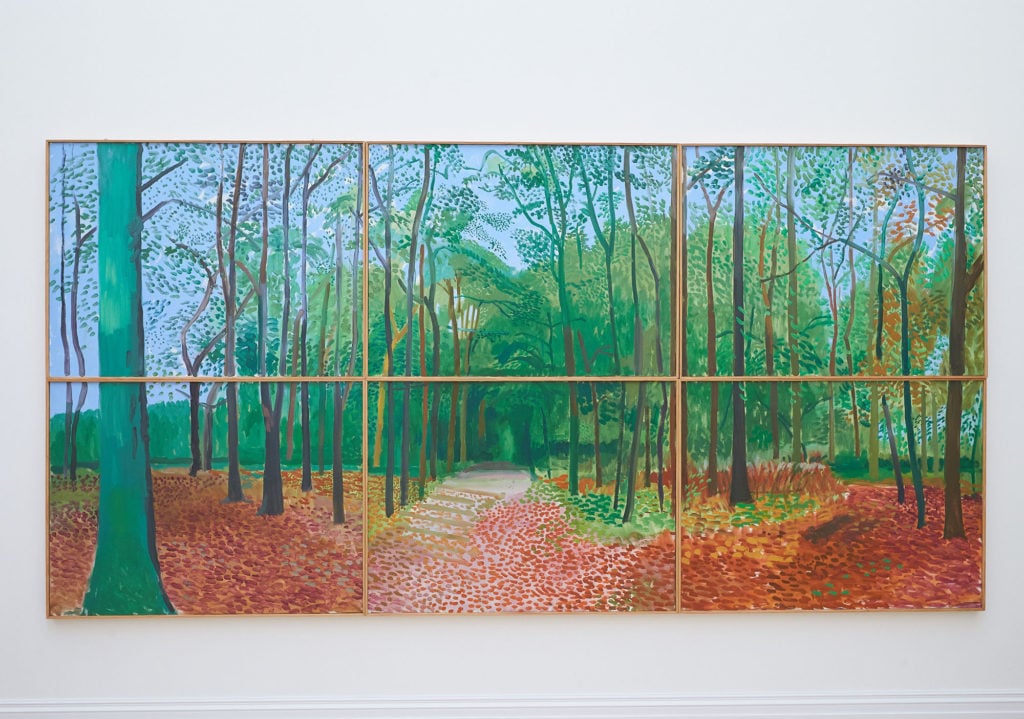
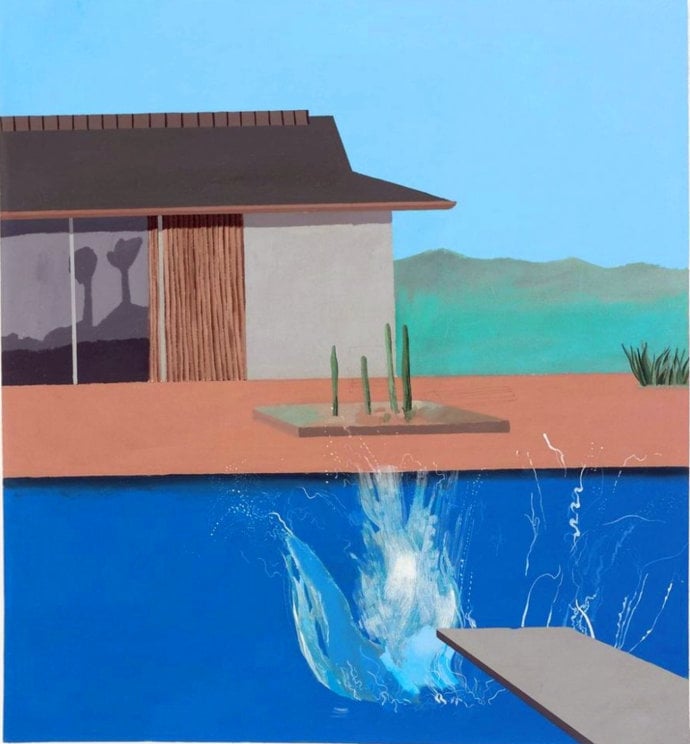
Measuring 72 by 144 inches,Woldgate Woods, 24, 25, and 26 October 2006 is a monumental work by a pillar of post-war British art, David Hockney. Making use of six canvases, Woldgate Woods beautifully captures the light and color of the Yorkshire landscape. Exhibited at the Royal Academy in the 2012 blockbuster exhibition, David Hockney: A Bigger Picture , the sale of this large-scale painting comes ten years after Sotheby’s redefined the market for the artist with
The Splash .
With an estimate of $9/12 million, Sotheby’s is once again set to establish a new record for Hockney at auction.

%20_%20Number%2031.jpg)