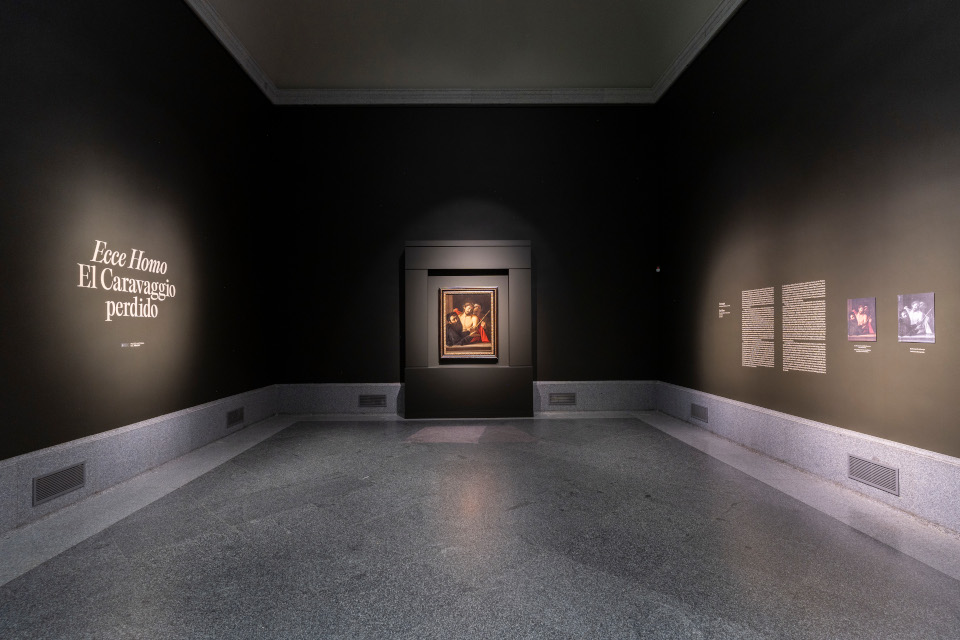
Thanks to the generosity of its new owner, Ecce Homo by Caravaggio will be on display at the Museo Nacional del Prado, in a special one-piece exhibition, in room 8 A from 28 May until 13 October 2024.
Painted by the great Italian artist around 1605-09 and believed to have once been part of the private collection of Phillip IV of Spain, the painting is one of around only 60 known works by Caravaggio in existence, and thus one of the most valuable old master artworks in the world.
This painting enriches the permanent collection of the Museo Nacional del Prado, which holds one of the few works by the master in a Spanish collection, David and Goliath, a painting that has recovered its colours and original contrasts after its restoration.
Since the Prado Museum alerted Spain’s Ministry of Culture of the relevance of the painting when it reemerged at Ansorena auction house in April 2021 attributed to a pupil of José de Ribera, the work has been under the custodianship of the art gallery Colnaghi, in collaboration with Filippo Benappi (Benappi Fine Art) and Andrea Lullo (Lullo Pampoulides). The painting was restored by specialist Andrea Cipriani and his team under the supervision of experts from the Comunidad de Madrid regional government. The results of this intricate process are featured in a comprehensive publication alongside texts by expert specialists including Keith Christiansen, Gianni Papi, Giuseppe Porzio and Maria Cristina Terzaghi, to be released to coincide with the unveiling.
Since its reappearance at auction three years ago, Ecce Homo has represented one of the greatest discoveries in the history of art, inspiring an unprecedented speed of consensus around its authentication. Following an in-depth diagnostic investigation by Claudio Falcucci – a nuclear engineer specialising in applying scientific techniques to the study and conservation of cultural heritage – restoration has been carried out in an informed and rigorous manner, allowing each decision to be based on an exhaustive assessment of the work’s constituent materials, their specific alteration processes, and the painting’s conservation history, reaffirming this initial attribution to the Italian master.
The unveiling of the Ecce Homo and the announcement of this loan – an act of generosity by its new owner – is accompanied by a collaborative publication bringing together leading experts in the field with seminal essays by Christiansen, Papi, Porzio and Terzaghi, bearing testament to the work’s monumental importance. Titled Caravaggio: The Ecce Homo Unveiled, it offers an essential starting point for the understanding of this new addition to Caravaggio’s oeuvre.
Specialist interpretation of the painting carried out by Maria Cristina Terzaghi (associate professor in History of Modern Art at University Roma Tre and member of the scientific committee of Museo di Capodimonte in Naples), Gianni Papi (art historian and author), Giuseppe Porzio (art history professor at the University of Naples L'Orientale and member of the scientific committees of Pio Monte della Misericordia and Royal Palace in Naples) and Keith Christiansen (curator at The Metropolitan Museum of Art) is included in the publication, each moving along different trajectories. Specifically: the circumstances of its discovery, the provenance, the stylistic, technical and iconographic aspects of the work, its critical fortune and the legacy left by the master in Naples. Four of the most authoritative experts on Caravaggio and Baroque painting, they all share the same passionate certainty: that Ecce Homo is a masterpiece by the Italian artist.
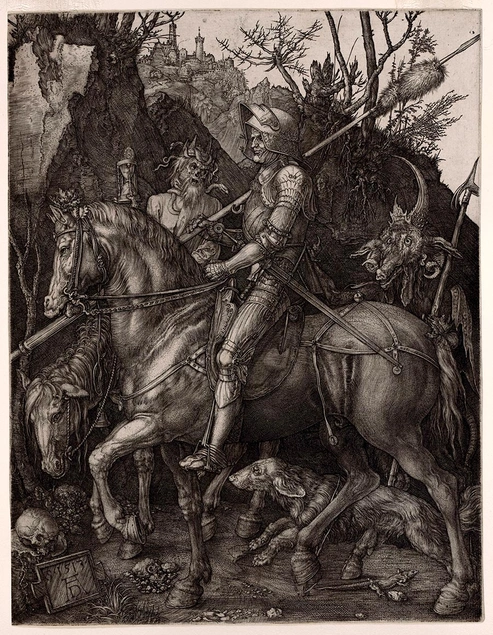
Albrecht Dürer, Knight, Death, and the Devil, 1513, engraving, 91/2x 73/4in. TheHuntington Library, Art Museum, and Botanical Gardens.
The Huntington Library, Art Museum, and Botanical GardenThe impact renowned German Renaissance artist Albrecht Dürer (1471–1528) had on European art takes center stage in a new exhibition at The Huntington Library, Art Museum, and Botanical Gardens, running from June 1 through Sept. 23, 2024. “Albrecht Dürer: Wanderlust” showcases Dürer’s art and legacy through prints, books, and paintings drawn primarily from The Huntington’s collections.
Albrecht Dürer, Virgin on a Grassy Bank, 1503, engraving, 41/2x 23/4in. The HuntingtonLibrary, Art Museum, and Botanical Gardens.
The exhibition focuses on works created during and following Dürer’s travels to Italy and beyond, illuminating the cultural network of artists and how they supported, competed with, and learned from one another—ultimately transforming European art.
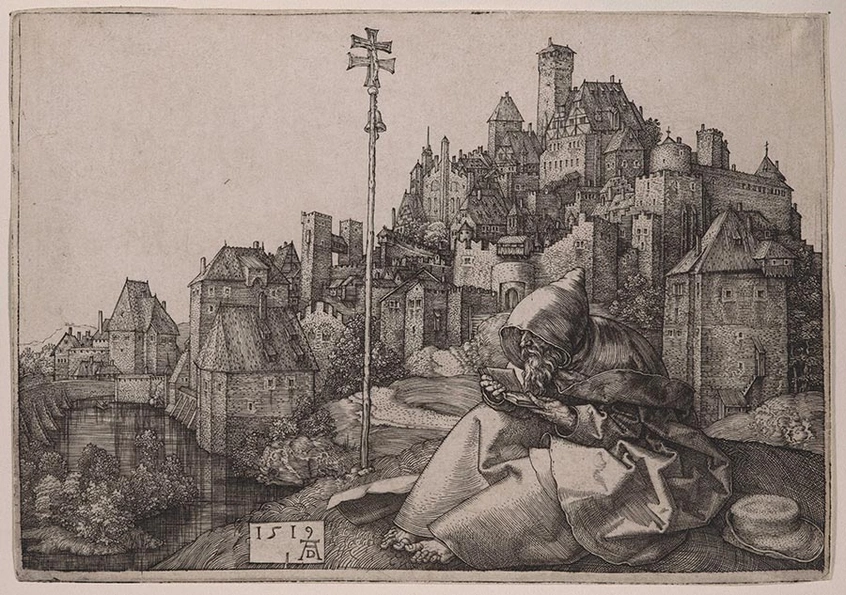
Albrecht Dürer, St. Anthony Before the Town, 1519,engraving, 4 x 5 3/4 in. The HuntingtonLibrary, Art Museum, and Botanical Gardens.
Dürer was a versatile artist who was at once a printmaker, painter, theorist, and publisher. Born in Nuremberg, Germany, in 1471, he began to travel to Italy and current-day France in his 20s, and the Low Countries of Belgium and the Netherlands years later. These experiences would significantly shape his artistic education and worldview.
Featuring 24 works, the exhibition examines Dürer’s mastery of perspective and integration of Italian artistic principles into German art, establishing him as a pioneering figure in the Northern Renaissance and earning him enduring international renown. Additionally, the exhibition presents both paintings and prints by contemporaries whom he visited during his travels, including work by Raphael (1483–1520), Giovanni Bellini (1430–1516), and Lucas van Leyden (1494–1533), among others.
Dürer’s skills as a printmaker revolutionized the art of his time. His ability to create a variety of effects using only black lines proved unmatched. His contemporaries and followers copied his woodcuts and engravings or incorporated elements from them into their work. The exhibition shows examples of the dramatic effects created with thick, dense, curvilinear lines, as demonstrated in Samson and the Lion (ca. 1497–98), and delicate, compact cross-hatching, as shown in St. Jerome in His Study (1514). Dürer studied the writings of the ancient Roman architect Vitruvius to understand the “canon of human proportions.” Vitruvius’ theories and his knowledge of classical art inform the design of Dürer’s figures of Adam and Eve (1504) in an elegant contrapposto pose. In the piece, the wooded environment, cliffs, and various animals re-imagine paradise in a northern European landscape. In the Knight, Death, and the Devil (1513) engraving, Dürer portrays a rider and his faithful dog unknowingly marching toward the figure of Death, who holds an hourglass to indicate the brevity of life on Earth. Knight, Death, and the Devil; St. Jerome in His Study; and Melencolia I (1514) form the trio of engravings known as Dürer’s Meisterstiche (master engravings).
In addition to showcasing Dürer’s technical mastery, the exhibition highlights his role as an artist-publisher. He started his publishing business in 1498, which allowed him to have greater control over the sale and distribution of his prints. The release of Apocalypse (Apocalipsis cum figuris), a series of 15 large woodcuts depicting the end of the world as described in the biblical Book of Revelation, propelled Dürer to the international stage.
His work was so highly revered that his Life of the Virgin series was copied—down to the “AD” monogram—and disseminated by the Italian printmaker Marcantonio Raimondi. The plagiarism prompted Dürer to initiate the first-known intellectual property lawsuit specific to art. While the Venetian Senate ruled that Dürer’s monogram could no longer be used in copies, the ruling allowed his prints to still be reproduced and distributed by others.
Dürer published some 700 engravings, etchings, and woodcuts. These included individual prints and illustrations designed for books authored by him or others. His final publications included treatises on geometry (1525), fortifications (1527), and human proportion (1528). In his publication Instruction on Measurement, Dürer shares the secret of linear perspective. The exhibition displays two of Dürer’s woodcut illustrations that show how to create images of three-dimensional objects (a portrait of a man and a lute) on two-dimensional surfaces using a perspectival apparatus.
“Albrecht Dürer: Wanderlust” is guest curated by Sophia Quach McCabe, adjunct professor of medieval art and architecture at California State University, Long Beach.
The Museo Nacional Thyssen-Bornemisza is jointly presenting with the Museo de Bellas Artes de Valencia an exhibition on the Spanish figurative painter Rosario de Velasco (Madrid, 1904 - Barcelona, 1991). Curated by Miguel Lusarreta and Toya Viudes de Velasco, the artist’s great-niece, the exhibition brings together around 30 paintings from the 1920s to the 1940s - the earliest and the most important from Velasco’s career - and also has a section on her work as an illustrator.
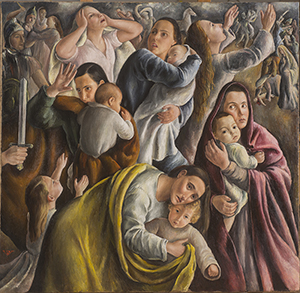
Rosario de Velasco, The Massacre of the Innocents, ca. 1936. Oil on canvas. 164 x 167,5 cm. Museo de Bellas Artes de Valencia
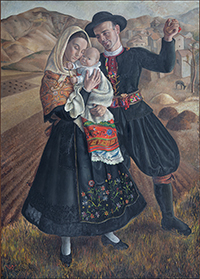
The exhibition, which is benefiting from the support of the Region of Madrid and the City Council of Madrid, aims to present and draw attention to the work of one of the great Spanish women artists of the first half of the 20th century. In addition to well-known paintings from museum collections, such as the famous oil Adam and Eve (1932) from the Museo Nacional Centro de Arte Reina Sofía, The Massacre of the Innocents (ca. 1936) from the Museo de Bellas Artes de Valencia, Maragatos(1934) from the Museo del Traje, Madrid, and Carnival (before 1936) from the Centre Pompidou, Paris, the exhibition features works still with the artist’s family and in private collections and others that have only been rediscovered and located in the past few months. Following its showing in Madrid, the exhibition will be presented at the Museo de Bellas Artes de Valencia from 7 November 2024 to 16 February 2025.
Rosario de Velasco’s work represents an outstanding example of the so-called “return to order” in Spain, a movement parallel to German New Objectivity and Italian Novecento with a style that combined tradition and modernity. Velasco admired painters such as Giotto, Masaccio, Piero della Francesca, Mantegna, Velázquez and Goya, but also avant-garde figures such as De Chirico, Braque, Picassoartistas de vanguardia, como De Chirico, Braque o Picasso and the exponents of the “return to order” in Germany and Italy, whom she encountered via magazines and exhibitions held in Madrid in the 1920s.
Rosario de Velasco. Maragatos, 1934. Oil on canvas, 210 x 150 cm. Museo del Traje, Madrid
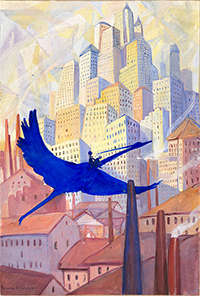
The exhibition also focuses on Velasco’s activities as an illustrator, revealing a graphic artist of great versatility. This is evident, for example, in her illustrations for the 1928 edition of Stories for dreaming by María Teresa León and Stories for my grandchildren (1932) by Carmen Karr.
Rosario de Velasco (Madrid, 1904 – Barcelona, 1991)
Born into a very traditional and religious family in Madrid, Rosario de Velasco began to study art aged fifteen at the academy of the genre painter Fernando Álvarez de Sotomayor, a member of the Royal San Fernando Academy of Fine Arts and two-time director of the Museo del Prado. Dating from that period is her Self-portrait (1924), which she signed with a monogram consisting of the initials R, D and V. Inspired by Dürer’s monogram, it has been fundamental to locating some of the artist’s paintings.
The young artist was, however, aware that she needed to go beyond tradition and assimilate the new trends and avant-gardes in her desire to compete as an equal in a largely male world. Her openness and cultural curiosity led her to associate with numerous creators of her generations, particularly women painters and writers such as Maruja Mallo, Rosa Chacel and María Teresa León. Other women friends included Mercedes Noboa, Matilde Marquina, Concha Espina and Lilí Álvarez, the tennis champion whom Velasco painted in the 1930s and with whom she enjoyed playing the sport. Velasco was also a tireless traveller and enjoyed mountaineering, skiing and rock climbing.
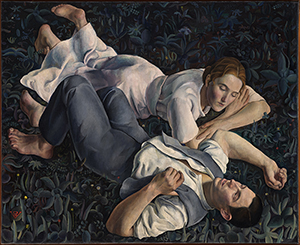
Rosario de Velasco, Adam and Eve, 1932. Oil on canvas, 109 x 134 cm. Museo Nacional Centro de Arte Reina Sofía, Madrid.
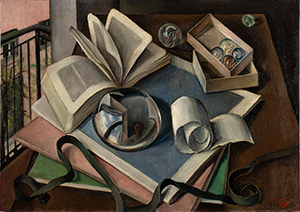
In 1924, the year she completed her studies, the artist participated in the National Fine Arts Exhibition in Madrid and also produced her first illustrations. By the 1930s Rosario de Velasco had established a considerable reputation, taking part in numerous group shows and competitions, such as the National Fine Arts Exhibition of 1932 in which she presented the canvas Adam and Eve, which earned her a second prize medal in the Painting category. The work was exhibited together with all the other entries in the Palacio de Exposiciones in the Retiro park and in various exhibitions organised by the Society of Iberian Artists held in Copenhagen and Berlin, where it was warmly praised by critics for its power and originality and Velasco was singled out as the major discovery of the season.The work is startling in its play of perspective, employing a bird’s-eye view, a device also used in various still lifes and in (Untitled) The Children’s Room (1932-33), another work in the collection of the Museo Reina Sofía, in which the artist disrupts the space through an original arrangement of objects that recalls Cubism.
Rosario de Velasco. Things, 1933. Oil on canvas, 45,5 x 65,5 cm. Private collection.
The majority of Velasco’s most important works date from that decade: Maragatos, which was awarded second prize in the National Painting competition of 1932; The Massacre of the Innocents (ca. 1936), which for many years was attributed to Ricardo Verde due to the signature “RV”, until it was correctly attributed to Velasco in 1995; and Laundresses (1934), a wedding gift to her brother, Dr Luis de Velasco, who appears in another work in the present exhibition.
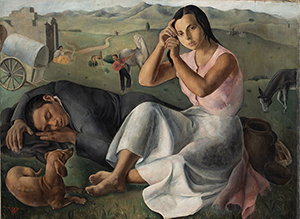
In 1935 Gypsies was selected to participate in the Carnegie International, an exhibition of artists from different countries organised by the Carnegie Museum of Art in Pittsburgh. Velasco’s work shared space with that of Carlo Carrá, Otto Dix, Edward Hopper and Georgia O’Keeffe, as well as Picasso and Dalí. Lost for years, the painting has only recently been located and is one of the major discoveries made during the preparation of this exhibition.
Rosario de Velasco. Gypsies, 1934. Oil on canvas, 95 x 132 cm. Private collection.
On the outbreak of the Spanish Civil War the artist’s membership of the Falange and her family context led her to leave Madrid. She went first to Valencia and later to Barcelona, to Sant Andreu de Llavaneres where she met a doctor, Javier Farrerons, who later became her husband and who succeeded in liberating her from the Modelo prison in Barcelona where she was being held. After the war Velasco settled in Barcelona with her husband and their daughter María del Mar.
Rosario de Velasco. The Blue Bird, 1927. Drawing for the cover of the book Cuentos para soñar by María Teresa León. Mixed media on paper. Colección González Rodríguez
In 1939 Velasco participated in the National Exhibition of Painting and Sculpture in Valencia and in 1940 presented her first solo exhibition, in Barcelona. Over the following years she continued to exhibit in Madrid although less often, for example at the National Fine Arts Exhibitions of 1941 and 1954, and at various galleries. In 1944 Velasco was selected for the 2nd Salón de los Once, organised by the Academia Breve de Crítica de Arte, founded by Eugenio d’Ors to promote art of the immediate post-war period. D’Ors was one of the well known figures in the artist and her husband’s circle of friends, together with Dionisio Ridruejo, Pere Pruna and Carmen Conde, among others.
The recent search for works by Velasco which was undertaken via the social media and the media in general has resulted in the identification in private collections of both celebrated works of which all trace had been lost, such as Things (1933), Motherhood (1933), Gypsies (1934) and Pensive Woman (1935), as well as various illustrations for books and a preparatory drawing for the oil painting Carnival (before 1936). It has also brought to light some previously completely unknown works such as Still Life with Fish (ca. 1930), and Girls with a Doll (1937).
EXHIBITION DETAILS
Title:Rosario de Velasco
Organised by: The Museo Nacional Thyssen-Bornemisza and the Museo de Bellas Artes de Valencia
With the collaboration of the Region of Madrid and the City Council of Madrid
Venue and dates: Madrid, Museo Nacional Thyssen-Bornemisza, from 18 June to 15 September 2024; Valencia, Museo de Bellas Artes, from 7 November 2024 to 16 February 2025.
Curators: Toya Viudes de Velasco and Miguel Lusarreta
Technicalcurator: Elena Rodríguez, Exhibitionsdepartment, Museo Nacional Thyssen-Bornemisza
Number of works: 68, including paintings, work on paper and books
Publications: Catalogue with texts by Estrella de Diego, Víctor Ugarte Farreronsand the exhibition’s curators
_-_Ecce_Homo_-_Google_Art_Project.jpg/800px-Caravaggio_(Michelangelo_Merisi)_-_Ecce_Homo_-_Google_Art_Project.jpg)