Leonard & Louise Riggio: Collected Works, is composed of 39 artworks from the esteemed collection of the Riggios, deeply generous patrons of the arts who played an instrumental role in shaping the landscape of New York’s art world as it exists today. Highlights in the group include outstanding works by artists including Mondrian, Picasso, Giacometti, Magritte and more. Together, the works collectively represent an anthology of changing ideas, ranging from Surrealist musings to reflections on the influence of Classicism.
Saturday, April 26, 2025
Saturday, April 19, 2025
Picasso: Tête-à-tête
GAGOSIAN
Beginning April 18, 2025
You see me here, and yet I’ve already changed, I’m already elsewhere. —Pablo Picasso, 1963
Gagosian is pleased to announce Picasso: Tête-à-tête, presented in partnership with the artist’s daughter Paloma Picasso. Offering a unique opportunity to view over fifty rarely seen paintings, sculptures, and drawings from the full span of the artist’s career—1896 to 1972—the exhibition will include nearly a dozen works that are being exhibited publicly for the very first time and others that have not been shown for decades. Drawn largely from Picasso’s estate, Picasso: Tête-à-tête opens on April 18 and is the final exhibition to be held at Gagosian’s flagship 980 Madison Avenue gallery. Gagosian and Paloma Picasso to Present Picasso: Tête-à-tête in New York Featuring Works from the Artist’s Estate, Including Several Never Before Exhibited More than Fifty Paintings, Sculptures, and Drawings from 1896 to 1972 Will Be on View Beginning April 18, 2025
I have been fortunate to present more than twenty exhibitions dedicated to Pablo Picasso throughout my career, and it seems only fitting that a blockbuster show of the artist’s work should close out our time at 980 Madison. It is incredibly exciting to partner with Paloma on her first major international exhibition, and to bring to light so many works that have never been shown before. —Larry Gagosian
I was delighted when Larry suggested we work together on a significant exhibition. Showing my father’s work as he wanted it to be seen—in conversation across subjects and periods—is a fitting tribute to his legacy. A number of the works we selected haven’t been seen since my father had them in his studio and to have them reunited with important examples from other collections will be a very special event. —Paloma Picasso
Records exist of two exhibitions that Picasso installed himself, the first being his 1932 retrospective at Galerie Georges Petit, Paris. On that occasion, rather than attempting to prove an academic thesis or arrange a strictly chronological presentation, he hung works of different eras and styles together, facilitating a conversation between them. In the same spirit, Picasso: Tête-à-tête juxtaposes paintings, sculptures, and drawings by the protean artist, encouraging viewers to discover new personal connections and continuities. The exhibition will include masterpieces from Picasso’s own collection, alongside works from other prominent sources.
Gagosian is publishing a fully illustrated catalogue of the exhibition featuring a conversation between Paloma Picasso and artist Peter Doig. A translation of a contemporaneous article by Eric Tériade on Picasso’s 1932 Paris installation is also included.
-
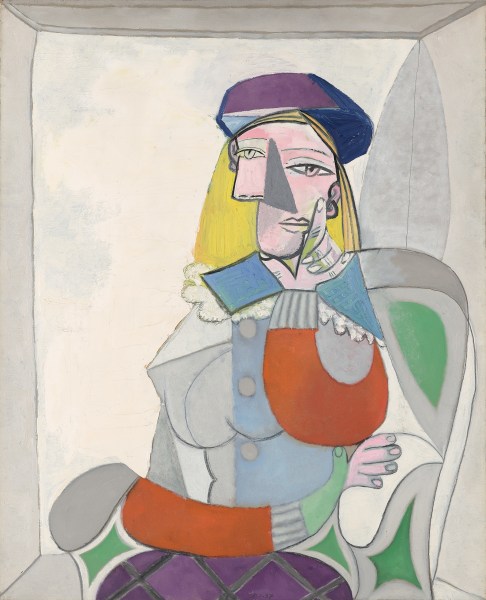
Pablo Picasso
Femme au Béret Bleu Assise dans un Fauteuil Gris, Manches Rouges (Marie-Thérèse), 1937
Oil on canvas
39 3/8 x 31 1/2 inches (100 x 80 cm)
© 2025 Estate of Pablo Picasso / Artists Rights Society (ARS), New York
Photo: Sandra Pointet
Courtesy Gagosian -
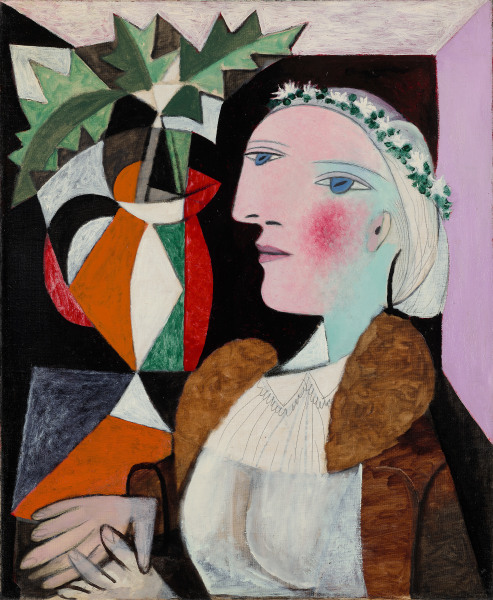
Pablo Picasso
Femme au Vase de Houx (Marie-Thérèse), 1937
Oil and charcoal on canvas
28 3/4 x 23 5/8 inches (73 x 60 cm)
© 2025 Estate of Pablo Picasso / Artists Rights Society (ARS), New York
Photo: Sandra Pointet
Courtesy Gagosian -
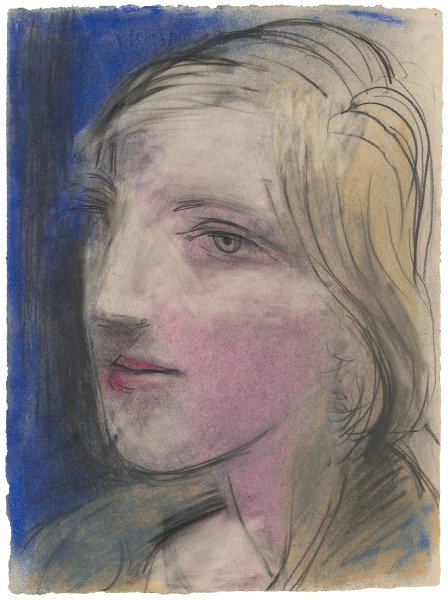
Pablo Picasso
Portrait de Femme (Marie-Thérèse), 1936
Pencil, watercolor, and pastel on paper
13 3/8 x 10 1/8 inches (34 x 25.5 cm)
© 2025 Estate of Pablo Picasso / Artists Rights Society (ARS), New York
Photo: Sandra Pointet
Courtesy Gagosian -
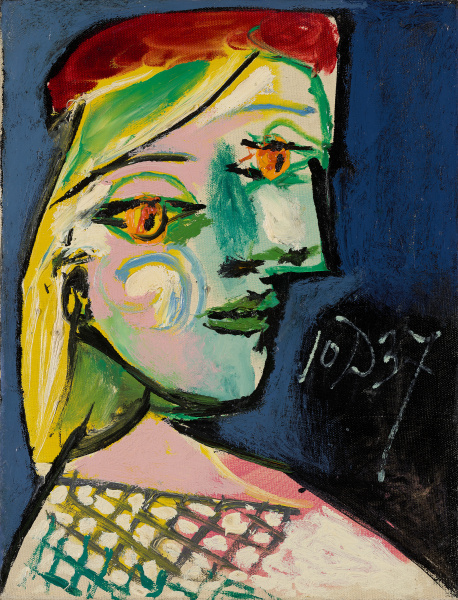
Pablo Picasso
Portrait de Femme au Béret Rouge (Marie-Thérèse), 1937
Oil on canvas
13 3/4 x 10 5/8 inches (35 x 27 cm)
© 2025 Estate of Pablo Picasso / Artists Rights Society (ARS), New York
Photo: Sandra Pointet
Courtesy Gagosian -
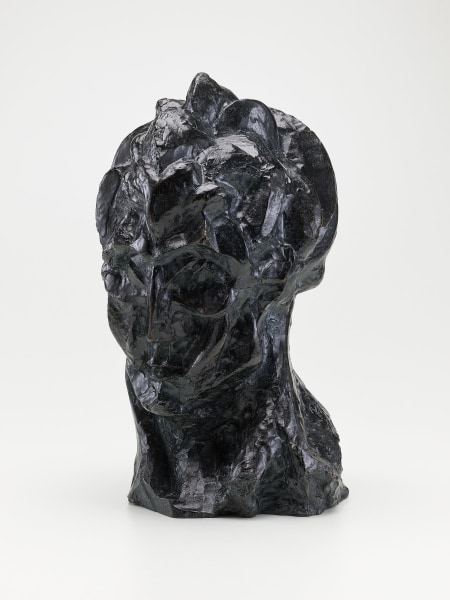
Pablo Picasso
Tête de Femme (Fernande), 1909
Bronze
16 3/8 x 9 7/8 x 10 5/8 inches (41.5 x 25 x 27 cm)
© 2025 Estate of Pablo Picasso / Artists Rights Society (ARS), New York
Photo: Sandra Pointet
Courtesy Gagosian -
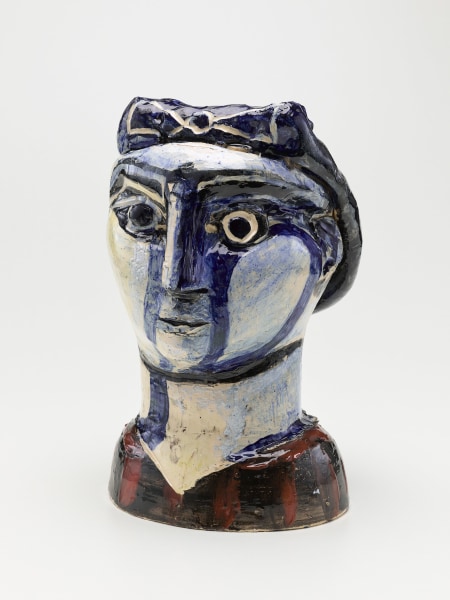
Pablo Picasso
Tête de femme bleu, 1948–49
Terra-cotta
14 5/8 x 9 1/2 x 11 7/8 inches (37 x 24 x 30 cm)
© 2025 Estate of Pablo Picasso / Artists Rights Society (ARS), New York
Photo: Sandra Pointet
Courtesy Gagosian -
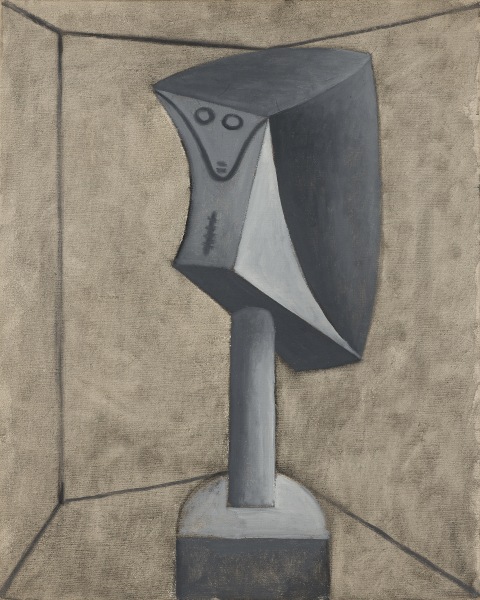
Pablo Picasso
Tête Trois-Quarts Gauche, 1945
Oil on canvas
31 7/8 x 25 5/8 inches (81 x 65 cm)
© 2025 Estate of Pablo Picasso / Artists Rights Society (ARS), New York
Photo: Sandra Pointet
Courtesy Gagosian -
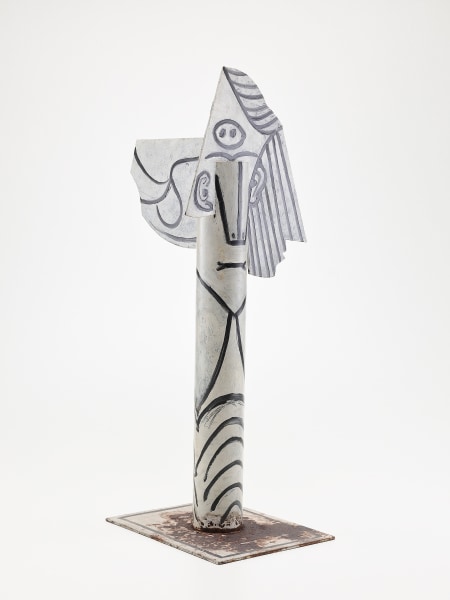
Pablo Picasso
Tête de Femme, 1957
Cut and painted sheet metal
32 3/8 x 13 x 18 1/8 inches (82 x 33 x 46 cm)
© 2025 Estate of Pablo Picasso / Artists Rights Society (ARS), New York
Photo: Sandra Pointet
Courtesy Gagosian

Friday, April 18, 2025
Rembrandt? Mauritshuis presents results of research on three paintings from its collection
17 April - 13 July 2025
The Mauritshuis and Rembrandt are inextricably linked. Our museum houses one of the most important colleThe Mauritshuis presented the results of its research on three paintings in its collection. In the case of two of these works, it was not certain whether they were painted by the great master himself or came from his studio. All three were subjected to close examination at the museum’s conservation workshop, where conservation work was also performed on two of them.
The research revealed a wealth of new information, including on the attribution of the paintings. The Mauritshuis is devoting a presentation in the museum to the project. Entitled Rembrandt?, it can be seen in room 10. The three paintings are: Portrait of Rembrandt with a Gorget (c.1629), Study of an Old Man (c. 1655-1660) and ‘Tronie’ of an Old Man (c.1630). ctions of paintings by the famous artist, comprising no fewer than eleven pieces by the painter himself. They include iconic highlights like The Anatomy Lesson of Dr. Nicolaes Tulp, Homer and a Self-Portrait painted in the year of his death.
The Mauritshuis also has seven paintings that have once been purchased as Rembrandts, but which have now been written off or are strongly called into question. Three of the paintings in this last category were recently re-examined in our conservation studio with the most modern techniques available to us today. Two of those works have also been restored. What has this taught us? Rembrandt research is never done, and that includes the work we do at the Mauritshuis.
Portrait of Rembrandt with a Gorget
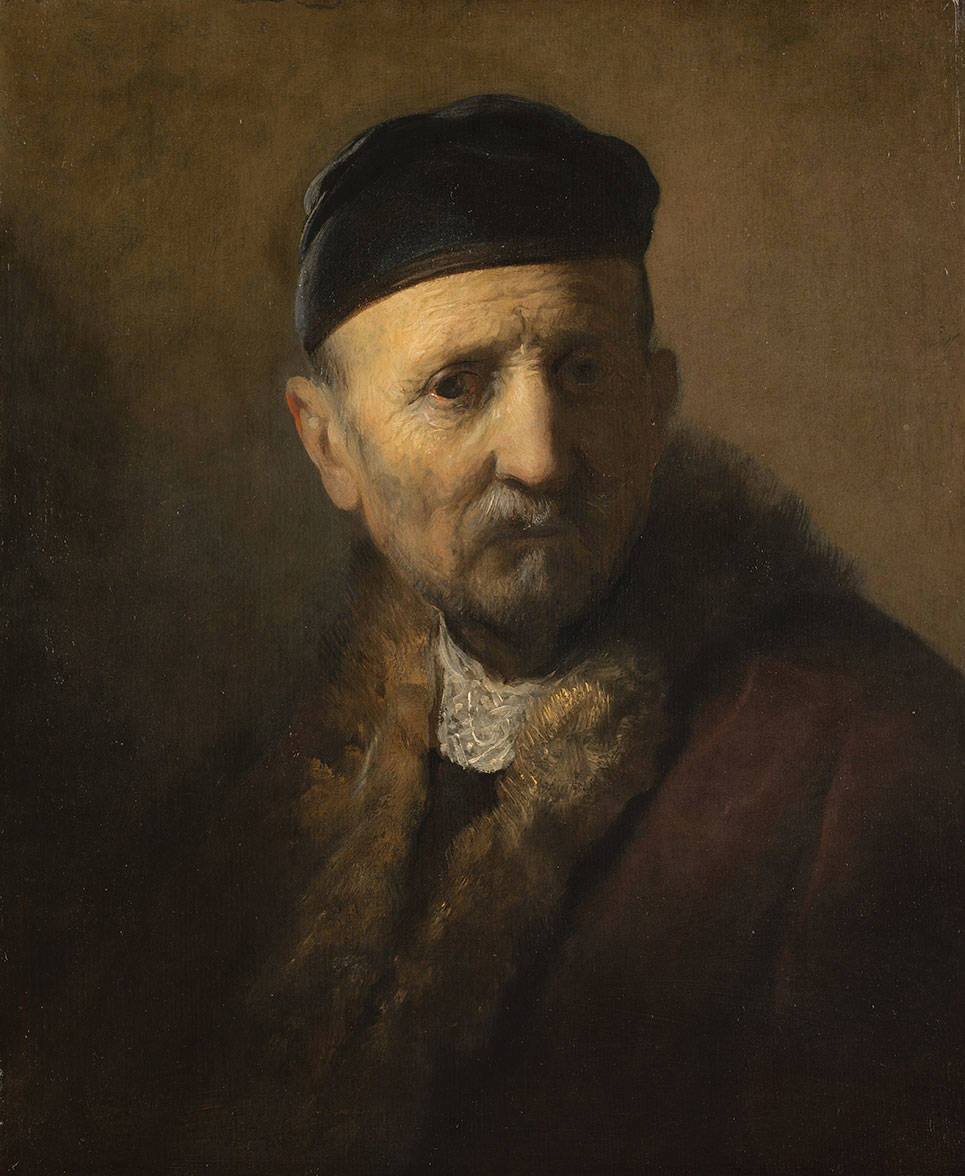
Rembrandt (en/of atelier), Tronie van een oude man, c.1630
Portrait of Rembrandt with a Gorget was acquired by Stadtholder William V in 1768. For years, the painting was regarded as an absolute highlight of Rembrandt’s oeuvre, a self-portrait painted at a young age. A second version of the painting is housed at the Germanisches Nationalmuseum in Nuremberg. Until twenty-five years ago, that painting was believed to have been a copy. But then…
It all started with the discovery of an underdrawing beneath the paint layers . Nothing like that had ever been seen before in a work by Rembrandt. This prompted further investigation, and it was eventually found that our Rembrandt, our masterpiece, is the copy, and the painting in Nuremberg turned out to be the original by Rembrandt himself. Now, the painting has been restored and re-examined. The conclusion that our version is a copy was confirmed.
So, who did paint it?
Okay, so the painting is not by Rembrandt. But how do we find out who did paint it?
- Clearly, it must have been one of Rembrandt’s students. They would practice their skills at the studio by copying the master’s work. It was part of their training. So we need to find an early student or employee of Rembrandt’s. Who are the possible candidates?
- The first possibility is Isaac de Jouderville, , but this pupil was simply not good enough to produce the quality we see in this painting.
- The second possibility is Jan Lievens, a good friend of Rembrandt’s from Leiden. Lievens, like Rembrandt, was a fully qualified painter around 1630. It is unlikely, therefore, that he would copy a painting by his friend.
- That leaves Gerrit Dou. It is he who is most commonly thought to be the painter behind this portrait. He was the first well-known student of Rembrandt’s in Leiden. Dou painted very meticulously and is regarded as the founder of the fijnschilders (‘fine painters’) group of artists in Leiden. Could he have painted it? It is certainly possible, but how do we prove it?
Rembrandt?
The final verdict remains, even after the new research: copy from Rembrandt's studio.
'Tronie’ of an Old Man
Rembrandt (en/of atelier), Tronie van een oude man, c.1630
An old man with a moustache and goatee frowns at us. He wears a brown coat trimmed with fur, and a black cap. The wrinkles on his face are painted with delicate precision.
Abraham Bredius, director of the Mauritshuis, bought the painting for his own collection in 1892, but loaned it to the museum, where it was displayed. In a piece in the Oud Holland art journal, Bredius enthusiastically referred to his acquisition as ‘probably the most interesting painting of Rembrandt’s father’. But is it in fact by Rembrandt? And is the man indeed Rembrandt’s father?
Abraham Bredius was sure that this painting by Rembrandt is a portrait of his father, Harmen Gerritsz van Rijn. The man appears in several pieces by Rembrandt, and in the work of artists he associated with. For centuries, people thought they recognised Rembrandt’s father in prints, drawings and paintings.
Until, that is, a drawing of ‘Harmen Gerrits Van Rhijn’ turned up. He had a wide nose and a full beard, and looked quite different from the ‘father’ in our painting. So we think that the old man was a model Rembrandt paid to sit for him at his studio. The painting is not a portrait, but a tronie: a study of an old man that is full of character. So not a family portrait at all.
The background
This painting has been tampered with at some point in its existence. Technical analysis has shown that the background was overpainted long after it was first finished. A sample of paint was removed from the background using a scalpel. Under a microscope, it is possible to see the different layers of paint. The top, ochre-coloured layer is the overpainting.
An x-ray fluorescence spectrometer allowed us to identify the chemical elements in the layers of paint. So we know exactly which pigments the painter chose. Here, you can see a scan of the element copper. The overpainted background fluoresces slightly because the pigment containing copper is verditer, a pigment that Rembrandt was not using in circa 1630. The overpainting probably dates from the early 18th century.
The overpainting was applied directly on top of the original paint, and it has become very hard. We have not (yet) succeeded in finding a solvent that will allow us to safely remove it, but techniques are advancing rapidly.
Rembrandt?
Final verdict: made by an employee of Rembrandt's studio
Study of an old man
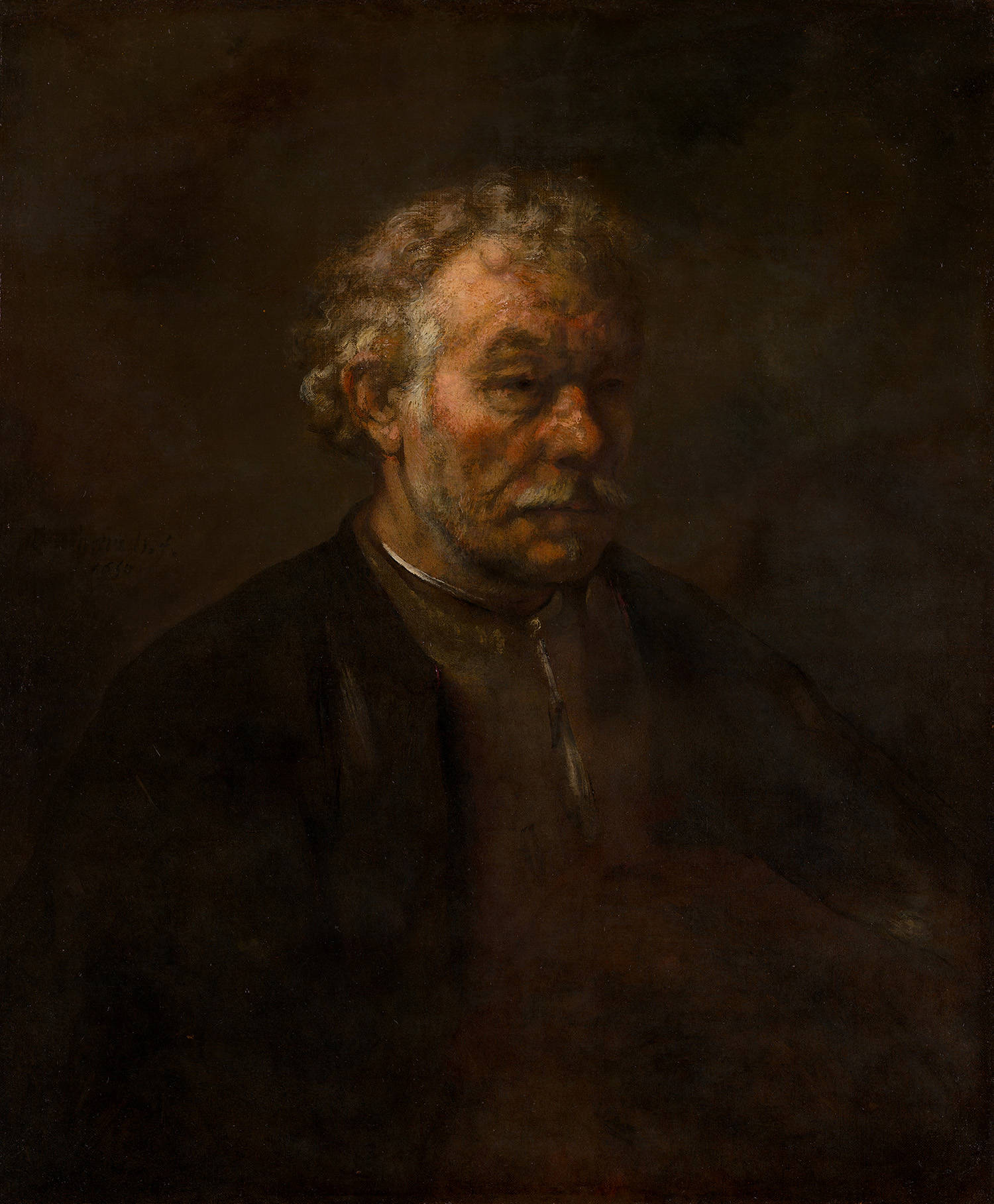
Rembrandt (atelier), Studie van een oude man, 1655-1660
Director Abraham Bredius was delighted when the Mauritshuis purchased this painting in 1891. ‘A specimen from the artist’s most mature period’ he called it. It was the first late work by Rembrandt in the collection, so it was an important acquisition. The old man in the painting was identified as Adriaen van Rijn, the artist’s brother.
Yet doubts were raised as to whether it was a real Rembrandt. For many years, it was difficult to say for sure, as the painting was in poor condition, with many layers of discoloured overpainting.
Thanks to recent conservation work, we now have the opportunity to take a fresh look at Study of an Old Man. One interesting outcome of the investigation so far is the conclusion that Rembrandt’s signature is entirely genuine. So we now face a dilemma, as doubts about the attribution persist. How is this possible?
The signature is authentic
Rembrandt’s name was written while the painting was still wet. So it is part of the original painting. The handwriting in the signature also seems entirely correct, and does not differ from other signatures by Rembrandt. There is however something wrong with the dating, which was applied later using a different paint. The year is definitely not written in Rembrandt’s handwriting.
Now that the conservation work is complete, we are better able to investigate who painted it, by carefully observing and comparing. Compared with the late self-portrait by Rembrandt, also displayed in this room, the nose is less clear. The light catching the nose in the self-portrait really makes it stand out.
The left eye is also very patchy, and this is not only because of damage to the paint. If you look at Rembrandt’s Self-Portrait and Homer (also in this room) you will see that every brushstroke is just right. Study of an Old Man is less accomplished. We believe that it is the work of a student attempting to imitate the style of the master.
You might think “Rembrandt signed it, so it must be ‘a real Rembrandt’.” But it’s not that simple. It was not unusual for a master to sign the work of a student. If it was painted at Rembrandt’s studio, it was his ‘product’. With Rembrandt’s signature, a painting by a student could be sold as if it were a piece by the master.
Rembrandt?
Provisional verdict: Possibly by a student or an employee of his studio, or perhaps by Rembrandt himself? The question mark remains.
Wednesday, April 16, 2025
Willem de Kooning: Endless Painting,
Gagosian is pleased to present Willem de Kooning: Endless Painting, opening on April 15 at 555 West 24th Street. The exhibition is organized with the support of The Willem de Kooning Foundation and curated by Cecilia Alemani, director and chief curator of High Line Art. It comprises paintings dating from 1944 through 1986 and two sculptures: Clamdigger (1972), and the monumental Standing Figure (1969–84). This will be the first presentation at the newly renovated Chelsea gallery and follows Willem de Kooning and Italy, a significant presentation of paintings, sculptures, and drawings at the Gallerie dell’Accademia in Venice last summer.
A pioneering figure of the postwar era, de Kooning probed the expressive potential of color, line, and space and continuously challenged the boundaries between figuration and abstraction. Through the considered placement of late paintings including Untitled V (1982), on loan from the Museum of Modern Art, New York, and Untitled XIX (1984) among works of the preceding decades, the exhibition foregrounds visual motifs that recurred throughout de Kooning’s career. This arrangement reflects Alemani’s close investigation of the 1980s paintings through which she identified an expansive repertoire of human forms—elbows, knees, mouths, eyes—that can be traced as far back as the artist’s works of the 1930s and 1940s that drew on Cubism and Surrealism.
In Montauk II (1969), flesh-toned biomorphic shapes dance in and out of focus, while profiles and limbs appear amid the slippery brushstrokes of . . . Whose Name Was Writ in Water (1975), on loan from the Solomon R. Guggenheim Museum, New York. In Untitled XIV (1986), the exhibition’s latest work, undulating arms extend energetically across the canvas, mirroring the outspread limbs of Standing Figure, a monumental bronze sculpture on view indoors for the first time in nearly three decades.

Willem de Kooning, Woman as Landscape, 1954-1955. Oil and charcoal on canvas, 65 1/2 x 49 3/8 inches (166.3 x 125.4 cm) © 2025 The Willem de Kooning Foundation/Artists Rights Society (ARS), New York. Photo: Christie's Image/Bridgeman Images.
De Kooning often reworked his canvases, reincorporating passages from earlier compositions by tracing shapes he wanted to preserve onto vellum, and even changing their orientation multiple times during their gestation. It was through revisiting and revising his compositions that he developed a consistent but flexible vocabulary of colors and gestures rooted in figuration. “A restless explorer of the canvas, de Kooning never stopped interrogating the possibilities of what painting could be,” Alemani notes. “As a curator, it is deeply rewarding to grapple with the constant process of artistic reinvention and self-interrogation that animates his creative trajectory, especially through closer examination of his late works.” The exhibition’s title, Endless Painting, references this enduring, ever-evolving visual language and the artist’s professed decision to “just stop” rather than formally finish paintings, perhaps seeking a more expansive definition of the medium itself.

Willem de Kooning, Suburb in Havana, 1958. Oil on canvas, 80 1/4 x 70 3/8 inches (203.8 x 178.8 cm) © 2025 The Willem de Kooning Foundation/Artists Rights Society (ARS), New York. Photo: Owen Conway. Courtesy Gagosian.
Endless Painting is the sixth solo exhibition of de Kooning’s work presented by Gagosian, with the first organized in 1987. It is accompanied by a fully illustrated catalogue featuring essays by Cecilia Alemani and John Elderfield, curator of de Kooning: A Retrospective at the Museum of Modern Art, New York (2011–12). On May 15, Alemani will moderate a conversation exploring the continued impact of de Kooning’s paintings and working methods on artists today.
Subscribe to:
Posts (Atom)