The Museum of Modern Art
November 10, 2025–April 11, 2026
The Museum of Modern Art presents Wifredo Lam:
When I Don’t Sleep, I Dream, the most extensive retrospective devoted to the artist in the
United States, on view at MoMA from November 10, 2025, through April 11, 2026.
Spanning the six decades of Lam’s prolific career, the exhibition includes more than 130
artworks from the 1920s to the 1970s—including paintings, large-scale works on paper,
collaborative drawings, illustrated books, prints, ceramics, and archival material—with key
loans from the Estate of Wifredo Lam, Paris.
The retrospective reveals how Lam—a Cubanborn artist who spent most of his life in Spain, France, and Italy—came to embody the figure
of the transnational artist in the 20th century. Wifredo Lam: When I Don’t Sleep, I Dream is
organized by Christophe Cherix, The David Rockefeller Director, and Beverly Adams, The
Estrellita Brodsky Curator of Latin American Art, with Damasia Lacroze, Curatorial
Associate, Department of Painting and Sculpture, and Eva Caston, Curatorial Assistant,
Department of Drawings and Prints.
“Lam’s visionary commitment to making his painting an ‘act of decolonization,’ as he put it,
forever changed modern art,” said Cherix. “He insisted on placing diasporic culture at the
heart of modernism—not as a peripheral influence, but as central, a generative force.”
Born in Sagua La Grande, Cuba, Wifredo Lam (1902–1982) emigrated at age 21 to pursue
training as a painter in Madrid. Organized chronologically, the exhibition begins with a
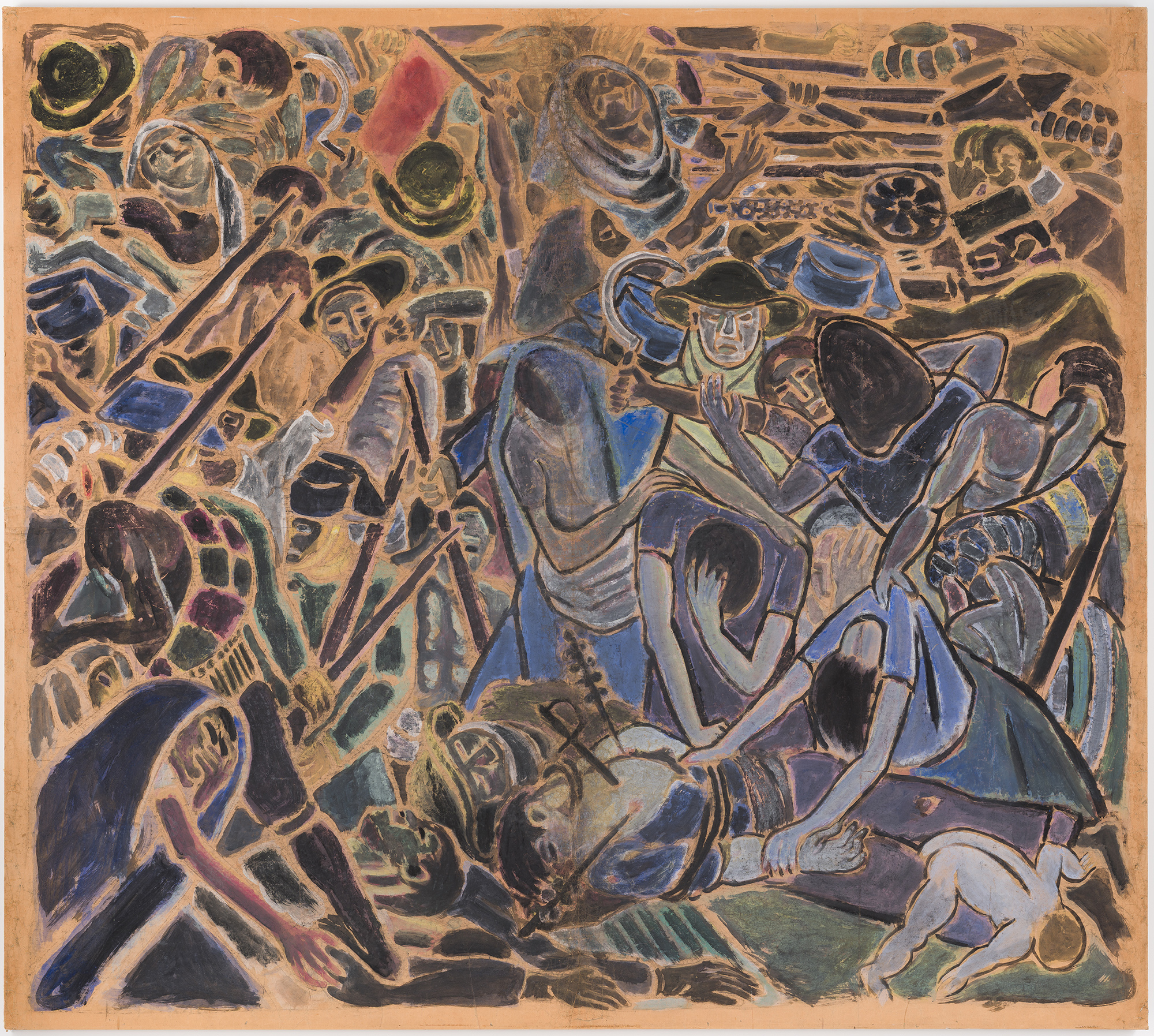
selection of his early paintings made during his time in Spain, including Lam’s first overtly
political and monumental work on paper, La Guerra Civil (The Spanish Civil War) (1937), on
view in the US for the first time.
In 1938 Lam fled the war in Spain for Paris, where he met
artists and writers such as Pablo Picasso and André Breton. After escaping to Marseille
during the Nazi occupation of Paris, Lam collaborated with Surrealists who were also
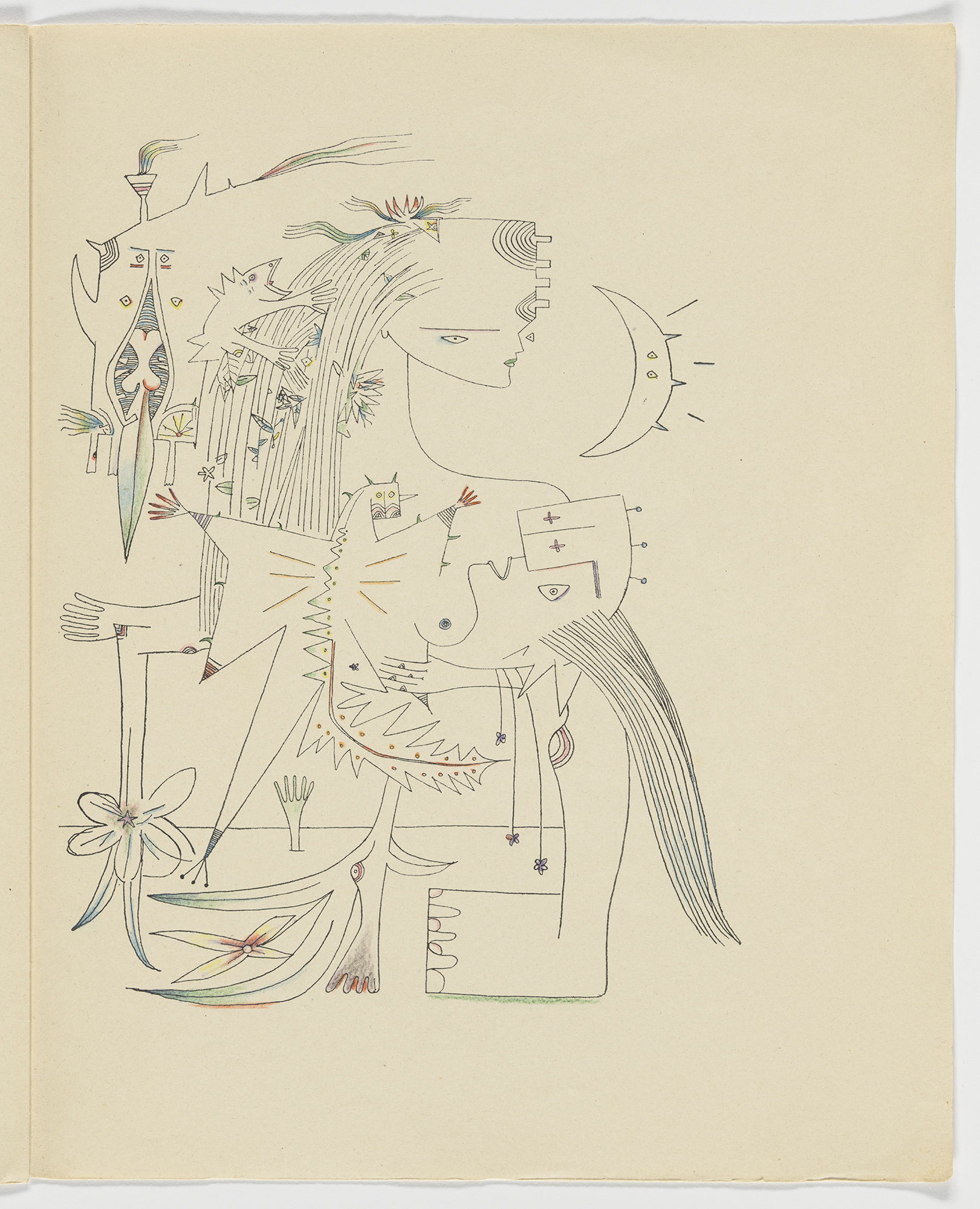
awaiting safe passage out of Europe. Among these collaborations, Lam created imaginative
line drawings for Breton’s poetry volume Fata Morgana (1941) as well as a number of
cadavre exquis (exquisite corpse) and collective drawings, which are on view in the
exhibition.
“His radically inventive works continue to speak to us across time,” said Adams. “The
realities he confronted—colonialism, racism, exile, and displacement—remain as urgent
today as they were in his lifetime.”
After almost two decades abroad, Lam returned to Cuba in 1941 via Martinique, where he
met his future collaborator and lifelong friend, the poet Aimé Césaire.
The retrospective
sheds light on how Lam’s return led to an absolute reinvention of his work and the creation
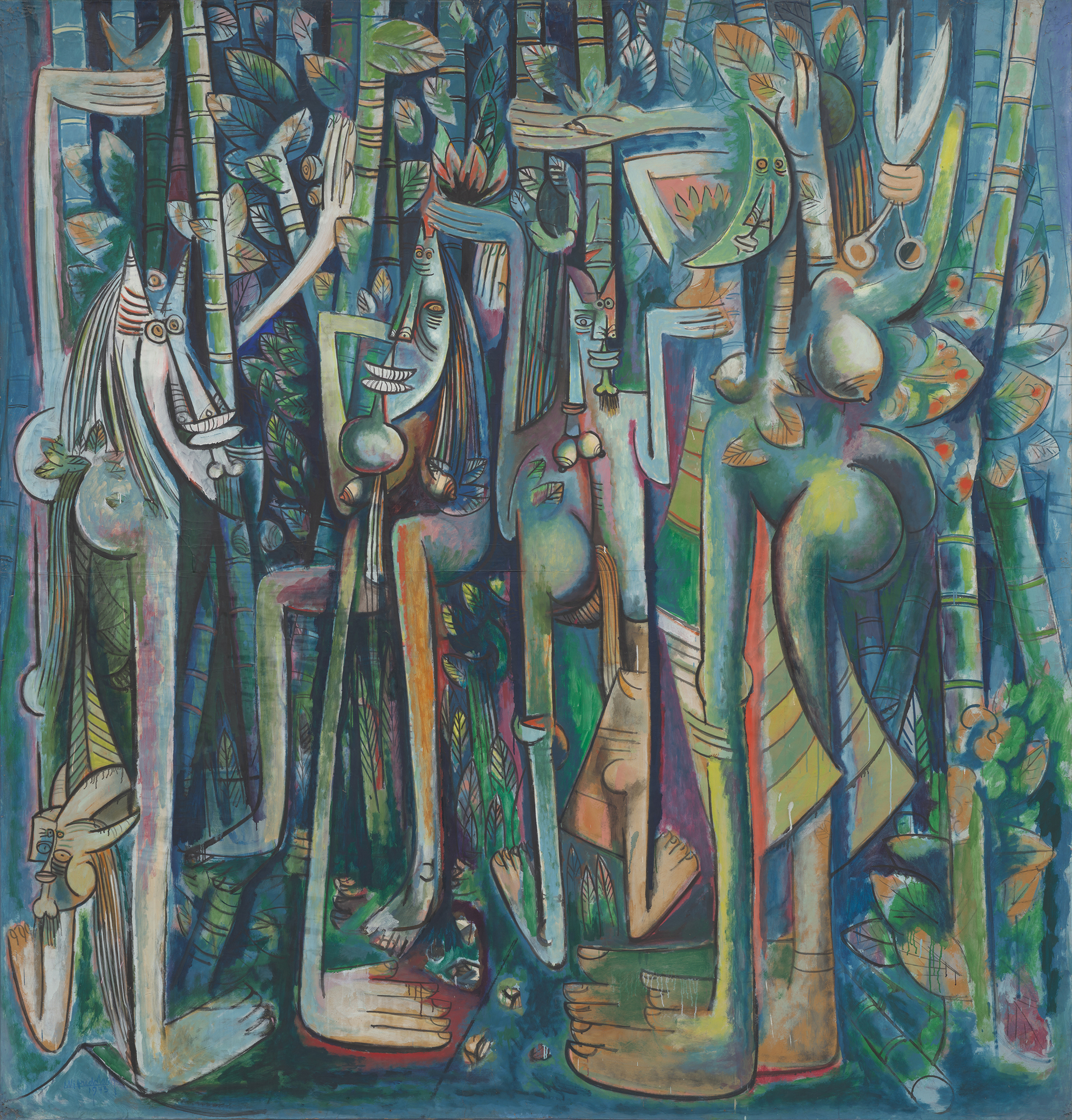
of some of his most important paintings, including La jungla (The Jungle) (1942–43).
Arguably his best-known work, which has been in MoMA’s collection since 1945, La jungla’s
densely active composition foregrounds the Caribbean landscape, its inhabitants, and its
histories of slavery and indenture. During this time, the artist also sought new ways to
visualize the fluidity between physical and spiritual space by depicting landscapes and
figures in moments of transformation and transcendence. Paintings from this prolific and
experimental period include Omi Obini (1943), Mofumbe (1943), and Ogue Orisa (1943), all
of which express his interest in Afro-Caribbean spiritualities.
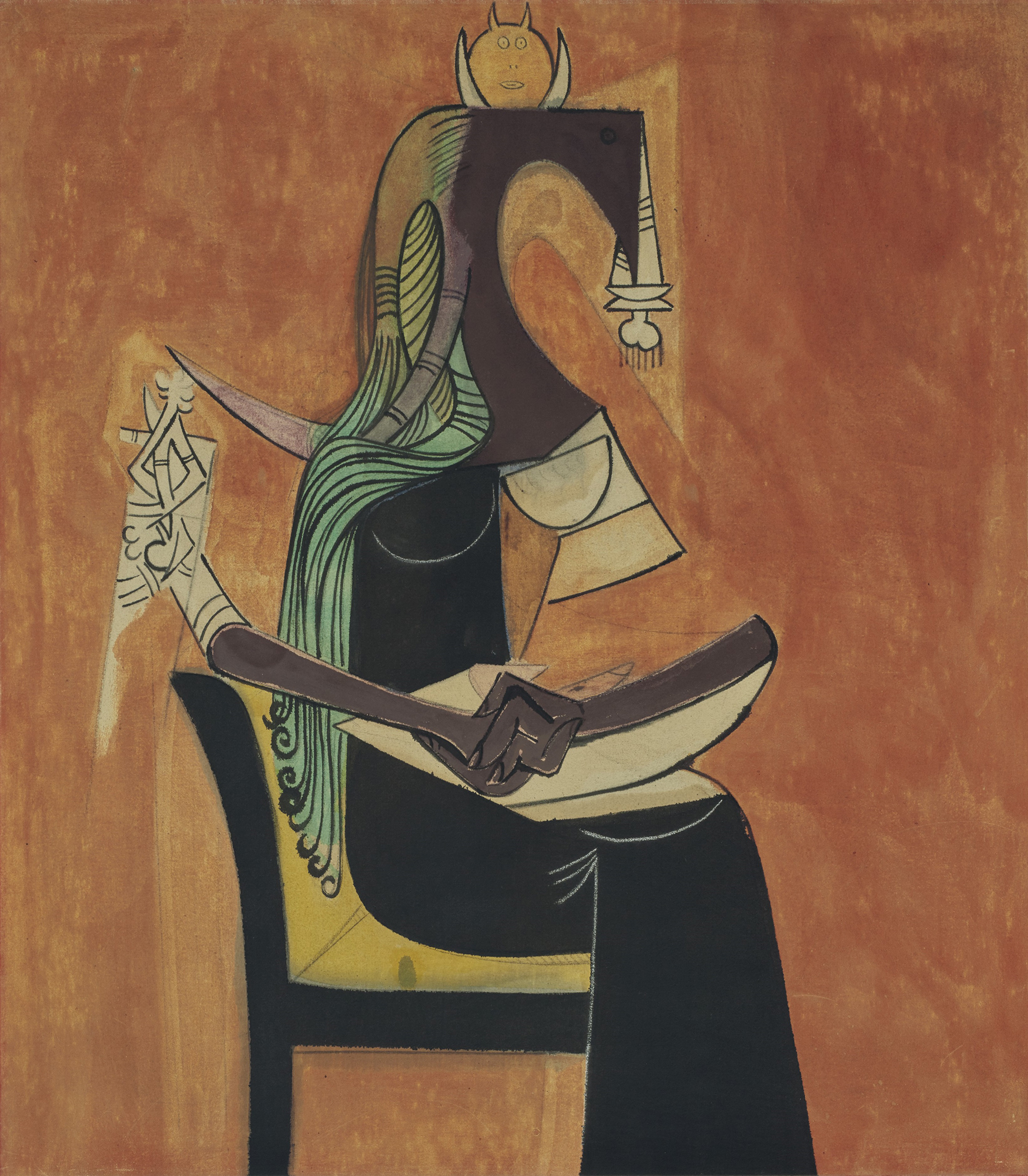
Lam would later transition to a
much darker and earthier palette, making way for new compositions that balanced
abstracted figures and forms in paintings like Bélial, empereur des mouches (Belial, Emperor
of the Flies) (1948) and Grande Composition (Large Composition) (1949). This pivotal work,
which has not been shown in more than 60 years, will make its US debut.
Marking his return
to painting on kraft paper, Grande Composition is the artist’s most ambitiously scaled work.
In 1952 Lam returned to Europe, marking yet another key moment in his artistic practice.
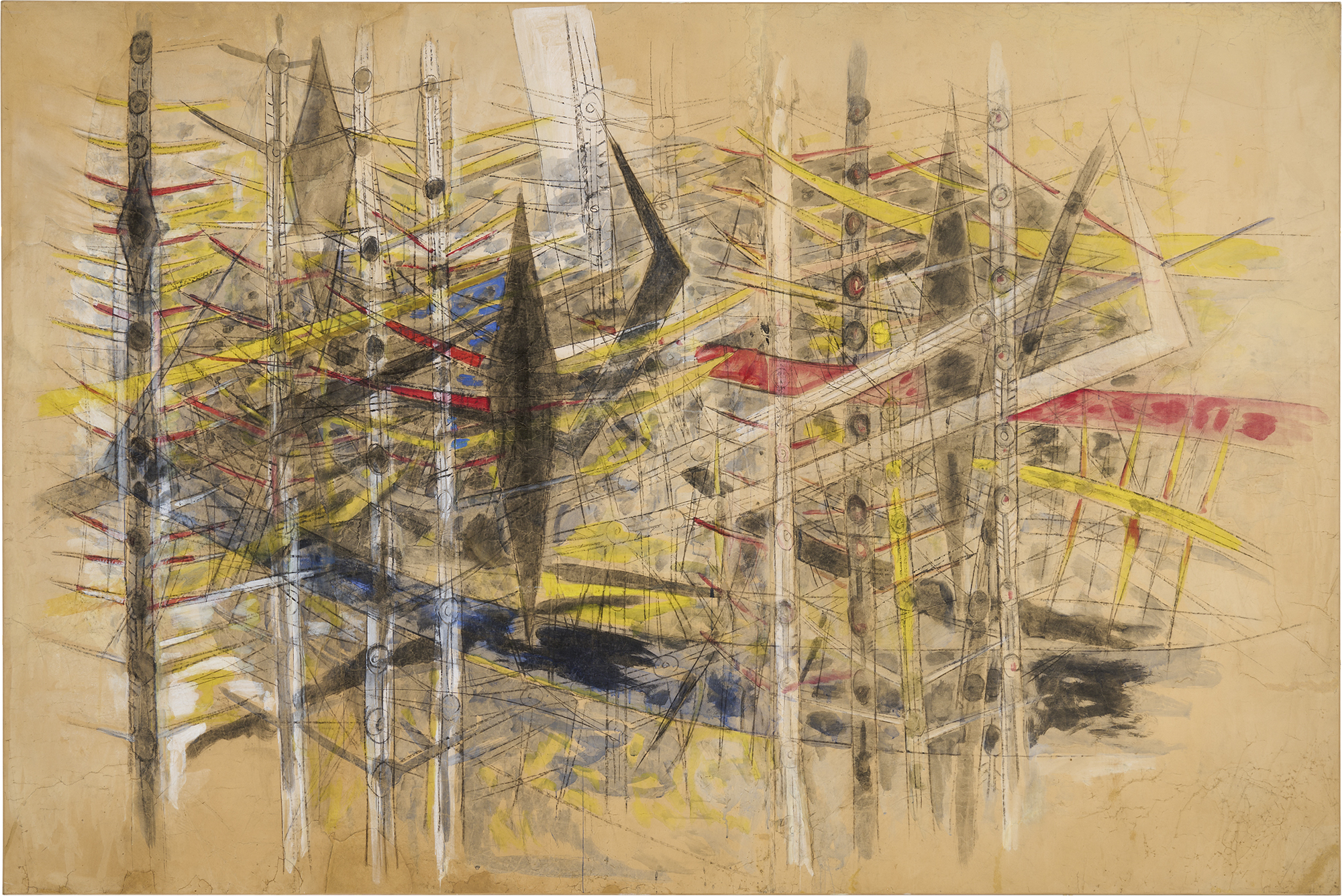
While living in Albissola Marina, Italy, he produced a series of ambitious, large-scale works
that radically shifted toward abstraction, notably the Brousse (The Bush) series (1958), also
on display in the US for the first time.
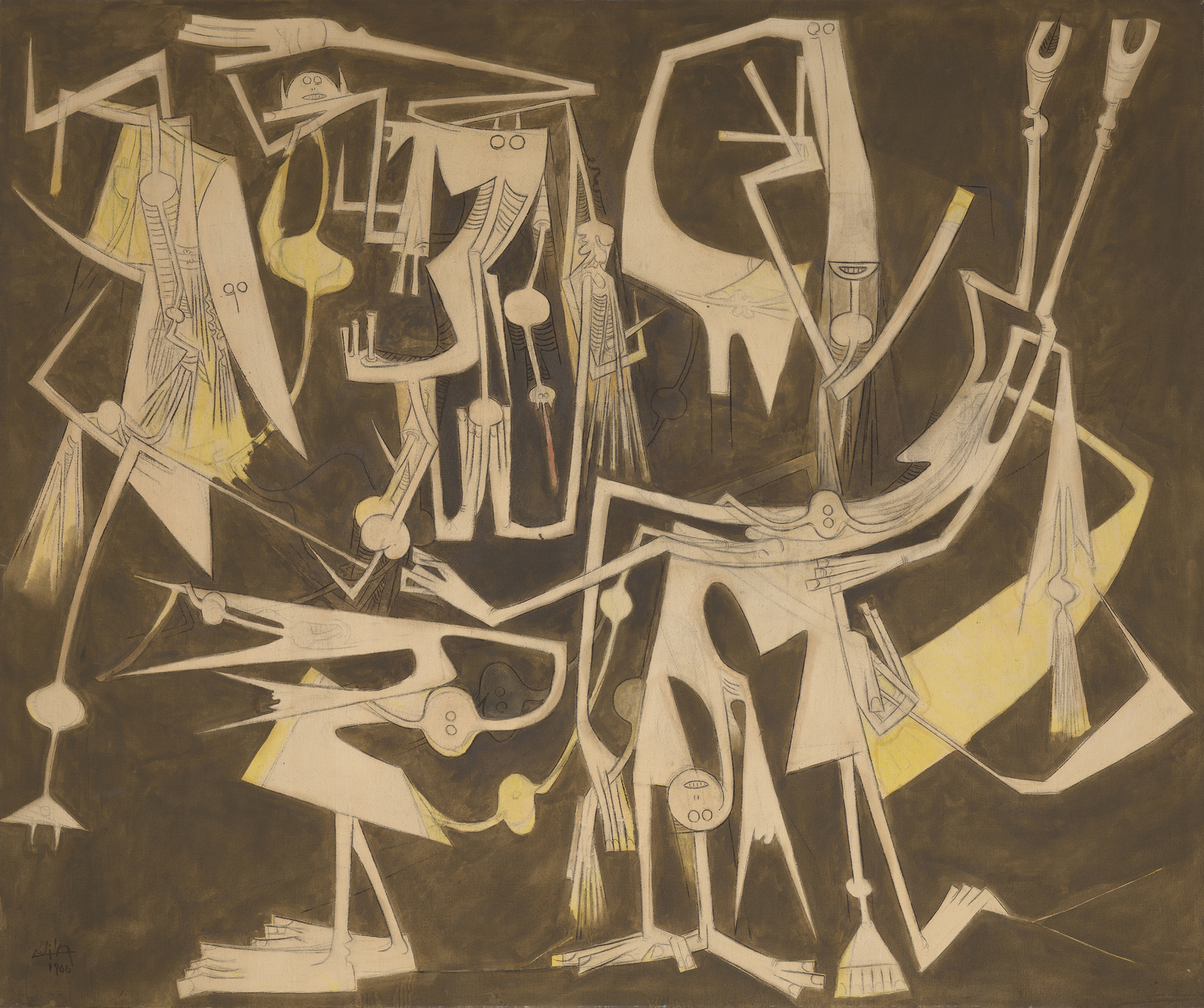
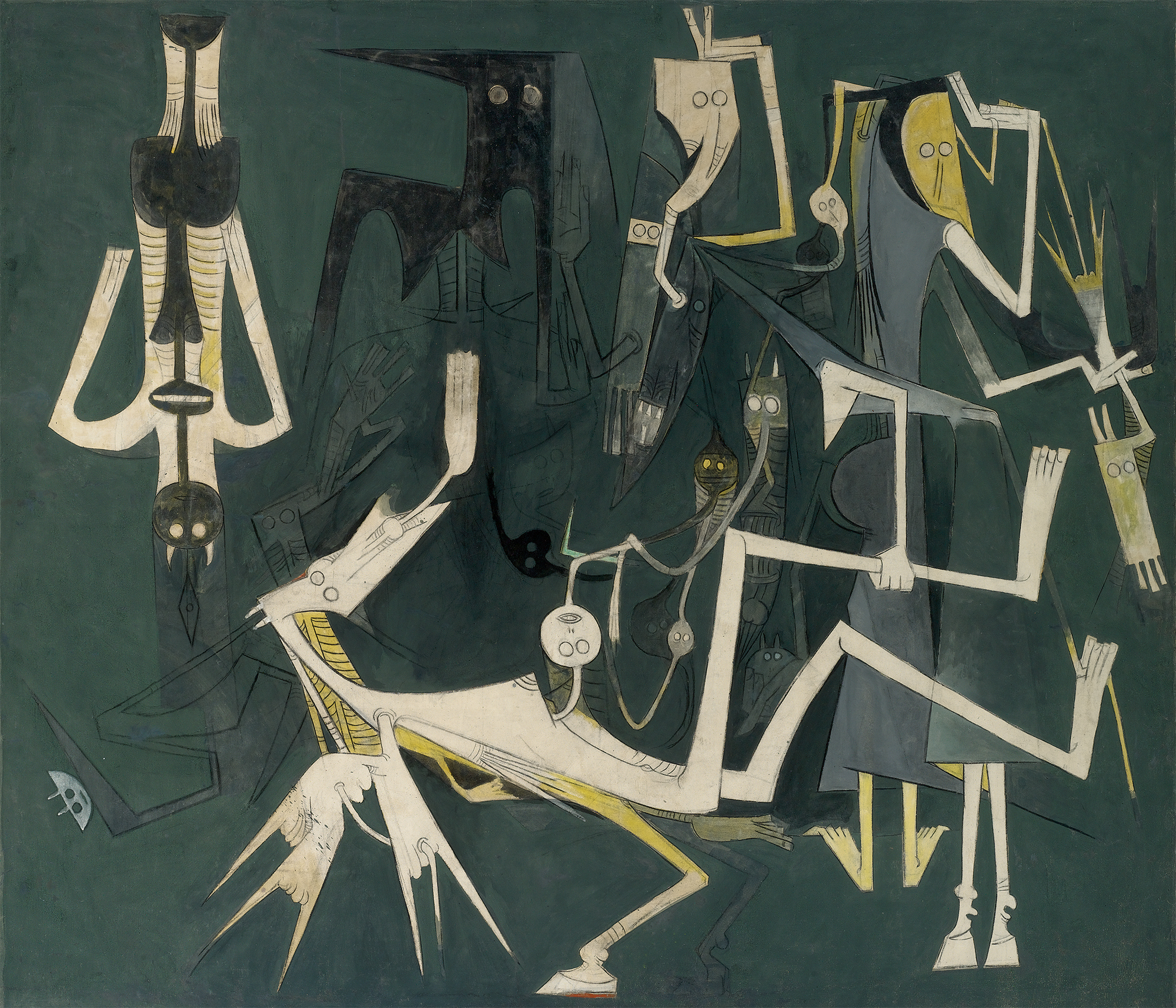
By the early 1960s, Lam renewed his approach to
figuration, developing a distinctive visual language marked by tangled, elongated figures
that appear in Les Invités (The Guests) (1966) and the final major painting of his career, Les
Abalochas dansent pour Dhambala, dieu de l’unité (The Abalochas Dance for Dhambala, the
God of Unity) (1970), both of which will be on view in the exhibition.
In his final years, Lam
continued to push the boundaries of his practice, actively experimenting with ceramics and
printmaking. The retrospective concludes with a selection of his late ceramic works, along
with his collaborations with some of the most notable literary voices of the 20th century,
including illustrated books with Édouard Glissant, René Char, and his print portfolio with
Aimé Césaire, titled Annonciation (Annunciation) (1982).
PUBLICATION
Wifredo Lam: When I Don’t Sleep, I Dream is accompanied by
a richly illustrated catalogueedited by Beverly Adams and Christophe Cherix. The landmark publication features
contributions by Anny Aviram, Miriam M. Basilio Gaztambide, Terri Geis, Jean Khalfa,
Damasia Lacroze, Laura Neufeld, María Elena Ortiz, Lowery Stokes Sims, Catherine H.
Stephens, and Martin Tsang; fresh insights into Lam’s relationship to Surrealism, Négritude,
and other literary, cultural, and poetic movements; extensive new photography of Lam’s
art; and the first in-depth conservation analysis of his best-known painting, La jungla (The
Jungle) (1942–43). 266 pages, 225 color illustrations. ISBN: 978-1-
63345-178-0. Published by The Museum of Modern Art, New York, and available at MoMA
stores and online at store.moma.org. Distributed to the trade through ARTBOOK|D.A.P. in
the United States and Canada, and through Thames & Hudson in the rest of the world.
IMAGES
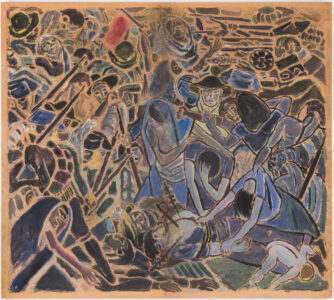
Wifredo Lam. La Guerra Civil (The Spanish Civil War), 1937. Gouache on paper mounted on canvas, 6’11 ¼” x 7’9 ¼” (211.5 x 236.9 cm). Capriles Cannizzaro Family Collection © Succession Wifredo Lam, ADAGP, Paris / ARS, New York 2025
“I am drawing a painting of big proportions . . .
an anti-fascist subject, not very beautiful but
very true and real,” wrote Lam of this painting,
originally commissioned for the 1937 Spanish
Pavilion at the Exposition Internationale in
Paris. The flat, churning scene depicts a violent
confrontation during the Spanish Civil War,
in which figures with grimacing, masklike faces
struggle against one another. While forced
to paint on kraft paper due to wartime scarcity,
Lam responded creatively to the medium,
using it to explore the boundary between
painting and drawing. This work’s interplay of
material, scale, line, and blank space would
become a hallmark of his practice.
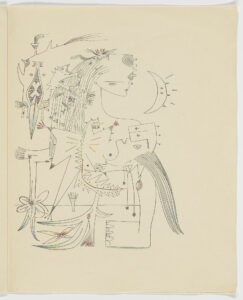
Wifredo Lam. Fata Morgana, 1941. Illustration from an unbound proof of an illustrated book with letterpress text and seven line block illustrations with hand additions in colored pencil and annotations in ink, sheet (closed): 11 × 9″ (28 × 22.8 cm), sheet (open): 11 × 17 11/16″ (28 × 45 cm). The Museum of Modern Art, New York © Succession Wifredo Lam, ADAGP, Paris / ARS, New York 2025
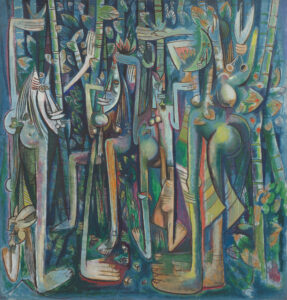
Wifredo Lam. La jungla (The Jungle), 1942-43. Oil and charcoal on paper mounted on canvas, 7’10 ¼” × 7’6 ½” (239.4 × 229.9 cm). The Museum of Modern Art, New York © Succession Wifredo Lam, ADAGP, Paris / ARS, New York 2025
Lam glued together two large pieces of kraft
paper to make the support for La jungla. He
first sketched the composition in charcoal
and then used layers of thinned oil paint over
the initial drawing. Lam’s figures feature faces
reminiscent of African masks, handlike feet,
elongated legs, and male and female attributes.
They are placed within a Caribbean landscape,
intertwined with broadleaves, tropical fruit, and
sugarcane. This setting recalls Cuba’s history
of slavery and indenture, while also signaling
the resilience of Afro-Caribbean cultures.
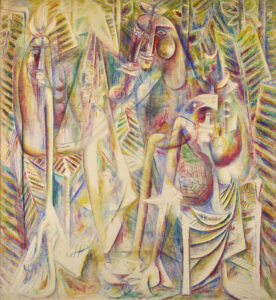
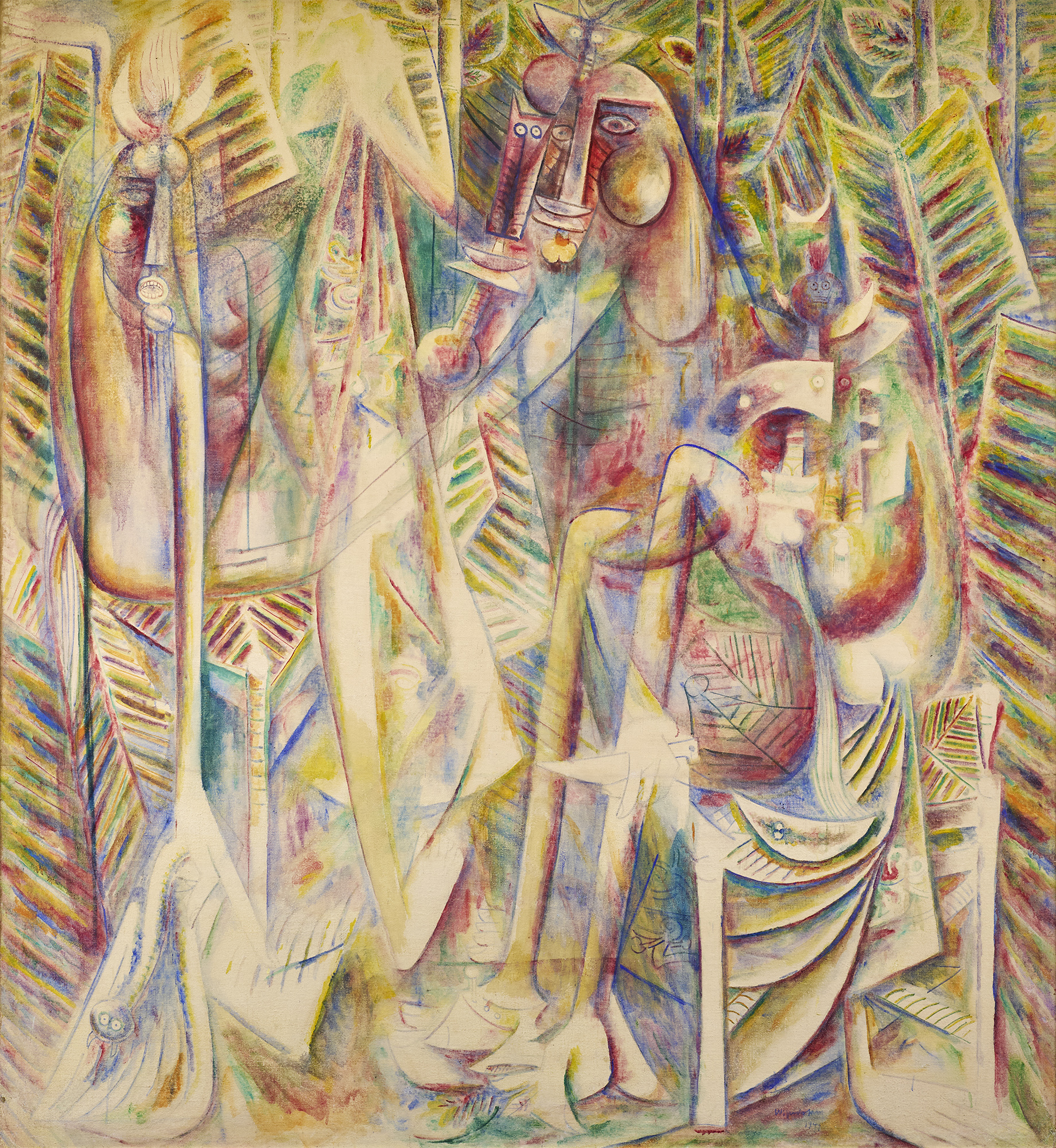
Wifredo Lam. Harpe astrale (Astral Harp), 1944. Oil on canvas, 6’10 ⅝” × 6’2 ¾” (210 × 190 cm). Private collection. © Succession Wifredo Lam, ADAGP, Paris / ARS, New York 2025
Afro-diasporic religions in the Americas were
often formed through the strategic entangling
of African religions with Catholicism in order
to ensure their survival under colonial rule.
Sprouting horseshoes and small horned heads,
this painting’s winged, spectral beings
simultaneously suggest the presence of angels
and Afro-Cuban orishas, or deities. The
painting’s play of shadow and light evokes a
sense of movement between the earthly
and spiritual realms. In the final year of his life,
Lam returned to the theme of genesis in a
collaboration with the writer Aimé Césaire.
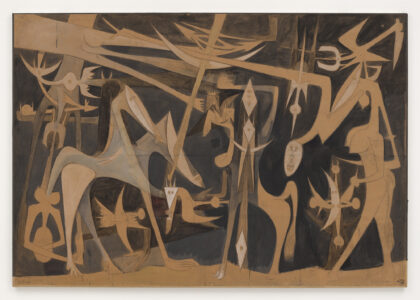
Wifredo Lam. Grande Composition (Large Composition), 1949. Oil and charcoal on paper mounted on canvas, 9’6 ½” × 13’9 ¾” (291 × 421 cm). The Museum of Modern Art, New York. Acquired in memory of Gustavo Cisneros through the generosity of the Sue and Edgar Wachenheim III Endowment Fund, Mimi Haas, Marlene Hess and James D. Zirin, The Judith Rothschild Foundation Contemporary Drawings Collection Gift (by exchange), Committee on Drawings and Prints Fund, The Werner H. Kramarsky Endowment Fund for Drawings, Marie-Josée and Henry R. Kravis, Sue and Edgar Wachenheim III, Emilio Ambasz, Anne Dias Griffin, Agnes Gund, Richard Roth, Tony Tamer, Candace King Weir, The Dian Woodner Acquisition Endowment Fund, the Frances Keech Fund, Joshua and Filipa Fink, Ann and Graham Gund, Alice and Tom Tisch, the Richard S. Zeisler Fund, Adriana Cisneros de Griffin, Glenn D. and Susan Lowry, and Marnie S. Pillsbury (as of September 2025) © Succession Wifredo Lam, ADAGP, Paris / ARS, New York 2025
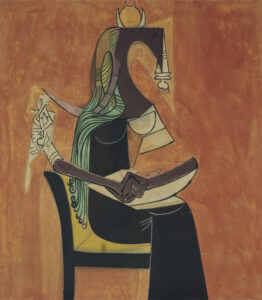
Wifredo Lam. Je Suis (I Am), 1949. Oil on canvas, 49 × 42 15/16″ (124.5 x 109 cm). Private collection © Succession Wifredo Lam, ADAGP, Paris / ARS, New York 2025
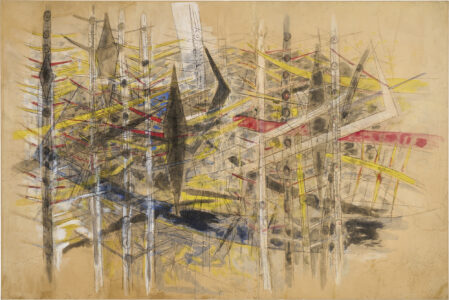
Wifredo Lam. Untitled, 1958. Oil and charcoal on paper mounted on canvas, 8′ × 11’3 ⅞” (244 × 345 cm). Private collection © Succession Wifredo Lam, ADAGP, Paris / ARS, New York 2025
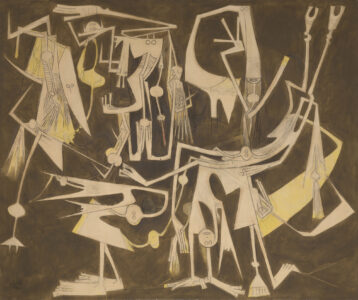
Wifredo Lam. Les Invités (The Guests), 1966. Oil and charcoal on canvas, 6’10 11/16″ x 8’2 7/16″ (210 x 250 cm). Colección Patricia Phelps de Cisneros © Succession Wifredo Lam, ADAGP, Paris / ARS, New York 2025
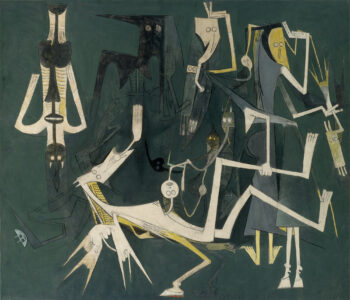
Wifredo Lam. Les Abalochas dansent pour Dhambala, dieu de l’unité (The Abalochas Dance for Dhambala, the God of Unity), 1970. Oil on canvas, 6’11 ⅞” × 8′ (213 × 244 cm). Private collection. Courtesy McClain Gallery © Succession Wifredo Lam, ADAGP, Paris / ARS, New York 2025