Sunday, October 4, 2026

The Surrealist Book: Tomorrow Lives in Mirror

The Museum of Modern Art 

October 4, 2026, through January 23, 2027

The Museum of Modern Art presents The Surrealist Book: Tomorrow Lives in Mirrors, an exhibition showcasing the propulsive impact of artists’ books—books made as works of art—within the Surrealist movement. For the artists and writers associated with Surrealism, the book was an ideal vehicle for subversive experimentation and the promotion of their revolutionary tenets. Working collaboratively to unlock the unconscious, they transformed the bound volume into a provocative new art form, an enchanted portal to the unexpected, the irrational, and, what they called, the “marvelous.” 

On view at MoMA from October 4, 2026, through January 23, 2027, The Surrealist Book features a selection of rare volumes produced by Surrealism’s most imaginative artists and writers, including André Breton, Claude Cahun, Salvador Dalí, Paul Éluard, Max Ernst, and Toyen. The exhibition is organized by Jodi Hauptman, The Robert Lehman Foundation Chief Curator of Drawings and Prints, and Starr Figura, Senior Curator, with Kolleen Ku, Curatorial Assistant, and Emma Kang, Brooke Alexander Fellow, Department of Drawings and Prints. 

The exhibition presents—for the first time at MoMA—a transformative gift of artists’ books from Helen and Sam Zell, which came to the Museum in 2022. The Zell Collection is one of the most significant collections of artists’ books formerly in private hands. Comprising approximately 100 works, it spans the period from 1857 to 2014, with an extensive and unparalleled concentration of editions and unique book works made in the context of Surrealism and its legacy. What unites these volumes is a sensibility that extends from the Surrealists’ profound sensitivity to all facets of the book, from the intellectual and poetic to the formal and tactile, from the intimate and personal to the subversive and revolutionary. 

Anchored by this singular collection, the exhibition will display special editions printed on unusual papers or enhanced with supplementary materials, unique maquettes and singular sketchbooks filled with collages and fantastical drawings, sculptural bindings that turn books into hybrid, interactive artworks, and much more. Among the extraordinary rarities in the Zell Collection are original manuscripts for some of Surrealism’s iconic texts, including Breton’s Manifeste du surréalisme; Poisson soluble (Surrealist Manifesto; Soluble Fish) (1924); outstanding books by such women artists as Unica Zürn, who filled a private notebook with intricate drawings of hybrid animal-human creatures; and one-of-a- kind bindings by Georges Hugnet that incorporate unexpected materials like liquid mercury or shattered glass. 

The Surrealist Book foregrounds intimate partnerships between artists and poets, such as that of Dalí, Breton, and Éluard in L’Immaculée conception (The Immaculate Conception) (1930); radical explorations of materiality, including the frottage rubbings Ernst made for Mr. Knife, Miss Fork (1931) and Je Sublime (I Sublime) (1936); photographic experiments, such as the kaleidoscopic photomontages in Cahun and Marcel Moore’s Aveux non Avenus (Cancelled Confessions) (1930), the solarized nudes by Man Ray that merge with Éluard’s love poems in Facile (Easy) (1935), and the transformation of succulent plants into mutating forms in Yoshio Shimozato’s Mesemu zoku; Chōgenjitsushugi shashinshū (Genus Mesemb; 20 Surrealist Photographs) (1940); and dynamic typography, as exemplified by Hugnet and Marcel Duchamp’s La septième face du dé: Poèmes-découpages (The Seventh Face of the Die: Collage Poems) (1936). Through these and other works, the exhibition demonstrates the centrality of bookmaking within Surrealism and the artist’s book’s place among the most compelling achievements of avant-garde art in the 20th century. 

The exhibition begins in the 1920s, when collaborations between writers and artists became a driving force in Surrealist practice and the Surrealist book emerged as one of the movement’s most prevalent, expressive, and significant art forms. Works made in the 1930s capture the expansive ambition of the movement’s members, as Surrealist artists and poets lavished attention on the book’s aesthetic and material possibilities and sought to spread their ideas across the globe. Ever more intricately conceived and elaborately housed, with texts and images increasingly transgressive and unfettered—and distribution networks expanding internationally—the book evolved into a quintessential Surrealist object of desire and a key emissary in the field. 

With the rise of fascism and war in the late 1930s and ’40s, books became stealth agents of resistance, as publishers searched for covert ways to distribute their antiwar books and private homes served as clandestine printshops for volumes such as Toyen and Jindřich Heisler’s Z kasemat spánku: Realisované básně (From the Strongholds of Sleep: Realized Poems) (1940). 

Well into the postwar period, the Surrealists continued to deploy published editions and unique volumes to explore and communicate their ideas. In the landmark A Toute Épreuve (Proof Against All) (1958), for example, Joan Miró’s colorful biomorphic woodcuts float playfully around Éluard’s lyrical poems. Meanwhile, a new generation of artists and writers, including Charles Henri Ford, William S. Burroughs, and Brion Gysin, took up Surrealist strategies of collaboration, collage, and chance within the pages of their own inventive books, using them to create new ways to bypass the conscious mind. 

“A sense of the marvelous, the pursuit of new forms of expression via collaborative means, an invitation to expand consciousness; these aspects of Surrealism are fully activated in the Surrealist book,” says Hauptman. “At its most quintessential and exquisite, the Surrealist book combined the literary, artistic, and political in a way that no other object could, and enabled the spread of Surrealist thought in a way that no other vehicle would.” Figura adds, “For the Surrealists, a book was like a door, a portal to a higher realm, where untold surprises and liberatory revelations await. The Surrealist Book demonstrates how and why books were so meaningful, evocative, and inspiring for the Surrealists, and it offers a rare opportunity to see their experiments with this medium at their most dazzling and creative.” 


The Surrealist Book will be accompanied by a richly illustrated catalogue exploring the Zell Collection’s rare and unique artists’ books, highlighting experimentation with unconventional materials and innovative formats, and discussing the contexts in which these special volumes were created. The catalogue is edited by Jodi Hauptman and Starr Figura, with contributions by leading scholars, curators, and conservators, including Barbora Bartunkova, Chang Yuchen, Lee Ann Daffner, Leah Dickerman, Hal Foster, Hannah Freed-Thall, Samantha Friedman, Johanna Gosse, Caitlin Gozo Richeson, Sofia Kofodimos, Kolleen Ku, Alyce Mahon, Sean O’Hanlan, Abigail Susik, Whitney Trettien, Anne Umland, and Annie Wilker with Sonya Barron. Hardcover, $75. ISBN: 978-1-63345-181-0. Published by The Museum of Modern Art, New York, and available at MoMA stores and online at store.moma.org. 

Giorgio de Chirico, artist. Paul Éluard, author. Georges Hugnet and Louis Christy, binders. Défense de savoir (Knowledge Forbidden). Published 1928; rebound 1936. Book with one collotype reproduction of a drawing by de Chirico (frontispiece); letterpress text. Bespoke rebinding by Hugnet and Christy for Hugnet, with leather, blind tooling, blind stamping, and paint, front and back covers each holding a sheet of shattered lead glass between two additional sheets of lead glass; metallic-paper flyleaves and decalcomania (gouache transfer) endpapers. Pages (dimensions vary), largest: 10 1/2 × 8 1/8 in. (26.6 × 20.7 cm). Publisher: Éditions Surréalistes, Paris. Edition: no. 14 of 100. The Museum of Modern Art, New York. Gift of Helen and Sam Zell

Photo by Martin Parsekian
© 2026 Artists Rights Society (ARS), New York / SIAE, Rome; © 2026 Artists Rights Society (ARS), New York; © 2026 Artists Rights Society (ARS), New York / ADAGP, Paris

André Breton, author. Paul Bonet, binder. Manifeste du surréalisme; Poisson soluble (Surrealist Manifesto; Soluble Fish). Published 1924; additional documents c. 1920–29; rebound 1931. Book with letterpress text, annotated by Breton. Rebound with additional manuscripts and one collage poem by Breton, folded to fit, and bespoke nickel silver binding by Bonet for René Gaffé. Pages (dimensions vary): from 7 1⁄16 × 4 ⁵⁄16 in. (18 × 11 cm) to 13 ⅞ × 9 13⁄16 in. (35.2 × 25 cm). Publisher: Éditions du Sagittaire, Paris. Edition: no. 1 of 19. The Museum of Modern Art, New York. Gift of Helen and Sam Zell

Photo by Ben Blackwell
© 2026 Artists Rights Society (ARS), New York / ADAGP, Paris

André Breton, author. Paul Bonet, binder. Manifeste du surréalisme; Poisson soluble (Surrealist Manifesto; Soluble Fish). Published 1924; additional documents c. 1920–29; rebound 1931. Book with letterpress text, annotated by Breton. Rebound with additional manuscripts and one collage poem by Breton, folded to fit, and bespoke nickel silver binding by Bonet for René Gaffé. Pages (dimensions vary): from 7 1⁄16 × 4 ⁵⁄16 in. (18 × 11 cm) to 13 ⅞ × 9 13⁄16 in. (35.2 × 25 cm). Publisher: Éditions du Sagittaire, Paris. Edition: no. 1 of 19. The Museum of Modern Art, New York. Gift of Helen and Sam Zell

Photo by Ben Blackwell
© 2026 Artists Rights Society (ARS), New York / ADAGP, Paris

Salvador Dalí, artist. André Breton, author. Paul Éluard, author. Paul Bonet, binder. L’immaculée Conception (The Immaculate Conception). Published 1930; additional documents c. 1935; rebound 1942. Book with one gravure and etching by Dalí (frontispiece); letterpress text; line-block vignette by Dalí on title page and on publisher’s original paper cover. Rebound with an original pencil drawing by Dalí, manuscript materials by Paul and Nusch Éluard, Breton, and Dalí, and other documents. Bespoke black leather rebinding by Bonet for Éluard, front and back covers each with a gelatin silver print, colored leather onlays, blind tooling, and foil stamping. Pages (dimensions vary): from 9 1/16 × 7 1/16 in. (23 × 18 cm) to 9 13/16 × 8 ¼ in. (25 × 21 cm). Publisher: Éditions Surréalistes/Librairie José Corti, Paris. Edition: Éluard’s author’s copy, no. 6 of 116 and one of 13 on Japon blanc nacré paper (plus 2,000 without the gravure and etching). The Museum of Modern Art, New York. Gift of Helen and Sam Zell

Photo by Martin Parsekian
© 2026 Salvador Dalí, Fundació Gala-Salvador Dalí, Artists Rights Society; © 2026 Artists Rights Society (ARS), New York / ADAGP, Paris; © 2026 Artists Rights Society (ARS), New York

Salvador Dalí, artist. Georges Hugnet, author and binder. Louis Christy, binder. Onan. Published 1934; rebound 1936. Book with one gravure, aquatint, and drypoint by Dalí (frontispiece); letterpress text. Bespoke rebinding by Hugnet and Christy for Hugnet, with leather, blind tooling, and foil stamping, front cover with dye-colored sand between two sheets of lead glass with rayon-covered board elements on top, back cover with dried seahorse between two sheets of lead glass; printed-paper flyleaves, front flyleaf with collage by Hugnet in cut-and-pasted printed paper and pencil. Pages (dimensions vary, approx.): 11 × 9 in. (27.9 × 22.9 cm). Publisher: Éditions Surréalistes, Paris. Edition: Hugnet’s author’s copy, unnumbered, from the edition of 77, (plus 200 without the gravure). The Museum of Modern Art, New York. Gift of Helen and Sam Zell

Photo by Martin Parsekian
© 2026 Salvador Dalí, Fundació Gala-Salvador Dalí, Artists Rights Society; © 2026 Artists Rights Society (ARS), New York / ADAGP, Paris

Claude Cahun, artist and author. Marcel Moore, artist. Aveux non avenus (Canceled Confessions). Published 1930 (texts 1919-28). Book with ten gravure reproductions of photomontages and one gravure reproduction of a photograph; letterpress text. Pages: 8 1/4 × 6 5/16 in. (21 × 16 cm). Publisher: Éditions du Carrefour, Paris. Edition: one of 25 press copies, this one lettered J (total edition 500). The Museum of Modern Art, New York. Gift of Helen and Sam Zell

Photo by Ben Blackwell

Toyen, artist. Jindřich Heisler, artist and author. Z kasemat spánku: Realisované básně (From the Strongholds of Sleep: Realized Poems). Published 1940. Book with eight gelatin silver prints, including title page (staged environments by Toyen and Heisler, photographed by Miro Bernat and Viktor Radnitzer), each mounted on metallic paper; printed text. Pages: 6 1/8 × 5 1/16 in. (15.5 × 12.9 cm). Publisher: Edice Surrealismu, Prague. Edition: no. 2 of 17. The Museum of Modern Art, New York. Gift of Helen and Sam Zell

Photo by Martin Parsekian
© 2026 Artists Rights Society (ARS), New York / ADAGP, Paris

Toyen, artist. Jindřich Heisler, artist and author. Z kasemat spánku: Realisované básně (From the Strongholds of Sleep: Realized Poems). Published 1940. Book with eight gelatin silver prints, including title page (staged environments by Toyen and Heisler, photographed by Miro Bernat and Viktor Radnitzer), each mounted on metallic paper; printed text. Pages: 6 1/8 × 5 1/16 in. (15.5 × 12.9 cm). Publisher: Edice Surrealismu, Prague. Edition: no. 2 of 17. The Museum of Modern Art, New York. Gift of Helen and Sam Zell

Photo by Martin Parsekian
© 2026 Artists Rights Society (ARS), New York / ADAGP, Paris

Unica Zürn, artist and author. Orakel und Spektakel, IV. Buch: Anagramme und Zeichnungen (Oracle and Spectacle, Book IV: Anagrams and Drawings). 1960. Book with ink, colored ink, pencil, torn-and-pasted paper, dried plant material, feathers, envelopes, playing card, and embroidery-thread winder with thread; pamphlet binding with red paper wrapper with cut-and-pasted paper and drawing in ink on torn-and-pasted papers. Pages: 12 13/16 × 9 13/16 in. (32.5 × 25 cm). The Museum of Modern Art, New York. Gift of Helen and Sam Zell

Photo by Ben Blackwell
© Verlag Brinkmann & Bose, Berlin, Germany

Unica Zürn, artist and author. Orakel und Spektakel, IV. Buch: Anagramme und Zeichnungen (Oracle and Spectacle, Book IV: Anagrams and Drawings). 1960. Book with ink, colored ink, pencil, torn-and-pasted paper, dried plant material, feathers, envelopes, playing card, and embroidery-thread winder with thread; pamphlet binding with red paper wrapper with cut-and-pasted paper and drawing in ink on torn-and-pasted papers. Pages: 12 13/16 × 9 13/16 in. (32.5 × 25 cm). The Museum of Modern Art, New York. Gift of Helen and Sam Zell

Photo by Ben Blackwell
© Verlag Brinkmann & Bose, Berlin, Germany

Ray Johnson, artist and author. Th Thee for and Lai Book. c. 1955. Book with cut-and-pasted printed, colored, and metallic paper and hand-lettered text in ink on irregularly shaped paper leaves, some with cutout holes, foldout flaps, synthetic leather, and partially erased handwritten text in pencil; cover with cut-and-pasted printed, colored, and metallic paper on paper over boards. Pages (approx., irreg.): 7 5/16 × 5 13/16 in. (18.5 × 14.8 cm). The Museum of Modern Art, New York. Gift of Helen and Sam Zell

Photo by Ben Blackwell
© 2026 Ray Johnson Estate / Artists Rights Society (ARS), New York

Ray Johnson, artist and author. Th Thee for and Lai Book. c. 1955. Book with cut-and-pasted printed, colored, and metallic paper and hand-lettered text in ink on irregularly shaped paper leaves, some with cutout holes, foldout flaps, synthetic leather, and partially erased handwritten text in pencil; cover with cut-and-pasted printed, colored, and metallic paper on paper over boards. Pages (approx., irreg.): 7 5/16 × 5 13/16 in. (18.5 × 14.8 cm). The Museum of Modern Art, New York. Gift of Helen and Sam Zell

Photo by Ben Blackwell
© 2026 Ray Johnson Estate / Artists Rights Society (ARS), New York


Saturday, October 3, 2026

Christies 20th/21st Century: London Evening Sale on 14 October 2026

Christie’s will host its 20th/21st Century: London Evening Sale on 14 October 2026, celebrating the revolutionary threads of art-making that have defined this transformative period in history.

Leading the sale are masterworks by two of the leading pioneers of the early twentieth century – Wassily Kandinsky and Piet Mondrian. Rich in symbolism, Kandinsky’s 1907 composition Das bunte Leben is filled with a kaleidoscopic play of vivid colour and vitalistic energy, and presents a panoramic, romantic view of the often conflicting and contrasting aspects of the human experience – love and loss, joy and sadness, conflict and harmony. Mondrian’s Composition III, meanwhile, offers a contrastingly minimalist vision, reducing his focus to the internal tensions of geometric planes of pure colour set within a linear grid. Painted in 1920, this is a key breakthrough work in Mondrian’s career, showcasing the core principles of his pioneering abstract language known as Neo-Plasticism.

The Post-War and Contemporary selection features major works by artists including Andy Warhol, Cy Twombly, Gerhard Richter and Domenico Gnoli. Many of these come from important private collections, including Property from the Matthys-Colle Collection, The Collection of Senator and Mrs. Thomas F. Eagleton and New Horizons: Property from a West Coast Collection. Other highlights include David Hockney’s painting of his dachshund, Stanley – all the more poignant after the artist’s passing this summer – and a rare, large-scale self-portrait by Albert Oehlen, made in the heady days of 1980s Cologne.

Christie’s is also delighted to present Radiant Modernism: Signac to Albers, a Private European Collection of late-nineteenth to twentieth-century art spanning paintings, works on paper and prints, which will be offered across multiple sales and regions from October 2026 throughout 2027. The collection is debuted in the 20th/21st Century: London Evening Sale with an important group of works by Josef Albers and Paul Signac’s Sainte-Anne (Saint-Tropez) (1905). 


A hymn to the South of France, which Paul Signac loved and where he made his home, Sainte-Anne (Saint-Tropez) (estimate: £4,500,000-6,500,000), is a 1905 landscape showing the evening light caressing the trees, buildings and distant hills. The port of Saint-Tropez is situated in the lower centre of the picture, the bell tower being clearly visible and forming a silhouette against the turquoise sea. This painting, with its subtle treatment of light and vivid colours, was admired by the artist himself and his contemporaries, as it featured in a number of important early exhibitions of Signac's work, including his 1907 retrospective at the Galerie Bernheim-Jeune. The importance of Sainte-Anne is also reflected in its provenance: it was formerly in the collection of Gustave Fayet, one of the most important supporters of the avant-garde in the early 20th century, as well as an early patron of Post-Impressionism, particularly Paul Gauguin.  The timing of the painting's presentation at auction is especially significant, underscoring its continued relevance within the current cultural zeitgeist. On 9 October, Fondation Louis Vuitton will open Gustave Fayet, Collector-Designer. Icons of Modern Art, while the Royal Academy of Arts in London will launch Painting the French Riviera on 2 October, an exhibition exploring how the Côte d'Azur captivated and inspired modern art's great innovators.
Sainte-Anne (Saint-Tropez) will be offered in the 20th/21st Century: London Evening Sale on 14 October 2026
.


Piet Mondrian's Composition III will be one of the key highlights of its 20th/21st Century: London Evening Sale on 14 October 2026 during Frieze Week. Carrying an estimate of £20,000,000-30,000,000, this masterwork is the most important Mondrian offered at auction in Europe since 2009, when Composition avec bleu, rouge, jaune et noir (1922) and Composition I (1920) were sold at Christie's Paris from the Collection of Yves Saint Laurent and Pierre Bergé.

Composition III comes to auction for the first time, with past custodians including the legendary architect and collector of Modernism Armand P. Bartos and his wife Celeste.

Painted in 1920, Composition III dates to a pivotal moment in the artist's career, as he achieved the first breakthrough examples of his visionary Neo-Plastic style. That year, Mondrian completed just eight landmark paintings, five of which are now held in internationally renowned museum collections: Tate, London; The Museum of Modern Art, New York; the Stedelijk Museum, Amsterdam; the Galleria Nazionale d'Arte Moderna e Contemporanea, Rome; and the Wilhelm-Hack Museum, Ludwigshafen.

Composition III stands as a clear expression of intent, and embodies Mondrian's newly crystallised artistic vision. After returning to Paris in late 1919 having spent the First World War in the Netherlands, Mondrian once again engaged with the city's avant-garde scene. This period marked a crucial turning point in his practice, in which he embraced a completely new aesthetic. Throughout 1920, he systematically established the principles of his pioneering abstract language – known as Neo-Plasticism – and achieved a powerful and coherent formulation of his ideas. At the same time, he was working on his seminal essay 'Le Néo-Plasticisme: Principe général de l'équivalence plastique,' which was published the following year as a pamphlet by Léonce Rosenberg, marking the first time Mondrian's influential theories were available in French.

The paintings produced in 1920 present the dynamic development of Mondrian's ideas, as he distilled his works down to their most essential components: he focused on the interaction of a series of strictly linear, geometric forms on the canvas, the boundaries of the shapes marked by graphic lines, and his palette consisting only of a few essential colours. This sense of visual simplicity was the result of a wider philosophical belief: Mondrian thought that by reducing painting to its basic elements - such as pure areas of carefully calibrated colours and lines - he could convey a sense of universal harmony and explore the fundamental laws that govern the universe.

Mondrian's works from this defining year reflect a painstaking creation process in which theory and intuition progressed together. He would work on one composition over a number of months, letting the paint dry between each stage, and at various points stepping back to think over the alterations he had made. Instead of using an easel, he painted with the canvas spread out on a table, which he positioned close to a window for the best light, and kept the easel for when he was reviewing the work, so that he could look at the composition from a distance.

Composition III gives tangible expression to all this. The work only employs the colours allowed by Mondrian's Neo-Plastic system: namely the three primary colours, red, yellow and blue, together with black, white and grey - arranged in a dynamic grid made up of lines whose tone subtly changes as they cross the surface of the canvas. The bold passages of red and blue are counterbalanced by planes of bright, almost acidic yellow and delicately gradated greys, each panel showing several layers of pigment and clear traces of brushwork, revealing the artist's hand. Mondrian added a layer of varnish to only the black panels within the work, which enhanced the saturation and luminosity of the pigment and produced a captivating contrast against the other colour planes. At the centre, a yellow square aligned on the axis of symmetry creates an outward-moving energy, bringing rhythm and balance to the whole composition.

Keith Gill, Vice Chairman 20/21 at Christie's: “We are delighted to celebrate Mondrian's extraordinary legacy and present his masterpiece from 1920, Composition III, in London, where another key work from this pivotal year resides, in the collection of the Tate. Composition III dates from the breakthrough moment in Mondrian's career, in which he reached a new, radical abstract idiom that profoundly reshaped the language of modern art. Appearing at auction for the first time in its history, it ranks among the most important and rarest of his paintings ever to come to market.”

Piet Mondrian (1872-1944), Composition III, 1920. Oil on canvas. 21 x 20⅛ in (53.4 x 51.2 cm). Estimate: £20,000,000-30,000,000. Offered in the 20th/21st Century: Evening Sale on 14 October 2026 at Christie’s in London


    Das bunte Leben (1907): a monumental turning point on Kandinsky’s road to abstraction

    In this mysterious panoramic landscape teeming with life — influenced both by Russian folklore and Fauvism — the artist emulates his Parisian peers’ scenes of utopia, exploring the richness of human experience.

    Wassily Kandinsky, Das bunte Leben (The Colourful Life), 1907, offered in the 20th/21st Century: London Evening Sale on 14 October 2026 at Christie's London

    Wassily Kandinsky (1866-1944), Das bunte Leben (La vie mélangée), 1907. Tempera and gouache on canvas. 51⅜ x 64⅛ in (130.5 x 162.6 cm). Estimate on request. Offered in the 20th/21st Century: London Evening Sale on 14 October 2026 at Christie’s in London

    In May 1906, the artists Wassily Kandinsky and Gabriele Münter arrived in Paris. The pair, who were also lovers, had spent much of the previous three years travelling together through Europe and North Africa. Now they settled into a property on the Rue des Ursulines, in the 5th arrondissement.

    Their aim was to immerse themselves in the fervent Parisian art scene, where avant-garde painters — from the Post-Impressionists to the Fauves — were at work. The impact on Kandinsky was marked, and it was in such a context that he produced the monumental painting Das bunte Leben, in 1907.

    Within a few years, he would establish himself as one of the pioneers of Western abstraction, and this picture marks a major turning point in his oeuvre. On 14 October 2026, the work will be offered in the 20th/21st Century: London Evening Sale at Christie’s in London.

    Of the works made around the time of Das bunte Leben, Kandinsky said that he wanted to ‘let the viewer take a stroll within the picture’ and ‘become absorbed’ in it. In this particular case, one strolls into a mysterious panoramic landscape teeming with life.

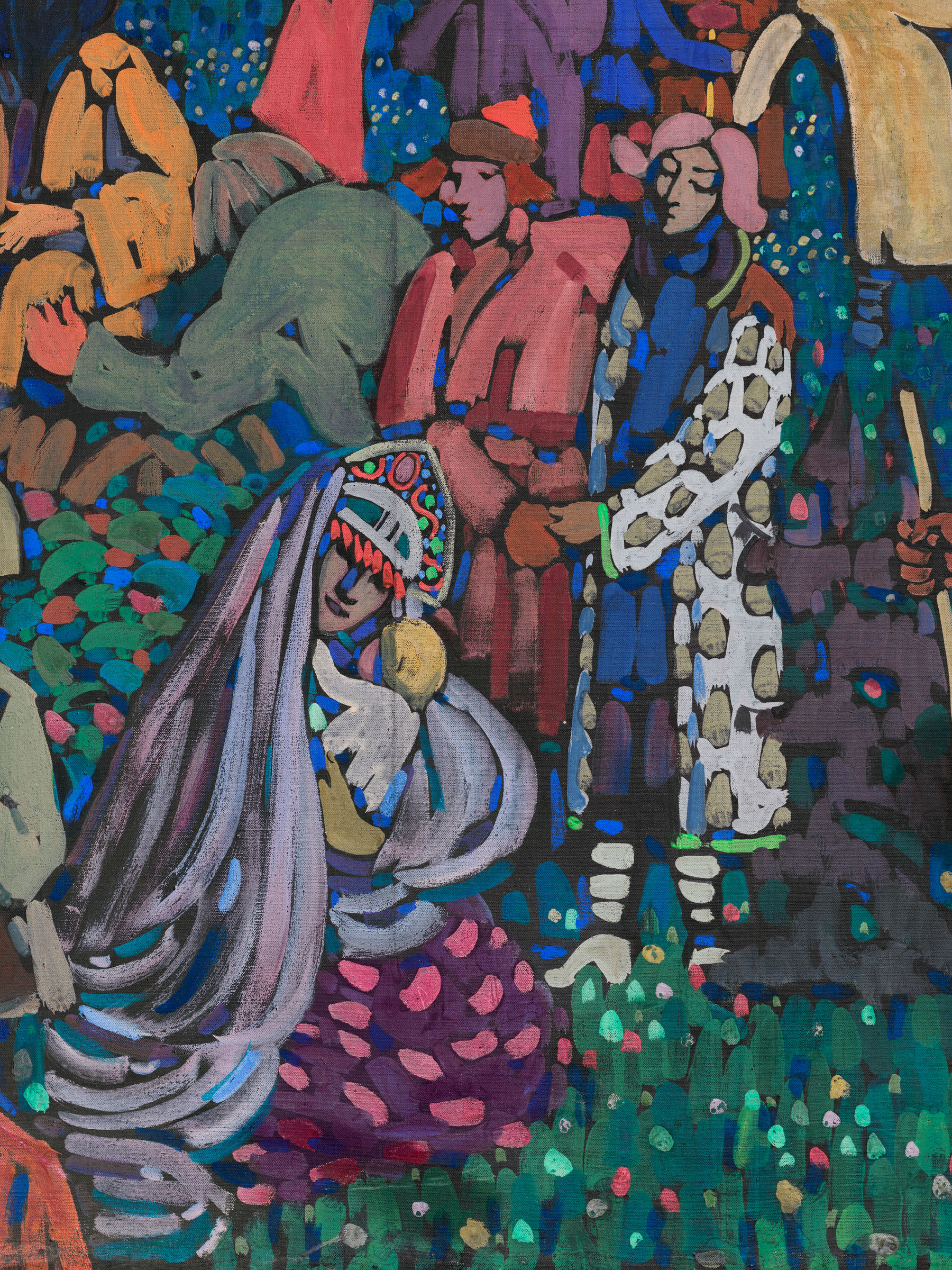
    People of various ages and backgrounds gather together in a semi-rural setting: from pilgrims and peasants, beggars and monks, to a mother cradling her young child, each of them dressed in vividly patterned clothing. No clear narrative thread unites them. However, activity abounds, in a set of intriguing vignettes.

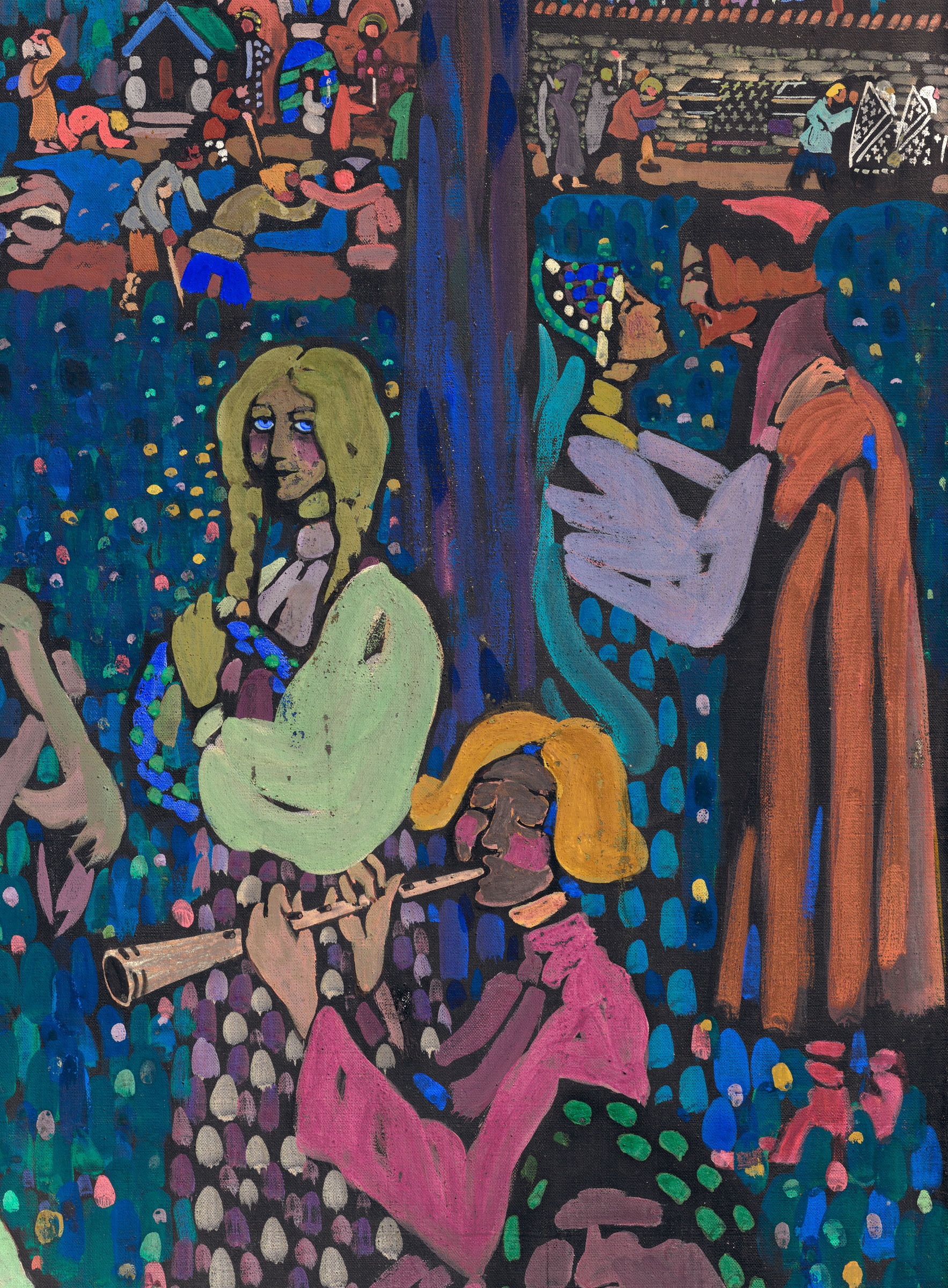
    Kandinsky painted the scene in distinct compositional bands, leading our eye from figures in the foreground to a walled town crowning a hill in the distance. The figures include an aged traveller with a walking stick, and a pipe-player (on the right) who creates a festive atmosphere, while those around her eat, revel and chat.

    That atmosphere doesn’t extend to the area directly behind them, though, where a handful of men are engaged in heated argument. Behind those men, in turn, is the more startling sight of a battle between a crowd of figures with spears.


    Wassily Kandinsky, Das bunte Leben (The Colourful Life), 1907, offered in the 20th/21st Century: London Evening Sale on 14 October 2026 at Christie's London

    A mother and child are among the many colourfully clothed figures depicted by Kandinsky in Das bunte Leben

    Wassily Kandinsky, Das bunte Leben (The Colourful Life), 1907, offered in the 20th/21st Century: London Evening Sale on 14 October 2026 at Christie's London

    A broad sweep of human life is represented, from a happy musician in the foreground, via a pair of lovers, to a funeral procession in the distance

    Newly settled in Paris, Kandinsky and Münter attended numerous art exhibitions and got to know dealers, gallerists and collectors aplenty. The collectors included the expatriate American siblings Leo and Gertrude Stein, who acquired Henri Matisse’s picture Le Bonheur de vivre after its successful showing at the Salon des Indépendants early in 1906. Leo went so far as to describe it as ‘the most important painting of our age’. This joyful scene depicts a set of nude figures reclining and frolicking together in an Arcadian landscape.

    It’s possible that Kandinsky saw the painting on a visit to the Steins’ apartment. In any case, he would have been aware of a trend in contemporary Paris for art exploring the richness of human life through scenes set in utopias. Other examples include Paul Signac’s Au temps d’Harmonie and André Derain’s La Danse.

    Kandinsky challenged himself to emulate his peers with a take on a similar theme. Set on a grand scale, measuring 130.5 x 162.6 cm, Das bunte Leben was his largest painting to date.

    Kandinsky was born in Moscow in 1866. He trained as a lawyer and, before deciding upon a life in art, served as associate professor of law at Moscow University. His initial career saw him travel through the Russian province of Vologda, hundreds of miles north of his home town, to study the local legal system.

    He found the area untouched by Western influence. It was like ‘journeying to another planet’, Kandinsky said, emerging from his trip in 1889 with a lifelong appreciation of the wealth of traditional art, culture and storytelling that persisted there.


    Henri Matisse, Le Bonheur de vivre (The Joy of Life), 1905-06. The Barnes Foundation

    Henri Matisse (1869-1954), Le Bonheur de vivre (The Joy of Life), 1905-06. Oil on canvas. 69½ x 94¾ in (176.5 x 240.7 cm). The Barnes Foundation. Photo: courtesy of the Barnes Foundation, Merion and Philadelphia, Pennsylvania

    By the time of his move to Paris, that appreciation was twinned with a wider one of Russian folklore as a whole, notably the epic songs known as byliny, which told of heroic and magical characters. Now this was to manifest itself in his art.

    Kandinsky produced a number of pictures, such as Das bunte Leben and Lied (Chanson) — today part of the Pompidou Centre’s collection — which drew heavily on elements from different tales. With these works, Kandinsky said he wished to ‘express the musical spirit of Russia’.

    The shift may have been inspired, at least in part, by the popularity of the Exposition de l’art Russe, a vast exhibition of old and new Russian art organised as part of the Salon d’Automne in Paris in 1906 by the impresario Sergei Diaghilev. Though none of the 700-plus works in Diaghilev’s showcase was by Kandinsky, the artist visited multiple times.

    These experiences, combined with his memories of traditional legends and stories, found bold expression in Das bunte Leben. Certain details and motifs may be tied to specific tales, such as the house of a legendary witch called Baba Yaga, seen in a tree canopy towards the composition’s top right; and the figures of Boris and Gleb in the central foreground, two royal princes who, after their martyrdom in 1015, were declared saints.

    There is also an armoured knight on horseback, raising his sword in the air. Knights were recurring characters in byliny, and the example here seems to be readying his steed for a mission outside of the picture, to the right. The character of the horse and rider would later become the iconic emblem of the Blaue Reiter group Kandinsky founded in Munich alongside Franz Marc.


    Wassily Kandinsky, Lied (Chanson), 1906. The Pompidou Centre, Paris

    Wassily Kandinsky (1866-1944), Lied (Chanson), 1906. Tempera on cardboard. 49 x 66 cm. The Pompidou Centre, Paris

    Das bunte Leben translates as ‘The Colourful Life’, and the painting’s colour — at once expressive and intense — is among its most striking features. Against a black ground, numerous bright touches of pigment stand out, accentuating the slight sense of otherworldliness.

    Kandinsky’s influence here may have been the clothing and furniture he saw in Vologda — their ornamentation so brightly coloured, he said he would never forget it.

    Another influence was surely the Fauves, who had burst onto the art scene in 1905, liberating colour from its ages-old descriptive function. They heightened the vibrancy of their pigments and treated colour as an autonomous force capable of conveying emotion and spirit, or simply serving as decoration.

    Such freedom of colour is in evidence throughout Das bunte Leben, perhaps most notably in the rendering of the traveller’s beard in luminous mint-green. It marked a crucial stepping stone on Kandinsky’s career path towards complete abstraction (a destination he reached in the run-up to the First World War, with works such as Composition VII).

    Kandinsky had strong ambitions for Das bunte Leben. He showed it at the Salon d’Automne in October 1907. It was subsequently acquired by the progressive German gallerist Herwarth Walden, who included it in an exhibition of the artist’s work at his Berlin headquarters, Galerie Der Sturm, in 1912.

    Emanuel Albert Lewenstein and Hedwig Lewenstein-Weyermann, a Dutch husband and wife, purchased the painting the following decade. The former ran a successful business manufacturing and selling sewing machines, and the couple were keen collectors of modern art. They also owned works by the likes of Jean Metzinger and Oskar Kokoschka.

    Wassily Kandinsky, Das bunte Leben (The Colourful Life), 1907, offered in the 20th/21st Century: London Evening Sale on 14 October 2026 at Christie's London

    Kandinsky’s intention in Das bunte Leben and similar works was to ‘let the viewer take a stroll within the picture’. Offered in the 20th/21st Century: London Evening Sale on 14 October 2026 at Christie’s in London

    Lewenstein died in 1930, and his wife in 1937, after which, according to the terms set out in her will, the couple’s art collection was to be divided between their two children, Robert and Wilhelmine Lewenstein.

    There is no indication that such a division ever took place, however. When Nazi Germany invaded the Netherlands shortly after the start of the Second World War, both Robert and Wilhelmine were living abroad.

    Because they were Jewish, the siblings’ assets — including their shares in the family business — were confiscated. The art collection was lost to them, too, being offered for sale at the Amsterdam auction house Frederik Muller & Cie in October 1940. (It remains unclear under whose direction the works came to market, or who benefited from the proceeds.)

    Das bunte Leben was bought by the Dutch collector Salomon B. Slijper, after whose death in 1971 it entered the collection of Bayerische Landesbank in Germany. The bank placed the painting on long-term loan at the Städtische Galerie im Lenbachhaus, in Munich, where it hung for almost five decades.In 2023, Das bunte Leben was restituted to the Lewensteins’ heirs following decades of diligent research and legal action on the family’s part — Robert and Wilhelmine having begun a quest at the end of the war to recover their parents’ art collection.

    The German art historian and Kandinsky expert Hans K. Roethel described Das bunte Leben as ‘one of Kandinsky’s most important paintings’. It is a timeless scene, meditating on the complexity of human existence. Peace is juxtaposed with strife, old with young, rich with poor, and (in the case of the two lovers on the right, unaware of a funeral procession going on behind them) love with death.

    Such dichotomies and symbolic allusions are found across the picture — Kandinsky marrying the cultural traditions of his native Russia with the cutting-edge artistic developments he was absorbing apace in Paris.