Thursday, June 28, 2012

Revealing the Renaissance: Art in Early Florence


The splendour and devotion of the Early Renaissance come to life at the Art Gallery of Ontario (AGO) next spring with a large-scale exhibition of Florentine masterpieces, presented in partnership with the world renowned J. Paul Getty Museum in Los Angeles.

Revealing the Renaissance: Art in Early Florence brings together rare panel paintings, manuscripts, sculpture and stained glass to tell the inside story of how the artists of one city brought about the birth of the Renaissance. Thanks to new scientific and art-historical research into the materials and techniques employed by painters of the time, as well as interactive iPad stations, audiences will learn more about how these masterpieces were created. The exhibition will take place at the AGO from March 16 to June 16, 2013.

Revealing the Renaissance: Art in Early Florenceis presented in collaboration with the J. Paul Getty Museum of Los Angeles, which will display the exhibition from Nov. 13, 2012 to Feb. 10, 2013 under the title Florence at the Dawn of the Renaissance: Painting and Illumination, 1300–1350.

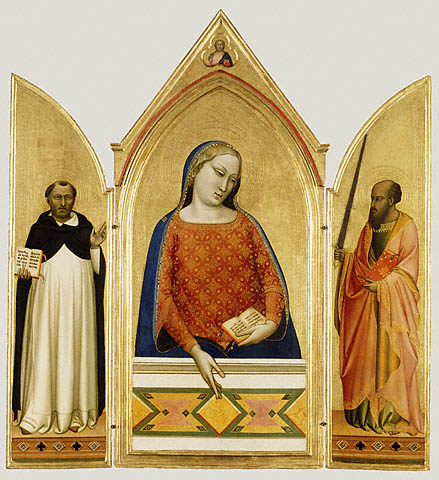
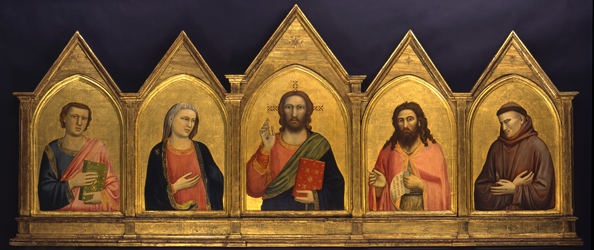
The exhibition comprises more than 90 key pieces from the first half of the 14th century, including Giotto’s five-panel Peruzzi Altarpiece and his Madonna of San Giorgio alla Costa, two painted and hand-written copies of Dante’s Divine Comedy, and Bernardo Daddi’s Virgin Mary with Saints Thomas Aquinas and Paul. The works, which have been secured by a team of staff members from the AGO and the Getty, will transport audiences back in time to Florence in the Early Renaissance.

“The AGO is proud to join forces with the Getty Museum, which is renowned internationally for its exhibitions, conservation and research,” said Matthew Teitelbaum, director and CEO of the AGO. “This exhibition and the programming around it allow us to look at one of the most crucial periods in Western art history with fresh eyes. We invite visitors to view these seminal works through a contemporary lens, relating the issues of Florentine society at the dawn of the Renaissance to those of our modern lives.”

Subdivided into various themes,Revealing the Renaissance: Art in Early Florence will explore how the city’s burgeoning economy of the time fostered a unique demand for artworks both religious and civic, as well as the collaborative nature of artistic production, a closer look at the workshops of artists, the stories behind the works and their subjects and insight into conservation research. Visitors will interact with the exhibition at numerous hands-on stations, offering the opportunity to explore inside the Renaissance artist’s studio, discover the pigments and tools used, hear music from a book whose pages will be reunited for the first time in over a century, view footage of Florence and see aspects of the works through the microscopes of conservators.

Curated by Christine Sciacca, assistant curator of manuscripts at the J. Paul Getty Museum, together with coordinating curator Sasha Suda, assistant curator of European art at the AGO, Revealing the Renaissance: Art in Early Florence will bring to life recent discoveries about artistic techniques and studio practice in Florence between 1300 and 1350. In conjunction with the exhibition, the AGO will host a public symposium that will assemble leading international experts to discuss the relationship between scientific research and art history.

"The exhibition features artists who were masters in both panel painting and manuscript illumination in the vibrant cultural climate of 14th-century Florence," explained Sciacca. "With new findings about artistic techniques and artists' workshops based on conservation research and scientific analysis, we are able to present a rich, nuanced picture of the beauty and creativity of artistic production in Florence." According to Suda, “this exhibition will make it clear that the diverse artistic practices of Giotto and his contemporaries paved the way for generations of Italian Renaissance masters to come.”

The exhibition is the first of its kind in Canada, as many of the treasured works have never travelled before and likely will not again for generations to come. Notable works include:


• Giotto di Bondone, Pentecost, Tempera and gold leaf on panel, 43 cm x 31.7 cm (The National Gallery, London)


• Giotto di Bondone, Madonna of San Giorgio alla Costa, Tempera and gold leaf on panel, 180 cm x 90 cm (Museo Diocesano di Santo Stefano al Ponte, Florence)


• Bernardo Daddi, The Virgin Mary with Saints Thomas Aquinas and Paul, Tempera and gold leaf on panel, 120.7 cm x 55.9 cm (Getty)

• Pacino di Bonaguida, Polyptych: The Crucifixion, Saint Nicholas, Saint Bartholomew, Saint Florentius, and Saint Luke, 182 cm x 249 cm (Galleria dell’Accademia, Florence)


• Pacino di Bonaguida, Carmina regia: The Appeal of Prato to Robert of Anjou, 47.7 cm x 34.2 cm (The British Library, London)

• Biadaiolo Illuminator, Specchio Umano, 38.5 cm x 27.2 cm (Biblioteca Medicea Laurenziana, Florence)


PUBLICATION:


A catalogue, Florence at the Dawn of the Renaissance: Painting and Illumination, 1300-1350 will be published to accompany the exhibition.

Wednesday, June 27, 2012

Alfred Stieglitz: Photographs


Alfred Stieglitz has been renowned for his introduction of modern European art to America and for his support of contemporary American artists, but he was first and foremost a photographer. His photographs, which span more than five decades from the 1880s through the 1930s, are widely celebrated as some of the most compelling ever made. Alfred Stieglitz: Known and Unknown, on view at the National Gallery of Art West Building June 2 through September 2, 2002, presented 102 of Stieglitz's photographs from the National Gallery's collection. Encompassing the full range and evolution of his art, the exhibition included many works that had not been exhibited in the last fifty years. It highlighted less well-known images in order to demonstrate how they expand our understanding of the development of his art and his contributions to 20th-century photography.

The exhibition, which was the culmination of a multi-year project on Stieglitz at the National Gallery, also celebrated the publication of Alfred Stieglitz: The Key Set, a definitive study of this seminal figure in the history of photography. Consisting of 1,642 photographs, the key set of Stieglitz's photographs was donated to the National Gallery by Georgia O'Keeffe in 1949 and 1980 and contains the finest example of every mounted print that was in Stieglitz's possession at the time of his death. It was the largest and most comprehensive collection of his work in existence.

The exhibition, which was arranged chronologically, provided new insights into the development of Stieglitz's art and demonstrates how he continuously investigated the technical and expressive capabilities of the medium.

Germany, 1886-1890:

Born in Hoboken, New Jersey, Stieglitz began to photograph, probably in 1884, while a student in Germany. The medium captivated and challenged him as nothing else had done before. His teacher, Hermann Wilhelm Vogel, a highly respected photographer, scientist, and professor at the Königliche Technische Hochschule in Berlin, instilled in him a profound appreciation for the science and practice of the process. At Vogel's direction, Stieglitz tackled a wide variety of subjects and exhaustively explored the relationship of light to photography.


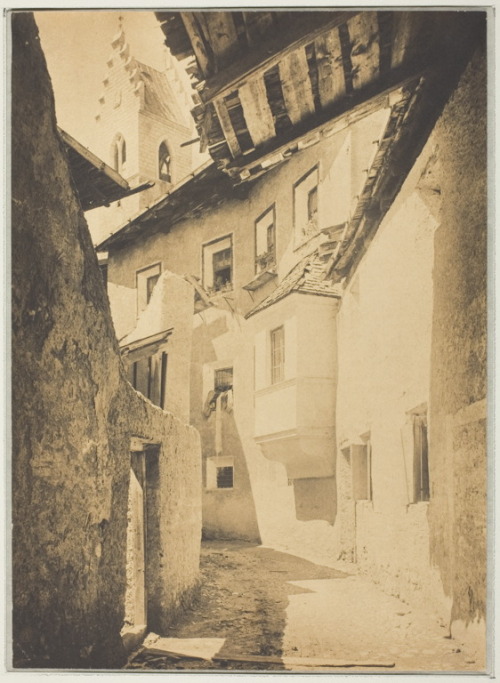
These technical experiments, including A Street in Sterzing, The Tyrol (1890), on view in the exhibition, are among his most accomplished early works. Stieglitz was also influenced by contemporary German, Dutch, and Austrian painters, several of whom were close friends. He strove to replicate their anecdotal, narrative, and picturesque subject matter in such photographs as The Harvest, Mittenwald (1886), also on view in the exhibition.

1890-1904:

In the fall of 1890, after nine years of study in Germany, 26-year-old Stieglitz returned to New York and quickly established himself as a leading artistic photographer. He continued to draw inspiration from contemporary painters, but his scope widened considerably to include the French artist Jean-François Millet, the German Max Liebermann, and the American James Abbott McNeill Whistler. Like other photographers of the time, Stieglitz began to use a small, hand-held camera, but he utilized every means available to him to transform his images, as he wrote, from mere "photographs [into] pictures." He radically cropped his negatives to eliminate distracting and extraneous elements from his compositions. He also often enlarged them to make prints as big as twenty-one inches wide and to retouch portions of the pictures easily. Further appropriating the materials and palette of a painter, he also made carbon, gum bichromate, and photogravure prints in charcoal gray and brown, even red, green, and blue hues. And he carefully matted and framed his finished prints so that they would command attention in the large international exhibitions.


Several of the photographs, including Winter-Fifth Avenue (1893),


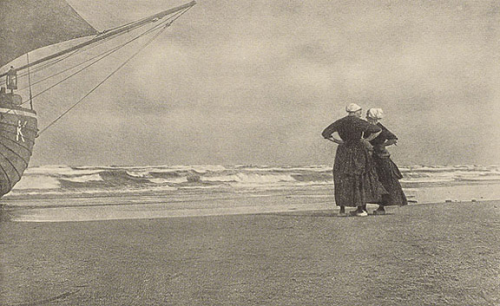
Gossip-Katwyk (1894),


and A Wet Day on the Boulevard, Paris (1894),
were in their original mats and framed as Stieglitz would have presented them in the 1890s.

291, 1905-1917:

In 1905 Stieglitz opened a gallery, which came to be called 291 (from its address on Fifth Avenue in New York), where he exhibited the work of his elite group of artistic photographers, the Photo-Secession (founded by Stieglitz in 1902). In 1908, in order to initiate a dialogue between contemporary photographers and painters, he began to show the work of leading European modernists, including Paul Cézanne, Henri Matisse, Pablo Picasso, and Constantin Brancusi. These artists introduced Stieglitz to new ideas of color, form, and abstraction that deeply influenced his art.


In a series of photographs of New York from 1910, such as Outward Bound,


The Mauretania,


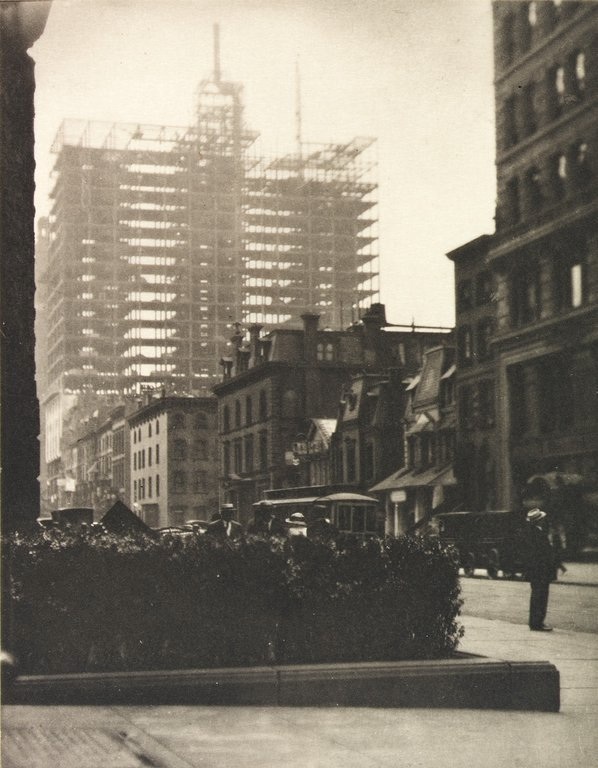
and Old and New New York,
Stieglitz abandoned the soft focus of his work from the turn of the century and revealed the new, bolder use of form that he had learned from these artists.

Stieglitz continued his investigation of New York in the spring of 1915 in a series of photographs made out of the back window of 291. Influenced by Picasso and Braque, he sought to eliminate a sense of three-dimensional space and traditional one-point perspective. In these precisely constructed and elegantly realized photographs, Stieglitz carefully dissected the planes of the rooftops and buildings in order to reveal both the physical mass of the city and its psychological weight.

The portraits Stieglitz made at 291 represent a significant advancement in his art and demonstrate the dialogue between modern painting and photography that he sought to construct.


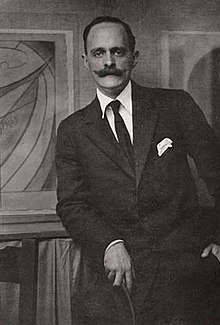
In Marius de Zayas (1913)


and Georgia O'Keeffe (1917) he placed the artists in front of their own works, echoing the forms from the canvas in his own depictions of them. Fascinated by Picasso, whom he met in 1911 and exhibited that same year and again in 1915, Stieglitz photographed several friends and family in front of the Spanish artist's works, as, for example, in Kitty at 291 (1915).

Georgia O'Keeffe, 1918-1921:

The years from 1918, when Georgia O'Keeffe moved to New York, until 1937, when Stieglitz put his camera away because of poor health, were the most prolific ones in his career. O'Keeffe inspired in him a creative passion he had never known before, and within the first three years that they lived together he had made more than 140 studies of her (the key set contains 331 photographs of O'Keeffe taken between 1917 and 1937). He called his photographs of her a "composite portrait," and his aim was to document not only his understanding of O'Keeffe's personality but also the larger concept of "womanhood." Stieglitz soon applied the lessons he had learned from photographing O'Keeffe to his portraits of other people.


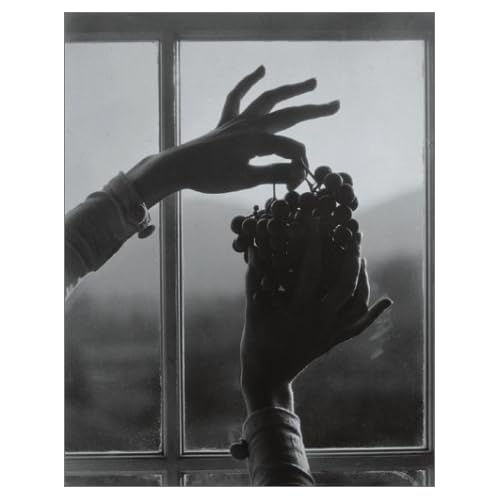
In his series of studies of Helen Freeman (1921/1922), for example, he progressed, as he had done with O'Keeffe, from the formal studies of face and shoulders to more intimate photographs, and he also recorded her hands as an index of her personality.

Lake George, 1920s:

A lighthearted, playful quality, coupled with a more daring experimentation, entered Stieglitz's work in the 1920s. With the closure of 291 in 1917, Stieglitz was freed from his responsibilities as a gallery director and had more time to devote to his own art. During the 1920s he and O'Keeffe spent several months each year at Lake George--his family's summer home in New York's rolling Adirondack Mountains. Here he vigorously investigated the most amateurish aspect of photography, the snapshot. Made with his small hand-held 4 x 5 or 3 1/4 x 4 1/4 inch cameras, these casual and spontaneous compositions record the long, languid days of summer, as seen in


Bly and Venus (1920),

Georgia O'Keeffe and Waldo Frank (1920), Katharine (1921), and Rebecca Salsbury Strand (1922).


In the late 1910s and early 1920s, encouraged by the work of American artists Arthur Dove, John Marin, and O'Keeffe, Stieglitz, for the first time in his art, began to explore the rural American landscape and photographed the surrounding vistas at Lake George. It was also during these years that Stieglitz made his series of abstract and evocative studies of clouds. Using a small hand-held camera that could be easily pointed at the zenith of the sky, he made photographs without a horizon line to anchor the viewer, thus creating a sense of disorientation and abstraction. He strove to make a new language for photography that was less dependent on subject matter, more intuitive and expressive of a mood or emotional state.

New York, 1927-1937:

In the early 1930s Stieglitz rediscovered a subject that had inspired him throughout his career--New York City--but his photographs of it from these years have a formal strength and lucidity unknown in his previous work. He was inspired by the views from his windows high up in the newly constructed Shelton Hotel, where he and O'Keeffe lived from 1925 to 1936, as well as from his last gallery, An American Place, at 509 Madison Avenue, which he directed from 1929 until his death in 1946.
At various times of the day and using different lenses, he photographed the visual spectacle of the constantly changing city as seen in his series of photographs, From My Window at An American Place, taken from 1930 to 1932. When Stieglitz exhibited these photographs he grouped them into series--two of which have been recreated in the exhibition--that charted both the growth of the skyscrapers and the more subtle but constantly changing patterns of light and shade. Once the buildings were completed, though, Stieglitz generally lost interest in photographing them for the sense of change was no longer present.

Lake George, 1929-1937:

In the early 1930s, O'Keeffe reappeared as a major subject in Stieglitz's art, but the distance between them, as seen in several studies on view in the exhibition, is obvious. With their metallic sheen, deep blacks and complex geometry, these photographs are among his strongest portraits of O'Keeffe and also his most poignant. As he spent more time alone at Lake George, the farmhouse and its surrounding fields, trees, and lakes once again became the focus of his art. Like his photographs of New York from the same time, these are rigorous but also quiet and intensely autobiographical works.

Curator

The exhibition was organized by the National Gallery of Art, Washington. The curator was Sarah Greenough, the Gallery's curator of photographs and a noted expert on Alfred Stieglitz. It was on view at the Museum of Fine Arts, Houston, from October 6, 2002, through January 5, 2003.

PUBLICATIONS:


Alfred Stieglitz: The Key Set: This two-volume catalogue--in which all 1,642 photographs in the Gallery's key set are beautifully reproduced--includes an introductory essay by Greenough and appendices on Stieglitz's techniques and processes. It presents a wealth of significant new research, and, for the first time, an accurate record of the development of Stieglitz's art.

A new edition of the Gallery's award-winning 1983 book Alfred Stieglitz: Photographs and Writings, which had long been out of print was also issued.
Tuesday, June 26, 2012

ANDRÉ KERTÉSZ Renowned Photographer


In a 70-year career, which spanned much of the 20th century, André Kertész (1894-1985) made some of the most deceptively simple yet compelling and poetic photographs ever created. André Kertész, on view February 6 through May 15, 2005, at the National Gallery of Art, was the first major Kertész retrospective of vintage photographs held in the United States; also, the show will present works never before exhibited or reproduced. Following its premiere in Washington, D.C., the exhibition traveled to the Los Angeles County Museum of Art, where it was on view June 12 through September 5, 2005.
Including some of the most celebrated works in 20th-century photography--such as Chez Mondrian and


Satiric Dancer, both from 1926--120 objects featured photographs from all periods of Kertész's exceptionally rich and diverse body of work: from his early photographs of his native Budapest made in the 1910s and early 1920s, to his studies of Paris in the 1920s and 1930s, and the final series of photographs he took of New York in the 1970s and 1980s, shortly before his death.

Arranged chronologically, the exhibition surveyed the development of Kertész's oeuvre. It demonstrated his deep involvement with other artists of his time and shows how he used the camera to examine his relationship to the people and things around him. Kertész was revealed as emblematic of a generation of 20th-century artists whose migrations allowed them to rethink the nature and aims of their art as they sought to reconcile their native sensibilities with new cultures.

Born Kertész Andor, he began photographing in 1912. When he served in the Austro-Hungarian army in World War I, he packed a camera. He took photographs not of the battles or destruction of the war, but of soldiers during their rare moments of leisure. After the war, he became fascinated with recording scenes of active, physically fit young people exuberantly enjoying life, such as his portrait of his brother, Jen Kertész (1919-1924). His circle of friends at this time grew to include many painters and graphic artists who sought to find the roots of a new Hungarian identity through a celebration of Hungary's rural past and its peasant life.


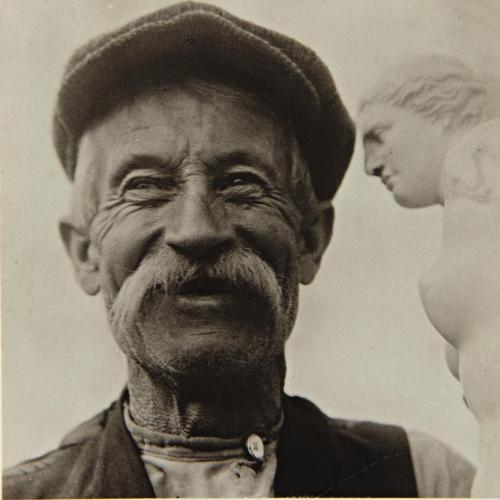
The influence of their art and ideas can be seen in such Kertész photographs as Blind Musician, Abony (1921).

Kertész in Paris

In 1925, after several desultory years working in a variety of jobs in Budapest, Kertész Andor decided to pursue a career in photography. Like so many artists and intellectuals of the period, he moved to Paris, where he changed his name to André Kertész. Never fluent in French, he was closest to his fellow Hungarians, including the painters Lajos Tihanyi, Gyula Zilzer, and István Bethy. He also met and photographed such luminaries as Marc Chagall, Colette, Sergei Eisenstein, Tristan Tzara, and many others.


One of his best-known works, Chez Mondrian (1926), depicts Mondrian's vestibule.

Kertész's poetic celebrations of traditional Parisian life and culture--its cafés, fairs, and parks; its streets, clochards, and the Seine--captured the essential mystery of the French capital. During his years in Paris he created some of his most well-known works, including


Meudon (1928),


Under the Eiffel Tower (1929),


and Clock of the Académie Française (1929)
. Kertész was fortunate to arrive in Paris at the moment when European illustrated magazines were hungry for photographs to fill their pages. He sold his work to--and gained wide recognition in--such French periodicals as Vu, L'Art Vivant, and Variétés and the German publications Berliner Illustrirte Zeitung and UHU.

Kertész in New York

In 1936, lured by a lucrative contract to establish a fashion studio for a picture agency in New York, Kertész moved to the United States. He soon realized, though, that he was not adept at studio work and that his European sensibility did not merge easily with an American way of doing business. However, the growing hostilities in Europe prevented him from returning there, and he remained in America for the rest of his life. Kertész worked for Harper's Bazaar, House and Garden, and other magazines. He also made photographs for himself that express his fascination with the spectacle of New York City, and his growing sense of isolation and loneliness.

In 1962, after fifteen years, Kertész quit his job at House and Garden. At the same time, his work began to find broad favor with an American audience increasingly fascinated with European photography of the period preceding World War II. By the mid-1970s, a succession of high quality books, exhibitions, and portfolios made Kertész a rising star in the photography world. The final years of Kertész's life were filled with honors and awards, perhaps the greatest of which was receiving the decoration of the Legion of Honor from the French government.

As a sign of his deeply felt connection to the country where he had first achieved significant artistic success, Kertész made plans to donate his archive to the French government, including a lifetime of notes and correspondence as well as his negatives and contact sheets. He also founded The André and Elizabeth Kertész Foundation in New York and dedicated it to supporting the arts and preserving his legacy. He continued to explore the world through his camera with his characteristic playful curiosity almost up to his death; he died at home in New York on September 28, 1985.

Cézanne to Picasso


Cézanne to Picasso: Paintings from the David and Peggy Rockefeller Collection was an intimate installation that highlights a group of nine exceptional early modern European paintings that have been promised over the years to The Museum of Modern Art by David and Peggy Rockefeller. Thematically, the ensemble provided a small survey of portraiture, landscape, and still-life painting during the early period of modern art. Featuring superb examples of Post-Impressionist, Fauvist, and Cubist painting, ranging from Paul Cézanne’s Still Life with Fruit Dish (1879–80) to Pablo Picasso’s The Reservoir, Horta de Ebro (summer 1909), this presentation of the early flowering of modern art celebrated the Rockefellers’ longstanding generosity to the Museum. Cézanne to Picasso: Paintings from the David and Peggy Rockefeller Collection is organized by Ann Temkin, Marie-Josée and Henry Kravis Chief Curator, Department of Painting and Sculpture, The Museum of Modern Art, and was on view in The Mercedes T. and Sid R. Bass Gallery on the fifth floor from July 17 to August 31, 2009.

Mr. Rockefeller’s association with MoMA began in his childhood when he often visited the galleries with his mother, Abby Aldrich Rockefeller, who, along with Miss Lillie P. Bliss and Mrs. Cornelius J. Sullivan, founded the Museum in 1929. He has served the Museum with great distinction in many capacities, including two terms as Chairman of the Board of Trustees and in his present position as Honorary Chairman.


The installation began with four works associated with Post-Impressionism: Cézanne’s Still Life with Fruit Dish


and Boy in a Red Vest (1888-90),


Paul Gauguin’s Portrait of Jacob Meyer de Haan (1889),

and Paul Signac’s Opus 217. Against the Enamel of a Background Rhythmic with Beats and Angles, Tones, and Tints, Portrait of M. Félix Fénéon in 1890 (1890).

Fauvist works by Henri Matisse and André Derain feature the radical color palette that the artists developed together in the summer of 1905 in Collioure, France.


In Interior with a Young Girl (Girl Reading) (1905–06), Matisse painted his daughter Marguerite in nearly as many colors as the fruit on the table beside her.


In Charing Cross Bridge (1906 or 1907), Derain ignores the customary gray of the London sky, rendering it instead with imaginative colors.


These two works are followed by Georges Braque’s The Large Trees, L’Estaque (1906-07) and Raoul Dufy’s The 14th of July at Le Havre (1907).


The installation concluded with Picasso’s cubist landscape The Reservoir, Horta de Ebro.

Drawings of Jim Dine


Leading American artist Jim Dine's groundbreaking achievements as a draftsman beginning around 1970 were featured in Drawings of Jim Dine at the National Gallery of Art, West Building, March 21 through August 1, 2004. The first major survey of Dine's drawings in over 15 years, the exhibition included more than 100 of his drawings from around 1970 to the present, borrowed from public and private collections. Often associated with Pop art and the Happenings of the 1960s, Dine became known for his paintings, prints, and sculptures--works that employed recurring themes such as tools, hearts, and bathrobes. This exhibition will focus on subjects for which Dine is renowned--his iconic images of tools--as well as less publicized themes from the eighties and nineties, including images of owls, studies of ancient sculpture and nature, and portrayals of proverbial characters such as Pinocchio.


Drawings of Jim Dine was organized chronologically and began with a 16-foot-long charcoal work on canvas entitled Name Painting (1935-1963) #1 from 1968-1969. National Gallery curator Judith Brodie suggested that this work--an attempt by Dine to recall all the names of those individuals who affected his life between 1935 and 1963--very likely inspired a period of concentrated involvement with drawing during the 1970s. Works on view from that decade showcased Dine's intensified commitment to drawing and include a series of seven superb drawings of tools from the Museum of Modern Art, New York.


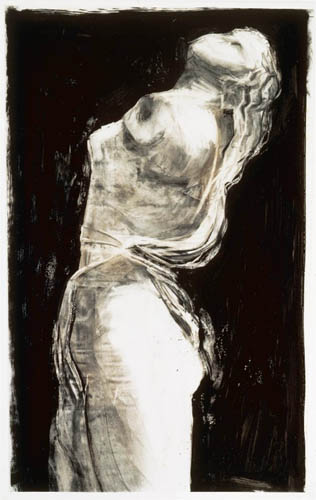
In 1974, Dine began drawing from the figure, employing live models, photographs, mirror-images of himself, even department store mannequins. The Die-Maker (1975) reveals Dine's shift to life drawing and his innate skills as a draftsman.


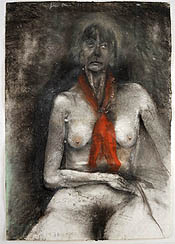
Other large-scale and evocative drawings of nudes--The Skier (1976),

The Red Glove (1975–1976)


and Red Scarf
(1976)--reveal a similar attention to the human form as well as Dine's very physical approach to drawing. Some areas of these drawings are abraded and torn. Dine aims to have his works convey a sense of history, the weathered signs of their own making. In Nine Self-Portraits with a Very Long Beard (1977), Dine explored the traditional genre of self-portraiture but in a non-traditional format, creating a set of nine variably adjusted drawings that the artist considers one work.

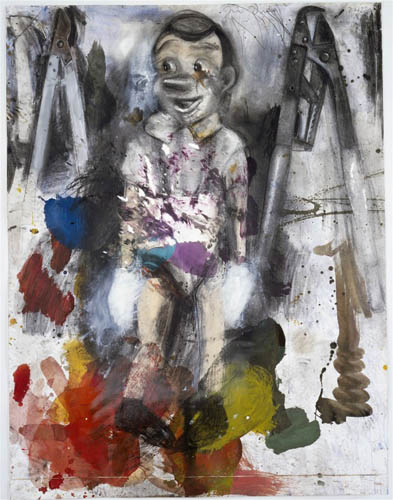
Since the last major exhibition of his drawings in 1988, Dine has introduced new subjects--such as antique sculpture, the owl and raven, a towering mountain in Austria, and the puppet Pinocchio. Dine feels a strong kinship with all of his subjects. In the case of Pinocchio, he adopts the puppet as an alter ego. He is moved by the puppet's tale, especially his genesis and identifies with Geppetto's ability to bring an inanimate object to life.


Pinocchio with Two Kinds of Clippers from 2002 pairs the new subject of Pinocchio with the artist's trademark tools, enriching Dine's dialogue with his subjects.

Throughout the seventies and into the eighties, Dine lived in Vermont and in this lush environment, trees, plants and flowers became one of his enduring themes, as revealed in Tree (The Kimono) from 1980 and Mandrake Root (after Ligozzi) from 1985.


In keeping with the artist's inclination to revisit chosen themes, the exhibition also featured drawings of tools from 2000 to the present, such as Elyria,

Natural Light #1, and Natural Light #2.


The exhibition concluded with one room devoted entirely to forty works--The Glyptotek Drawings--made from early Greek and Roman sculpture. These forty separate sheets, which constitute one work, demonstrate Dine's profound sense of wonder in the presence of the antique.

THE ARTIST

Dine was born in 1935 in Cincinnati, Ohio. After his mother's death when he was a teenager, he went to live with his maternal grandparents. His grandfather owned a hardware store where Dine acquired an appreciation for tools. Dine received a B.F.A. in 1957 from Ohio University and enrolled in its graduate program the following year. In 1958 he went to New York, where he collaborated with artists such as Claes Oldenburg. Dine soon became a pioneer creator of Happenings--multimedia theatrical pieces that were highly unpredictable in character.

Dine's mixed-media constructions and experimentation with Happenings quickly earned him a reputation as an exceptional young talent, and between 1960 and 1965 his work was widely exhibited with that of the newly emerging Pop artists. In the 1970s Dine made a dramatic shift, an aspect of which was a heightened regard for drawing. He believed that he had exhausted the possibilities at hand and needed a broader foundation to build on--one grounded in life drawing. Dine's objective was not, however, to become a figurative artist, instead, as he states in the exhibition catalogue, it was "all about looking--looking hard."

As Dine continued to revise his artistic ambitions throughout the 1970s, he repeatedly turned to drawing. Thirty years later, drawing remains at the core of his range of expression.

Judith Brodie, curator of modern prints and drawings at the National Gallery of Art, was curator of the exhibition and principal author of the catalogue (200 pages, 110 color plates). The artist joined the design team of the catalogue, which was co-published by the National Gallery of Art and Gerhard Steidl, Göttingen.

Related article

Monday, June 25, 2012

The Cubist Paintings of Diego Rivera


On view at the National Gallery of Art, Washington, D.C. April 4 through July 25, 2004, The Cubist Paintings of Diego Rivera: Memory, Politics, Place celebrated a significant but little-known Rivera painting of 1915, No. 9, Nature Morte Espagnole (No. 9, Spanish Still Life), a recent gift to the National Gallery from the estate of Washington Post publisher Katharine Graham.


No. 9, Nature morte espagnole (No. 9, Spanish Still Life), 1915


Organized by the National Gallery of Art, Washington, in collaboration with the Museo de Arte Moderno, Mexico City, the exhibition coincided with the Gallery's showing of the Courtly Art of the Ancient Maya. The Rivera exhibition then traveled to the Museo de Arte Moderno in Mexico City, where it was on view from September 22, 2004, through January 16, 2005.


Diego Rivera's work has been studied and shown in depth, yet his cubist period remains a less understood aspect of his career. The Cubist Paintings of Diego Rivera included some 20 works that demonstrate his distinctive approach to synthetic cubism--his use of complex structures of transparent planes, with a particular emphasis on sensory and memory association.

The exhibition explored the intersection of history and the avant-garde at a key moment in the artist's development. The selection emphasized the years 1914 and 1915, when Rivera was working in France and Spain. These works also illuminate the artist's deep engagement with themes of identity and place during a period that coincided not only with World War I but also with the most active period of the Mexican Revolution.

In key works in the exhibition, Rivera explored evocative links between objects, people, and places.


Among them are such works as Eiffel Tower (1914),


and En la fuente de Toledo (At the Fountain of Toledo), 1913 oil on canvas Museo Dolores Olmedo Patiño, Xochimilco

with emotionally charged references to the cities Rivera inhabited,


and portraits of figures he associated with these cities, including his Portrait of Martín Luis Guzmán (1915)and


The Architect (Jesús T. Acevedo), 1915 oil on canvas Museo de Arte Carillo Gil, CONACULTA, INBA, Mexico City


Many of the works in the exhibition, such as Zapatista Landscape (1915), incorporate objects that serve as emblems of Mexican identity: sarapes, petates (straw mats), an equipal (reed chair), and guajes (peasant gourds). The inclusion of Mexican motifs and Rivera's frequent use of the colors of the Mexican flag present a souvenir of his native land from afar, filled with revolutionary sympathy, nostalgia, and longing.

Together these paintings represent Rivera's finest cubist work and offer important meditations on self-identity and nationalism.

CURATORS

The exhibition was organized by Leah Dickerman, associate curator, modern and contemporary art, National Gallery of Art, in consultation with Luis-Martín Lozano, director, Museo de Arte Moderno, Mexico City. The exhibition was accompanied by a fully illustrated brochure.

The Weir Family, 1820-1920: Expanding the Traditions of American Art


New Britain Museum of American Art
June 30 - Sept. 30, 2012
Opening Reception:5:30-7:30 p.m., Friday, June 29, 2012
New Britain Museum of American Art 56 Lexington Street New Britain, CT 06052

About the exhibition

The Weir Family, 1820-1920: Expanding the Traditions of American Art, was organized by the Brigham Young University Museum of Art. It is the first major exhibition to collectively examine paintings by Robert Walter Weir, John Ferguson Weir, and Julian Alden Weir. It showcases important pieces from museum and private collections across the country, many of which have never been seen together. The exhibition explores how the transatlantic encounters of the Weir family of artists helped to shape American art for nearly a century.

The exhibition includes seldom-seen paintings from the collections of the Weir family and from the large Weir holdings of the Brigham Young University Museum of Art. The BYU holdings, which include paintings by Robert, John, and Julian Weir came to the university from the estate of the artist Mahonri Young, who was married to J. Alden Weir’s daughter Dorothy.

A fully illustrated catalogue with new essays by leading scholars in American art history and cultural studies accompanies the exhibition.

Robert Walter Weir

Robert began his artistic study in 1820 at the Academy of Design in New York City and then traveled to Italy for further training. He studied in Florence and Rome from 1824 to 1827. After returning to the United States, he married Louisa Ferguson and they became the parents of eight children, including John Ferguson Weir. On 8 May 1834, Robert was appointed professor of drawing at West Point, where he remained for the next forty-two years. After Louisa’s death from complications of childbirth, Robert married Susan Martha Bayard.

John Ferguson Weir

John received his initial art training from his father, Robert Walter Weir. He made several trips overseas, but did not complete any formal art study abroad. John is perhaps best known for founding the first studio arts program at Yale University, the first program of its kind at an American school. He served as director of the Yale School of Fine Arts for forty-four years, from 1869 to 1913. John married his childhood sweetheart, Mary Hannah French on 17 May 1866 in the Church of the Holy Innocents at West Point, which had been designed by his father Robert in honor of his mother Louisa. John and Mary had two daughters, Clara “Louise” and Edith Dean Weir.

Julian Alden Weir

From 1874 to 1877, Julian studied art at the renowned École des Beaux-Arts in Paris, under the tutelage of French artist Jean-Léon Gérôme. During the course of his studies, he befriended fellow artists like Jules Bastien-Lepage and made several trips to the French countryside as well as Spain. He often went by the name “J. Alden Weir” emphasizing the name of his benefactress, Mrs. Percy Alden, who financed his studies abroad. Julian was involved in various American art societies including the Tile Club and “The Ten.” He also served as president of the Society of American Artists as well as the National Academy of Design.

Works of Art Included in the Exhibition :


Julian Alden Weir (1852-1919), Normandy Farm, Oil on panel, c. 1874-76, Brigham Young University Museum of Art, Purchase/gift of Mahonri M. Young Estate

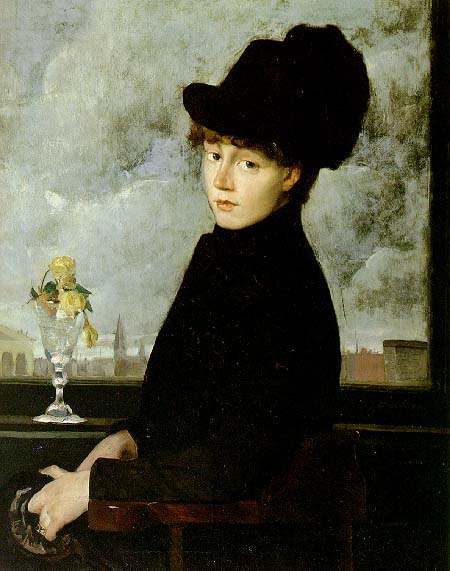
Julian Alden Weir (1852-1919), Against the Window, 1884, oil on canvas, 36 1/8 x 29 in., private collection.


Julian Alden Weir (1852-1919), Silver Chalice with Roses, 1882, oil on canvas, 12 x 9 in., Brigham Young University Museum of Art.

Julian Alden Weir (1852-1919), Moorish Figure, Brigham Young University Museum of Art


Julian Alden Weir, (1852-1919), In the Sun, 1899, oil on canvas, 3315/16 x 26 15/15 in. Brigham Young University Museum of Art, Purchase/gift of Mahonri M. Young Estate.

Robert Walter Weir (1803-1889), Picnic along the Hudson, 1881 oil on canvas, 20 1/8 x 30 1/8 in.. Palmer Museum of Art of the Pennsylvania State University, 2000.95.

Robert Walter Weir (1803-1889), Taking the Veil, 1863, oil on canvas, 49 1/2 x 39 3/4 in., Yale University Art Gallery.


Julian Alden Weir (1852-1919), Milkmaid of Popindrecht, 1881 oil on canvas, 76 1/2 x 51 in., Brigham Young University Museum of Art, Purchase/gift of Mahonri M. Young Estate.

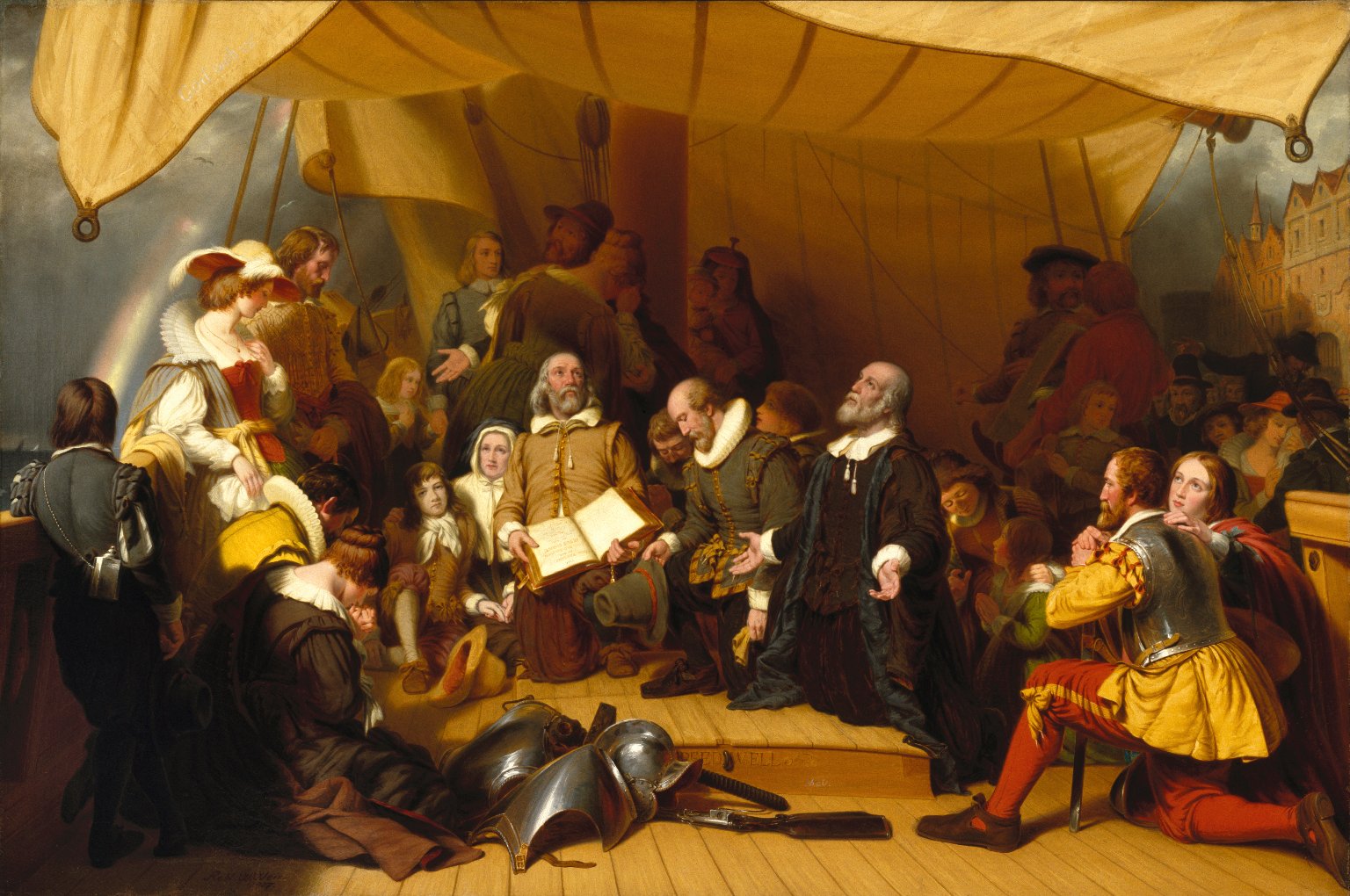
Robert Walter Weir (1803-1889), Embarkations of the Pilgrims, 1837-44, oil on canvas, 144 x 216 in. U.S. Capitol Rotunda.