On view through February 16, 2015, El Greco in the National Gallery of Art and Washington-Area Collections: A 400th Anniversary Celebration
National Gallery of Art
National Gallery of Art

El Greco (Domenikos Theotokopoulos), Laocoön, c. 1610/1614oil on canvas
Samuel H. Kress Collection
Samuel H. Kress Collection
The 400th anniversary of El Greco's death will be remembered at the National Gallery of Art with an exhibition of 11 paintings from the Gallery, Dumbarton Oaks, and the Phillips Collection in Washington, DC, and from the Walters Art Museum, in Baltimore. On view through February 16, 2015, El Greco in the National Gallery of Art and Washington-Area Collections: A 400th Anniversary Celebration includes some of the artist's most beloved paintings, renowned for compositions of bold colors and subjects with dramatic expression.
"This exhibition showcases the artist's groundbreaking style of painting that fused elements of Byzantine and Renaissance art with the heightened spirituality of the Counter-Reformation," said Earl A. Powell III, director, National Gallery of Art, Washington. "El Greco's expressive style fascinated early 20th-century American collectors who competed to acquire his paintings."
With seven paintings by El Greco (1541–1614), the Gallery has one of the largest collections of his work in the United States, made possible by the generosity of the Gallery's early benefactors Andrew W. Mellon, Samuel H. Kress, Joseph Widener, and Chester Dale.
From November 4, 2014 through February 1, 2015, New York City will commemorate the 400th anniversary of El Greco's death with two exhibitions showcasing all of the artist's work from New York public collections. The exhibitions are on view at The Frick Collection and the Metropolitan Museum of Art (with works on loan from the Hispanic Society of America). See the write-up with images here.
Exhibition Highlights
The exhibition in Washington includes works from various stages of El Greco's career—from early work in Venice to unfinished paintings made in Toledo. The exhibition is organized by the National Gallery of Art.


Christ Cleansing the Temple (probably before 1570, National Gallery of Art)
In this passionate work, El Greco depicted a popular theme from the Counter-Reformation: the Catholic Church's attempt to purify itself. Painted in Venice, the composition shows that El Greco was still learning to master Renaissance painting. The loose brushwork and bold colors reveal the influence of Venetian artists such as Titian and Tintoretto. El Greco signed this painting, as he did throughout his career, with his name in Greek characters.

In this passionate work, El Greco depicted a popular theme from the Counter-Reformation: the Catholic Church's attempt to purify itself. Painted in Venice, the composition shows that El Greco was still learning to master Renaissance painting. The loose brushwork and bold colors reveal the influence of Venetian artists such as Titian and Tintoretto. El Greco signed this painting, as he did throughout his career, with his name in Greek characters.

Saint Martin and the Beggar (1597/1599, National Gallery of Art)

and Madonna and Child with Saint Martina and Saint Agnes (1597/1599, NGA)
El Greco was commissioned to paint altarpieces for the Chapel of Saint Joseph in Toledo, Spain. Those for the two side altars were purchased by Philadelphia financier, collector, and Gallery benefactor Peter A. B. Widener. The paintings hung prominently in the Widener residence until 1942, when his son Joseph Widener donated them to the Gallery. Both paintings were recently cleaned to remove yellowed varnish and to reveal the original color relationships and vibrancy of El Greco's brushwork.

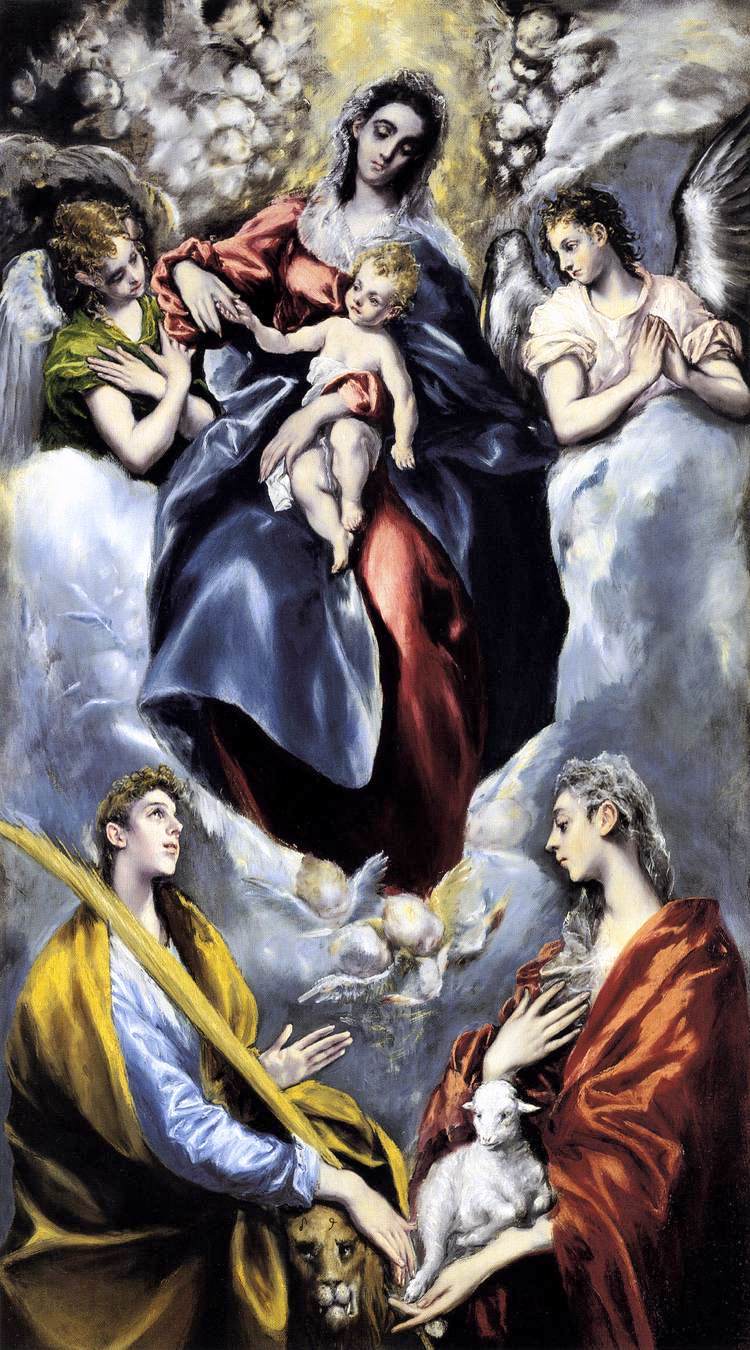
and Madonna and Child with Saint Martina and Saint Agnes (1597/1599, NGA)
El Greco was commissioned to paint altarpieces for the Chapel of Saint Joseph in Toledo, Spain. Those for the two side altars were purchased by Philadelphia financier, collector, and Gallery benefactor Peter A. B. Widener. The paintings hung prominently in the Widener residence until 1942, when his son Joseph Widener donated them to the Gallery. Both paintings were recently cleaned to remove yellowed varnish and to reveal the original color relationships and vibrancy of El Greco's brushwork.
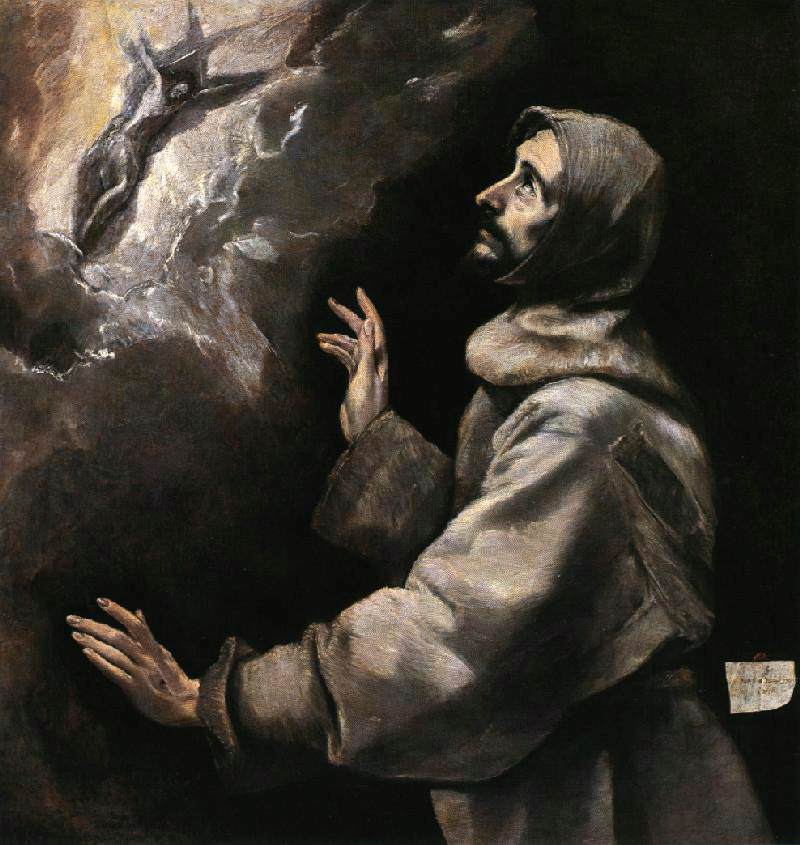
Saint Francis Receiving the Stigmata, (1585–1590, The Walters Art Museum)
In this work, painted in Toledo, a leading center of the Counter-Reformation, El Greco portrays the founder of the Franciscan order in his monk's habit, silhouetted by a dramatic golden light and receiving the stigmata.

In this work, painted in Toledo, a leading center of the Counter-Reformation, El Greco portrays the founder of the Franciscan order in his monk's habit, silhouetted by a dramatic golden light and receiving the stigmata.
The Holy Family with Saint Anne and the Infant John the Baptist (c. 1595/1600, National Gallery of Art)
El Greco experimented with the subject of the Holy Family in several paintings, most of which are significantly larger than this version, measuring 21 inches by 14 inches. The painting was donated to the Gallery in 1959 by the Samuel H. Kress Foundation.

El Greco experimented with the subject of the Holy Family in several paintings, most of which are significantly larger than this version, measuring 21 inches by 14 inches. The painting was donated to the Gallery in 1959 by the Samuel H. Kress Foundation.

The Repentant Saint Peter, (1600–1605 or later, The Phillips Collection)
Images of penitent saints served to affirm the legitimacy of penitence, or confession, a sacrament scorned by Protestants but passionately defended by Catholics during the Counter-Reformation.

Images of penitent saints served to affirm the legitimacy of penitence, or confession, a sacrament scorned by Protestants but passionately defended by Catholics during the Counter-Reformation.

Saint Ildefonso (c. 1603/1614, National Gallery of Art)
Edgar Degas once owned this portrait of the seventh-century archbishop of Toledo. Ildefonso, one of the city's patron saints, is shown in his study, furnished as it would have been in El Greco's time.

Edgar Degas once owned this portrait of the seventh-century archbishop of Toledo. Ildefonso, one of the city's patron saints, is shown in his study, furnished as it would have been in El Greco's time.
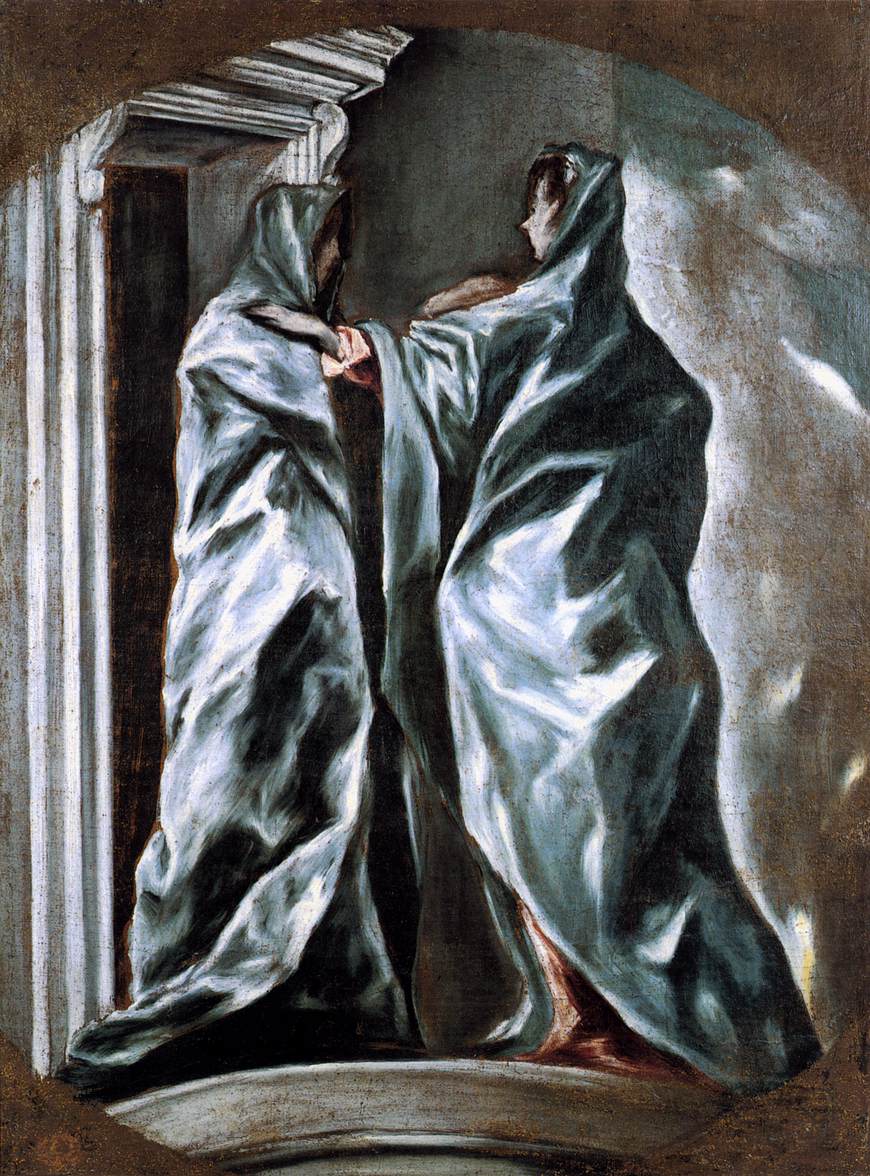
The Visitation (c. 1610/1614, Dumbarton Oaks)
This canvas depicts the meeting between the Virgin Mary and her cousin Elizabeth, both pregnant—Mary with Jesus and Elizabeth with John the Baptist. The figures are viewed from below because the painting was conceived for the ceiling above the altar in the Church of San Vicente, Toledo. Mildred and Robert Woods Bliss purchased this work in 1936 for the renowned Music Room of their home Dumbarton Oaks.

This canvas depicts the meeting between the Virgin Mary and her cousin Elizabeth, both pregnant—Mary with Jesus and Elizabeth with John the Baptist. The figures are viewed from below because the painting was conceived for the ceiling above the altar in the Church of San Vicente, Toledo. Mildred and Robert Woods Bliss purchased this work in 1936 for the renowned Music Room of their home Dumbarton Oaks.
Saint Jerome (c. 1610/1614, National Gallery of Art)
In this unfinished canvas, El Greco depicts Saint Jerome—one of the Four Doctors of the Church and responsible for the Latin translation of the Bible known as the Vulgate—as a penitent, kneeling in the wilderness while clutching the bloodied rock that he used to beat his chest in repentance for his love of classical learning. This work was donated to the Gallery in 1943 by New York investment broker Chester Dale, and due to a stipulation in the bequest, the painting may be seen only at the Gallery.

In this unfinished canvas, El Greco depicts Saint Jerome—one of the Four Doctors of the Church and responsible for the Latin translation of the Bible known as the Vulgate—as a penitent, kneeling in the wilderness while clutching the bloodied rock that he used to beat his chest in repentance for his love of classical learning. This work was donated to the Gallery in 1943 by New York investment broker Chester Dale, and due to a stipulation in the bequest, the painting may be seen only at the Gallery.
This unfinished painting provides evidence of El Greco's working method. He began with a ground coat of dark reddish brown, still visible in many places. He outlined the figure with heavy dark contours, as in Jerome's lower left leg, then used thin, fluid strokes of lighter paint to define the body, as the right leg reveals. With a stiff brush and thick white paint he enlivened some parts of the anatomy, most noticeably the torso. And in completed areas such as the saint's face, he smoothed these jagged contours.
Laocoön (c. 1610/1614, National Gallery of Art)
No work by El Greco has inspired more controversy than his one surviving mythological painting. From the story of the Trojan horse in Virgil's Aeneid, El Greco's Laocoön symbolizes a number of topics from the Counter-Reformation, ranging from Christian martyrdom to criticism of the clergy. El Greco replaced Troy with a view of Toledo in the background, with a horse trotting toward one of the city's principal gates.
No work by El Greco has inspired more controversy than his one surviving mythological painting. From the story of the Trojan horse in Virgil's Aeneid, El Greco's Laocoön symbolizes a number of topics from the Counter-Reformation, ranging from Christian martyrdom to criticism of the clergy. El Greco replaced Troy with a view of Toledo in the background, with a horse trotting toward one of the city's principal gates.
A visionary artist, El Greco was also a savvy businessman. As head of a large and productive studio, he oversaw the creation of numerous replicas of his most admired compositions. At least six replicas exist of El Greco's Saint Martin and the Beggar; the Gallery's is included in the exhibition along with the artist's original.

Masterworks | Portland: El Greco
PORTLAND ART MUSEUM
DEC 13, 2014 – APR 5, 2015

El Greco [Domenikos Theotokopoulos] (Spanish, born Greece, 1541-1614), The Holy Family with Saint Mary Magdalen, 1590-1595, oil on canvas, The Cleveland Museum of Art, Gift of Friends of the Cleveland Museum of Art in memory of J.H. Wade.
Masterworks | Portland commemorates the fourth centenary of the death of El Greco (1541-1614), the brilliant, multicultural genius whose highly personal, conceptual style gave form to the intense spirituality of Spain’s Golden Age. Coinciding with the celebrations of Christmas and Easter, this special installation features the artist’s greatest devotional painting, the magisterial Holy Family with Saint Mary Magdalen, a rarely loaned treasure of the Cleveland Museum of Art.
Painted at the height of El Greco’s powers in the 1590s, The Holy Familyshows the Virgin Mary holding the squirming Christ child on her lap as Joseph offers a bowl of fruit. They are joined by Mary Magdalen, whose sorrowful gaze alludes to the future suffering of the happy child. El Greco’s approach is based on Venetian depictions of the subject set in a landscape, but transformed so that the figures seem to exist out of space and time, floating before a turbulent sky. The visionary quality of the elongated forms, animated by flashing light and vivid color, is tempered by touches of realism, particularly seen in the faces of the virgin and child, in the bowl of fruit, and in the warm domesticity that characterizes the scene. This endows the image with unusual accessibility and appeal.
El Greco (1541–1614)
Domenikos Theotokopoulos, universally known as El Greco, was born on the Greek island of Crete, where he became a master painter of Byzantine icons. Aspiring for more opportunities and success, he moved to Venice and absorbed the lessons of High Renaissance masters, especially Titian and Tintoretto. In 1570 he departed for Rome, where he studied the work of Michelangelo and encountered the style known as mannerism, one that rejected the logic and naturalism of Renaissance art.
El Greco relocated to Spain in 1576 and spent the rest of his life in Toledo, where he received major commissions that had not been available to him in Italy. Blending diverse influences—Byzantine, Renaissance, and mannerist—he developed a unique style that reflects the religious fervor of Counter-Reformation Spain.
After his death in 1614, El Greco's work fell into obscurity until early 19th-century French artists and connoisseurs began to take note of it after the Napoleonic occupation of Spain. By 1838 several of his paintings were displayed in Paris in the Spanish gallery of the Louvre. In 1902 the Prado Museum in Madrid staged El Greco's first monographic exhibition and within a decade other exhibitions would be devoted to him in Paris, Munich, Düsseldorf, and elsewhere.
At the close of the 19th century, artists striving for emotional or expressive effects found a kindred spirit in El Greco, and since that time his influence has been immense. Many have regarded him as a forerunner of modernism. Echoes of his art appear in the works of such diverse artists as Paul Cézanne, Amedeo Modigliani, Pablo Picasso, Paul Klee, Alberto Giacometti, Thomas Hart Benton, Jackson Pollock, and Francis Bacon.