National Gallery of Art (Washington, DC):
Honoré Daumier's career was one of the most unusual in the history of nineteenth-century art. Famous in his time as France's best-known caricaturist, he remained unrecognized in his actual stature--as one of the period's most profoundly original and wide-ranging realists. Even today, his essential quality may not be fully understood; the marvels of his pictorial inventions are half-hidden in the profusion of his enormous lithographic work, the sharp truths of his observation overshadowed by his comic genius and penchant for monumental stylization. Honoré Balzac's remark, "There is a lot of Michelangelo in that fellow," was perceptive, though probably made in a spirit of friendly condescension.
Daumier was born in Marseille in 1808, the son of an eccentric glazier and frame maker with highflown poetic ambitions. In 1816 the elder Daumier took his family to Paris in pursuit of his doomed literary projects. Young Honoré, obliged to earn a living from the age of twelve, started as a book dealer's helper and later ran errands for a firm of attorneys. Though he showed signs of a talent for drawing, his parents, perhaps fortunately, were unable to pay his way through the course of regular art training. A family friend, the antiquarian Alexandre Lenoir, who had assembled fragments from churches vandalized during the Revolution in a Musée des Monuments Français, gave him early, informal drawing lessons. On his own, he took his sketching pad to the sculpture galleries of the Louvre and attended the Académie Suisse, a teacherless establishment that offered inexpensive model sessions. He is said to have made his first experiments in lithography in 1822, aged fourteen; by 1825, at any rate, he had found employment with a commercial printer in whose shop he gained the technical skills he needed. From 1829 onward he was able to produce lithographic caricatures of his own, imitating the styles of such popular artists as Nicholas-Toussaint Charlet (1792-1845), Charles-Joseph Traviès (1804-1859), and Henry Monnier (1799-1877).
The relaxation of censorship after the Revolution of 1830 opened the door to a flood of illustrated pamphlets. After working briefly for several short-lived journals, Daumier in 1831 was engaged by a great publicist, Charles Philipon, as cartoonist for a newly founded journal of political satire, La Caricature. This launched him on a career of forty years as comic artist to the weekly press, during which he drew 3,958 lithographs before the onset of blindness in the 1870s put a stop to his work. The initial target of his attacks was the government of King Louis-Philippe, which he ridiculed with a corrosive wit that brought him to the notice of the press police and earned him a jail term of six months in 1832. He nevertheless continued to draw for La Caricature and for another of Philipon's journals, Le Cbarivari, developing, in the heat of weekly combat, a graphic style of unsurpassed brilliance in an art that in France had little prestige, and only a brief history compared to the English tradition that boasted such ancestors as William Hogarth (1697-1764) and Thomas Rowlandson (1756-1827).
Living at the time amid a circle of bohemian friends that included the sculptor Auguste Préault (1810-1870), he relied on his own talent for sculpture in modeling small clay portrait busts of politicians, based on sketches drawn during parliamentary sessions. Several of these cruelly truthful likenesses served him for a series of lithographic caricatures culminating in Le Ventre législatif, a burlesque collective portrait of the National Assembly. Published in 1834 as a supplement of La Caricature, it was shortly followed by a sinister sequel, Rue Transnonain, recording the aftermath of a murderous police raid. These large prints crown Daumier's youthful work: visual reportage, conceived in the anger of party strife, their graphic power carries them beyond their period and its politics.
When a tightening of censorship in 1835 put an end to La Caricature, Daumier shifted to politically unobjectionable social satire for Philipon's other journal, Le Cbarivari. In hundreds of lithographs, published serially, two or three a week, he turned a sharp eye on the characteristic look and demeanor of every segment of Parisian society, ranging from the crotchets and timidities of the urban middle class with which he fondly empathized (Les Bons Bourgeois), to the frauds of speculators (Robert Macaire), the pomposities of lawyers (Gens de justice), the self-delusions of artists, the rapacity of landlords, and the vanity of bluestockings.
For its breadth and insight, his work has been compared with that of the novelist Balzac and for its expressive energy with that of the art of Jean-François Millet (1814-1875). Though himself without intellectual pretensions, Daumier was closely in touch with a sophisticated, modern-minded society of literary men and artists, including Charles Baudelaire, Eugène Delacroix (1798-1863), and Charles-François Daubigny (1817-1878), who gathered at the Hôtel Pimodan, near Daumier's house on the Ile Saint-Louis, where after 1840 he was modestly quartered with his wife, Marie-Alexandrine Dassy, a dressmaker.
The revolution that overthrew the monarchy of Louis-Philippe in February 1848 briefly opened the art establishment to marginal, nonacademic practitioners. Daumier did not exhibit at the "free" Salon of 1848 but later that year entered an official competition for an allegorical painting of the Republic. His design, representing a powerfully statuesque female "giving nourishment and instruction to her children" was judged eleventh in a group of twenty entries. He did not carry this project further but was evidently encouraged to devote himself seriously to painting in oil, producing in short order several exhibition pictures on literary and even classical subjects. His Miller and His Son (Glasgow Museums, The Burrell Collection), based on La Fontaine's fable, was shown at the Salon in 1849, his Nympbs Pursued by a Satyr (Museum of Fine Arts, Montreal), Drunkenness of Silenur (Musée des Beaux-Arts et de la Dentelle, Calais), and Don Quixote at the one held in 1850-1851. Self-taught as a painter in oil, Daumier struggled with the technical difficulties of the medium. His exhibited work was ignored by the critics. Among his unfinished projects of this time was The Uprising (The Phillips Collection, Washington, D.C.), a daring attempt to give monumental form to a modern political subject of dramatic urgency.
The Bonapartist coup d'état of 2 December 1851 abolished the parliamentary constitution and installed Louis-Napoleon as autocratic president, shortly to be confirmed by plebiscite as emperor of the French (December 1852). During the struggles that preceded the fall of the Republic, Daumier drew fiercely polemical caricatures and created his most memorable sculpture, Ratapoil (1851), the image of a Bonapartist bully of the type that terrorized the Parisian electorate on the eve of the coup. The strict censorship enforced by the imperial government once again limited Daumier to politically harmless social caricature for Le Charivari. During 1853-1857 he spent his holidays in Valmondois on the Oise in the company of his friend Daubigny and frequently visited Théodore Rousseau and Millet in Barbizon.
His lithographic imagery now assumed a larger, more painterly character, perhaps reflecting the influence of his friends. After 1853 he ceased to exhibit at the Salon but continued to paint privately. In 1860 he was dismissed from the staff of Le Charivari; his caricatures no longer amused the public. For his living, he turned to painting large, finished watercolors on modern subjects for which there was a demand on the art market. More privately, he continued to work in oil, a medium that he found difficult and practiced experimentally and cautiously, as an "amateur" wholly independent of the fashions of the Salon and the recipes of the Academy. In a broadly sketchlike technique he recorded observations from his everyday life: street entertainers, histrionics of the stage or the courts of law, railway travelers, artists at work, collectors rummaging in their portfolios. Caricature and comic effect, central to his works on paper, hardly appear in his paintings in oil. It seems as if, in his modesty, he considered humor appropriate for the popular media of communication but unsuited to the dignity of painting.
Granted a new contract by Le Charivari in 1864, he resumed his weekly lithographic chores. His eyesight was gradually failing. Needing the restorative quiet of the country, he extended his stays at Valmondois, where, in 1865, he rented a small house that, except for business stays in Paris, was to be his home for the remainder of his life. The government discreetly approached him in early 1870 with the offer of the cross of the Legion of Honor. Daumier quietly declined. Poorly paid and in constant financial straits, he continued to draw lithographs for the press and to paint in private. The great series of episodes from Don Quixote, begun in í850 and continued through the 1860s, may have been influenced, in part, by Gustave Doré's (1832-1883) popular illustrations published in 1863.
The Franco-Prussian War (1870-1871) swiftly disposed of the empire of Napoleon III.
During the siege of Paris, Daumier, who had been elected a member of the commission charged with the protection of the collections of the Louvre, was one of the artists who opposed Courbet's proposal to destroy the column in the place Vendôme. Some of Daumier's most powerful lithographs date from this time of war and civil strife; stark, tragic, grandiose in their appeal to humanity and common sense, they are his last works in this medium.
The final years of his life were darkened by poverty, illness, and growing blindness. In 1874 a gift from his friend Corot enabled him to buy the small house in Valmondois which he had been renting for the previous nine years. In 1877 he was granted a small government pension, and the following year an exhibition of his paintings, drawings, and sculptures was arranged under the patronage of Victor Hugo at the Paris gallery of Durand-Ruel. On 10 February 1879 Daumier died after a paralytic stroke. He left behind a large number of paintings in various states of incompletion.
When, about 1900, the demand for his work began to rise, many of these remainders, some badly deteriorated, were restored, finished, and supplied with "signatures," making it difficult in some instances to determine Daumier's half-effaced authentic part in them.
SOTHEBY'S Impressionist and Modern Art February 4, 2003
Honoré Daumier's career was one of the most unusual in the history of nineteenth-century art. Famous in his time as France's best-known caricaturist, he remained unrecognized in his actual stature--as one of the period's most profoundly original and wide-ranging realists. Even today, his essential quality may not be fully understood; the marvels of his pictorial inventions are half-hidden in the profusion of his enormous lithographic work, the sharp truths of his observation overshadowed by his comic genius and penchant for monumental stylization. Honoré Balzac's remark, "There is a lot of Michelangelo in that fellow," was perceptive, though probably made in a spirit of friendly condescension.
Daumier was born in Marseille in 1808, the son of an eccentric glazier and frame maker with highflown poetic ambitions. In 1816 the elder Daumier took his family to Paris in pursuit of his doomed literary projects. Young Honoré, obliged to earn a living from the age of twelve, started as a book dealer's helper and later ran errands for a firm of attorneys. Though he showed signs of a talent for drawing, his parents, perhaps fortunately, were unable to pay his way through the course of regular art training. A family friend, the antiquarian Alexandre Lenoir, who had assembled fragments from churches vandalized during the Revolution in a Musée des Monuments Français, gave him early, informal drawing lessons. On his own, he took his sketching pad to the sculpture galleries of the Louvre and attended the Académie Suisse, a teacherless establishment that offered inexpensive model sessions. He is said to have made his first experiments in lithography in 1822, aged fourteen; by 1825, at any rate, he had found employment with a commercial printer in whose shop he gained the technical skills he needed. From 1829 onward he was able to produce lithographic caricatures of his own, imitating the styles of such popular artists as Nicholas-Toussaint Charlet (1792-1845), Charles-Joseph Traviès (1804-1859), and Henry Monnier (1799-1877).
The relaxation of censorship after the Revolution of 1830 opened the door to a flood of illustrated pamphlets. After working briefly for several short-lived journals, Daumier in 1831 was engaged by a great publicist, Charles Philipon, as cartoonist for a newly founded journal of political satire, La Caricature. This launched him on a career of forty years as comic artist to the weekly press, during which he drew 3,958 lithographs before the onset of blindness in the 1870s put a stop to his work. The initial target of his attacks was the government of King Louis-Philippe, which he ridiculed with a corrosive wit that brought him to the notice of the press police and earned him a jail term of six months in 1832. He nevertheless continued to draw for La Caricature and for another of Philipon's journals, Le Cbarivari, developing, in the heat of weekly combat, a graphic style of unsurpassed brilliance in an art that in France had little prestige, and only a brief history compared to the English tradition that boasted such ancestors as William Hogarth (1697-1764) and Thomas Rowlandson (1756-1827).
Living at the time amid a circle of bohemian friends that included the sculptor Auguste Préault (1810-1870), he relied on his own talent for sculpture in modeling small clay portrait busts of politicians, based on sketches drawn during parliamentary sessions. Several of these cruelly truthful likenesses served him for a series of lithographic caricatures culminating in Le Ventre législatif, a burlesque collective portrait of the National Assembly. Published in 1834 as a supplement of La Caricature, it was shortly followed by a sinister sequel, Rue Transnonain, recording the aftermath of a murderous police raid. These large prints crown Daumier's youthful work: visual reportage, conceived in the anger of party strife, their graphic power carries them beyond their period and its politics.
When a tightening of censorship in 1835 put an end to La Caricature, Daumier shifted to politically unobjectionable social satire for Philipon's other journal, Le Cbarivari. In hundreds of lithographs, published serially, two or three a week, he turned a sharp eye on the characteristic look and demeanor of every segment of Parisian society, ranging from the crotchets and timidities of the urban middle class with which he fondly empathized (Les Bons Bourgeois), to the frauds of speculators (Robert Macaire), the pomposities of lawyers (Gens de justice), the self-delusions of artists, the rapacity of landlords, and the vanity of bluestockings.
For its breadth and insight, his work has been compared with that of the novelist Balzac and for its expressive energy with that of the art of Jean-François Millet (1814-1875). Though himself without intellectual pretensions, Daumier was closely in touch with a sophisticated, modern-minded society of literary men and artists, including Charles Baudelaire, Eugène Delacroix (1798-1863), and Charles-François Daubigny (1817-1878), who gathered at the Hôtel Pimodan, near Daumier's house on the Ile Saint-Louis, where after 1840 he was modestly quartered with his wife, Marie-Alexandrine Dassy, a dressmaker.
The revolution that overthrew the monarchy of Louis-Philippe in February 1848 briefly opened the art establishment to marginal, nonacademic practitioners. Daumier did not exhibit at the "free" Salon of 1848 but later that year entered an official competition for an allegorical painting of the Republic. His design, representing a powerfully statuesque female "giving nourishment and instruction to her children" was judged eleventh in a group of twenty entries. He did not carry this project further but was evidently encouraged to devote himself seriously to painting in oil, producing in short order several exhibition pictures on literary and even classical subjects. His Miller and His Son (Glasgow Museums, The Burrell Collection), based on La Fontaine's fable, was shown at the Salon in 1849, his Nympbs Pursued by a Satyr (Museum of Fine Arts, Montreal), Drunkenness of Silenur (Musée des Beaux-Arts et de la Dentelle, Calais), and Don Quixote at the one held in 1850-1851. Self-taught as a painter in oil, Daumier struggled with the technical difficulties of the medium. His exhibited work was ignored by the critics. Among his unfinished projects of this time was The Uprising (The Phillips Collection, Washington, D.C.), a daring attempt to give monumental form to a modern political subject of dramatic urgency.
The Bonapartist coup d'état of 2 December 1851 abolished the parliamentary constitution and installed Louis-Napoleon as autocratic president, shortly to be confirmed by plebiscite as emperor of the French (December 1852). During the struggles that preceded the fall of the Republic, Daumier drew fiercely polemical caricatures and created his most memorable sculpture, Ratapoil (1851), the image of a Bonapartist bully of the type that terrorized the Parisian electorate on the eve of the coup. The strict censorship enforced by the imperial government once again limited Daumier to politically harmless social caricature for Le Charivari. During 1853-1857 he spent his holidays in Valmondois on the Oise in the company of his friend Daubigny and frequently visited Théodore Rousseau and Millet in Barbizon.
His lithographic imagery now assumed a larger, more painterly character, perhaps reflecting the influence of his friends. After 1853 he ceased to exhibit at the Salon but continued to paint privately. In 1860 he was dismissed from the staff of Le Charivari; his caricatures no longer amused the public. For his living, he turned to painting large, finished watercolors on modern subjects for which there was a demand on the art market. More privately, he continued to work in oil, a medium that he found difficult and practiced experimentally and cautiously, as an "amateur" wholly independent of the fashions of the Salon and the recipes of the Academy. In a broadly sketchlike technique he recorded observations from his everyday life: street entertainers, histrionics of the stage or the courts of law, railway travelers, artists at work, collectors rummaging in their portfolios. Caricature and comic effect, central to his works on paper, hardly appear in his paintings in oil. It seems as if, in his modesty, he considered humor appropriate for the popular media of communication but unsuited to the dignity of painting.
Granted a new contract by Le Charivari in 1864, he resumed his weekly lithographic chores. His eyesight was gradually failing. Needing the restorative quiet of the country, he extended his stays at Valmondois, where, in 1865, he rented a small house that, except for business stays in Paris, was to be his home for the remainder of his life. The government discreetly approached him in early 1870 with the offer of the cross of the Legion of Honor. Daumier quietly declined. Poorly paid and in constant financial straits, he continued to draw lithographs for the press and to paint in private. The great series of episodes from Don Quixote, begun in í850 and continued through the 1860s, may have been influenced, in part, by Gustave Doré's (1832-1883) popular illustrations published in 1863.
The Franco-Prussian War (1870-1871) swiftly disposed of the empire of Napoleon III.
During the siege of Paris, Daumier, who had been elected a member of the commission charged with the protection of the collections of the Louvre, was one of the artists who opposed Courbet's proposal to destroy the column in the place Vendôme. Some of Daumier's most powerful lithographs date from this time of war and civil strife; stark, tragic, grandiose in their appeal to humanity and common sense, they are his last works in this medium.
The final years of his life were darkened by poverty, illness, and growing blindness. In 1874 a gift from his friend Corot enabled him to buy the small house in Valmondois which he had been renting for the previous nine years. In 1877 he was granted a small government pension, and the following year an exhibition of his paintings, drawings, and sculptures was arranged under the patronage of Victor Hugo at the Paris gallery of Durand-Ruel. On 10 February 1879 Daumier died after a paralytic stroke. He left behind a large number of paintings in various states of incompletion.
When, about 1900, the demand for his work began to rise, many of these remainders, some badly deteriorated, were restored, finished, and supplied with "signatures," making it difficult in some instances to determine Daumier's half-effaced authentic part in them.
SOTHEBY'S Impressionist and Modern Art February 4, 2003
Honoré Daumier

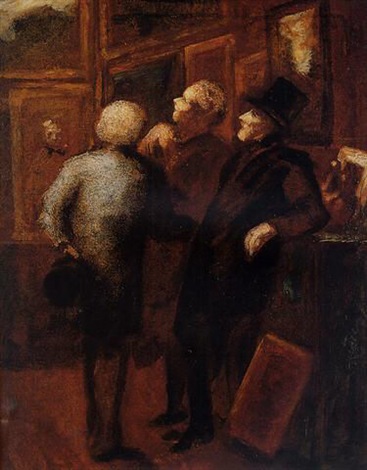
Another
artist whose concern for light and fondness for contemporary subject matter
links him crucially to Modernism is Honoré Daumier (1808-79). His Les amateurs
de tableaux is a rare example of an oil by the artist coming on to the market
(est: £350,000-500,000).
Sotheby's 2013

Sotheby's 2013

Honoré Daumier
LOT SOLD.
2,629,000 USD
Christie's


Le Fardeau
PRICE REALIZED
$361,000
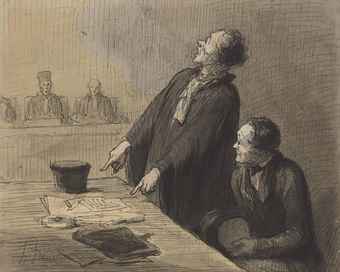
Le défenseur (The Defense Attorney)
PRICE REALIZED
$314,500
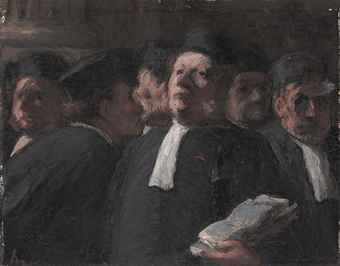
La salle des pas-perdus au Palais de Justice
PRICE REALIZED
£157,250
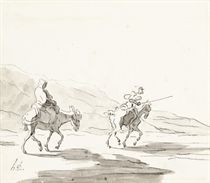
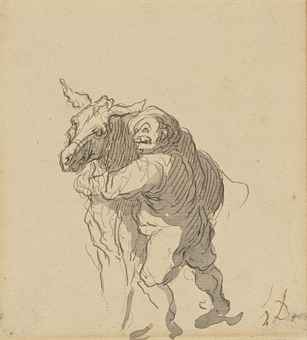
Don Quixote et Sancho Pansa
PRICE REALIZED
€99,400

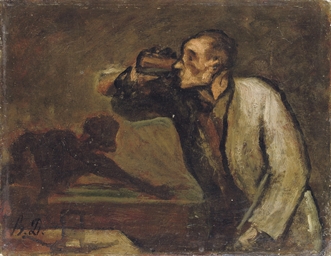
Joueurs de billiard (Le buveur)
PRICE REALIZED
£51,650
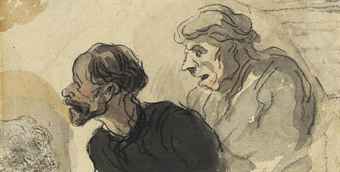
The heads of two men
PRICE REALIZED
£44,450
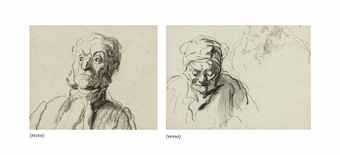
Tête d'un avocat (recto); Tête de femme (verso)
PRICE REALIZED
$55,000
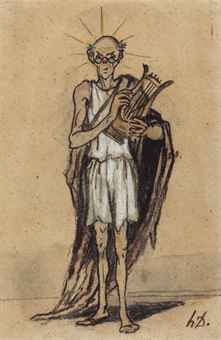
Apollon
PRICE REALIZED
$47,500
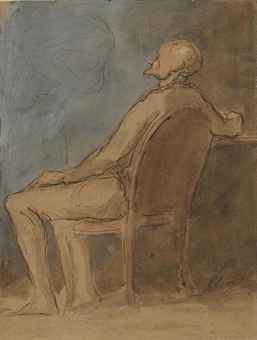




.jpg)