Friday, September 29, 2017

The Art of Laughter: Humour in the Golden Age


Frans Hals Museum
From 11 November

Seldom have more humorous paintings been made than in the Dutch Golden Age. Prosperity and a new buying public encouraged painters to think up an enormous variety of visual jokes. Naughty children, stupid peasants, foolish dandies and drunkards, quack doctors, pimps and procuresses, lazy serving maids and lusty ladies–they appear in large numbers in Golden Age masterpieces. The humour implicit in the works would have been evident to contemporary viewers. 


Frans Hals is often called ‘the master of the laugh’. More than any other painter in the Golden Age, he was able to bring a vitality to his portraits that made it appear as if his models could just step out of the past into the present. Hals was one of the few painters in the seventeenth century who dared portray his figures – often common folk – with a hearty laugh and bared teeth. Merriment and jokes are prominent features in his genre paintings; artists in the Golden Age frequently used it in their work. Now – centuries later – the visual jokes are harder to fathom. A great deal of new research into the field has been carried out, particularly in the last twenty years, and we are beginning to get an idea of the full extent of seventeenth-century humour.

The exhibition showcases some sixty masterpieces from the Low Countries and beyond by Rembrandt, Frans Hals, Jan Steen, Judith Leyster, Adriaen Brouwer, Gerard van Honthorst, Jan Miense Molenaer and Nicolaes Maes. Works by these and other artists will be shown in the context of an introduction and seven specific themes, including mischief, farce and love and lust, and one room is devoted to each of them.

The exhibition ends with the comical self-portrait, in which painters feature in their own jokes. Thus humour eventually arrives at the artists themselves, creating an intriguing finale.

There will also be a small selection of joke books, incredibly popular in the seventeenth century, which confirm the reputation of the Dutch as an unusually cheerful and humorous people. According to an Italian contemporary, the writer Lodovico Guicciardini, who was living in the Low Countries at that time, the Dutch were ‘very convivial, and above all jocular, amusing and comical with words, but sometimes too much.’

Catalogue

A catalogue is being published to coincide with The Art of Laughter: Humour in the Golden Age with contributions by the curators of the exhibition, Anna Tummers, Curator of Old Masters at the Frans Hals Museum | De Hallen Haarlem, Jasper Hillegers, Assistant Curator of Old Masters, Elmer Kolfin, lecturer at the University of Amsterdam and Mariët Westermann, Golden Age specialist and Vice-President of the Andrew W. Mellon Foundation. The catalogue is being published by Uitgeverij Waanders. 

http://www.franshalsmuseum.nl/media/medialibrary/2017/06/Frans_Hals_Pekelharing_Kassel.jpg


Frans Hals,
Pekelharing, 
1628-30,
oil on canvas, 75 x 61,5 cm,
Museumlandschaft Hessen Kassel, Gemäldegalerie Alte Meister, Kassel

http://www.franshalsmuseum.nl/media/medialibrary/2017/06/Honthorst_St_Louis.jpg

Gerard van Honthorst,
Smiling Girl, a Courtisane, Holding an Obscene Image, 
1625,
oil on canvas, 46,9 x 60 cm, Saint Louis Art Museum, Saint Louis

http://www.franshalsmuseum.nl/media/medialibrary/2017/06/Roestraten_De_losbandige_keukenmeid_Frans_Hals_Museum.jpg

Pieter van Roestraeten,
The Licentious Kitchen Maid, 
1665/70,
oil on canvas,73,5 x 63 cm, Frans Hals Museum, Haarlem

http://www.franshalsmuseum.nl/media/medialibrary/2017/06/Jan_Steen_Kinderen_leren_katje_dansen_Rijksmuseum.jpg

Jan Steen,
Children Teaching a Cat to Dance,
c. 1662/63,
olieverf op paneel, 68,5 x 59 cm,
Rijksmuseum, Amsterdam

A Global Table - Magnificent food still lifes of the Durch Golden Age


Frans Hals Museum and De Hallen Haarlem
23 September 2017 to7 January2018

This unique exhibition featuring old and new art showcases the magnificent food still lifes of the Golden Age. It offers an alternative reading of these works as documents from an eventful history. What does the foodwe see tell us about the Netherlands’colonial and trade relations in the sixteenth and seventeenth centuries?

As quinoa and the avocado have changed European cooking over the last few decades, so, from the fifteenth century onwards,‘new’ foodstuffs like coffee, sugar and tomatoes transformed our ancestors’ eating habits. 

From the end of that century European imperialism changed the map of the world and created a global trading network.The start of an emotionally charged exchange between peoples and cultures, it sawt he import of new agricultural produce and foodstuffs from Africa, America, East and Southeast Asia and India.Before this,Europeans had no knowledge of tea, sugar, coffee, tomatoes, potatoes or maize.These new and,at the time, exotic types of food changedthe European diet forever. 

As the prime movers of international trade,the Dutch saw their economy boom in the sixteenth and seventeenth centuries.The huge abundance of wealth gave rise to a self-assured bourgeoisie that delighted in displaying its affluence. People had their portraits painted and they also wanted landscapes and seductive still lifes on their walls. It is no surprise that many of the new products feature in the Golden Age still lifes. 

The Still Life as a HistoricalDocument

A Global Table features seventeenth-century Dutch and Flemish stilllifes by artists such as Floris van Dijck, Balthasar van der Ast, Clara Peeters, Jan de Heemand Willem Kalf.

The Old Master paintings are not the subject of traditional art-historical analysis but rather ‘read’ as historical documents. The exhibition invites viewers to ask three simple questions about the foods in the still lifes: What are they? Where did they come from and how much did it cost–in terms of money and human suffering –to get them here? In finding answers to these questions,the paintings can be seen as documents charting the growthof economic powerand colonial expansion of the Republic and the Dutch contribution to the creation of the world economy. 


Balthasar van der Ast
Still Life with Shells and Tulips,1620
Oil on Panel
Mauritshuis, The Hague

http://www.franshalsmuseum.nl/media/medialibrary/2017/07/4.Jan_De_Heem_Stilleven_met_Moor_en_papegaai.jpg

Jan Davidsz de Heem
Still Life with Moor and Parrot, 1641
Oil on Panel
Hotel de Ville (Broodhuis), Brussel

Monday, September 25, 2017

Frank Stella: Experiment and Change


NSU Art Museum Fort Lauderdale will present Frank Stella: Experiment and Change, an exhibition that spans the artist’s 60-year career from the late 1950’s to the present.  The exhibition, composed of approximately 300 paintings, relief sculpture and drawings will offer insight into his trajectory from minimalism (e.g. the geometry of the black paintings) to maximalism (eg. the spatially complex constructionist and large sculptures of the Moby Dick series.) Curated by Bonnie Clearwater, Director and Chief Curator, Experiment and Change leads the museum’s 60th anniversary celebration presented by AutoNation, and will be on view from November 12, 2017 to July 8, 2018.

 Frank Stella, Paradoxe sur le comediene, 1974, Synthetic polymer paint on canvas, Private Collection, NY © 2017 Frank Stella,/ Artists Rights Society (ARS), New York, Photo Credit: Jason Wyche
  • Frank Stella, Paradoxe sur le comediene, 1974, Synthetic polymer paint on canvas, Private Collection, NY © 2017 Frank Stella,/ Artists Rights Society (ARS), New York, Photo Credit: Jason Wyche


The exhibition juxtaposes works from various periods of Stella’s career, revealing his aesthetic development and focusing on his “Working Archive,” which contains material never exhibited before, such as notes, sketches and maquettes that shed light on his growth as an artist. Stella’s diverse interests include art history, architecture, new materials (fluorescent pigment, carbon fiber, titanium, et al.) and computer-aided modeling for rapid prototyping.  His preparatory studies show the ideas in his work that led to a notion about the enlargement of pictorial space.
Included will be penciled color sequences for the larger concentric square paintings (1973), flat foam-core cut-outs leading to the emergence of a more generous “working space” and 3D printed models from the 1990’s through the present outlining the use of digital technology.
Frank Stella (b. 1936) emerged as part of a generation of American artists excited by, driven and challenged by Abstract Expressionism.   Frank Stella: Experiment and Change emphasizes the variety of expression found throughout his entire body of work.  The twists and turns of Stella’s career are illuminated by insights that were discovered during the curatorial process.  This exhibition elaborates on the research Clearwater began for a previous exhibition, Frank Stella at 2000: Changing the Rules, an in-depth exploration of the artist’s bold paintings, sculpture and architectural models from the 90’s.
Clearwater notes, “An initial spark of his artistic aspirations was the experience of seeing Rogier van der Weyden’s early Netherlandish Crucifixion Diptych (c. 1460) at the Philadelphia Museum of Art while an undergraduate at Princeton University.  Stella said that the sheer visual impact of van der Weyden’s diptych appeared as a ready-made definition of art.  Rogier’s painting became a goal for him to hope to live up to.  Given the characterization of this moment I realized the necessity to remap his career to show how this painting, rather than the rules of formalist modernism, propelled his progress.
Clearwater further states “We can see the influence of van der Weyden in the large number of diptych-like paintings divided into two equal parts.  A typical double concentric painting, Paradoxe sur le comediene, (1974), and a mitered maze work such as Fortin de las Flores support this view.
These paintings might also encourage us to speculate how Stella’s attraction to the use of shallow pictorial space and bright fluorescent pigments helped him to approach his goal, the absolute beauty of the Netherlandish masterpiece."
One of the exhibition’s highlights is Deauville (1970) a 45-foot long canvas shaped like a thoroughbred racetrack.  As an aficionado of racing of all kinds, he often imagines himself running across the canvas. “While his contemporaries Donald Judd and Dan Flavin created work that was machine-made, I see Stella as a modern day John Henry, racing against the machine, brushing paint from one end of the canvas to the other and back again, setting an admirable and competitive pace.”
For Stella, Deauville was the starting point for the exhibition design at NSU Art Museum.  The shape of the elongated oblong painting complements the 83,000-square foot museum’s curved galleries designed by leading modernist architect Edward Larrabee Barnes.  Architecture has played into Stella’s work throughout his career. The Irregular Polygons (1965-66) broke with the conventional rectangular format of easel painting, as did the early 1960's notched aluminum paintings.  This departure was suggested by a view of European mural painting, which noted the irregularity of the perimeter.  The interruption of the imagery by windows, doorways and other architectural features generated irregular edging which in turn generated irregular and complicated surfaces.  This notion coupled with illustrations from intersecting Kazmir Malevich’s planar geometry helped to establish the shaped canvas as a format in its own right, one which Stella continues to exploit.
In the exhibition, Deauville is shown adjacent to several Irregular Polygons and a large double concentric square Parodoxe sur le comediene (1974), and works from the Polish Village series (1971-74), which represent Stella’s first constructed relief paintings, his attempt to build a painting and then paint it.  Among these works we find a full-scale sketch, a 12-foot cartoon for Suchowola, and a Polish Village relief, drawing attention to Stella’s leap from a flat, two-dimensional plane to the literal three-dimensional depth of these constructions.
Another project inspired by architectural space enlists Hooloomooloo paintings (early 1990’s) made for the Kawamura Museum in Japan.  The entire series of these paintings will be exhibited at NSU Art Museum, creating an almost continuous frieze on the second floor, starting on a long curved wall and ending high above the atrium.  The irregular shapes of these paintings were determined by the architectural space of the Japanese museum.  Removed from their intended location, their arched forms and cutout shapes appear arbitrary until the viewer imagines the resulting negative space as doors, windows and arches.
“Stella believes that art offers at least the illusion of ultimate freedom.  In the context of the art world, he appears fearless and indifferent to risk.  Even works that initially looked like misfits to him (and others) now appear revelatory in light of his most recent pursuits,” explains Clearwater.
Frank Stella’s Experiment and Change is part of NSU Art Museum’s Regeneration Series, exhibitions designed to explore the wide-ranging impact of World War II on artists in Europe and the United States.  It was launched in 2016 with Anselm Kiefer from the Hall Collection.  Stella’s work is grounded in the post-war philosophical shift in which the individual was to master his/her own existence as popularized through the zeitgeist of existential philosophy, phenomenology and gestalt psychology. When Stella stated in a 1964 radio interview, “What you see is what you see,” not only was he suggesting that his compositions were nothing more than their appearance, but he was also pointing out that his work dealt with the psychology of perception and could be rephrased as, “What you see is how you comprehend what you see.”
Born in 1936 in Malden, Massachusetts, and based in New York, Frank Stella is one of the most important artists working today. He first studied art in high school at Phillips Academy in Andover, MA and continued painting at Princeton University where he graduated with a degree in history. Following his graduation in 1958, he moved to New York and achieved fame before the age of 25. His Black Stripe Paintings (1959), comprised of a regulated sequence of stripes painted in enamel with the broad strokes of a house painters brush, debuted in the Sixteen Americans exhibition at Museum of Modern Art in the same year. In 1962, Stella’s first solo exhibition was presented by the Leo Castelli Gallery in New York. His first retrospective was presented by the Museum of Modern Art in 1970 and he was honored with a second retrospective by the institution in 1987. His work has subsequently been the subject of retrospective exhibitions throughout the United States, Europe, and Japan, including the touring exhibition Frank Stella: A Retrospective, which originated at Whitney Museum of American Art in 2015. Among his numerous honors, he received the National Medal of the Arts in 2009 and the Lifetime Achievement Award in Contemporary Sculpture in 2011.

Friday, September 22, 2017

Monet: Framing Life

Detroit Institute of Arts
Oct. 22, 2017“ to March 4, 2018

Monet: Framing Life” is an intimate exhibition focusing on an important painting in the DIA collection—: Claude Monet'’s “Rounded Flower Bed (Corbeille de fleurs)” from 1876, formerly known as “Gladioli” and recently retitled based on new research. Monet created this work while living in the Paris suburb of Argenteuil between late 1871 and early 1878, an especially productive time. It was there that he met and worked beside fellow avant-garde painters that formed the group now known as the Impressionists.

This exhibition brings the DIA’s painting together with 10 other Argenteuil paintings by Monet and fellow impressionist Pierre-Auguste Renoir—including seven major loans from the National Gallery of Art, Washington, D.C. In doing so, the exhibition presents a more comprehensive story about the creation of “Rounded Flower Bed (Corbeille de fleurs)” and how it fits into Monet’s body of work, as well as the history of Impressionism more broadly.

A catalog accompanies the exhibition.

This exhibition has been organized by the Detroit Institute of Arts.


  • “Rounded Flower Bed (Corbeille de fleurs),” 1876, Claude Monet, oil on canvas. Detroit Institute of Arts  
 
 
  • “Snow in Argenteuil,” 1875, Claude Monet, oil on canvas. The National Museum of Western Art, Tokyo. Matsukata Collection  
 
  • “Argenteuil,” about 1872, Claude Monet, oil on canvas. National Gallery of Art, Washington, D.C. Ailsa Mellon Bruce Collection, 1970.17.42 

 
  • “Bridge at Argenteuil on a Gray Day,” about 1876, Claude Monet, oil on canvas. National Gallery of Art, Washington, D.C. Ailsa Mellon Bruce Collection, 1970.17.44 


  • “Claude Monet Painting in His Garden at Argenteuil,” 1873, Pierre-Auguste Renoir, oil on canvas. Wadsworth Atheneum Museum of Art, Hartford, Connecticut. Bequest of Anne Parrish Titzell, 1957.614 
 
  • “Claude Monet,” 1872, Pierre-Auguste Renoir, oil on canvas. National Gallery of Art, Washington, D.C. Collection of Mr. and Mrs. Paul Mellon, 1985.64.35  
 
  • “Regatta at Argenteuil,” 1874, Pierre-Auguste Renoir, oil on canvas. National Gallery of Art, Washington, D.C. Ailsa Mellon Bruce Collection, 1970.17.59

 
  • “The Artist’s Garden in Argenteuil (A Corner of the Garden with Dahlias),” 1873, Claude Monet, oil on canvas. National Gallery of Art, Washington, D.C. Gift of Janice H. Levin, in Honor of the 50th Anniversary of the National Gallery of Art, 1991.27.1  
  • “The Artist’s House at Argenteuil,” 1873, Claude Monet, oil on canvas. The Art Institute of Chicago. Mr. and Mrs. Martin A. Ryerson Collection, 1933.1153  
 
  • “The Bridge at Argenteuil,” 1874, Claude Monet, oil on canvas. National Gallery of Art, Washington, D.C. Collection of Mr. and Mrs. Paul Mellon, 1983.1.24  
 
  • “Woman with a Parasol–Madame Monet and Her Son,” 1875, Claude Monet, oil on canvas. National Gallery of Art, Washington, D.C. Collection of Mr. and Mrs. Paul Mellon, 1983.1.29

Tuesday, September 19, 2017

Gilded Age Drawings at The Met


The Metropolitan Museum of Art
August 21–December 10, 2017


More than three dozen rarely seen treasures from The Metropolitan Museum of Art’s collection of late 19th-century American works on paper are featured in the exhibition Gilded Age Drawings at The Met. Created primarily during the 1870s to ’90s—America’s so-called Gilded Age—shortly after the founding of the Museum, many of these innovative drawings in watercolor, pastel, and charcoal were acquired during the artists’ lifetimes and represent the beginnings of The Met’s collecting of American examples of this art form. On view will be iconic works by some of the leading American artists of the period, including Mary Cassatt, Thomas Eakins, Winslow Homer, John La Farge, and John Singer Sargent, along with striking examples by artists who are less well-known today. A highlight of the exhibition will be three works by Cecilia Beaux, La Farge, and Sargent that are recent promised gifts to The Met.

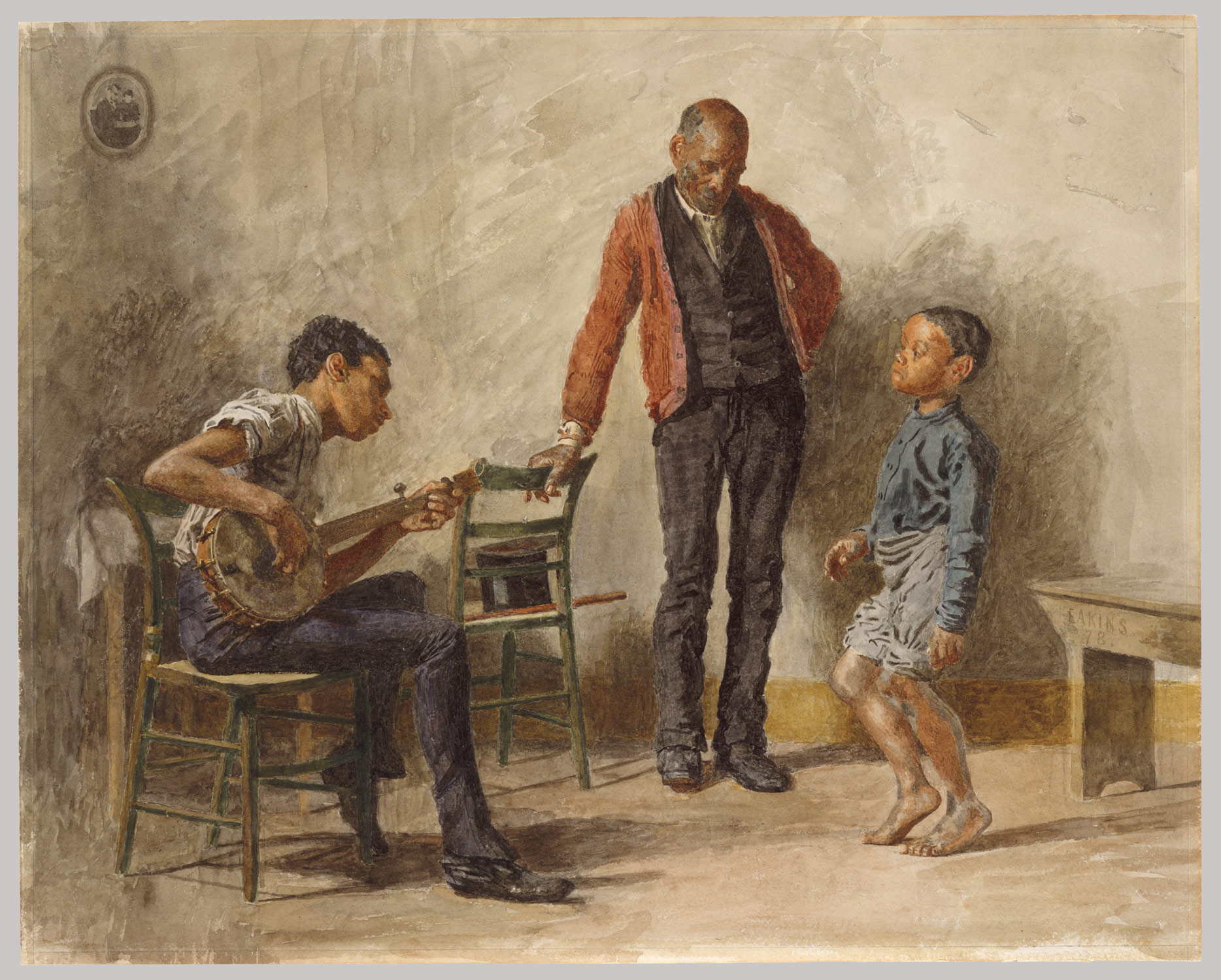
Arranged thematically in groupings of figure studies, landscapes, and still lifes, the presentation will reveal how some American artists of the period used drawing in preparation for painting in oil, while others created fully realized works of art for exhibition. The former practice is represented by five major works by the acclaimed American realist Thomas Eakins (1844–1916), whose masterful watercolors were collected more enthusiastically in New York than in his native Philadelphia, as well as a grisaille drawing by Eakins’s one-time student Henry Ossawa Tanner. Other highlights include the evocative and meticulously observed watercolor Winter Scene in Moonlight by the American Pre-Raphaelite Henry Farrer (1844–1903) and lyrical floral still lifes by Ellen Robbins (1828–1905) and Laura Coombs Hills (1859-1952) underappreciated Boston artists who specialized in the popular genre.

A display of late 19th-century artists’ materials—watercolor boxes, among other items—will also be featured.

Due to their sensitivity to light, drawings cannot be regularly displayed, and many of these American examples have not been shown for more than 30 years. The exhibition underlines the American Wing’s renewed commitment to presenting works on paper on a rotating basis in our collection galleries as well as exhibitions. 


Thomas Eakins (American, 1844-1916). The Dancing Lesson, 1878 

Watercolor on off-white wove paper. 18 1/8 x 22 5/8 in. (45.9 x 57.3 cm). 


  • Louis Comfort Tiffany (1848–1933)
    Louise Tiffany, Reading, 1888
    Pastel on buff colored wove paper
    20–1/2 x 30–1/4 in. (52.1 x 76.8 cm)
    The Metropolitan Museum of Art, Gift of the family of Dorothy Tiffany Burlingham, 2003 (2003.606)

    https://i.pinimg.com/564x/ca/29/9b/ca299b078031ee80492fb71d28426a4f.jpg

  • Henry Farrer (1844–1903)
    Winter Scene in Moonlight, 1869
    Watercolor and gouache on white wove paper
    11–7/8 x 15–3/16 in. (30.2 x 38.6 cm)

    In the Generalife

  •  John Singer Sargent (1856–1925)
    In the Generalife, 1912
    Watercolor, wax crayon, and graphite on white wove paper
    14–3/4 x 17–7/8 in. (37.5 x 45.4 cm)
    The Metropolitan Museum of Art, Purchase, Joseph Pulitzer Bequest, 1915 (15.142.8)


Word/Play: Prints, Photographs, and Paintings by Ed Ruscha


Joslyn Art Museum, Omaha
February 3 – May 6, 2018


Ed Ruscha, Clarence Jones, 2001, acrylic on canvas, 72 x 124 inches, Phillip G. Schrager Collection

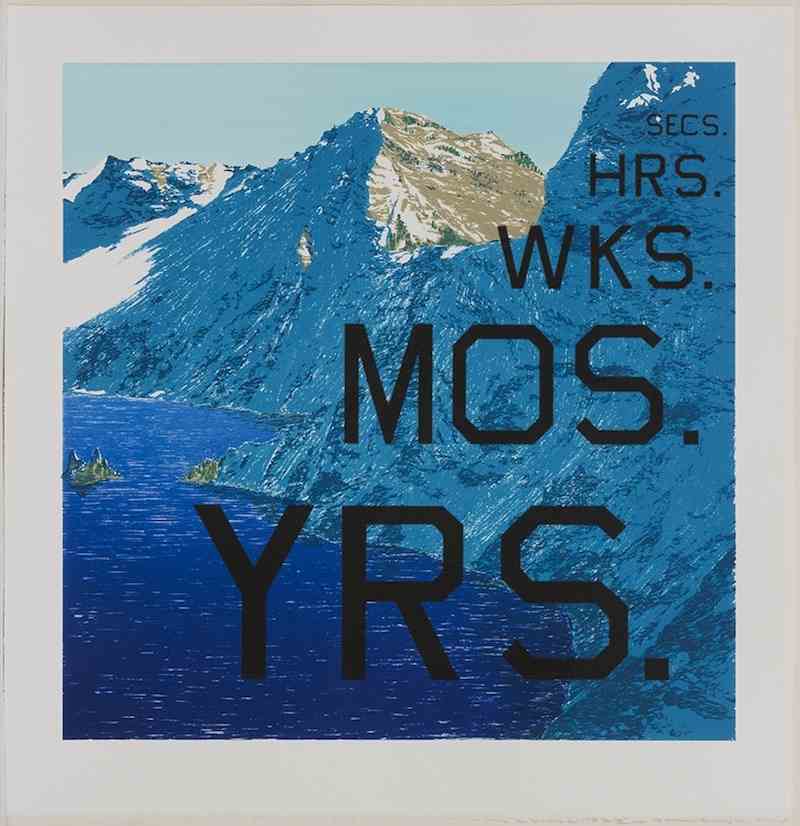
The first major exhibition featuring Ed Ruscha in his home state of Nebraska, Word/Play brings together prints, photographs, and artist books dating from the 1960s through 2014, complemented by a selection of major paintings. An important early figure in Conceptual Art, Ruscha deftly combines imagery and text. At turns poignant, provocative, and confounding, Ruscha’s use of the written word is a signature element of his work.

Born in Omaha in 1937, Ruscha lived in the city for several years before his family moved to Oklahoma City. In 1956, Ruscha relocated to Los Angeles to study commercial art at the Chouinard Art Institute and quickly became a fixture in the energized West Coast art scene. Rarely seen photographs featured in Word/Play reveal the urban landscapes that inspired many of Ruscha’s most famous prints and paintings, including images of nondescript apartment buildings, everyday consumer goods, and the Los Angeles streets.

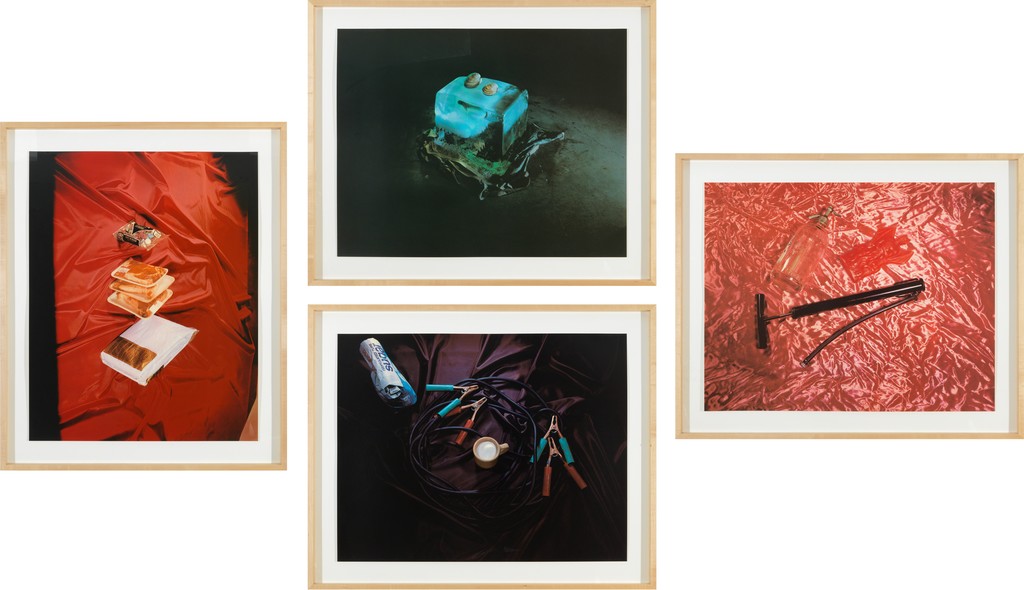
Examining the breadth of Ruscha’s rigorous engagement with printmaking, the exhibition encompasses screen prints, etchings, and lithographs, revealing his aptitude for pairing traditional techniques with unexpected subjects and unconventional materials, such as coffee or gunpowder. Ruscha’s monumental mountain paintings combine the names and occupations of traditional laborers with sublime topographies, highlighting his capacity to ennoble the mundane and cleverly transform it into the extraordinary. Several of these images contain palindromes, inscribed over mirror-image landscapes, such as


Lion in Oil (2002).


More images:


https://d32dm0rphc51dk.cloudfront.net/87cyFXBxuUFWTh4GanIoxA/larger.jpg

Ed Ruscha.  Sweets, Meats, Sheets; Closed; Air, Water, Fire; and Open from Tropical Fish Series, 1975


Sweets, Meats, Sheets; Closed; Air, Water, Fire; and Open from Tropical Fish Series, 1975
Contact Gallery

Renaissance Venice. Titian, Tintoretto, Veronese. From Italian and Russian collections

The Pushkin State Museum of Fine Art, Moscow

09.06.2017 – 20.08.2017
Main Building
The Pushkin State Museum of Fine Arts proudly presents a large-scale project of exceptional significance – “Renaissance Venice. Titian, Tintoretto, Veronese. From Italian and Russian collections”, exhibiting 25 outstanding works by three of the greatest painters. These works will be brought to Moscow for the first time, and some of them have never been displayed outside of Italy.

During the Renaissance, Venice experienced the golden age of art and, first and foremost, painting. In the 16th century, a triad of great masters of the brush – Titian Vecellio (c. 1490–1576), Jacopo Tintoretto (1518–1594) and Paolo Veronese (1528–1588) – created their famous paintings in this city. These artists played a defining role in the formation of the European artistic culture and rendered an important influence on the development of art over the next centuries.

This exhibition provides a unique opportunity to see works of these great contemporaries side by side, whose creations revolutionized the concepts of painting in many ways and laid the foundation for painting throughout Europe. Many great masters of the 17th century, including Velazquez, Rubens, Rembrandt and Poussin, learned from Titian, Tintoretto and Veronese.

The relationship among the great Venetian Renaissance masters is one of the most important topics reflected in the concept of the exhibition. Titian, Tintoretto and Veronese were born in different towns, belonged to different generations, had different social statuses and received different educations. Each of them had his own inimitable artistic language and style. At the same time, they complemented one another to some extent. Their creative lives had much in common: all of them fulfilled orders for Venetian churches and surrounding areas and worked for major politicians and influential people.

The three artists also headed popular studios, which, according to Venetian tradition, were family-owned. Their coexistence in the artistic space of Venice is often regarded as competition. The reality was much more complicated, however: every master had his own niche and worked for specific categories of customers and segments of society. They carefully observed each other’s works, studied them and eventually came to a mutual relationship without any open confrontation: while remaining loyal to their common cultural background, each one recognized the uniqueness of his own style.
The exposition presents a unique opportunity to see priceless masterpieces of the three artists from collections of the most famous Italian and Russian museums. Portraits and religious works – from compositions for private customers to large altarpieces (a type of painting revolutionized by Venetian artists in the 16th century) – will be displayed in the same space.

Curators also paid attention to the rendering of mythological scenes, where Titian, Tintoretto and Veronese discovered their own approaches to the topic of beauty filled with sensuality and thrill. Venetian painting of the 16th century, the golden age of Titian, Tintoretto and Veronese, gained fame for centuries thanks to the freedom and originality of interpretation of erotic scenes, common to mythological themes.


It is not easy to highlight specific examples in the diverse panorama of the exhibition, but Titian’s “Salome” is deserving. It belongs to the collection of the Doria Pamphilj Gallery housed in Rome, and it is rarely seen outside Italy. Made by the young artist in the mid-1520s, when the Renaissance in Venice reached maturity, this painting attracts viewers with its poetry and brightness of color. Striving to achieve the expressiveness of the color scheme is a distinguishing feature of the Venetian painting style, but Titian, Tintoretto and Veronese made an especially outstanding contribution to this tradition.

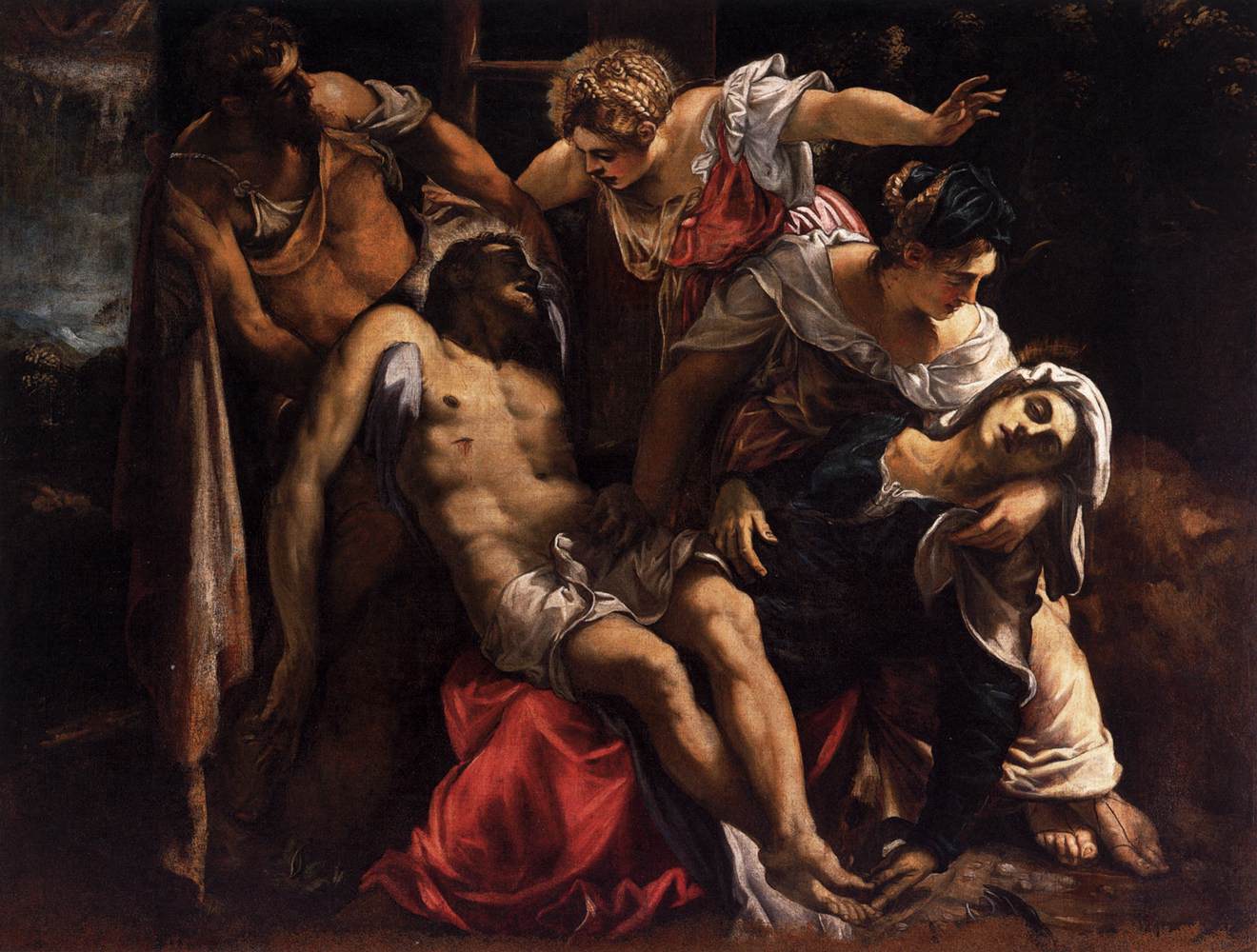
Jacopo Tintoretto was a dramatic artist who used color as a powerful expressive medium. This can be clearly seen in his altar paintings, such as


“Last Supper” from the church of San Marcuola,


“Baptism of Christ” from the San Silvestro church

 https://uploads4.wikiart.org/images/tintoretto/lamentation-over-the-dead-christ.jpg


and “Pietà”, which is currently housed in the Gallerie dell’Accademia in Venice.

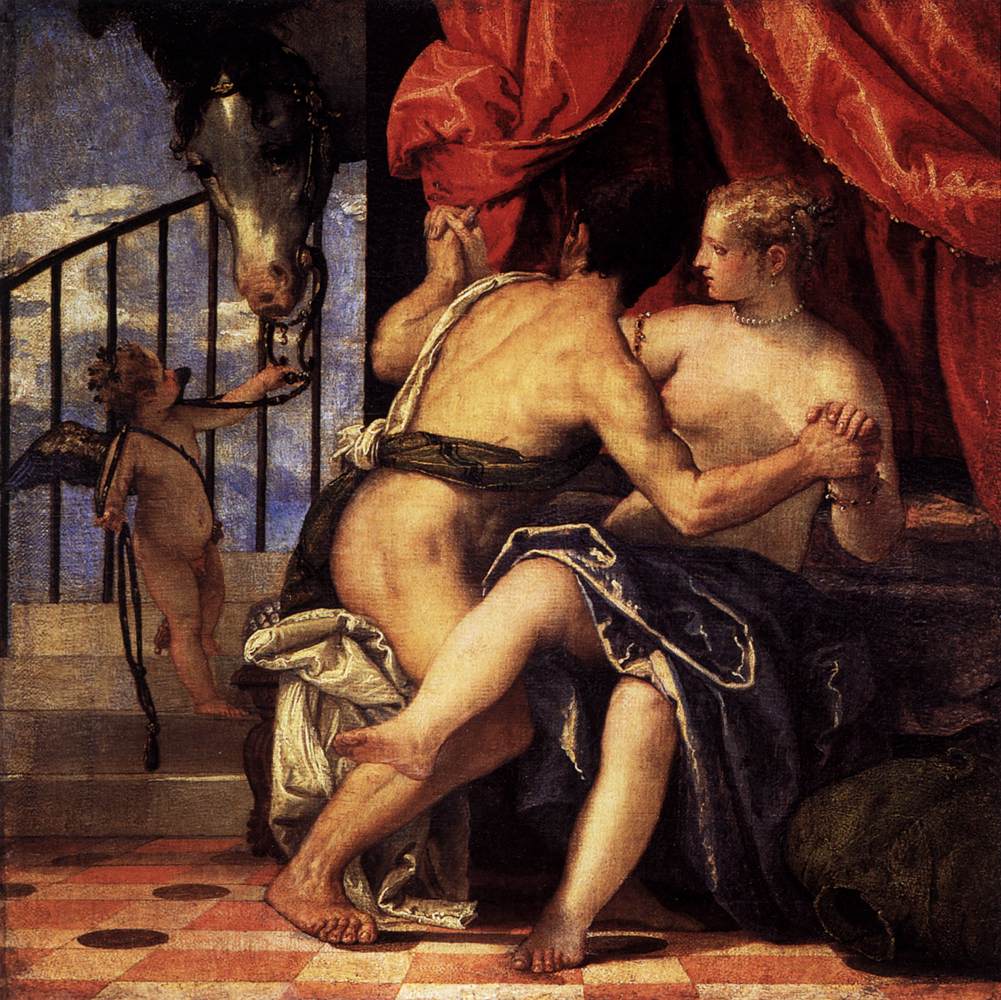
The wealth of colors in the works by Paolo Veronese (who, according to his name, was born in Verona) expresses the uplifting nature of his art and his worship of the world’s beauty. This is obvious in his paintings depicting ancient myths. The exhibition includes his magnificent


"Venus, Mars and Love with a Horse”, which is housed in the Sabauda Gallery in Turin.

Most of the paintings will be brought from the most famous Italian collections of museums and churches. A few artworks presented belong to Russian collections. These include two paintings from the Hermitage


 (“St. George” by Jacopo Tintoretto


and “Portrait of a Man” by his son and assistant Domenico Tintoretto),

http://www.arts-museum.ru/events/archive/2017/venice/21419_foto_1_03.jpg

one painting from the collection of the Pushkin State Museum of Fine Arts (“Resurrection of Christ” by Paolo Veronese, which will be exhibited for the first time after the restoration is completed by Nadezhda Koshkina, head of the Museum’s restoration workshop),


and Titian’s “Venus and Adonis”, owned by the Classica charity fund and considered to be one of the sensations of the exhibition. The chief researcher of the Pushkin State Museum of Fine Arts, Victoria Markova, identified this work as one by the great master, and it has only recently entered art history, having never been displayed in Russia before.

 The Last Supper by Jacopo Tintoretto. Pushkin Museum of Fine Arts

Curator – Victoria Markova, Doctor of Arts, chief researcher of the Pushkin State Museum of Fine Arts and the custodian of Italian paintings
Curator from Italy – Thomas Dalla Costa (University of Verona)
Academic supervisor – Professor Bernard Aikema (University of Verona)
The exhibition is held with the assistance of the Embassy of Italy in Moscow and Ambassador Cesare Maria Ragaglini.


The artworks courtesy of the following museums: Pushkin State Museum of Fine Arts; the National Art Gallery (Bologna); the Gallerie dell’Accademia (Venice); the Church of San Giovanni Elemosinario (Venice); the Church of San Marcuola (Venice); the Church of San Silvestro (Venice); Castelvecchio Museum (Verona); Palazzo Chiericati (Vicenza); Musei di Strada Nuova – Palazzo Bianco (Genoa); Galleria Estense (Modena); Museo di Capodimonte (Naples); Doria Pamphilj Gallery (Rome); National Gallery of Ancient Art, Palazzo Barberini (Rome); Capitoline Museums (Rome); Sabauda Gallery (Turin); Uffizi Gallery (Florence).