Museum
of Fine Arts, Boston (MFA),
February 27
through June 16, 2019
Throughout her entire career, Frida Kahlo (1907–1954) avidly collected traditional Mexican folk art—
arte popular—as
a celebration of Mexican national culture. She drew inspiration from
these objects, seizing on their political significance after the Mexican
Revolution and incorporating their visual and material qualities into
her now-iconic paintings.
The first-ever Kahlo exhibition at the Museum
of Fine Arts, Boston (MFA),
Frida Kahlo and Arte Popular (through
June 16, 2019) focuses on the artist’s lasting engagement with Mexican
folk art, exploring how her passion for objects such as decorated
ceramics, embroidered textiles, children’s toys, and devotional
ex-voto paintings
shaped her own artistic practice.
Eight Kahlo paintings—including
important loans from the Museum of Modern Art (MoMA), the Los Angeles
County Museum of Art (LACMA) and the Harry Ransom Center at the
University of Texas at Austin—are brought together with approximately 40
representative examples of
arte popular, many on loan from the
San Antonio Museum of Art (SAMA), as well as photographs and important
illustrated publications from the period. On view from February 27
through June 16, 2019 in the Saundra B. and William H. Lane Galleries,
located in the MFA’s Art of the Americas Wing, the exhibition features
interpretation in English and Spanish.
“We’re thrilled to bring our visitors the MFA’s first exhibition on
Kahlo, which provides a distinctive view of the artist,” said Layla
Bermeo, Kristin and Roger Servison Assistant Curator of American
Paintings. “While many exhibitions focus on the artist’s biography and
interpret her paintings as direct illustrations of life events, our
exhibition brings fresh attention to Kahlo as an ever-evolving and
ambitious painter, who actively responded to
arte popular. It also opens broader discussions about the influences of anonymous folk artists on famed modern painters.”
Powerfully linking art and politics, the term
arte popularwas
used publicly for the first time in 1921—one year after the end of the
Mexican Revolution (1910–1920). Following this devastating civil war,
government officials and artists played overlapping roles, trying to
construct patriotic histories and images that could unite Mexico’s
divided peoples. Kahlo herself was not a folk artist, but drew
inspiration from ceramics, carvings and other handmade objects made in
rural communities. She and other urban intellectuals championed these
works of
arte popular as expressions of true
mexicanidad,
or Mexican national culture, and as celebrations of Mexico’s indigenous
and working-class people.
By examining some of the social and political
ideas of the post-Revolutionary period, this exhibition offers contexts
for both Kahlo’s paintings and
arte popular, as well as explores dialogues between the two.
Upon entering the exhibition, visitors are greeted by an eight-foot-tall
“Judas” Figure (2018)
commissioned by the MFA from contemporary artist Leonardo Linares,
whose grandfather Pedro Linares made similar papier-mâché sculptures for
Kahlo and her husband Diego Rivera. Comparable Judas figures, along
with other objects in Kahlo’s collection of
arte popular, can
be seen in photographs taken around 1940 by Bernard Silberstein at the
Casa Azul—Kahlo and Rivera’s shared home in Coyoacán, then a village
outside Mexico City. The photographs are on loan from the Detroit
Institute of Arts and displayed in the exhibition. The introductory
section also provides historical context for the display of
arte popular at the MFA, highlighting a selection of objects that were shown at the Museum around 1930 as part of
Mexican Arts, an exhibition that traveled to 13 institutions across the U.S. Following the introduction,
Frida Kahlo and Arte Popular is organized thematically into five sections.
Exhibition Overview Art of the People /
Arte del Pueblo
Kahlo collected
arte popular as an act of national pride, to
show her knowledge and appreciation of Mexican artists working outside
European-style institutions. Around the same time that muralists
promised to liberate painting from easels and make art accessible to the
public,
arte popular was defined as a form of art for the
people, by the people. This section brings together for the first time
two paintings from different periods in Kahlo’s career: the MFA’s
recently acquired
 Dos Mujeres (Salvadora y Herminia)
 (1928), which in 1929 became the first painting sold by the artist,

Self‑Portrait with Hummingbird and Thorn. Frida Kahlo
(Mexican, 1907–1954). 1940. Oil on masonite. *Nickolas Muray
Collection of Modern Mexican Art, Harry Ransom Center, The University of
Texas at Austin. © 2018 Banco de México Diego Rivera Frida Kahlo
Museums Trust, Mexico, D.F. / Artists Rights Society (ARS), New York.
Courtesy, Museum of Fine Arts, Boston
and the iconic
Self-Portrait with Hummingbird and Thorn Necklace (1940,
Harry Ransom Center at the University of Texas at Austin).
Painted more
than a decade apart, these works demonstrate the progression of Kahlo’s
painting practice while also showing her politics and dedication to
Mexico’s diverse histories, peoples, plants and animals.
Dos Mujeres is
a dignified portrait of two mixed-race women who were muchachas, or
domestic workers, in Kahlo’s mother’s household.
The dense foliage
background of the painting evokes the organic patterns on many works of
arte popular, such as a
Burnished Jar (about
1930, San Antonio Museum of Art, The Nelson A. Rockefeller Mexican Folk
Art Collection) decorated with explosively bright flowers and leaves.
A
lush foliage background also appears in
Self-Portrait with Hummingbird and Thorn Necklace, in which the artist poses herself alongside imagined creatures and her own pet monkey. The painting is shown near two ceramic
arte popular monkeys
(about 1930, San Antonio Museum of Art, The Nelson A. Rockefeller
Mexican Folk Art Collection)—one is a whistle and the other is meant to
hold the alcoholic beverage mescal. They exemplify everyday
arte popular objects
that unified beauty and function, representing longstanding artistic
traditions and patterns of use within rural communities.
Aesthetics of Childhood /
Estéticas de la Infancia
Kahlo was fascinated by the world of children, sharing this interest
with many other Mexican modernists. Toys were one of the most prominent
categories of
arte popular—dolls, wooden marionettes and
ceramic animals captivated collectors with their sculpted details and
sophisticated color combinations, all rendered in miniature. The allure
of such small objects perhaps helped Kahlo see the monumental visual
power that could be developed in small dimensions.

Niña con máscara de la muerta (Girl with Death Mask).
Frida Kahlo (Mexican, 1907–1954). 1938. Oil on tin. *Nagoya City Art
Museum. © 2019 Banco de México Diego Rivera Frida Kahlo Museums Trust,
Mexico, D.F. / Artists Rights Society (ARS), New York.
Courtesy, Museum of Fine Arts, Boston
Measuring about six
by five inches, Kahlo’s painting
Girl with Death Mask (She Plays Alone) (1938,
Nagoya City Art Museum) depicts a child—likely the artist
herself—wearing a pink, lace-trimmed dress and hiding her face behind
the rounded yellow eyes and clenched teeth of a skeleton mask. The
jaguar mask next to her is connected to notions of physical and
supernatural strength.
-
-

Máscara de tigre (Jaguar Mask). Mexican Artist (active
Guerrero) late 19th century. Glass, painted wood, animal teeth, boar
bristle. San Antonio Museum of Art, The Nelson A. Rockefeller Mexican
Folk Art Collection.
Photography by Peggy Tenison. Courtesy, Museum of Fine Arts, Boston
The painting is displayed alongside a wooden
Jaguar Mask(late
19th century, San Antonio Museum of Art, The Nelson A. Rockefeller
Mexican Folk Art Collection) that is representative of the type
collected by Kahlo.

Additional works on view in this section include the
drawing
Untitled (Portrait of Girl with Orange Bow) (about 1937–38), Hood Museum of Art, Dartmouth College) by Diego Rivera
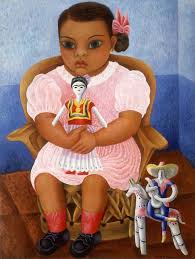
and
Girl with Doll (1943,
Andrés Blaisten Collection) by Rosa Rolanda, Kahlo’s close friend and
fellow artist. Rolanda depicts Kahlo herself as a work of
arte popular, in the form of a unibrowed doll tightly clasped in the hands of a wide-eyed little girl.
Painted Miracles /
Milagros Pintados
Kahlo collected hundreds of devotional
ex-votopaintings, which represent one of her most powerful artistic influences. Tiny images painted on tin,
ex-votosexpress the original owner’s gratitude for miracles and answered prayers.
Ex-voto, from the Latin term for devotional offering, is often used interchangeably with
retablo, which refers to sacred images placed on altars.
Kahlo and her contemporaries redefined
ex-votos as
arte popular,
admiring them for their visionary compositions rather than their
religious purpose.

The shifting perspectives, combination of standing
and floating figures, and metallic support of her painting
My Grandparents, My Parents and I (Family Tree) (1936, Museum of Modern Art, New York) recall the
ex-votoformat. In place of saints, however, Kahlo painted her own ancestors.

This section also features another Kahlo painting,
The Suicide of Dorothy Hale (1939, Phoenix Art Museum),

and
Girl (1925, Andrés Blaisten Collection) a painting by Kahlo’s contemporary Gabriel Fernández Ledesma, which renders the
ex-voto as a picture within a picture.
Ex-votos from the 19th and 20th centuries are on view,

as well as a rare 18th-century example:
Peres Maldonado Ex-voto (1777,
Davis Museum at Wellesley College), a violent yet beautifully painted
work that shows a woman undergoing breast cancer surgery. In 1939,
Surrealist André Breton, who had acquired this
ex-voto during a visit to Mexico, displayed it alongside paintings by Kahlo in an exhibition in Paris titled
Mexique.
A letter written by Kahlo, in which she critiques Breton’s curatorial vision, is also on view in this section.
Living Still Lifes /
Naturalezas Vivas
Kahlo engaged with the art historical genre of still life, especially
in the later stages of her career, but innovated the tradition even as
she worked within it. She aggressively filled small-scale compositions
with round, vividly colored forms that look like they might tumble out
of the picture. She painted fruits and rocks as though they had eyes,
skin and feelings, giving them humanlike qualities that are also visible
in many works of
arte popular.
Like the springy
Skeletons (about 1940, San Antonio Museum of Art, The Nelson A. Rockefeller Mexican Folk Art Collection) originally made for the
Día de Muertos (Day of the Dead) holiday, Kahlo’s
naturalezas vivas—“living”
still lifes—disobey the categories of inanimate and animate, things and
beings, dead and living.
Three lively and colorful Kahlo paintings are
included in this section—
 Still Life: Pitahayas
 (1938, Madison Museum of Contemporary Art),
 Still Life with Parrot and Fruit
 (1951, Harry Ransom Center, The University of Texas at Austin)

and
Weeping Coconuts (1951, LACMA)

—alongside
Cupboard (1947, Andrés Blaisten Collection) by María Izquierdo, Kahlo’s contemporary and a fellow collector of
arte popular.
Invented Traditions /
Tradiciones Inventadas
Just as Kahlo used paint to create pictures, she used clothing to
create her own image. Garments, headdresses and accessories from
Mexico’s rural and indigenous communities became her most visible
collection of
arte popular, worn during international travels and immortalized in photographs. The
huipil(rectangular blouse),
rebozo (traditional shawl) and regional
Tehuana dress
were not only critical to Kahlo’s self-fashioning, but also represented
broader notions of ideal, “authentic” Mexican femininity. Kahlo made
the Tehuana style her signature look—wearing, painting and even gifting
the distinctive dresses to people outside of Mexico.
The garments in
this section include a two-piece
Tehuana dress (top and skirt) (1930s–1940s),
on view for the first time since it was acquired by the MFA in 2017.
Although Kahlo did not wear the dress herself, it was purchased with her
help by Jackson Cole Phillips, the original owner of her painting
Dos Mujeres.









972x546.jpg "Lyonel Feininger, Rosa Wolke II")
200x152.jpg "Paul Klee, Das Haus in der Höhe")

.jpg)