Sunday, June 12, 2022

Serra/Seurat. Drawings


Museo Guggenheim Bilbao

June 9 – September 6, 2022 


Read the report: "Guggenheim Bilbao: what is the relationship between contemporary American sculptor Richard Serra and neo-impressionist French painter Georges Seurat?" https://judithbenhamouhuet.com/guggen...

Curators: Lucía Agirre, curator, Museo Guggenheim Bilbao, and Judith Benhamou, independent curator and art writer - Especially important in Seurat’s drawings is the handmade paper he uses, which he ‘brings to life’ by allowing it to absorb exactly the right amount of crayon to create the lights, volumes, and contrasts that make him one of the masters of drawing. - Richard Serra also revels in his materials, such as the handmade Japanese paper that he employs in his Ramble drawings. Owing to its manufacturing process, the fibers create different ‘accidents’ so that no drawing is the same as any other. - Seurat was an artist for artists, as draftsman was and is admired by many of them, such Van Gogh, Signac, Picasso, Moore and even now Jasper Johns and Richard Serra. His drawings are now fetishized by these creators and the followers of their cults all around the world, the collectors. The Guggenheim Museum Bilbao presents Serra/Seurat. Drawings, the exhibition that brings together a selection of 22 drawings by the late 19th-century master Georges Seurat, which in turn engage in dialogue with the drawings of Richard Serra, a great admirer of Seurat’s and without a doubt one of the most outstanding artists of the present day. Despite the years that separate them, both artists are notable for working with drawing as an end in itself and taking it to new levels, imbuing it with innovative characteristics and extrapolating it to other areas of their work. The drawings of Georges Seurat were highly valued by artists of his time like Maximilien Luce, Vincent van Gogh, and Paul Signac, who described them in 1899 as “the most beautiful painter’s drawings in existence,” and they have continued to win appreciation from later artists like Henri Matisse, Pablo Picasso, Henry Moore, Bridget Riley, and Richard Serra himself. Seurat was able with very simple means to make appear shapes from the conte crayon darkness placed on the white paper. This is what Serra calls the weight of shapes. “The weight of the drawing derives not only from the number of layers of paintstick but mainly from the particular shape of the drawing. It is obvious – from Mantegna’s Christ to Cézanne’s apples – that shapes can imply weight, mass and volume”. Especially important in Seurat’s drawings is the paper support he uses. He usually chooses a handmade French paper, Michallet, which is characterized by its irregularities, its heavy texture, and its undulations or crests, almost imperceptible to the naked eye but not to the crayon sliding over its surface. Besides the technical dexterity of the execution, it might be said that Seurat ‘feels’ the paper and brings it to life, allowing it to absorb exactly the right amount of crayon to create the lights, volumes, and contrasts that make him worthy to be considered one of the great masters of drawing. This knowledge of the material which distinguishes the great artists was discovered by Richard Serra while he was studying with Josef Albers. He expressed it in these words: "Once one you understood the basic lesson that procedure was dictated by the material, you also realized that matter imposed its own form on form." Richard Serra thus saw early on that sculpture is not subject only to carving, modeling, and casting, but that the materials have a great influence on the spatial experience they generate. He also gives drawing a transcendent quality, for besides using it as a means to other ends, he turns it into an autonomous language and applies new techniques, formats, and materials. In his Ramble drawings, a series he began in 2015, Serra, like Seurat, revels in his materials, such as the handmade Japanese paper whose manufacturing process makes the fibers create ‘accidents’ so that every sheet is different from the others. This means that no Ramble is the same as any other, both because of the manner in which the artist works on the paper and because of the way the paper reacts. In the Ramble drawings, Serra uses two different methods of applying the litho crayon. The first is transfer, and the second direct marking on the sheet. In the first case, the amount of pressure determines a greater or lesser degree of transfer, and so what looks in some works like a light mist becomes a dark blur in others. Direct application meanwhile allows greater control over the amount of grease used on the paper, leading to a wide variety of results with a wealth of fascinating nuances. Serra creates these works on a moderate scale, but still endows them with a certain monumentality by arranging 33 of the smallest Ramble drawings in a grid formed by three rows of eleven. With this configuration, the artist shares his creative process with the viewer, who is enabled to perceive the effects created by each impression on the unique sheets of paper. An Essential Activity As Serra himself explained in 1977: “Drawing is a concentration on an essential activity, and the credibility of the statement is totally within your hands. It’s the most direct, conscious space in which I work. I can observe my process from beginning to end, and at times sustain a continuous concentration. It’s replenishing. It’s one of the few conditions in which I can understand the source of my work.” For Seurat too, drawing is an essential activity, a fact demonstrated by the late date at which he started to paint and the small number of his paintings by contrast with the hundreds of drawings he produced. His contemporary Paul Signac recognized and extolled his importance: “Seurat's studies resulted in his wellconsidered and fertile theory of contrasts: a theory to which all his work was thereafter subjected. He applied it first to chiaroscuro: with the simplest of resources, the white of a sheet of Ingres paper and the black of a conté crayon, skillfully graded or contrasted, he executed some four hundred drawings, the most beautiful painters' drawings in existence. Thanks to their perfect science of values, we can say that these blacks and whites are more colorful and brighter than many paintings.” Seurat’s drawing and painting may appear to be two separate worlds, but his profound knowledge of color, which is fragmented when applied to his canvases, is reflected earlier in his black and white drawings. As color is an effect of the light, an extensive knowledge of chromatic gradations and combinations allows him to illuminate the maximum darkness of black in the absence of color. These words spoken by Serra in 2000 also stem from such a notion of black: “It’s definitely a color. [...] As soon as you think of Seurat’s drawings you think of black as a color.” Georges Seurat is a master at illuminating both darkness and brightness, an even more complicated task as this effect is harder to achieve when there is less contrast. His almost pointillist use of the grain of the paper allows him on occasions to work with ‘negative drawing’. Constant Evolution In this exhibition, viewers can appreciate the evolution of Seurat’s drawings after his training at the Lehmann school, which he subsequently left, abandoning the ‘traditional’ path with it. He also left behind him the drawings he made during his military service, some with colored pencils, in his famous Brest sketchbooks, which marked the artist’s development toward a definitive break with academicism and the beginning of his mature language. The small drawings Seated Couple (Couple Assis, ca. 1881) and In Shirt Sleeves (En bras de chemise, ca. 1881), probably also from a sketchbook, show his attempts to break away from traditional delineation by means of diagonal hatching framed by short broken lines. In Two-horse hitch (Attelage à deux chevaux, 1882–83), he uses a tangle of brief movements to sketch out the main form of the two horses and the driver, occupying the whole sheet with similar strokes—but with crayon of less density—to create a continuum nuanced only by a change of direction in the execution and the concentration of material. Somewhat similar is The Lamp (La Lampe, 1882–83), though the result is accentuated by making the neck and chin of the female figure disappear into the deep darkness of the crayon, allowing the lamp to frame her face and acquire presence even though hardly any light is projected on the rest of the scene. Seurat’s drawing evolved vertiginously during his mature phase, as demonstrated not only by the Impressionist modernity of the black and white landscapes of this period, such as The Edge of the Forest [Le Mur du chemin (La Forêt), ca. 1883] or Tree Trunks Reflected in Water (Homage to Stéphane Mallarmé) [Troncs d’arbres se reflétant dans l’eau (Hommage à Stéphane Mallarmé), 1883–84], but also by his figures, reclining, seated, or walking down a moonlit path, like those of Night Stroll (Promenoir, ca. 1882). Seurat continued experimenting and working on paper until the end of his brief career, as is clearly seen in his painting and palpable in works on display in the exhibition like Study for A Summer Sunday on the Grande Jatte island: skirt detail (Étude pour Un Dimanche d’été sur l’île de la Grande Jatte: detail de jupe, 1984-85) and An Evening, Gravelines (Un Soir, Gravelines, 1890). Seurat sketched this landscape rapidly, but without wasting the opportunity to create chiaroscuros and occupy the whole surface of the paper. The show ends with the beautiful scene of The White Sail (Le voile blanche, 1890), one of his last drawings, where the light emanates from a small sail that dominates the composition, filled by the artist with details as he uses every inch of the sheet. This connects with Richard Serra’s Ramble drawings in a stimulating dialogue. DIDAKTIKA As part of the Didaktika project, the Museum designs educational areas, online content, and programs to complement the exhibitions, offering viewers tools and resources to increase their appreciation of the works on display. The Didaktika Serra-Seurat. Drawings focuses on the mediums and materials used by artists Richard Serra and Georges Seurat, as for both, the choice of paper—texture and size—, the drawing tools, even the exclusive use of black, are essential. Thus, in this space, visitors will find samples of different papers, of various textures and thicknesses, ranging from old to contemporary, that they will be able to experience through touch. A selection of fragments from documentaries and interviews screened in two areas will also highlight Seurat’s influence on other contemporary artists and the importance of drawing for him. Exhibition-related Programs Introductory Talk (June 7) Exhibition curators Judith Benhamou and Lucía Agirre will talk about the exhibition, a celebration of drawing through two masters from the History of Art. Shared Reflections* Visits led by Museum professionals from the Departments of Curatorial and Education offering different perspectives of the pieces in the exhibitions. • Curatorial Vision (June 15). Lucía Agirre, Museum and exhibition curator, will guide participants on a tour of the show. • Key Concepts (June 29). Luz Maguregui, Museum Education Coordinator, will discuss the general and didactic keys of the exhibition. *Sponsored by Fundación Vizcaína Aguirre Creative Session: Hand-made Paper (June 30) Master paper-maker and engineer Juan Barbé Arrillaga, will share the craft of making paper in this beginner’s workshop for adults. CATALOGUE The exhibition will be accompanied by an illustrated catalogue featuring the works in the show, as well as three essays contributed by the exhibition curators about Georges Seurat’s and Richard Serra’s consideration of drawing as an artistic end in itself, imbuing it with innovative characteristics and taking it to new levels. Cover images: Georges Seurat Tree Trunks Reflected in Water (Homage to Stéphane Mallarmé) [Troncs d’arbres reflétés dans l’eau (Hommage à Stéphane Mallarmé)], 1883–84 Conté crayon on paper 22 x 32 cm. Permanent loan to Hahnloser/Jaeggli Foundation, Villa Flora, Winterthur

Saturday, June 4, 2022

Golden Boy Gustav Klimt. Inspired by Van Gogh, Rodin, Matisse…

Gustav Klimt is known throughout the world for his paintings featuring gold and decorative ornaments, his universal symbolism and his pictures of strong women. But where did he find inspiration?

The exhibition Golden Boy Gustav Klimt. Inspired by Van Gogh, Rodin, Matisse… offers visitors a remarkable opportunity to view Klimt’s art alongside work by the numerous artists who inspired him.

Klimt’s oeuvre is rarely offered on loan, but this autumn, masterpieces from all over the world will be travelling to Amsterdam. This is the largest retrospective of Klimt’s work ever to be organized in the Netherlands. Works including 

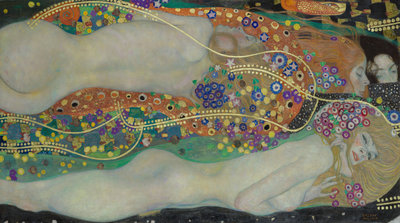
Emilie Flöge (1902) and Water Serpents II (1904) will be on public display for the first time in the exhibition, which is a collaboration with the Belvedere in Vienna.

Gustav Klimt (1826-1918) was one of the foremost artists in imperial fin-de-siècle Vienna, and his name still resonates today. Klimt was both celebrated and controversial, and remains one of the most fascinating artists of modern art history.

Based on new research, Golden Boy Gustav Klimt presents internationally famous works by Klimt alongside the work of other renowned artists including Vincent van Gogh, Whistler, Sargent, Toorop, Monet, Rodin, Toulouse-Lautrec and Matisse. The exhibition shows how Klimt drew inspiration from this art, before making equally captivating art in a style completely his own.

Golden Boy Gustav Klimt transports visitors to the turbulent times in which Klimt lived and charts his impressive career. The stories behind the paintings and the people figuring in them also play a role: who were they, why did Klimt paint them, and what was the relationship between the painter and his model?

The focus of the exhibition is on Klimt’s enormous stylistic development: from a classical portrait of pianist Pembaur from his early years (1890) to Adele Bloch-Bauer II (1912) and Eugenia Primavesi (1913), two explosions of colour inspired by Van Gogh and Matisse.

Iconic Klimt paintings

The exhibition features iconic works including Judith (1901), which brings the Biblical Judith into Klimt’s time, sensual and bathing in gold. The daring The Bride – which was left unfinished on the easel when Klimt died in 1918 – is also on display, as is the famous portrait of Klimt’s beloved muse Emilie Flöge.

A spectacular inclusion is the painting Water Serpents II, on public display for the first time since the 1960s.

Golden Boy Gustav Klimt. Inspired by Van Gogh, Rodin, Matisse… is on display at the Van Gogh Museum from 7 October 2022 to 8 January 2023.

Gustav Klimt, Waterslangen II, 1904, bewerkt 1906-1907, privécollectie, courtesy of HomeArt, Hongkong

Gustav Klimt, Water Serpents II, 1904, reworked 1906-1907, oil on canvas, 80 × 145 cm, private collection, courtesy of HomeArt

100 Great British Drawings

The Huntington Library, Art Museum, and Botanical Garden

June 18 through Sept. 5, 2022

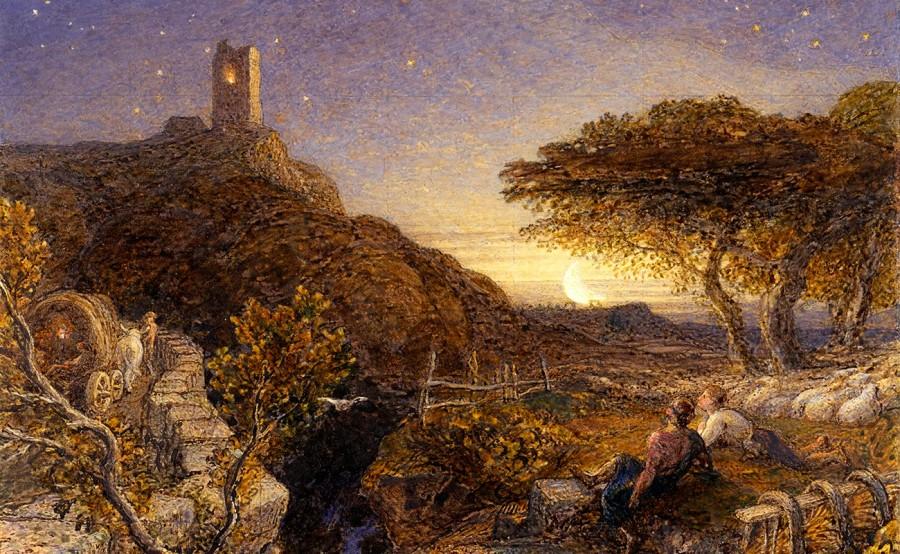
Samuel Palmer (1805–1881), Lonely Tower, ca. 1881. Opaque watercolor over traces of graphite on board, 7 x 9 5/8 in. Gilbert Davis Collection, The Huntington Library, Art Museum, and Botanical Gardens.

“100 Great British Drawings,” a major exhibition at The Huntington Library, Art Museum, and Botanical Gardens, will trace the practice of drawing in Britain from the 17th through the mid-20th century, spotlighting The Huntington’s important collection of more than 12,000 works that represent the great masters of the medium. On view June 18 through Sept. 5, 2022, in the MaryLou and George Boone Gallery, the exhibition will feature rarely seen treasures, including works by William Blake, John Constable, Thomas Gainsborough, and J. M. W. Turner, as well as examples by artists associated with the Pre-Raphaelite Brotherhood and early 20th-century modernism. A fully illustrated catalog accompanies the exhibition, examining for the first time the strength and diversity of The Huntington’s British drawings collection, a significant portion of which has never been published before. The Huntington is the sole venue for the exhibition.

Gwen John (1876–1939), Two Hatted Women in Church, 1920s. Matte water-based transparent paint on wove paper, 8 3/4 x 6 7/8 in. The Huntington Library, Art Museum, and Botanical Gardens.

“The Huntington is renowned for its incomparable collection of British art, ranging from 15th-century silver to the graphic art of Henry Moore, with the most famous works being, of course, our grand manner paintings,” said Christina Nielsen, Hannah and Russel Kully Director of the Art Museum at The Huntington. “Thomas Gainsborough’s Blue Boy and Thomas Lawrence’s Pinkie often serve as the poster boy and poster girl for the whole institution. But what most visitors do not realize is that The Huntington is also home to an extensive and remarkable collection of British drawings. This exhibition and catalog, the first to show the range of our British works on paper on such a scale, seek to fill that knowledge gap.”

Most of The Huntington’s British drawings collection, with a few notable exceptions, was established after the time of the institution’s founders, Henry and Arabella Huntington. Henry was an avid collector of rare books and manuscripts, and his wife, Arabella, was the force behind their collection of paintings and decorative art, but drawings did not factor largely into their art purchases. It was Robert R. Wark, curator of the art collections from 1956 to 1990, whose vision and tenacity established The Huntington as an outstanding repository of drawings made in Britain, where the art form was especially well developed, particularly in the late 18th to mid-19th century.

“Drawing is the most spontaneous and intimate of art forms, revealing the thoughts and mood of the artist through the stroke of a pen or touch of a brush dipped in watercolor,” said Melinda McCurdy, curator of British art, curator of the exhibition, and author of the catalog. “It is a practice especially associated with British artists, whose serious engagement with the medium is on vibrant display in the works we highlight in this exhibition.”

Chronologically Exploring a Range of Styles
Organized chronologically, “100 Great British Drawings” will explore portraiture, historical subjects, landscape, still life, botanical illustration, and caricature. The works on view will represent a full range of styles, including quick pencil sketches that candidly reveal artists’ creative processes, fluid pen-and-ink studies that approach the quality of finished works, and highly refined watercolor paintings.

William Blake (1757–1827), Hecate or The Night of Enitharmon’s Joy, 1795. Planographic color print with pen and ink and watercolor on wove paper, 16 3/8 x 22 in. The Huntington Library, Art Museum, and Botanical Gardens.

The art of drawing first flourished in Britain in the late 17th century with an influx of artists coming from continental Europe, where the practice was commonly a part of artistic training. British artists also traveled abroad to view and copy the works of Europe’s old masters and contemporary artists. While portraiture was the most popular British art form at the time (as polished works by John Greenhill and Edmund Ashfield demonstrate in the exhibition), British artists eventually embraced a wide range of subjects, from landscape painting to history painting, a genre that appealed to such 18th-century titans as Thomas Gainsborough and George Romney.

Joseph Mallord William Turner (1775–1851), Beaumaris Castle, Anglesey, ca. 1825–36. Watercolor and opaque watercolor over traces of graphite with scraping out on wove paper, 11 1/2 x 16 3/4 in. The Huntington Library, Art Museum, and Botanical Gardens.

Romney was unique among his peers in that he saw drawing as an end in and of itself, rather than merely a tool in preparation for oil painting. His Cimon and Iphigenia (early 1780s) was inspired by a tale from Boccaccio’s Decameron, and it captures the moment at which shepherd Cimon first spies his love, Iphigenia, asleep with two other women. Romney chose to depict Iphigenia in a sensual embrace with one of the women, using sweeping strokes of ink to imbue the scene with energy and passion. Cimon is barely present—cut off on the left of the frame—adding a suggestion of erotic voyeurism to Romney’s interpretation.

Matilda Conyers (ca. 1698–1793), Wallflower and Tulip, 1767. Watercolor and opaque watercolor over traces of graphite with brown ink (est. iron gall) inscriptions on vellum, 9 x 6 1/4 in. The Huntington Library, Art Museum, and Botanical Gardens.

Even William Blake, famous for his unique imagination, betrays his European influences in Hecate or The Night of Enitharmon’s Joy (1795). Made by using a complex mix of printing techniques, drawing, and watercolor, Hecate depicts the witchlike mythological figure with musculature that recalls Michelangelo’s female forms, which were sketched from male nudes. By applying Michelangelo’s approach, Blake gives Hecate a powerful physique that suggests an unnatural, occult strength. The large-scale work is drawn from The Huntington’s William Blake collection, which was established by Henry Huntington himself and easily ranks among the most important Blake collections in the world.

Most of the works in The Huntington’s British drawings collection are from the 18th and 19th centuries, when drawings and watercolors became popular commodities. Watercolors, though less forgiving than oil, allow artists to create luminous effects and are well suited to capturing the misty English climate. J. M. W. Turner was a master of these atmospheric effects. His Beaumaris Castle, Anglesey (ca. 1825–36) uses layered washes of color to create a soft fog that obscures people, horses, buildings, and ships, blending the line between sea and land. In its exploration of artistic techniques, the exhibition will look at the pigments and paper that artists used. Turner, for example, required a strong paper that could withstand his method, described by an eyewitness as first saturating the paper with wet paint. Then, “he tore ... scratched ... scrabbled at it in a kind of frenzy” until the image emerged as if by “magic ... with all its exquisite minutia.”

By the mid-19th century, transparent watercolor technique gave way to an interest in opaque pigments or gouache, in keeping with a Victorian-era taste for sharp-focus realism. Many of the Victorian works in the exhibition were created as illustrations to poems or stories, including Samuel Palmer’s watercolor and gouache Lonely Tower (ca. 1881), which was inspired by John Milton’s Il Penseroso, and popular children’s book illustrator Kate Greenaway’s watercolor and graphite Now All of You Come Listen (ca. 1879). Some works from this period—such as those by artist Edward Burne-Jones, who was associated with the Pre-Raphaelites and collaborated with designer William Morris—demonstrate a turn away from realism toward pure “art for art’s sake,” a notion affiliated with the Aesthetic movement.

John Roddam Spencer Stanhope (1829–1908), Millpond, ca. 1870. Watercolor and opaque watercolor on wove paper, 16 3/4 x 24 5/8 in. The Huntington Library, Art Museum, and Botanical Gardens.

Drawings from the first half of the 20th century reveal the extraordinarily wide array of artistic styles that were emerging at the time. Many of The Huntington’s works from the period are by artists from the Slade School of Fine Art in London, where students studied abstraction, French Impressionism, Fauvism, Expressionism, Cubism, and Surrealism. A highlight of this group is Gwen John’s Two Hatted Women in Church (1920s), a work in water-based transparent paint that she made when living in France. John attended church there regularly, where she would draw the congregation, focusing less on the individuals and more on the shapes she saw in their clothing, their varying postures, and the chairs they sat on. John asserts her modernism in the painting, said McCurdy, as she “wittily juxtaposes two differently shaped hats, abbreviating such descriptive details as facial features and composing the image with bold black outlines and broad washes of muted tones.” The exhibition includes several other arresting 20th-century works on paper in various styles by such artists as David Bomberg, Paul Nash, and John Piper.

John Brett (1831–1902), The Open Sea, 1865. Watercolor with opaque watercolor and scraping out on wove paper, 9 x 12 3/4 in. The Huntington Library, Art Museum, and Botanical Gardens.

The 20th-century works combine with the others in “100 Great British Drawings” to create a display that reveals the infinitely diverse aspects of “mark making,” said Ann Bermingham, professor emeritus of the history of art and architecture at the University of California, Santa Barbara, in her essay for the exhibition catalog. She concludes, “If The Huntington drawings speak to us over the distances of time and space, it is because they still hold in their linear grasp the thrill and promise of endless creativity.”

Related Catalog

To complement the exhibition, The Huntington published with Lund Humphries Excursions of Imagination: 100 Great British Drawings from The Huntington’s Collection. The 256-page, fully illustrated exhibition catalog is by Melinda McCurdy, curator of British art at The Huntington; with Ann Bermingham, professor emeritus of the history of art and architecture at the University of California, Santa Barbara; and Christina Nielsen, Hannah and Russel Kully Director of the Art Museum at The Huntington. The book features an introduction by McCurdy discussing the formation of The Huntington’s British drawings collection and an essay by Bermingham that places The Huntington’s collection within the context of the historical practice of drawing in Britain.

Andrew Wyeth: Life and Death

Colby College Museum of Art

 through October 16, 2022

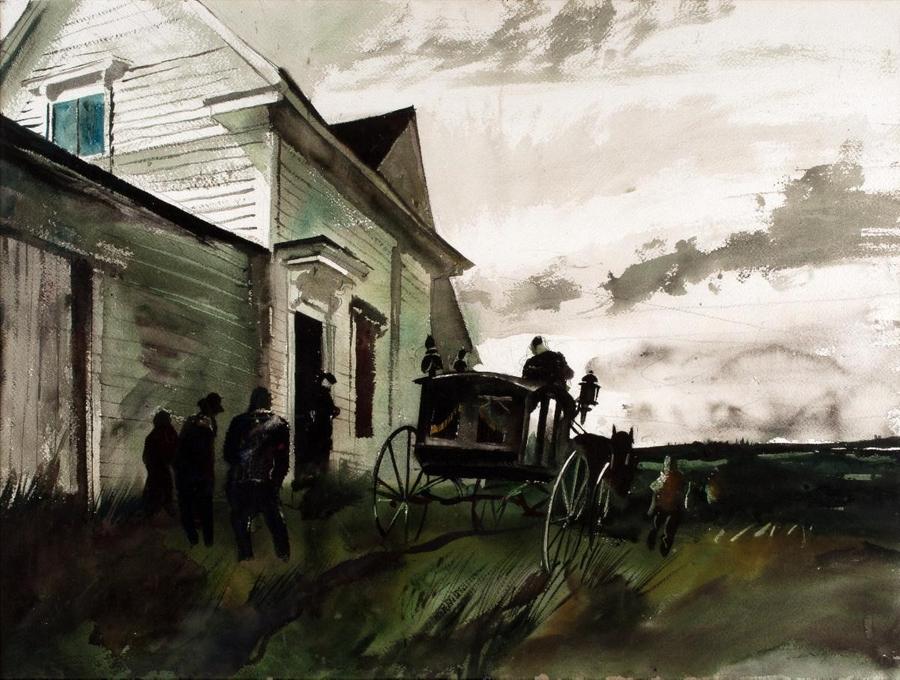
John Olson's Funeral, 1945. Watercolor on paper. © 2021 Andrew Wyeth/Artists Rights Society (ARS). New Britain Museum of American Art, Charles F. Smith Fund, 1945.26

Life and Death shows the artist engaging with his own mortality

A new exhibition in Waterville, Maine, at the Colby College Museum of Art, Andrew Wyeth: Life and Death, offers the first public presentation of a recently rediscovered series of drawings in which the artist Andrew Wyeth (1917-2009) imagined his own funeral.

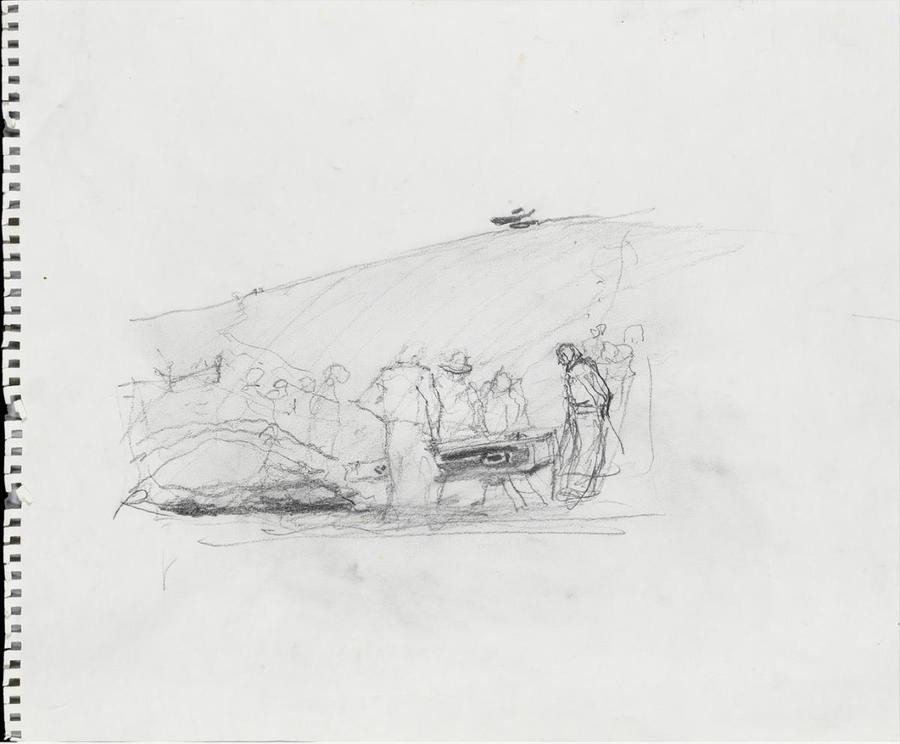
Created in the early 1990s, the drawings, now known collectively as the Funeral Group, depict Wyeth’s friends, neighbors, and wife, Betsy, surrounding a coffin at the base of Kuerner’s Hill in Chadds Ford, Pennsylvania, a site the artist long associated with death. Some of the drawings offer a view inside the coffin, revealing a rare self-portrait.

Kuerner's Hill 16 (Funeral Group), ca. 1991–94. Pencil on paper. © 2021 Andrew Wyeth/Artists Rights Society (ARS) Collection of the Wyeth Foundation for American Art

“Conceived before the current moment, this exhibition offers viewers a powerful resource for sense-making during a time that continues to test our resilience and ask each of us to recognize human interdependence and vulnerability,” said Jacqueline Terrassa, Carolyn Muzzy director of the Colby Museum.

The drawings in the exhibition represent a selection of the approximately fifty works that have been identified as part of the Funeral Group. In 2018, Wyeth’s son, artist Jamie Wyeth, received just over twenty drawings, which had been preserved privately in the home of his father’s friends George and Helen Sipala in Chadds Ford. Since 2020, additional funeral scene sketches have been located in the collection of the Wyeth Foundation for American Art.

Andrew Wyeth: Life and Death connects these sketches to Wyeth’s decades-long engagement with death as an artistic subject and places him in rare conversation with artists who also used self-portraiture to confront their mortality.

“Because the work of Andrew Wyeth has long been regarded as intensely personal and mysterious, it has often been situated outside the story of American art since the 1960s,” said Tanya Sheehan, William R. Kenan Jr. Professor of Art at Colby College and the exhibition curator.

“This exhibition shows that Wyeth was engaged in existential questions that have long preoccupied conceptual, performance and activist artists.”

Wyeth’s contemporaries, Andy Warhol, George Tooker, and Duane Michals, as well as later generation artists David Wojnarowicz, Janaina Tschäpe and Mario Moore, are featured in the exhibition. Several of their works foreground the harsh reality that death is always closer to some Americans than to others, by virtue of their economic status, sexuality, and racial or ethnic identities.

Andrew Wyeth: Life and Death is on view through October 16, 2022. Support for the exhibition is provided by the Wyeth Foundation for American Art.

Catalogue


This volume presents for the first time a recently rediscovered series of pencil drawings from the early 1990s, through which Wyeth imagined his own funeral. Chapters by leading art historians explore the significance of picturing one’s own death in both the context of Wyeth’s late career and contemporary American art. The book connects the funeral series to Wyeth’s decades-long engagement with death as an artistic subject in painting, his relationships with the models depicted, and his use of drawing as an expressive and exploratory medium. It further inserts Wyeth’s work into a larger conversation about mortality and self-portraiture that developed in American art since the 1960s, and includes works by Duane Michals, Andy Warhol, David Wojnarowicz, George Tooker, Janaina Tschäpe and Mario Moore. While his contemporaries posed a variety of existential questions in picturing their own passing, those that interrogate the universality of death as a human experience have become especially urgent in the wake of the coronavirus pandemic and the national reckoning with racial inequality that emerged in 2020. Andrew Wyeth: Life and Death thus addresses ideas about loss, grief, vulnerability and (im)mortality that pervade the current moment.
American painter 
Andrew Wyeth (1917–2009) lived his entire life in his birthplace of Chadds Ford, Pennsylvania, and his summer home in mid-coast Maine. His seven-decade career was spent painting the land and people that he knew and cared about. Renowned for his tempera painting Christina's World (1948), Wyeth navigated between artistic representation and abstraction in a highly personal way.

Thursday, June 2, 2022

Golden Boy Gustav Klimt. Inspired by Van Gogh, Rodin, Matisse...

 Van Gogh Museum

7 October 2022 till 8 January 2023

1 PB KLIMT Judith.jpg
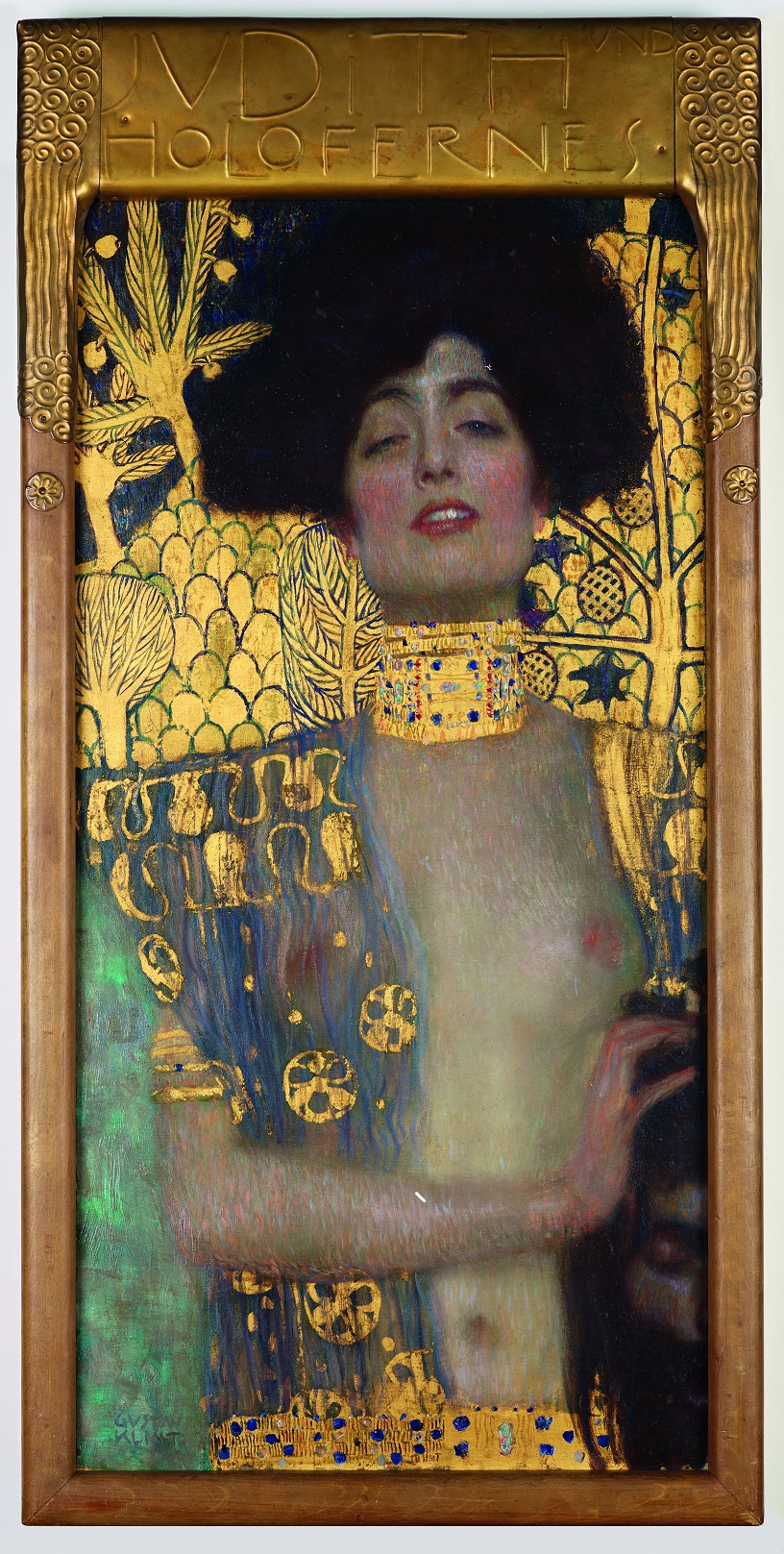
Gustav Klimt: Judith, 1901, Öl und Blattgold auf Leinwand, 84 × 42 cm, Belvedere, Vienna. Photo: Belvedere, Vienna, Johannes Stoll


Gustav Klimt is known throughout the world for his paintings featuring gold and decorative ornaments, his universal symbolism and his pictures of strong women. But where did he find inspiration?

The exhibition Golden Boy Gustav Klimt. Inspired by Van Gogh, Rodin, Matisse… offers visitors a remarkable opportunity to view Klimt’s art alongside work by the numerous artists who inspired him.

Klimt’s oeuvre is rarely offered on loan, but this autumn, masterpieces from all over the world will be travelling to Amsterdam. This is the largest retrospective of Klimt’s work ever to be organized in the Netherlands. Works including Emilie Flöge (1902) and Water Serpents II (1904) will be on public display for the first time in the exhibition, which is a collaboration with the Belvedere in Vienna.

Gustav Klimt (1826-1918) was one of the foremost artists in imperial fin-de-siècle Vienna, and his name still resonates today. Klimt was both celebrated and controversial, and remains one of the most fascinating artists of modern art history.

Based on new research, Golden Boy Gustav Klimt presents internationally famous works by Klimt alongside the work of other renowned artists including Vincent van Gogh, Whistler, Sargent, Toorop, Monet, Rodin, Toulouse-Lautrec and Matisse. The exhibition shows how Klimt drew inspiration from this art, before making equally captivating art in a style completely his own.

Turbulent times

Golden Boy Gustav Klimt transports visitors to the turbulent times in which Klimt lived and charts his impressive career. The stories behind the paintings and the people figuring in them also play a role: who were they, why did Klimt paint them, and what was the relationship between the painter and his model?

The focus of the exhibition is on Klimt’s enormous stylistic development: from a classical portrait of pianist Pembaur from his early years (1890) to Adele Bloch-Bauer II (1912) and Eugenia Primavesi (1913), two explosions of colour inspired by Van Gogh and Matisse.

Iconic Klimt paintings

The exhibition features iconic works including Judith (1901), which brings the Biblical Judith into Klimt’s time, sensual and bathing in gold. The daring The Bride – which was left unfinished on the easel when Klimt died in 1918 – is also on display, as is the famous portrait of Klimt’s beloved muse Emilie Flöge.

A spectacular inclusion is the painting Water Serpents II, on public display for the first time since the 1960s.

Golden Boy Gustav Klimt. Inspired by Van Gogh, Rodin, Matisse… is on display at the Van Gogh Museum from 7 October 2022 to 8 January 2023.


Gustav Klimt, Waterslangen II, 1904, bewerkt 1906-1907, privécollectie, courtesy of HomeArt, Hongkong

Gustav Klimt, Water Serpents II, 1904, reworked 1906-1907, oil on canvas, 80 × 145 cm, private collection, courtesy of HomeArt


The Woman in White: Joanna Hiffernan and James McNeill Whistler

National Gallery of Art, in Washington, DC, 

July 3–October 10, 2022

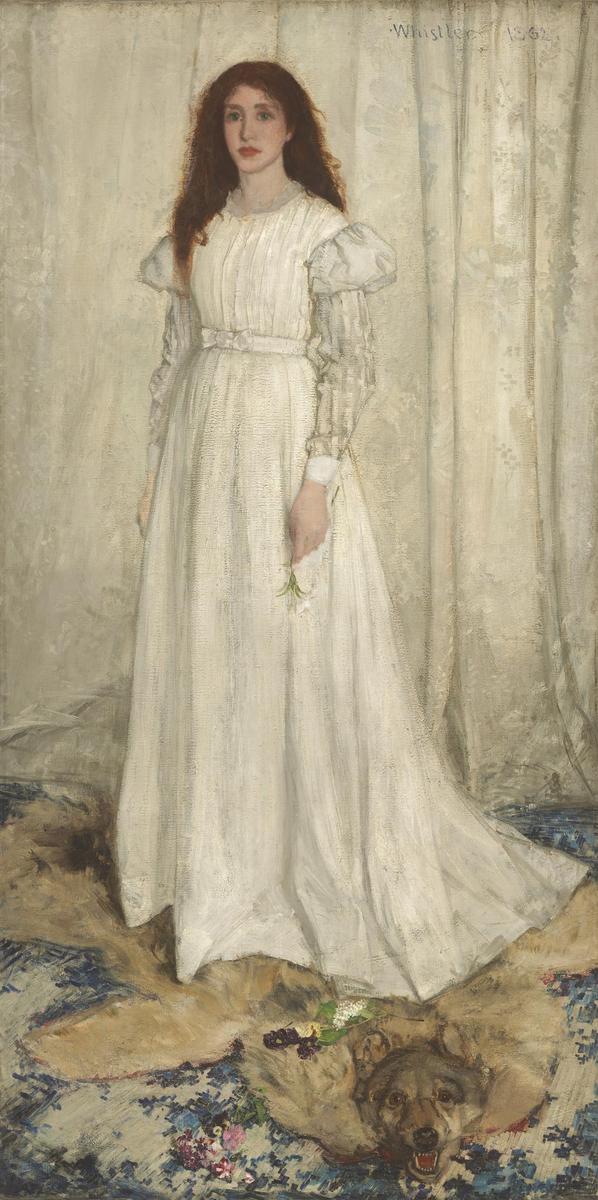
James McNeill Whistler, Symphony in White, No. 1: The White Girl, 1861–1863, 1872, oil on canvas, overall: 213 x 107.9 cm (83 7/8 x 42 1/2 in.) National Gallery of Art, Washington, Harris Whittemore Collection

When James McNeill Whistler (1834–1903) and Joanna Hiffernan (1839–1886) met in 1860, they began a close professional and personal relationship that lasted for over two decades. Featuring some 60 works including paintings, drawings, and prints, The Woman in White: Joanna Hiffernan and James McNeill Whistler explores their partnership and the iconic works of art arising from their collaboration. Bringing together nearly every known depiction of Hiffernan, as well as relevant documents and letters, this exhibition explores who Hiffernan was, her partnership with Whistler, and her role in the creative process. The Woman in White is on view from July 3 through October 10, 2022, in the National Gallery’s East Building in Washington, DC.

James McNeill Whistler, A White Note, 1862, oil on canvas, overall: 36.8 x 31.8 cm (14 1/2 x 12 1/2 in.) The Lunder Collection, Colby College Museum of Art, Waterville, ME, 021.2011

Baptized in Limerick, Ireland, Joanna Hiffernan immigrated to London with her parents and siblings—where, as Irish Catholics, they experienced poverty and social prejudice in a class-bound society. When they met in 1860, Hiffernan not only became Whistler's primary model but also helped manage his studio and financial affairs. In 1866, Whistler gave her power of attorney and made her his sole heir in his will. In 1870, after Whistler fathered a child with Louisa Fanny Hanson, Hiffernan and her sister Agnes Singleton raised the boy, Charles ("Charlie") James Whistler Hanson. The child became the primary connection between Hiffernan and Whistler through the 1870s and into the 1880s. In 1886, Hiffernan died of bronchitis after lifelong respiratory problems that may have been exacerbated by her earlier exposure to toxic art materials while working in the studio.

Despite all the records, letters, and works of art that document Hiffernan's life, much remains to be discovered. Personal correspondence is rare, and no photographs of Hiffernan or works of art by her have yet been found. Presenting what is known, the exhibition invites visitors to participate in recovering Hiffernan's humanity by considering the essential mystery of who she was.

"This is the first exhibition to delve deeply into how these exquisite depictions of Joanna Hiffernan were made, what they mean, who Hiffernan was, as well as the broader influence and resonance of Hiffernan's collaboration with Whistler for Victorian culture in the late 19th century," said Kaywin Feldman, director of the National Gallery of Art. "We are deeply grateful to Professor Margaret F. MacDonald, the preeminent authority on Whistler's art and life, for graciously agreeing to guest curate this presentation in collaboration with Ann Dumas and Charles Brock. I would like to extend our thanks to our lenders for their willingness to share their treasured works of art and to the Terra Foundation for American Art for their support of the exhibition and its accompanying book."

James McNeill Whistler, Weary, 1863, signed with butterfly, c. 1874, drypoint on cream Asian laid paper plate: 19.7 x 13.1 cm (7 3/4 x 5 3/16 in.) Collection of the University of Michigan Museum of Art, Ann Arbor, Bequest of Margaret Watson Parker, 1954/1.353

The exhibition has been curated by Margaret F. MacDonald, professor emerita of art history, University of Glasgow, in collaboration with Ann Dumas, curator at the Royal Academy of Arts and consultant curator of European art, Museum of Fine Arts, Houston, and Charles Brock, associate curator of American and British paintings at the National Gallery of Art.

The exhibition travels from Royal Academy of Arts, London, to the National Gallery of Art, in Washington, DC, July 3–October 10, 2022.

Symphony in White, No. 1: The White Girl (1861–1863), one of the National Gallery's most famous and popular works, is presented together with Whistler’s second and third "Symphony in White" paintings, for the first time in the United States. Featuring an anonymous subject—who we identify as Joanna Hiffernan, an Irish Catholic woman with little or no status in British society—these works shifted the essence of modern art from sentimental storytelling and stark realism toward abstraction: viewers were left to speculate about who the striking model might be.

James McNeill Whistler, The Artist in His Studio (Whistler in His Studio), 1865/1872, 1895, oil on paper mounted on panel overall: 63 x 47.3 cm (24 13/16 x 18 5/8 in.) The Art Institute of Chicago, Friends of American Art Collection, 1912.141 The Art Institute of Chicago / Art Resource, NY

In addition to these visual "symphonies," the first gallery of the exhibition showcases Hiffernan in a variety of other roles and settings, ranging from gritty, working-class surroundings (Wapping (1860–1864), named for a district by the River Thames in London) to exquisitely arranged interiors where she is surrounded by beautiful examples of textiles, pottery, and prints from Whistler's extensive collections of Asian art.  

In the second gallery, etchings and drawings portray Hiffernan as Whistler would have encountered her in the shared spaces of their studio and home in London. The intimate scale of these works on paper—originally intended to be handheld—amplify the personal, psychological dimensions of the pair’s relationship. Notable works include two striking drypoints: Jo (1861) and Weary (1863).

The paintings of women dressed in white in the third gallery were made during the Victorian era by European and American artists who either influenced, or were themselves directly inspired by, Hiffernan and Whistler's most significant and controversial collaboration, Symphony in White, No 1: The White Girl. This gallery highlights not only how other artists incorporated the technical challenges of painting white in their work, but also some of the broader cultural associations that the color held for Victorian audiences, from fashion and spiritualism to perceptions of gender and race. Among the works featured here are significant paintings by John Singer Sargent (1856–1925), Dante Gabriel Rossetti (1828–1882), and John Everett Millais (1829–1896). Symphonie in blanc (1908) by Andrée Karpelès (1885–1956) stands out as the sole portrait of a "woman in white" painted by a woman in this exhibition and is a particularly striking example of the pervasive influence of Whistler's "Symphony in White" paintings.

The last gallery of the exhibition returns to the history of Hiffernan and Whistler's partnership. It includes three portraits of Hiffernan by Gustave Courbet (1819–1877), from when the three spent time together in the seaside village of Trouville, France, in the fall of 1865. Also on view is a series of illustrations that Whistler and Hiffernan undertook in 1862. Featured in the popular periodicals Good Words and Once a Week, Hiffernan takes on various roles—a cotton-mill worker, a tapestry weaver, a nun—posed as if in moments of anguish, doubt, or peaceful introspection. These images suggest affinities between Hiffernan's own experience and the plight of the women she portrays.

James McNeill Whistler, Symphony in White, No. 3, 1865–1867, oil on canvas overall: 51 x 76.5 cm (20 1/16 x 30 1/8 in.) The Henry Barber Trust, The Barber Institute of Fine Arts, The University of Birmingham Bridgeman Images

In addition to the works of art, letters and documents presented in the final gallery shed light on the complex personal relationship between Whistler and Hiffernan. We see depictions of Hiffernan's sisters Agnes and Ellen, Whistler's son Charles—and the woman who supplanted Hiffernan as Whistler's chief model, Maud Franklin. Among the documents on view are letters from Whistler to Hiffernan, a legal document granting her power of attorney, and Whistler's will designating her as his sole heir—items that illuminate the key role Hiffernan played in their unconventional yet enduring partnership.

Albert Herter, Portrait of Bessie (Miss Elizabeth Newton), 1892 ,oil on canvas, overall: 149.9 x 81.3 cm (59 x 32 in.) High Museum of Art, Atlanta, Purchase with funds from the Margaret and Terry Stent Endowment for the Acquisition of American Art and High Museum of Art Enhancement Fund, 2000.162

Accompanying Book


Published with Yale University Press, this 232-page illustrated volume provides the first comprehensive account of Irish-born model Joanna Hiffernan's partnership with American-born artist James McNeill Whistler during a period when he was forging a reputation as one of the most innovative and influential artists of his generation. A series of essays discusses how the relationship between Hiffernan and Whistler overturned artistic conventions, and sheds light on their interactions with contemporaries, including Gustave Courbet, for whom Hiffernan also modeled. This catalog traces their resonance for artists, including Edgar Degas, Gustav Klimt, Dante Gabriel Rossetti, and John Singer Sargent, and includes new insights into the creation, marketing, and cultural context of Whistler's iconic works.

This book is edited and written by Margaret F. MacDonald, professor emerita and honorary professorial research fellow at the School of Culture and Creative Arts, University of Glasgow, with contributions from Charles Brock, associate curator of American and British paintings at the National Gallery of Art, Washington; Patricia de Montfort, lecturer in the history of art and at the School of Culture and Creative Arts and research curator for Whistler studies at the Hunterian, University of Glasgow; Ann Dumas, curator at the Royal Academy of Arts, London, and consultant curator of European art, Museum of Fine Arts, Houston; Joanna Dunn, painting conservator at the National Gallery of Art, Washington; Grischka Petri, honorary research fellow at the University of Glasgow; Aileen Ribeiro, professor emerita at the Courtauld Institute of Art, London; and Joyce H. Townsend, senior conservation scientist at Tate, London, and honorary professorial research fellow in the School of Culture and Creative Arts, University of Glasgow.