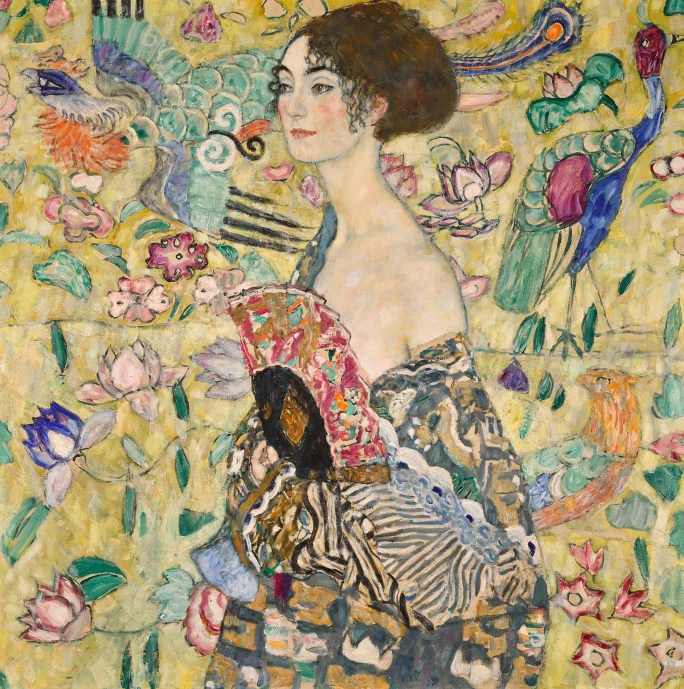
One of only a small number of portraits by Klimt still in private hands, Lady with a Fan will be offered in Sotheby’s marquee Modern & Contemporary Evening Auction in London on 27 June with an estimate in the region of £65 million ($80 million).
“Dame mit Fächer (Lady with a Fan) is the last portrait Gustav Klimt created before his untimely death, when still in his artistic prime and producing some of his most accomplished and experimental works. Many of those works, certainly the portraits for which he is best known, were commissions. This, though, is something completely different - a technical tour de force, full of boundary-pushing experimentation, as well as a heartfelt ode to absolute beauty.”
Sotheby’s to offer a work that is not only the star of the summer auction season in London, but also one of the finest and most valuable works of art ever to be offered in Europe.
Still standing on an easel in Gustav Klimt’s studio at the time of the artist’s unexpected and untimely death in February 1918, Dame mit Fächer (Lady with a Fan) – a beautiful, rich and alluring portrait of an unnamed woman – brings together all the technical prowess and creative exuberance that define Klimt’s greatest work.
The last portrait Klimt painted, Dame mit Fächer is also among his finest works, created when he was still in his artistic prime, and at a moment when the ‘formality’ of his earlier commissioned work gives way to a new expressivity – an ever-deeper, ever-more joyful immersion in pattern, colour and form, which – while clearly influenced by his contemporaries Van Gogh, Matisse and Gauguin – became something entirely different in his hands.
Similarly, while the slightly earlier works of Klimt’s famous ‘golden period’ – led by the iconic portrait of Adele Bloch-Bauer I of 1907 – see their sitter presented icon-like, amid a tapestry of golden shapes, here the sitter almost dissolves into the background, the soft patterning of the woman’s skin repeated in the pale-yellow background.

Klimt first started work on Lady with a Fan in 1917, by which time he was among the most celebrated portraitists in Europe: commissions came thick and fast, for which he was able to command prices far higher than any of his contemporaries. But this was a rare work painted entirely in the pursuit of his own interests. Full of freedom and spontaneity, it reflects Klimt’s joy in painting it and in celebrating beauty in its purest form. It also reveals his innovative approach. Traditionally, portraits were – and still are – painted in the eponymous ‘portrait (or vertical) form’. Here, Klimt returns to the square format that he used for his avantgarde landscapes earlier in the century, giving this painting a uniquely ‘modern’ edge.
Klimt also here gives full expression to his complete fascination with Chinese and Japanese art and culture. Luscious, silken kimonos and Chinese robes are known to have been his dresswear of choice, and his home abounded with beautiful objects from the East. Egon Schiele, a regular visitor, describes it like this: ‘the sitting room, [was] furnished with a square table in the middle and a large number of Japanese prints covering the walls… and from there into another room whose wall was entirely covered by a huge wardrobe, which held his marvelous collection of Chinese and Japanese robes.’
In Dame mit Fächer, Klimt draws principally on Chinese motifs: the phoenix (symbol of immortality and rebirth, good fortune and fidelity) and lotus blossoms (symbols of love, happy marriage and/or purity). Meanwhile, his flattening of the background and juxtaposition of patterns reflects his deep interest in Japanese woodblock prints.
“The beauty and sensuality of the portrait lies in the detail: the flecks of blue and pink which enliven the sitter’s skin, the feathery lines of her eyelashes and the pursed lips that give her face character. Klimt here gave himself full freedom to capture on canvas a devastatingly beautiful woman. Her provocatively bared shoulder, poise and quiet self-assurance combine to stunning effect.”
The painting was acquired shortly after Klimt’s death by Viennese industrialist Erwin Böhler. The Böhler family, including Erwin’s brother Heinrich and his cousin Hans, were close friends and patrons of both Klimt and Egon Schiele. They vacationed with Gustav Klimt on the Attersee, a lake near Salzburg that was the inspiration for many of the artist’s most important landscapes and can be seen in photographs together. In 1916 Erwin purchased the Litzelberg – a small island in the lake immortalised in Klimt’s paintings. An important supporter of the arts, Erwin Böhler commissioned leading architect Josef Hoffmann to decorate the rooms of his apartment in the Palais Dumba in Vienna where the painting hung in the Music Room alongside Klimt’s landscapes Waldabhang in Unterach am Attersee and Presshaus am Attersee which were also part of his collection. The work eventually passed to Heinrich and then, upon his death in 1940, to Heinrich’s wife Mabel.
By 1967 it was in the collection of Rudolf Leopold, who is known to have purchased a large group of Schiele drawings from Mabel Böhler in 1952 and may also have acquired this work from her. Dame mit Fächer was last offered for sale nearly thirty years ago in 1994, when it was acquired by the family of the present owner. Most recently it was the subject of an important exhibition at the Belvedere in Vienna where it was reunited with and shown alongside Klimt’s other great, late masterpieces.
The exhibition of the painting in Sotheby’s New Bond Street galleries later this month will mark a major moment for Klimt lovers in London, with three major portraits by the artist on view simultaneously in the capital for the first time ever. (The other portraits, Hermine Gallia of 1904 and Adele Bloch Bauer II of 1912, are currently on view in the National Gallery’s much-acclaimed show, ‘After Impressionism’.)
The appearance of this major work at auction marks an important moment for the market: not only is the painting the most valuable ever to have been offered at auction in Europe, it also now joins the ranks of the most valuable portraits – of any era – ever to have come to auction.
Klimt himself also sits in the select pantheon of artists to have achieved over $100m at auction – his Birch Forest having sold as part of the Paul G. Allen Collection last year for $104.6m. While that was a landscape, only one portrait by Klimt of this calibre has ever appeared at auction before: Portrait of Adele Bloch-Bauer II, from 1912, which made $87.9m in 2006.
Dame mit Fächer also joins a strong sequence of spectacular works to have starred in Sotheby’s Marquee Seasons in London: most recently René Magritte’s L’empire des lumières (sold for £59.4m / $79.8m, March 2022) and Wassily Kandinsky’s Murnau mit Kirche II (sold for £37.2m / $44.9m, March 2023).
The star offering in London this June, Dame mit Fächer will feature large in what is set to be a very special season of auctions, exhibitions and events at Sotheby’s this summer, much of which will be focussed around the subject of portraiture – timed to celebrate the much-anticipated reopening of the National Portrait Gallery in London.
Accordingly, Sotheby’s marquee Modern & Contemporary Evening Auction on 27 June will include a strong grouping of portraits - by leading artists such as Alberto Giacometti, Edvard Munch, Leonor Fini, Elizabeth Peyton and Kerry James Marshall – all to be presented in a special sequence (‘Face To Face’) dedicated to this long but totally timeless and multi-faceted tradition.
That too will be complemented by a special exhibition of masterpieces from Chatsworth House in Derbyshire, one of Britain’s finest stately homes, featuring works by Rembrandt, Sir Joshua Reynolds, Lucian Freud and Michael Craig-Martin, many of them never seen in the UK outside of Chatsworth before.
Portraits from Chatsworth – A Loan Exhibition will be on public view from 30 May to 4 July. Meanwhile, Klimt’s Dame mit Fächer, and other highlights from Sotheby’s suite of flagship June sales will be on view to the public from 20 to 27 June. Both exhibitions are free and open to all.
| Lucian Freud's "Tender Portrait" to highlight Sotheby's London summer sales season | ||
Frank Auerbach, Mornington Crescent, 1969 Estimate: £3.5-4.5 million. Courtesy Sotheby’s. | ||
LONDON.- This season’s major evening sale of Modern & Contemporary art at Sotheby’s London is set to star four extraordinary pieces by three visionaries of British Art: Lucian Freud, Frank Auerbach and Frank Dobson. Coming to auction from a distinguished private collection, all four works were created within just a few miles of one another in London. Lucian Freud’s naked portrait of Penelope Cuthbertson leads this exceptional group with an estimate of £8-12 million. While from a first glance, the painting appears to be simply a portrait, a closer inspection also alludes to the presence of the artist himself: the haphazard wardrobe offers a glimpse of Freud’s overcoat and boots, while the glowing reflections in the window perhaps hint subtly to Freud’s form, his brush, and his easel. Freud’s meditative portrait will be offered alongside two remarkable paintings from Frank Auerbach’s most revered series’: Mornington Crescent, which carries the highest estimate ever placed on a work by the artist at auction (est. £3.5-4.5m), and a portrait of his most famed sitter Juliet Yardley Mills, J.Y.M. Seated II (est. £800,000-1.2m). Scraped and sculpted, its richly impastoed surface powerfully conveys the depth of Auerbach’s emotional response to his subject in a manner akin to Freud’s portrait of Cuthbertson (Night Interior). The collection also comprises a white marble sculpture of a female form by Frank Dobson - a prominent player in the revival of ‘direct carving’ in Britain (est. £600,000-800,000). Rare to market, only ten carvings by the artist have appeared at auction in the last thirty years. Please find further information on each of the works below. All four works will go on public view as part of Sotheby’s preview exhibitions in its New Bond Street galleries, opening on 20 June, before they are offered at auction on the evening of 27 June. A Closer Look at the Works  Lucian Freud’s Night Interior, 1969-70 Estimate: £8-12 million. Courtesy Sotheby’s. At once tender and meditative, intimate and contemplative, Lucian Freud’s Night Interior is an entrancing naked portrait of Penelope Cuthbertson, the daughter of Teresa Jungmann, one of the original Bright Young Things, grand-daughter of the artist Nico Wilhelm Jungmann, and wife of the late Desmond Guinness. Here, Cuthbertson is portrayed sitting in a chair in front of a large window - her legs dangling over its arm, her eyes shut, dreaming. She does not confront the viewer, or the artist, rather the viewer confronts her in an intimate moment of privacy. Night Interior is one of seven painted portraits the artist created of Cuthbertson during his lifetime. They first met at a party in the late 1960s, and soon after Freud asked Cuthbertson to sit for him, creating the very first portraits of her in 1966 and a further three in 1968, before embarking on this final work in 1968-70. Night Interior illuminates Freud’s mastery in the genre of portraiture, though his output was restricted to capturing only those closest to him. Whether self-portraits, or portraits of his children, friends, lovers, fellow artists and luminaries, Freud did not take commissions and instead chose only to paint those with a particular significance to him. He would scrutinise his sitter for hour upon hour, day upon day, as an artist notorious for taking months and even years over a particular work. Alongside portraiture, ‘the nude’ was the other defining leitmotif of Freud’s career. Across six decades of painting, innumerable mutations of painterly style, and a multitude of sitters, he would return to this subject time and again. It was, in many ways, the greatest challenge of his career; a problem to which he never found a solution: “All portraits are difficult for me. But a nude presents different challenges. When someone is naked, there is in effect nothing to be hidden. You are stripped of your costume as it were. Not everyone wants to be that honest about themselves. That means I feel an obligation to be equally honest in how I represent their honesty. It’s a matter of responsibility. I’m not trying to be a philosopher. I’m more of a realist. I’m just trying to see and understand the people that make up my life.” Night Interior once resided in the collection of the late Garech Domnagh Browne, cousin of Lady Caroline Blackwood, before it was acquired by Charles Saatchi and then by the present owner. The painting also has an illustrious exhibition history: it was a formative part of Freud’s first major UK travelling retrospective which began at the Hayward Gallery, London, in 1974; it was included in the seminal show, Lucian Freud. L’Atelier, at the Centre Georges Pompidou, Paris, in 2010, and six years later in the Irish Museum of Modern Art’s loan exhibition Lucian Freud (2016-2018).  Frank Auerbach, Mornington Crescent, 1969 Estimate: £3.5-4.5 million Courtesy Sotheby’s. Mornington Crescent is among Frank Auerbach’s earliest and largest painterly musings on North London. After moving to his studio in Camden Town, taking it over from Leon Kossoff in 1954, Auerbach would soon begin to explore the streets on his immediate doorstep, as well as those around Chalk Farm, Primrose Hill and Mornington Crescent, all of which carry long cultural associations: the painter Walter Sickert live there, and Charles Dickens attended a school nearby. These areas quickly became places as familiar to Auerbach as the faces of his long-standing sitters: “This part of London is my world. I’ve been wandering around these streets for so long that I have become attached to them, and as fond of them as people are of their pets.” Painted in tandem with his inimitable portrayals of the human figure, London’s topography remained a central focus of Auerbach’s career for over half a decade, counterbalancing yet corresponding to the zoomed in focus of the studio-based recordings of his sitters. In this regard, Auerbach's dynamic landscape paintings go beyond mere landscape, instead becoming daring recreations, rather than representations, of places that resonate on a profoundly personal level with the artist. Mornington Crescent has remained in the same private collection since it was first acquired from Marlborough Gallery in 1982, and exhibited only once on the occasion of the Royal Academy’s momentous retrospective of Auerbach’s oeuvre in 2001. Auerbach, J.Y.M. Seated II, 1987 Estimate: £800,000-1.2 million Portraying his most famed sitter, Frank Auerbach’s Head of J.Y.M. was painted in 1987, thirty years into the artist’s friendship with Juliet Yardley Mills, referred to by her friends simply as J.Y.M. The two formed a close bond that resulted in some of Auerbach’s most significant paintings. Mills first posed for the artist in 1956 when she was a professional model at Sidcup College of Art and continued to do so for over forty years until 1997. Every Wednesday and Sunday, J.Y.M would take two buses from her home in Southeast London to Auerbach’s studio in Camden Town. Speaking of the experience, she said: “We had a wonderful relationship because I thought the world of him and he was very fond of me. There was no sort of romance but we were close. Real friends. Sundays now I’m always miserable.” Punctuated with swathes of yellow ochre and orange - in dramatic contrast to the outlines of black impasto which vigorously sculpt the eyes, nose, mouth and jaw - Auerbach portrays his subject sitting upright, her back firmly pressed against the back of a supporting tall Windsor chair, exuding an imposing presence within the composition. This portrait comes to the market on the heels of Sotheby’s record-breaking sale of another of Auerbach’s most celebrated portraits of J.Y.M. for £5.6 million in October 2022. The artist is also currently the subject of a major solo exhibition, ‘Frank Auerbach: Twenty Self-Portraits’, at Hazlitt Holland gallery. | ||