Philadelphia Museum of Art
October 10, 2026–January 31, 2027
The (PMA) is pleased to present the first major U.S. retrospective in more than 50 years dedicated to the work of Marcel Duchamp (1887–1968). On view in the Dorrance Galleries from October 10, 2026–January 31, 2027, the exhibition will feature a chronological display of approximately 300 works from a career spanning painting, drawing, sculpture, photography, film, printed matter, and the unclassifiable works known as readymades.
The last major U.S. Duchamp survey took place in 1973–74, co-organized by the PMA—home to the world’s largest Duchamp collection—and The Museum of Modern Art (MoMA) in New York. Co-organized by the same two institutions, this exhibition will reappraise an oeuvre that transformed the very idea of what art could be.
“We are delighted to join forces once again with The Museum of Modern Art to present an ambitious retrospective of Marcel Duchamp’s work,” said Daniel Weiss, the George D. Widener Director and Chief Executive Officer, PMA. “Remarkably, Duchamp himself played a key role in guiding the distinguished art collection of Louise and Walter Arensberg, his principal patrons, to the PMA as a gift in 1950. That act made Philadelphia the artist’s permanent home, and today, the PMA holds the world’s most significant assembly of works by Duchamp—comprising some two hundred paintings, sculptures, and works on paper, as well as the most extensive archives relating to the artist’s life and work.”
“When, in 1913, Duchamp produced the first readymade, making use of ordinary, mass produced, commercially-available items, he defied fixed beliefs about the nature and definition of art itself. He also brought forth new ways of being an artist,” said Matthew Affron, the Muriel and Philip Berman Curator of Modern Art, PMA. “This retrospective will reintroduce contemporary audiences to Duchamp’s complex ideas, his elusive personae, and his revolutionary approach to making art.”
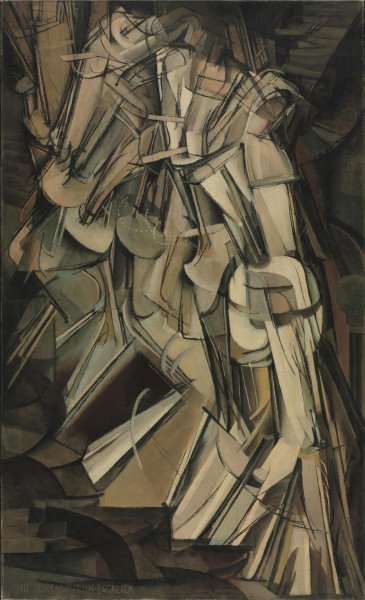
Duchamp was associated with three of the 20th century’s radical art movements—Cubism, Dada, and Surrealism—yet his practice was one of continuous reinvention, impossible to consolidate under any singular label. Marcel Duchamp will present a chronological survey of the entirety of the artist’s career, from 1900 to 1968. The exhibition’s opening sections will explore Duchamp’s early development: his fledgling efforts as a cartoonist working for the satirical press, his apprenticeship in the various styles of French modern art, and his first flashes of public recognition as a member of the Cubist group in Paris in 1911 and 1912. The rejection of Nude Descending a Staircase (No. 2) (1912) by his own Cubist associates, and the scandal provoked by its display at the 1913 Armory Show in New York, cemented both the painting’s iconic status and its maker’s enduring reputation as an artistic provocateur.
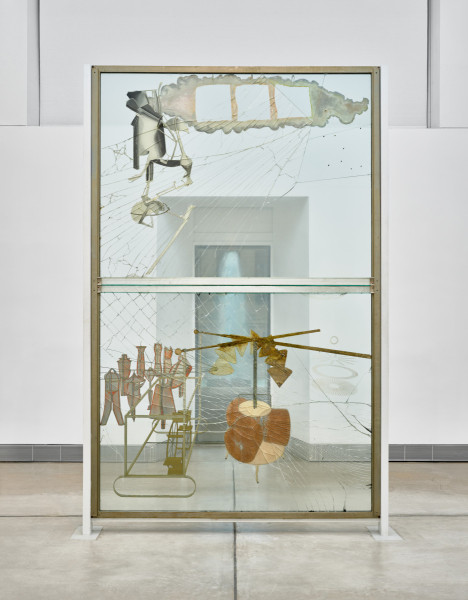
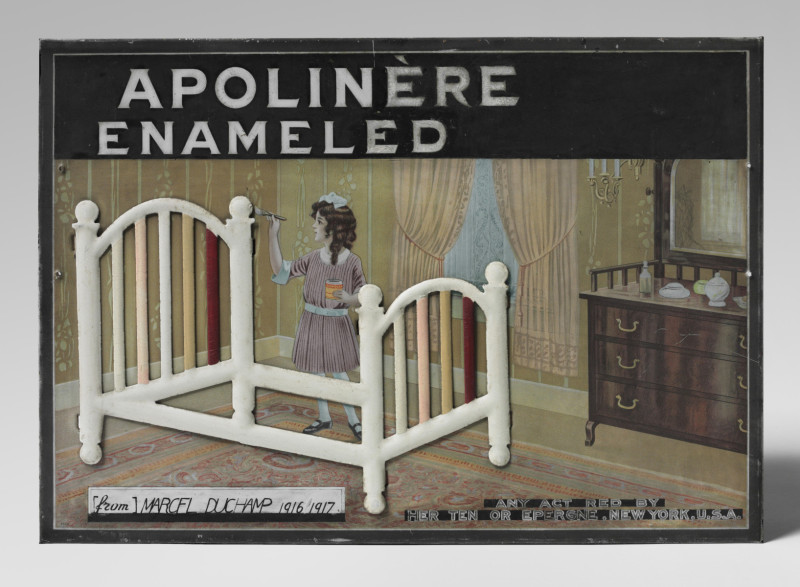
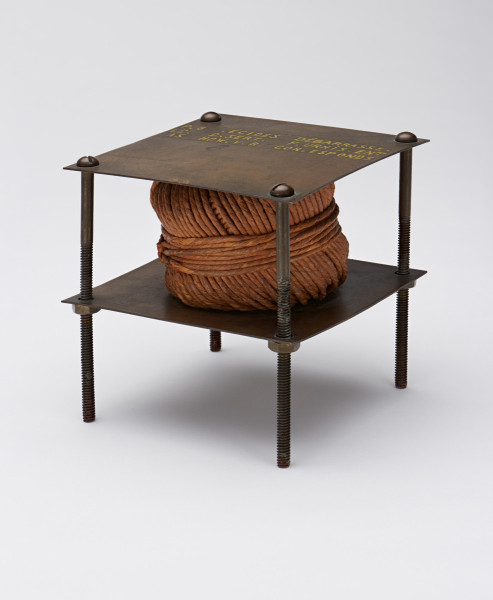
In 1912, Duchamp began to question his occupation and, remarkably for a young artist who was having his first brush with fame, decided to abandon the craft of oil painting to imagine more independent ways of being an artist. This led to the creation of his magnum opus, the monumental painting on glass titled The Bride Stripped Bare by Her Bachelors, Even (The Large Glass) (1915–23). One section of the exhibition will offer a rare opportunity to study the full range of materials and approaches that Duchamp employed in his precise planning and execution of The Large Glass. The exhibition will also look at the invention of the readymades through many of the early examples that remain extant, including With Hidden Noise (1916), Apolinère Enameled (1916–17), and one of the best-known images of the 20th century: L.H.O.O.Q. (1919), Duchamp’s irreverent defacement of a reproduction of Leonardo da Vinci’s Mona Lisa with added moustache, beard, and a vulgar phonetic pun.
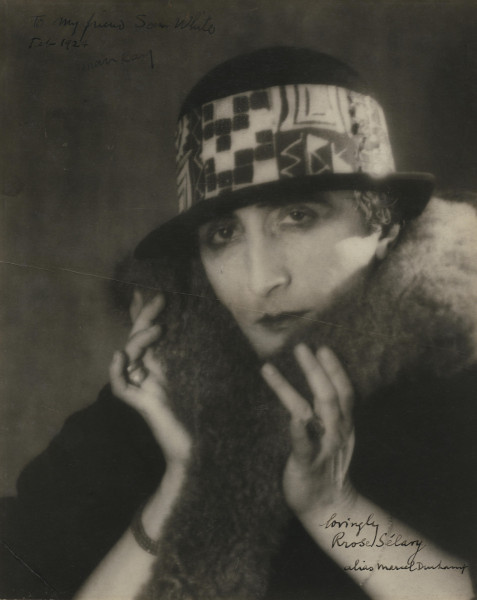
Around 1920, Duchamp began talking about shifting his vocation from art to chess, which he thought had a higher form of abstract beauty. He also took on the female alter ego known as Rrose Sélavy. The exhibition will go on to explore Rrose Sélavy’s work in different specialities. One was language games: aphorisms, puns, tongue twisters, and spoonerisms, or sentences with sounds or letters transposed to humorous effect. The other was machines for producing optical illusions, or visual images with no material reality.
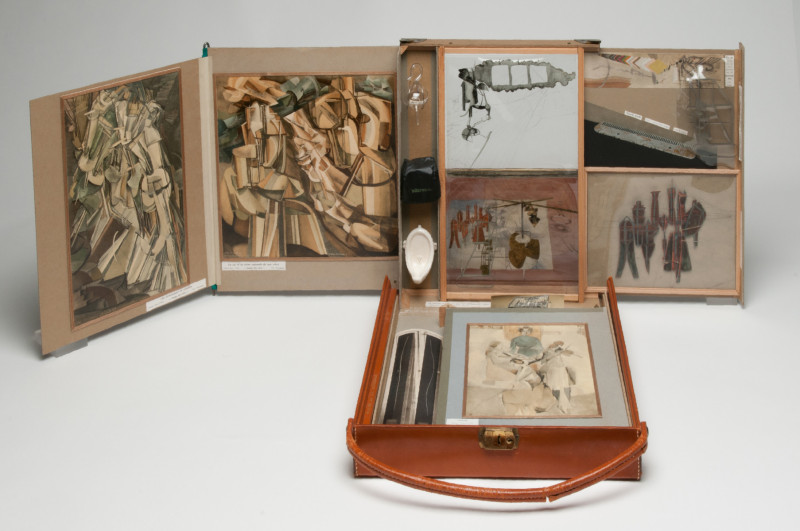
By the mid-1930s, Duchamp became interested in revisiting his own life’s work in the form of reproductions. The centerpiece of the exhibition will be the work known as Box in a Valise (1935–41), Duchamp’s “portable museum” of his own drawings, paintings, works on glass, and readymades. Not only did the Box in a Valise embody Duchamp’s work in miniature; it also epitomized the positive paradox of his art by advancing his lifelong exploration of originals, copies, and the nature of art in the era of mechanical reproduction. This will be the most extensive presentation of the Box in a Valise to date. The exhibition will feature three deluxe examples, a complete set of standard copies assembled between 1941 and 1971, and a large, never-before-seen selection of preparatory materials detailing the work’s genesis and assembly.
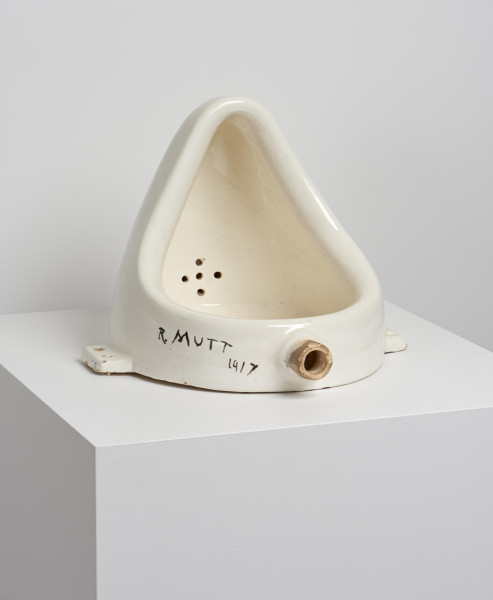
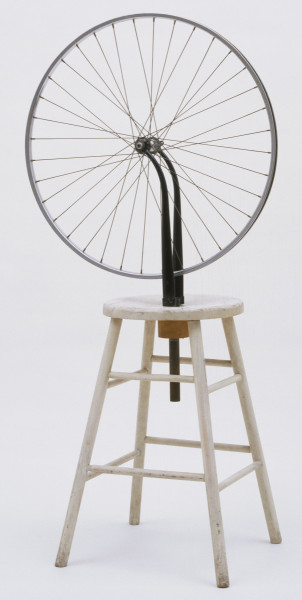
In the 1950s and 1960s, Duchamp gained unprecedented visibility through lectures, interviews, television appearances, publications, gallery exhibitions, and his first museum retrospectives. These exhibitions were made possible, in part, because Duchamp changed his mode of working yet again: he allowed the proliferation of his work via the creation, often by others, of full-scale replicas. The exhibition will feature a comprehensive group of readymade replicas, including iterations of Bicycle Wheel (1913), Bottle Rack (1914), In Advance of the Broken Arm (1915), and the notorious Fountain (1917), the porcelain urinal laid on its back and signed with a pseudonym.
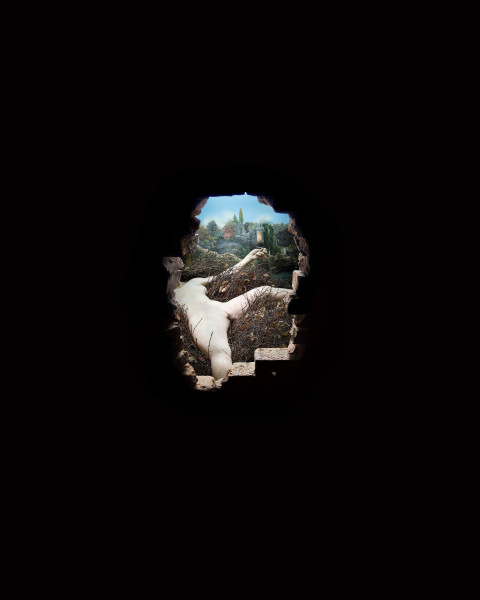
In the final twenty years of Duchamp’s life, when it was generally assumed that his work was complete, Duchamp labored in secret to create Étant donnés: 1° la chute d’eau, 2° le gaz d’éclairage . . . (Given: 1. The Waterfall, 2. The Illuminating Gas . . . ) (1946–66), a room-sized diorama with a sculpted female figure in a landscape. The exhibition will conclude with artworks and studies that supported the creation of this final major work (the alter ego of The Large Glass), which was installed at the PMA in 1969, according to Duchamp’s wishes. Visitors will be invited beyond the Dorrance Galleries to visit Galleries 281-283 where The Large Glass and Étant donnés are on permanent display.
Marcel Duchamp is organized by Matthew Affron, the Muriel and Philip Berman Curator of Modern Art, PMA; Ann Temkin, the Marie-Josée and Henry Kravis Chief Curator of Painting and Sculpture, MoMA; and Michelle Kuo, Chief Curator at Large and Publisher, MoMA, with Alexandra “Lo” Drexelius, Curatorial Assistant, Department of Painting and Sculpture, MoMA; Helena Klevorn, Curatorial Assistant, Department of the Chief Curator at Large, MoMA; Danielle Cooke, Exhibition Assistant, PMA; and Julia Vázquez, Andrew W. Mellon Postdoctoral Fellow, PMA.
The exhibition in Philadelphia will follow its presentation at MoMA (April 12–August 22, 2026). A related exhibition will travel to the Grand Palais in Paris in Spring 2027, where it will be organized by Jeanne Brun, Deputy Director, Musée National d’Art Moderne, with Pauline Créteur, Research Assistant to the Deputy Director.
Marcel Duchamp will be accompanied by an illustrated catalogue published by MoMA and authored by the PMA and MoMA co-curators, offering a panoramic view of the artist’s work in all mediums. The catalogue essay addresses Duchamp’s museum-like approach to working with private collections, his role as co-founder of the exhibition society known as the Société Anonyme, Inc., his close association with MoMA during its early decades, and his decision to make the PMA the permanent repository of his work.
Organizing Information
Marcel Duchamp is organized by the Philadelphia Art Museum and The Museum of Modern Art, New York, with the generous collaboration of the Centre Pompidou.
Curatorial Credits
The exhibition is organized by Matthew Affron, The Muriel and Philip Berman Curator of Modern Art, Philadelphia Museum of Art; Ann Temkin, The Marie-Josée and Henry Kravis Chief Curator of Painting and Sculpture, MoMA; and Michelle Kuo, Chief Curator at Large and Publisher, MoMA; with Danielle Cooke, Exhibition Assistant, Philadelphia Museum of Art; Julia Vázquez, Andrew W. Mellon Postdoctoral Fellow, Philadelphia Museum of Art; Alexandra “Lo” Drexelius, Curatorial Assistant, Department of Painting and Sculpture, MoMA; and Helena Klevorn, Curatorial Assistant, Department of the Chief Curator at Large, MoMA.
IMAGES

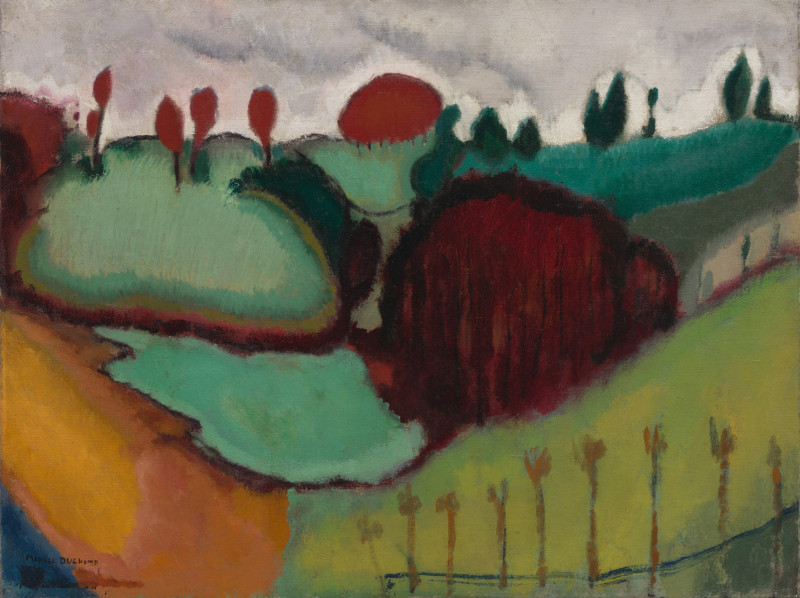
Marcel Duchamp. Landscape. Neuilly, January-February 1911. Oil on canvas; 18 1/8 x 24" (46.3 x 61.3 cm). The Museum of Modern Art, New York. Katherine S. Dreier Bequest © 2026 Artists Rights Society (ARS), New York / ADAGP, Paris / Estate of Marcel Duchamp

Man Ray (1890 –1976), Marcel Duchamp as Rrose Sélavy, c. 1920-1921, Gelatin silver print, 1/2 x 6 13/16 in, The Samuel S. White 3rd and Vera White Collection, 1957, 1957-49-1. © Man Ray Trust / Artists Rights Society ARS), New York / ADAGP, Paris.

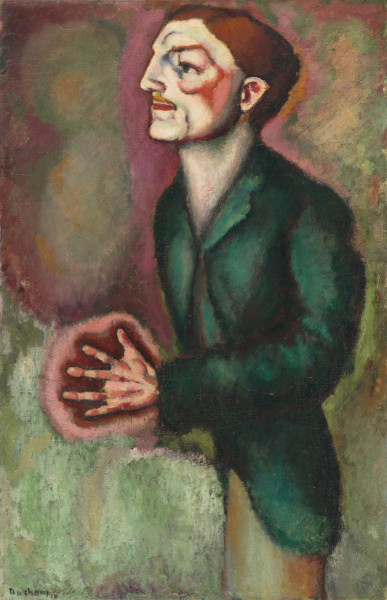
Marcel Duchamp (1887–1968), Portrait of Dr. Dumouchel, 1910, Oil on canvas, 39 1/2 x 25 7/8 in, Philadelphia Museum of Art, The Louise and Walter Arensberg Collection, 1950, 1950-134-508. © Artists Rights Society (ARS), New York / ADAGP, Paris / Association Marcel Duchamp.

Marcel Duchamp (1887–1968), Nude Descending a Staircase (No. 2), 1912, Oil on canvas, 57 7/8 x 35 1/8 in, Framed: 59 3/4 × 36 3/4 × 2 inches (151.8 × 93.3 × 5.1 cm), Philadelphia Museum of Art, The Louise and Walter Arensberg Collection, 1950, 1950-134-59. © Artists Rights Society (ARS), New York / ADAGP, Paris / Association Marcel Duchamp.

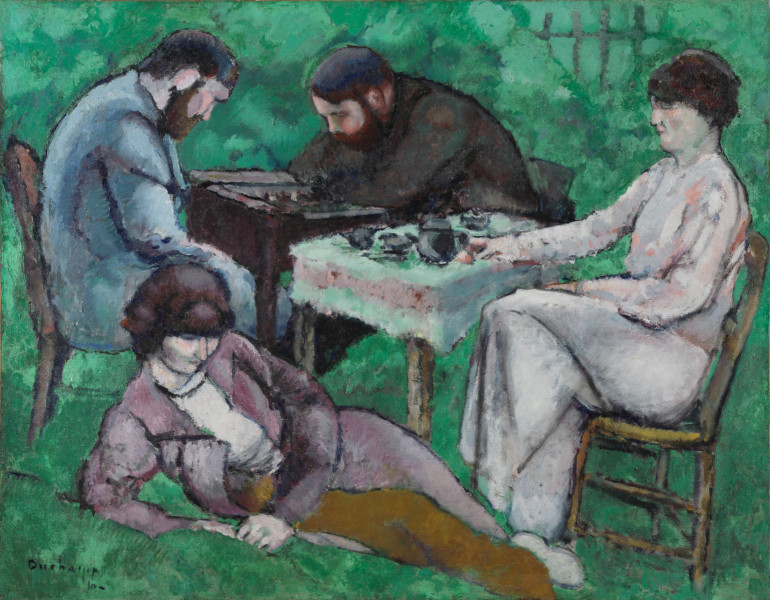
Marcel Duchamp (1887–1968), The Chess Game, 1910, Oil on canvas, 44 7/8 x 57 11/16 in, Philadelphia Museum of Art, The Louise and Walter Arensberg Collection, 1950, 1950-134-82. © Artists Rights Society (ARS), New York / ADAGP, Paris / Association Marcel Duchamp.