Tate Modern
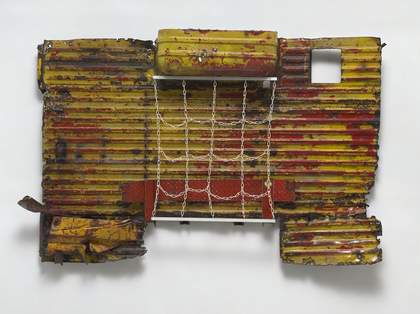
Robert Rauschenberg, Rasputin's Revenge Early Winter Glut 1987. © Robert Rauschenberg Foundation. Photo: Ron Amstutz
ARTIST ROOMS: Robert Rauschenberg, a large-scale free display in the ARTIST ROOMS gallery at Tate Modern, opens on 21 September. It brings together over 20 works by Rauschenberg (1925-2008) spanning three decades, including paintings, prints, and his unique kinetic and light works. At the heart of the presentation are a selection of the artist’s renowned Glut sculptures, including three newly gifted by the Robert Rauschenberg Foundation to mark 100 years since the artist’s birth. These have been donated to Tate Americas Foundation for the ARTIST ROOMS collection, which is jointly shared by Tate and the National Galleries of Scotland. The display at Tate Modern foregrounds how these works relate to the artist’s engagement with dance and performance.
One of the most influential American artists of the 20th century, Rauschenberg’s practice moved freely between painting, collage, sculpture, performance and photography. In his early practice in the 1950s, he challenged the dominance of Abstract Expressionism in the US, making work that blurred the distinction between art and everyday life. In Almanac 1962, one of his first silkscreen works, he printed imagery taken from books, magazines and his own photographs onto canvas. Integrating found objects such as Coca-Cola signs, ironing boards and newspapers into his work, he developed a series combining aspects of painting and sculpture called ‘Combines’. In works like Dylaby 1962, he gives new purpose to these overlooked materials, questioning how we assign meaning to the objects around us.
Fuelled by a curiosity about how he could work with the materials around him, Rauschenberg invented new methods of art making. Taking their inspiration from the abandoned petrol stations, cars and machinery that dotted the Texan landscape in the wake of the 1980s oil surplus, his Gluts series from 1986-94 are made from scrap metal scavenged from junkyards. He saw these works as a stark warning about the consequences of the ‘throwaway culture’ of capitalist society. Three Gluts gifted by the Robert Rauschenberg Foundation are central to the display at Tate Modern. Combining layers of crumpled metal, G-I Glut 1986 is one of a group made using petrol station signage which together reveal the phrase ‘$AVING$, while Rasputin's Revenge Early Winter Glut 1987 embraces the readymade colours and dents of the salvaged materials.
Rauschenberg was attracted to the sense of 'liveness' he could achieve when he activated his work with performance and movement, and frequently made costumes, sets and props throughout his career. Made from scrap metal, Mobile Cluster Glut (Neapolitan) 1987 is adapted from a set he made for a performance of Trisha Brown Dance Company’s Lateral Pass 1985, one of the most important works in postmodern dance. Film documentation of the performance, which took place in Naples, Italy, shows the pieces suspended above the stage. Also on display are examples of the costumes he designed for the dancers in Trisha Brown’s Set and Reset 1983, for which he screen-printed his own photographs of urban and industrial scenes onto transparent fabric.
Rauschenberg was interested in technology’s potential for artmaking. The display features an example from his Carnal Clocks series 1969, kinetic artworks that keep time, containing a mechanism that switches electrical lights on and off at regular intervals. He also experimented with new printing techniques in works such as

Tides, Drifts and Gulf from 1969, creating overlapping images to evoke reflections on the surface of water. Inspired by the colour and texture of silk he saw in Ahmedabad, India, he made a series of works titled the Jammers 1975-6, made predominantly from sewn fabric with rattan poles. In another textile-based series the Hoarfrosts 1974-6, transferred imagery is obscured by multiple layers of fabric.


G-I Glut

Almanac

Dylaby
