Sunday, June 3, 2012

Leonardo's "Ginevra de' Benci" and Renaissance Portraits of Women


Virtue and Beauty: Leonardo's "Ginevra de' Benci" and Renaissance Portraits of Women, the first exhibition on the subject ever organized, surveyed the phenomenal rise of female portraiture in Florence from c. 1440 to c. 1540. On view in the West Building of the National Gallery of Art from 30 September 2001 through 6 January 2002, the exhibition comprises 47 works, some never before seen in this country, including panel paintings, marble sculptures, medals, and drawings. The works presented were not only rare and beautiful but also offered the opportunity to examine the social role of women during the Renaissance and the evolution of their portraiture.

The Exhibition

Renaissance panel portraits, depicting women independent from their husbands, were almost exclusively produced in Florence. This exhibition brought together all of the most significant examples of the genre, with the exception of a few panel paintings that could not safely travel. The works were presented in loose chronological order and in subgroups by medium.

In addition to panel portraits, there were a smaller number of medals, drawings, and marble busts. Florentine artists that are represented include Filippo Lippi, Botticelli, Verrocchio, Leonardo, Domenico Ghirlandaio, and Bronzino. Works on display by masters such as Pisanello, Rogier van der Weyden, and Jacometto Veneziano provide further insight into the development of female portraiture outside Florence.

Two major themes were highlighted in this exhibition--virtue and beauty as they relate to female portraiture, and the broad shift from the aloof painted profile to the more communicative three-quarter or frontal view.

Ruler Portraits: Independent portraits of women were rare prior to the mid-15th century. They often depicted a prospective partner for a royal or noble marriage. More common for the time were ruler portraits depicting both husband and wife. These portraits were likely executed in the traditional profile view because of its association with ancient coins and medallions. Examples of this portrait type can be seen in the beginning of this exhibition.
Early Florentine Profiles: As the 15th century progressed, portraits of females, independent of men, increased in popularity. Filippo Lippi created portraits of women that were the first of their kind in Renaissance Florence. The exhibition features his two surviving masterpieces of the genre,
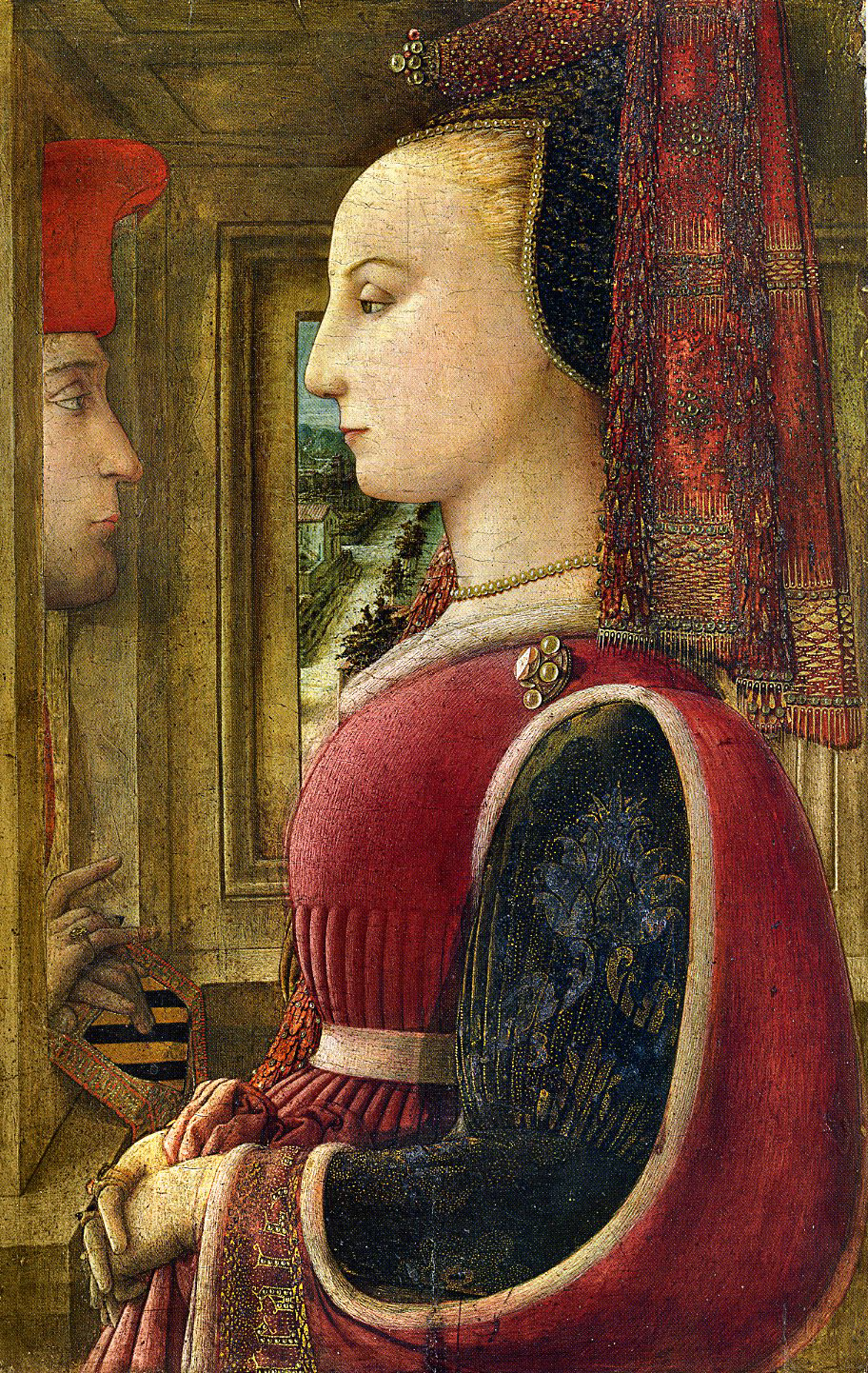
Woman with a Man at a Window (c. 1438/1444), and

Profile Portrait of a Young Woman (c. 1450-1455). Both works depict the sitter facing left, establishing the standard profile type for portraying Florentine women. An additional early Florentine profile in the exhibition, A Young Lady of Fashion (c. 1460/1465), is attributed to Paolo Uccello and exemplifies the mid-15th century treatment of female portraits in which the sitter's individuality is suppressed in favor of the social ideals for which she stands.

Medals: Portrait medals, reflecting the ancient tradition of commemorative medallions and coins, flourished in the courts of northern Italy. Representations of female sitters, mostly the daughters and wives of rulers, were common. Pisanello (Antonio Pisano), whose medal Cecilia Gonzaga (1447) can be seen in the exhibition, is credited with inventing this art form. The practice of medals reached Florence in the 1470s. One of the most graceful of all the Florentine medals created is on view, Giovanna degli Albizzi Tornabuoni (c. 1486), attributed to Niccolò Fiorentino. It can be compared to Domenico Ghirlandaio's portrait of the same sitter, also in the exhibition.
Leonardo: This exhibition includes the only portrait by Leonardo da Vinci in the Western Hemisphere,

Ginevra de' Benci (c. 1474-1478). The front side depicts a simply dressed woman in a landscape, while the reverse depicts a wreath of laurel and palm encircling a sprig of juniper. A scroll, entwined around the plants, bears the Latin inscription "Beauty Adorns Virtue," exemplifying a major theme of the exhibition. Ginevra's portrait was shortened and may have originally included her hands.

Leonardo's Study of Hands (c. 1474), on view, was used to reconstruct the possible original format of the painting.

Breaking with the Florentine tradition of the bust-length profile, Leonardo was influenced by Verrocchio's Lady with a Bunch of Flowers (c. 1475_1480), the first 15th century sculptural portrait to show the sitter in half-length with arms and hands. Verrocchio's bust is here reunited with Leonardo's portrait for the first time since they were created in Florence more than 500 years ago.
Northern Analogues: Several northern European works in this exhibition are included for comparison. An especially beautiful example is Rogier van der Weyden's
Portrait of a Lady (c. 1460) in which he abandons the traditional profile and depicts the sitter in three-quarter view. The artist also utilizes a half-length format, allowing him to include the sitter's hands in a pose which captures the dignity and modesty of the lady. 15th century portraiture in northern Europe and Italy.

A pair of devotional panels by Petrus Christus, Portrait of a Male Donor (c. 1455) and Portrait of a Female Donor (c. 1455), also utilize the more progressive three-quarter view and demonstrate the growing international character of 15th century portraiture in northern Europe and Italy.

Botticelli Group: The exhibition includes four works by Sandro Botticelli. The earliest, Woman at a Window (Smeralda Brandini?) (c. 1470/1475), depicts the sitter in informal dress and hairstyle standing before a window. In an attempt to convey the physical and psychological presence of his sitter, Botticelli, like Leonardo, has departed from the more traditional profile in favor of the three-quarter view.

His portrait Young Woman (Simonetta Vespucci?) in Mythological Guise (c. 1480/1485) appears to portray a legendary beauty who tragically died young. Her features: golden tresses, partly loose and partly braided, and pearly white skin, reflect the ideal type of female beauty for the time.

The Botticelli group also contains two striking male portraits, Giuliano de' Medici (c. 1478/1480) and Young Man Holding a Medallion (c. 1485), that are both related to the female portraits.
Ghirlandaio Group: Like Leonardo and Botticelli, Domenico Ghirlandaio was committed to the three-quarter view, which he used for the

Portrait of a Lady (c. 1480/1490), and the Portrait of a Young Man (c. 1490), part of a diptych portrait which also includes a female in profile.
Ghirlandaio, however, retained the traditional profile view for what is perhaps the most admired and discussed of all the Florentine portraits, his


Giovanna degli Albizzi Tornabuoni (c. 1488/1490). This portrait repeats the profile of the same sitter in a fresco scene painted by the artist in the Tornabuoni Chapel of the Church of Santa Maria Novella in Florence. Both likenesses are posthumous, representing the sitter after her tragic death in childbirth. This special circumstance may explain Ghirlandaio's departure from the three-quarter view.

Life Drawings: Renaissance portraits were not direct likenesses completed in the sitter's presence. They involved life studies that were made in preparation of the painted portrait. Recording the subject's physical features, such drawings were more likely to capture the sitter's actual likeness than the completed, idealized painted portrait. Life drawings in this exhibition include Pietro Perugino's Bust of a Young Woman (c. 1480/1490), Domenico Ghirlandaio's Head of a Woman (c. 1486/1490), and Raphael's Young Woman in Profile (c. 1504).

Early 16th Century: By the early 16th century the style for portraits of women had evolved. The Renaissance concept of virtuous beauty remained the same but the three-quarter view, established by Leonardo's Ginevra de' Benci (c. 1474-1478), and the frontal view, together with a larger format, now became the standard for female portaiture. Particularly imposing examples of this new type in the exhibition include Giuliano Bugiardini's Portrait of a Lady ("La Monaca") (c. 1516) with its painted cover, and Ridolfo Ghirlandaio's Lucrezia Sommaria (c. 1530-1532). Agnolo Bronzino's portraits, Portrait of a Lady (c. 1533) and A Young Woman and Her Little Boy (c. 1540), both reflect a new type of aristocratic portraiture emphasizing the dignified demeanor and elegant dress of the sitters that would be favored in courts throughout Europe.

Virtue and Beauty: Leonardo's "Ginevra de' Benci" and Renaissance Portraits of Women was organized by the National Gallery of Art, Washington. The exhibition curator is David Alan Brown, curator of Italian Renaissance paintings at the Gallery.

A beautifully illustrated exhibition catalogue, with an introduction by the curator and four informative essays by other experts on Renaissance art, was published by the National Gallery of Art, Washington, in association with Princeton University Press.

Saturday, June 2, 2012

John Marin: Modernism at Midcentury


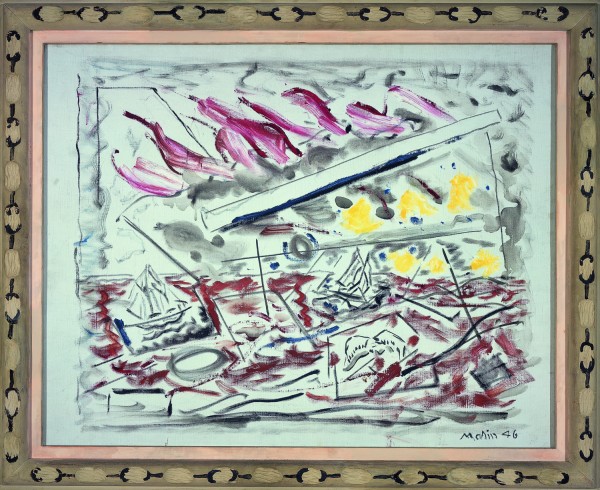
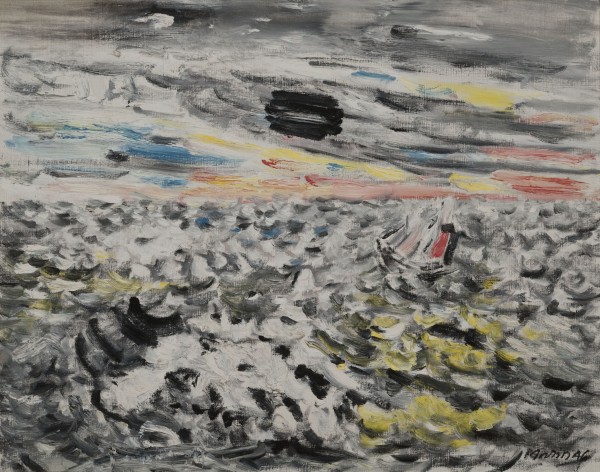
John Marin (1870–1953) Movement in Greys and Yellows, 1946. Oil on canvas. © Estate of John Marin / Artists Rights Society (ARS), New York. Private collection.
(Courtesy of Amon Carter Museum of American Art)

John Marin (1870–1953) Top of Radio City, New York City, 1937. Watercolor on paper. John Marin © Estate of John Marin / Artists Rights Society (ARS), New York. Private collection, Seattle.
(Courtesy of Amon Carter Museum of American Art)

John Marin (1870–1953) Movement in Red, 1946. Oil on canvas. John Marin © Estate of John Marin / Artists Rights Society (ARS), New York. Collection of Deborah and Ed Shein.
(Courtesy of Amon Carter Museum of American Art)
The Amon Carter Museum of American Art presented the work of one of America’s foremost modernists, John Marin (1870–1953), in the special exhibition John Marin: Modernism at Midcentury. On view from November 5, 2011, through January 8, 2012, the exhibition covered the last 20 years of Marin’s career, from 1933 until his death in 1953. With more than 60 paintings, this is the first in-depth examination of Marin’s work in over 20 years. Admission is free.

Among the most widely acclaimed artists of the early 20th century, Marin was consistently praised by critics for his distinctive approach to modernism, the bold originality and the authentic “Americaness” of his work. Writing in 1932, The New Yorker literary critic Lewis Mumford considered Marin “the most significant and poignant and accomplished landscape painter of his generation in America.” Roughly 20 years later, at the time of Marin’s memorial exhibition held in New York in 1954, the critic Robert Rosenblum astutely noted, “He stands in full center of the major currents of American Art … he parallels, even prophesies, abstract-expressionist trends.”

John Marin: Modernism at Midcentury examined the artist’s modernist vision as it developed during the last decades of his life. For Marin, the 20-year span between 1933 and 1953, a period bracketed by the Great Depression and the decade following World War II, was a time to position his legacy within the grand narrative of art and to reaffirm the validity of American avant-garde, the ambitious, home-grown experiment upon which he had staked his more than 50-year career.

John Marin, United States, 1870 - 1953 Island (Ship’s Stern), 1934, watercolor on paper, 17 x 22 inches. Private collection, courtesy Meredith Ward Fine Art, New York. © Estate of John Marin / Artists Rights Society (ARS), New York

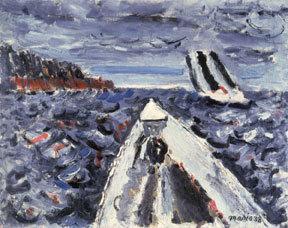
John Marin, United States, 1870 - 1953, Lobster Boat, Cape Split, Maine, 1938, oil on canvas, 22 x 28 inches. Collection of Mr. & Mrs. Theodore Shen. © Estate of John Marin / Artists Rights Society (ARS), New York.

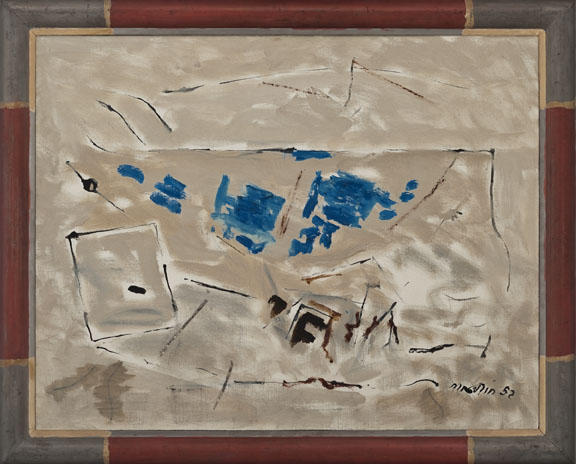
John Marin, United States, 1870 - 1953, Autumn Coloring No. 4, 1952, watercolor, graphite and ink, 14 x 18 1/2 inches. Estate of the artist, courtesy Meredith Ward Fine Art, New York. © Estate of John Marin / Artists Rights Society (ARS), New York.

Although John Marin (1870-1953) was regarded as one of America’s most important painters at the time of his death, scholarship and museum exhibitions to date have focused on his early work coloring popular understanding of his life’s work. Featuring approximately 60 paintings, drawings, and watercolors, John Marin: Modernism at Midcentury, was on view June 23 through October 10, 2011 at the Portland Museum of Art.


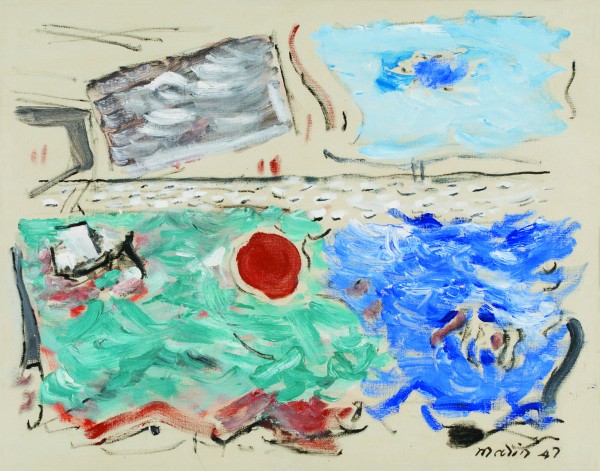
John Marin (1870–1953) Movement: Sea, Ultramarine and Green; Sky, Cerulean and Grey, 1947 Oil on canvas © Estate of John Marin / Artists Rights Society (ARS), New York Blanton Museum of Art, The University of Texas at Austin, Gift of Mari and James A. Michener, 1991.262
Based in New York and New Jersey, Marin followed a path time-honored by artists to coastal Maine. Unlike an earlier generation, however, Marin brought his modernist eye to Maine’s venerable landscape. He initially painted near mid-coast Small Point in 1914, but in 1933 began summering in remote Cape Split. This move farther north heightened the painter’s commitment to a raw, unspoiled landscape. Marin sensed the radical potential for his painting on Cape Split; the possibility to transform the ephemeral patterns of waves into innovative compositions would forecast some of the primary features and preoccupations of mid-century American art. By the time he took up residence along the coast of Maine, Marin had begun to work in oil on canvas alongside his staple of watercolor. The medium of oil, with its innate fluidity and viscous texture, suited capturing not only the impact of the wind, sun, and rain on the sea but the intense blue and green colors of its waters. His work in oil and watercolor came to inform each other as the saturation of the former and immediacy of the latter were placed in service of more compact and non-referential compositions.

While the sea became a focus of Marin’s work after 1933, he would never forgo the New York skyline, or the Ramapo hills and Saddle River of New Jersey. He continued to mine these sites for their vitality, but they became progressively non-representational, employing geometric patterns, and culminating in the 1950s in calligraphic, lace-like statements. Many of Marin’s oil paintings during this period were accompanied by stock frames which he painted with loose, geometric shapes as an extension of the canvas.

Beginning in 1914, Marin began spending summers in Maine and drew inspiration from the state’s varied geography—forested mountains, picturesque towns, misty harbors and rolling seas. In 1933, he discovered Cape Split, a remote and sparsely settled northern peninsula in Pleasant Bay; and in 1934, he began living part of each year there in a house “so close to the water I almost feel at times that I am on a boat,” he said. This new location proved hugely liberating and revelatory for the artist. Immersed within “the spirit of the Cape,” even in winter while residing at his home in Cliffside, New Jersey, Marin confronted the forces of nature as never before.

“Marin’s talent, prodigious memory and his unfettered enthusiasm for both Cape Split and the landscape near his New Jersey home inspired him to produce an innovative synthesis of watercolor and oil painting,” says Balken. “Working vigorously, he explored the symbiotic relationship between the two mediums, learning to accentuate the tactile possibilities of each and to translate the fluidity and directness of watercolor to the medium of oil and, conversely, the depth and solidarity of oil to the medium of watercolor without sacrificing its appealing luminosity.”

John Marin: Modernism at Midcentury was co-organized by the Addison Gallery of American Art, Phillips Academy, Andover, Massachusetts, and the Portland Museum of Art, Portland, Maine, and brought together important loans from the National Gallery of Art, Washington, D.C., and Museum of Fine Arts, Boston, as well as from many other institutions and private collections.

The accompanying catalogue, written by Balken and produced by Yale University Press, provides insight into Marin’s work from this period within the context of contemporary critical discourse.

Portrait of an Age: John Singer Sargent and Paul César Helleu


Trinity House Paintings will present an exhibition of pictures by master portrait artists John Singer Sargent (1856 – 1925) and Paul César Helleu (1859-1927) at their gallery in Broadway, UK, 8 - 15 June 2012. The show will then travel to their Mayfair gallery at 50 Maddox Street, London W1 from 18 - 22 June, and latterly will be on their stand at the Masterpiece London fair, 28 June – 4 July. The exhibition provides an excellent opportunity to view the work of these two artists and great friends alongside each other.

Sargent was the most celebrated portrait painter of the Edwardian age. In 1885, Sargent caused a scandal when he painted Madame X, a sensual portrait of Mme Gautreau, a noted society beauty. He fled Paris and over the next five years he used his new found freedom and flamboyant social network to his advantage. This period of development coincided with his time spent in Broadway, a quiet Cotswold village that had been ‘discovered’ and ‘colonised’ by various artists as well as wealthy artistic Americans.

He exhibited at the Royal Academy in 1887, with the Carnation, Lily, Lily, Rose. This large piece painted on site of two young girls lighting lanterns in an English garden was produced during his time in Broadway, on the same High Street as Trinity House’s flagship gallery. The painting was immediately purchased by the Tate Gallery, where it is still exhibited today.

Marionettes, 1903 Alternative title: Behind the Curtain; (Marionettes) Oil on canvas, 28 x 21 in. (72.4 x 53.3 cm)

A highlight of the exhibition at Trinity House Paintings is Marionettes painted in 1903. The picture records a backstage performance of Sicilian rod puppets, with two knights in battle, watched by a distressed female in black. Marionettes is the only documented picture of a marionette theatre by Sargent, and it was painted in the Philadelphia slums, during the artist’s visit to the city in May 1903. Philadelphia had and still has a large Italian community, including many Sicilians, who brought their native traditions with them, including their marionette theatres. Also of interest by Sargent is an impressive oil on canvas study featuring Pomegranates, Majorca in dappled sunlight painted in 1908.

Picasso: Masterpieces from the Musée National Picasso, Paris


Marking the only Canadian stop on its world tour, the highly anticipated exhibition Picasso: Masterpieces from the Musée National Picasso, Paris opened at the Art Gallery of Ontario (AGO) on May 1, 2012.

The Musée National Picasso, Paris has been temporarily closed this season for renovations, sending its treasures out on a rare world tour. “We at the AGO are proud to be the only Canadian institution to present this truly unparalleled exhibition,” said Matthew Teitelbaum, AGO director and CEO. “Picasso’s artistry was constantly evolving, and this particular collection offers our members and visitors a rare opportunity to experience the entire trajectory of his artistic achievement.”

Exhibited chronologically and covering virtually every phase of the modern master’s unceasingly radical and diverse career, Picasso: Masterpieces from the Musée National Picasso, Paris features 147 of the works he kept for himself and his family, dubbing the term “Picasso’s Picassos”:

“Picasso is a true artistic legend whose profound work revolutionized fine art, captivating audiences across borders and beyond time,” said Michael Chan, Minister of Tourism, Culture and Sport. “The McGuinty Government is proud to partner with the AGO to bring this exciting exhibit to Ontario for its only Canadian stop, ensuring Ontarians and visitors alike have an opportunity to explore and experience Picasso’s prolific work.”

Co-organized by the Musée National Picasso, Paris, and the Art Gallery of Ontario, the exhibition is curated by Anne Baldassari, chairman and chief curator of collections of the Musée National Picasso, Paris. Elizabeth Smith, the AGO’s executive director of curatorial affairs, will oversee the exhibition’s installation at the AGO.

An exhibition for all ages, Picasso: Masterpieces from the Musée National Picasso, Paris features a special audio tour created just for children. Opening simultaneously with the exhibition, the new Family Creativity Lounge in the Margaret & Jim Fleck Gallery will provide visitors of all ages a space to stop, rest and have fun, engaging with art-making and ideas in a relaxed atmosphere. It will feature comfortable seating, books and a large table with drawing and other art-making activities.

“I paint the way some people write an autobiography. The paintings, finished or not, are the pages from my

This exhibition offers a rare perspective on the life and work of this iconic artist: his own. It features works from Picasso’s private collection, now in the holdings of the Musée National Picasso in Paris, whilst the museum undergoes renovations. Over a career of more than seventy years, these are the works he kept with the intent of shaping his own artistic legacy.

The AGO is the sole Canadian and final venue on an international tour, which includes stops in Madrid, Abu Dhabi, Tokyo, Helsinki, Moscow and St. Petersburg, Seattle, Richmond, San Francisco and Sydney. The pieces on display span this modern master’s unceasingly radical and diverse career, Picasso: Masterpieces from the Musée National Picasso, Paris features:

The Death of Casagemas, one of the first works he created in Paris in 1901;

Autoportrait (Self-Portrait), the iconic 1906 self-portrait;

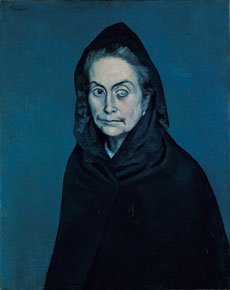
the 1904 Blue-period masterpiece Celestina (The Woman with One-Eye), and

The Two Brothers, a 1906 work from his Rose period;landmark African-inspired artwork that led to the advent of Cubism, including studies for the 1907 masterpiece Les Demoiselles d’Avignon and Three Figures Beneath a Tree, 1907-08;examples of his genre-defining Analytic and Synthetic Cubism artworks, including the 1909-10 Sacré Coeur, 1911’s seminal Man with a Guitar and 1915’s Violin;

Two Women Running on the Beach (The Race), a 1922 masterwork from his Neoclassical period, and

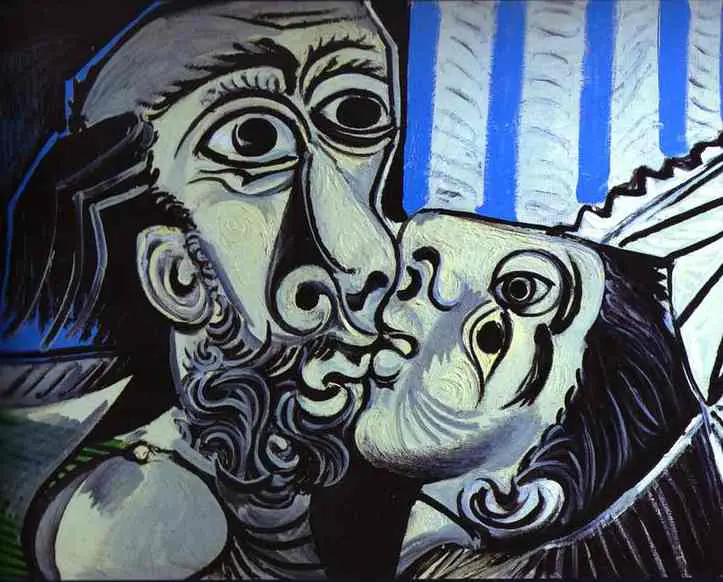
1925’s The Kiss, from his Surrealist period; a series of sculptures created during the Second World War, including 1942’s Bull’s Head, and two bronzes, 1943’s Death’s Head and 1950’s The Goat; The Bathers, the 1956 life-sized, six-piece figurative sculpture series created during a summer in Cannes; and

The Matador
, the famous self-portrait painted in 1970, three years before his death.

The exhibition also highlights Picasso’s depictions of his muses and mistresses, including

1918’s Portrait of Olga in an Armchair, which features the Russian ballerina and Picasso’s first wife seated on a Spanish tapestry, the background left purposefully unfinished. French surrealist photographer Dora Maar, who inspired his 1937 “Weeping Woman” series, is also prominently featured, as is Jacqueline Roque, Picasso’s second wife and most-painted muse, depicted in the 1954 work

Jacqueline with Crossed Hands.

Ultimately, every Picasso artwork is about Picasso – the works reveal his unique vision of the world and embody his profound responses to it. They lay bare the beauty and anxieties of his time, the horrors of war, as well as his personal passions, desires and fears.


ABOUT THE AGO

With a collection of more than 80,000 works of art, the Art Gallery of Ontario is among the most distinguished art museums in North America. From the vast body of Group of Seven and signature Canadian works to the African art gallery, from the cutting-edge contemporary art to Peter Paul Rubens’ masterpiece The Massacre of The Innocents, the AGO offers an incredible art experience with each visit. In 2002 Kenneth Thomson’s generous gift of 2,000 remarkable works of Canadian and European art inspired Transformation AGO, an innovative architectural expansion by world-renowned architect Frank Gehry that, in 2008, resulted in one of the most critically acclaimed architectural achievements in North America. Highlights include Galleria Italia, a gleaming showcase of wood and glass running the length of an entire city block, and the often-photographed spiral staircase, beckoning visitors to explore. The AGO has an active membership program offering great value, and the AGO’s Weston Family Learning Centre offers engaging art and creative programs for children, families, youth and adults. Visit ago.net to find out more about upcoming special exhibitions, to learn about eating and shopping at the AGO, to register for programs and to buy tickets or memberships.

The Art Gallery of Ontario is funded in part by the Ontario Ministry of Tourism, Culture and Sport . Additional operating support is received from the City of Toronto, the Canada Council for the Arts and generous contributions from AGO members, donors and private-sector partners.

Friday, June 1, 2012

Edward Hopper's Maine


Edward Hopper. "Road in Maine," 1914. Oil on canvas. Whitney Museum of American Art, New York.


The Bowdoin College Museum of Art organized the first comprehensive exhibition of Edward Hopper's artistic production in Maine from 1914 to 1929. On view from July 15 through October 16, 2011, Edward Hopper's Maine showcased nearly 90 rarely exhibited paintings, watercolors, drawings, and prints that provided an exhaustive look at Hopper's work during this period. Hopper's Maine paintings span two critical decades of the artist's career, yet have never been studied as a unified body of work and are often overlooked in favor of his better-known paintings from the 1930s forward. This long-overdue exhibition presented Hopper's Maine oeuvre together for the first time, reexamining and demonstrating its significance to his later production. The Bowdoin College Museum of Art was the exhibition's sole venue.

"Maine was a font of inspiration for Hopper, a respite from New York City, and the place where he established the iconic style for which he is known," said Kevin Salatino, director of the Bowdoin College Museum of Art and co-curator of Edward Hopper's Maine. "The exhibition will reconsider this important moment in Hopper's artistic development, while enabling the public to see these works collectively in the very place that inspired them."

Hopper spent nine fruitful summers in Maine, in the resort town of Ogunquit, on the beautiful island of Monhegan, and in the maritime communities of Rockland, Cape Elizabeth, and Portland. Featuring loans from nearly 30 public and private collections including the Whitney Museum of American Art, the Metropolitan Museum of Art, the Museum of Modern Art, the Museum of Fine Arts, Boston, the Cleveland Museum of Art, and the Harvard Art Museums, the exhibition will reunite Hopper's Maine works and reassert their importance in shaping his lengthy career and establishing his distinctive artistic voice.

Edward Hopper's Maine is accompanied by a fully illustrated catalogue published by DelMonico Books-Prestel with contributions by renowned Hopper scholar Carol Troyen, actor/collector/writer Steve Martin, poet-critic Vincent Katz, Whitney Museum curator Carter Foster, Bowdoin College Museum of Art Director Kevin Salatino, and exhibition co-curator Diana Tuite. Edward Hopper's Maine is organized in association with the Whitney Museum of Art.

The collections of Bowdoin College Museum of Art-begun 200 years ago with a major gift from James Bowdoin III and his family-are among the most comprehensive of any college museum in the United States. They are maintained in the landmark Walker Art Building, designed in 1894 by Charles Follen McKim, and located on the historic quadrangle of Bowdoin College. A 2007 renovation and expansion has re-established the Museum as the centerpiece of Bowdoin's vibrant arts and culture community. Fully accessible, Bowdoin College Museum of Art is open to the public free of charge.

Romancing the West: Alfred Jacob Miller


Antelope. Alfred J. Miller, American, 1810 - 1874. Watercolor, ink, touches of gouache, and pencil on cream, wove paper, 6 7/8 x 10 5/8 inches (17.5 x 27 cm) Framed: 12 x 15 inches (30.5 x 38.1 cm). Nelson-Atkins Museum of Art, Kansas City, Missouri
(Image Courtesy of the Philadelphia Museum of Art)

The Indian Guide. Alfred J. Miller, American, 1810 - 1874. Oil over white ground and graphite with patches of glossy coating on dark tan paper, 7 15/16 x 10 inches (20.2 x 25.4 cm) Framed: 16 x 18 inches (40.6 x 45.7 cm). Nelson-Atkins Museum of Art, Kansas City, Missouri
(Image Courtesy of the Philadelphia Museum of Art)

Grizzly Bear Hunt. Alfred J. Miller, American, 1810 - 1874. Watercolor, gouache, iron gall ink, blue or gray ink and pencil on tissue mounted to thin card, 7 1/8 x 10 7/8 inches (18.1 x 27.6 cm) Framed: 13 x 16 inches (33 x 40.6 cm). Nelson-Atkins Museum of Art, Kansas City, Missouri
(Image Courtesy of the Philadelphia Museum of Art)


The American West was a source of great fascination for Easterners and visitors to this country alike during the 19th century. Novelists such as James Fenimore Cooper and Charles Bird King capitalized on this fascination with books such as King’s Young Omaha, War Eagle, Little Missouri, and Pawnees, featuring descriptions of wild mountain men and Native Americans that incited the public’s imagination about life on the frontier.

Alfred Jacob Miller (1810–1874) was one of the first American artists to paint the American West, producing beautiful watercolors of the remarkable landscape, exotic wildlife, and Native American peoples that he encountered during the trips he made through the Great Plains and into the Rocky Mountains during the late 1830s.

Romancing the West: Alfred Jacob Miller in the Bank of America Collection, at the Philadelphia Museum of Art, through Sept. 18, 2011, presented a selection of 30 rarely seen watercolors from Miller’s most important body of work: the images he created in 1837 when traveling with the Scottish adventurer Captain William Drummond Stewart west from St. Louis to Wyoming’s Wind River Mountains, along what would become known as the Oregon Trail.

“As a greenhorn from the East, Miller captured life in the West with wide-eyed admiration, depicting the landscape in a captivating way,” said Kathleen A. Foster, the Robert L. McNeil, Jr. Senior Curator of American Art, and Director, Center for American Art. “He was also a vivacious and accomplished draftsman, and gave us a picture of roundups, fur trappers and hunting expeditions that blended visual journalism with the fanciful and made an important contribution to what would become a shared mythology of the West.”

Commissioned by Captain Stewart to document scenes from their travels to the annual fur-trading rendezvous in Wyoming’s Wind River Mountains, Miller spent six months creating hundreds of sketches that would serve as a mine of inspiration for the next three decades. The watercolors in Romancing the West are drawn from a group of more than 1,000 works created during and after his trip. Many feature horsemen riding at breakneck speeds, hunting expeditions, colorfully-dressed fur traders, beautiful Native American women, and all of the thrills of the trail.

Driven by his patron’s agenda, the works Miller created for Stewart depict a heroic and romantic way of life, frequently starring Miller’s enterprising patron as the protagonist. Stewart leads the hunt in Elk Taking the Water, while Chase of the Grizzly Bear, Black Hills suggests the Scotsman’s prowess and bravery in pursuit of the fierce grizzly. Large-game hunting was among Stewart’s favorite leisure activities, and the theme appears in more than one-quarter of the images Miller created for him. When they returned from the trip, Stewart commissioned several large paintings in oil and watercolor from Miller’s original sketches, which were bound into an album he kept back in his castle in Perthshire, Scotland, to illustrate his dramatic tales of his American adventures.

Of different sizes and on different papers, the watercolors in the exhibition suggest works done over time and in different locations. Historical details depicted in works like Departure of the Caravan at Sunrise provide a first-hand record of the contrasts seen between white and Native American travelers and provide important cultural and historical evidence of everyday life on the frontier during the 1830s. Others are based on accounts from other travelers or are drawn from Miller’s imagination, depicting views from vantage points that Miller would never have seen, including Watching the Caravan, depicting two Native Americans peering over the edge of a cliff at a wagon train below. He also embellished certain details, giving fur trappers an air of mystique by replacing ordinary trousers and jackets with elaborate, fringed buckskin ensembles (Old Bill Burrows, a Free Trapper). These romanticized characters and invented landscapes captivated viewers back East and in Europe, many of whom fantasized about the picaresque life of the fur trappers of the Wild West.

Miller’s formal art training, first with Thomas Sully in Baltimore, and later at the École de Beaux-Arts in Paris, presented an opportunity for him to study the Old Masters and to become known as a skilled copyist. He particularly admired the work of Eugène Delacroix and of French Romantic painter Horace Vernet, whose images of horses offered a possible model for On the Warpath – Running Fight, and War Path, both part of the Bank of America collection. Snake Female Reposing, a sensual portrayal of a young woman from the Snake tribe reposing under a tree, references the paintings of Middle Eastern odalisques Miller would have seen in the galleries of the Louvre while training abroad in 1833-34.

As a result, the works in Romancing the West mix fact with fantasy, reflecting frontier life both as it was, and as it was imagined to be. The exhibition offers a glimpse of a thrillingly unknown, frequently mythologized region of the country that was intoxicating to its mid-19th-century Eastern and European viewers.

Met's New American Wing Galleries Opened January 16, 2012


The Metropolitan Museum’s collection of American art, one of the finest and most comprehensive in the world, returns to view in expanded, reconceived, and dramatic new galleries on January 16, 2012, when the Museum inaugurates the New American Wing Galleries for Paintings, Sculpture, and Decorative Arts. The new installation will provide visitors with a rich and captivating experience of the history of American art from the 18th through the early 20th century. The suite of elegant new galleries encompasses 30,000 square feet for the display of the Museum’s superb collection.

This final phase of the American Wing renovation project is comprised of 25 renovated and enlarged galleries on the second floor. The new architectural design is a contemporary interpretation of 19th-century Beaux-Arts galleries, including coved ceilings and natural light flowing through new skylights. The redesign, which has added 3,300 square feet of gallery space, also allows for a chronological installation of the American paintings and sculpture, and improved pathways connecting to adjacent areas of the Museum.

Twenty-one of the new galleries—including the 18 sky-lit Joan Whitney Payson Galleries—have been created for the display the American Wing’s extraordinary collection of paintings. Its origins date back to the 1870s, thanks to the strong support of founding Trustee-painters Frederic Edwin Church and John Frederick Kensett. For the first time, the paintings collection will be shown on a single floor, enhancing accessibility and coherence of the display. The Museum’s holdings are particularly rich in the works of the great masters, including

John Singleton Copley (Daniel Crommelin Verplanck),

Gilbert Stuart (George Washington),

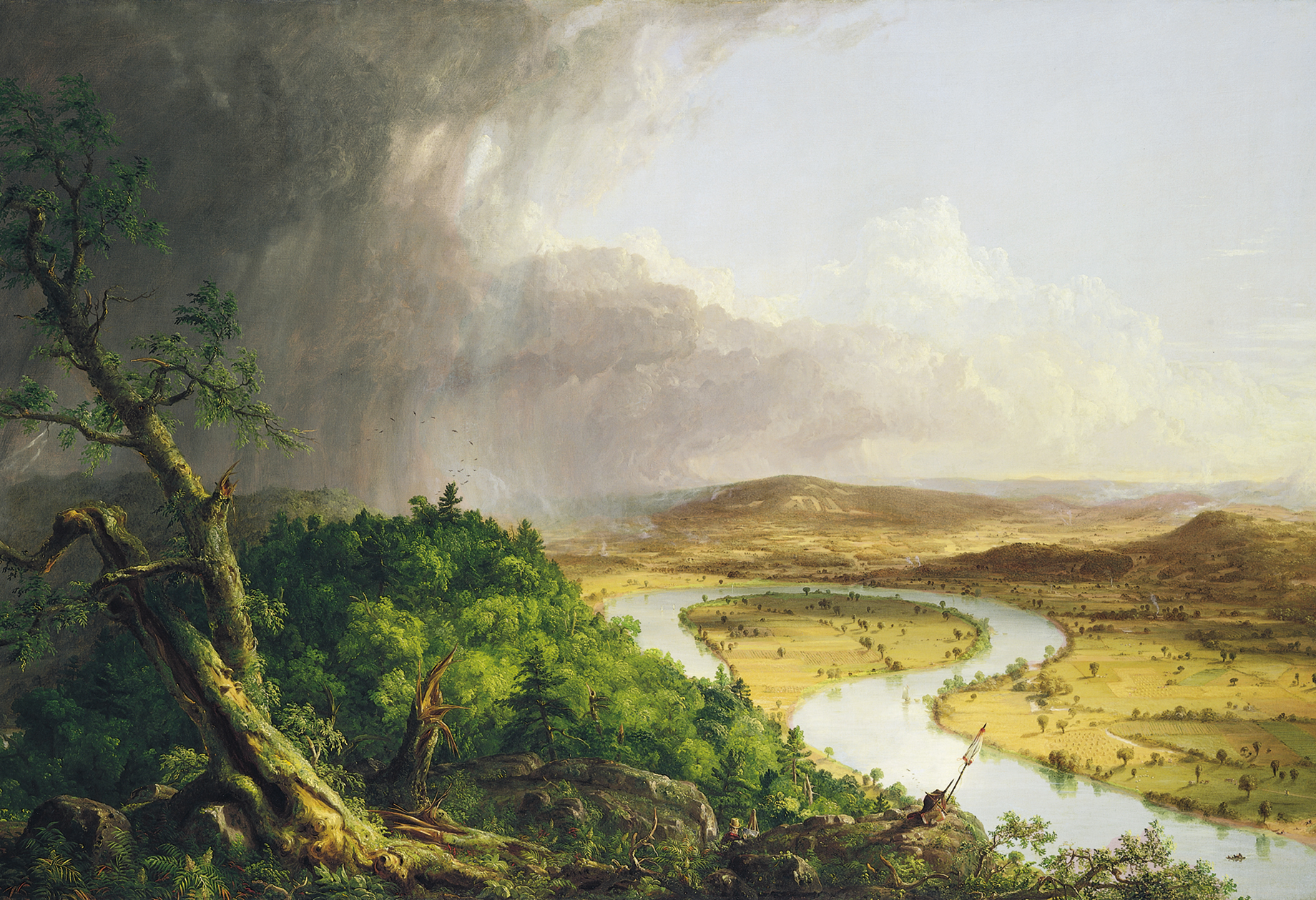
Thomas Cole (The Oxbow),

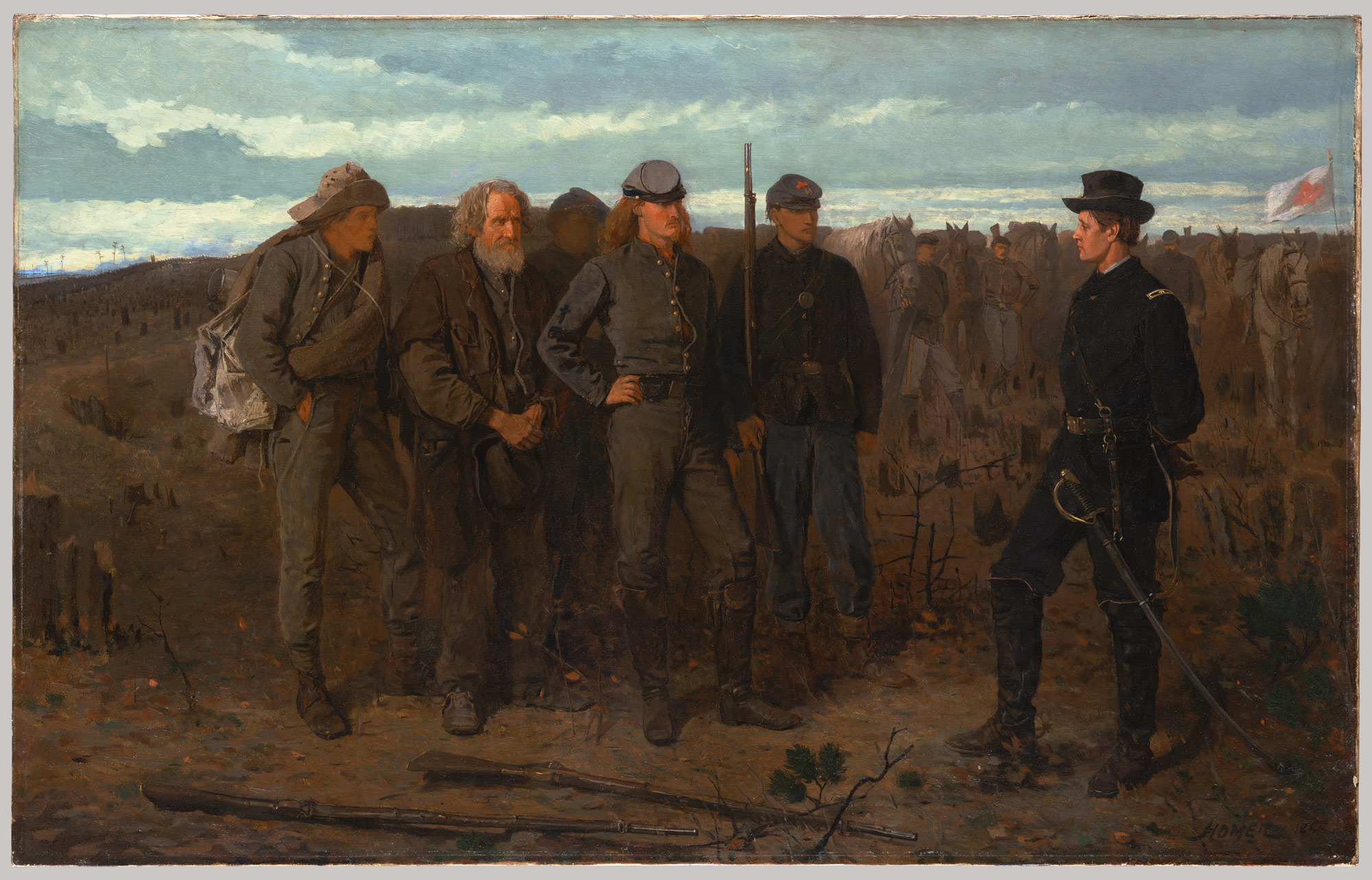
Winslow Homer (Prisoners from the Front),

Thomas Eakins (Max Schmitt in a Single Scull),

and John Singer Sargent (Madame X).


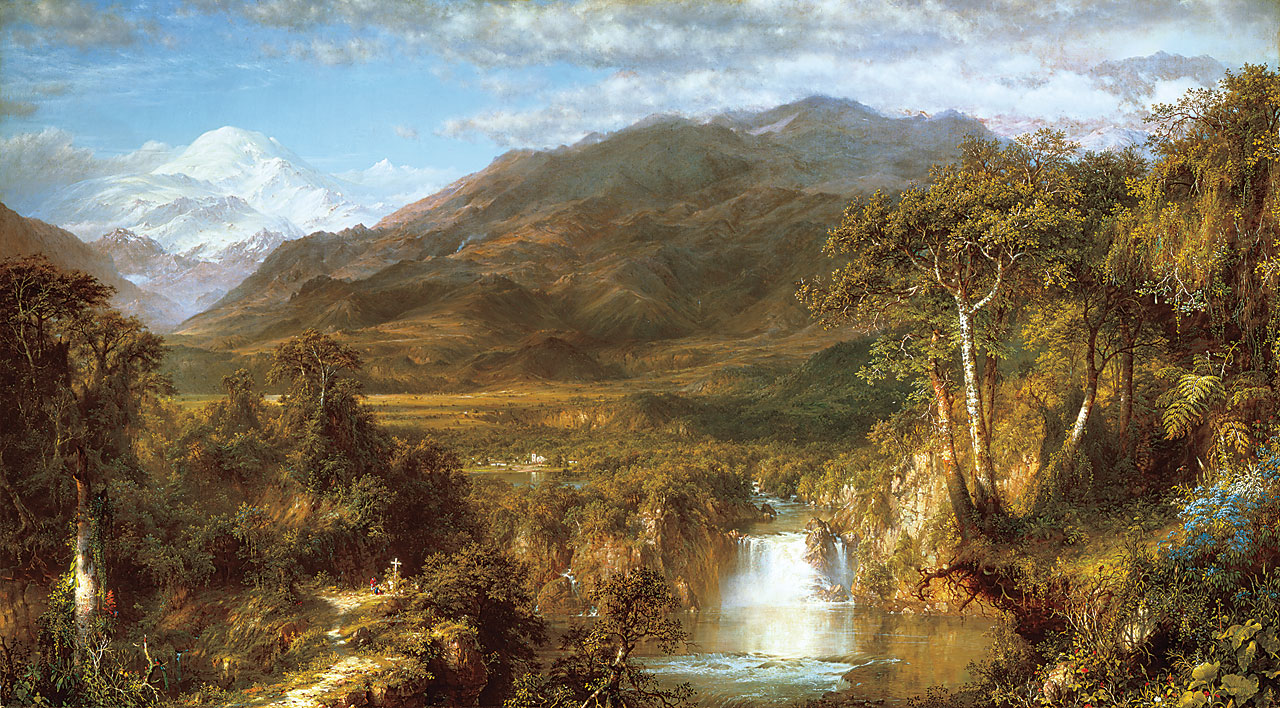
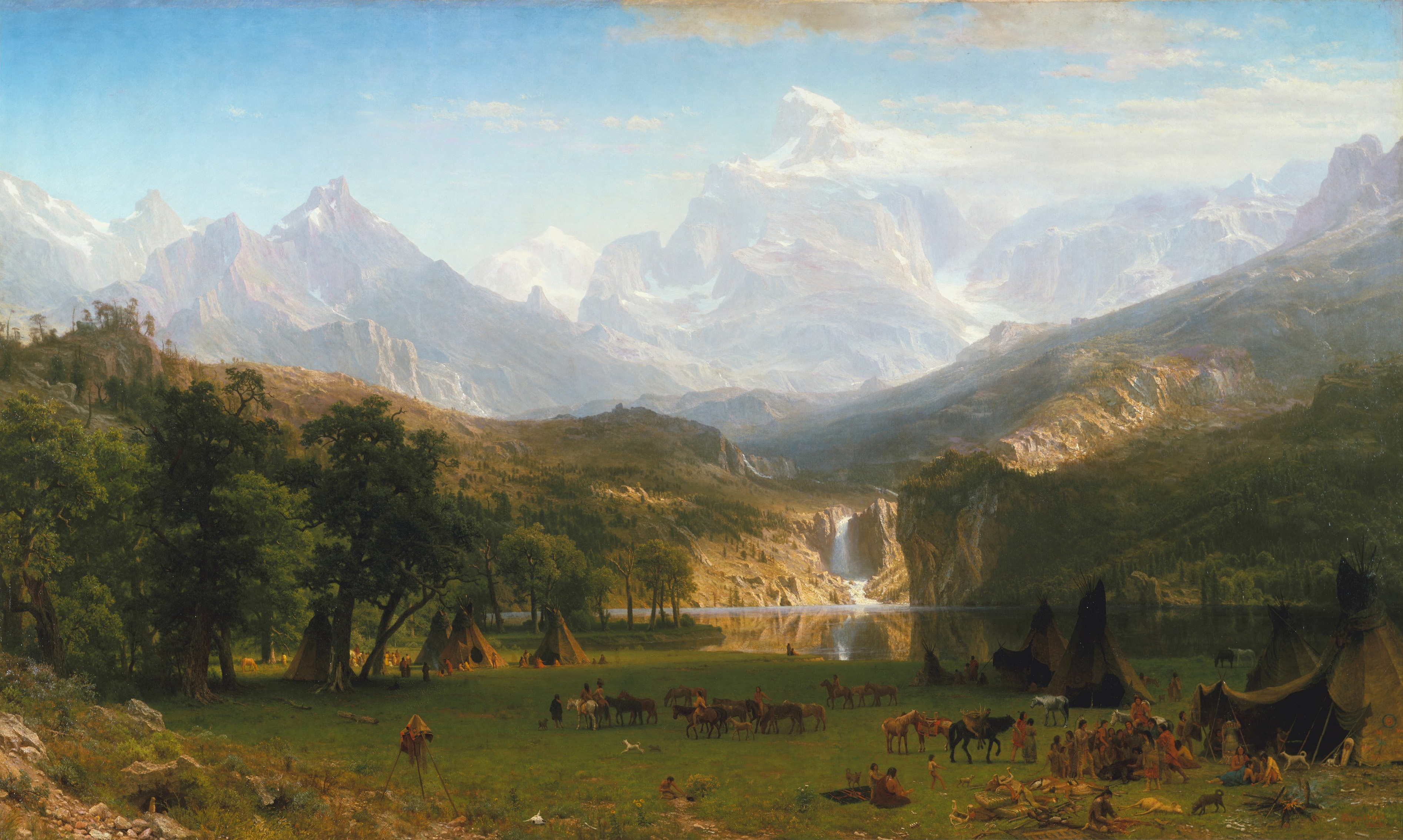
The centerpiece of the new installation is one of the best-known works in all of American art, Emanuel Gottlieb Leutze’s 1851 painting Washington Crossing the Delaware. For the re-hanging of this magnificent work, a large and stately gilded frame has been painstakingly recreated by Eli Wilner & Company from a recently discovered photograph of the painting from 1864. The renovated galleries will afford a dramatic vista toward this monumental canvas, which will hang in the Peter Jay Sharp Foundation Gallery. This double-sized gallery will showcase Leutze’s iconic work alongside two other masterpieces—Church’s Heart of the Andes


The Heart of the Andes, 1859, by Frederic Edwin Church (American, 1826–1900). Oil on canvas, 66 1/8 x 119 1/4 in. (168 x 302.9 cm). Bequest of Margaret E. Dows, 1909 (09.95). Metropolitan Museum of Art.

and Albert Bierstadt’s Rocky Mountains—just as they were displayed at the famous 1864 Metropolitan Sanitary Fair. These three paintings have been beautifully restored as part of the renovation project.

The Museum’s encyclopedic collection will offer visitors the broad sweep of American history as told through great works of art. The aforementioned central gallery focuses on the themes of freedom, exploration, and expansion that pervaded America during the mid-19th century. Other subjects, themes, and periods presented in the new galleries include: Colonial Portraiture, the American Revolution, the Young Republic, the Civil War Era, Art in the Folk Tradition, the Hudson River School, the West, the Cosmopolitan Spirit, and American Impressionism.

Interspersed among the pictures will be the American Wing’s sculpture collection, which is equally distinguished and especially strong in Neoclassical and Beaux-Arts works. Artists represented include Erastus Dow Palmer, John Quincy Adams Ward, Augustus Saint-Gaudens, Daniel Chester French, Frederic Remington, and Frederick William MacMonnies.

The new suite of galleries will also encompass the Anthony W. and Lulu C. Wang Galleries of Eighteenth-Century American Art, featuring four rooms dedicated to the display of American decorative arts, principally treasures of colonial furniture and silver. Selected highlights of the Museum’s extraordinary collection of early American silver include works by John Hull and Robert Sanderson, Myer Myers, and Paul Revere. The furniture gallery will have masterpieces of late colonial case furniture by John Townsend of Newport and Thomas Affleck of Philadelphia, complemented by imposing architectural elements. In addition, the galleries will include the grand pre-revolutionary entrance hall of the Van Rensselaer Manor House, Albany, New York.

The reserve collections of the American Wing are housed in the 17,000-square-foot Henry R. Luce Center for the Study of American Art, on the mezzanine level. The Luce Center, with its glass cases of some 9,500 objects, allows the Museum to display entire collections that otherwise would be represented by only a few highlights in the galleries. The concurrent renovation of the Luce Center includes a major revamping of its technological capabilities and additional cases for American sculpture and furniture. The public’s interface with the collection will be improved vastly by new touch-screen case labels and upgraded computer access enabling easy and in-depth searching for information about objects both in the Luce Center and throughout the American Wing.

The opening of the New American Wing Galleries for Paintings, Sculpture, and Decorative Arts in January 2012 represents the third and final phase of a major, multi-part renovation project. Part 1 opened in January 2007 with galleries dedicated to the classical arts of America, 1810-1845. Part 2 opened in May 2009 with the renovation of The Charles Engelhard Court and the Period Rooms. After Part 3 is completed, nearly all of the American Wing’s 17,000 works will be on view.