Sotheby's 2017
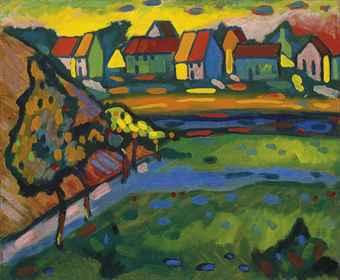
Wassily Kandinsky’s Murnau – Landschaft mit grünem Haus
An Expressionist Masterpiece by the Pioneer of Abstract Art
Wassily Kandinsky, Murnau – Landschaft mit grünem Haus, oil on board, 1909 (est. £15-25 million)Helena Newman, Global Co-Head of Sotheby’s Impressionist & Modern Art Department & Chairman of Sotheby’s Europe, said:
“Kandinsky’s major early work Murnau – Landschaft mit grünem Haus is a blazing celebration of colour that captures the moment of transition in the artist’s career when he is on the cusp of moving from figuration to abstraction. Many of his important paintings from this highly sought-after period are housed in major museums, so this work surfacing from a private collection after almost a century represents a tremendously appealing opportunity for collectors worldwide.”
Kandinsky was at the forefront of the momentous changes that were to transform the face of art history and it was in the critical year of 1909 that the artist took his first steps along the path towards creating something radically new. Works from this transformative expressionist year are rare to the market, attracting strong interest whenever they appear (in 2012, another painting from 1909 made $23 million to establish a record for the artist that was only recently eclipsed). This summer, Sotheby’s will bring to the market one of the finest early works by Kandinsky left in private hands. Having remained in the private collection of the same family since the 1920s, Murnau – Landschaft mit grünem Haus will appear at auction for the first time with an estimate of £15-25 million.
In the summer of 1908 Kandinsky and his companion Gabriele Münter, together with artist friends including Jawlensky, summered in the Bavarian mountain village of Murnau. The surrounding dramatic mountain landscapes with their bucolic atmosphere and picturesque viewpoints were to inform his move into Abstraction. Kandinsky pioneered a style of Expressionism that was fuelled by an explosion of pure colour, applied in brushstrokes of thick paint. The artist was deeply impacted by the Fauve invention of a vibrant modern palette, by Paul Cézanne’s breaking up of form and structure as well as by Vincent van Gogh’s transformation of the landscape. In this richly-coloured and dynamic painting, Kandinsky embraces and fuses these three revolutionary approaches to painting and transforms these elements to create an intensely expressive style that was ground-breaking.
Kandinsky’s use of colour was essentially fuelled by a belief in a spiritual reality that could only be discovered through the evocative possibilities of music and colour on the senses. The blue in this painting has a strong dominating presence and was in many ways the most important colour to the artist – the most spiritual of all.
Murnau – Landschaft mit grünem Haus was first exhibited at The Royal Albert Hall in 1910, when it was chosen to represent the artist at The London Salon of the Allied Artists' Association. The AAA was founded by Frank Rutter, an art critic of The Sunday Times newspaper, with the aim of providing a platform for the promotion of modernist art in Britain. This firmly placed Kandinsky at the forefront of the contemporary art scene in Europe, with his works deeply resonating with those of the Bloomsbury Group. Following this, in 1912 it was exhibited at Herwarth Walden’s revolutionary gallery Der Sturm in his first major retrospective.
This early exhibition history places the painting at the very heart of Kandinsky’s critical importance. Just under a century later, the painting returned to London as part of a landmark show at the Tate Modern in 2006. A sensation in the art world and the public alike, the exhibition followed Kandinsky’s intriguing journey from figurative landscape painter to master of abstraction. The painting has for many years been on loan to the Tel Aviv Museum of Art, with a smaller-scale study of it in the collection of the Hermitage Museum in St Petersburg.
Christie’s Evening Sale of Impressionist & Modern Art Nov 16, 2016
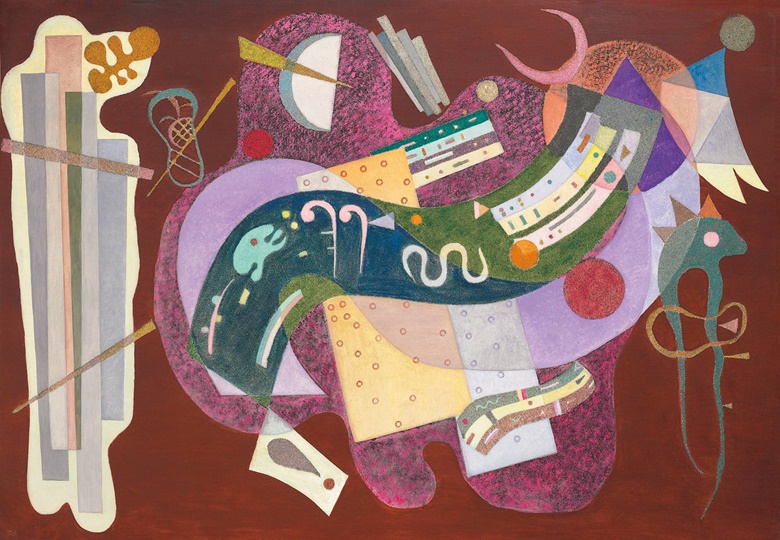
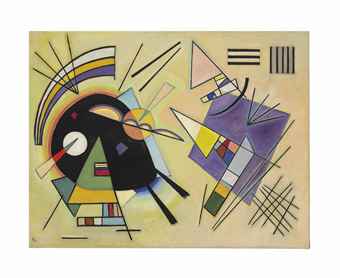
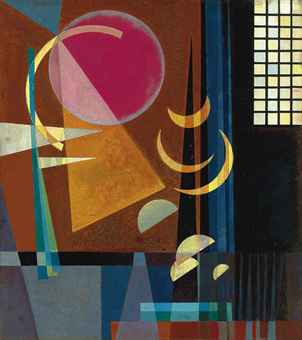
Wassily Kandinsky’s Rigide et courbé (Rigid and Curved) (estimate: $18-25 million), undoubtedly the most important Paris period painting by Kandinsky to ever appear on the market, is a highlight of its November 16th Impressionist and Modern Art Evening Sale in New York. Rigide et courbé (Rigid and Curved) is one of the most celebrated and dynamic compositions, of grand scale. The canvas is densely packed with lively geometric vignettes and a thoughtfully textured surface composed of sand mixed with paint, a technique Kandinsky used only in his Paris paintings of 1934-1935. The present work, first owned by Solomon R. Guggenheim who acquired it from Kandinsky in 1936, has been extensively published and highly exhibited from 1937-1949. Estimated at $18-25 million, the painting is undoubtedly the most important Paris period painting by Kandinsky to ever appear on the market. It is being offered from an important private American collection and has not been on the market since 1964. The upcoming sale preview marks the first time in over 50 years that the work will be publicly displayed.
Conor Jordan, Deputy Chairman of Impressionist and Modern Art, remarked: “With its dynamic sweep of upward energy, Kandinsky’s Rigide et courbé, a late masterpiece from the mid-1930s, unseen in public for over fifty years, evokes an epic paean, a rhapsodic song of thanksgiving suggesting the bright hope the artist saw in his new home in Paris following his flight from Nazi Germany. Abstract forms, runic symbols and mythic references, summoning Kandinsky's life and career, intertwine with veiled allusions to contemporary events, across the broad dimensions of this technically audacious canvas which is richly worked in oil and sand. It ranks among the greatest Kandinskys still in private hands.”
CHRISTIE’S IMPRESSIONIST AND MODERN ART SALE IN LONDON ON 6 FEBRUARY 2013
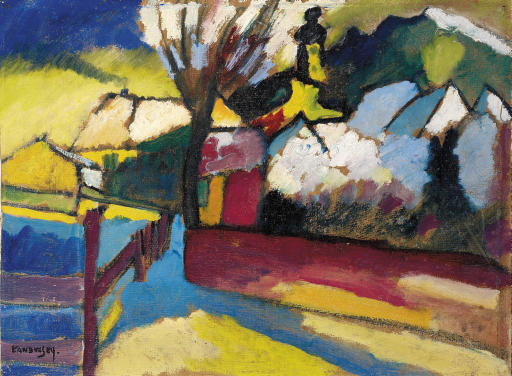
The landscapes that Wassily Kandinsky (1866-1944) painted in Murnau between 1908 and 1909 reflect the first full flowering of his art and mark the beginning of the artist’s epic pioneering journey into abstraction. His 1909 painting

Murnau - Ansicht mit Burg, Kirche und Eisenbahn, epitomises the way that he magnified and intensified colour to the point where it begins to float freely and operate as a dynamic, abstract and interactive pictorial entity on the painting’s surface (estimate: £5-7 million). Kandinsky’s works from these years are the first in Kandinsky’s oeuvre to demonstrate his independence from the influences of Van Gogh, Gauguin and French Fauvism and the emergence of a new and wholly unique vision.
Near-autonomous colour set deliberately against contrasting dark shadows presents a near panoramic overview of the leafy skyline of the small and sleepy Bavarian town of Murnau as seen from the rear of the house that Kandinsky shared with his lover and fellow pioneering artist Gabriele Münter. Kandinsky’s discovery of Murnau proved the catalyst for his liberation of colour from form; it also prompted his renewed affection for folk art and inspired his profound sense of the ‘spiritual.’
Heightening his use of colour to a level of expressionistic intensity, and broadening his brushstrokes to the point where each mark takes on a formal function of its own within the work, Kandinsky’s Murnau landscapes rapidly grew to become increasingly abstract statements about the nature of painting itself.
Sotheby's Impressionist and Modern Art May 3, 2005

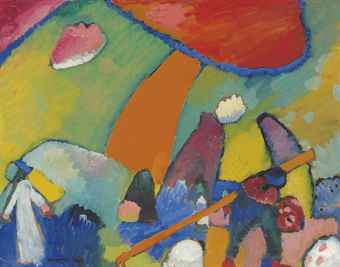
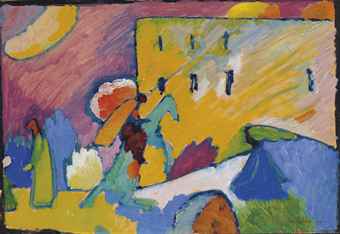
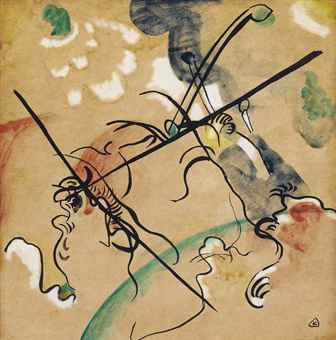
Sotheby's evening sale of Impressionist and Modern Art on May 3, 2005 will include a rediscovered masterpiece by Wassily Kandinsky entitled Zwei Reiter und liegende Gestalt (Two Riders and Reclining Figure).
Painted in 1909-10, this brilliantly-colored and fantastical composition had, until recently, been unseen for nearly a century and largely unknown to scholars. It is one of two compositions that the artist originally painted on the front and back of a single piece of millboard.
The other composition, which has since been separated from the reverse of the present work, is currently in the collection of the Minneapolis Institute of Arts. Kandinsky gave the double-sidedpainting to his friend and fellow Expressionist painter Alexej von Jawlensky, and the present work, Zwei Reiter undliegende Gestalt, is estimated to sell for $15/25 million.
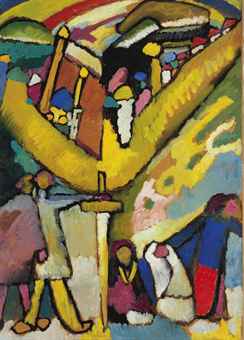
"The recent exhibition at the Minneapolis Institute of Arts, in which the museum's Studie zuI mprovisation 5 (Study for Improvisation 5) was re-united with its long-lost companion Zwei Reiter und liegende Gestalt (Two Riders and Reclining Figure) was a moment of historic importance to scholars and enthusiasts of Kandinsky's art. Both works represent the very moment when one of the 20th Century's leading artists would foreverc hange the course of Western Art through the creation of Abstraction. Zwei Reiter und liegende Gestalt is a symphony of heightened color, abstracted form and dynamically charged space. This work issues from a key moment in Kandinsky's career and demonstrates why he was one of the most important contributors to the birth of Modern Art.
Acquired by his fellow artist, Alexej von Jawlensky, the work has been unseen for nearly a century. Its discovery, and the subsequent research that led to scholars' identification of the work as the lost companion to the great painting belonging to the Minneapolis museum, is a thrilling occurrence. Its appearance now on the market creates a historic and almost unique opportunity for collectors to acquire a great work from the artist's most important period."
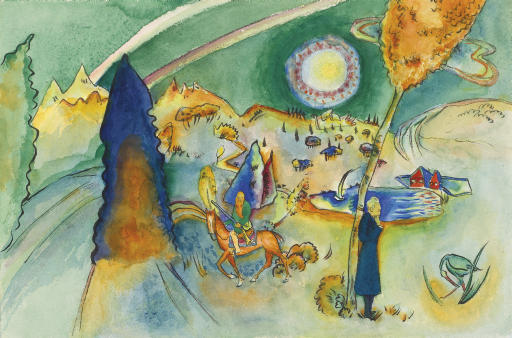
When Kandinsky painted Zwei Reiter und liegende Gestalt in 1909-10 he was integrating this new metaphysical aesthetic with his existing predilection for depicting symbolic motifs and Russian-inspired iconography. The mounted rider, for example, is understood to be the symbol of the Christian dragon slayer, St. George. One can decipher his lance-like arms, outstretched in opposite directions, as he leaps over the hills with his horse. The sleeping figure along the bottom left edge is understood to be symbolic of introspection and imagination, which were both characteristics that Kandinsky valued very highly in his art.
The present work also codifies the stylistic and thematic concerns that Kandinsky would extol one year later in his treatise, Concerning the Spiritual in Art, in which he wrot epassionately about his color theories and the recent advances of his art. This treatise set the stage for the direction of all of his future work in that it gave resounding praise for color as a means of complete and spiritually-penetrating expression.
The fact that Jawlensky acquired this important painting, and its attached companion, directly from Kandinsky is not surprising, given that the two artists frequently exchanged pictures over the course of their lifetimes. Jawlensky received the double-sided millboard from Kandinsky before 1914. The two compositions were subsequently separated whilst the painting was in Jawlensky's possession and the present work was signed by an unidentified hand, which may have been that of the artist himself, Jawlensky or his assistant Lisa Kümmel.
Mr. Norman continued,"Jawlensky had separated some of his own double-sided millboard compositions, and in letters maintained in the archives, he instructs his son to do so to many of his own compositions. Sotheby's recent sale of Jawlensky's 1910 masterpiece Schokko (Schokko mit Tellerhut) for a record $8.3 million is one such example. As with theaforementioned painting and the present pairs of Zwei Reiter und liegende Gestalt and Studie zu Improvisation 5,each picture set off on its own separate journey through history."
SOTHEBYS’ SALE of German & Austrian
Art February 5, 2007

Painted in 1909,
Wassily Kandinsky’s Weilheim-Marienplatz ( est:
£1,500,000-2,000,000/€2,230,000-2,970,000) is a strikingly colourful depiction
of the main market square in Weilheim, a small town in Upper Bavaria.
Captivated by the
charm, colourful facades and romantic atmosphere of Bavarian towns, Kandinsky
(1866-1944) and his artist-friends Jawlenksy, Münter and von Werefkin (who were
later to form the ‘Blaue Reiter’ group) moved to the Bavarian town of Murnau in
1908. The weeks Kandinksy spent there were pivotal in the development of his
art: his work took ona renewed energy, and the fauviste influence he had
absorbed in Paris now combined with the influence of the folk art he
encountered around him – in particular that of glass painting. As a result,
Kandinsky’s works of the time became almost two dimensional, with colour
playing an increasingly important role as a means of expression.
Weilheim-Marienplatz is both a seminal work from this
important period in Kandinsky’s career and an early indicatorof the artist’s
move towards abstraction – something that was to play a major part in the
development of Modern Art.
Sotheby's 2015

Estimate
 200,000
—
300,000 GBP
200,000
—
300,000 GBP
200,000
—
300,000 GBP


Sotheby's evening sale
of Impressionist and Modern Art on May 3, 2005 will include a
rediscovered masterpiece by Wassily Kandinsky entitled Zwei Reiter und
liegende Gestalt (Two Riders and Reclining Figure). Painted in 1909-10,
this brilliantly-colored and fantastical composition had, until
recently, been unseen for nearly a century and largely unknown to
scholars. It is one of two compositions that the artist originally
painted on the front and back of a single piece of millboard. The other
composition, which has since been separated from the reverse of the
present work, is currently in the collection of the Minneapolis
Institute of Arts. Kandinsky gave the double-sided painting to his
friend and fellow Expressionist painter Alexej von Jawlensky, and the
present work, Zwei Reiter und liegende Gestalt, is estimated to sell for
$15/25 million. Prior to its exhibition and sale in New York, Zwei
Reiter und liegende Gestalt will be on view at Sotheby's Bond Street
Galleries in London on March 17, 18 and 20.
David Norman, Executive Vice President and Co-Chairman of Sotheby's
Impressionist and Modern Art Department Worldwide, said, "The recent
exhibition at the Minneapolis Institute of Arts, in which the museum's
Studie zu Improvisation 5 (Study for Improvisation 5) was re-united with
its long-lost companion Zwei Reiter und liegende Gestalt (Two Riders
and Reclining Figure) was a moment of historic importance to scholars
and enthusiasts of Kandinsky's art. Both works represent the very moment
when one of the 20th Century's leading artists would forever change the
course of Western Art through the creation of Abstraction. Zwei Reiter
und liegende Gestalt is a symphony of heightened color, abstracted form
and dynamically charged space. This work issues from a key moment in
Kandinsky's career and demonstrates why he was one of the most important
contributors to the birth of Modern Art. Acquired by his fellow artist,
Alexej von Jawlensky, the work has been unseen for nearly a century.
Its discovery, and the subsequent research that led to scholars'
identification of the work as the lost companion to the great painting
belonging to the Minneapolis museum, is a thrilling occurrence. Its
appearance now on the market creates a historic and almost unique
opportunity for collectors to acquire a great work from the artist's
most important period."
When Kandinsky painted Zwei Reiter und liegende Gestalt in 1909-10 he
was integrating this new metaphysical aesthetic with his existing
predilection for depicting symbolic motifs and Russian-inspired
iconography. The mounted rider, for example, is understood to be the
symbol of the Christian dragon slayer, St. George. One can decipher his
lance-like arms, outstretched in opposite directions, as he leaps over
the hills with his horse. The sleeping figure along the bottom left edge
is understood to be symbolic of introspection and imagination, which
were both characteristics that Kandinsky valued very highly in his art.
The present work also codifies the stylistic and thematic concerns that
Kandinsky would extol one year later in his treatise, Concerning the
Spiritual in Art, in which he wrote passionately about his color
theories and the recent advances of his art. This treatise set the stage
for the direction of all of his future work in that it gave resounding
praise for color as a means of complete and spiritually-penetrating
expression.
The fact that Jawlensky acquired this important painting, and its
attached companion, directly from Kandinsky is not surprising, given
that the two artists frequently exchanged pictures over the course of
their lifetimes. Jawlensky received the double-sided millboard from
Kandinsky before 1914. The two compositions were subsequently separated
whilst the painting was in Jawlensky's possession and the present work
was signed by an unidentified hand, which may have been that of the
artist himself, Jawlensky or his assistant Lisa Kümmel. Mr. Norman
continued, "Jawlensky had separated some of his own double-sided
millboard compositions, and in letters maintained in the archives, he
instructs his son to do so to many of his own compositions. Sotheby's
recent sale of Jawlensky's 1910 masterpiece Schokko (Schokko mit
Tellerhut) for a record $8.3 million is one such example. As with the
aforementioned painting and the present pairs of Zwei Reiter und
liegende Gestalt and Studie zu Improvisation 5, each picture set off on
its own separate journey through history."
More Information: http://artdaily.com/news/12933/Sotheby-s-to-Sell-Work-by-Wassily-Kandinsky#.VM5rAydJVcw[/url]
Copyright © artdaily.org
More Information: http://artdaily.com/news/12933/Sotheby-s-to-Sell-Work-by-Wassily-Kandinsky#.VM5rAydJVcw[/url]
Copyright © artdaily.org


Sotheby's evening sale
of Impressionist and Modern Art on May 3, 2005 will include a
rediscovered masterpiece by Wassily Kandinsky entitled Zwei Reiter und
liegende Gestalt (Two Riders and Reclining Figure). Painted in 1909-10,
this brilliantly-colored and fantastical composition had, until
recently, been unseen for nearly a century and largely unknown to
scholars. It is one of two compositions that the artist originally
painted on the front and back of a single piece of millboard. The other
composition, which has since been separated from the reverse of the
present work, is currently in the collection of the Minneapolis
Institute of Arts. Kandinsky gave the double-sided painting to his
friend and fellow Expressionist painter Alexej von Jawlensky, and the
present work, Zwei Reiter und liegende Gestalt, is estimated to sell for
$15/25 million. Prior to its exhibition and sale in New York, Zwei
Reiter und liegende Gestalt will be on view at Sotheby's Bond Street
Galleries in London on March 17, 18 and 20.
David Norman, Executive Vice President and Co-Chairman of Sotheby's
Impressionist and Modern Art Department Worldwide, said, "The recent
exhibition at the Minneapolis Institute of Arts, in which the museum's
Studie zu Improvisation 5 (Study for Improvisation 5) was re-united with
its long-lost companion Zwei Reiter und liegende Gestalt (Two Riders
and Reclining Figure) was a moment of historic importance to scholars
and enthusiasts of Kandinsky's art. Both works represent the very moment
when one of the 20th Century's leading artists would forever change the
course of Western Art through the creation of Abstraction. Zwei Reiter
und liegende Gestalt is a symphony of heightened color, abstracted form
and dynamically charged space. This work issues from a key moment in
Kandinsky's career and demonstrates why he was one of the most important
contributors to the birth of Modern Art. Acquired by his fellow artist,
Alexej von Jawlensky, the work has been unseen for nearly a century.
Its discovery, and the subsequent research that led to scholars'
identification of the work as the lost companion to the great painting
belonging to the Minneapolis museum, is a thrilling occurrence. Its
appearance now on the market creates a historic and almost unique
opportunity for collectors to acquire a great work from the artist's
most important period."
When Kandinsky painted Zwei Reiter und liegende Gestalt in 1909-10 he
was integrating this new metaphysical aesthetic with his existing
predilection for depicting symbolic motifs and Russian-inspired
iconography. The mounted rider, for example, is understood to be the
symbol of the Christian dragon slayer, St. George. One can decipher his
lance-like arms, outstretched in opposite directions, as he leaps over
the hills with his horse. The sleeping figure along the bottom left edge
is understood to be symbolic of introspection and imagination, which
were both characteristics that Kandinsky valued very highly in his art.
The present work also codifies the stylistic and thematic concerns that
Kandinsky would extol one year later in his treatise, Concerning the
Spiritual in Art, in which he wrote passionately about his color
theories and the recent advances of his art. This treatise set the stage
for the direction of all of his future work in that it gave resounding
praise for color as a means of complete and spiritually-penetrating
expression.
The fact that Jawlensky acquired this important painting, and its
attached companion, directly from Kandinsky is not surprising, given
that the two artists frequently exchanged pictures over the course of
their lifetimes. Jawlensky received the double-sided millboard from
Kandinsky before 1914. The two compositions were subsequently separated
whilst the painting was in Jawlensky's possession and the present work
was signed by an unidentified hand, which may have been that of the
artist himself, Jawlensky or his assistant Lisa Kümmel. Mr. Norman
continued, "Jawlensky had separated some of his own double-sided
millboard compositions, and in letters maintained in the archives, he
instructs his son to do so to many of his own compositions. Sotheby's
recent sale of Jawlensky's 1910 masterpiece Schokko (Schokko mit
Tellerhut) for a record $8.3 million is one such example. As with the
aforementioned painting and the present pairs of Zwei Reiter und
liegende Gestalt and Studie zu Improvisation 5, each picture set off on
its own separate journey through history."
More Information: http://artdaily.com/news/12933/Sotheby-s-to-Sell-Work-by-Wassily-Kandinsky#.VM5rAydJVcw[/url]
Copyright © artdaily.org
More Information: http://artdaily.com/news/12933/Sotheby-s-to-Sell-Work-by-Wassily-Kandinsky#.VM5rAydJVcw[/url]
Copyright © artdaily.org

LOT SOLD. 1,777,500 EUR

LOT SOLD. 125,000 USD

Estimate 600,000
—
800,000 USD

LOT SOLD. 5,570,500 GBP

LOT SOLD. 1,650,500 GBP

LOT SOLD. 1,676,700 EUR

Estimate
 400,000
—
600,000 GBP
400,000
—
600,000 GBP
400,000
—
600,000 GBP


LOT SOLD. 1,273,250 GBP

Estimate
700,000
—
1,000,000 GBP
700,000
—
1,000,000 GBPCHRISTIE’S 2015
CHRISTIE’S 2014
CHRISTIE’S 2013
CHRISTIE’S 2012
Pr.£1,105,250($1,737,453)



CHRISTIE’S 2011


CHRISTIE’S 2009


CHRISTIE’S 2008