John Singer Sargent's (1856–1925) decades-long captivation with Spain yielded a remarkable body of work depicting the rich and diverse culture he encountered. Sargent and Spain is the first exhibition to reveal the depth of this engagement and the intentional approach the artist adopted there. Presenting some 140 oils, watercolors, drawings, and never-before published photographs, several almost certainly taken by the artist himself, the exhibition is on view from October 2, 2022, through January 2, 2023, in the West Building of the National Gallery of Art.
Sargent left a rich visual record of his time in Spain—over 225 oils, watercolors, and drawings, supplemented by sketchbooks, scrapbooks, and nearly 200 photographs that he collected or possibly took himself. Over seven extended visits between 1879 and 1912, he depicted stunning landscape views, detailed architectural studies, local peoples and traditions, dynamic scenes of flamenco dance, and everyday moments of Spanish Roma life. He copied paintings, especially by Diego Velázquez (1599–1660), in museums and was intrigued by art in churches, which influenced his expansive murals for the Boston Public Library.
"Sargent and Spain examines, for the first time, how Sargent engaged with that country, in all its diversity, and depicted it in paintings, drawings, and photographs," said Kaywin Feldman, director of the National Gallery of Art. "We are deeply grateful to Richard Ormond and Elaine Kilmurray, leading authorities on the artist and authors of the John Singer Sargent catalogue raisonné, who worked closely with Sarah Cash, associate curator of American and British paintings, on this presentation. I would like to extend our thanks to our lenders for their willingness to share their treasured works of art as well as to the Buffy and William Cafritz Family Fund, the Virginia Cretella Mars Endowment Fund for the International Exchange of Art, the Henry Luce Foundation, and the Director's Circle of the National Gallery of Art for providing additional support that allowed us to present this exhibition. We are also grateful to the Federal Council on the Arts and the Humanities for their continued dedication to the National Gallery's exhibitions and programs. I would also like to thank Bank of America for their sponsorship and long-standing support."
"Sargent’s influence on American painting is substantial,” said Larry Di Rita, Bank of America President, Greater Washington DC. “Bank of America is excited to support the exhibition of this vibrant collection of Sargent’s works."
Exhibition Organization
The exhibition is organized by the National Gallery of Art, Washington, in collaboration with the Fine Arts Museums of San Francisco.
Exhibition Curators
The exhibition is curated by Sarah Cash, associate curator of American and British paintings at the National Gallery of Art, with Richard Ormond and Elaine Kilmurray, leading authorities on the artist and authors of the John Singer Sargent catalogue raisonné.
About the Exhibition
Arranged in six thematic sections, Sargent and Spain traces the artist's many and varied approaches to depicting Spain. The first section examines the young Sargent's immersion in Spanish art—especially by Velázquez—at the Museo del Prado in Madrid, where he learned to interpret the placement of the figure in shallow space, the simplicity of the silhouette against the neutral background, and the restrained palette. In addition to paintings and prints by Velázquez and other earlier artists, Sargent was drawn to works by several Spanish contemporaries who also influenced his artistic style, particularly works by Joaquín Sorolla and the slightly older Mariano Fortuny Marsal.
The second section reveals Sargent's interest in depicting the performing arts he enjoyed in Spain. From 1879 to 1881 and again around 1890, this artist-connoisseur produced an extraordinary series of images of Spanish dancers and musicians, particularly those inspired by the traditions of Andalusia (southern Spain). Among the works on view are the paintings The Spanish Dance (c. 1879–1882) and Spanish Roma Dancer (two versions, both dated c. 1879–1880), the watercolor Spanish Dancer (c. 1880–1881), sketches and drawings related to El Jaleo (1882) and Spanish Dancer (c. 1880–1881), as well as images (1890) of the celebrated performer Carmen Dauset Moreno, known as La Carmencita.
As Sargent traveled throughout Spain, he studied and depicted subjects from north (Santiago de Compostela and Camprodón) to south (Granada), and out to the island of Majorca, which fascinated him. He was captivated by both rural and urban locales, exploring the countryside, coasts, architecture, gardens, and the inhabitants he met. Along the way, over the course of three decades, he created a comprehensive portrayal of the Spanish landscape—its flora and fauna; its people and their animals; its ports and ships. These works capture the country's intrinsic character and spirit of place, as well as the distinctive qualities of its light and atmosphere.
These works are featured in the next three sections of the exhibition, which includes highlights such as architectural elements in royal palaces, notably the Alhambra and Generalife, and their surroundings; the graceful arches, colonnades, and courtyards he found in the cities he visited; as well as the lush fruits and foliage of Majorca (he would soon adapt the latter for the Triumph of Religion murals at the Boston Public Library). His depictions, in both oil and watercolor, focus on the clarity of line; the interrelationship between exterior and interior space, ornament and pattern; and the dramatic and shifting play of light, shade, and watery reflection.
The exhibition concludes with an exploration of the religious imagery that occupied Sargent, especially in relation to his commission to paint the Triumph of Religion murals at the Boston Public Library. His engagement with Spanish Catholicism includes lively oil sketches—recording architectural spaces and designs—as well as objects he collected and represented. Among the works on view are studies of soaring cathedrals, the Crucifixion, and the Madonna that he made in preparation for the mural cycle. The final gallery in the exhibition offers photo murals, a reading area, and an interactive kiosk where visitors can examine one of Sargent's scrapbooks.
In the Library: Photography and Travel in Sargent's Spain
Complementing Sargent and Spain, the National Gallery of Art presents 19th- and early 20th-century archival material drawn entirely from its department of image collections. Selections from its rare archives include photographs by Juan Laurent, Rafael Garzón, Casiano Alguacil Blázquez, and Joseph Lacoste—some of whom are also represented in Sargent and Spain; images of art and monuments from Aranjuez, Ávila, Burgos, Granada, Madrid, and Zaragoza; photographs of people in typical dress, gardens, and a thousand-year-old Majorcan olive tree; and fine collotype postcards. A collodion glass negative of the main gallery of the Prado in 1872, select reproductive prints of art, Manuel Cossío's influential catalog El Greco (1908), and a woodcut from the Illustrated London Times give viewers a sense of the period. Also featured is an early photograph of Sargent's El Jaleo on view in the Spanish Cloister of the Isabella Stewart Gardner Museum, Boston, in 1915.
Curated by Thomas O'Callaghan, image specialist for Spanish art, National Gallery of Art, this installation is on view from October 3 through December 30, 2022, in the East Building Study Center, from 11:00 a.m. to 4:00 p.m., Monday through Friday.
Exhibition Catalog

Copublished by the National Gallery of Art and Yale University Press, this 256-page illustrated volume reveals Sargent's fascination with Spain and the extraordinary body of work that resulted—stunning landscapes and seascapes, architectural studies, scenes of everyday life, and sympathetic portrayals of the Roma and other local people he encountered. Featuring essays by Cash, Kilmurray, Ormond, Museo del Prado curator Javier Barón, and independent scholars Nancy G. Heller and Chloe Sharpe, this book presents some 130 dazzling watercolors, oil paintings, and drawings recording Sargent's engagement with Spain. Immersing himself in the country's rich culture, he studied Spanish masters old and new, lavishing particular attention on works by Velázquez in the Prado. Sargent rendered the distinctive architecture of the Alhambra as well as other palaces and churches, explored religious imagery, and captured lively scenes of ports and villages. Intrigued by Spanish dance and music, he created dynamic views of flamenco and the renowned Carmencita. The artist's seven trips to Spain are detailed in a map and illustrated chronology by Catherine Southwick, curatorial associate in American and British paintings at the National Gallery of Art. The only known photographs of Sargent working and traveling in Spain were discovered during research for the exhibition and are published here for the first time.
Images
Francisco Goya
Señora Sabasa Garcia, c. 1806/1811
oil on canvas
overall: 71 x 58 cm (27 15/16 x 22 13/16 in.)
framed: 94.6 x 81.3 x 7.6 cm (37 1/4 x 32 x 3 in.)
National Gallery of Art, Washington, Andrew W. Mellon Collection

John Singer SargentUnder the Olives, 1908
oil on canvas
overall: 55.88 x 71.12 cm (22 x 28 in.)
framed: 77.47 x 93.98 x 5.72 cm (30 1/2 x 37 x 2 1/4 in.)
Cedarhurst Center for the Arts, Mount Vernon, Illinois, Gift of John R. and Eleanor R. Mitchell, 1973.1.54
Photograph by Daniel Overturf

John Singer Sargent
Pomegranates, 1908
watercolor over graphite, with gouache, on paper
overall: 53.82 x 36.67 cm (21 3/16 x 14 7/16 in.)
framed: 90.96 x 70.64 x 3.65 cm (35 13/16 x 27 13/16 x 1 7/16 in.)
Brooklyn Museum, Purchased by Special Subscription 09.832

John Singer Sargent
Gourds, 1908
watercolor over graphite, with gouache, on paper
overall: 33.5 x 50.01 cm (13 3/16 x 19 11/16 in.)
framed: 61.6 x 76.84 x 4.6 cm (24 1/4 x 30 1/4 x 1 13/16 in.)
Brooklyn Museum, Purchased by Special Subscription 09.822


John Singer Sargent
"The Infanta Margarita," after Juan Bautista Martínez del Mazo, 1879
oil on panel
overall: 34.93 x 24.13 cm (13 3/4 x 9 1/2 in.)
Estate of Judith and Philip Sieg
Photo Credit: Courtesy Knoedler Archives, New York
Photographer Credit: Scan by Prudence Cumming Fine Art Photography


John Singer Sargent
"Prince Baltasar Carlos on Horseback," after Velázquez, 1879
oil on canvas
overall: 45.7 x 35.5 cm (18 x 14 in.)
framed: 57 x 48 x 7.5 cm (22 7/16 x 18 7/8 x 2 15/16 in.)
Hon. Mr. and Mrs. Peter Stanley


John Singer Sargent
A Spanish Woman, 1879–1880
oil on canvas
overall: 55.88 x 45.72 cm (22 x 18 in.)
Private collection


John Singer Sargent
Head of "Aesop," after Velázquez, 1879
oil on canvas
overall: 46.36 x 37.15 cm (18 1/4 x 14 5/8 in.)
framed: 65.09 x 55.88 x 8.26 cm (25 5/8 x 22 x 3 1/4 in.)
Lent courtesy of the Ackland Art Museum, The University of North Carolina at Chapel Hill


John Singer Sargent
"The Holy Trinity," after El Greco, 1895
oil on canvas
overall: 80.01 x 46.99 cm (31 1/2 x 18 1/2 in.)
framed: 100.33 x 55.25 cm (39 1/2 x 21 3/4 in.)
Private collection
Photographer Credit: Elizabeth BernsteinFile name: 5313-068.jpg


John Singer Sargent
Albert de Belleroche, c. 1882
oil on canvas
overall: 70.49 x 49.53 cm (27 3/4 x 19 1/2 in.)
Collection of the Colorado Springs Fine Arts Center at Colorado College, Purchase Funds in Memory of Mrs. A.E. Carlton from her friends, FA 1961.1


John Singer Sargent
The Spanish Dance, c. 1879–1882
oil on canvas
framed: 89.5 x 84.5 x 4 cm (35 1/4 x 33 1/4 x 1 9/16 in.)
unframed: 88.2 x 83.7 cm (34 3/4 x 32 15/16 in.)
On loan from The Hispanic Society of America, New York, NY
Photo Credit: Courtesy of The Hispanic Society of America, New York


John Singer Sargent
Study for "The Spanish Dance", c. 1879–1880
oil on canvas
overall: 48.58 x 39.69 cm (19 1/8 x 15 5/8 in.)
framed: 60.33 x 51.44 x 6.35 cm (23 3/4 x 20 1/4 x 2 1/2 in.)
Private collection


John Singer Sargent
La Carmencita Dancing, 1890
oil on canvas
overall: 137.16 x 88.9 cm (54 x 35 in.)
Private collection


John Singer Sargent
Alhambra, Patio de los Arrayanes (Court of the Myrtles), 1879
oil on canvas
overall: 57.47 x 48.9 cm (22 5/8 x 19 1/4 in.)
framed: 87 x 67 cm (34 1/4 x 26 3/8 in.)
Private collection
Photo Credit: Courtesy Adelson Galleries, New York.
Photographer Credit: Image and scan by Prudence Cuming Fine Art Photography


John Singer Sargent
A Spanish Figure, c. 1879–1880
oil on panel
overall: 33.02 x 27.94 cm (13 x 11 in.)
framed: 52.3 x 48.7 x 3 cm (20 9/16 x 19 3/16 x 1 3/16 in.)
Private collection
Photo Credit: Courtesy Adelson Galleries, New York.
Photographer Credit: Image and scan by Prudence Cuming Fine Art Photography


John Singer Sargent
Santa María La Blanca, Toledo, 1879
oil on panel
framed: 45 x 36.5 cm (17 11/16 x 14 3/8 in.)
image: 34.29 x 25.4 cm (13 1/2 x 10 in.)
Private collection
Photographer Credit: James Dobson Photography


John Singer Sargent
A Marble Fountain at Aranjuez, 1912?
oil on canvas
image: 55.88 x 71.12 cm (22 x 28 in.)
framed (Approx): 78.74 x 83.82 cm (31 x 33 in.)
Sharon P. and John D. Rockefeller IV
QuickSilver Photographers LLC


John Singer Sargent
Pool in the Garden of La Granja, c. 1903
watercolor over graphite on paper
framed: 49 x 64 cm (19 5/16 x 25 3/16 in.)
image: 30.16 x 46 cm (11 7/8 x 18 1/8 in.)
Private collection
Photo Credit: Courtesy Adelson Galleries, New York
Photographer Credit: Image and scan by Prudence Cuming Fine Art Photography


John Singer Sargent
Santiago de Compostela, c. 1903
watercolor over graphite on paper
overall: 30.48 x 43.18 cm (12 x 17 in.)
Private collection
Photo Credit: Courtesy Adelson Galleries, New York.
Photographer Credit: Image and scan by Prudence Cuming Fine Art Photography

John Singer Sargent
Street at Camprodón, Spain, 1892
watercolor over graphite, with gouache, on paper
overall: 45.09 x 28.58 cm (17 3/4 x 11 1/4 in.)
framed: 71.12 x 55.88 cm (28 x 22 in.)
Private collection
Photo Credit: Courtesy Adelson Galleries, New York.
Photographer Credit: Image and scan by Prudence Cuming Fine Art Photography


John Singer Sargent
Driving in Spain, c. 1903
watercolor over graphite on paper
framed: 50.8 x 64.14 cm (20 x 25 1/4 in.)
image: 34.93 x 48.26 cm (13 3/4 x 19 in.)
Private collection
Photo Credit: Courtesy Adelson Galleries, New York
Photographer Credit: Quesada/Burke Photography and scan by Prudence Cuming Fine Art Photography


John Singer Sargent
Cuadra (Stable), c. 1903
watercolor on paper
overall: 24.13 x 33.97 cm (9 1/2 x 13 3/8 in.)
framed: 38 x 53 x 3 cm (14 15/16 x 20 7/8 x 1 3/16 in.)
Museo Sorolla, Madrid, inv. 01321


John Singer Sargent
Group of Spanish Convalescent Soldiers, c. 1903
watercolor over graphite, with gouache, on paper
framed: 50 x 60 cm (19 11/16 x 23 5/8 in.)
image: 30 x 40 cm (11 13/16 x 15 3/4 in.)
Private collection
Photo Credit: Courtesy Adelson Galleries, New York
Photographer Credit: Image and scan by Prudence Cuming Fine Art Photography


John Singer Sargent
Spanish Soldiers, c. 1903
watercolor over graphite, with gouache, on paper
overall: 45.88 x 30.64 cm (18 1/16 x 12 1/16 in.)
framed: 75.88 x 60.64 x 3.49 cm (29 7/8 x 23 7/8 x 1 3/8 in.)
Brooklyn Museum, Purchased by Special Subscription 09.840


John Singer Sargent
Spanish Fountain, 1912
watercolor over preliminary pencil on paper, with gouache
overall: 53.34 x 34.61 cm (21 x 13 5/8 in.)
framed: 72.7 x 55 x 2.5 cm (28 5/8 x 21 5/8 x 1 in.)
The Syndics of the Fitzwilliam Museum, University of Cambridge, PD.1-1971
© Fitzwilliam Museum, Cambridge


John Singer Sargent
Spanish Roma Dwelling, 1912
oil on canvas
framed: 91.44 x 111.76 x 11.43 cm (36 x 44 x 4 1/2 in.)
image: 71.44 x 91.44 cm (28 1/8 x 36 in.)
Addison Gallery of American Art, Phillips Academy, Andover, Massachusetts, gift of anonymous donor, 1931.13
Photo Credit: Addison Gallery of American Art, Phillips Academy, Andover, MA/Bridgeman Images


John Singer Sargent
Women at Work, c. 1912
oil on canvas
framed: 87.63 x 102.87 cm (34 1/2 x 40 1/2 in.)
image: 56.52 x 71.12 cm (22 1/4 x 28 in.)
Private collection, Seattle, Washington
Image courtesy of A.J. Kollar Fine Paintings, LLC; Seattle, Washington


John Singer Sargent
Granada, 1912
watercolor over graphite, with wax crayon, on white wove paper
overall: 40.01 x 53.02 cm (15 3/4 x 20 7/8 in.)
framed: 62.23 x 77.47 x 2.86 cm (24 1/2 x 30 1/2 x 1 1/8 in.)
Lent by The Metropolitan Museum of Art, Gift of Mrs. Francis Ormond, 1950 (50.130.80m)
Image copyright © The Metropolitan Museum of Art.
Image source: Art Resource, NY


John Singer Sargent
Sierra Nevada, 1912
oil on canvas
overall: 55.88 x 64.77 cm (22 x 25 1/2 in.)
framed (approx.): 86.36 x 95.25 cm (34 x 37 1/2 in.)
Barty Smith
© NATIONAL MUSEUM OF WALES


John Singer Sargent
Courtyard, Casa del Chapiz, 1912–1913
oil on canvas
overall: 71.12 x 91.44 cm (28 x 36 in.)
framed: 95.25 x 114.94 x 5.08 cm (37 1/2 x 45 1/4 x 2 in.)
Myron Kunin Collection of American Art, Minneapolis, MN
Photo: Minneapolis Institute of Art


John Singer Sargent
Turkey in a Courtyard, c. 1879–1880
oil on panel
overall: 35.56 x 26.67 cm (14 x 10 1/2 in.)
Private collection
Photo Credit: Courtesy Adelson Galleries, New York
Photographer Credit: Image and scan by Prudence Cuming Fine Art Photography


John Singer Sargent
Alhambra, Patio de los Leones (Court of the Lions), 1895
oil on canvas
framed: 74.17 x 101.6 x 7.62 cm (29 3/16 x 40 x 3 in.)
original canvas: 47.63 x 80.01 cm (18 3/4 x 31 1/2 in.)
Private collection
QuickSilver Photographers LLC


John Singer Sargent
Escutcheon of Charles V of Spain, 1912
watercolor over graphite on white wove paper
overall: 30.48 x 45.72 cm (12 x 18 in.)
framed: 61.6 x 76.84 x 3.18 cm (24 1/4 x 30 1/4 x 1 1/4 in.)
Lent by The Metropolitan Museum of Art, Purchase, Joseph Pulitzer Bequest, 1915 (15.142.11)
Image copyright © The Metropolitan Museum of Art.
Image source: Art Resource, NY


John Singer Sargent
Majorcan Fisherman, 1908
oil on canvas
framed: 89.54 x 74.93 x 6.67 cm (35 1/4 x 29 1/2 x 2 5/8 in.)
image: 69.85 x 54.61 cm (27 1/2 x 21 1/2 in.)
Private collection
Photographer Credit: Julia Featheringill Photography


John Singer Sargent
Mosquito Nets, 1908
oil on canvas
framed: 92.08 x 107.32 x 7.62 cm (36 1/4 x 42 1/4 x 3 in.)
unframed: 57.15 x 71.76 cm (22 1/2 x 28 1/4 in.)
Detroit Institute of Arts, Founders Society Purchase

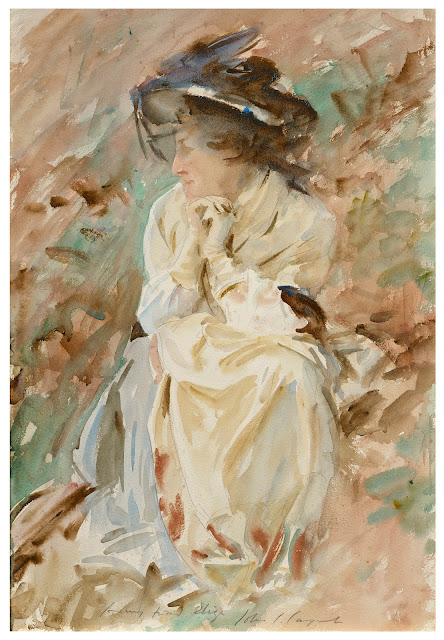
John Singer Sargent
Eliza Wedgwood, c. 1908–1909
watercolor over graphite on paper
overall: 53.34 x 36.83 cm (21 x 14 1/2 in.)
framed: 86.36 x 68.58 x 5.08 cm (34 x 27 x 2 in.)
The Hevrdejs Collection
Photo by Thomas DuBrock


John Singer Sargent
White Ships, 1908
watercolor over graphite, with gouache and wax resist, on paper
overall: 35.24 x 49.21 cm (13 7/8 x 19 3/8 in.)
framed: 61.44 x 76.68 x 4.76 cm (24 3/16 x 30 3/16 x 1 7/8 in.)
Brooklyn Museum, Purchased by Special Subscription 09.846


John Singer Sargent
Palma, Majorca, 1908
watercolor over pencil on Whatman board, with gouache
overall: 36.2 x 52.71 cm (14 1/4 x 20 3/4 in.)
framed: 65.1 x 85.4 x 2.5 cm (25 5/8 x 33 5/8 x 1 in.)
The Syndics of the Fitzwilliam Museum, University of Cambridge, 1170
© Fitzwilliam Museum, Cambridge


John Singer Sargent
Horses at Palma, Majorca, 1908
oil on canvas
unframed: 55.25 x 71.12 cm (21 3/4 x 28 in.)
framed: 73.03 x 88.27 x 5.72 cm (28 3/4 x 34 3/4 x 2 1/4 in.)
Private collector c/o MK Fine Art
Photo Credit: MK Fine Art, Inc.
Photographer Credit: CAPEHART Photography


John Singer Sargent
Gathering Blossoms, Valldemosa, Majorca, 1908
oil on canvas
framed: 100.97 x 85.73 x 8.89 cm (39 3/4 x 33 3/4 x 3 1/2 in.)
unframed: 71.76 x 56.83 cm (28 1/4 x 22 3/8 in.)
Virginia Museum of Fine Arts, Richmond, The James W. and Frances Gibson McGlothlin Collection, L2015.13.52
© Virginia Museum of Fine Arts, Photo: Katherine Wetzel


John Singer Sargent
Study of a Fig Tree, 1908
oil on canvas
framed: 73.66 x 88.9 cm (29 x 35 in.)
image: 55.88 x 71.12 cm (22 x 28 in.)
framed (inner): 54.61 x 69.69 cm (21 1/2 x 27 7/16 in.)
McMullen Museum of Art, Boston College, Carolyn A. and Peter S. Lynch Collection
Photo Credit: Courtesy Adelson Galleries, New York.
Photographer Credit: Thomas Powel Photography and scan by Prudence Cumming Fine Art Photography


John Singer Sargent
Pomegranates, Majorca, 1908
oil on canvas
overall: 72.39 x 55.88 cm (28 1/2 x 22 in.)
framed: 99.06 x 84.46 x 8.89 cm (39 x 33 1/4 x 3 1/2 in.)
Anonymous lender
Photo Credit: Courtesy Adelson Galleries, New York


John Singer Sargent
Saint with Dragon, c. 1895
watercolor over graphite on paper
overall: 43.18 x 32.39 cm (17 x 12 3/4 in.)
mat: 50.48 x 40.01 cm (19 7/8 x 15 3/4 in.)
mount: 50.8 x 40.3 cm (20 x 15 7/8 in.)
framed: 54.1 x 43.8 x 1.7 cm (21 5/16 x 17 1/4 x 11/16 in.)
Private collection
Photo Credit: Courtesy Adelson Galleries, New York
Photographer Credit: Image and scan by Prudence Cuming Fine Art Photography


John Singer Sargent
Palma, Majorca, West Front of the Cathedral, 1908
watercolor over graphite on paper
image: 53.34 x 35.56 cm (21 x 14 in.)
mat: 66.04 x 49.53 cm (26 x 19 1/2 in.)
framed: 73.66 x 57.15 cm (29 x 22 1/2 in.)
Private collection
Photo Credit: Courtesy Adelson Galleries, New York
Photographer Credit: Scan by Prudence Cuming Fine Art Photography


John Singer Sargent
Tarragona, c. 1908
watercolor over graphite, with gouache on paper mounted on board
framed: 65.41 x 50.48 x 1.27 cm (25 3/4 x 19 7/8 x 1/2 in.)
image: 49.53 x 35.24 cm (19 1/2 x 13 7/8 in.)
New Britain Museum of American Art, Grace Judd Landers Fund, 1944.02

John Singer Sargent
Astarte, 1893–1894
oil on canvas
overall: 91 x 60 cm (35 13/16 x 23 5/8 in.)
framed: 115.6 x 88.3 cm (45 1/2 x 34 3/4 in.)
Isabella Stewart Gardner Museum, Boston
© Isabella Stewart Gardner Museum