Sunday, July 28, 2024

Helen Frankenthaler: Painting on Paper, 1990–2002


Gagosian has announced Helen Frankenthaler: Painting on Paper, 1990–2002, an exhibition opening at the gallery in Rome on September 30, 2024. It features eighteen large-scale paintings on paper from the later part of Frankenthaler’s career, many of which have never before been exhibited.

Helen Frankenthaler (1928–2011) was one of the most highly regarded American artists of her time. Over her last decade of art making, painting on paper became Frankenthaler’s primary means of expression. “I’ve always worked on paper,” she noted in 1996, “but not conceived on the scale of my canvases. . . . The shift was a tremendous move for me.” The paintings in the exhibition reveal her exploration of the material and compositional possibilities of working on paper: new kinds of chromatic juxtapositions and painterly gestures, often set down on a smoother surface than canvas.

At several earlier moments in her career, Frankenthaler had added more visibly dense brushstrokes and applications of pigment to the revolutionary soak-stain technique she had pioneered in the early 1950s. This approach became a constant in her late compositions. After working directly on the floor during the first four decades of her career, she began painting on large, waist-high tabletops, a concession to her age; the turn to painting on paper also coincided with her increased activity in printmaking.

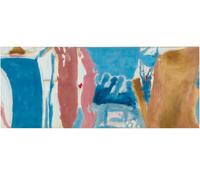
These works exhibit the range of approaches that Frankenthaler brought to painting on paper. Santa Fe XIII (1990) and New Mexico (1995)—abstractions that recall, respectively, the light-filled skies and sandy vistas of the Southwestern landscape—were inspired by her teaching residencies at the Santa Fe Art Institute in 1990 and 1991. With warm earth tones and variegated greens in layered washes, End of Summer (1995) evokes a sunlit landscape with an application that emphasizes the irregular texture of the handmade paper.

Free-flowing lines of great variety can be seen throughout these works, alternately defining contours and remaining unbounded. An untitled painting from 1994 with a bright yellow ground is defined by linear traces drawn in pastel, colored pencil, and charcoal, accentuated by washes of hot and cool hues that appear animated by elemental interactions. Another large-scale untitled work from 1996 features softly spreading areas of color resting on a linear horizontal reminiscent of her celebrated 1952 canvas, Mountains and Sea, except for the pencil grid that runs through and around the colors in the later composition.

The dark shades and layered luminosity of White Owl (2002) make it one of Frankenthaler’s most expressive later works. Others are nearly monochromatic, placing emphasis on variations in tone, application, directionality, and layering. Contentment Island (2002) is titled after the district on the Connecticut shore overlooking the Long Island Sound, where Frankenthaler had moved her home and studio in 1997. With its aqueous spread of turquoise and blues, the work recalls her observation that “On certain days, the horizon line disappears completely. The sky seems to fall into the water.” The dark purple-black palette of Port of Call (2002) suggests a nocturnal seascape, a thin stroke of radiant blue evoking a distant horizon.

A fully illustrated catalogue with an essay by curator and art historian Isabelle Dervaux accompanies the exhibition.

The exhibition in Rome is concurrent with Helen Frankenthaler: Painting without Rules at Fondazione Palazzo Strozzi, Florence, on view September 27, 2024–January 26, 2025. The largest presentation of works by Frankenthaler ever mounted in Italy, it features thirty paintings that survey the artist’s oeuvre, together with paintings and sculptures by contemporaries from her circle, highlighting the reciprocal influences and synergies between these artists.

This fall, Gagosian, in collaboration with the Helen Frankenthaler Foundation, will publish John Elderfield’s revised and expanded edition of Frankenthaler, his definitive monograph on the artist initially published in 1989. Extensively updated to cover the entirety of the artist’s career, it features more than three hundred full-color reproductions of her paintings, works on paper, prints, and sculpture, including many that have never before been published in color, along with over a hundred comparative illustrations and documentary photographs.


  •  
    Helen Frankenthaler
    Untitled, 1996
    Acrylic and charcoal on paper

    40 1/4 x 60 1/8 inches
    102.2 x 152.7 cm
    Photo: Maris Hutchinson
    © 2024 Helen Frankenthaler Foundation, Inc. / Artists Rights Society (ARS), New York

  •  
    Helen Frankenthaler
    End of Summer, 1995
    Acrylic on paper

    78 x 78 inches
    198.1 x 198.1 cm
    Photo: Maris Hutchinson
    © 2024 Helen Frankenthaler Foundation, Inc. / Artists Rights Society (ARS), New York
  •  
    Helen Frankenthaler
    New Mexico, 1995
    Acrylic on paper

    40 x 60 inches
    101.6 x 152.4 cm

    Photo: Maris Hutchinson
    © 2024 Helen Frankenthaler Foundation, Inc. / Artists Rights Society (ARS), New York

  •  
    Helen Frankenthaler
    Contentment Island, 2002
    Acrylic on paper

    74 1/8 x 60 1/8 inches
    188.3 x 152.7 cm
    Photo: Maris Hutchinson
    © 2024 Helen Frankenthaler Foundation, Inc. / Artists Rights Society (ARS), New York

  •  
    Helen Frankenthaler
    Santa Fe XIII, 1990
    Acrylic on paper

    29 1/2 x 41 1/4 inches
    74.9 x 104.8 cm
    Photo: Maris Hutchinson
    © 2024 Helen Frankenthaler Foundation, Inc. / Artists Rights Society (ARS), New York

  •  
    Helen Frankenthaler
    Untitled, 1997
    Acrylic on paper

    30 1/4 x 36 inches
    76.8 x 91.4 cm
    Photo: Maris Hutchinson
    © 2024 Helen Frankenthaler Foundation, Inc. / Artists Rights Society (ARS), New York

Helen Frankenthaler Painting without Rules


Palazzo Strozzi

27 September 2024 - 26 January 2025


Palazzo Strozzi presents Helen Frankenthaler: Painting without Rules, an ambitious presentation of the poetic abstractions of one of the most significant American artists of the twentieth century whose work has rarely been exhibited at such scale in Italy.

This survey examines Helen Frankenthaler’s artistic affinities, influences, and friendships by interweaving paintings created between 1953 and 2002 with select works by some of her contemporaries—including Anthony Caro, Morris Louis, Robert Motherwell, Kenneth Noland, Jackson Pollock, Mark Rothko, David Smith, and Anne Truitt. In addition to loans from the Helen Frankenthaler Foundation, international museums, and private collections, the exhibition also features works by her peers that were part of the artist’s personal collection.

Celebrated among the second generation of postwar American abstract painters, Frankenthaler (1928–2011) played a pivotal role in the transition from Abstract Expressionism to Color Field painting. Active for more than six decades, Frankenthaler emerged on the American art scene with a no-rules approach to painting, protean imagination, and improvisational skills that reshaped the narrative, not only for women artists, but for the genre itself. With her innovative soak-stain technique, Frankenthaler explored a new relationship between color and form, expanding the potential of abstract painting in ways that continue to inspire artists today.

Working with color and space, abstraction and poetry, Frankenthaler distinguished herself through her unique ability to combine technique and imagination, research and improvisation, expanding her practice beyond established canons in the pursuit of a new freedom in painting.

The exhibition is co-organized by Fondazione Palazzo Strozzi, Florence, and the Helen Frankenthaler Foundation, New York, and is curated by Douglas Dreishpoon, Director, Helen Frankenthaler Catalogue Raisonné.

Helen Frankenthaler, Open Wall (det.), 1953 © 2023 Helen Frankenthaler Foundation, Inc. / Artists Rights Society (ARS), New York / SIAE, Rome


Thursday, July 25, 2024

How Rembrandt combined special pigments for golden details of The Night Watch

Chemists at the Rijksmuseum and the University of Amsterdam (UvA) have for the first time established how Rembrandt applied special arsenic sulfide pigments to create a ‘golden’ paint. Using sophisticated spectroscopic techniques they were able to map the presence of pararealgar (yellow) and semi-amorphous pararealgar (orange/red) pigments in a striking detail of his famous work The Night Watch. Corroborated by study of related historical sources, they conclude that Rembrandt intentionally combined these particular arsenic sulfide pigments with other pigments to create the golden luster.

The discovery was published recently in research paper in the scientific journal Heritage Science, by Fréderique Broers and Nouchka de Keyser, PhD candidates at the UvA’s Van ‘t Hoff Institute for Molecular Sciences and researchers at the Rijksmuseum. They conclude that Rembrandt used the rather unusual combination of pigments to depict the golden threading in the doublet sleeves and embroidered buff coat worn by Lieutenant Willem van Ruytenburch. He is the right of the two central figures at the front of the shooting company tableau, accompanying Captain Frans Banninck Cocq.

Unusual pigments

The discovery of the arsenic sulfide pigments took place in the large-scale research project Operation Night Watch which started in 2019 and continues to deliver striking results. A full X-ray fluorescence (MA-XRF) scan of the painting had already revealed the presence of arsenic and sulfur in parts of Van Ruytenburch’s clothing. It led the researchers to assume the presence of the well-known arsenic sulfide pigments orpiment (yellow) and realgar (red). A detailed study of two tiny paint samples taken from the painting showed otherwise. High-tech analysis combining light microscopy with micro-Raman spectroscopy, electron microscopy and X-ray powder diffraction revealed the presence of the more unusual arsenic sulfide components pararealgar (yellow) and semi-amorphous pararealgar (orange-red).

Cross section of paint sample SK-C-5_017 as seen through a light microscope. It shows various crystals of yellow, orange and red pigments of which the precise composition was established using a combination of electron microscopy, Raman spectroscopy, and X-ray powder diffraction. Image courtesy of the Rijksmuseum.

Deliberate use

The presence of pararealgar in historical paintings is often explained by the ageing of realgar. However, because pararealgar is homogeneously distributed with the semi-amorphous pararealgar, and the paint looks unaltered, the researchers arrive at a different explanation. They argue that Rembrandt deliberately chose to use these pigments in his effort to imitate the golden details of Van Ruytenburch’s clothing. Heating yellow pararealgar pigment results in formation of the reddish semi-amorphous pararealgar. This was then combined with lead–tin yellow and vermilion (red mercury sulfide) pigments to create the golden luster.

This chemical explanation was supported by a comprehensive review of historical sources reporting on the use of arsenic sulfide pigments. It seems that in seventeenth-century Amsterdam a broader range of arsenic pigments were available than previously thought. These probably arrived through known trade routes from Germany/Austria and Venice to Amsterdam. This is further supported by the reported use of a very similar mixture of pigments by Willem Kalf (1619–1693), a contemporary of Rembrandt in Amsterdam. The researchers therefore conclude that Rembrandt intentionally used pararealgar and semi-amorphous pararealgar, together with lead–tin yellow and vermilion, to create the special orange-‘golden’ paint.

Paper details

Nouchka De Keyser, Fréderique T. H. Broers, Frederik Vanmeert, Annelies van Loon, Francesca Gabrieli, Steven De Meyer, Arthur Gestels, Victor Gonzalez, Erma Hermens, Petria Noble, Florian Meirer, Koen Janssens & Katrien Keune: Discovery of pararealgar and semi-amorphous pararealgar in Rembrandt's The Night Watch: analytical study and historical contextualization. Heritage Science (2024) 12:237 DOI: 10.1186/s40494-024-01350-x

Wednesday, July 24, 2024

EGON SCHIELE: LIVING LANDSCAPES


Neue Galerie 
October 17, 2024
 - January 13, 2025

“Egon Schiele: Living Landscapes” will investigate the importance of landscape in the Austrian artist’s work. Plants, natural environments, and townscapes determine the spaces Egon Schiele created in his paintings, and they also reflect the rich symbolism he employed that is centered around the human condition. In particular, plants are often endowed with an allegorical meaning. Flowers and trees assume the role of portrait subjects and convey an almost human appearance. Schiele’s landscapes always represent more than their apparent subject matter. His portrayal of nature and his rendering of towns and trees epitomize the life cycle and the human condition. 

Schiele is arguably best known for his portraits, but he was also a gifted landscape painter. Even while a child, Schiele was a keen recorder of nature. As an adult, the Expressionist artist frequently sought escape from the pressures of life in Vienna, and found relief in rural surroundings. Beginning in the summer of 1910, Schiele made several trips to Krumau (today Česky Krumlov, Czech Republic), his mother’s birthplace in Bohemia on the Moldau River (now Vlatva River). Schiele gravitated toward highpoints on the outskirts of town where he could look down and have a bird’s-eye-view of the city and its inhabitants. 


Egon Schiele 
Town among the Greenery (The Old City III), 1917
Oil on canvas
Neue Galerie New York, in memory of Otto and Marguerite Manley,
given as a bequest from the Estate of Marguerite Manle

His rapturous painting, Town among Greenery (The Old City III), one of the masterworks presented in the exhibition, is depicted from such a vantage point. While the exact location of this scene is unclear, it most likely represents an imaginative and composite creation based upon Schiele’s study of Krumau and its environs. Here, the city is sandwiched between dense and verdant clusters of trees. Uncharacteristically, Schiele has even populated the vibrantly hued streets with figures immersed in the details of daily life. Krumau, a picturesque medieval town with distinctive interlocking buildings and historic structures captivated him. He also collected postcards of Krumau, which became a part of his creative process. 

On occasion, Schiele shifted his lens from a macro to a micro view, and focused his attention on singular plants and trees. Sunflowers were among his favorite motifs. He painted them in all stages of life — in full bloom to brown and withering. It is easy to imagine that his intention was to imbue these flowers with anthropomorphic characteristics. Schiele may well have been inspired by the example of Vincent van Gogh, whose work was shown in Vienna during Schiele’s lifetime, including in both 1906 and 1909. 

Schiele also found resonance in emotive portraits of trees. Such pictures capture the desolate quality of late autumn, especially his series of spindly and seemingly lifeless trees. Schiele offered his personal impression of this shift between seasons: “I often cried with half-opened eyes when autumn came.” Such words are even more poignant given that Schiele died on October 31, 1918, just days after his pregnant wife Edith passed away herself. They were both victims of the influenza pandemic.

Schiele’s landscapes are imbued with an existential message about the human condition. The hope and promise of spring and summer give way to decay and death before the cycle renews again. Hence, these luminous paintings are emblematic of life itself and carry universal implications.

"Egon Schiele: Living Landscapes" is organized by Neue Galerie New York. This exhibition is curated by Christian Bauer.

Friday, July 19, 2024

Dalí: Disruption and Devotion

Museum of Fine Arts, Boston (MFA)

July 6 through December 1, 2024


A surrealist painting of floating fish, melted clocks, broken tree branches, bullet-like objects, and a mountain range.

Salvador Dalí, The Disintegration of the Persistence of Memory (detail), 1952–54. Oil on canvas. Collection of the Dalí Museum. Gift of A. Reynolds and Eleanor Morse. © 2024 Salvador Dalí, Fundació Gala-Salvador Dalí, Artists Rights Society.

The outlandish and iconoclastic artist Salvador Dalí (1904–1989) is famous for his bizarre imagery, eccentric behavior and unparalleled technical skill. The renowned Surrealist was also, however, deeply rooted in tradition. He revered his artistic predecessors—among them Dürer, Raphael, El Greco, Vermeer and above all Velázquez. 

Opening this summer, the first-ever exhibition of work by Dalí at the Museum of Fine Arts, Boston (MFA) examines this sustained engagement with European art of the past. Dalí: Disruption and Devotion presents nearly 30 paintings and works on paper on loan from the Salvador Dalí Museum in St. Petersburg, Florida, as well as books and prints from a private collection, which are shown alongside works from the MFA’s European collection made by artists who inspired him. The unique juxtapositions, presented in both pairings and small thematic groupings, offer a new take on one of the most celebrated artists of the 20th century.

Dalí spent his youth in the small Spanish town of Figueres, north of Barcelona near the Catalan coast. His artistic talent was noticed early on, and at 18, he enrolled at Madrid’s San Fernando Royal Academy of Fine Arts. On a trip to Paris in 1929, Dalí connected with the Surrealist group through another Catalan artist, Joan Miró. In the words of the group’s leader, André Breton, Surrealism aimed to “resolve the previously contradictory conditions of dream and reality into an absolute reality, a super-reality.” The unconscious mind was first explored in literature, but the movement soon expanded to the visual arts, with Dalí a highly visible member of the circle.

“The Surrealist movement, announced by André Breton in 1924, is 100 years old. The MFA’s exhibition, using superb loans from the Salvador Dalí Museum in St. Petersburg, Florida, offers a timely opportunity to reconsider the most famous Surrealist in terms of the historical artists he deeply admired,” said Frederick Ilchman, Chair and Mrs. Russell W. Baker Curator of Paintings, Art of Europe.

Dalí: Disruption and Devotion showcases a broad range of Dalí’s best-known works, in terms of subject matter, chronology and scale. Highlights include:

  • The Disintegration of the Persistence of Memory (1952–54), a reworking of Dalí’s single most famous picture, painted two decades earlier, which shows his preoccupation with the elasticity of time
  • The 10-foot-tall Ecumenical Council (1960), which includes art historical references, religious themes, elements from earlier works and a hyper-realistic self-portrait in the lower left corner
  • Velázquez Painting the Infanta Marguerita with the Lights and Shadows of His Own Glory (1958), paired with Velázquez’s Infanta Maria Theresa (1653) to demonstrate Dalí’s deep reverence for the 17th-century Spanish painter
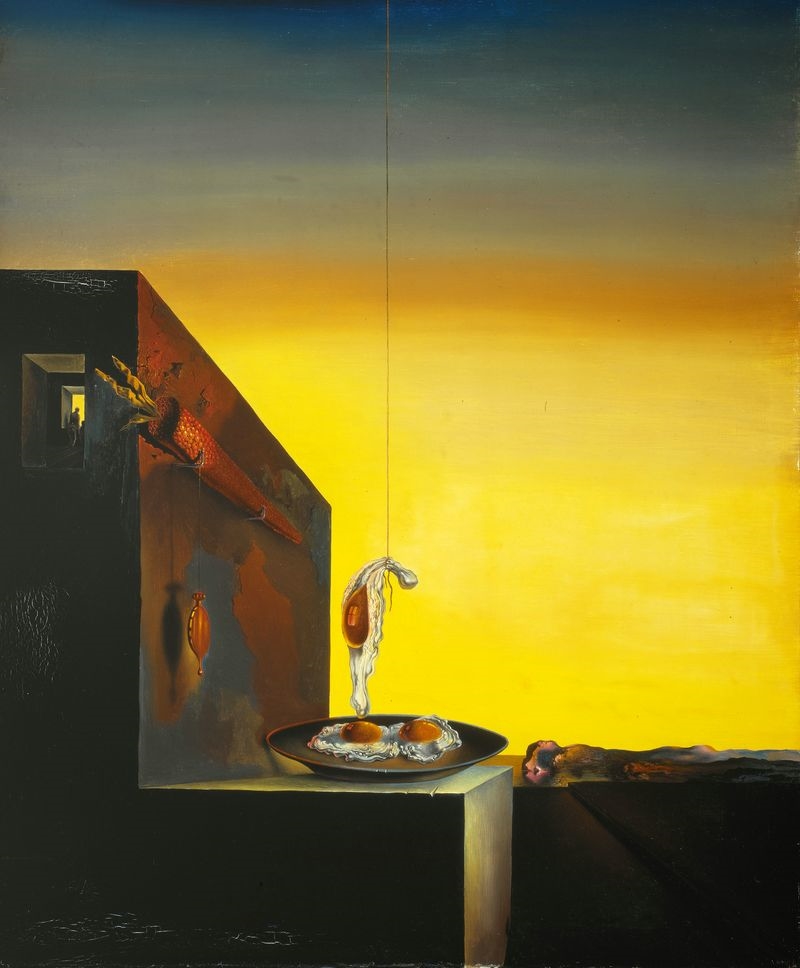
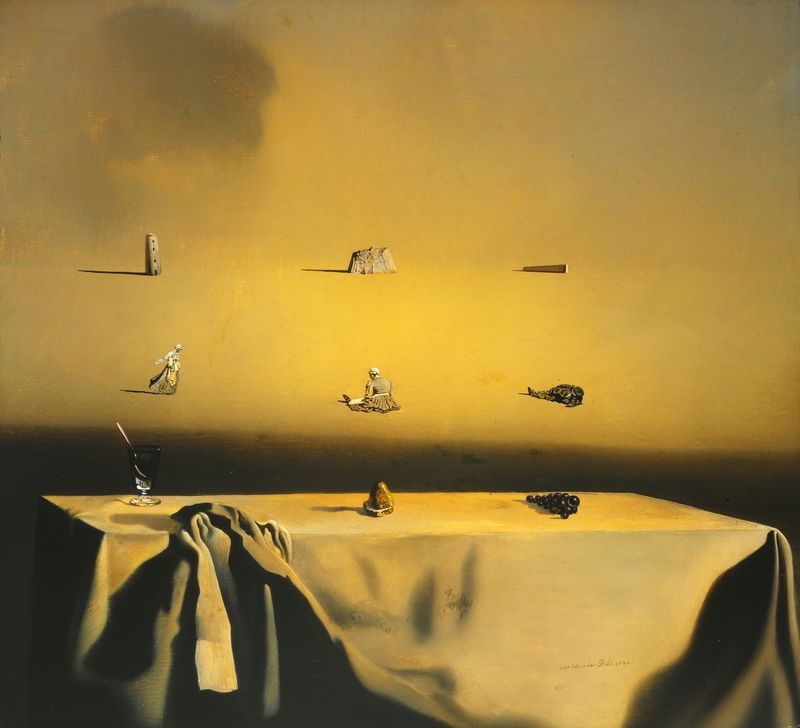
  • Morphological Echo (1936) and Nature Morte Vivante (Still Life-Fast Moving) (1956), examples of how Dalí distorted and riffed upon 17th-century Dutch and Flemish still lifes
  • Four of Dalí’s reinterpretations of Francisco Goya’s Los Caprichos (1799), one of the greatest print series of European art, which include detailed embellishments and revised captions, shown facing Goya’s original etchings
  • Sainte Hélène à Port Lligat (1956), presenting Dalí’s wife and muse Gala in the guise of Roman Emperor Constantine’s mother Saint Helena, which is paired with El Greco’s Saint Dominic in Prayer (about 1605) to show both artists meditating on solitude and the power of spiritual experience


Old Age, Adolescence, Infancy (The Three Ages), 1940

Salvador Dalí (Spanish, 1904–1989)

Oil on canvas

* Collection of The Dalí Museum, St. Petersburg, FL (USA); Gift of A. Reynolds & Eleanor Morse

* Courtesy Museum of Fine Arts, Boston


Infanta Maria Theresa, 1653

Diego Rodríguez de Silva y Velázquez (Spanish, 1599–1660)

Oil on canvas

* Gift of Charlotte Nichols Greene in memory of her father and mother, Mr. and Mrs. Howard Nichols

* Photograph © Museum of Fine Arts, Boston


Velázquez Painting the Infanta Marguerita with the Lights and Shadows of His Own Glory, 1958

Salvador Dalí (Spanish, 1904–1989)

Oil on canvas

* Collection of The Dalí Museum, St. Petersburg, FL (USA); Gift of A. Reynolds & Eleanor Morse

* Courtesy Museum of Fine Arts, Boston


Shades of Night Descending, 1931

Salvador Dalí (Spanish, 1904–1989)

Oil on canvas

* Collection of The Dalí Museum, St. Petersburg, FL (USA); Gift of A. Reynolds & Eleanor Morse

* © 2024 Salvador Dalí, Fundació Gala-Salvador Dalí, Artists Rights Society

* Courtesy Museum of Fine Arts, Boston


Nature Morte Vivante (Still LifeFast Moving), 1956

Salvador Dalí (Spanish, 1904–1989)

Oil on canvas

* Collection of The Dalí Museum, St. Petersburg, FL (USA); Gift of A. Reynolds & Eleanor Morse

* © 2024 Salvador Dalí, Fundació Gala-Salvador Dalí, Artists Rights Society

* Photo © Daniel Portnoy, 2023

* Courtesy Museum of Fine Arts, Boston


Oeufs sur le Plat sans le Plat, 1932

Salvador Dalí (Spanish, 1904–1989)

Oil on canvas

* Collection of The Dalí Museum, St. Petersburg, FL (USA); Gift of A. Reynolds & Eleanor Morse

* © 2024 Salvador Dalí, Fundació Gala-Salvador Dalí, Artists Rights Society

* Photo © David Deranian, 2021 |

* Courtesy Museum of Fine Arts, Boston


The Ecumenical Council, 1960

Salvador Dalí (Spanish, 1904–1989)

Oil on canvas

* Collection of The Dalí Museum, St. Petersburg, FL (USA); Gift of A. Reynolds & Eleanor Morse

* © 2024 Salvador Dalí, Fundació Gala-Salvador Dalí, Artists Rights Society

* Photo © Doug Sperling and David Deranian, 2021 |

* Courtesy Museum of Fine Arts, Boston


Morphological Echo, 1936

Salvador Dalí (Spanish, 1904–1989)

Oil on wood panel

* Collection of The Dalí Museum, St. Petersburg, FL (USA); Gift of A. Reynolds & Eleanor Morse

* © 2024 Salvador Dalí, Fundació Gala-Salvador Dalí, Artists Rights Society

* Courtesy Museum of Fine Arts, Boston


Saturday, July 13, 2024

WILLIAM BLAKE’S UNIVERSE

Hamburger Kunsthalle

14 June to 8 September 2024


The Hamburger Kunsthalle is devoting a large-scale exhibition to the astonishing oeuvre of the English draughtsman, printmaker and poet William Blake (1757–1827). Blake worked in the years around 1800 against the backdrop of revolution and war in Europe, slavery in the European colonies, and oppression in his native Great Britain. His works express his critique of his world while at the same time conjuring a vision of universal redemption. Both his mystical imagery and grim literary works continue to be emulated even in today’s pop culture, even though his oeuvre is still little-known outside of England. The exhibition, featuring around 90 of Blake’s works on paper, sets the artist in the context of his European contemporaries, so that a total of 170 exhibits are on view. Even though Blake never left Great Britain, the show reveals him to have been a genuine European, giving it special pertinence for our present-day world. Nearly 50 years after the first William Blake show at the Hamburger Kunsthalle, curated by David Bindman in 1975, this is now the second museum exhibition ever of Blake’s work in Germany. It is at the same time the first public presentation of the entire Blake collection of the Fitzwilliam Museum in Cambridge together with the bequest of the well-known Blake collector Geoffrey Keynes.


In three chapters – Past, Present, Future – WILLIAM BLAKE’S UNIVERSE introduces definitive aspects of Blake’s art, from his training at the Royal Academy of Arts in London, to his engagement with antiquity and the Renaissance, and onward to his enthusiasm for the mystical imagery of the early modern period. The »universe« in the title refers to the worlds that Blake created in his visionary imagination but also to the larger intellectual and artistic cosmos to which his ideas and imagery belong. He was not personally acquainted with his German contemporaries Philipp Otto Runge (1777–1810) and Caspar David Friedrich (1774–1840), and perhaps had not even heard of them, but even during his lifetime, comparisons were already being drawn between his work and the German art of the period. Like Blake, both Runge and Friedrich were faced with the devastating political crises of their time and turned to visual art to rebuild the world. The Romantic artist Runge strove like Blake to visualise the spiritual renewal of humanity in a novel artistic form. Blake’s depictions of the soul’s journey from the fall of man to redemption are also compared to works by Friedrich and other contemporaries such as Blake’s younger compatriot Samuel Palmer (1805–1881), illustrating the artistic tensions that prevailed around 1800 between personal, national and universal liberation.


An extensive catalogue (380 pages, Hatje Cantz Verlag) is available for 39 euros in the museum shop or at www.freunde-der-kunsthalle.de at the bookstore price of 54 euros. The Hamburger Kunsthalle app offers audio tours for adults in German and English and for children and young people aged 8 and over in German. An animated film in the exhibition as well as a short film place William Blake in the context of his time. In addition, an accompanying publication in the form of a graphic novel by Noëlle Kröger recounts the life of William Blake (in German and English / free for visitors to take with them).


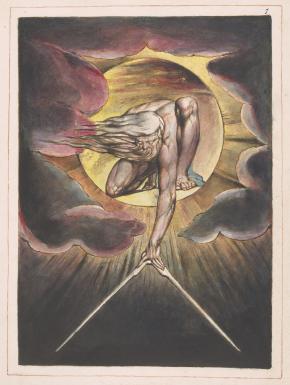
WILLIAM BLAKE (1757–1827)
Europa, eine Prophezeiung, Frontispiz – Urizen (Europe a Prophecy, frontispice – Urizen), 1794
Relief- und Weißlinienradierung, koloriert, 30,3 x 23,1 cm
The Fitzwilliam Museum, Cambridge
© The Fitzwilliam Museum, University of Cambridge
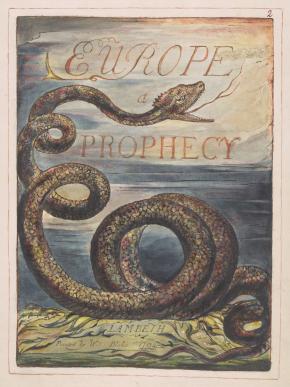
WILLIAM BLAKE (1757–1827)
Europa, eine Prophezeiung, Titelseite (Europe a Prophecy, title page), 1794
Relief- und Weißlinienradierung, koloriert, 30,3 x 23,1 cm
The Fitzwilliam Museum, Cambridge
© The Fitzwilliam Museum, University of Cambridge
WILLIAM BLAKE (1757–1827)
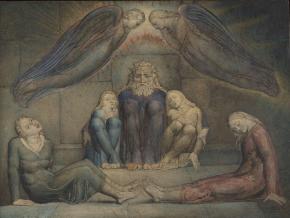
Ugolino und seine Söhne im Gefängnis (Ugolino and his Sons in prison), 1826
Tempera-Malerei, 33 x 44 cm
The Fitzwilliam Museum, Cambridge
© The Fitzwilliam Museum, University of Cambridge
JOHN LINNELL (1792–1882)
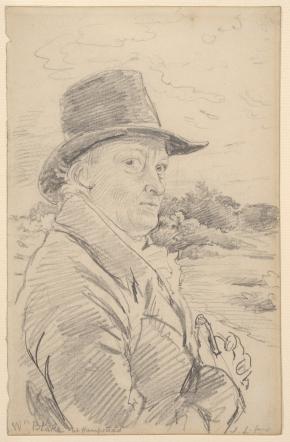
Porträt William Blakes in Hampstead (Portrait of William Blake at Hampstead), ca. 1820
Graphit, 17,9 x 11,5 cm
The Fitzwilliam Museum, Cambridge
© The Fitzwilliam Museum, University of Cambridge
CATHERINE BLAKE (1762–1831)
Wahrscheinlich posthumes Porträt von William Blake als junger Mann (Probably posthumous portrait of William Blake as a young man), um 1830 (?)
Graphit, 155 x 104 mm
The Fitzwilliam Museum, Cambridge
© The Fitzwilliam Museum, University of Cambridge

WILLIAM BLAKE (1757–1827)
Albion erhebt sich (Glücklicher Tag oder Der 


Monday, July 1, 2024

Gauguin's World: Tōna Iho, Tōna Ao


From 29 June until 7 October 2024


Trace the trajectory of Paul Gauguin’s distinctive work, from impressionist beginnings to Polynesian visions.


Paul Gauguin, Te faaturuma (The brooding woman), 1891. Oil on canvas, 91.1 × 68.7 cm. Worcester Art Museum. Museum Purchase, 1921.186.

Paul Gauguin, Still life with Hope, 1901. Private collection, Milan © Paolo Vandrasch.

PUBLICATION

Gauguin’s World: Tōna Iho, Tōna Ao inspires new ways of seeing and thinking about one of the most renowned artists of the nineteenth century. Revisiting Paul Gauguin at a particular moment in his life, when he was approaching death, looking back on scattered memories from his final resting place in the Marquesas Islands, Gauguin’s World: Tōna Iho, Tōna Ao deepens our understanding of one of the most polarising artists of his time and ours.

This magnificent and authoritative publication, edited by the internationally esteemed scholar of nineteenth century French art, Henri Loyrette, traces Gauguin’s physical, spiritual and artistic journey as he travelled first to Denmark, Brittany and Provence, then to Martinique, Tahiti and finally the Marquesas Islands in Polynesia. Tracing Gauguin’s path as he sought increasingly remote locations to live and work, Loyrette explains how Gauguin ‘believed in a real correspondence between man and the world around him’. Thoughtful, wide-ranging perspectives on Gauguin’s life and practice by Nicholas Thomas, Vaiana Giraud, Norma Broude and Miriama Bono, with particular focus on Gauguin’s time in the Pacific, illuminate the artist in all his human and artistic complexity.

Featuring more than 150 colour reproductions, this publication is the first to explore Gauguin’s inner journey and quest to develop his own identity, surveying his practice from its impressionist beginnings and symbolist leanings to his Polynesian periods.