Thursday, August 2, 2012

Edward Hopper's Greatest Works at the Whitney


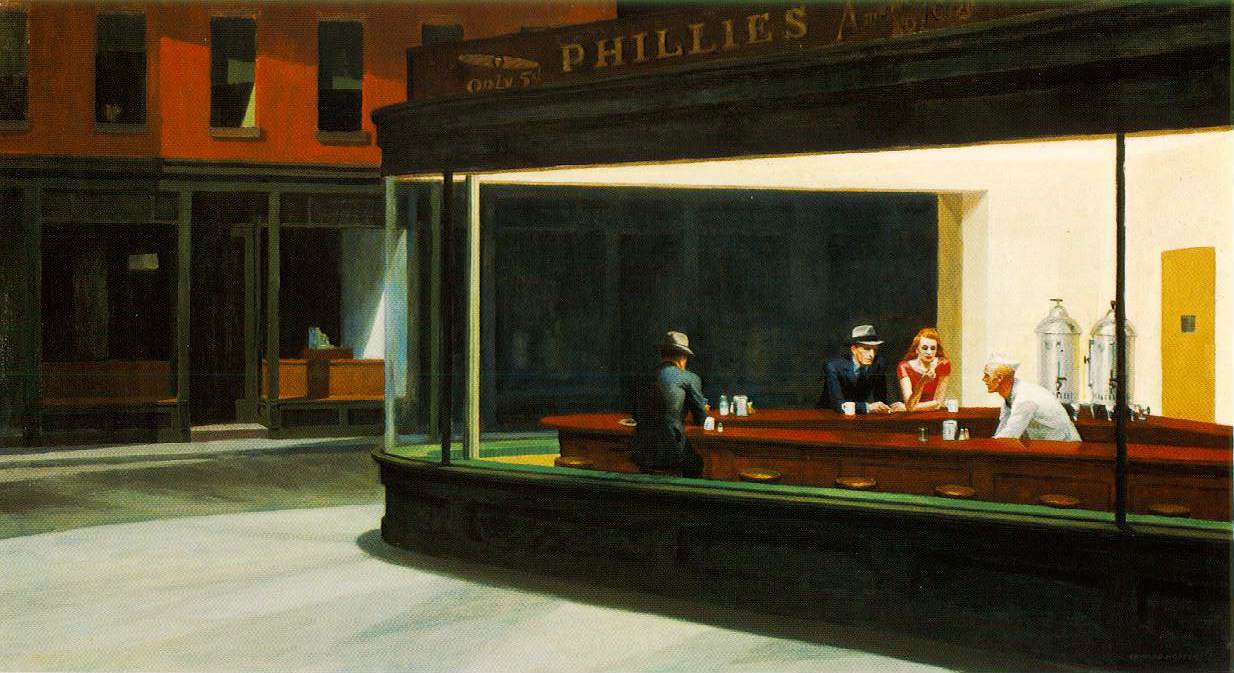
In celebration of its 75th anniversary, the Whitney Museum devoted its entire fifth floor of the museum is devoted to the art of Edward Hopper (1882-1967), the artist most closely identified with the Whitney, which is home to the most extensive holdings of his work in the world.

On view were not only the Whitney’s most iconic Hopper paintings


(Seven A.M.,


Second Story Sunlight,


A Woman in the Sun
, and many more), but also an extraordinary selection of drawings and sketches made in preparation for these works. The Whitney’s holdings include more than 2,500 paintings, watercolors, drawings, prints, and illustrated journals, which offer an unparalleled opportunity to see into the artist’s creative processes and study his work in depth. In addition to the Whitney’s holdings, major works from other institutions have been borrowed for this installation in order that they may be seen with their corresponding preparatory works.

Over the course of the six-month installation, such masterworks as


Nighthawks (from the Art Institute of Chicago),


Hotel Lobby (Indianapolis Museum of Art),


Morning in the City (Williams College Museum of Art),


Cape Cod Evening (National Gallery),


Office at Night (Walker Art Center),


Hotel Window (from a private collection),


and New York Movie (MoMA)
rotated into view along with Hopper’s related drawings, studies, and ledger entries from the Whitney’s collection.

The definition of an American original, Hopper created unforgettable images that extraordinary manipulation of space and light, Hopper’s works hover between the theatrical and the strangely familiar. His scenes of everyday life are imbued with an understated dramatic force. In an essay in London’s Telegraph, the writer Alain de Botton discussed the enduring fascination of Hopper’s art: “We may, in contact with it, feel as if we had been carried back to some important place in ourselves, a place of stillness and sadness, of seriousness and authenticity: it can help us to remember ourselves.”

Whistler & Rebellion in the Art World Opens August 4, 2012


Only an artist as talented as James Abbot McNeill Whistler could get away with his rebellious persona. Deliberately provocative and controversy-seeking, Whistler maintained a contentious stance toward other artists, critics, academics, viewers, and patrons. His legacy, on the other hand, speaks for his immense ability to create exquisite works of art. Carnegie Museum of Art engaged Whistler shortly after its foundation in 1895; he served on several advisory boards for Carnegie International exhibitions between 1897 and 1903. Between 1896 and 1907 (posthumously), Whistler exhibited 12 works of art at Carnegie Internationals. The museum holds a substantial collection of Whistler's prints, which have not been on view since 1998. Organized by associate curator of fine arts Amanda Zehnder, Whistler & Rebellion in the Art World draws upon the museum's collection to explore Whistler's flamboyant defiance of artistic conventions, and his insistence on the importance of "art for art's sake."

At the core of his disputes with critics was Whistler's assertion of a pure aesthetic experience, removed from moral lessons and context. To Whistler, only beauty, form, tone, color, and line mattered. According to Zehnder, "This exhibition showcases Whistler's beautiful etchings, lithographs, and paintings as he intended them to be seen-as aesthetic objects to be appreciated solely for their visual qualities, and not primarily for their subject matter." His most radical works approached abstraction, and his critical voice and philosophies about the function of art paved the way for later abstract art movements. His book, The Gentle Art of Making Enemies, allows a peek at his forceful debates with and jabs at critics and other intellectuals, which surprise museum-goers today given what we've come to view as the graceful, delicate appearance of his art. Whistler's standoff with the art world of his day came to a head in 1878 when he sued academic artist John Ruskin over a scathing critical review of one of Whistler's paintings.

"Art should be independent of all clap-trap - should stand alone, and appeal to the artistic sense of eye or ear, without confounding this with emotions entirely foreign to it, as devotion, pity, love, patriotism, and the like. All these have no kind of concern with it and that is why I insist on calling my works 'arrangements' and 'harmonies.'"
-Whistler (The Gentle Art of Making Enemies, 1890)

Whistler & Rebellion in the Art World includes a Ruskin watercolor to demonstrate the striking similarities in the aesthetic sensibilities of both artists, despite the very different foundations from which they arose. The Ruskin row boiled down to a philosophical, rather than aesthetic conflict: for Ruskin, art exists to uplift and morally influence the viewer; for Whistler, art must be beautiful, nothing more. The weight of Whistler's radical ideas would shape later artists dramatically, even though, to modern eyes, his artworks no longer seem controversial. With around 90 prints on view, the exhibition displays Whistler's immense ability in both etching and lithography.


The exhibition will also include the museum's important full-length painted portrait Arrangement in Black: Portrait of Señor Pablo de Sarasate (1884). And, it will be augmented by excerpted quotations chosen by Zehnder to reveal Whistler's motivations, philosophies, and disputes. "Whistler's personality was towering," Zehnder remarks. "He was one of the most famously witty aesthetes and simultaneously difficult artists of his era. Understanding his elegant and often delicate art work in relation to his contentious personality will be part of the fun of this exhibition."

More Images:


James Abbott McNeill Whistler, American, 1834–1903; Nocturne, the River at Battersea, 1878, lithotint with scraping on laid paper, mounted on wove paper; Carnegie Museum of Art, Bequest of Charles J. Rosenbloom


James Abbott McNeill Whistler, American, 1834–1903; Nocturne, 1879–1880, from the series Venice, a Series of Twelve Etchings (the “First Venice Set”), etching and drypoint on laid paper; Carnegie Museum of Art, Bequest of Charles J. Rosenbloom


James Abbott McNeill Whistler, American, 1834–1903; The Dyer, 1879–1880, etching and drypoint on laid paper; Carnegie Museum of Art, Bequest of Charles J. Rosenbloom


James Abbott McNeill Whistler, American, 1834–1903; The Thames, 1896, lithotint with scraping on wove paper mounted on wove paper; Carnegie Museum of Art, Purchase


Monday, July 30, 2012

Winslow Homer's Depictions of Maritime Catastrophe and Rescue


Shipwreck! Winslow Homer and “The Life Line” The Philadelphia Museum of Art September 22–December 16, 2012

While living in a tiny fishing village in England in 1881-82, the American artist Winslow Homer was profoundly moved by the sight of a shipwreck that would focus his imagination on the power and peril of the sea.


His art took on a new seriousness and drama, demonstrated in a major painting made soon after his return to the United States: The Life Line (1884),one of his greatest popular and critical successes. A masterpiece owned by the Philadelphia Museum of Art for almost 90 years, The Life Line is the centerpiece of an exhibition about the making and meaning of an iconic American image of rescue at sea.

Celebrating modern heroism and the thrill of unexpected intimacy between strangers thrown together by disaster, Shipwreck! Winslow Homer and “The Life Line” contains works by Homer complemented by a range of precedents in the shipwreck and rescue genre including paintings, watercolors, etchings, engravings, sketches and ceramics ranging in date from the mid-17th to the early 20th centuries. The Philadelphia Museum of Art will be the only venue for this important exhibition, which includes fragile and rarely seen watercolors, prints, and drawings.

“The Museum contains one of this nation’s greatest collections of American art and many of our finest exhibitions are inspired by it,” notes Timothy Rub, The George D. Widener Director and Chief Executive Officer. “We are delighted to focus on Homer’s The Life Line in this important exhibition, as it places a major artistic milestone in an illuminating context within the traditions of marine painting and American art and history.”

The exhibition explores the related themes of the exhilaration of ocean travel, disaster on the high seas, and romantic rescue, while examining the creative contributions of one of this country’s greatest artists to the rich tradition of marine painting.

The opening gallery introduces the importance of ocean travel to the Eastern seaboard of the United States and its significance to Boston-born Homer, and includes the watercolor Clear Sailing (c. 1880; Philadelphia Museum of Art). Typical of Homer’s lighthearted work from this period, the painting shows children watching white-sailed boats on a calm and sun-drenched harbor.

The next section takes on a darker tone, surveying the theme of shipwreck during the first great age of marine painting from the 17th through the 19th centuries. The aftermath of a shipwreck for those waiting onshore follows, with works based on Homer’s experience in the English village of Cullercoats, on the North Sea in 1881–2, where he witnessed the wreck of the Iron Crown.

Other sections look at the theme of the romantic rescue of the helpless damsel, while “Heroes of the Coastline: The Rise of the Unites States Life Saving Service” examines the real life historical context of these rescue scenes. ”Heroes of the Coastline” also tells the story of the spectacularly successful reform of the shoddy American coastal defenses, beginning with the establishment of the United States Life Saving Service in 1871, followed by the integration of new technology and the employment of trained personnel.

Against this backdrop of tradition and recent innovation, Homer created a painting of startling modernity and old-fashioned romance. A full section of the exhibition is dedicated to the making of The Life Line, including preparatory drawings and etchings that suggest changes the artist made before arriving at the final image. These alterations, seen in revisions visible on the surface of the painting and in recent X-radiographs and infrared photographs, demonstrate Homer’s wish to focus the composition on the figure of the woman by obscuring the visage of his hero and tempering the erotic narrative of intertwined figures to suit the buttoned-up morals of the Victorian period. A section containing a small group of prints and paintings made by Homer after 1884 introduces his late marine paintings, with their themes of anxiety, struggle, and stoicism in the face of nature.


Human narratives receded as more abstract treatments of elemental conflict—land, sea, and sky—came to dominate the last two decades of the artist’s career, represented by paintings such as Winter Coast, 1890 (Philadelphia Museum of Art), a study in the eternal battle of majestic natural forces.

When The Life Line was first exhibited at the National Academy of Design in New York in 1884 it became an instant sensation. Demonstrating a recent innovation in life saving technology, the breeches buoy, Homer’s painting is at once realistic and romantic, demure and suggestive. The drama of the roiling seas and realism of the breeches buoy is softened by the form of a voluptuous woman, her soaked dress clinging to her curves, being ferried to safety by an anonymous rescuer whose face is obscured by the woman’s red scarf blowing in the gale.

“Homer was at the peak of his powers when he painted The Life Line , which has never before been the subject of intensive study. It was one of the triumphs of his career, and it has remained one of his best-known paintings. This exhibition will explore how The Life Line was made, how it was understood in its own day, and why it has become such an icon of American art,” said Kathleen Foster, the Robert L. McNeil, Jr. Curator of American Art. “By placing The Life Line in the context of Homer’s work and alongside popular images of rescue at sea published by the likes of Currier & Ives, we can see how Homer drew from both old and new sources to create a strikingly modern image.”

About the catalogue: The Philadelphia Museum of Art, in association with Yale University Press, will publish a 104-page catalogue with 110 color plates and five black and white illustrations. Written by curator Kathleen Foster, Shipwreck! combines a close analysis of Homer’s masterpiece with an engaging look at historical images of disaster and rescue.It will be available in the Museum Store in paperback ($20) beginning September. It also can be purchased by calling 1-800-329-4856, or online at philamuseum.org. ISBN: 978-0-87633-238-2.

About the artist: A painter, illustrator, and etcher, Winslow Homer (1836-1910), is considered to be the greatest pictorial poet of outdoor life in American history. Dedicated to subjects based on the national experience, from Civil War to rural life and the native landscape, Homer was an artist of power and individuality whose images rise beyond realism to engage with the larger relationship of man to nature.

More Images:


The Wreck of the "Atlantic" - Cast up by the Sea, 1873. Winslow Homer, American, 1836 - 1910. Wood engraving, Image: 9 1/8 x 13 7/8 inches (23.2 x 35.2 cm). Philadelphia Museum of Art, Purchased with the Lola Downin Peck Fund from the Carl and Laura Zigrosser Collection, 1965.


The Wreck of the Iron Crown, 1881. Winslow Homer, American, 1836 - 1910. Transparent and opaque watercolor over graphite and charcoal, Sheet: 20 1/4 x 29 7/16 inches (51.4 x 74.8 cm). Carleton Mitchell and Ruth Mitchell Collection, on extended loan to The Baltimore Museum of Art.


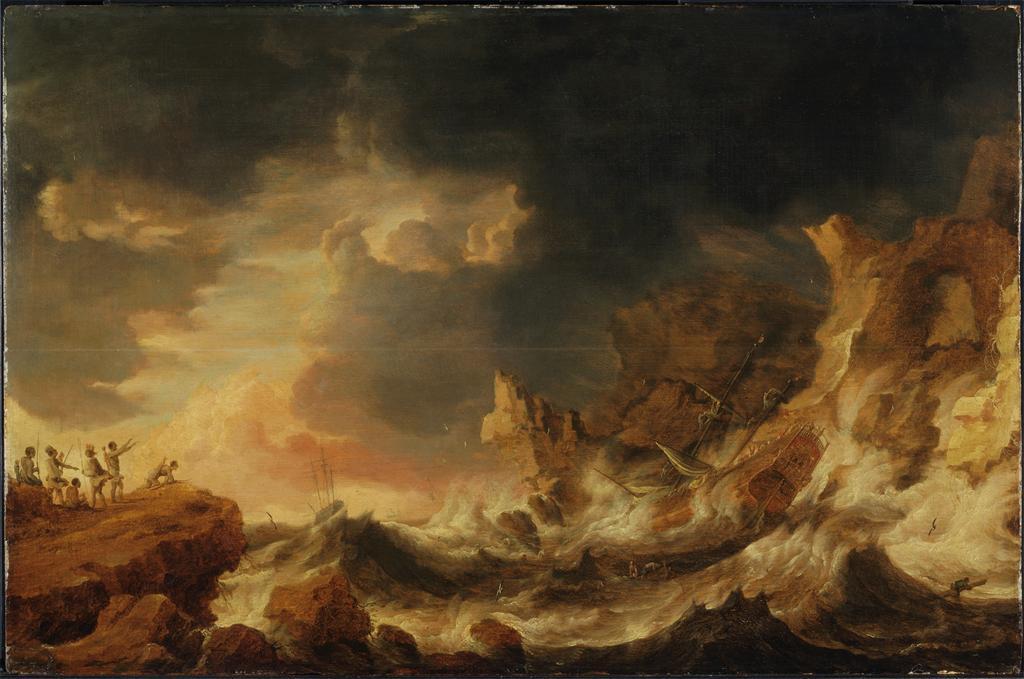
Shipwreck on a Rocky Coast, c. 1640. Bonaventura Peeters, Flemish (active Antwerp), 1614 - 1652. Oil on panel, 18 13/16 x 28 5/8 inches (47.8 x 72.7 cm). Philadelphia Museum of Art, Purchased with the Director's Discretionary Fund, 1970.


The Shipwreck, 1772. Claude-Joseph Vernet, French, 1714 - 1789. Oil on canvas, 44 11/16 x 64 1/8 inches (113.5 x 162.9 cm). Framed: 49 1/8 x 68 1/16 x 3 inches (124.8 x 172.9 x 7.6 cm). National Gallery of Art, Washington, Patrons' Permanent Fund and Chester Dale Fund 2000.22.1.


Wednesday, July 25, 2012

101 ICONIC PRINTS BY AMERICAN MASTER JASPER JOHNS


One of the most celebrated artists of the modern era, Jasper Johns (b. 1930) transformed the field of printmaking. For over 50 years, he has tested the medium’s boundaries, reinventing subjects like targets, American flags, and images from art history in endless variation. The first exhibition of his work at The Phillips Collection features prints from each decade, with groundbreaking examples of lithography, intaglio, silkscreen, and lead relief. Jasper Johns: Variations on a Theme is on view June 2 through Sept. 9, 2012 at The Phillips Collection, 1600 21st Street, NW | Washington, DC 20009 | 202-387-2151

The exhibition spans Johns’s entire printmaking career, beginning with his first experiments and culminating in 2011. In 1960, Universal Limited Art Editions (ULAE) founding director Tatyana Grosman encouraged Johns to work on lithographic stones, and he completed five prints and began his celebrated 0–9 series. Inspired, Johns saw printmaking as a way to transform ideas he had already developed in painting, drawing, and sculpture.

Johns mines art history, including his own work, to repeat and vary motifs. Fragments–According to What
(1971), for example, excavates six details from his 1964 painting, According to What. The exhibition brings together all six prints from this important series. In 1976, Johns partnered with writer Samuel Beckett to create Foirades/Fizzles on view in the exhibition. The book includes 33 etchings, which revisit an earlier work by Johns and five text fragments by Beckett.

“Jasper Johns’s persistent experimentation not only transformed printmaking but set the standard for contemporary art,” says Phillips Director Dorothy Kosinski. “A champion of visionary American artists since 1921, the Phillips is proud to present over five decades of Johns’s graphic achievements, including our own The Critic Sees (1967). We are deeply grateful to the John and Maxine Belger Foundation whose collaboration makes a project on this scale possible.”

Opening with early prints like Target (1960), the exhibition unfolds to reveal the artist’s evolving interests. At the end of the 1960s, he experiments with etching in 1st Etchings Portfolio (1968). In the 1970s, an abstract aesthetic emerges with a crosshatch motif in works like Corpse and Mirror (1976). In the 1980s, autobiographical elements enter Johns’s work such as a tracing of the artist’s shadow in The Seasons (1987). In the 1990s, images from art history appear in After Holbein (1993–94) and Green Angel (1991). Johns’s latest prints, Fragments of a Letter (2010) and Shrinky Dinks 1–4 (2011), layer text, cubist forms, and hand gestures from American Sign Language.

Johns’s collaborations with master printers, including those at ULAE in New York and Gemini G.E.L. in Los Angeles, are essential to his work. They empowered him to test methods unprecedented in the history of the medium. He said: “It’s the printmaking techniques that interest me . . . the technical innovation possible.” Six ingenious lead reliefs realized at Gemini G.E.L. from 1969 to 1970 are featured in the exhibition, as are several important collaborations with ULAE including Decoy (1971), considered Johns’s first offset print, Voice 2 (1982), as well as the artist’s newest prints.

Jasper Johns: Variations on a Theme is organized by The Phillips Collection in collaboration with the John and Maxine Belger Foundation. Exhibition curator is Phillips Assistant Curator Renée Maurer.

ABOUT THE ARTIST

Awarded the Presidential Medal of Freedom in 2011, Jasper Johns is a central figure in modern and contemporary art. His work is represented in nearly every major museum collection and has been the subject of one-person exhibitions throughout the world. Born in Georgia in 1930 and raised in South Carolina, Johns grew up wanting to be an artist. He moved to New York City in his 20s and emerged as a force in the American art scene in 1958 with a solo show at Leo Castelli Gallery from which the Museum of Modern Art purchased three pieces. For over 50 years Johns has challenged the possibilities of printmaking, painting, and sculpture, laying the groundwork for a wide range of experimental artists. He represented the United States at the Venice Biennale in 1988 and was awarded the Grand Prix. Johns currently lives and works in Sharon, Conn., and the Caribbean island of Saint Martin.


1) Jasper Johns, Flags II, 1970. Lithograph, 34 x 25 in. Published by Universal Limited Art Editions. John and Maxine Belger Foundation © Jasper Johns and ULAE / Licensed by VAGA, New York, NY.


2) Jasper Johns, Figure 1, 1969. Lithograph, 37 3/4 x 31 in. Published by Gemini G.E.L. John and Maxine Belger Foundation © Jasper Johns and Gemini G.E.L./Licensed by VAGA, New York, NY.


3) Jasper Johns, Target, 1960. Lithograph, 22 1/2 x 17 1/2 in. Published by Universal Limited Art Editions. John and Maxine Belger Foundation © Jasper Johns and ULAE / Licensed by VAGA, New York, NY.


4) Jasper Johns, Bread, 1969. Embossing with object, 23 x 17 in. Published by Gemini G.E.L. John and Maxine Belger Foundation © Jasper Johns and Gemini G.E.L. / Licensed by VAGA, New York, NY.


5) Jasper Johns, Decoy, 1971. Lithograph with die cut, 41 x 29 in. Published by Universal Limited Art Editions. John and Maxine Belger Foundation © Jasper Johns and ULAE / Licensed by VAGA, New York, NY.


6) Jasper Johns, Savarin, 1977. Lithograph, 45 x 35 in. Published by Universal Limited Art Editions. John and Maxine Belger Foundation © Jasper Johns and ULAE / Licensed by VAGA, New York, NY.


7) Jasper Johns, Fragment—According to What (Leg and Chair), 1971. Lithograph, 35 x 30 in. Published by Gemini G.E.L. National Gallery of Art © Jasper Johns and Gemini G.E.L. / Licensed by VAGA, New York, NY.


ABOUT THE PHILLIPS COLLECTION

The Phillips Collection is one of the world’s most distinguished collections of impressionist and modern American and European art. Stressing the continuity between art of the past and present, it offers a strikingly original and experimental approach to modern art by combining works of different nationalities and periods in displays that change frequently. The setting is similarly unconventional, featuring small rooms, a domestic scale, and a personal atmosphere. Artists represented in the collection include Pierre-Auguste Renoir, Vincent van Gogh, Edgar Degas, Henri Matisse, Pierre Bonnard, Paul Cézanne, Pablo Picasso, Paul Klee, Claude Monet, Honoré Daumier, Georgia O’Keeffe, Arthur Dove, Mark Rothko, Milton Avery, Jacob Lawrence, and Richard Diebenkorn, among others. The Phillips Collection, America’s first museum of modern art, has an active collecting program and regularly organizes acclaimed special exhibitions, many of which travel internationally. The Intersections series features projects by contemporary artists, responding to art and spaces in the museum. The Phillips also produces award-winning education programs for K–12 teachers and students, as well as for adults. The museum’s Center for the Study of Modern Art explores new ways of thinking about art and the nature of creativity, through artist visits and lectures, and provides a forum for scholars through courses, postdoctoral fellowships, and internships. Since 1941, the museum has hosted Sunday Concerts in its wood-paneled Music Room. The Phillips Collection is a private, non-government museum, supported primarily by donations.

Also:

Fragment—According to What: Hinged Canvas 1971 lithograph, working proof with crayon, chalk, and graphite National Gallery of Art, Washington, Patrons' Permanent Fund and Special Friends of the National Gallery of Art. Art © Jasper Johns/Licensed by VAGA, New York, NY

Lyonel Feininger: At the Edge of the World


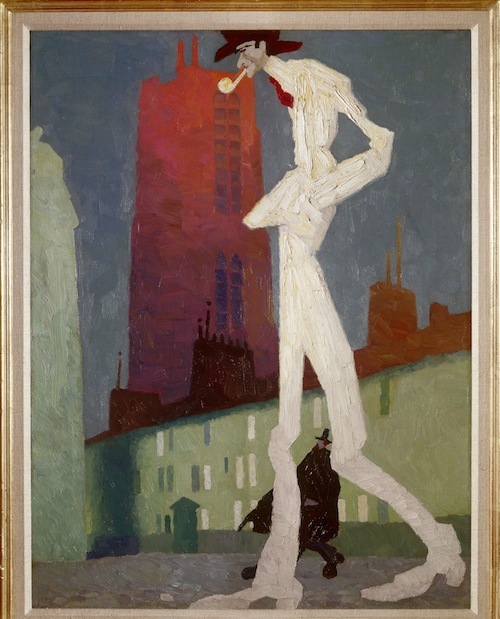
Lyonel Feininger, The White Man, 1907, Oil on canvas, 26 7/8 x 20 5/8 in. (68.3 x 52.3 cm), Collection of Carmen Thyssen-Bornemisza, © 2011 Lyonel Feininger Family, LLC./Artists Rights Society (ARS), New York


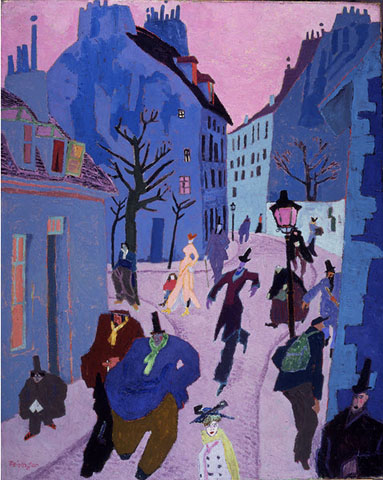
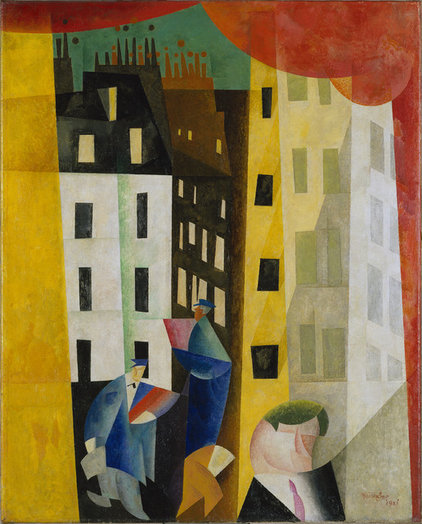
Lyonel Feininger, In a Village Near Paris (Street in Paris, Pink Sky), 1909. Oil on canvas, 39 3/4 x 32 in. (101 x 81.3 cm) University of Iowa Museum of Art, Iowa City; gift of Owen and Leone Elliott 1968.15 © Lyonel Feininger Family, LLC./Artists Rights Society (ARS), New York


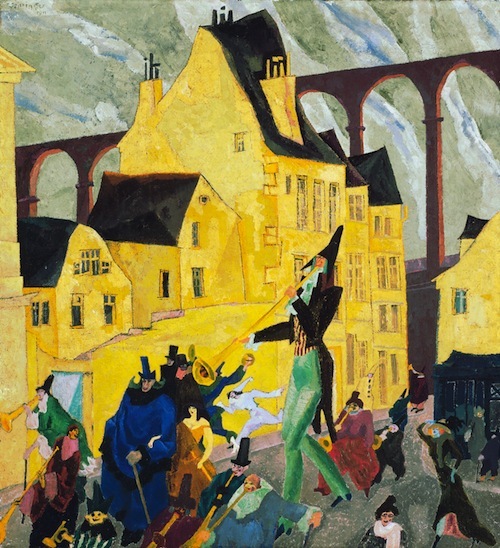
Lyonel Feininger, Carnival in Arcueil, 1911. Oil on canvas, 41 3/10 × 37 8/10 in (104.8 × 95.9 cm). Art Institute of Chicago; Joseph Winterbotham Collection 1990.119, © Lyonel Feininger Family, LLC./Artists Rights Society (ARS), New York, Photograph © The Art Institute of Chicago


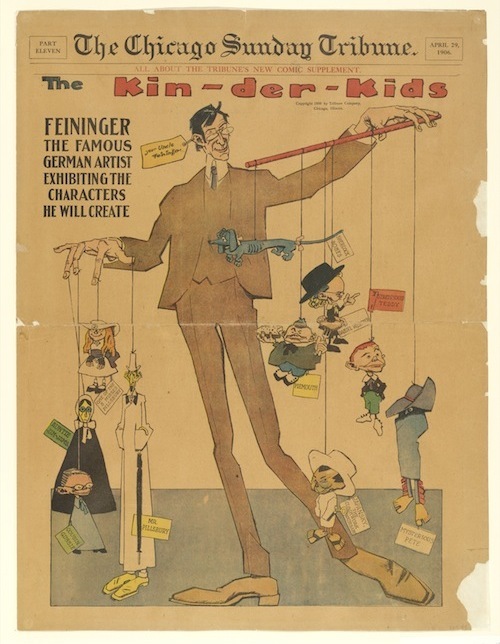
Lyonel Feininger has long been recognized as a major figure of the Bauhaus, renowned for his romantic, crystalline depictions of architecture and the Baltic Sea. Yet the range and diversity of his achievement are less well known. Lyonel Feininger: At the Edge of the World, the artist’s first retrospective in the United States in forty-five years, was the first ever to incorporate the full breadth of his art by integrating his well-known oils with his political caricatures and pioneering Chicago Sunday Tribune comic strips; his figurative German Expressionist compositions; his architectural photographs of Bauhaus and New York subjects; his miniature hand-carved, painted wooden figures and buildings, known as City at the Edge of the World; and his ethereal late paintings of New York City. Curated by Barbara Haskell with the assistance of Sasha Nicholas, the exhibition debuted at the Whitney Museum of American Art from June 30 to October 16, 2011, and subsequently traveled to The Montreal Museum of Fine Arts, January 16 – May 13, 2012.


Born and raised in New York City, Lyonel Feininger (1871–1956) moved at the age of sixteen to Germany to study music. Instead, he became a caricaturist and eventually a leading member of the German Expressionist groups Die Brücke and Die Blaue Reiter and, later, the Bauhaus. In the late 1930s, when the Nazi campaign against modern art necessitated his return to New York after an absence of fifty years, his marriage of abstraction and recognizable imagery made him a beloved artist in the United States.

Having spent fifty years of his life in Germany, Feininger is most often considered a German artist. This exhibition and its accompanying catalogue illuminate his dual national loyalties and their reverberations in his art. As Haskell notes in her catalogue essay: “(Feininger’s) complex and contradictory allegiances—to American ingenuity and lack of pretension on the one hand, and to German respect for tradition and learning on the other—rendered him an outsider in both countries. Always yearning for one world while living in the other, he never stopped longing for the ‘lost happiness’ of his childhood.”


Lyonel Feininger, "The Kin-der-Kids," from The Chicago Sunday Tribune, April 29, 1906, Commercial lithograph, 23 3/8 x 17 13/16 in. (59.4 x 45.3 cm), The Museum of Modern Art, New York; gift of the artist 260.1944.1 © 2011 Lyonel Feininger Family, LLC./Artists Rights Society (ARS), New York Photograph © The Museum of Modern Art/Licensed by SCALA / Art Resource, NY

Before he began to paint in 1907, at the age of thirty-six, Feininger had built a career as one of Germany's most successful caricaturists.


Newspaper Readers (1909)

When he turned to painting, he fused the whimsical figuration of his comic strips and illustrations with the high-keyed color of German Expressionist painting.


The Green Bridge

Just at the moment that Feininger's oils began to earn him widespread recognition, World War I broke out.


Self Portrait

He spent the war in Germany as an enemy alien, never having relinquished his American citizenship. In 1919, Walter Gropius, founder of the Bauhaus, appointed Feininger as the school's first professor and commissioned him to design the cover of the Bauhaus manifesto. Feininger's expressionist woodcut, depicting a tripartite cathedral surrounded by shooting stars, symbolized the school's idealistic unification of fine art, architecture, and crafts.


Feininger remained at the Bauhaus until it was closed by the Nazis in 1933, revered as a teacher and head of the school's graphics workshop. The monumental compositions of architectural and seascape subjects that he produced at the Bauhaus gained him national renown, culminating in his receipt in 1931 of Germany's highest honor for an artist: a large-scale retrospective at Berlin's National Gallery.


Lyonel Feininger. Gelmeroda XIII (Gelmeroda), 1936 Oil on canvas, 39 1/2 x 31 5/8 in. (100.3 x 80.3 cm.) The Metropolitan Museum of Art, New York; George A. Hearn Fund, 1942 42.158 © 2011 Lyonel Feininger Family, LLC./Artists Rights Society (ARS), New York Photograph © The Metropolitan Museum of Art / Art Resource, NY

When the Nazi Party came to power in 1933, the situation became unbearable for Feininger and his wife, who was Jewish. They moved to America in 1937, just months before his work was featured in the Nazi's infamous Degenerate Art exhibition. Readjusting to the changed landscape of New York was difficult after such a long absence; not until 1939 did Feininger begin painting again. In America, as in Germany, he employed geometric forms to invest the modern world with a secular spirituality. Art, for him, was a "path to the intangibly Divine,” a way of expressing what he called the “glory there is in Creation." At the same time, Feininger continued in his last years to call upon the playful figurative vocabulary of his early illustrations and comics to evoke the harmony and innocence of childhood. Feininger's 1944 retrospective at the Museum of Modern Art, which traveled for two years to major American cities, established him as a major artist in his native country during his final years.

Nice article

The Book


A monograph accompanying the exhibition, with its overview essay by Whitney curator Barbara Haskell, covers the full breadth of Feininger’s career, placing his biography and art within the context of art history and politics, tracing his relationships to movements and institutions that defined the development of modern art, including Cubism, the Blaue Reiter, the Blue Four, the Bauhaus, and Black Mountain College. The catalogue features additional essays by Ulrich Luckhardt, curator, Hamburger Kunsthalle, Germany; Sasha Nicholas, senior curatorial assistant, Whitney Museum of American Art, New York; Bryan Gilliam, Frances Hill Fox Professor in Humanities, Duke University; John Carlin, independent writer and curator, president and CEO of Funny Garbage. The book is published by the Whitney Museum of American Art, New York, in association with Yale University Press, New Haven and London.

Wednesday, July 18, 2012

Dove/O’Keeffe: Circles of Influence


The life and work of Georgia O’Keeffe have fascinated critics, scholars, and art lovers alike since she burst onto the New York art scene in the early 1900s. On June 7, 2009 through September 7, 2009, the Sterling and Francine Clark Art Institute added a chapter to this story with the first exhibition to explore the role of the influential American modernist painter Arthur Dove as the key figure in O’Keeffe’s development of abstraction as a means of artistic expression. Dove/O’Keeffe: Circles of Influence featured 60 major oil paintings, watercolors, drawings, and pastels created from 1910 to the early 1940s. The Clark was the exclusive venue for this exhibition.


Among the seminal works on view were O’Keeffe’s Dark Abstraction (1924)


and Jack-in-The Pulpit No. VI (1930)
,


and Dove’s Moon (1935)


and Fog Horns (1929)
.

Although Dove and O’Keeffe’s approach to imagery ultimately diverged, their shared interest in capturing the ephemeral, fugitive traits of nature—the play of light on water, the transitions of the sun and moon, and the rustle of the wind through grass—was the basis for an abiding commitment to each other’s works and a profound aesthetic connection that lasted throughout their lifetimes.

“Georgia O’Keeffe has captured the imagination of art lovers around the world, not only by virtue of her incredible talent, but through her bohemian spirit as well,” said Clark director Michael Conforti. “The Clark is excited to look for the first time at O’Keeffe’s early modernist work along with the work of the extraordinary artist Arthur Dove, examining their shared influence on each other’s works.”

From the start of her career, O’Keeffe credited a reproduction of a Dove pastel as her introduction to modernism. Dove’s use of sensual, abstract forms to evoke the flowing rhythms and patterns of nature had already put him at the forefront of the American modernist movement by the time O’Keeffe entered the scene around 1916. Dove had been featured at the renowned photographer Alfred Stieglitz’s New York gallery “291” in 1912, and O’Keeffe’s work was first shown there in 1916. Works from this period, including Dove’s Abstraction, No. 3 (1910-11) and O’Keeffe’s No. 24-Special/No. 24 (1916-17), established the innovative aesthetic vision that characterized their early work.

During the 1920s and 1930s, critics began to take serious note of the two artists as major American modernist painters. In particular, the critics began to read the paintings from a Freudian point of view, pairing Dove and O’Keeffe as representative of the “masculine” and “feminine.” Unlike Dove, O’Keeffe reacted strongly against these psychoanalytic readings of her work, arguing for a more formal interpretation. Dove, always a strong and vocal supporter of O’Keeffe, ultimately used the Freudian interpretation in defense of O’Keeffe’s work.


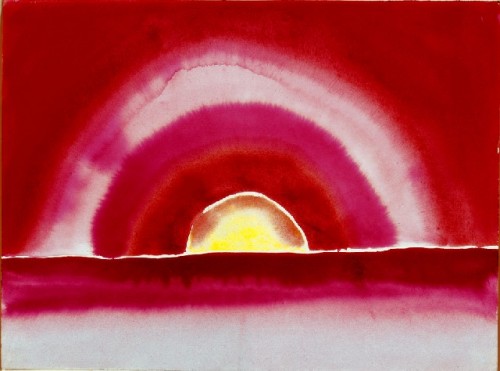
O’Keeffe’s influence on Dove can be seen in the 1930s, when he turned to her early works, particularly her watercolors, such as Sunrise (1916), as means through which to renew his own work and vision.


Although O’Keeffe had long abandoned the medium, Dove created a number of important works including Sunrise #1 (1936) during this period, when he found his inspiration in what he called O’Keeffe’s “burning watercolors.”

The paintings from the exhibition will be drawn from international public and private collections. The exhibition featured works once owned by Alfred Stieglitz, O’Keeffe’s husband and Dove’s longtime friend, as well as works from the Georgia O’Keeffe Museum. This exhibition was funded in part by the National Endowment for the Arts and by an indemnity from the Federal Council on the Arts and the Humanities.

The exhibition was organized by the Clark and was curated by Debra Bricker Balken, an independent curator specializing in American modernism and contemporary art who organized a Dove retrospective in 1997.

More images from the exhibit:


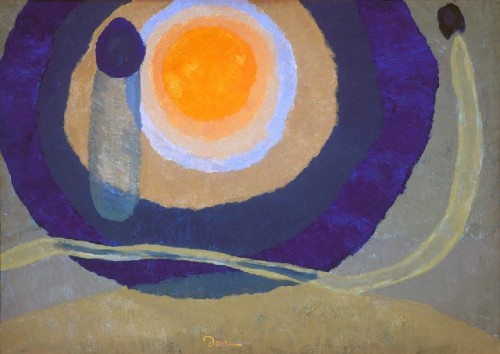
Arthur Dove, Sunrise, 1924. Oil on panel, 18 1/4 x 20 7/8 in. Milwaukee Art Museum. Gift of Mrs. Edward R. Wehr [Milwaukee Art Museum (photo by John R. Glembin); Courtesy of and copyright The Estate of Arthur Dove / Courtesy Terry Dintenfass, Inc.]


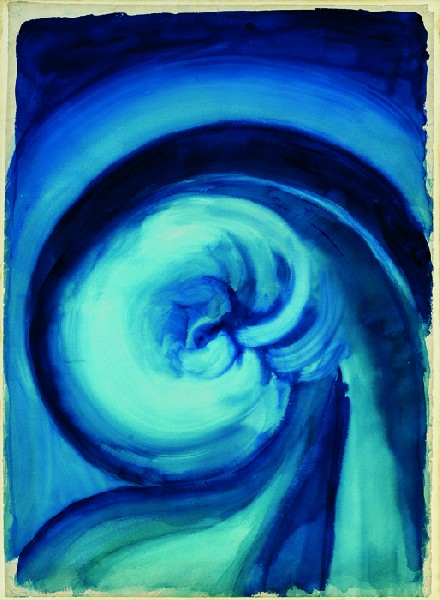
Georgia O’Keeffe, Blue I, 1916. Watercolor on paper, 30 7/8 x 22 1/4 in. Private collection [(c) 2009 Georgia O’Keeffe Museum / Artists Rights Society (ARS), New York]


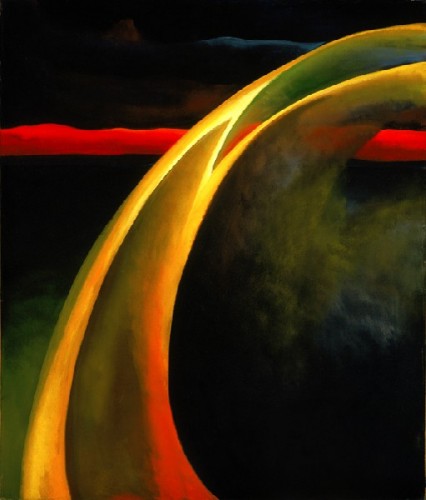
Georgia O’Keeffe, Red & Orange Streak, 1919. Oil on canvas, 27 x 23 in. Philadelphia Museum of Art. Bequest of Georgia O’Keeffe for the Alfred Stieglitz Collection, 1987 [Courtesy of the Philadelphia Museum of Art]

More Images Here


The Clark published an exhibition catalogue authored by Balken and distributed by Yale University Press. This will be the first publication to focus on the relationship between Dove and O’Keeffe and explores the nature of art criticism in the early twentieth century as it related to psychoanalytic thought and formalism.

The Clark

Set amidst 140 acres in the Berkshires, the Clark is one of the few major art museums that also serves as a leading international center for research and scholarship. In addition to its extraordinary collections, the Clark organizes groundbreaking exhibitions that advance new scholarship and presents public and educational programs. The Clark’s research and academic programs include an international fellowship program and conferences. The Clark, together with Williams College, sponsors one of the nation’s leading master’s programs in art history.

In June 2008, the Clark opened Stone Hill Center, the first phase of its expansion and campus enhancement project. Designed by Tadao Ando, the 32,000-square-foot, wood-and-glass building houses two galleries, a meeting and studio art classroom, an outdoor café, and the Williamstown Art Conservation Center. The second phase of the expansion includes the creation of another stand-alone building by Ando that will house exhibition galleries, visitor services, and education and conference spaces. Scheduled for completion in 2013, Phase II also encompasses the upgrade and internal expansion of the Clark’s current buildings by Annabelle Selldorf.