Ever an innovator, he broadened and
deepened the dialogue of post-war American painting where his colleagues
remained entrenched in established styles. His experiments with
silkscreening and graphic arts helped him to clarify a slick, almost Pop
quality. His attentions, however, were bent not to the shiny and new,
but also to the collapsing and decaying. His photographs of jazz
musicians have been celebrated and his crisp modernist paintings are in
important public and private collections, including the Museum of Modern
Art, the Whitney Museum of American Art, and the Metropolitan Museum of
Art. When he died at 71 in 1978, he had influenced several generations
of American artists.
Early Life
The son of a ship captain, George Ralston Crawford was born in
Ontario in 1906. Though his father would soon trade in the masts and
riggings for insurance and real estate sales, young Ralston would
forever identify with the transient life of the sailor. He move to New
York with the idea of enrolling at the Pratt Institute, but apparently
found work on a fruit company boat bound for South America instead. He
spent six months traveling with the United Fruit Company on board
La Perla, and
the affair left its mark: he would retain a Kerouac-like attitude of
“may as well travel” for the rest of his life. Following his impulse to
travel, he hitched a ride again on
La Perla through the Panama
Canal and up to Los Angeles. (Haskell, pp. 10-11) There, he enrolled in
art classes at the Otis Art Institute. Otis’s curriculum, along with a
side gig at Walt Disney Studios, did the double duty of imbuing his
aesthetics with a flavor of commercial illustration, while
simultaneously confirming that the life of a commercial artist was not
for him. The winds shifted after two years in LA, and he was off to
pursue the life of the fine artist, this time in Philadelphia.
For Crawford, 1927 was the right moment to be in Philadelphia. He
enrolled at the Pennsylvania Academy of Fine Arts, which had then the
same reputation it does now: a conservative institution, it taught the
young Crawford what a fine artist is and does. Important, too, was the
Barnes Foundation, which had opened its doors only five years earlier.
There Crawford found the now world-renowned collection of
post-Impressionist painting a stimulating solution to the contradictory
pulls of Thomas Eakins and Walt Disney. Cézanne in particular influenced
him. Some of the works that survive from this period demonstrate not
only a superficial fascination with Cézanne’s plastic form method of
building a volume and space, but also a profound appreciation for the
adroit manipulation of space in tension with the picture plane. (Harnsberger, p. 79)
(Illustration:
Still Life, Fruit on Table, c.
1931).
Already by 1930, Crawford had appropriated the master’s
technique of subtly modulated brushstrokes to create vibrating forms.
Back at the Academy, the influence of one of the few remaining modernist
members of the faculty, Hugh Henry Breckenridge, also pressed home the
chromatic lessons of the master of Aix. Breckenridge was an attentive
disciple of Cézanne, and his students included some of the artists with
whom Crawford would be associated in the 1930s, including Charles
Demuth, John Sloan.
Precisionist Years
For the Precisionists, the stamp of Cézanne was refracted through a
uniquely American lens. Cotemporaneous with the broad acceptance of
Cubism and with the development of Futurism, the American movement
retained a flavor quite distinct from its European counterparts. It
should be remembered that the Precisionists in general, and Crawford in
particular, were encountering the European vanguard all at once. The
post-Impressionists were on view for the first time to American
audiences about the same time as Picasso and Braque, along with the
multitude of abstract movements of the 1930s. Secondly, the idea of
industrial modernity had a very different ring in Pennsylvania than it
did in Paris. The connections to cubism are clear enough: they shared
crisp edges and sharply delineated planes, views broken up into a
multitude of flattened forms. But the American works from the twenties
and thirties lacked the dour colors of Braque and Picasso’s analytic
cubism, and, while the Parisians were staring down café tables and small
groups of figures, Demuth, Dickinson, and Crawford were almost entirely
prepossessed with industrial subjects. The staying out of doors and
more colorful palette, as well as the handling of space, owed as much to
Cézanne as to the cubists and the futurists.
The features of his work that bound Crawford with the Precisionists
were personal, rather than the symptom of a shared manifesto; Crawford
liked movement, but not necessarily
movements. The precise lines
of his work proved very effective in the depiction of the sharp-edged
architecture of industrial buildings, and so form and content seemed to
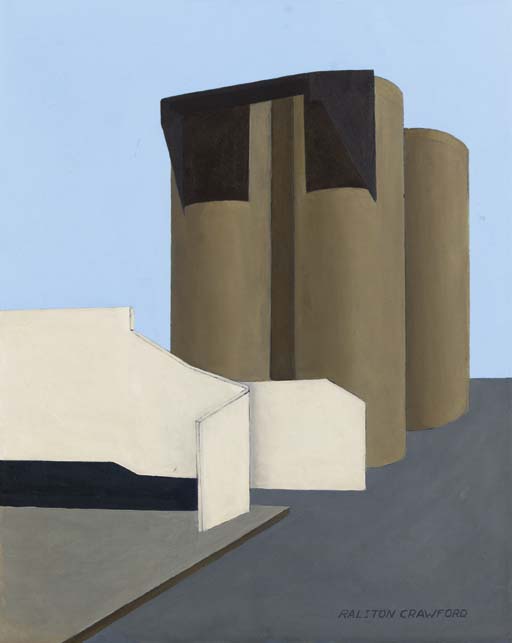
support one another. Peculiar to Crawford was a special attention paid
to silos and elevators. Given Cézanne’s love for cones and cylinders,
Crawford had identified in the American landscape the perfect form: a
grain silo is just a cone atop a cylinder. Also from Cézanne, Crawford’s
work in the thirties activates the sky as a planar, modulated form.
Whereas there are precious few skies depicted in cubist paintings,
Crawford and his cohort almost never failed to include the sky. But
while Demuth would divide up the sky using invented lines—the imagined
extensions of lines of architecture— Crawford found novel graphic
devices to compose his canvases. As his work in the 1930s progressed,
his canvases became more composed. The barns that once stood peacefully
centered in the scene gave way to arrangements of foreground elements
that ran off the canvas in all directions. By the end of the decade, he
had mastered the technique, activating the canvas as a flat and dynamic
form.

A major success of the period came with 1939’s
Overseas Highway. At
first glance, it is a simple exercise in one-point perspective: a pair
of lines narrowing to a vanishing point on an unobstructed horizon. Upon
closer inspection, however, the painting’s zipping speed is the product
of subtle asymmetries and clever balances. The guard rail that seems to
reach high above the viewer’s head achieves that studious division of
the sky that Crawford elsewhere achieved with dangling ropes and
powerlines. The vanishing point itself is off of center in both, and the
peculiar placement of the point of view and the commitment to the
parallel lines of the pavement bring the road swelling up to meet us, as
if we are already on our way. Combining many techniques, it was a
breakthrough for the painter.
Overseas Highway feels fresher and
more modern than his Precisionist forbears, as if the art world is being
launched along with the viewer into a cool new future, headed toward
the horizon at high speed, the Depression behind, an uncertain but
bright future ahead.
The Atomic Age
The paintings of the early 1940s took the successes of
Overseas Highway and
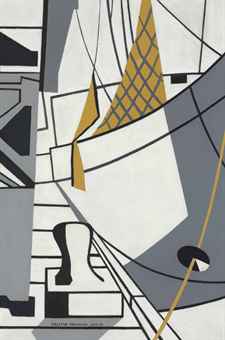
ran with them. Canvases were now now filled to the brim with shapes. A
boat that once sat nicely in the harbor suddenly fills the entire view
in
At the Dock.
The industry that was building the country up for
war was now an unignorable presence. That presence was not limited to
Crawford’s work, as by 1942 he had been drafted for the military. In
this regard, Crawford’s age played a large factor in distancing him from
his colleagues of the thirties. He was old enough to be accepted as a
significant force in American painting, but not old enough, like Demuth
and Sheeler, to avoid service. Not a little did he dislike the sacrifice
of these prime years of his career, dutifully he went. Cut off as he
was from art-making, he found his way into the Visual Presentation Unit,
where he produced, among other graphics, maps showing predicted weather
patterns. (Haskell, p. 62) Though he regretted the sacrifice, the
weather maps provided some new insights, and indeed, when he was invited
to join the stable of Edith Halpert’s Downtown Gallery in 1943, the
weather maps were shown alongside his oils. After all, a map is just an
abstracted landscape, with the plane of the land tilted radically
upward. Along with the rest of his work, the maps garnered favorable
attention as well as several graphic art commissions, not least from the
magazine
Fortune.
After several covers and interior illustrations,
Fortune
bestowed upon the freshly-minted veteran the distinction of being the
sole painter to witness the first public test of a nuclear bomb. On the
first of July, 1946, Crawford witnessed the detonation of two nuclear
weapons on Bikini Atoll. The bright, glaring work that Crawford produced
in response to the event were among those that signaled a shift in his
work. A depiction of the power and brilliance of the explosion itself,
the work for the first time lacked clear connection to its subject
matter. If it was a beginning of a new phase for Crawford, the birth of
the atomic age was also a new beginning for a generation of American
painters. In this, Crawford’s fear of being out of step came partially
true: the power and anxiety of the living under the specter of the bomb
was better depicted by the abstract expressionists than by Crawford’s
still somewhat comfortable images. They are powerful, but not dreadful
or awful, the way Pollock’s work sometimes is. If the explosive power
of

Tour of Inspection (1946, Ralston Crawford Estate) failed to capture a generation’s anxieties, Crawford emerged from the war a changed artist.
Crawford’s commitment to observation, rather than expressionistic
outpourings or symbolism, was unshaken –in fact, he redoubled his
efforts. By deepening his observation, he began to find new entryways
into the picture. He began to embrace new media, returning to a single
scene with a crayon, with oil, with silkscreen, experimenting with the
ways in which different media brought out different forms. His paintings
benefited from the way silkscreening emphasized flat, bright planes of
color, as well as from his renewed interest in drawing in pen and ink.
But chief of among these tools of innovation was his early adoption of
photography.
Ralston Crawford was not alone among painters adopting photography.
His fellow Precisionist, Charles Sheeler, had made experimental films,
both as independent works (with Paul Strand) and as source material for
his paintings. But in the decades since the abstract film
Manhatta,
photography had grown more independent as an artform, and more
practicable as a craft. As Vince Alletti wrote: “The best of these
teeter provocatively between documentation and abstraction, anticipating
similarly tough work by Robert Adams and Lee Friedlander.” (
New Yorker,
April 16, 2007) In his post-war pictures, Crawford increasingly
embraced the sharp, graphic edges and non-local color. Having
photographs handy in the studio allowed him to crop the image to isolate
forms and remove elements that would identify scale and location. The
forms in his paintings, in this way, became unmoored from their
circumstances. Because of photography, some elements became more
certain; because of his painterly flattening and removal of detail, the
pictures became even more abstract.
The close of the 1940s also marked the beginning of the artist’s
thorough engagement with the sounds of New Orleans. Though he had
previously traveled to the Big Easy in 1926 and again in 1938, by the
early fifties it had become a second home to a man who may have had
trouble naming his first. New Orleans is considered the birth place of
jazz, and had developed and long maintained unique sounds and
performance customs, from the “second line” marching bands and the
syncopated march-beat, to multiple lines of improvisation and call and
response. The city remains a melting pot of cultural influences, and the
music and culture surrounding the music had a unique flavor that
appealed immensely to Ralston Crawford. At a time when such mix was not
socially acceptable (and, in some circumstances, illegal), Crawford dug
deep into the city’s jazz clubs and back rooms.
Jazz
The lifeblood of New Orleans, jazz was not simply a spectator affair.
While the 1950s saw the profile of jazz rising in New York as a form of
high art, it retained in New Orleans its vibrant connection to life in
the streets. Just as bar patrons are free to wander into the street with
a drink in their hands, the jazz musician was not a prisoner to the
stage, the sound and spectacle mingling with all the other aspects of
life—including the end of life. Death, in New Orleans, is a decidedly
above-ground affair.
The city’s high water-table demands that the dead
be interred literally above ground, in mausoleums, or else risk being
disinterred in the next flood. And what elsewhere might be an occasion
for solemnity is in New Orleans closer to a celebration; drawing from
Louisiana tradition of military brass bands and African and Creole
rhythms, the “jazz funeral” features a procession from the home or
church of the deceased to the cemetery. Typically the first leg of the
jazz funeral is staid and sober, the band playing hymns and spirituals,
giving way later to the more famous upbeat numbers like “When the Saints
Go Marching In,” and “Didn’t He Ramble” after the body of the deceased
is interred. With a song structure based on hymns, New Orleans jazz
features call and response as well as a loose form allowing multiple
musicians to improvise on the melody simultaneously, while the beat
deviates from a metronomic march to an off-kilter syncopation.
Thus did Crawford’s focus return toward the cemetery. His paintings
of headstones and mausoleums are not, however, somber meditations, but
are infused with the swing and life of a street jazz band. They offer
visual parallels to the features of the music that so inspired him:
theme and variation, off-center soloing and call and response. As he
reworked images in various media, the identifiable theme of the pictures
comes in and out of focus, not unlike the melody of a jazz composition.
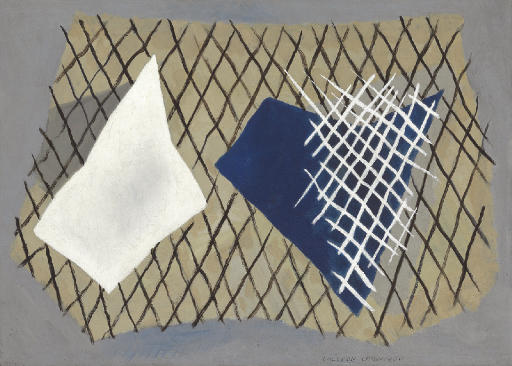
Elements from one painting may crop up, unannounced but perfectly
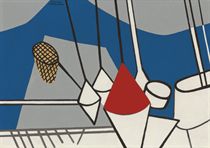
harmonized in seemingly unrelated works, as in
Third Avenue Elevated, (1949, oil on canvas 29 ¼ x 40 1/8 inches Walker Art Center) and
Nets with Red.
Ralston Crawford thought about his paintings at times explicitly in these musical terms:
“I am very much interested in a kind of pictorial counterpoint—the
juxtaposing of one melody or theme in relation to another , or to
several. It is out of this argument or contrast that I believe interest
is created in pictorial structure. This must be part of the total plan –
I am uninterested in producing the decorative.”
(As quoted in Agee, p.
45)
Crawford’s theme or melody would be a particular industrial scene.
Like a line of melody for a jazz musician, that melody could then be
transposed into another key, bent out of shape, and inserted into an
improvised moment in an entirely different tune. Finding a literal
connection between visual and musical form has preoccupied many painters
and musicians, from Wassily Kandinsky and Arthur Dove to Claude Debussy
and Charles Mingus—but Crawford was unconcerned, as ever, with being
literal. He saw the active interpretation of found forms into paint as
metaphorically linked to a piece of music through melody and
improvisation.
Later Years
Though his attention to industry and sleek machines never faded, over
the years the artist’s interest shifted from the shiny and new to the
crumbling and scarred. Racecars, always a fascination, gave way to
scrap-heap cars; high gloss magazines were replaced with peeling posters
and illegibly torn signs. Siskind and Evans would treat similar
subjects in strictly formalist terms, but Crawford invested his images
with more meaning. One of the artist’s sons has pointed out the possibly
grim undertones of these mounting symbols later in his father’s life:
car wrecks, crumbling builidings, time-worn tombstones and blistering
billboards. (personal correspondence) The pictures themselves retain the
brightness and clarity of earlier days, so if there is something to
this growing sense of death and destruction, it is approached with a
frankness that seems quite in keeping with the artist himself.
“I went to this junk pile many times. In truth, the shapes I found
there were indeed more interesting than the new cars. The unpredictable
relationships of broken, torn and twisted automobile parts, plus the
startlingly unique equality of the individual shapes called for all of
my attentiveness. In my continuing line of consciousness they were of
course related to the plane wrecks of World War Two and to my
recollections of Bikini, where I saw Test Able.
The positive nature of seeing transcended the dreary connotations of
these shapes. In short, my reaction was one of extreme pleasure. I am
quite certain that this picture will in no way affect the automobile
accident rate. Such motivation is out of my field. But I will be pleased
if it provides for the person seeing it some of the satisfaction that I
got from viewing the wrecked cars.” (as quoted in Agee, p. 46)
Ralston Crawford died in Texas in 1978. His legacy as one of the
luminaries of Precisionism retains its luster, and he has become
increasingly esteemed as a proto-pop artist and a photographic
documentarian. Ultimately, his work stands as a lasting invitation to
the pure joy of looking, and seeing. For his love of the city of New
Orleans and the music of its streets, Crawford decided to make the city
his final resting place. Apropos of a life spent on the road, his
cemetery monument is engraved, after the old jazz funeral standard,
“Didn’t he ramble.”
Christie's 2006