Wednesday, November 4, 2026

Sotheby's -- Vision: The Extraordinary Collection of Theodore and Ruth Baum November 16

Vision: The Extraordinary Collection of Theodore and Ruth Baum


A landmark collection of postwar and contemporary art, estimated to exceed $100 million, featuring works by Rothko, Mitchell, Ruscha, Burri, Warhol, Fontana and more, many appearing at auction for the first time in decades.

United by a singular vision, collectors and philanthropists Theodore and Ruth Baum’s passion for life, art, design and philanthropy led them on a deeply personal, decades-long pursuit to cultivate an extraordinary collection – one that was not only among the most distinguished private collections encapsulating the developments of 20th-century art history, but reflective of the forward-thinking vision, refined elegance and intellectual rigor that defined them as partners in life and collecting.


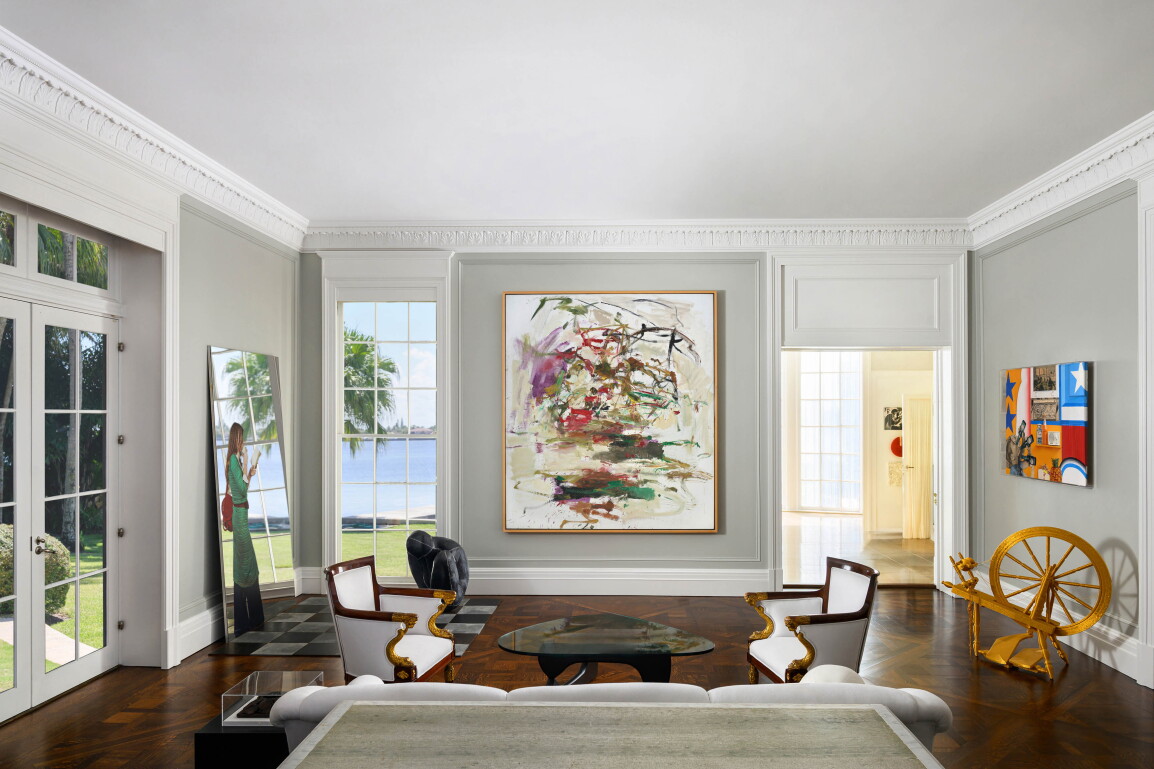
Theodore and Ruth Baum's Palm Beach residence. Art © Estate of Joan Mitchell. Art © The Estate of Tom Wesselmann / Artists Rights Society (ARS), New York. Art © Carl Andre / Licensed by VAGA at Artists Rights Society (ARS), New York. Art © Antony Gormley 2026. All rights reserved. Art © 2026 Michelangelo Pistoletto. Photograph by Diana Todorova

As storytellers in every sense, the Baums were guided by their insatiable curiosity as they built a collection that transcended movements, generations and geographies. Throughout the course of two decades, they traveled around the world in pursuit of great works by the visionaries of American abstraction, the innovators of Pop, Minimalism and Conceptualism, and the radical experimenters of post-war Italian art, assembling a constellation of artists engaged in dialogue with one another, each work challenging and illuminating its counterpart.

Highlights from the Collection


Type: lot
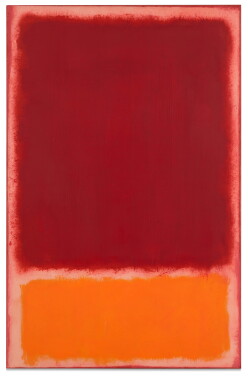
Mark Rothko
Untitled, 1967

Type: lot
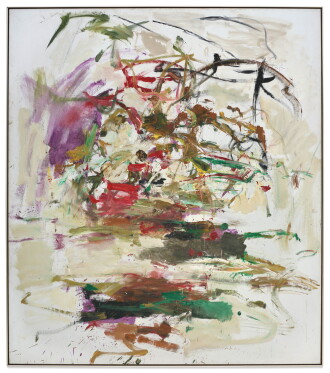
Joan Mitchell
Green Book of Barbara Guest, 1960

Type: lot
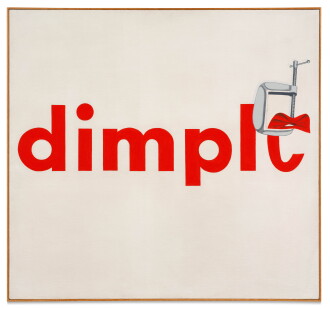
Ed Ruscha
Dimple, 1964


Type: lot
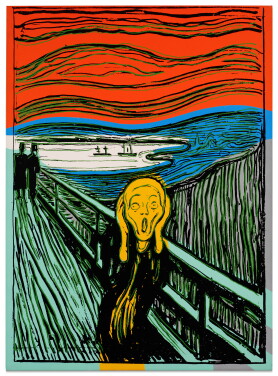
Andy Warhol
The Scream (After Edvard Munch), 1984

Type: lot
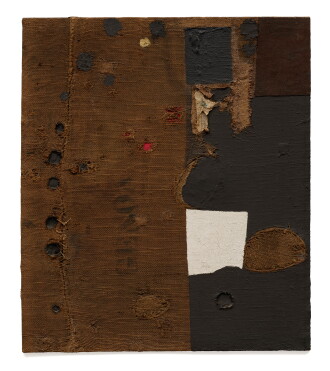
Alberto Burri
GA1, 1954

Type: lot
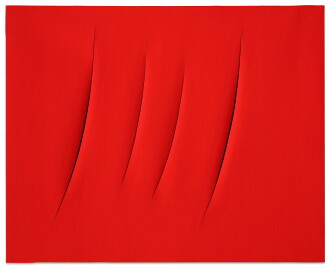
Lucio Fontana
Concetto Spaziale, Attese, 1960

Type: lot
Andy Warhol
The

Tuesday, November 3, 2026

Christie's Old Master Paintings from a Distinguished Private Collection

Julie Le Brun as a Bather 
by Elisabeth-Louise Vigée Le Brun

Leads a group of Old Master Paintings from a Distinguished Private Collection being offered across London and New York sales in December and February

 Julie Le Brun as a Bather <br />by Elisabeth-Louise Vigée Le Brun

Left to right: New York Old Masters Evening Sale, 3 February 2027, Elisabeth-Louise Vigée Le Brun, Julie Le Brun as a Bather (estimate: $1,800,000-2,200,000) and London Old Masters Evening Sale, 8 December, Henri Pierre Danloux, The Masters Foster, 1792 (estimate: £150,000-250,000)


 Christie's is proud to announce that paintings from a distinguished private collection including works by Osias Beert, Jan Massys, Henri-Pierre Danloux, Jan van Huysum, Jan van Os and Mihály Munkácsy will be offered in London's Old Master Evening Sale on 8 December, and Old Master Paintings Part I in New York on 3 February 2027. Highlights will tour to Paris (on view until 4 November) and London (4 – 8 December), ahead of the auctions. The lead lot of the group comes to auction for the very first time in more than two centuries: Julie Le Brun as a Bather by Elisabeth-Louise Vigée Le Brun. This important work returned to public view as part of the landmark retrospective dedicated to Vigée Le Brun at the Grand Palais in Paris and Metropolitan Museum of Art in New York in 2015 and 2016 (estimate: $1,800,000-2,200,000).

The subject of the painting is Jeanne-Julie-Louise Le Brun (1780–1819), called Julie, the only child of Elisabeth-Louise Vigée Le Brun (1755–1842), one of Europe's most celebrated portraitists in the late-18th and early-19th centuries and Jean-Baptiste-Pierre Le Brun (1748–1813), the preeminent dealer, auctioneer and art expert in Paris during the final decades of the Ancien Régime. Vigée Le Brun was one of the few women artists to be elected to the Académie Royale in Paris, in 1783, and served as the official portraitist to Queen Marie Antoinette, before fleeing France at the outbreak of the French Revolution and achieving international fame across Europe. This painting was executed in 1792, when artist and daughter were living in exile in Italy. This striking image of Julie was acquired through the intermediary of Jean-Baptiste Greuze by the Russian nobleman and art collector Prince Nikolai Borisovich Yusupov, in whose family it remained until the 20th century. It is unlined and preserved in a near-miraculous state.

Vigée Le Brun painted images of Julie throughout her childhood and adolescence, most famously in two double portraits featuring mother and daughter in a tender embrace which are among the most beloved works in the Louvre. As with earlier portraits of her daughter, Vigée drew from a rich visual tradition when crafting Julie's pose for this painting.

Also painted in 1792 whilst in exile from Revolutionary Paris, Henri-Pierre Danloux's charming double portrait of the sons of Constantia and Richard Foster, with cricket bats in a wooded landscape, launched his career in London when it was exhibited at the Royal Academy in 1793.

Further highlights include


a beautifully rendered still-life by Jan van Huysum, which will tour with the Le Brun to Paris, and 


Mihály Munkácsy's After Dessert - Die Jungen Hunde, painted circa 1890.


Fruit and Flowers in a Terracotta Vas
e (also known as A Rich Still Life of Summer Flowers), an 18th-century oil painting by the Dutch still-life master Jan van Os (1744–1808)


Of Light and Air: Winslow Homer from the Museum of Fine Arts, Boston

Few American artists are as closely associated with the outdoors as Winslow Homer (1836–1910), and few rival his ability to depict it in watercolor. This fall, visitors to the Museum of Fine Arts, Houston, have a once-in-a-generation opportunity to see the largest collection in the world of Homer’s watercolors, from the holdings of the Museum of Fine Arts, Boston. Because of the works’ sensitivity to light, they have not been displayed together in almost half a century.

 
The exhibition, Of Light and Air: Winslow Homer from the Museum of Fine Arts, Boston, is on view at the MFAH from November 1, 2026, through February 7, 2027. The MFAH is the only travel venue for the show, which was organized by and debuted at the MFA Boston in fall 2025.

 
Of Light and Air presents nearly 50 watercolors by the artist, alongside a selection of his oils, drawings, and prints. With material ranging from Homer’s childhood drawings to his final canvas, the exhibition follows the major chapters in his career and explores the various environments—ecological, artistic, social, and economic—that shaped his enduring work in watercolor. Homer’s watercolors capture the look and feel of a place, transporting us to the rugged Maine coast, New York’s Adirondack Mountains, the English seashore, and the sunlit Caribbean.
 
“We are thrilled that our colleagues in Boston have consented to share with us their definitive collection of works by Winslow Homer,” commented Gary Tinterow, director and Margaret Alkek Williams chair of the MFAH. “The Museum of Fine Arts, Boston, is not only one of the world’s premier art museums, but the longtime steward of the singular legacy of Winslow Homer. As a quintessential New England artist, Homer—much like his exact contemporary Mark Twain—captured life in America as it transformed from an agrarian economy to an industrial powerhouse. Because Homer's light-sensitive works on paper are normally kept in dark storage, this exhibition provides a once-in-a generation opportunity to see Homer's vision of our country, made visible only in Houston on the occasion of the nation’s semiquincentennial.”
 
“This exhibition invites visitors to explore how Homer grew as a watercolor artist—and to see for themselves why he’s considered the greatest American watercolorist of the 19th century. His dazzling works burst with color and showcase techniques that were bold, inventive, and ahead of their time,” said Dr. Kaylin H. Weber, the Lora Jean Kilroy Curator of American Painting and Sculpture.
 
Exhibition Overview
The exhibition is largely organized chronologically, following the major chapters of Homer’s life. The first gallery opens with some of Homer’s most iconic watercolors, including the The Blue Boat (1892), and introduces the range of techniques and approaches he developed over the course of nearly 40 years. Highlights in this section include Leaping Trout (1889), the first watercolor by Homer to enter the MFA Boston’s collection and the first to be purchased by any museum.
 
The following section, “Origins,” explores Homer’s early years in Boston and his work as a freelance illustrator for print houses and publications including Ballou’s Pictorial Drawing Room Companion and Harper’s Weekly, along with works from when he served as a “special artist” on the front lines of the Civil War. These include rare examples of Homer’s eyewitness observations: ink wash drawings that introduced him to the possibilities of watercolor.
 
The 1870s marked a pivotal shift in both Homer’s life and the cultural landscape of the U.S. The section “Transitions” highlights the artist’s early forays into watercolor and show how he moved between watercolor and oil, often revisiting the same subjects in both mediums, such as the rural lives of children, New York’s rolling Hudson Valley, and popular new leisure spaces like the beach. In this period, Homer's work offered solace to a nation recovering from the Civil War, and he increasingly depicted women and children in works such as Boys in a Pasture (1874).
 
Throughout his career, Homer was drawn to the sea. “Atlantic Shores” looks at the watercolors painted between 1873 and 1904 in coastal communities from Gloucester, Massachusetts, to Prouts Neck, Maine, as well as in Florida, the Caribbean, and England. As Homer refined his practice, he increasingly differentiated his oils from his watercolors—laboring over large paintings but painting watercolors quickly, favoring observation and experimentation over narrative content.
 
Beginning in the early 1870s, Homer spent extended periods in the Adirondacks in upstate New York, later joining the North Woods Club, a private organization that preserved land for fishing and hunting. “The North Woods” presents some of Homer’s most innovative watercolors, trading ocean vistas for enveloping forest scenery.
 
In the video “Winslow Homer: A Legacy in Watercolor,” visitors can enjoy seeing Judith Walsh, paper conservator and Professor Emerita, SUNY Buffalo State College, and James Prosek, artist, writer, and naturalist, share insights on Homer’s life and influence. The two take a closer look at some of Homer’s watercolors in the MFA Boston’s Morse Study Room and venture to Homer's home and studio in Prouts Neck. Prosek also paints a watercolor, employing many of Homer’s techniques.
 
Homer’s studio was located directly on the coast, and he spent many hours during the last decades of his life observing and recording the movement of waves and the varied colors of ocean and sky. “Turn, Turn, Tumble,” the final gallery in the exhibition, takes its name from a phrase Homer wrote on the wall of his Prouts Neck studio, articulating the motion of rolling waves, a phenomenon he frequently strove to capture. It includes two depictions of waves painted 23 years apart: Breaking Wave (Prouts Neck) (1887) and Driftwood (1909), Homer’s final oil painting.
 
About the Artist
Winslow Homer was born in Boston and raised in Cambridge, Massachusetts. Around the age of 17, he began an apprenticeship at one of Boston’s leading print shops, where he learned about composition and draftsmanship. Though he later relocated to New York and then to Maine, Homer maintained his ties to Boston through the patrons, dealers, printers, and publishers who supported him throughout his career. Working as a freelance artist, Homer contributed illustrations to popular newspapers. At the start of the Civil War in 1861, Harper’s Weekly sent him to the front lines as an artist-correspondent. Homer was embedded with a regiment of Union troops for six weeks, where he sketched scenes of military action and life in camp.
 
Homer painted some of his first oils and began experimenting with watercolor after the war. He enjoyed increasing success as an oil painter, regularly exhibiting and selling his work to collectors in Boston and New York. In the 1870s, watercolor became a critical part of his art practice. As he honed his technique, Homer traveled widely to the Hudson Valley, the Adirondacks, Massachusetts, Maine, Florida, the Caribbean, England, and Canada—drawing inspiration from the landscapes and communities he encountered. From 1884 until his death in 1910, he lived and worked in his Prouts Neck studio in Maine.
Monday, November 2, 2026

Frederic Church in Jamaica

Cooper Hewitt, Smithsonian Design Museum

Oct. 30 through Feb. 15, 2027

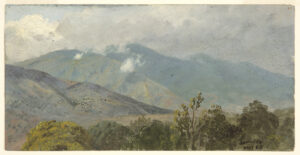
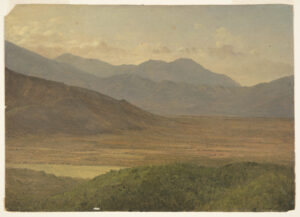
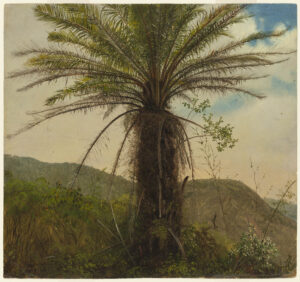
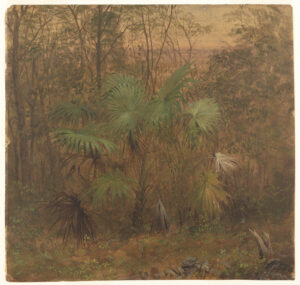
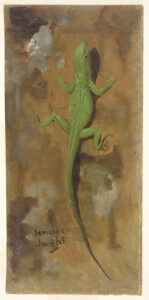
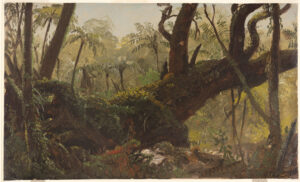
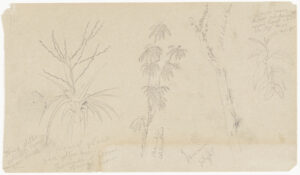
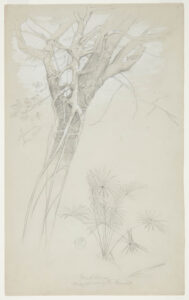
 This fall, Cooper Hewitt, Smithsonian Design Museum will present “Frederic Church in Jamaica,” featuring the artist’s rarely exhibited sketches from his 1865 travels to Jamaica. On view Friday, Oct. 30, through Monday, Feb. 15, 2027, the exhibition brings together over 60 works documenting Jamaica’s plant life and landscapes in detailed observational studies, framed within Church’s personal biography, grieving the loss of his two young children, and the wider context of a society and environment under colonial rule. Celebrating the 200th anniversary of Church’s birth, the exhibition draws from Cooper Hewitt’s holdings of over 2,000 of the artists’ oil studies and graphite sketches—the largest collection of Church works in the world.

“‘Frederic Church in Jamaica’ offers a window into the creative process of one of America’s most influential artists through oil studies and ‘en plein air’ sketches, which have rarely—if ever—been publicly exhibited,” said Caitlin Condell, curator and head of Drawings, Prints & Graphic Design at Cooper Hewitt. “The 200th anniversary of Church’s birth is an ideal moment for a celebration of the artist’s extraordinary work and a reinterpretation of these objects in the context of Jamaican history. These intimate drawings, made during a period of intense grief, have a powerful resonance in our contemporary moment.”

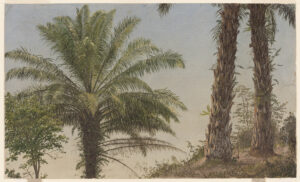
Very detailed painted botanical sketch of three palm trees growing on a steep hillside in Jamaica.
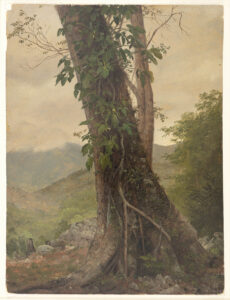
Painted sketch of a lone tree, half-framed to feature mostly its trunk and the leaves and vines that adorn it.
Painted sketch of stormy valley landscape. In the foreground, small hills covered in vegetation are in shadow.
Highly detailed painted sketch of a mountain valley in Jamaica.
Detailed painted sketch of the top of a palm tree.
Painted detail sketch of a short palm tree centered against a brown toned interior of a jungle.
Detailed painted sketch of a bright green lizard with yellow eyes climbing a lightly sketched brown and grey background.
Detailed painted sketch showing a view of a large, diagonally-growing tree in a dense rainforest.
Botanical study sketches showing views of four different plants in Jamaica.
Detailed graphic sketch drawing of tree ensnared in a parasitic vine.
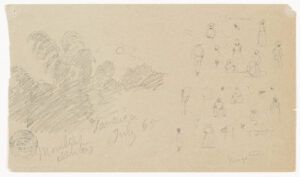
Loosely sketched drawing of nighttime scene with a cluster of bamboo trees on left, and figure studies on the right.
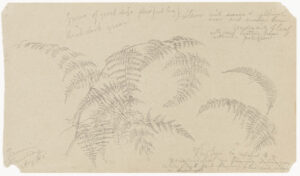
Detailed pencil sketch of a fern leaves, the studies overlapping one another to create a cluster.


Acclaimed for his monumental and astonishingly detailed landscape paintings, Church (American, 1826–1900) was an intrepid traveler and regularly journeyed around the globe seeking inspiration for his pictures. However, his April 1865 trip to Jamaica with his wife, Isabel, was in search of emotional and spiritual refuge, following the recent deaths of their two young children from diphtheria. Every day for five months, Church trekked on foot and by horse documenting the island’s topography and plant life and capturing dramatic moments of light and weather. Created during the artist’s private anguish and the public turmoil engulfing the country, where Black Jamaicans lived in extreme poverty under British colonial rule, the breathtaking sketches attest to the expressive and healing power of drawing from nature and the complexity of memory imbued in the land.

Whether executed in moments or over the course of hours, the sketches on view reveal Church’s extraordinary artistic range. The picturesque, atmospheric drawings and oil studies reflect his aspiration to accurately record details of light, color and form, but also the emotional experience of a place or scene. His graphite sketches are frequently annotated with brief notations that are both informative and poetic.

The exhibition will offer important historical context and surface the voices of Black Jamaicans, including Paul Bogle and George William Gordon, who actively addressed political tensions in the island. On view will be reproductions of period photographs (some collected by Church and some from the National Library of Jamaica), as well as rare books from Smithsonian Libraries and Archives.

Throughout the span of the exhibition, a dynamic lineup of public programs will draw in contemporary perspectives to reflect on Church’s career and the relevance of his drawings today, the economic and climate legacy of Jamaica, and the significance of observation and drawing through time. On Thursday, Nov. 12, Victoria Johnson, author of the 2026 Church biography, Glorious Country, will present an illustrated lecture that places Church within the broader global context of his time. Additional programming includes a hands-on workshop with the Smithsonian’s botanical illustrator, Alice Tangerini, highlighting the flora native to Jamaica through the practice of drawing specimens.

“Frederic Church in Jamaica” is organized by Caitlin Condell, curator and head of Drawings, Prints & Graphic Design, with Mackenzie Jones, collections assistant.

The Photography Collection: Man Ray: Kiki

 The Museum Ludwig

October 31, 2026 – June 13, 2027

The Museum Ludwig’s photography collection comprises approximately 70,000 works, spanning from the early days of photography in the early 19th century to the present day. In our photography galleries, we regularly curate exhibitions featuring selected themes and photographers.

This presentation centers on Man Ray’s photograph Le Violon d’Ingres (1924), a nude showing the singer, actress, and painter Alice Prin – known as Kiki de Montparnasse (1901–1953) – from the back. Inspired by works of the neoclassical painter Jean-Auguste-Dominique Ingres, Man Ray transposes the motif into the twentieth century: in the darkroom, he used a stencil to add the f-holes of a violin to Kiki’s back so that her body becomes the resonator of a string instrument – an allusion to Ingres’ passion for playing the violin. The print on display at the Museum Ludwig is from the collection of L. Fritz and Renate Gruber and is a hand-signed reproduction of the version that made headlines in 2022 as the most expensive photograph ever sold at auction. The exhibition sheds light on the making and reception of this Surrealist icon.

Kiki grew up in poverty and earned a meagre living in Paris as a “singer, actress, painter, Queen of Montparnasse,” as the inscription on her grave states. Since her earliest youth, she also worked as a painter’s model. In 1921 she met the American painter and photographer Man Ray. They became a couple and in the eight years they were together Man Ray repeatedly took her picture, often as a nude or in closeup. Of the resulting pictures, Le Violon d’Ingres is among the most famous.

There are two original versions of Le Violon d’Ingres. For the first, Man Ray painted the f-holes onto the print. This is the picture that André Breton published in the Surrealist magazine Littérature in 1924 and that is now held by the Centre Pompidou in Paris. For the second version he took a different approach. He made a stencil of the sound holes and used it in the darkroom, combined with the negative of the main image, to make a photogram. The Museum Ludwig print is a later reproduction derived from this second original version and came to the museum with the collection of L. Fritz and Renate Gruber in 1977. Man Ray hand-signed the print with “E.A. Man Ray”. E.A. stands for épreuve d'artiste, an artist’s print, making it especially interesting to collectors.

How many prints of Man Ray’s picture exist is a matter of research. Only a few are known; the Museum Ludwig copy is the focus of this exhibition. Its production and reception offer insights not only into Surrealist photography, but also into the development of the photography market and the recognition of Man Ray as a photographic artist, even though he preferred, right up to his death in 1976, to be known as a painter – like Ingres.

Alongside Le Violon d'Ingres and related materials from the Museum Ludwig’s Man Ray – L. Fritz Gruber Archive, the exhibition also shows other photographs of Alice Prin taken by Man Ray, as well as historical images and sound recordings of the sitter.

Yilmaz Dziewior, director of the Museum Ludwig: “The Museum Ludwig holds over a hundred photographs, paintings, and objects by Man Ray, as well as extensive archive materials. Le Violon d’Ingres is among the best-known works in the history of art and photography, and I am very glad to give our visitors the chance to take a deep dive into its making and reception thanks to this focused exhibition. The show also recalls Man Ray’s decades-long association with the collectors L. Fritz and Renate Gruber, and their later links with the Museum Ludwig. Le Violon d’Ingres is one of the works that laid the foundations for the Museum Ludwig’s photography collection in 1977.”


Curator: Miriam Szwast


Man Ray, Kiki, Violon d’Ingres, 1924, Gelatinesilberpapier, Montage 38,6 x 30 cm, Museum Ludwig, Köln, Repro: Historisches Archiv der Stadt Köln mit Rheinischem Bildarchiv, © Man Ray 2015 Trust / VG Bild-Kunst, 2026


Man Ray, Kiki, 1926, Gelatinesilberpapier 23,2 x 17,9 cm, Ankauf Gruber 1977, Museum Ludwig, Köln, Repro: Historisches Archiv mit Rheinischem Bildarchiv / Rolf Zimmermann, © Man Ray 2015 Trust / VG Bild-Kunst, 2026


Man Ray, Kiki, 1925, Kontaktabzug 10,5 x 7,3 cm, Ankauf Gruber mit Unterstützung der Kulturstiftung der Länder und der Kunststiftung NRW 2012, Museum Ludwig, Köln, Repro: Historisches Archiv mit Rheinischem Bildarchiv

© Man Ray 2015 Trust / VG Bild-Kunst, 2026


Man Ray, Selbstporträt mit Kamera, 1932, Gelatinesilberpapier, Print 20,4 x 15,7 cm, Schenkung Gruber 1985, Museum Ludwig, Köln Repro: Historisches Archiv mit Rheinischem Bildarchiv, © Man Ray 2015 Trust / VG Bild-Kunst, 2026