Tate Britain
Tate Britain has launched Europe’s largest retrospective of James McNeill Whistler in 3 decades. Bringing together 150 exquisite works of art, it offers a once-in-a-generation opportunity to see the full breadth of his painting, drawing, printmaking and design, from the iconic Portrait of the Artist’s Mother to a remarkable collection of nocturnes and previously unseen sketchbooks. It also reveals how Whistler created his ethereal visions of modern life and foretold the future of modern art. Visitors will discover a defiantly experimental artist and cosmopolitan celebrity who disrupted Victorian society in the pursuit of truth, beauty and artistic progress.
The exhibition opens with a room inspired by Whistler’s studio. Four major self-portraits have been brought together from across his career, including The Artist in His Studio 1865-6, as well as two outstanding full-length portraits of fellow painter Maud Franklin. These are surrounded by Whistler’s own collections of East Asian ceramics, Japanese prints and artist-designed furniture, as well as his easel, paint palette and brushes, evoking the artist’s working environment and creative process.
Whistler was a truly global figure, forging a nomadic career that spanned four continents. For the very first time, his teenage years will be explored through the studies he made at the Imperial Academy of Arts, St Petersburg and the United States Military Academy, West Point. These include his earliest notebooks, which are displayed publicly for the first time. After moving to Paris at the age of 21, Whistler embraced the vibrant, bohemian atmosphere of the city and, alongside young contemporaries like Edgar Degas, developed a lifelong interest in working-class subjects and spaces. His etchings of modern life will be reassessed alongside his earliest oil paintings from nature, pictures of friends and self-portrait Whistler Smoking 1856-60, unseen since his death.
Whistler spent his late twenties crossing between Paris and London, pioneering impressionist techniques and painting landscapes in the open air, including the French coast and the modern spectacle of the industrialised River Thames. The exhibition showcases his first and largest statements in landscape, Coast of Brittany 1861 and Wapping 1860-4, as well as domestic interiors for which he gained critical recognition. In a landmark loan to the UK, Whistler’s iconic Arrangement in Black and Grey: Portrait of the Painter's Mother 1871 is presented as part of a triumphant familial ‘triptych’ between his self-portrait Arrangement in Grey: Portrait of the Painter 1872, and that of his brother, Portrait of Dr. William McNeill Whistler 1871-3. They are at once an audacious declaration of a minimal new style and a poignant exploration of family identity.
Whistler argued that ‘nature is very rarely right’ and believed that the true artist invents their own harmony of colour and line. The elegant Butterfly Cabinet will be seen in the context of Whistler’s provocative interior design, notably Harmony in Blue and Gold: The Peacock Room 1877, in the Freer Gallery of Art in Washington. The exhibition hosts the largest ever assembly of Whistler’s Nocturne landscapes, beginning with the first, painted in Chile (Nocturne in Blue and Gold: Valparaiso 1865–74) and ending with the last, painted in Italy (Nocturne: Blue and Gold – St Mark's, Venice 1880). In Britain, Whistler turned nighttime views of factories and pleasure gardens along the Thames, reflected by streetlights and fireworks, into timeless, atmospheric works of art. Tate has offered a fresh perspective on how Whistler made these paintings, which provoked bitter arguments among artists, patrons and critics, and even a court case, resulting in his bankruptcy and exile from London.
Whistler continued to battle for his idea of beauty until the end of his life. His last two decades were spent roaming Britain, Europe and North Africa, exploring poetic, spontaneous techniques in every medium. He grew increasingly experimental and his style became more atmospheric and abstract, leading to some of his finest etchings and lithographs, including Dance House: Nocturne 1889. In London, he set out his new theories in satirical letters, booklets and the hugely influential performance Mr Whistler’s 10 O clock. He also staged ground-breaking solo and group exhibitions, their lighter colour schemes and minimal furnishings anticipating the modern ‘white cube’ aesthetic.
The exhibition concludes with exceptional examples of the astonishing full-length portraits, repeatedly rubbed back and reworked until they became almost apparitional, from the mysterious Portrait of Lady Archibald Campbell 1883 to the Rembrandt-inspired Gold and Brown: Self Portrait c.1896-8.
The exhibition is curated by Carol Jacobi, Curator, British Art 1850-1915; Tate Britain, with Isobel Muir, Assistant Curator, 19th Century British Art; James Finch, former Assistant Curator, 19th Century British Art; and Edwin Becker, Chief Curator of Exhibitions, Van Gogh Museum, and Renske Suijver, Curator Van Gogh Museum and The Mesdag Collection. With curatorial advisors Patricia de Montfort, Senior Lecturer in History of Art & Research Curator, The Hunterian at University of Glasgow; Elisa Germán, Lunder Curator of Works on Paper and Whistler Studies, Colby College Museum of Art; and honorary advisor Margaret F. MacDonald Professor Emerita & Honorary Professorial Research Fellow, School of Culture and Creative Arts, University of Glasgow.
BOOKS
James McNeill Whistler
Published May 2026
edited by Carol Jacobi
Hardback £45/Paperback £35
An international selection of writers look afresh at this audacious artist, casting new light on his unsettled life, and the way he redefined the special value of the artist in a shifting, materialist world. The catalogue boasts contributions by Horace D. Ballard, Qamoos Bukhari, Alexis Clark, Caitlin Doley, James Finch, Miguel Gaete, Eliza Germán, Diana Greenwold, Anna Gruetzner Robins, Jane McCree, Margaret MacDonald, Patricia de Montfort, Kenneth John Myers, Ayako Ono, Grischka Petri, Renske Suijver, Daniel E. Sutherland, and Joyce H. Townsend.
Meet the Artist: James McNeill Whistler
by Dide Tengiz
£7.99
Join Dide Tengiz on a wonderful adventure through the astonishing landscapes and portraits of James McNeill Whistler, an artist who challenged the art world and is now celebrated as one of the most influential artists of the nineteenth century. Learn about tonal harmony and the Aesthetic Movement, draw an urban streetscape and etch your own Whistler-inspired motif.
IMAGES
James McNeill Whistler, Wapping, 1860-4. National Gallery of Art, Washington.- James McNeill Whistler, Coast of Brittany (Alone with the Tide), 1861. Wadsworth Museum of Art. In memory of William Arnold Healy, given by his daughter, Susie Healy Camp
James McNeill Whistler, Symphony in White, No. 2: The Little White Girl. 1864. Tate.
James McNeill Whistler, The Artist in His Studio. 1865-66. Art Institute of Chicago. Friends of American Art Collection.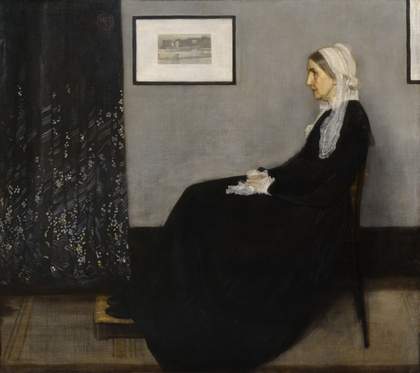
James McNeill Whistler, Portrait of Dr. William McNeill Whistler, 1871-73. Art Institute of Chicago. Gift of Mary T. Wentworth in memory of her husband, John.
James McNeill Whistler, Arrangement in Gray: Portrait of the Painter, ca. 1872, oil on canvas. Detroit Institute of Arts, Bequest of Henry Glover Stevens in memory of Ellen P. Stevens and Mary M. Stevens, 34.27.
James McNeill Whistler, Harmony in Grey and Green: Miss Cicely Alexander. 1872-3. Tate. Photo (c) Tate.
James McNeill Whistler, Nocturne: Blue and Gold - Old Battersea bridge. 1872-5. Tate.
James McNeill Whistler, Nocturne: Black and Gold - The Fire Wheel. 1875-7. Tate.
James McNeill Whistler, Head of a Peasant Woman, 1855–58. © The Hunterian, University of Glasgow.
James McNeill Whistler, Whistler Smoking, 1856-60. Private Collection.
James McNeill Whistler, Nocturne. c.1870-7. The White House © 2026 White House Historical Association.
James McNeill Whistler, ‘St Petersburg Sketchbook’, p.6, 1844–48. © The Hunterian, University of Glasgow.


