Waddington Custot, Paris
8 April to 6 June 2026
The Nabi Shock, a landmark exhibition devoted to a movement at the heart of the gallery’s expertise. Bringing together key works by Émile Bernard, Pierre Bonnard, Maurice Denis, Charles Filiger, Paul Ranson, József Rippl-Rónai, Ker-Xavier Roussel, Paul Sérusier and Edouard Vuillard, the exhibition foregrounds the subtle radicalism of these modernist artists. Presented alongside works by contemporary artists, such as Etel Adnan, Ben Arpéa, Marcel·la Barcelò, Ian Davenport, Marcel Dzama, Pierre Knop, François Réau, Anne Rothenstein, Christine Safa, and Fabienne Verdier, The Nabi Shock reveals the striking contemporary resonance of the Nabis aesthetic, in which colour, rhythm, and interiority remain the driving forces.
The exhibition brings together around thirty works by the leading figures of the movement, including Émile Bernard, Pierre Bonnard, Maurice Denis, Charles Filiger, Paul Ranson, József RipplRónai, Ker-Xavier Roussel, Paul Sérusier and Edouard Vuillard.

Paul Sérusier, Bretonne allaitant, 1892, oil on canvas, 73x55 cm (28,7 x 21,6 in)
As proponents of Paul Gauguin's philosophy, which advocated the right "to dare anything", the Nabis drew inspiration from the painter's quest for colour liberation and his conception of painting as an inner spiritual journey. One of the most notable works produced under Gauguin's direct influence was Le Talisman by Paul Sérusier, which became a foundational work and aesthetic touchstone for the group.
The term “Nabi”, borrowed from Hebrew and meaning “prophet”, reflects both the spiritual quest and innovative ambition of this collective, which saw itself as heralding an artistic renewal. The Nabis favoured simplified forms and swathes of colour, as seen in Bretonne allaitant by Paul Sérusier. The influence of Neo-Impressionism is also prevalent in Pierre Bonnard's Étude pour Le Corsage à Carreaux, while Japonism shaped the work of artists such as Paul Ranson, exemplified in Le Grand Tigre.
Closely aligned with Symbolism, the Nabis were equally attentive to contemporary life, seeking to celebrate the everyday. Interior scenes, contemplative figures and stylised landscapes were thus elevated to the status of artistic subjects in their own right.
Despite being composed exclusively of men, the group drew constant inspiration from women, making "their mother, their companion or wife, their sister" as "privileged models" (Gilles Genty), as exemplified by Maurice Denis's Portrait de Marthe au tablier rouge (esquisse) and Ker-Xavier Roussel's Femmes au jardin.
Drawing inspiration from prints, stained glass and folk art, the Nabis movement rejected the traditional hierarchy of genres and advocated continuity between the so-called 'major' and 'minor' arts.
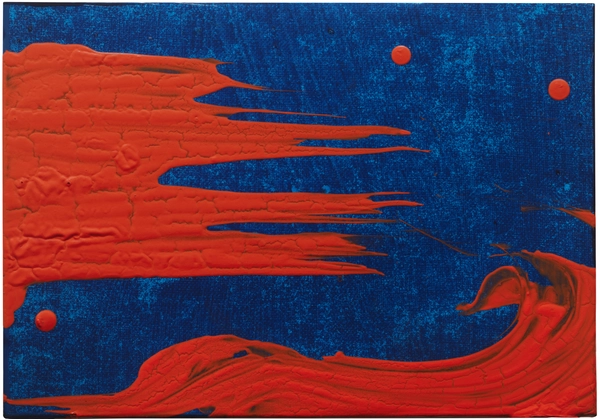
- Fabienne Verdier, Sur les routes de la mer, 2025acrylic and mixed media on canvas6 3/8 x 9 1/4 in 16 x 23.5 cm
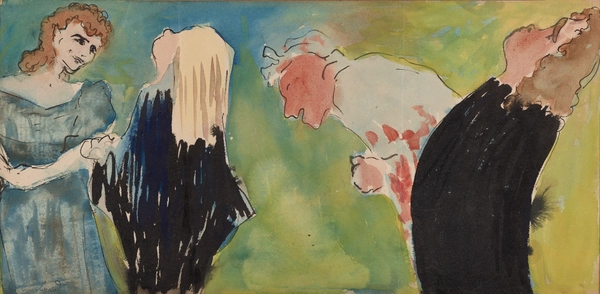
- Édouard Vuillard, Coquelin Cadet dans “Le Malade imaginaire”, c.1890watercolour on paper affixed to panel9 1/2 x 18 7/8 in 24 x 48 cm
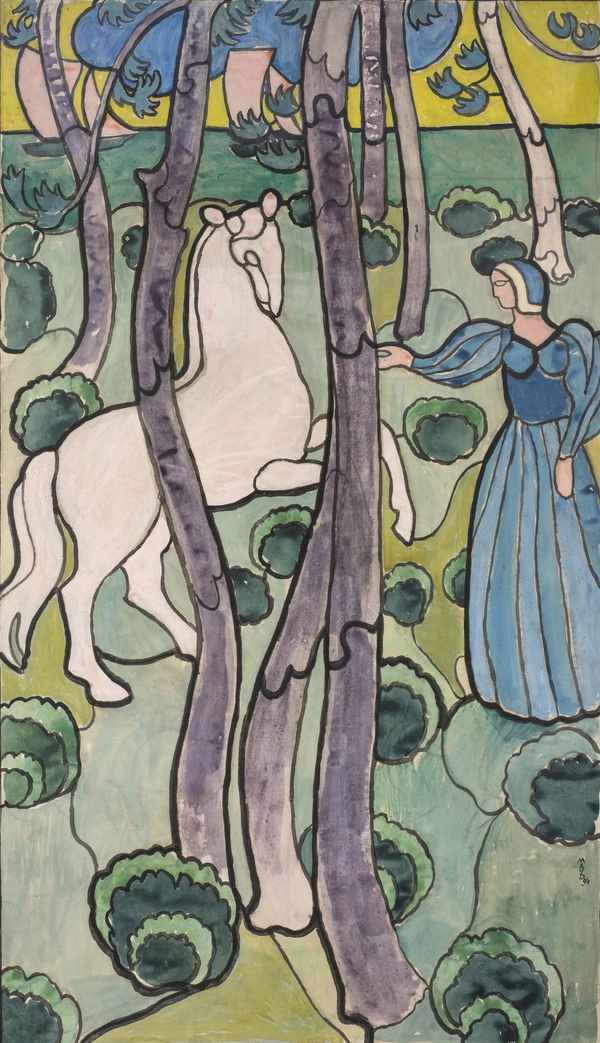
The same rigorous approach was therefore applied to painting, decoration, printmaking and the applied arts, resulting in a variety of projects, such as Maurice Denis' stained-glass design Le Cheval blanc. This openness enabled the group to experiment with a variety of media, playing a pivotal role in the evolution of the decorative arts and reproducible practices at the dawn of modernity.
The 'Nabi shock' is embodied through an unprecedented dialogue between works by the Nabis and contemporary pieces by Etel Adnan, Ben Arpea, Marcella Barceló, Ian Davenport, Marcel Dzama, Pierre Knop, François Réau, Anne Rothenstein, Christine Safa and Fabienne Verdier, highlighting a shared conception of painting as an autonomous, sensory and interior space.
While the Nabis championed a subjective, decorative and synthetic approach to painting, in which colour, rhythm and interiority took precedence over illusionistic representations of reality, this sensibility continues to resonate in contemporary practice.
Through radical simplification and bold chromatic choices, Etel Adnan's compositions reflect the spiritual journey and symbolic depth of artists such as Charles Filiger.
Fabienne Verdier's concentrated, meditative and physical gesture engages in dialogue with Maurice Denis's conception of painting as an inner experience. Ian Davenport's work features repetition, fluidity, and the musicality of colour, building upon the creative and rhythmic ambition evident in the oeuvre of Pierre Bonnard and Édouard Vuillard.
Like the Nabis, these contemporary artists embrace a variety of artistic languages while sharing a common intention: to reaffirm a vision of painting in which surface, material, and colour become vehicles for a poetic and interior experience of the world. In doing so, they inscribe the Nabi aesthetic within a living and ongoing history.
A catalogue featuring texts by art historian Gilles Genty further expands upon this perspective and sheds light on the historical and contemporary significance of this artistic constellation.
