ICABIA AND VAN RYSSELBERGHE LEAD IMPRESSIONIST AND MODERN ART SALE AT BONHAMS IN PARIS
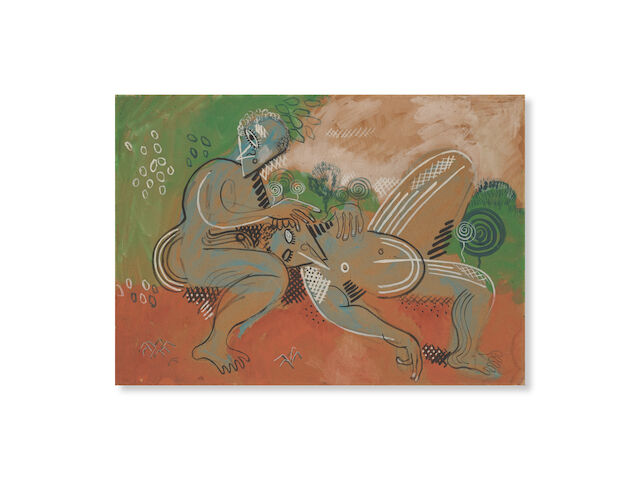
Paris – Estimated at €600,000-800,000, Idylle, an important masterpiece by Francis Picabia (1879-1953) a leading figure of the European avant-garde and one of the most inventive artists of the twentieth century, will be offered at Bonhams in the forthcoming Impressionist & Modern Art Sale in Paris on 2 December.
Emilie Millon, International Director, Impressionist and Modern department at Bonhams, said: "Idylle is a quintessential Picabia. It combines mystery, humour, seduction and subversion in equal measure. Its remarkable provenance and exceptional exhibition history make it one of the most significant works by Picabia to appear on the market in recent years."
Painted circa 1925-1927, Idylle belongs to Picabia's celebrated series known as the Monstres (Monsters), a pivotal body of work created during one of the artist's most radical and experimental periods. Executed in oil and gouache on cardboard, the composition exemplifies Picabia's fascination with ambiguity, theatricality and the fluid boundaries between beauty and grotesque transformation.
The painting boasts an exceptional provenance. It was held in the collection of Gabrielle Buffet-Picabia, the artist's wife and one of the key intellectual figures of the Parisian avant-garde, before entering the collection of André Breton, founder of Surrealism. The work later passed to Simone Collinet, Breton's first wife and an influential patron of the Surrealist movement, before remaining in private Belgian collections for more than three decades.
Idylle has also enjoyed an outstanding exhibition history, having been shown in major exhibitions dedicated to Picabia and Surrealism across Europe and the United States. Highlights include presentations at the Solomon R. Guggenheim Museum in New York (1970), the Musée des Arts Décoratifs in Paris (1976), the Centro de Arte Reina Sofía in Madrid (1991), the Centre Pompidou in Paris (1991), and the Kunsthalle Krems (2012).
Another highlight of the sale is a remarkable portrait of Valère Mabille by Théo Van Rysselberghe (1862-1926), one of the leading figures of Belgian painting at the end of the nineteenth and beginning of the twentieth century. Dated 1888 and signed with the artist's monogram and dated upper left, this important large-scale oil on canvas (140.5 x 90.5 cm) has remained in a Belgian family collection for several generations (estimate : €40,000-60,000).
The painting depicts Valère Mabille (1840-1909), a visionary industrialist, banker, philanthropist and distinguished patron of the arts. Few portraits so perfectly embody the spirit of an era shaped simultaneously by industrial expansion, social ambition and Belgium's cultural flourishing. Painted at a time when Théo Van Rysselberghe had already established himself as one of the most brilliant artists of his generation, the portrait reveals the painter's remarkable psychological insight. Even before embracing Neo-Impressionism, Van Rysselberghe excelled in portraiture, capturing the character of his sitters with extraordinary intensity. Valère Mabille's direct gaze and confident bearing convey the stature of this exceptional entrepreneur, whose industrial achievements would profoundly influence the Centre region of Wallonia.
Born in 1840 in Hon-Hergies in northern France, Valère Mabille abandoned his studies at the Mons School of Mines to take over a modest metalworking workshop at Les Hayettes, near Morlanwelz. Through determination, hard work and ambition, he built a true industrial empire specialising in railway equipment exported around the world at a time when the railways were transforming the global economy. Known as the "master of ironworks", he also expanded into banking through the creation of the Comptoir du Centre and became a pivotal figure in the region's economic development. Yet Valère Mabille distinguished himself not only through his industrial success. Guided by deep Christian convictions, he devoted a significant portion of his fortune to social, educational and cultural causes. He supported schools, mutual aid organisations and workers' housing projects, embodying the ideals of the social Catholic movement that emerged in the late nineteenth century.
A passionate art lover, Valère Mabille maintained close relationships with several major figures of the Belgian cultural scene, including the poet Émile Verhaeren and the painter Fernand Khnopff. His Château des Hayettes became a lively centre for intellectual and artistic exchange. His commission of a portrait from Théo Van Rysselberghe reflects his proximity to the most progressive artistic circles of his time. Today, the painting stands as a precious testament to the close ties that united leading Belgian industrialists and avant-garde artists at the end of the nineteenth century.
Christine de Schaetzen, Senior international Specialist, 20th & 21st Century Art department at Bonhams, said: "This portrait brings together two exceptional figures of late nineteenth-century Belgium: Théo Van Rysselberghe, one of the most important artists of his generation, and Valère Mabille, a visionary industrialist and patron deeply committed to the social and cultural life of his time. Through its scale, provenance and inclusion in the artist's catalogue raisonné, this work represents a major rediscovery and a fascinating testament to the golden age of industrial and artistic Belgium."
