Thursday, October 2, 2014

Arthur Boyd: Agony & Ecstasy at the National Gallery of Australia


The National Gallery of Australia is exhibiting Arthur Boyd: Agony & Ecstasy until 9 November. It is the first major exhibition of Boyd’s art in over twenty years. The exhibition includes more than 180 spectacular works of art including paintings, tapestries, prints, drawings, sculptures and ceramics. The exhibition is on display in Canberra only.

The focus of the exhibition is on Arthur Boyd as an intense, passionate visionary capable of plumbing the depths and vicissitudes of human emotions. The show is not a retrospective but rather provides the opportunity to take a close look at a number of works that have never or rarely been previously exhibited, as well as series and groups of works, undertaken from 1937 through to 1980. While the Australian landscape informs some works, the emphasis is on the way that Boyd engages with human experience—starting with an intense early self-portrait painted when he was only seventeen through to works of great potency undertaken four decades later. While there are intimate as well as expansive works, the sheer scale of many of them mean that this is a once in a lifetime opportunity to see them together. While the public are perhaps very familiar with Boyd’s works from the 1940s and 50s, the exhibition also seeks to emphasise the strengths of his art created in the 1960s and 70s.


    • Arthur Boyd
      Self portrait in red shirt 1937
      oil on canvas on cardboard
      51.5 x 45.4 cm
      National Gallery of Australia, Canberra
      The Arthur Boyd gift 1975


    • Arthur Boyd
      Nebuchadnezzar making a cloud 1968
      oil on canvas
      174.8 x 183. 2 cm
      National Gallery of Australia, Canberra
      The Arthur Boyd gift 1975


      Arthur Boyd
    • Nebuchadnezzar being struck by lightning 1969
      oil on canvas
      174.3 x 183.2 cm
      National Gallery of Australia, Canberra
      The Arthur Boyd gift 1975


      Arthur Boyd
    • Paintings in the studio: 'Figure supporting back legs' and 'Interior with black rabbit' 1973–74
      oil on canvas
      313.5 x 433.2 cm
      National Gallery of Australia, Canberra
      The Arthur Boyd gift 1975


      Arthur Boyd
    • Birth of Narcissus 1976
      oil on canvas
      152.5 x 122.0 cm
      National Gallery of Australia, Canberra
      Gift of Joseph Brown 1991


      Arthur Boyd  
    • The unicorn sees the lady 1973–74, plate 10 in The lady and the unicorn, a portfolio of twenty-four etchings
      etching and aquatint
      78.8 x 57.6 cm
      National Gallery of Australia, Canberra, purchased 1978
      Reproduced with the permission of Bundanon Trust


      Arthur Boyd  
    • The prodigal son 1948–49, from the Harkaway mural
      casein tempera, powder colour on plaster on mortar
      230.0 x 227.0 cm
      National Gallery of Australia, Canberra
      Gift of Arthur Boyd 1969
      Reproduced with the permission of Bundanon Trust


      Arthur Boyd  
    • The mining town (Casting the money lenders from the temple)c.1946
      oil and tempera on composition board
      87.4 x 109.4 cm
      National Gallery of Australia, Canberra, Purchased 1974
      Reproduced with the permission of Bundanon Trust


      Arthur Boyd  
    • Europa and the bull 1951–52
      earthenware, coloured slips, clear glaze

      39.9 x 42.9 cm
      National Gallery of Australia, Canberra
      The Arthur Boyd gift 1975

The exhibition is extensive and includes important series such as the dramatic, biblical Nebuchadnezzar paintings, exquisite prints and large tapestries on the theme of The lady and the unicorn, lively costume designs for the ballet Elektra (choreographed by Robert Helpmann in 1963) and his remarkable Caged painter series. 


St Francis beaten by his father

A special room has also been constructed for Boyd’s visionary images on the life of St Francis, including prints and pastels as well as a dazzling group of large-scale tapestries not previously exhibited together.

Among the many works that have not been exhibited before is The prodigal son, a large fragment of a mural that was painted by Arthur for his uncle, the well-known novelist, Martin Boyd. Undertaken in 1948, its original location was the dining room of a house known as The Grange, built by his great grandparents in 1866 at Harkaway near Berwick in Victoria. Sadly, The Grange was eventually demolished to make way for a quarry. After years of thwarted attempts to save the mural, four relatively large components and several small sections were saved and eventually came to the National Gallery of Australia..


Wednesday, October 1, 2014

Manet, Cézanne, Van Gogh – Guests from Around the World


Key pieces from outstanding museums in the United States and Europe encounter the high-quality collection of late 19th-century, modern French art of Kunsthalle Mannheim, at the Kunsthalle Mannheim, September 26, 2014 - January 18, 2015.


“The Cardplayers” by Paul Cézanne (1892/95) flown in from London,


“The Dead Toreador” (probably 1864), a main work by Édouard Manet,  from Washington. 

A dialogue between masterpieces begins in the lavishly refurbished Jugendstil building. For the first time, the museum in Mannheim places the focus on its most valuable art treasures and enables the audience to view rare loans from around the world.


Claude Monet (1840–1926), Die Rue de la Bavolle in Honfleur, 1864 


Guest curator Dr. Marie-Amélie zu Salm-Salm juxtaposes the works in Mannheim with carefully selected, imposing counterparts from major European and American museums, thus highlighting important artistic innovations of this unique rise to modernism - like the treatment of colour and light, questions of composition, the choice of motifs, and the use of new painting techniques. Key works by Manet, Cézanne and Van Gogh, as well as paintings by Delacroix, Courbet, Corot, Pissarro, Sisley, Monet, and Renoir enter into a fascinating dialogue of styles and motifs. The focus on top class works of French painting allows visitors an intensive encounter with the individual work and its counterpart.


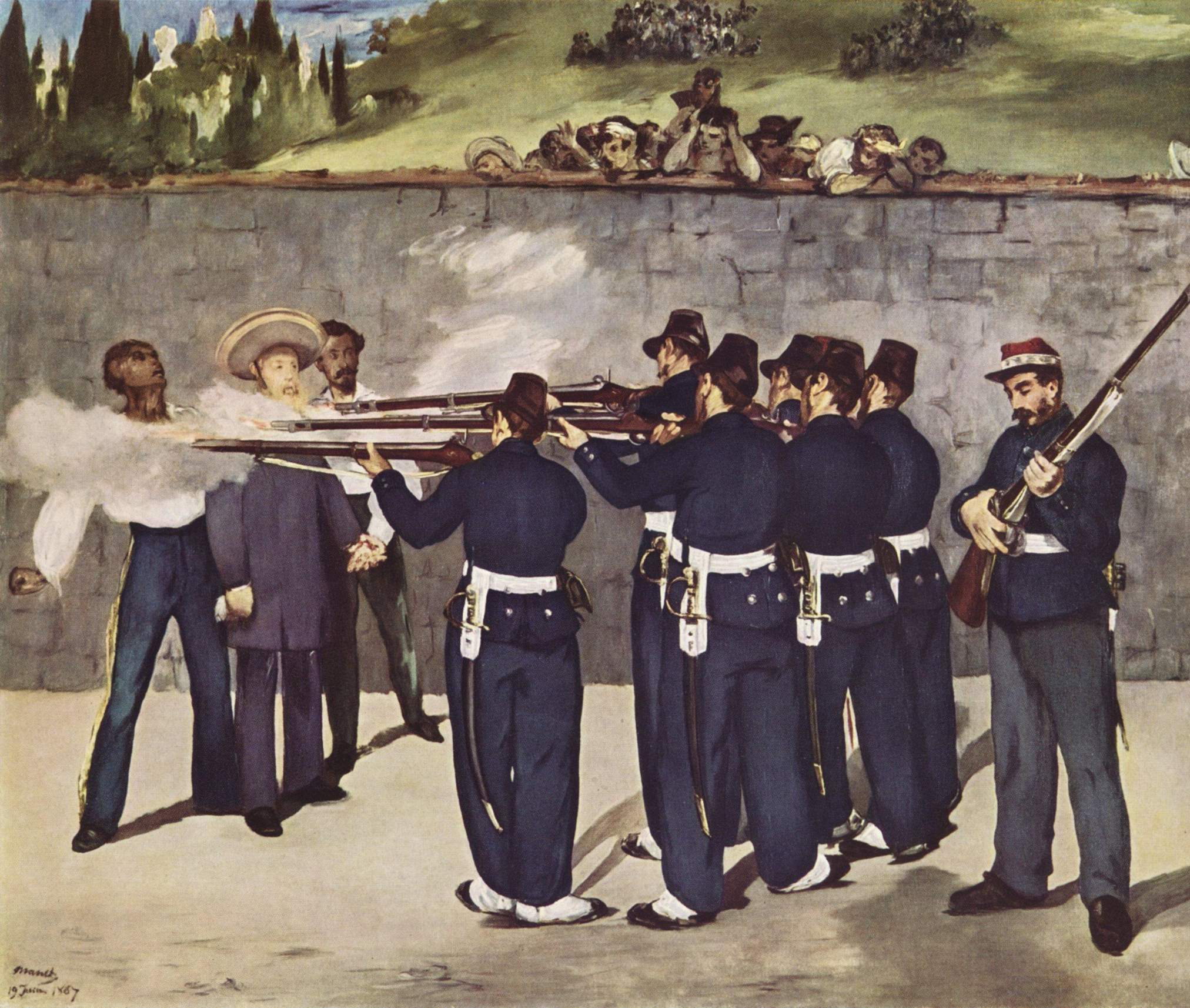
Édouard Manet’s “The Execution of Emperor Maximilian” 

Mirrored by the other, the key works of Mannheim can be newly perceived and taken to one’s heart.

A surprise waits for the visitor at the end of the tour: The view to 20th-century abstraction with pivotal works by Piet Mondrian, Ellsworth Kelly and Josef Albers, exemplarily reveal the impact of Impressionism on art and artists of the 20th century and their way of dealing with form and color.


One highlight is certainly the finale of the exhibition: 


Mondrian’s “Composition with Yellow and Blue”, 1932, from Switzerland, 


next to Cézanne’s “Smoker with Propped Arm” from Mannheim 

and his “The Card Players” (above) from London. This constellation visualizes Mondrian’s affinity to Cézanne’s approach of liberating colour from form.


Picturing America: Signature Works from the Westmoreland Museum of American Art


Childe Hassam (1859-1935), The Outer Harbour, 1909 oil on canvas, 28 x 26 3/16 in., Collection of the Westmoreland Museum of American Art, 
Mary Marchand Woods Memorial Fund, 1964.1
                                      

Picturing America represents two hundred years of American art, from colonial times to the mid-twentieth century, as America came into its own as the cultural capital of the world. Seen through the subject areas of portraiture, still life, landscape, and narrative painting, the artists represented in this exhibition serve as a survey of American art.   

Venues

Dixon Gallery and Gardens Memphis, TN hrough October 6. 2013
Vero Beach Museum of Art February 15 - May 25, 2014
Georgia Museum of Ar June 14, 2014 - August 24, 2014
Hyde Museum, Glens Falls, N.Y., September 28, 2014 - January 4, 2015


From the 1758 Portrait of John Gardiner by John Singleton Copley to Milton Avery's Arrangement with Plants of 1948, the exhibition presents 57 paintings and sculptures that describe the American experience from the Colonial period to early Modernism.


Gifford Beal, Sea Bass Fisherman, 1940, Oil on canvas, Westmoreland Museum of American Art, Anonymous Gift through the Westmoreland Society, 1995.51
Magnificent scenes of the early American landscape painted by Hudson River School artists Alfred Thompson Bricher, George Inness, and Worthington Whittredge recall the emergence of the Hudson River School during the nineteenth century, a period when our young nation was struggling to define its identity. The period of growth and development that ensued at the turn of the century coincided with a national shift in aesthetic—audiences will recognize this transition through impressionist pieces by Mary Cassatt, Childe Hassam, and Paul Cornoyer, and examples of urban Realism by Robert Henri and Everett Shinn. Moving into the twentieth century, Modernism and the move towards abstraction can be seen in scenes by Milton Avery and Guy Pène du Bois. 

Other renowned artists from the two hundred year span represented in this selection include William Merritt Chase, Susan MacDowell Eakins, Childe Hassam, Robert Henri,  Paul Manship, John Singer Sargent and Benjamin West as well as Charles Willson Peale and his children Rembrandt, Rubens and Mary Jane. The rich variety of expressive means represented by the works in the exhibition, including still-life, portraiture, narrative and abstraction, provides a visual embodiment of such national ideals as freedom, diversity and opportunity. 

Portraits, America's earliest and most dominant form of pictorial expression, were most often commissioned to record a person's affluence, as a means of attaining immortality and as memento mori pieces for remembering the dead. 

The collection offers a spectrum, ranging from objective portraits like Westmoreland's first painting acquisition, 


"Portrait of George Washington" by Rembrandt Peale, 

to more subjective, narrative paintings like 


"Death of Elaine" by Thomas Hovenden, 

which depicts King Arthur, Queen Guenivere and Sir Lancelot mourning over the body of Elaine, who has died from a broken heart. 
Though still-life paintings continued to thrive into the 20th Century, their focus generally shifted away from recording organic materials to creating arrangements of abstract forms. This contrast can be seen between trompe l'oeil master  Severin Roesen's "Still Life with Fruit," 


(ABOVE Is another Severin Roesen's "Still Life with Fruit," )

a brilliantly hued oil painting epitomizing the country's physical bounty, and American Abstract Artists founding member 


Balcomb Greene's "Organic Forms," 1939 Oil on canvas, 24 x 36 inches Collection: Westmoreland Museum of American Art, Anonymous gift with additional funding from the William Jamison Art Acquisition Fund 

a geometric work playing with shape and space.
Reflecting the transformation of American society from primarily agrarian to industrial, the exhibition's landscape paintings range from pristine natural settings to city scenes. Lush waterfall painting 


"Silver Thread Falls, Pennsylvania" by Hudson River School painter James Brade Sword and  "The Outer Harbor" by foremost Impressionist painter Frederick Childe Hassam  (above)
 contrast greatly with the paintings of "Pittsburgh's Painter Laureate" Samuel Rosenberg, who documented socioeconomic life of the urban poor during the Depression.


(An example of Rosenberg's work)

Picturing America is organized and toured by the Westmoreland Museum of American Art, Greensburg, Pennsylvania, which is currently under renovation and expansion.


“Portrait of Helen Gallagher (Black and Green),” (ca. 1928) by Malcolm Parcell (1896-1987). Oil on canvas mounted on board, 44 1/2 x 40 inches. Gift of the Estate of Malcolm  Parcell (1896-1987). Oil on canvas mounted on board, 44 1/2 x 40 inches. Gift of the Estate of Malcolm Purcell, Westmoreland Museum of American Art.


(Photo: COURTESY of The Hyde Collection Art Museum & Historic House)

Alfred Thompson Bricher (1837–1908) Point Judith, Narragansett Bay, Rhode Island, ca. 1885 Oil on canvas 13 x 29 inches Westmoreland Museum of American Art; Gift of the Westmoreland Society, 1998.2
Alfred Thompson Bricher (1837–1908), Point Judith, Narragansett Bay, Rhode Island, ca. 1885. Oil on canvas, 13 x 29 inches. Westmoreland Museum of American Art; Gift of the Westmoreland Society, 1998.2
John George Brown (1831–1913) Maid of the Hills, ca. 1900 Oil on canvas 30 x 25 inches Westmoreland Museum of American Art; Gift of Mrs. Paul B. Ernst, 1981.78
John George Brown (1831–1913), Maid of the Hills, ca. 1900. Oil on canvas, 30 x 25 inches. Westmoreland Museum of American Art; Gift of Mrs. Paul B. Ernst, 1981.78
Robert Henri (1865–1929), Picnic at Meshoppen, PA, July 4, 1902, 1902 Oil on canvas 26 x 32 inches Westmoreland Museum of American Art; Gift of the William A. Coulter Fund, 1958.39
Robert Henri (1865–1929), Picnic at Meshoppen, PA, July 4, 1902, 1902. Oil on canvas, 26 x 32 inches.  Westmoreland Museum of American Art; Gift of the William A. Coulter Fund, 1958.39

Tuesday, September 30, 2014

Sotheby’s To Auction Vincent van Gogh's STILL LIFE, VASE WITH DAISIES AND POPPIES


Sotheby’s will offer Vincent van Gogh’s Still Life, Vase with Daisies and Poppies in its Evening Sale of Impressionist & Modern Art in New York on 4 November 2014. Painted at the home of Dr. Paul Gachet just weeks before the end of Van Gogh’s life, the artist uses the richly- colored bouquet of wildflowers to convey his psychological state at the time – a hallmark of the Expressionist icon. The resulting composition teems with the intense energy, emotion and sensitivity of this creative genius at the height of his short but renowned career. 


Still Life is one of the few works that Van Gogh sold during his lifetime, and is one of only a handful of great works by the artist to appear at auction in recent decades. The painting comes to auction this November with a pre-sale estimate of $30/50 million.

Simon Shaw, Co-Head of Sotheby’s Worldwide Impressionist & Modern Art Department, commented: “Still Life, Vase with Daisies and Poppies radiates the exuberance and passion found in Van Gogh’s greatest and most coveted works. The vibrant composition captures in sharp relief the intensity of the artist at the height of his mania, only weeks before his tragic end. Still Life has remained in the same private collection for more than two decades, which adds again to its appeal for today’s market. We are privileged to present it to collectors across the globe this autumn.”

Still Life will be on view in the Hong Kong Convention & Exhibition Centre from 2–5 October and in Sotheby’s London galleries from 12–18 October, before returning to New York for exhibition in Sotheby’s York Avenue galleries beginning 31 October.

Vincent van Gogh painted the present work in June of 1890 in Auvers-sur Oise, the town where he settled following his release from the asylum at St-Rémy that May. Renting a room at the local Ravoux Inn, he spent his days setting up his easel in the fields to paint the scenes of the lush countryside, as well as visiting with his physician, Dr. Gachet.

Still Life was painted at Dr. Gachet's house and presumably came immediately into his possession upon completion. The viewer can imagine Van Gogh walking through the fields on his way to Gachet's, gathering up armfuls of poppies, daisies, cornflowers and sheaves of wheat to squeeze into one of the doctor’s modest vases. In comparison with the more reserved and academic still-lifes that he had completed in Paris in the mid-1880s, the present work evinces a dramatic shift in Van Gogh’s painterly style, characterized by a frenetic energy. The artist was flooded with anxiety in Auvers, and this agitation spilled over onto even his most optimistic canvases. It is in these same fields that Van Gogh would attempt to take his own life, only weeks after painting this work.

Whether Van Gogh gave Still Life to Dr. Gachet in exchange for medical consultation is unknown, but he was certainly dependent upon his brother Theo for money and art supplies at the end of his life. Van Gogh was eager to show his brother – an art dealer – that he could support himself, and he believed that his still lifes would be the most saleable of his compositions.

Still Life is one of the very few paintings sold during Van Gogh’s lifetime. It was acquired by Gaston Alexandre Camentron, a noted collector of Impressionist pictures, who eventually sold it to Paul Cassirer Gallery in 1911. Still Life remained with a series of private collectors in Germany until the mid-1920s, when it made its way to London and eventually to New York – one of the earliest works by the artist to enter the United States – where it was sold by the Knoedler Gallery in 1928 to A. Conger Goodyear. Known as one of the principle founders of the Museum of Modern Art, Goodyear kept this work in his family's private collection. It was eventually gifted in part by the Goodyears to the Albright-Knox Art Gallery in Buffalo, where it was on display for over 30 years before it was sold at the request of the family.