The Städel Museum is presenting the large-scale exhibition
“Maniera.
Pontormo, Bronzino and Medici Florence”. With the aid of some 120
prominent loans, the exhibition will acquaint the German public with a
key chapter in the history of Italian art – Florentine Mannerism – in
all its diversity for the first time.
Works by Jacopo Pontormo, Agnolo
Bronzino, Andrea del Sarto, Rosso Fiorentino, Giorgio Vasari and others
will be on view. Altogether fifty paintings as well as eighty-one
drawings, sculptures and works in other media will offer an experience
hitherto possible only in Florence – a broad survey of a stylistically
formative epoch characterized by the art historiographer Giorgio Vasari
with the colourful term “maniera”. Devoted to Florence as the first
centre of European Mannerism, the large-scale special exhibition will
cover the period from the return of the Medici to that city in 1512 and
the early artistic forays by the new generation around Pontormo and
Rosso to the 1568 publication of the second edition of Giorgio Vasari’s
Lives, a work still influential today.
One of the most exquisite works
in the Städel holdings –
Bronzino’s famous
Portrait of a Lady in Red (Francesca Salviati?)
(ca. 1533) – formed the point of departure. The project is being
carried out with special support from the museums of Florence, above all
the Uffizi, the Galleria dell’Accademia and the Galleria Palatina,
which are all contributing exceptional selections of works. Further key
loans will come from such prominent institutions as the Metropolitan
Museum of Art in New York, the J. Paul Getty Museum in Los Angeles, the
National Gallery of Art in Washington, the Paris Louvre, the Prado and
the Museo Thyssen-Bornemisza in Madrid, the Staatsgalerie Stuttgart, the
Szépművészeti Múzeum in Budapest and the Brera in Milan.
Owing in great part to Leonardo, Michelangelo and Raphael, the High
Renaissance of the early sixteenth century is generally considered a
zenith in the development of art in Italy. In altogether eight chapters
with differing temporal and thematic emphases, the Städel Museum
exhibition will now impressively demonstrate that a number of especially
outstanding artistic accomplishments can be attributed to the following
two generations of artists.
“The art of Mannerism in Florence has many
facets: it is elegant, cultivated and artificial, but also capricious,
extravagant and sometimes even bizarre. Sophisticated elegance and
creative eccentricity characterize the painting of the ‘maniera’ as one
of the most fascinating phenomena in Italian art”, notes Bastian
Eclercy, the show’s curator.
A Tour of the Exhibition
“Maniera” will spread out over both floors of the exhibition annex. To
start with, it will focus on the most prominent exponents of a young
generation of Florentine painters, Pontormo and Rosso. With the aid of
variations on the Florentine pictorial theme of the “Madonna and Child
with the Infant St John”, this section will show how Pontormo and Rosso
emancipated themselves increasingly from the artistic ideals of the High
Renaissance – here represented by Raphael –, deliberately playing with
the stylistic rules then in effect.
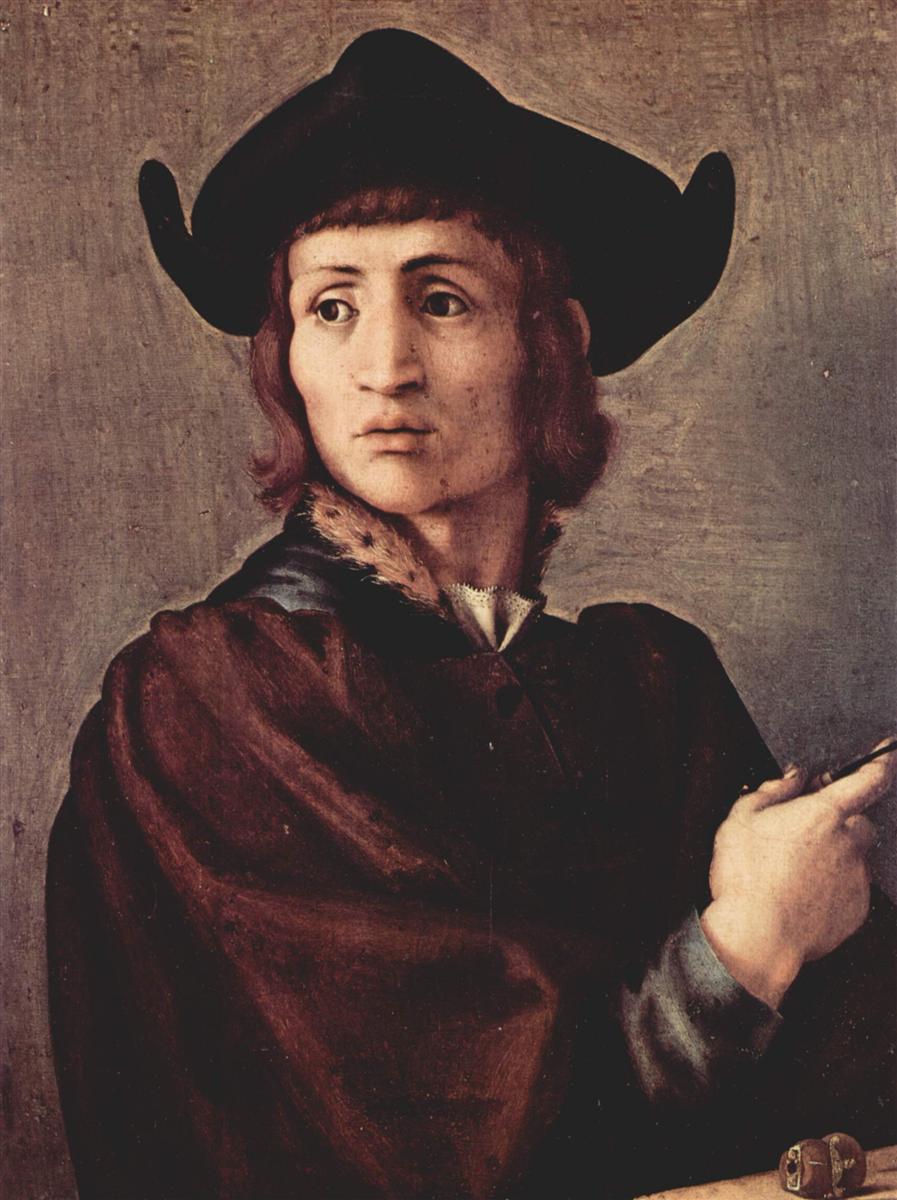
With his
Portrait of a Goldsmith
(ca. 1518, Musée du Louvre, Paris), Pontormo also commended himself as
an innovative portraitist of his time. What is more, his drawings of
this phase are distinguished by a virtually unsurpassable dynamic, as is
evident, for example, in his
Three Studies of a Male Nude (ca. 1517, Musée des Beaux-Arts, Lille).
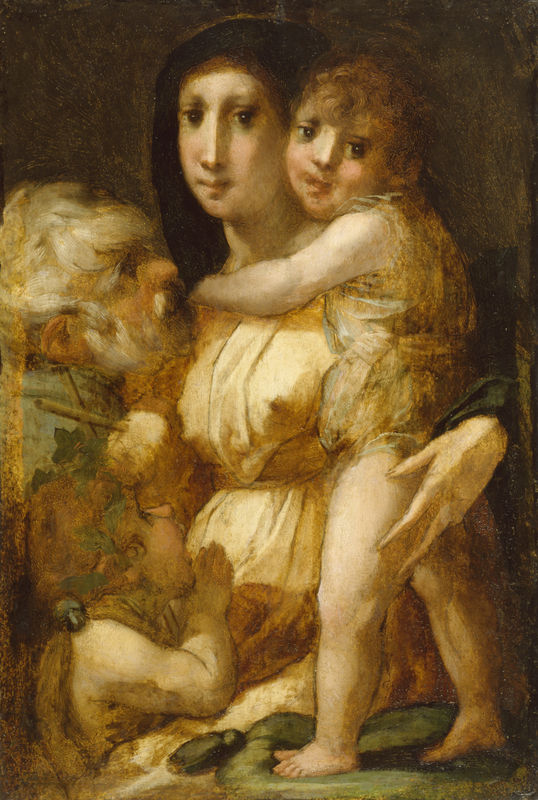
Between 1519 and 1525, for example in the
Holy Family with the Infant St John
Rosso found his way to expressive new means of artistic expression, as
will be evident in the following section of the show.
His fellow artist
Pontormo developed his own very distinctive artistic fingerprint during
this phase, strongly inspired by his study of art from north of the
Alps, and translated prints by Albrecht Dürer and Lucas van Leyden into a
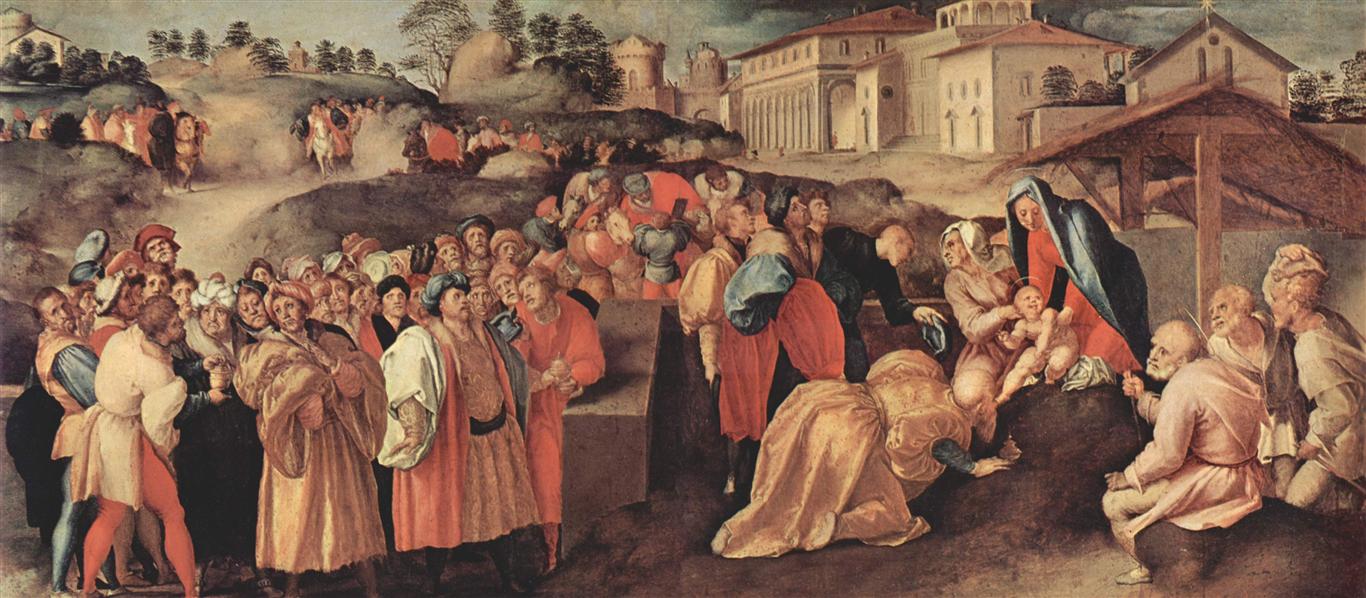
blend of Florentine and German styles. His famous
Adoration of the Magi (ca. 1519–23, Galleria Palatina, Florence), which has never been outside Florence until now, is a case in point.
As the next section of the show will illustrate, the history of the
Florentine art of those years – and that of the town itself – bear a
close relationship to the events unfolding in the papal metropolis of
Rome. Under the Medici Pope Clement VII, a number of young talents
converged in that town, among them Rosso Fiorentino, Parmigianino,
Polidoro da Caravaggio and Perino del Vaga. The pillage of the city by
the mercenary troops of Charles V (
Sacco di Roma) would bring
this productive constellation to an end in 1527. Rosso had arrived in
Rome in 1524 and initially produced frescoes and panel paintings. Soon,
however, he shifted his artistic focus to printmaking, for example the
Gods in Niches
(1526) on view here, a series belonging to the Städel Museum’s
Department of Prints and Drawings.
The plundering of Rome also had
consequences for Florence. The faction of the Medici’s opponents drove
the family out of town and proclaimed the Republic. In the autumn of
1529, however, imperial troops laid siege to the city, ultimately
forcing the Republic of Florence to surrender in 1530. This phase of
political and societal upheaval was one of the most creative and
productive periods in Florentine painting, as is evident in major works
such as
Andrea del Sarto’s
Sacrifice of Isaac (ca. 1529/30, Museo del Prado, Madrid)

or Bronzino’s
St Sebastian
(ca. 1528/29, Museo Thyssen-Bornemisza, Madrid).
The historic events
taking place in Florence in those years are also mirrored in the four
differing versions of the
Martyrdom of the Ten Thousand (ca.
1522–30) by Pontormo, Bronzino and Perino del Vaga brought together in a
single venue for the first time ever by this exhibition.
Next the show will take a look at Bronzino’s rise to become Florence’s
leading portrait painter under its first duke, Alessandro de’ Medici.
Here the highlight will be Bronzino’s brilliant
Portrait of a Lady in Red (Francesca Salviati?)
(ca. 1533) (above) from the Städel collection, a key work of Florentine
portrait painting. As a monumental, prestigious likeness of a lady it
embodies a new portrait type whose emergence this exhibition
reconstructs for the first time, assembling a number of closely related
likenesses of women around the
Portrait of a Lady in Red.
The prelude to the second floor of the show will be devoted to the
so-called “paragone” – the rivalry for pride of place between the media
of painting and sculpture that was a topic of lively discussion in the
Florentine art scene of the 1540s. Pontormo carried out his monumental
painting of
Venus and Cupid (ca. 1533, Galleria dell’Accademia,
Florence), likewise on display here for the first time outside of
Florence, after a design by Michelangelo.
By lending the bodies a
sculptural quality, he was virtually offering his own artistic argument
to the paragone debate. Yet the architecture of Florentine Mannerism
likewise competes with sculpture:
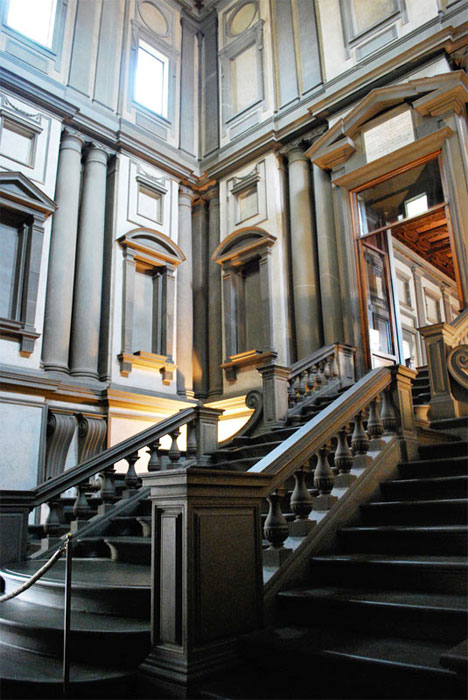
the stairs of Michelangelo’s
Staircase of the Biblioteca Laurenziana
(1524–1529) take on sculptural forms. A monumental model of the entire
staircase on a scale of 1:3 conveys an impression of the playful
elegance of this architectural feat.
Bronzino’s appointment as court painter to the new Duke Cosimo I de’
Medici in 1539 will be the theme of the second room in this part of the
show. The artist painted the likenesses of the duke, his consort
Eleonora di Toledo and their children, thus creating an entire portrait
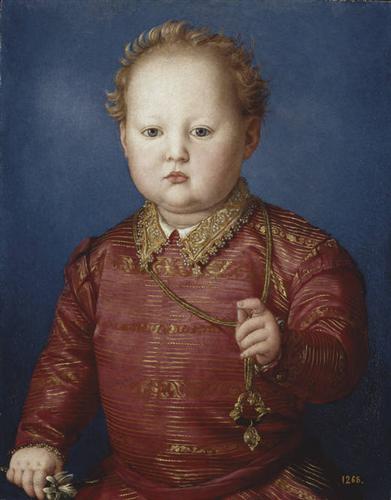
series. In the process, he shaped the genre of the courtly child’s
portrait to a decisive degree, as exemplified by the
Portrait of Garzia de’ Medici
(ca. 1550, Museo del Prado, Madrid).
At the same time, with his
frescoes decorating Eleonora’s private chapel in the Palazzo Vecchio as
well as his religious panel paintings, he set new standards for the art
of the Florentine court. In 1546, Cosimo I founded a tapestry
manufactory and commissioned Bronzino to design monumental pictorial
tapestries celebrating his ducal sovereignty in complex allegories. The exhibition will feature the first of these works, the so-called
Dovizia (1545, Galleria del Costume, Florence), along with several preparatory drawings.
Finally, the show will shine a spotlight on Giorgio Vasari. Known
primarily as an art writer and architect, he will here be introduced as
an important painter and draughtsman. From 1555/56 onward, in his
capacity as court painter Vasari carried out a great number of fresco
decorations in the Palazzo Vecchio, having first designed them in
detailed drawings. He also executed a number of his most impressive
panel paintings in this phase, for example the
 Toilet of Venus
(ca. 1558, Staatsgalerie Stuttgart).
His magnum opus as a writer is the second edition of his
Lives of the Artists
published in 1568, the first comprehensive history of Italian art from
Giotto to Vasari himself. In addition to the biographies of various
Florentine Mannerists, the
Lives of the Artists also contain
the earliest theoretical reflections on the art of the “maniera”.
The
concluding section of the exhibition will moreover present Pontormo’s
diary from the Biblioteca Nazionale Centrale in Florence. As one of the
earliest extant artists’ diaries, it provides authentic insight into the
Florentine master’s working process and everyday life.
More images from the exhibition: