Moderna Museet, Stockholm
22.11 2025 – 5.4 2026
The latter part of Pablo Picasso’s artistic career burns with intensity. In the exhibition “Late Picasso”, visitors encounter a collection of seemingly contradictory and idiosyncratic works created when the artist was in his late eighties. Working tirelessly, Picasso revisited themes and motifs from his own past as well as from the broader traditions of European painting. Once dismissed by critics and overlooked by scholars, these late works gained renewed relevance in the 1980s, when a younger generation of painters embraced their expressive gestures and untamed vitality. “Late Picasso” is the first major presentation of Pablo Picasso at Moderna Museet in over thirty years. Here, the artist appears in his final decade – from 1963 until his death in 1973 – when painting had come to embody an unrelenting process of inquiry rather than the transgressive force of his youth.
The exhibition brings together approximately fifty paintings and thirty works on paper. Alongside loans from other collections, the exhibition also features paintings and prints from Moderna Museet’s own holdings.
A Refusal to Conclude
Jo Widoff, curator for the Moderna Museet portion of this touring exhibition, remarks that Picasso’s late works are more concerned with urgency than resolution.
– They are marked by a deliberate refusal to be polished or conclusive. Many can be seen as allegories for the act of painting itself, where the canvas becomes a threshold between art and life.
At Odds with the Contemporary
By the 1960s, Picasso had outlived many of his peers and withdrawn from public life to devote himself entirely to working in his studio in Mougins. At a time when contemporary art was turning towards minimalism and conceptualism, Picasso remained committed to painting the human form.
In the last decade of his life, he worked with increasing urgency, and his style became ever more expressive and unapologetic. These late works reveal two distinct approaches to painting: one quick and simplified, made up of abbreviations, ideograms, and codified signs; the other bold and gestural, with thick, flowing paint hastily applied.
Picasso approached painting as a form of fiction, embracing the theatrical, the spontaneous, and the immediate. He worked indefatigably, painting by day and drawing by night, often for hours on end. The act of making itself – the layering, reworking, and gradual shifts – became central to his artistic process.
Dismissed by Critics, Celebrated by a Younger Generation
The response from critics was deeply divided, as Jo Widoff notes:
– For some, these late works represented a bold final act, affirming Picasso’s continuing relevance and daring. For others, the hastily applied paint, distorted forms, and prolific output of his final years appeared chaotic or self-indulgent – a sign of decline rather than creative vigour.
– Yet in the 1980s, Picasso’s late works gained renewed significance. As painting re-emerged as a dominant medium, a younger generation of artists found inspiration in the expressive freedom of his final decade.
A pivotal moment in this reassessment came with the influential “A New Spirit in Painting” exhibition at the Royal Academy in London in 1981, where Picasso’s works were shown alongside those of contemporary painters such as Georg Baselitz, Jean-Michel Basquiat, and Anselm Kiefer. The exhibition marked a turning point in how Picasso’s late painting was understood – no longer as the work of a fading master, but as a vital precursor to the renewed energy and experimentation of the era.
The Reception of Picasso After 1973
Since Picasso’s death in 1973, his legacy has remained both towering and complex – celebrated with near-mythic reverence and examined with increasing critical depth. In the years immediately following his death, major retrospectives reaffirmed his status as a modern master. In more recent years, his work has been revisited with greater nuance. As feminist and postcolonial critiques have reshaped the field of art history, scholars and artists alike have begun to examine the personal and political dimensions of his work.
At a time when contemporary art was gravitating toward minimalism and conceptualism, Pablo Picasso (1881–1973) followed his own path. In his later years, he instead turned to painting as a form of fiction, embracing the theatrical. To many contemporaries, his persistence in painting the human form seemed outdated – an echo of earlier modernism. While critics often dismissed these later works as incoherent or excessive, for Picasso, painting had come to embody an unrelenting process of inquiry rather than the transgressive energy of his youth. In the 1960s, now in his eighties, Picasso had outlived most of his peers and withdrew from public life to devote himself entirely to the studio. He worked restlessly, revisiting themes and motifs drawn from his own past and from the broader tradition of European painting. Produced with remarkable speed and in great abundance, these late works are marked by repetition and variation. The very act of making – the layering, reworking, and gradual shifts – became central to the work itself.
The exhibition Late Picasso presents a collection of seemingly contradictory works that are, nevertheless, defined by the artist’s intense engagement with the act of painting and its formal constraints. In these works, the polished yields to the spontaneous and immediate. Initially overlooked, the late works attracted the attention of a new generation of painters in the 1980s, drawn to expressive gestures and to the works’ idiosyncratic energy. These artists looked less to Picasso for his authority than for the untamed vitality of his painting.
Today, Picasso stands less as an untouchable icon than a figure through whom the complexities and contradictions of modern art are considered.
The exhibition Late Picasso is organised in collaboration between PoMo, Trondheim; Moderna Museet, Stockholm; Kunsten Museum of Modern Art, Aalborg; and Fundación Almine y Bernard Ruiz-Picasso. The curatorial concept is initiated and organised by PoMo, Trondheim and curated by Dr. Dieter Buchhart and Dr. Anna Karina Hofbauer.
The exhibition at Moderna Museet is curated by Jo Widoff.
About the Artist
Pablo Picasso (1881–1973) was born in Málaga, Spain but lived most of his life in France. Over a career spanning more than seventy years, he produced a remarkable body of work across painting, sculpture, drawing, printmaking, and ceramics, constantly reinventing his style. His early expressions include the melancholic Blue Period (1901–04) and the warmer Rose Period (1904–06). In 1907 Picasso began developing Cubism with Georges Braque. This radical approach broke with centuries of artistic convention by deconstructing objects into geometric forms and depicting them from multiple viewpoints at once. Cubism challenged traditional notions of space, depth, and representation, laying the groundwork for much of modern art.
Following World War I, Picasso returned to neoclassicism, creating monumental, classically inspired figures. In the 1930s, influenced by Surrealism, his work became more symbolic and psychologically charged. Though never formally part of the movement, he shared its fascination with myth, dream, and metamorphosis. A committed political figure, Picasso joined the French Communist Party in 1944 and expressed his activism most famously in Guernica (1937), a response to the bombing of the eponymous Basque town during the Spanish Civil War.
At Moderna Museet, there are more works by Picasso to discover. In the collection exhibition Yet Another Morning, examples of Picasso’s early drawings are on display, while The Subterranean Sky presents his work in a surrealist context. In the Study Gallery, there are additional photographs on display by David Douglas Duncan showing Picasso at work in his studio. And not least – in the garden stands the monumental sculpture group The Luncheon on the Grass, a collaboration between Picasso and Norwegian artist Carl Nesjar.
Picasso after 1973
Since Picasso’s death in 1973, his legacy has remained both towering and tumultuous – celebrated with near-mythic reverence and scrutinised with growing critical complexity. In the immediate aftermath, Picasso’s reputation as a modern master was reaffirmed through major retrospectives and surging market interest. The opening of the Musée Picasso in Paris in 1985, founded on the artist’s own personal collection, further institutionalised his status. A key moment in the posthumous reception of Picasso came with the influential 1981 exhibition A New Spirit in Painting at the Royal Academy in London, where works by Picasso were shown alongside those of young contemporary painters. This exhibition marked a turning point in the perception of Picasso’s late painting. Positioned alongside a new generation of expressive painters – Georg Baselitz, Jean-Michel Basquiat, and Anselm Kiefer – Picasso was presented not as a distant monument of modernism but as an active precursor to the renewed vitality of the medium. In recent years, Picasso’s work has been revisited with greater nuance. As feminist and postcolonial critiques gained traction in the late 20th century, scholars and artists began to interrogate the cultural appropriation and the representation of women in his work. He stands less as an untouchable icon and more as a figure through whom the complexities of modern art are considered.
There is a common notion that artists attain stylistic maturity late in life. In reality, some resist such an expected development, instead continuing to seek out new and more challenging modes of expression – what has come to be known as a “late style”. Rather than offering closure, these works embrace tension, contradiction, and unresolved complexity. They do not soften with age, they sharpen. The philosopher Theodor W. Adorno explored this late style (Spätsstil) in his reflections on Beethoven’s final compositions. For Adorno, Beethoven’s late works are not gentle culminations of his earlier works but “catastrophic” – fragmented, alienated, and defiantly at odds with aesthetic and social conventions. In late style, death appears not as a subject in itself but as part of the very form and expression.
Faced with mortality, the artist no longer seeks unity or approval but asserts a radical subjectivity with nothing left to lose. Picasso’s late works exhibit a similar resistance to closure. They did not become more coherent with age; on the contrary, they grew increasingly raw, distorted, and unabashedly erotic. Adorno writes of the late work as “process, but not progress”. Picasso’s late works, similarly, seem less concerned with resolution and more with urgency. They are marked by a self-aware theatricality, an embrace of fiction, and a refusal to be polished or conclusive.
Picasso had long drawn motifs and inspiration from the history of painting, and between 1959 and 1962, he turned to Édouard Manet’s The Luncheon on the Grass (1863). Scandalous in its own time for depicting not a goddess but an unmistakably ordinary nude woman, Manet provoked outrage – while inspiring Picasso to create over 150 variations on the scene. Far from a simple homage, Picasso sought to understand the painting by dismantling, reassembling, and inhabiting it on his own terms. For Picasso, Manet’s painting was still worth grappling with decades later. As he reworked the composition, he stripped it bare, amplified certain elements and distorted others, re-situating it in his own visual language.
The Luncheon on the Grass offered a mirror for Picasso’s own artistic concerns: the subversive nature of painting, the interplay of clothed men and nude women, and the recurring theme of painter and model. In one of the most ambitious interpretations of Manet’s painting, Picasso collaborated with Norwegian artist Carl Nesjar. In August 1962, Picasso created cardboard models of the scene’s figures, arranging and photographing them outdoors, referencing Manet’s original composition. These models became the basis for Picasso’s The Luncheon on the Grass, a group of monumental concrete sculptures produced by Nesjar and installed in 1966 in the garden of Moderna Museet, where they can still be seen today.
. In the last decade of his life, Picasso worked with increasing haste, and his style became ever more expressive and unapologetic. His late works combined two distinct ways of painting: one quick and simplified, made up of abbreviations, ideograms, and codified signs; the other bold and expressive, with thick, flowing paint hastily applied. Rather than depicting a figure in full, Picasso often rendered eyes, mouths, hands as reduced signs: a curve suggesting a breast, a slash an eye. This ideographic style allowed him to communicate complex emotions and human presence with quick, declarative marks, transforming painting into a kind of pictorial writing. Although Picasso rarely painted self-portraits, between 1964 and 1965 he produced a series of stylised male heads in which likeness is subordinated to the immediate expressiveness of the painting. With striking variation, these works range from simplified, expressive figures rendered in fluid, colourful lines, to more detailed representations evoking Picasso’s own appearance, if only for the blue-striped Breton shirt he often wore. Here, late repetitions of male heads are juxtaposed with two earlier portraits of the French Surrealist photographer Dora Maar, whose image became a recurring motif in Picasso’s work some twenty years earlier. Dora Maar once remarked: “All his portraits of me are lies. They are all Picassos, not one is Dora Maar.” Her statement underscores how Picasso’s portraits, while ostensibly of others, often serve as interrogations of the self. P
Throughout his career, Picasso repeatedly returned to the theme of the artist and his model. Yet it was between 1963 and 1965 that he produced his most extensive and inventive body of work on the subject. Typically depicting a painter at work, often opposite a reclining nude, these scenes are set in imagined studios. Though often read as self-portraits of sorts, the artist within these works is, in many ways, a fiction: Picasso rarely used a palette – favouring newspaper instead – and seldom worked from a posed model or used an easel. For Picasso, the theme offered endless possibilities for experimentation with composition, colour, and form. In his numerous versions of the studio motif, Picasso continually returned to 7 the relationship between artist, model, and canvas. This trinity became a structure through which Picasso examined the process of creation. Ultimately, these scenes are not simply depictions of artistic labour. They are allegories of the act of painting itself, where the canvas may be read as a threshold between art and life. In this space, everything is fiction – and everything is true.
.In Picasso’s late work the women are naked, while the men are in disguise. His female nudes are stripped of idealisation, depicted in contorted, reclining, or seated poses, presenting multiple viewpoints simultaneously. Form and space are compressed into dense compositions. In these works, the female body emerges as a visceral assembly of limbs, breasts, and orifices – confrontational in its physicality. Picasso’s desire to convey the subjects’ carnal reality left the compositions intentionally crude and overtly sexual.
“It’s all there,” he told writer André Malraux, “I try to do a nude as it is. If I do a nude, people ought to think: it’s a nude, not Madame Whatsit.” By contrast, he mocked the nudes of fellow painter Georges Braque: “With Braque, when you look at his pictures you say to yourself: Is it a woman or a painting – does its armpit smell?” While Picasso grew increasingly isolated during this time, he continued to explore the theme of lovers in his art. In several works, scenes of desire, intimacy, possession, and conflict unfold within ambiguous, dreamlike spaces.
During his last years Picasso summoned a cast of flamboyant male figures – musketeers, cavaliers, and pipe-smoking swordsmen – that came to dominate his paintings. Inspired by 17thcentury painting and literature, Picasso’s musketeers echo the worlds of Rembrandt, Velázquez, El Greco, and Alexander Dumas. They wear ruffled collars and wield swords, yet their puffed-up posturing often slips into parody and self-ridicule. Behind the bravado lies a knowing sense of play – these are not portraits in any conventional sense; they are roles to be performed.
Throughout his career, Picasso masked self-representation through alter egos or guises like the harlequin, the monkey, and the minotaur, with the musketeers becoming his final persona. Part parody, part homage, he even went so far as to sign some of them with the imagined name “Domenico Theotokopoulos van Rijn da Silva”, borrowing freely from the names of his art historical heroes. Yet, these dashing figures are more than nostalgic echoes of a heroic past. They are masks through which Picasso wrestled with aging and artistic legacy. Furthermore, the musketeer allowed Picasso to explore painting as fiction: a space for masquerade, excess, and disguise. His brushwork is hasty and unruly, the compositions sometimes comical, sometimes grotesque – as if to mock the gravity of tradition even while invoking it. At a time when contemporary art was turning toward minimalism and conceptualism, Picasso instead embraced theatricality and artifice.
On 23 May 1973, just weeks after Picasso’s death, a large exhibition opened in the Papal Palace in Avignon. Comprising over two hundred paintings from the preceding three years – each selected by Picasso himself – the exhibition transformed the vast medieval nave of the Papal Palace into a polyphonic totality. The installation itself broke decisively with traditional museum display. The unframed paintings were hung in dense, multiple rows – often edge to edge – directly on the rough medieval stone walls. This arrangement emphasised the serial, ongoing nature of Picasso’s late production, where images often reappear in varying progression, and underscored the artist’s resistance to declaring works as finished.
The response was deeply divided. For some, the exhibition was a bold final act, asserting Picasso’s continued relevance and daring. For others, the hastily applied paint, distorted forms, and prolific output of his final years seemed chaotic or indulgent – a sign of decline rather than creative vigour. Whether interpreted as a testament to ongoing innovation or as a closing chapter marked by exhaustion and repetition, the Avignon exhibition remains a key site for reassessing Picasso’s late work and the polarised responses it continues to provoke.
Painting by day and drawing by night, often for hours, Picasso described his drawing practice as a way of writing fiction. Suite 347 is his largest print series, comprising 347 etchings completed in less than seven months. The series unfolds like a vast visual diary, revisiting Picasso’s life and art through unruly characters and imagined scenes. Its imagery teems with the circus, classical antiquity, mythology, and art history. Artists, fauns, jesters, and buffoons recur throughout, guiding viewers through carnivalesque encounters. Picasso appears as Rembrandt, a musketeer, a baby, an old man, and occasionally as himself. The creation of Suite 347 coincided with a period of profound cultural and social upheaval. Television, a mass phenomenon in France by the 1960s, fed Picasso’s imagination with broadcasts of circus shows, musketeer films, Westerns, and the charged images of the May 1968 student protests. Erotic films and their explicit imagery also found their way into the compositions. So much so that, when the suite was first exhibited in Paris, many of the images were relegated to a private back room, sparking debate over art and pornography. Picasso confronts the end of his life not with quiet reflection but with ferocious intensity and unrestrained imagination. As the British art historian David Sylvester wrote in 1987: “Picasso’s art affirmed until the end that, even when it is a diary, art is not meant to be a confession but a game.”
Texts about art works in the exhibition

Pablo Picasso, La Pisseuse/Woman Pissing, April 16 1965. Centre Pompidou.
© Succession Picasso/Bildupphovsrätt 2025.
Photo: © Centre Pompidou, MNAM-CCI, Dist. GrandPalaisRmn/image Centre Pompidou,
La Pisseuse Woman Pissing April 16, 1965 Centre Pompidou. A stately female figure urinates unabashedly on the shore – a scene that fuses myth with the necessities of everyday life. Picasso drew inspiration both from Rembrandt van Rijn’s Woman Bathing in a Stream (1654) and from the ancient myth of Aphrodite, goddess of love and beauty, who rose naked from the foam of the sea. Here the motif is given a monumental inevitability: the body appears unadorned, with sharp contours and vigorous brushstrokes typical of Picasso’s late style. By combining the mythologically idealised with such a bodily and unguarded moment, the painting challenges conventional notions of femininity.

La source The Spring 1921 Moderna Museet In The Source,
Picasso presents his first wife, Olga Khokhlova, as a Greek goddess. She rests in a tranquil landscape, where the water flowing from the urn appears as a symbol of life and renewal. The painting reflects Picasso’s neoclassical period, when, in the aftermath of the First World War, he sought the presumed clarity and order of antiquity. Here he combines personal subject matter with mythological references. His inspiration stemmed partly from Italian ruins and partly from artists such as the seventeenth-century painter Nicolas Poussin, renowned for his pursuit of harmony and perfection in landscape painting. With clear contours and a balanced composition, Picasso reconnects with the ideals of classicism, while reshaping them into an expression of his own time – and his own life.

Le déjeuner sur l’herbe Luncheon on the Grass July 30, 1961 Louisiana Museum of Modern Art, Humlebaek, Danmark.
In Picasso’s The Luncheon on the Grass, the woman turns towards the man before her, rather than meeting the viewer’s gaze, as in Édouard Manet’s version. She bears features of Picasso’s second wife, Jacqueline Roque, and the man reaching out his hand may represent the artist himself. Behind him appears a strange figure reminiscent of the African sculptures that had inspired Cubism half a century earlier. The painting explores several themes that interested Picasso, including the relationship between artist, model, and audience, reflections on the depiction of the nude, and the potential of its layers of art-historical references to evoke memories and associations in the viewer.
Tête de femme Woman’s Head July 1–8 and December 30–31 1957.
The same year Picasso created Head of a Woman, he began a close collaboration with the Norwegian sculptor Carl Nesjar. In a series of sculptural sketches developed by Picasso, thin planes intersect at angles around a central axis—a play with geometric forms that can also be recognised in this painting. The sketches were realised on a large scale when Picasso and Nesjar created the 15-metre-high sculpture of a woman’s head, erected in 1965 on the shore of Lake Vänern in Kristinehamn. The following year, the sculptural group The Luncheon on the Grass was installed outside Moderna Museet – one of the few works from Picasso and Nesjar’s collaboration to be found in Stockholm.
Tête d’homme Head of a Man May 15, 1964 Fundación Almine y Bernard Ruiz-Picasso, Madrid.
The painting Head of a Man (5 December 1964) is boldly outlined with a few broad brushstrokes and geometric shapes. Colourful zig zag lines of yellow, red, and green dance through the face, adding energy, movement and depth. The reduced style shows Picasso at his most free, turning simplicity into expressive power with minimal means. As he explained: “A dot for the breast, a line for the artist, five spots of paint for the foot, a few pink and green lines – that’s enough, isn’t it? What more need I do? What can I add to that? It’s all been said.”

La femme à la collerette bleue Woman with Blue Collar June 5, 1941 Moderna Museet
Woman with a Blue Collar is often described as a portrait of the Surrealist photographer Dora Maar, who at the time was in a relationship with Picasso. In the painting, Picasso employs the Cubist visual language he had previously developed with Georges Braque – where a person or object is shown from multiple viewpoints simultaneously within a single image, using simplified forms. This distorts the woman’s face, revealing, for example, both ears. One half of the head is painted in light colours, while the other is concealed in shadow, which has been interpreted as a representation of a dual personality or inner conflict.

Homme portant un enfant Man Carrying a Child February 24, 1965 Fundación Almine y Bernard Ruiz-Picasso, Madrid
The striped shirt in Man Carrying a Child is characteristic for Picasso and suggests this could be a self-portrait. When Picasso painted the work, he was 83 years old and a father of four. Children had always played an important role in his art. In the later works, the motif of a male figure holding a swaddled child appears several times. In these paintings, he explored personal dimensions of his life – his relationship with his father, his own role as a father and grandfather, and perhaps the notion of the child as a symbol of resurgence, renewal, and the continuity of life.

Le baiser The Kiss October 25,1969 Kunsthaus Zürich
In his final years, Picasso painted with time as his adversary. His art became a form of struggle against the inevitability of aging and death, marked by a constant pursuit of spontaneity and immediacy. The sketch-like quality of The Kiss is a deliberate choice, an attempt to capture the intensity of the moment without “finishing”, fixing, or closing it. As he himself expressed it: “To finish is also to kill.” Here, two faces come together in an almost dissolved embrace, simultaneously present and elusive. The painting raises questions about when a work – or a life – can truly be considered complete.
Homme assis Seated Man 1969 Courtesy of Masterworks After a stomach surgery in 1965, Picasso immersed himself in reading, particularly Alexandre Dumas’ The Three Musketeers (1844). The novel’s figures of ambition and passion inspired him, and by 1969 they appeared in his paintings. In Seated Man, a musketeer with a piercing gaze wears yellow and red stripes, evoking the Catalan flag – a potent reminder of a culture suppressed under Francisco Franco’s dictatorship. For Picasso, the musketeer became a symbol of resistance and vitality. Following Franco’s victory in the Spanish Civil War (1936–39), Picasso refused to return to Spain until the regime ended, embodying exile and defiance.
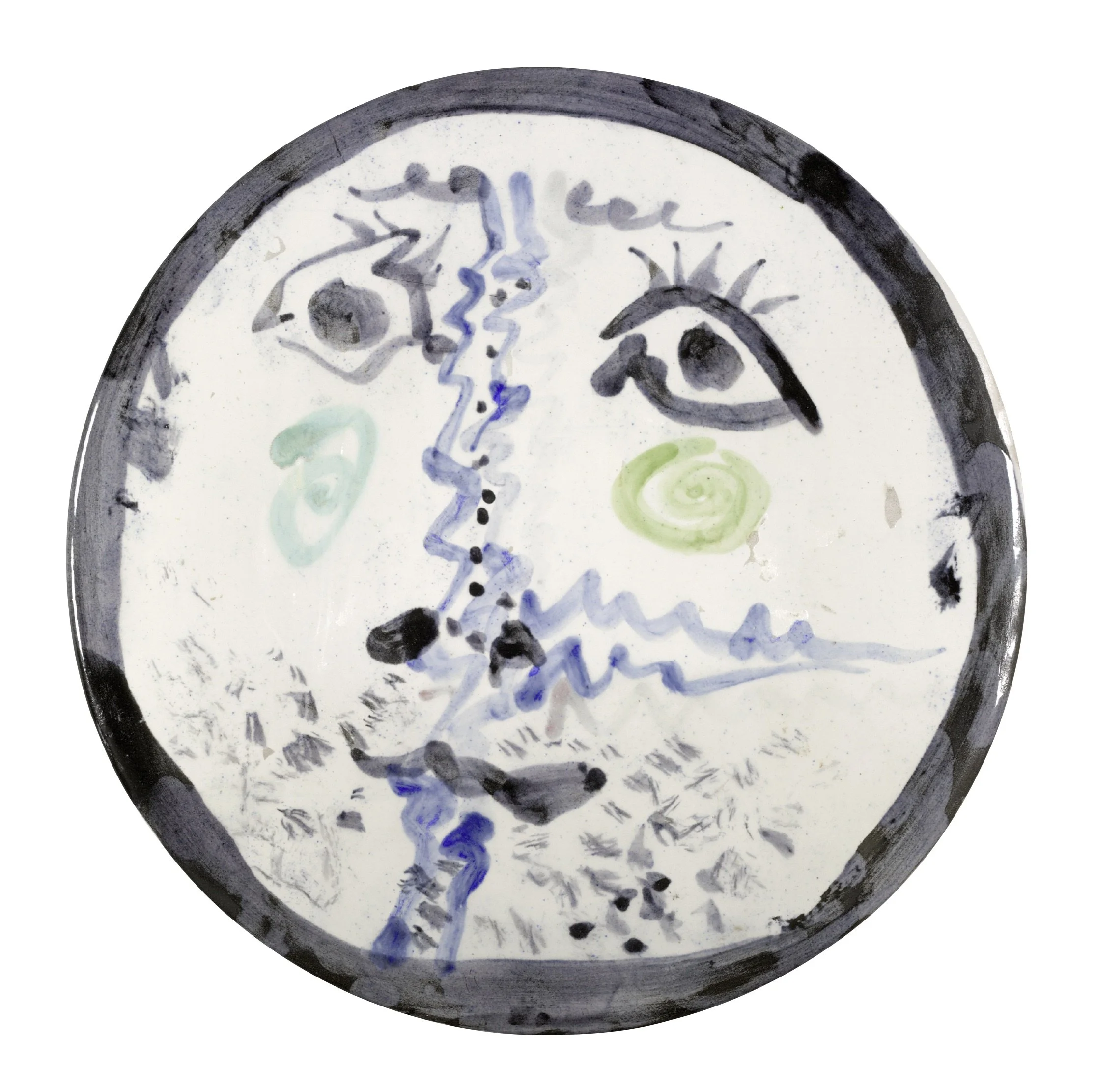
Pablo Picasso, Assiette décorée d’un visage II (Plate with a Face II), 1963.
Ceramic, painted and glazed. 25.3 x 2.2 cm.
The ALBERTINA Museum, Vienna – The Batliner Collection.
Image: The ALBERTINA Museum, Vienna.
© Succession Pablo Picasso / BONO, Oslo 2025
Assiette décorée d’un visage (and others) Plate with a Face Fundación Almine y Bernard Ruiz-Picasso, Madrid In the summer of 1946, during a visit to a ceramics exhibition in the southern French town of Vallauris – celebrated for its pottery tradition – Picasso felt an immediate attraction to the craft. Over the following decades, he explored ceramics with great intensity, experimenting with diverse materials, techniques, and processes. Some works were created on pre-existing ceramic forms, others he sculpted entirely by hand. From the early 1960s onward, Picasso often used commercially produced plates and tiles, transforming them with paints and oxides into vivid faces or recurring motifs such as birds. Much like his bold, simplified portraits, he could suggest facial features – eyes, eyebrows, noses, mouths – with just a few decisive strokes. He frequently exhibited these ceramics alongside his paintings, as in the 1973 exhibition at the Papal Palace in Avignon.

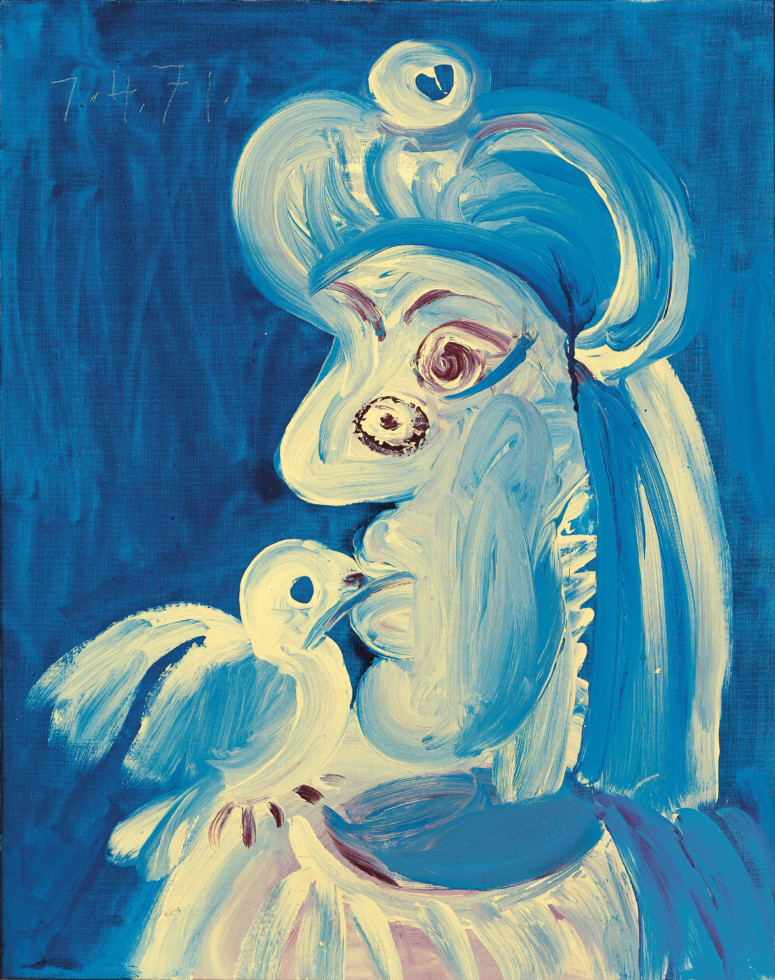
Photo: Marc Domage © FABAFemme à l’oiseau Woman with Bird April 7, 1971 (I) Fundación Almine y Bernard Ruiz-Picasso, Madrid As a child in Málaga, Picasso often watched his father, painter José Ruiz y Blasco, at work. His father favored doves as a motif, and occasionally let young Picasso participate, sparking a lifelong fascination with birds. This theme resurfaced frequently throughout his career, and Picasso even kept live birds in his studios. In the spring of 1971, he revisited the theme in a 4 series of figures with birds. Woman with a Bird (1971) depicts a bare-shouldered woman facing a bird poised near her mouth, suggesting a kiss or gentle feeding. Bathed in deep blue night tones, the dreamlike scene conveys care and fragile co-dependency.

Tête d’Arlequin Masqué Head of a Harlequin in a Mask January 10, 1971 Private Collection of KAWS In 1971, Picasso began to systematically explore anguished faces with open mouths, as if in silent cries. In Head of a Harlequin in a Mask, the existential dimension is intensified as Picasso refers to his first alter ego, the Harlequin. The masked figure often signifies playfulness and cunning but can also carry deeper symbolic meaning. For Picasso, the Harlequin becomes an expression of identity, role-playing, and human emotion, and here the portrait appears almost like a death mask. The gaze shifts between aged vulnerability and anxiety over the looming presence of death. The painting captures both a sense of resignation before mortality and Picasso’s persistent determination to use the figure to express the human condition.

© Succession Picasso/Bildupphovsrätt 2025.
Photo: My Matson/Moderna Museet

© Succession Picasso/Bildupphovsrätt 2025.
Photo: Hugard & Vanoverschelde © FABA

© Succession Picasso/Bildupphovsrätt 2025.
Photo: George Condo, Private Collection.

© Succession Picasso/Bildupphovsrätt 2025.
Photo: Peter Schälchli, Zürich/Private Collection

© Succession Picasso/Bildupphovsrätt 2025.
Photo: Prallan Allsten/Moderna Museet

Pablo Picasso, Homme Assis/Seated Man, 1969. The Masterworks Foundation.
© Succession Picasso/Bildupphovsrätt 2025.
Photo: Dan Jackson/The Masterworks Foundation

Pablo Picasso, Homme à la pipe/Man With a Pipe, Mougins, November 22 1970. Fundación Almine y Bernard Ruiz-Picasso.
© Succession Picasso/Bildupphovsrätt 2025.
Photo: Hugard & Vanoverschelde © FABA

Pablo Picasso, Grotesques et singe/Grotesques and Monkey, 1954. Moderna Museet.
© Succession Picasso/Bildupphovsrätt 2025
Photo: Albin Dahlström/Moderna Museet

Pablo Picasso, Carreau décoré d’un visage/Tile With Face, Mougins, June 15 1963. Fundación Almine y Bernard Ruiz-Picasso.
© Succession Picasso/Bildupphovsrätt 2025.
Photo: Hugard & Vanoverschelde © FABA

Pablo Picasso, Buste de femme/Bust of a Woman, Mougins, July 11 1971 (I). Fundación Almine y Bernard Ruiz-Picasso.
© Succession Picasso/Bildupphovsrätt 2025.
Photo: Hugard & Vanoverschelde © FABA

Pablo Picasso, Nu couché/Reclining Nude, Mougins, October 9 1967. Fundación Almine y Bernard Ruiz-Picasso.
La source/The Spring, 1921.
© Succession Picasso/Bildupphovsrätt 2025.
Photo: My Matson/Moderna Museet
