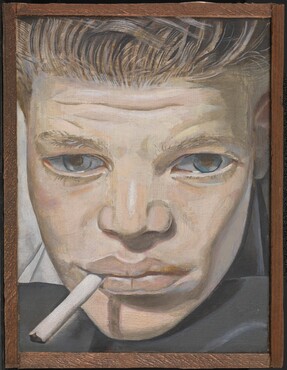
Lucian Freud, Boy Smoking, 1950-51. Tate, Bequeathed by Simon Sainsbury 2006, accessioned 2008. © The Lucian Freud Archive / Bridgeman Images 2025. Photo: Tate.
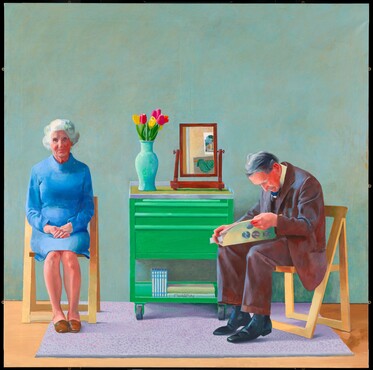
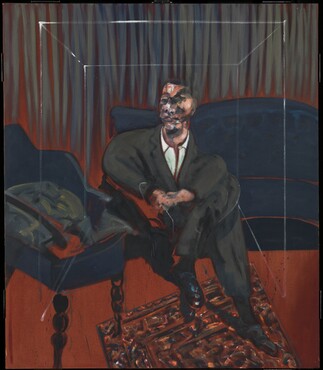
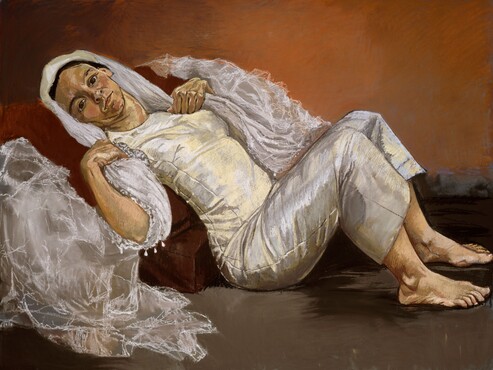
From 14 February, the Kunstmuseum Den Haag presents London Calling.
Representing the first major survey of its kind in the Netherlands, the exhibition brings together highlights of postwar British figurative painting, including works by Francis Bacon, Lucian Freud, David Hockney and Paula Rego. Organised in collaboration with Tate, London Calling will offer a snapshot of twentieth century London. In the human figures, personal relationships and interiors, a city at the crossroads of ideas emerges in paint.
In collaboration with Tate, in the spring of 2026 the Kunstmuseum Den Haag presents a major exhibition on the so-called School of London. Tate is lending around forty-five exceptional works by artists such as Francis Bacon, Lucian Freud, David Hockney and Paula Rego, and their lesser-known contemporaries Frank Auerbach, R.B. Kitaj and Leon Kossoff. The exhibition reveals how well-known figures in postwar British painting explored the human experience through a focus on the human form. It also seeks to expand the canon of British figurative painting by showcasing the work of equally noteworthy but previously overlooked artists such as Denzil Forrester, Eva Frankfurther and Celia Paul. Until recently, these artists have remained largely excluded from the dominant narrative of the School of London. Featuring work by fourteen artists, London Calling presents a cross-section of postwar painting in the British capital and provides an exciting opportunity to see the works of artists who all employed painting to depict their experience of the world.
“Postwar British painting is a bountiful subject: magnificent paintings that appeal to everyone through their focus on the human figure. A joy to behold. The artists from highly diverse backgrounds found their subject in London, a city that is as stimulating as it is controversial, and endlessly fascinating.” – Thijs de Raedt, curator of modern art, Kunstmuseum Den Haag.
Old favourites
The term School of London was coined in 1976 by the London-based American painter R. B. Kitaj. It became the umbrella term for a loose grouping of artists who knew each other, exhibited in the same galleries or drank together in Soho’s bars. As abstraction came to dominate the international art world, Francis Bacon, Lucian Freud and Frank Auerbach continued to paint reality. Some people called it old-fashioned, but as a magnet for migrants, post-war London was becoming a crossroads for diverse ideas, traditions and talent from Europe and beyond, giving figurative painting a new relevance. While they had no manifesto and did not constitute a clearly defined movement, these artists shared the use of oil on canvas to depict people in interiors – and, by extension, something bigger: the expression of a zeitgeist. These painters pushed the human figure to its limits, depicting a society in which old certainties were crumbling, and identity, gender and social relations were being redefined.
New icons
The exhibition poses questions that are as relevant now as they ever were. Who is seen? Who belongs? London Calling also explores ways to expand the School of London narrative, making room for parallel histories, suppressed perspectives and new icons. For example, it features paintings by Celia Paul, best-known for many years as Lucian Freud’s muse, Eva Frankfurther’s portraits of the working class of which she herself was a part, and Denzil Forrester’s vibrant depictions of London’s reggae culture of the 1980s.
London Calling shows works of: Francis Bacon, Lucian Freud, David Hockney, Paula Rego, Michael Andrews, Frank Auerbach, Sandra Fisher, Denzil Forrester, Eva Frankfurther, R.B. Kitaj, Leon Kossoff, Celia Paul, Sylvia Sleigh, Lynette Yiadom-Boakye.
