Matisse: Radical Invention, 1913–1917, a large-scale investigation into a pivotal moment in the career of Henri Matisse (1869–1954), presented an important reassessment of the artist’s work between 1913 and 1917, revealing this period to be one of the most significant chapters in Matisse’s evolution as an artist. On view from July 18 through October 11, 2010, at The Museum of Modern Art, the exhibition examined paintings, sculptures, drawings, and prints made by the artist between his return to Paris from Morocco in 1913 to his departure for Nice in 1917. Over these five years, he developed his most demanding, experimental, and enigmatic works: paintings that are abstracted, often purged of descriptive detail, geometrically composed, and dominated by blacks and grays. Comprising nearly 110 of the artist’s works,
Matisse: Radical Invention, 1913–1917, was the first exhibition devoted to this period, thoroughly exploring Matisse’s working processes and the revolutionary experimentation of what he called his “methods of modern construction.”
Organized by The Museum of Modern Art and The Art Institute of Chicago, the exhibition was curated by John Elderfield, Chief Curator Emeritus of Painting and Sculpture at The Museum of Modern Art, and Stephanie D’Alessandro, Gary C. and Frances Comer Curator of Modern Art at The Art Institute of Chicago. The exhibition was the result of a five-year collaboration between MoMA and The Art Institute of Chicago, combining new archival and art-historical research, fresh physical examinations of artworks, and innovative methods of scientific investigation to generate an unprecedented understanding of Matisse’s work during these years. Technical examinations have revealed the evolution of objects from this period and illuminated previously unknown relationships among them.
Matisse: Radical Invention, 1913–1917, was organized chronologically, and began with the immediately preceding years of 1907–1912. When Matisse was 22 years old, he began to study under Symbolist painter Gustave Moreau, who sent his pupils to make copies of Old Master paintings in the Musée du Louvre. Matisse pursued a similar practice in his independent work, reusing compositions and a range of subjects and poses in an effort to pare down forms to what he called “a truer, more essential character.”
On view as part of the exhibition was Paul Cézanne’s (French, 1839–1906)
Three Bathers (1879–82), a work Matisse had acquired in 1899 which then became a touchstone for the artist as he worked on issues of color and construction in his own bathers compositions.
Also on view were Matisse’s
Nude with a White Scarf (1909)
and
Bathers with a Turtle (1908), which inaugurated Matisse’s new practice of extensively reworking his canvases.
By 1909 Matisse had formed relationships with a number of important and supportive collectors, including Sergei Shchukin, who commissioned decorative panels by Matisse for the stairway of his Moscow home. For this project Matisse initially suggested imagery of dance and bathers, subjects that would allow him to synthesize his evolving interests in harmonious colors, arabesques, and flat, overall designs with the tradition of décorations, pictures of mythical subjects intended to evoke tranquility.
The composition of bathers begun that year would be transformed over the following nine years to become
Bathers by a River, on view in the final gallery of the exhibition. Also in 1909, Matisse continued to work on his largest sculpture to that point, the bas-relief
Back, begun in 1908, which he would return to several times over the next 21 years. On each occasion Matisse began with a new plaster cast of the relief; but instead of destroying the previous states when he moved on to the next version, Matisse preserved them, resulting in
Back (I), Back (II), Back (III), and Back (IV), each of which was on view within the exhibition. The last gallery of the exhibition also includes a digital presentation illustrating the known states of
Bathers by a River and
Back, exploring the techniques that provided the foundation for the artist’s most radical inventions of this period.
In winter 1910–11 Matisse traveled to Spain and Morocco, following the harsh reception of his recent works at the 1910 Salon d’Automne.
During his travels, rich textiles and Moorish architecture inspired him to introduce decorative patterning and flat expanses of color to his canvases, such as
The Manila Shawl (1911).
In the years that followed, he continued to explore the language of color, juxtaposing flat areas of contrasting hues, as in
Zorah in Yellow (1912).
Other paintings, including
Fatma, The Mulatto Woman (1912), dissolve form and reconstruct space into vaporous, interwoven layers of color.
The exhibition continued with the spring of 1913, when, after his final return from Morocco, Matisse abruptly altered his course, pursuing an interest in formal structure that accompanied and then superseded his prior focus on color. Evidence of this attempt to forge a new path can be seen in
Bathers by a River (1909–10; 1913; 1916–17) which the artist drastically altered in 1913.
In addition to photographic illustrations of Matisse working on that major painting, the section included two paintings from 1913,
The Blue Window
and
Flowers and Ceramic Plate.
1914, New Ambitions
On January 1, 1914, Matisse and his wife, Amélie, moved into an apartment on the fourth floor of 19 quai Saint-Michel in Paris, directly beneath the studio he had occupied from 1894 to 1907. Matisse wanted a break from his studio in Issy in order to better focus on his artistic exploration. The new space energized him, and in just over six months he produced almost a dozen canvases. Although Matisse used a different visual approach in almost every painting, the works are united by palette and size, giving them the quality of a series. These remarkably bold works constitute Matisse’s response to Cubism’s new challenge to the representation of form and space.
On view was
Interior with Goldfish (1914), the first of four great canvases from this period that picture the artist’s studio. The form and position of the fishbowl, furniture, grillwork, and planter within the work underwent multiple revisions, many of which are visible in the finished painting.
He reprised this composition in
Goldfish and Palette (1914–15) simplifying the vertically banded format of the earlier work into a single broad black band.
Also on view was
Woman on a High Stool (1914), which shares its simplified geometric forms, heavy contouring, and austere palette with the work of Cézanne and the Cubist paintings of Matisse’s own peers.
In
View of Notre Dame (1914), which depicts the Paris cathedral as seen from Matisse’s studio window, he reworked features of the canvas before covering almost the entire surface in blue, leaving early compositional elements visible beneath the paint.
The section concluded with
Portrait of Yvonne Landsberg (1914): startling even to its maker, it is one of the most dramatic of Matisse’s canvases from early 1914. After many campaigns of wiping, incising, and repainting, work on this canvas ended with the artist scraping the lines that radiate from the figure, echoing the curve of the subject’s hairline and the arms of her green chair.
This painting was joined by
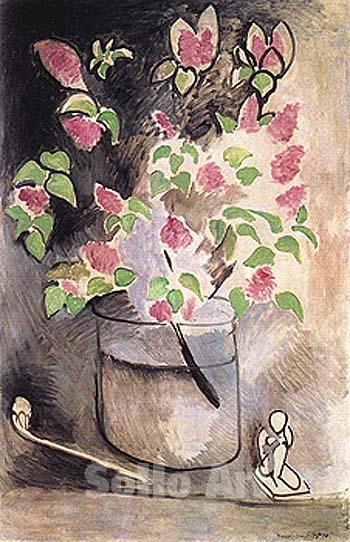
Branch of Lilacs (1914),
and
Still Life with Lemons (1914), a work that demonstrates Matisse’s interest in the visual vocabulary of Cubism.
August 1914–1915, Interruptions and Returns
Matisse’s daring achievements in 1914 came to a dramatic and abrupt end with the outbreak of World War I. The period between August 1914 and the end of 1915 was full of stops and starts, interruptions and returns, as the artist tried to negotiate the challenges of wartime and satisfy his own creative ambitions.
In summer 1915 Matisse and his family moved from Paris back to Issy, which they had left the previous year when their home there was requisitioned by the French military.
While reorganizing his studio, the artist was inspired by the rediscovery of his 1893 canvas
La Desserte (After Jan Davidsz. de Heem), on view in this section,
which he had copied from the 1640 original, Jan Davidsz. de Heem,
Table of Desserts ("La Desserte"), in the Musée du Louvre when he was a student.
He remade the composition with
Still Life after Jan Davidsz. de Heem's "La Desserte" (1915) “adding everything I’ve seen since,” he said, and working with “the methods of modern construction.” He was most likely referring to Cubism, which he used to toughen his visual approach, though continuing to privilege detail and brilliant color.
In his new work he also returned to still lifes, portraits, and open windows or doors—familiar subjects that he could easily set down on canvas and then develop when time allowed.
On view was
Composition (1915), in which Matisse returned to his earlier mode of working, drawing the composition and then filling it in with color.
In contrast, the surface of
Head, White and Rose (1914–15), reveals the extent of the artist’s revisions; the scraping and overlapping layers of paint as Matisse reworked a naturalistic image into an abstracted face.
These canvases are joined by
The Italian Woman (1916), which demonstrates how, even in his most daring and austere paintings of this period, Matisse continued to reuse and repeat themes, this work being the first of a series of over 50 paintings and drawings of the Italian model Laurette that Matisse would make over the next year.
Finally, over the summer of 1916 Matisse brought many of his most ambitious works to conclusion, including the sculpture
Jeannette (V) (1916). This work, with its formal and psychological concentration, is more radical than its predecessors (Jeannette I–IV), demonstrating a primal, atavistic power well beyond the traditional protocols of portraiture.
This section also focuses on Matisse’s printmaking. In fall 1913, after a six-year hiatus, Matisse returned to printmaking; and when he relocated to his Quai Saint-Michel studio, he purchased a hand etching press with which to make his own prints. Through early 1917 he produced eight lithographs, 66 drypoints and etchings, and at least 69 monotypes, the latter for the first and only time in his career. Their modest subjects reflected the world around him—everyday life in the studio, and especially his family and friends. The format, tools, and techniques of printmaking had a great impact on Matisse’s practice, and in its potential for simplification of color and form the medium complemented the artist’s formal goals.
The section concluded with a series of prints Matisse made to benefit his compatriots imprisoned by German forces. From the early days of France’s involvement in World War I, Matisse’s hometown of Bohain-en-Vermandois was under German control. Matisse had no news of his family for months, and his concern deepened with reports of the poor condition of civilians transported to a prison camp in Havelberg, Germany. This situation spurred the artist to aid the French war effort, and with funds from sales of his prints he was able to send weekly shipments of food and other necessities to Havelberg. Although Matisse mainly sold single prints, in at least one instance he sold a set, in June 1915 to the French collector Jacques Doucet: a group of portraits of artists, wives, and daughters of men who had been called away to serve and friends otherwise affected by the conflict. Each was inscribed, “For the civil prisoners of Bohain-en-Vermandois.” The selection on view represented examples of all but one of the works Doucet acquired.
January–November 1916, The Challenge of Painting
The year of 1916 was one of the worst of the war for France, punctuated by the terrible battles of Verdun and the Somme. That year, Matisse made progress on some of the most difficult but pivotal works of his career, notably
The Moroccans (1916) and
Bathers by a River (1909–17).
In
The Moroccans , he employed his demanding “methods of modern construction” on an ambitious scale. Its surface is thick with the trails of repeated reworking, products of the artist’s attempt to reconsider and adjust his approach to familiar motifs. Matisse conceived this “souvenir of Morocco” in 1912, stretched a canvas for it in 1913, returned to his composition on an enlarged scale in 1915 and started this new canvas in 1916. Black is the principal agent in
The Moroccans , at once simplifying, dividing, and joining the three zones of the canvas: the still life of melons and leaves on a tiled pavement, bottom left; the architecture with domed marabout, top left; and the figures, right, among them a seated Moroccan seen from the behind and, above the shadowed archway, figures in two windows. Matisse built up the surface with thin layers of pigment, with the color of the underlying layers modifying those on top.
Other paintings of this time demonstrate that the artist had begun to loosen his approach in certain ways, with the works in this gallery suggesting that Matisse was slowly beginning to experiment with a new process while preserving the same formal concerns: paring down what he had previously painted not by scraping it away but by applying new paint to cover and reshape what lay below.
In
The Window (1916), light from the outside powerfully enters the room. Turquoise merges floors and walls, flattening deep space and solid forms into a single plane. The thick band of white paint signals the powerful, dematerializing nature of light.
In
Bowl of Oranges (1916), the still life fills the canvas’s visual field, producing an effect of colossal size. Matisse reinforced this sense of monumentality through near-sculptural handling of paint, applying coarse, hatched strokes, layering new pigment over dry layers, reserving the heaviest paint for areas of reflected light, and employing a thinner application in the dense, dark shadows. This compressed composition echoes the dense, compacted areas of the surface of
The Moroccans and recalls its vivid yellow melons and other circular motifs.
1916–1917, Changing Course
In spring, summer, and fall 1916 Matisse returned yet again to
Bathers by a River and his Back series, both of which were by then significantly altered from their 1913 states. The artist built upon his earlier processes of scraping and incising while adding new material, reducing and fragmenting form. He also painted
The Piano Lesson (1916), the most ambitious of his interiors in this whole period, and, in early 1917, the starkest of this period’s portraits,
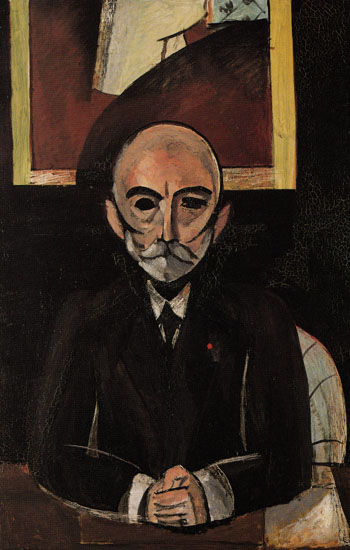
Portrait of Auguste Pellerin (II). While these works make no direct reference to the war in style or subject, they were physical and mental challenges for the artist, pushing his art to levels of extremity and difficulty that may be considered his responses to the conflict.
The Piano Lesson depicts the living room of Matisse’s home at Issy-les-Moulineaux, with his elder son, Pierre, at the piano. The painting also features, at bottom left, the artist’s sculpture
Decorative Figure (1908) and, at upper right, his painting
Woman on a High Stool. The artist began with a naturalistic rendering which he then purged of detail as he worked, scraping down areas and rebuilding them in broad fields of color. His incising on the window frame and stippling on the left side produced a pitted quality that suggests the eroding effects of light or time, a theme reiterated by the presence of the metronome on the piano.
Portrait of Auguste Pellerin (II) (1917) is the second of two portraits commissioned by Pellerin, a wealthy Parisian businessman and renowned art collector. The first—a colorful, thinly painted work—was rejected by the sitter as too daring. The artist began again, on this larger, more vertical canvas, reworking and revising as he went; the dark ground conceals the changes made to the position, size, and contours of the sitter’s head, and incised lines define the shape of Pellerin’s black suit and keep his torso from merging completely into the background. Matisse transformed what had been the more naturalistic portrait into a radically formal, masklike representation.
The artist’s major preoccupation in 1916–17 was the advancement of
Bathers by a River, He transformed the almost monochrome canvas of 1913 into a composition of vertical bands with now greatly enlarged and abstracted figures confined within the rigid geometric structure. His changes closely relate to those that he made in transforming Back (II) into Back (III) at the same time in the Issy studio. In the painting, a central black band both divides and coheres its two halves, one filled with verdant foliage, the other void of incident. Matisse’s final work on the canvas was to revise the colored band between the third and the fourth figure, and to lightly scrape into the paint at the left side to reveal the layers beneath.
PUBLICATION:
The
accompanying publication, incorporating over 650 illustrations—including never before published archival, X-ray, and infrared images—exemplifies a new kind of art history that fully integrates historical, technical, and scientific information for a fresh look at this popular artist’s most demanding, experimental, and surprising creations. 368 pages with 650 illustrations. Hardcover, $65.00. It is published by the Art Institute of Chicago.