Thursday, July 5, 2012
VICTORIAN PHOTOGRAPHER ROGER FENTON
All the Mighty World: The Photographs of Roger Fenton, 1852-1860, on view from October 17, 2004 through January 2, 2005 at the National Gallery of Art , presented 91 works by the groundbreaking 19th-century photographer. It was the first exhibition of Fenton's work in this country in more than 15 years.
All the Mighty World: The Photographs of Roger Fenton, 1852-1860, was on view at the J. Paul Getty Museum, Los Angeles, February 1 through April 24, 2005, and The Metropolitan Museum of Art, New York, May 24 through August 21, 2005. The exhibition also traveled to Tate Britain, London, where it was on view from September 21, 2005 through January 2, 2006. The exhibition was organized by the National Gallery of Art, Washington, The J. Paul Getty Museum, Los Angeles, and The Metropolitan Museum of Art, New York.
One of the most important 19th-century photographers, Roger Fenton exerted a profound influence on the medium despite the fact that his career lasted only eleven years. All the Mighty World, the exhibition title, is a phrase from Wordsworth's poem about Tintern Abbey, where Fenton frequently photographed, and where the poet declared himself a lover "of all that we behold/from this green earth; of all the mighty world/or eye and ear, both what they half-create,/and what they perceive." These lines echo the reverence for nature evident in Fenton's photographs and also reveal his great ambition for both his own photographs and the medium itself.
Born in 1819, the grandson of a wealthy industrialist, Fenton set aside his law studies in the early 1840s to become a painter. After studying with Michel-Martin Drölling in Paris, he returned to London and worked with Charles Lucy, a member of the Royal Academy. By 1852, however, he had made his first photographs and become an important force in English photography.
In the first few years of his career he helped to found the Photographic Society (which later became the Royal Photographic Society) and made landscape and architectural views that evidenced such great technical ability and aesthetic refinement that his work came to the attention of Queen Victoria and Prince Albert.
Commissioned by Thomas Agnew and with letters of introduction from Prince Albert, Fenton traveled to Balaclava (in present-day southern Ukraine) to document the Crimean War. Because his project was a commercial venture, one designed to produce a portfolio of photographs of heroes of the war, his photographs generally present a positive view of the campaign.
The exhibition included portraits of generals who led the armies, such as General Bosquet (1855),
as well as the picturesque and exotic individuals who populated the region, as in Group of Croat Chiefs (1855). But he also photographed the soldiers who bore the brunt of the fighting, and their ravaged faces demonstrate the war's true toll.
On his return to England, Fenton made ambitious studies of the English countryside, its cathedrals, country houses, and landscape. Traveling throughout England, Scotland, and Wales, he photographed historic sites such as Lindisfarne Priory, Holy Isle, as well as numerous cathedrals, such as Ely, Salisbury, and Lichfield, and country houses such as Harewood House.
While several of Fenton's photographs on display were distinguished by their evocative depictions of light, atmosphere, and place, others demonstrate his deep appreciation of the solidity, permanence, and integrity of English architecture.
The exhibition also included his portraits of the royal family, a series of still lifes, and studies of figures in Oriental costume, such as Reclining Odalisque (1858)
and Pasha and Bayadere (1858).
As his career progressed, Fenton pushed himself to tackle ever greater challenges, for example, striving to photograph clouds and the landscape using only one negative or interiors of darkly-lit cathedrals, difficult technical problems at the time.
Some of his last compositions, as demonstrated by The Queen's Target, No. 56 (1860)
and The Long Walk, Windsor (1860) are radically simplified and daringly bold.
For reasons still unknown, Fenton sold all of his equipment and negatives at an auction in November 1862 and resigned from the Royal Photographic Society. He died seven years later at the age of 50.
Lenders to the exhibition include: the National Museum of Photography, Film and Television, Bradford, England; the Royal Library, Windsor Castle; the Canadian Centre for Architecture, Montreal; the Gilman Paper Company Collection, New York; The J. Paul Getty Museum; the Victoria and Albert Museum and The British Museum, London; The Metropolitan Museum of Art, New York; the National Gallery of Art, Washington, and private collections in the United States and Europe.
CURATORS
The curators of the exhibition werre Sarah Greenough, curator and head of the department of photographs, National Gallery of Art, Washington; Malcolm Daniel, curator in charge, department of photographs, The Metropolitan Museum of Art, New York; and Gordon Baldwin, associate curator at The J. Paul Getty Museum, Los Angeles.
CATALOGUE
The exhibition was accompanied by a major catalogue with essays by the three organizing curators, as well as other leading Fenton scholars. All the Mighty World: The Photographs of Roger Fenton, 1852-1860 was published by The Metropolitan Museum of Art, New York, the National Gallery of Art, and The J. Paul Getty Museum, in association with Yale University Press (320 pp., 85 tritone and 50 duotone illustrations).
MORE IMAGES
Roger Fenton Self Portrait, ca. 1854 albumen silver print, 19.5 x 14.7 cm (7 11/16 x 5 13/16) Private collection, London
Roger Fenton (Self-Portrait) February 1852, albumen silver print 12.2 x 9 cm (4 13/16 x 3 9/16 in.) Gilman Paper Company Collection, New York
OFF:
ON:
Roger Fenton’s photographs of the Crimean War:
Both of the images above are from the Harry Ransom Humanities Research Center at The University of Texas at Austin, and were digitally cleaned and enlarged by Dennis Purcell.
Lots more info and images
Wednesday, July 4, 2012
Focus: Jasper Johns
Focus: Jasper Johns celebrated MoMA’s acquisition of a series of 13 untitled compositions from 2001 by Jasper Johns (American, b. 1930) with an exhibition of 85 prints, drawings, and paintings, all from the Museum’s significant collection of his works. On view for the first time at MoMA, Johns’s Untitled series of prints—referencing his “Catenary” theme, named for the curve formed by a cord hanging between two fixed points—show the artist cutting, pasting, painting, and drawing to make works that are linked thematically but differ widely in their expressive content. This series, along with the other works selected for this exhibition, comprise a revealing display of the artist’s creative process and demonstrate Johns’ longstanding practice of re-investigating a repertoire of images, including flags, numerals, targets, and studies of the four seasons.
On view December 5, 2008, through February 16, 2009, the exhibition was organized by Deborah Wye, The Abby Aldrich Rockefeller Chief Curator for Prints and Illustrated Books, The Museum of Modern Art.
“Just the process of printmaking allows you to do things that make your mind work in a different way,” Johns has said.
Numerals have been the most prevalent motif in Johns’s work.
Among the works on view were two variations of a portfolio entitled 0-9 (1963): one is printed in gray ink on tan paper, the other in a range of colors on white paper. All the prints were made from one lithographic stone, with Johns effacing and reworking the surface of the stone after drawing each numeral.
Decoy (1971) contains imagery from several of his earlier works. For this print, Johns had access for the first time to an offset printing press, which facilitates the use of multiple plates, photographic transfers, and layering.
After finishing Decoy , he used the leftover, rejected prints to create Decoy II (1971–73).
With Flags (1968), Johns revisited his composition and created something almost entirely new from it.
On view were a series of trial proofs that demonstrate how the artist later developed a new version entitled, Flags II (1970).
The print Savarin (1977) is based on Johns’ life-size bronze sculpture of a paint brush filled Savarin coffee can. The composition was designed first as a poster for a retrospective exhibition of his work. Johns went on to experiment extensively with this imagery.
This exhibition also included a series of six lithographs that are variations on the theme.
In the late 1980s, Johns’s works known as The Seasons were his most autobiographical to date. Their imagery combines fragmented references to the artist’s work and to his life. Incorporating personal elements such as a tracing of his own shadow was, at the time, a departure for him. A painting, drawing, and several prints on this theme are on view.
Johns has sometimes looked to other artists for themes and patterns to serve as compositional elements in his own work. While many references are known—from the work of the modern master Pablo Picasso to that of the Renaissance painter Matthias Grünewald,
Green Angel (1991) presents a shape traced from a source the artist has not identified. This motif has appeared in over 40 paintings, drawings, and prints.
Monet, Inness, Courbet: The Draw of the Normandy Coast
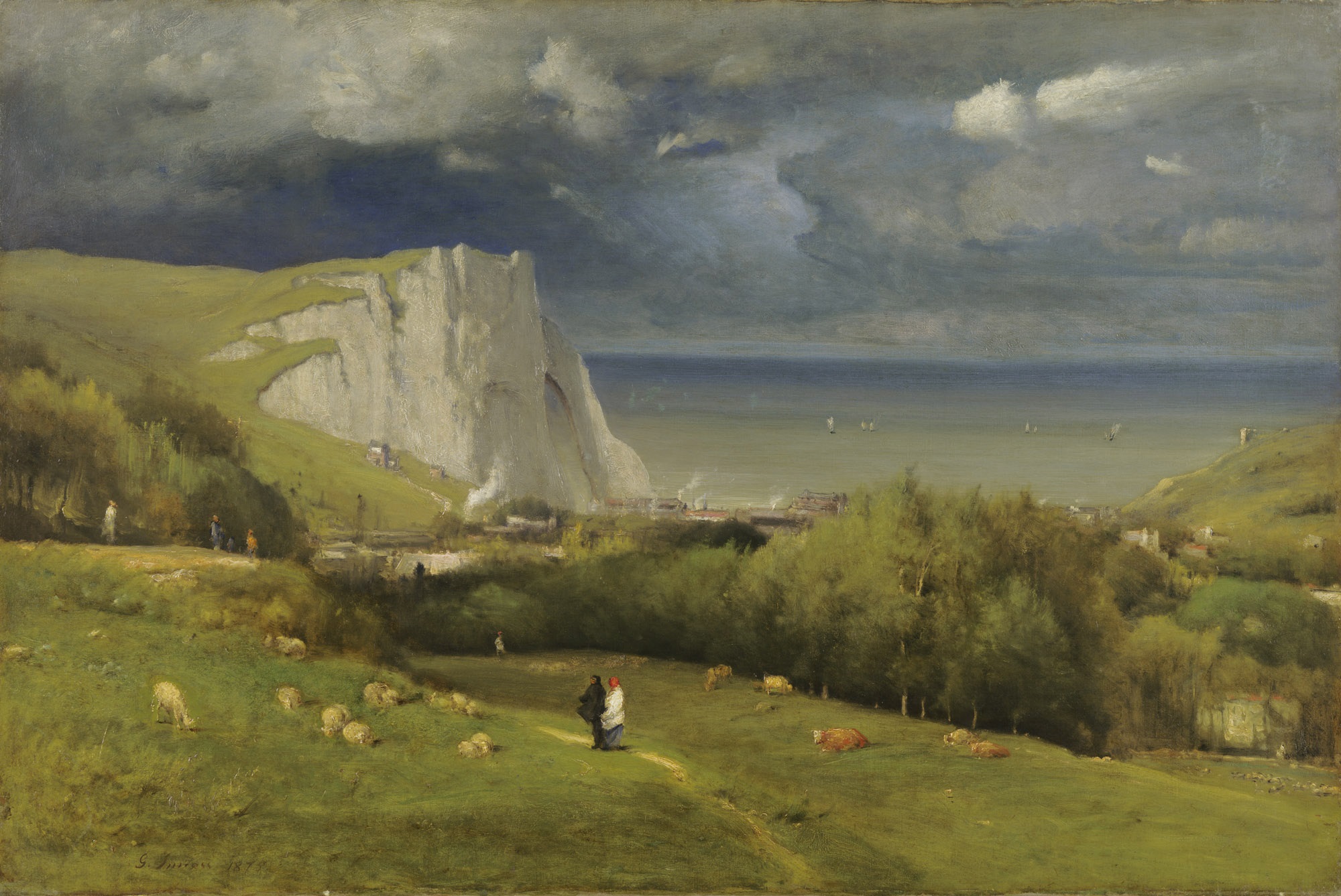
This summer, the Portland (Maine)Museum of Art presents the exhibition The Draw of the Normandy Coast, 1860-1960, on view June 14 through September 3, 2012. This exhibition focuses on the impressive Normandy coast which proved to be an artistic crucible for European and American artists during the course of the 19th and 20th centuries. Geographically convenient to Paris, accessible by train, with dramatic cliffs and rock formations, and picturesque and active ports, Normandy was an attractive haven. Realists, Impressionists, Neo-Impressionists, Fauves, Cubists, and Surrealists all gravitated to the area, including Claude Monet, Henri Matisse, Camille Pissarro, and James Abbott McNeill Whistler. Featuring more than 40 works, mostly paintings and works on paper, The Draw of the Normandy Coast, 1860-1960, charts the coast’s significance and showcase the ways in which the landscape was rendered by a spectrum of artists.
The Draw of the Normandy Coast, 1860-1960, was inspired by the masterful painting by Claude Monet, La Manneporte Vue en Aval (The Manneporte Seen from Below) (ca. 1884).
This powerful landscape is part of the Isabelle and Scott Black Collection and is currently on long-term loan to the Portland Museum of Art. The Manneporte, the dramatic arch at Étretat, was the focus of one of Monet’s most significant painting campaigns in Normandy. Monet’s painting is one of several works from the Isabelle and Scott Black Collection that are showcased in the exhibition.
Here's another:
Maximilien Luce France, 1858-1941 Camaret, La Digue (The Breakwater at Camaret), 1895 oil on canvas 25 5/8 x 36 1/4"
The exhibition also includes a carefully selected group of masterworks by European and American artists from the Museum’s permanent holdings, including Samuel Colman’s Cliffs at Étretat (ca. 1873), a work on paper acquired by the Museum in 2009 with the support of the Friends of the Collection.
The exhibition is greatly enhanced by generous loans not only from collegial institutions across Maine, including Bowdoin College Museum of Art, but also by special loans from the National Gallery of Art, Washington, D.C.; the Museum of Modern Art, New York; the Detroit Institute of Arts, Michigan; the Museum of Fine Arts, Boston; and the Dixon Gallery and Gardens, Tennessee, among other collaborating private collectors and museums.
Chefs d’oeuvres including Félix Vallotton’s Vuillard Drawing at Honfleur (Montreal Museum of Fine Arts),
George Inness’ Étretat (Wadsworth Atheneum, Hartford),
and Gustave Courbet’s M. Nodler, the Elder at Trouville (Smith College Museum of Art, Northampton) will grace the galleries of the Museum this summer.
The Draw of the Normandy Coast, 1860-1960 follows in the tradition of the summer 2009 Museum’s exhibition Call of the Coast., Just as Call of the Coast.,studied the attraction of the Maine coast for countless American artists as well as explored the art colonies of New England, The Draw of the Normandy Coast, 1860-1960 examines the importance of the towns and villages of Honfleur and Le Havre, and such unique destinations as Étretat.
The exhibition is curated by Margaret Burgess, the Susan Donnell and Harry W. Konkel Associate Curator of European Art at the Portland Museum of Art.
A full-color catalogue accompanies the exhibition with essays by scholars Frances Fowle, Senior Lecturer and Senior Curator of French Art at the National Gallery of Scotland, and Richard Kendall, curator-at-large at the Sterling and Francine Clark Art Institute and preeminent Degas scholar.
Tuesday, July 3, 2012
Photography’s Image of the American West
From March 29–June 8, 2009 the Museum of Modern Art presented Into the Sunset: Photography’s Image of the American West, a survey of 138 photographic works dating from 1850 to 2008 that charted the West’s complex, rich, and often compelling mythology via photography.
The exploration of a large part of the American West in the mid-nineteenth century by European Americans coincided with the advent of photography, and photography and the West came of age together. The region’s seemingly infinite bounty and endless potential symbolized America as a whole, and photography, with its ability to construct persuasive and seductive images, was the perfect medium with which to forge a national identity. This relationship has resulted in a complex association that shapes the perception of the West’s social and physical landscape to this day. With political, cultural, and social attitudes constantly shifting in the region over the last 150 years, Into the Sunset/ further examined the way photographers have responded to these changes.
The exhibition was organized by Eva Respini, Associate Curator, Department of Photography, The Museum of Modern Art.
Organized thematically rather than chronologically, Into the Sunset/ brought together the work of over 70 photographers, including Robert Adams, John Baldessari, Dorothea Lange, Timothy O’Sullivan, Cindy Sherman, Joel Sternfeld, Carleton E. Watkins, and Edward Weston, among others. The exhibition drew extensively from MoMA’s collection, along with private and public collections in the United States, and features new acquisitions from Adam Bartos, Katy Grannan, and Dennis Hopper, with each work also on view for the first time at the Museum.
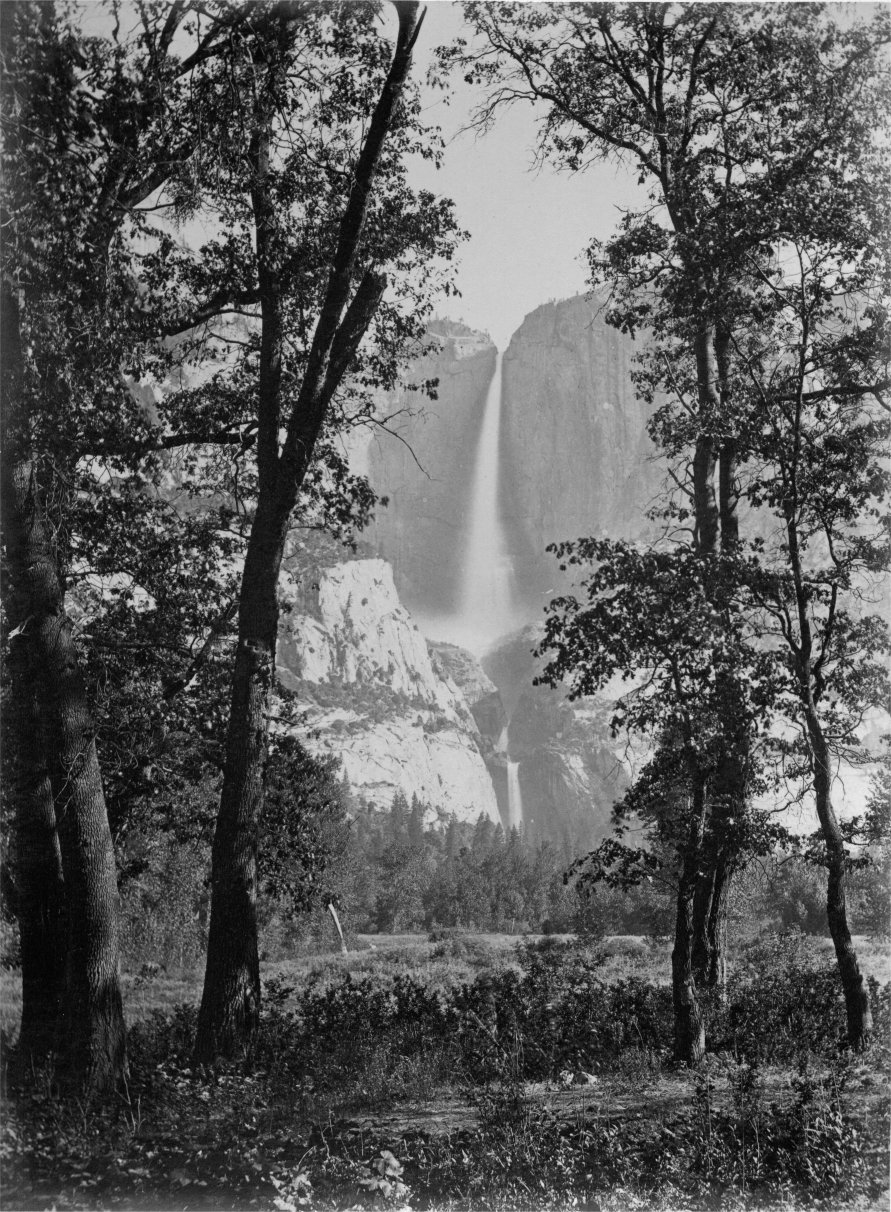
Into the Sunset/ began with the birth of photography and the American West. In the mid-nineteenth century, the region’s seemingly infinite bounty and endless potential symbolized America as a whole, and Carleton E. Watkins (American, 1829-1916) captured the grand depictions of an American paradise in his photographs of Yosemite Valley in California. Arguably the world’s first renowned landscape photographer, Watkins made his first photographs there in 1861—large sized prints made with an 18-by-22-inch mammoth plate camera, well suited to the grandeur of the land.
Included were the three contiguous photographs that make up his extraordinarily detailed View from the Sentinel Dome (1865-66).
The exhibition balanced the early work of landscape photographers with the twentieth century focus on the failure of the West’s promised bounty.
In Joel Sternfeld’s (American, b. 1944) After a Flash Flood, Rancho Mirage, California (1979), the photographer documents the impact of a natural disaster, specifically a landslide, shot with neutral tones softly camouflaging the extent of flash flood on this suburban neighborhood.
And in Karin Apollonia Müller’s (German, b. 1963) Civitas (1997), the photographer shows a very different view of California than that of Watkins, with Müller revealing a contemporary Los Angeles as a littered wasteland of freeways and anonymous glass towers.
As highways and interstate travel became more prevalent, the automobile and the open road became synonymous with the region, with Edward Weston (American, 1886-1958) as the first great photographer of these open roads.
Included in the exhibition was Weston’s iconic Hot Coffee, Mojave Desert (1937), a humorous black-and-white photograph of a roadsign revealing a greater thematic shift to the highway and its signage as an inescapable element in picturing the West in the twentieth century.
Once the West became more populated, photographers began to showcase humans’ effects on the land, including images of industrial development. In the 1950s William Garnett (American, 1916-2006) was hired by a real estate company to record the efficiency of mass produced housing.
For this series, Lakewood, California (1950), Garnett took photographs of the neighborhood from an airplane, resulting in images that are completely devoid of people and focus on the progress of mass-produced construction. However, the series subsequently came to represent all that was wrong with such development and the massive sprawl of the West in the eyes of its critics.
Photographs of the people of the West represent a diversity of archetypes: gold miners and loggers, Native Americans, cowboys, suburbanites, city dwellers, starlets, dreamers, and drifters. Into the Sunset explores these archetypes, and their mutability into the twenty-first century.
The exhibition included Half Indian/Half Mexican (1991), from the photographer James Luna (Native American, Pooyukitchum/Luiseno, b. 1950), an artist of Native American ancestry. This tongue-in-cheek self-portrait captures in profile both an identity photograph and a mug shot, and works as a counterpoint to the tokenized portrayals of Native Americans from the past 150 years.
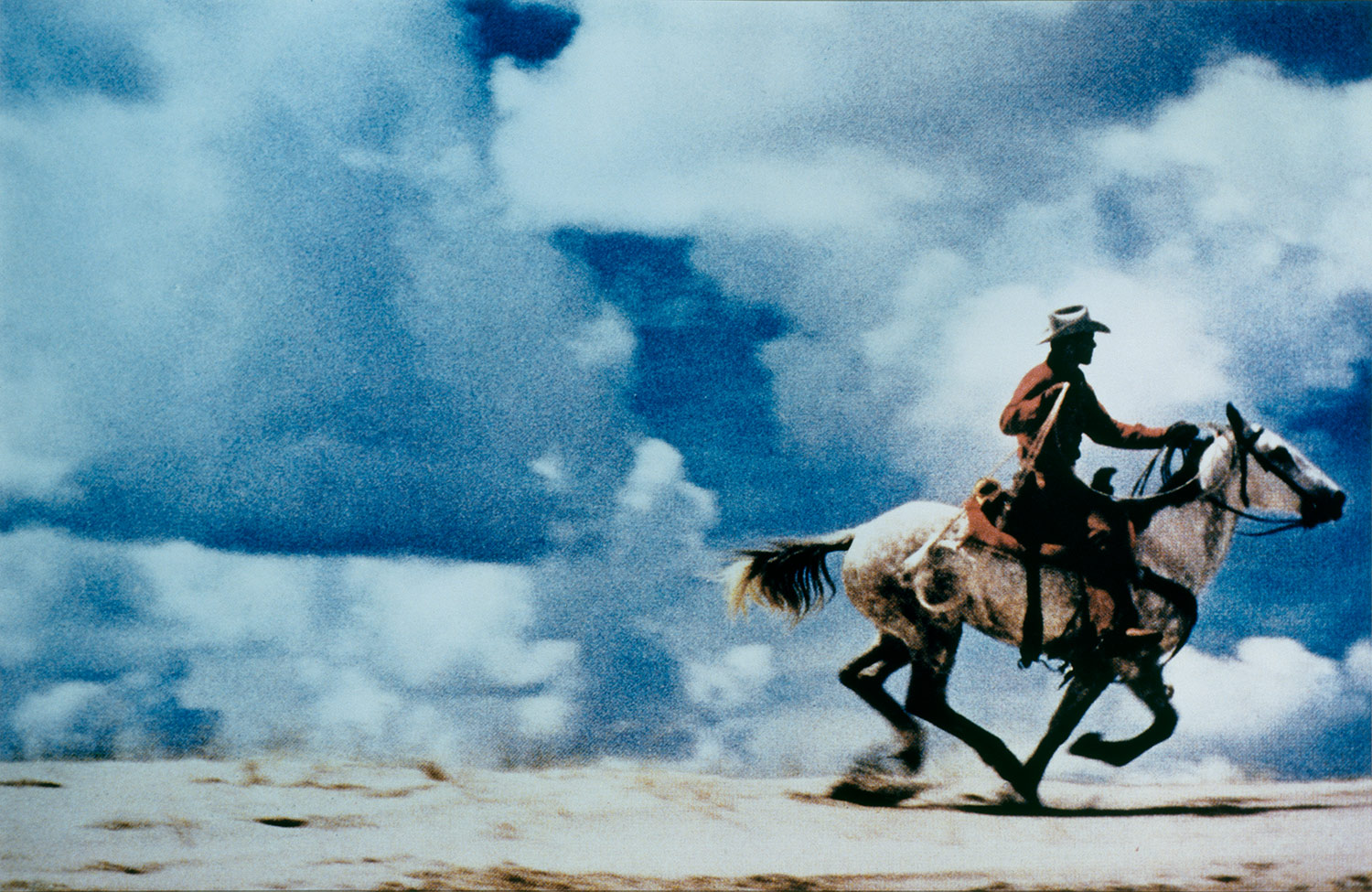
A similar reevaluation of past archetypes occurs in Richard Prince’s (American, b. 1949) “Cowboy” series from 1980, with one work from the series included in the exhibition. For that series Prince famously photographed Marlboro advertisements, cutting out the text, cropping the images, and enlarging them, highlighting the artifice of the virile image of the cowboy and its potency as a deeply ingrained figure in American mythology. The suburbs and their inhabitants have been a rich subject for photographers of the West, and included were Larry Sultan’s (American, b. 1946) “Film Stills from the Sultan Family Home Movies” (1943-1972), in which Sultan chose individual frames from his family’s home movies and enlarged them. Although the images feature the activities that epitomize suburban life, a sense of unease lurks beneath the surface of these images; cropped and grainy, they resemble surveillance or evidence photographs.
Into the Sunset concluded with the theme of the failed promise of Western migration. Dorothea Lange’s well-known 1936 photograph Migrant Mother, Nipomo, California, photographed when Lange was employed by the Farm Security Administration, is included and documents the conditions of the West in rural areas during the Great Depression. Her photographs had a humanist purpose and resulted in putting a face on the hardships of that era.
This tradition of capturing the downtrodden of the West continues into this century with Katy Grannan (American, b. 1969), a photographer who recently completed a series of new pioneers, individuals struggling to define themselves in the West of today. In Nicole, Crissy Field Parking Lot (I) (2006), a woman, “Nicole,” poses seductively on a gravel parking lot, with her makeup-streaked face and harsh light alluding to her perilous existence on the fringe of society.
MORE IMAGES:
The Yosemite Falls by Carleton E. Watkins, circa 1865-1866
Felling a Fir Tree, 51 Feet in Circumference (Darius Kinsey, 1906) />
Dorothea Lange (American, 1895-1965), The Road West, New Mexico, 1938, Gelatin silver print, 9 5/8 x 13 1/16", The Museum of Modern Art, New
Garry Winogrand, New Mexico, 1957
Robert Adams (American, born 1937), Colorado Springs, Colorado. 1968, Gelatin silver print, 5 15/16 x 5 15/16". The Museum of Modern Art, New York, © 2008 Robert Adam
Stephen Shore (American, born 1947), U.S. 97, South of Klamath Falls, Oregon. July 21, 1973, Chromogenic color print (printed 2005), 17 1/4 x 21 1/2”, Courtesy the artist and 303 Gallery, New York, © 2009 Stephen Shore.
Cindy Sherman. Untitled Film Still #43. 1979. Gelatin silver print. 7 9/16 x 9 7/16” (19.2 x 24 cm). The Museum of Modern Art, New York. Acquired through the generosity of Sid R. Bass. © 2008 Cindy Sherman
PUBLICATION:
Through more than 130 photographs reproduced in its plate section and an expansive essay by Eva Respini, Into the Sunset: Photography’s Image of the American West charts changing myths and cultural attitudes about the West from 1850 to the present. 9.5 x 10.5 in.; 168 pages; 158 illustrations (77 color). ISBN: 978-0-87070-749-0
Willem de Kooning's Drawings of Women
Willem de Kooning: Tracing the Figure, a comprehensive survey of the artist's drawings on paper depicting the female form, was on view in the East Building of the National Gallery of Art, from September 29, 2002, through January 5, 2003. Widely regarded as one of the great pioneers of abstract expressionism, de Kooning is known for the vividly abstract figure-based paintings and drawings that placed him at the center of the New York School. The exhibition featured 66 works produced between 1938 and 1955.
In Willem de Kooning: Tracing the Figure, the assembled works on paper, organized around themes found in the critical early years of de Kooning's exploration of the female figure, illustrated the artist's struggle to eliminate traditional barriers between drawing and painting. Ranging from his early surrealist-inspired portraits of Elaine de Kooning and Juliette Brauner in 1938, to the drawings of 1955, when the figure dissipates into abstraction, the works incorporated a variety of media, including graphite, charcoal, pastels, and oil on paper.
The exhibition highlighted key pastels from 1952-1953 that were the centerpiece of de Kooning's 1953 exhibition at the Sidney Janis Gallery, in New York. Many of the original 16 works on paper were exhibited together for the first time since that groundbreaking exhibition. To many, this group of pastels and charcoals represents the pinnacle of de Kooning's examination of the female form.
His first series of women, approximately 1938-1944, revealed the influences of his formal training and highlighted thematic dualities such as tradition and modernism, geometry and automatism, figuration and abstraction. Between 1945 and 1946, de Kooning's semi-abstract works, which included color and collage elements, contributed to an increasingly noticeable tension between flatness and an illusion of depth. It is during this period that the double figure drawings began to emerge.
As de Kooning's figural compositions developed, geometric configurations were transformed into architectural elements, as in Two Women (1952).
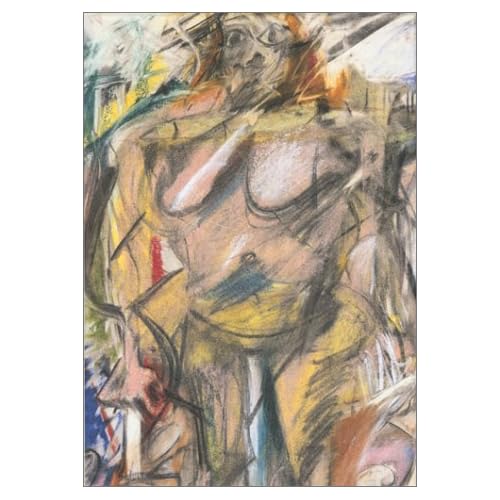
In 1951, de Kooning suspended his simultaneous work on abstract and figurative forms and returned to depictions of women. The anatomy of these women disintegrates into a cross layering of brushwork. The effect created by the size and intentional vulgarity of the images establish an almost violent sensuality--an exaggeration of gender parallel to the ubiquitous calendar girl of the time. But de Kooning's turbulent gestural style belies the artist's meticulous re-working of his paintings and drawings.
ABOUT THE ARTIST
Willem de Kooning was born April 24, 1904, in Rotterdam, Holland. Following formal studies in fine and applied art at the Rotterdam Academy, he emigrated to America at age 22. In New York he initially supported himself as a house painter and commercial artist. During the late 1920s and 1930s he developed friendships with fellow painters Stuart Davis, John Graham, and Arshile Gorky, and painted murals for the Federal Arts Project before devoting himself full-time to a career as an artist in 1936.
He is best known for a provocative series of paintings of women, whose aggressive forms are rendered with slashing strokes and dripping paint. Throughout his long and prolific career, his painting oscillated between the figurative and the purely abstract, eventually dissolving anatomy into abstraction. His work places him in the tradition of figurative artists such as Eugène Delacroix, Jean-Auguste-Dominique Ingres, Paul Cézanne, and Pablo Picasso. His first retrospective exhibition came in 1968 at the Stedelijk Museum, Amsterdam. In 1985, the artist received the National Medal of Arts in the United States. De Kooning died March 19, 1997, on Long Island.
On Display
Seated Woman, 1940
pencil drawing of Elaine De Kooning, 1940
Untitled, 1947
Pink Lady (Study), ca. 1948
Woman,1951
Two Women with Still Life, 1952
Woman, II, 1952
CURATORS
Willem de Kooning: Tracing the Figure, has been organized by The Museum of Contemporary Art, Los Angeles.
CATALOGUE
The exhibition is accompanied by a comprehensive catalogue copublished by MOCA and Princeton University Press. Willem de Kooning: Tracing the Figure features 85 color plates and essays by MOCA chief curator Paul Schimmel and MOCA curator Cornelia Butler, who both served as the exhibition’s co-curators, as well as leading art historians Anne Wagner and Richard Shiff. Additional support for the exhibition catalogue has been provided by the Frederick R. Weisman Art Foundation.
Subscribe to:
Posts (Atom)