Friday, July 6, 2012

Van Gogh and the Colors of the Night


The Museum of Modern Art, in collaboration with the Van Gogh Museum, Amsterdam, presented Van Gogh and the Colors of the Night, the first exhibition to examine Vincent van Gogh’s lyrical view of the night through nocturnal interiors and landscapes, which he often combined with other longstanding themes of his art—peasant life, sowers, wheatfields, and the encroachment of modernity on the rural scene.

This exhibition included 23 paintings and 10 works on paper from all periods of Van Gogh’s career, as well as a selection of his letters and examples of the rich literary sources that influenced the artist’s work in this area by writers such as Hans Christian Andersen, Jules Michelet, and Emile Zola.

Van Gogh and the Colors of the Nightwas organized by Joachim Pissarro, Adjunct Curator, Department of Painting and Sculpture, The Museum of Modern Art, and the Bershad Professor of Art History and Director of the Hunter College Galleries, Hunter College, New York; Sjraar van Heugten, Head of Collections, Van Gogh Museum, Amsterdam; and Jennifer Field, Curatorial Assistant, Department of Painting and Sculpture, The Museum of Modern Art. It was on view at MoMA from September 21, 2008, to January 5, 2009, and then traveled to the Van Gogh Museum in Amsterdam, where it will be on view February 13 to June 7, 2009.

Vincent van Gogh (Dutch, 1853–1890) depicted and reflected upon the night throughout his career. Painting in the dark was a challenge in the late nineteenth century, particularly for an artist who relied merely on his powers of observation; Van Gogh refused to be bound by this alternative to work strictly from observation, or from imagination. Instead, he relied on both. Thus, he was also an artist for whom the real was intertwined with the symbolic, and who set out to capture the spiritual qualities he sensed in the world around him. It was during the night hours that his experiments with imagination, memory, and observation, altogether went the farthest.

Mr. Pissarro said, “Van Gogh’s night scenes offer rich layers of significations and associations. Some show the strong relationship that he perceived between the cycles of nature and those of rural labor. Others evoke poetic associations of the evening with either the vagaries of life in modern times or with profound metaphysical questions. Van Gogh’s works and letters not only carried on the art historical tradition of twilight and night scenes but also reflected how his thoughts were influenced by abundant literary sources. The powerful technical innovation— Van Gogh’s signature—that he applied to capture the effects of dark and light proved to be a rewarding field of investigation.”

The exhibition was divided into four sections. “Early Landscapes” features Van Gogh’s earliest landscapes at dusk, painted in 1883-84. “Peasant Life” refers to Van Gogh’s study of peasants in Nuenen in the southern Dutch province of Brabant, and features, most notably, The Potato Eaters (1885). The third section, “Sowers and Wheatfields,” addresses his interest in the sowing of wheat, which formed the basis of many of his works, including The Sower (1888). The last section, “Poetry of the Night,” focuses on Van Gogh’s lyrical view of the night and is divided into two parts: “The Town,” which features works such as The Night Café (1888), which will only be shown in the MoMA presentation, and The Starry Night over the Rhône (1888); and “The Country,” which centers on Van Gogh’s iconic painting The Starry Night (1889) from MoMA’s collection.

Early Landscapes

Van Gogh did not pursue a career as an artist until 1880, when he was 27 years old. Many of his earliest paintings portray the effects of aerial light, particularly around sunset, on the landscape of Brabant, the region in the southern Netherlands where he was born.


In these works, including Lane of Poplars at Sunset (1884)


and Evening Landscape (1885), the artist aligned himself with the centuries-old traditions of night scenes and Dutch landscape painting, typified by seventeenth century masters such as Rembrandt and Jacob van Ruisdael, respectively. In the middle decades of the nineteenth century, nocturnal landscapes were favored by the Barbizon painters in France, such as Charles Daubigny and Jules Dupré, whom Van Gogh greatly admired. At first a devotee of their effets de soir, or “evening effects,” Van Gogh soon took up the challenge of fashioning his own approach and modernizing this genre with his striking use of color and rhythmic brushstroke.

Peasant Life

Van Gogh believed that rural laborers stood closer to nature than other people, and were more strongly linked to the cycles of life. Between 1883 and 1885, while living with his parents in Brabant, he made a series of paintings and drawings describing the humble life of the peasants there.


One of these was The Potato Eaters which depicts a family gathered around their evening meal. His first significant interior night scene, it is also widely accepted as his first major canvas. To make it he returned regularly to the home of a local family and sketched them at dinner. In 1885, he included a sketch of the scene in a letter in his brother Theo. Before starting the final composition, Van Gogh made one large study, from which he printed a lithograph, also on view, and a series of studies of figures and heads.


The Potato Eaters was immediately followed by The Cottage (1885), a painting of one of the region’s modest rural homes, again depicted in the evening. Van Gogh’s affection for such dwellings, which he called “human nests,” would be evident in his work until the end of his life.

Sowers and Wheatfields

In February 1888, Van Gogh moved to Arles, a Provençal town in the South of France. Here he adopted a more vibrant palette, moving away from closely representational painting toward a more poetic, associative approach.


He was fascinated by the effects of the southern light at different times of day, and in several paintings he combined scenes of peasants sowing or harvesting wheat with the cool tones of twilight, or with the ambers and golds of a large sun nearing the horizon, like in the various versions of The Sower.

For Van Gogh, the endless flow of the days and the cycle of sowing and harvesting functioned symbolically as metaphors for the eternal cycle of life and death. It was in working through this theme that he began to come closer to his mature style, honing his use of complementary colors, such as violet and yellow, and embracing the stylistic elements of Japanese woodblock prints, which he had viewed with enthusiasm in Paris over the previous two years.

Poetry of the Night

The Town:

Van Gogh looked hard at the world around him, and his depictions of night extended to the afterdark entertainments of urban life, such as cafés and dance halls.


In The Night Café, for example, he observed the listless patrons of a bar underneath the harsh glare of gas lamps at night. Despite their obvious differences, he connected this work to his earlier painting The Potato Eaters , an equally ambitious rendering of a complex figure arrangement in a nocturnal interior. Yet he was still preoccupied with nature, and after finishing The Night Café he wrote to his sister Wil, “I definitely want to paint a starry sky now.” He had expressed this aspiration in letters throughout 1888, but the painting had not yet materialized. Eventually he had the idea of setting up his easel under the outdoor gas lamps of an Arles café, which lit the canvas enough for him to paint a street scene below twinkling stars.
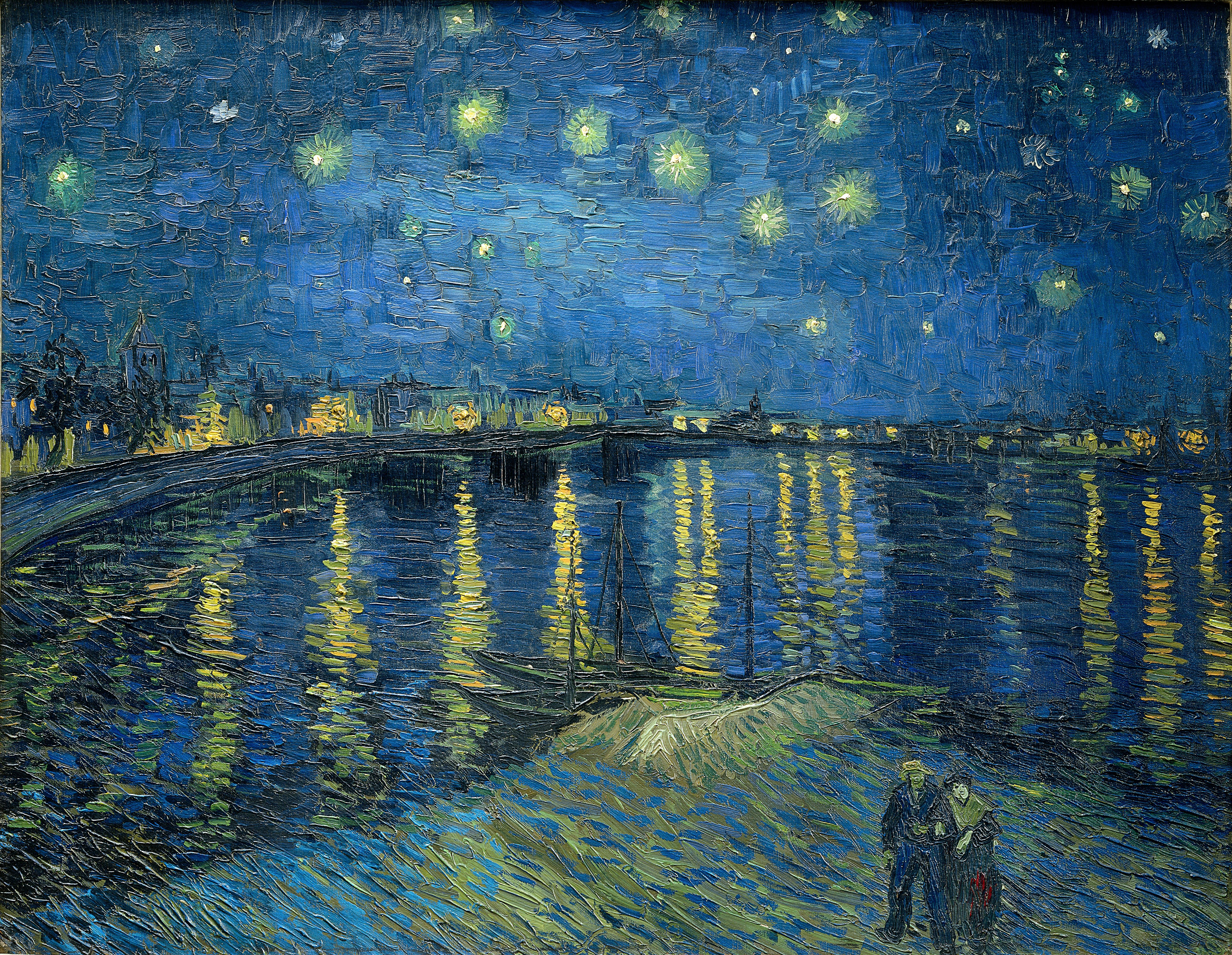


Twelve nights later, emboldened by the results of this endeavor, Van Gogh embarked on his seminal painting The Starry Night over the Rhône, which features a vast expanse of night sky in the upper half of the canvas.

The Country:

Van Gogh’s interest in working from both observation and imagination fused in the night scenes he made in 1889 and 1890.
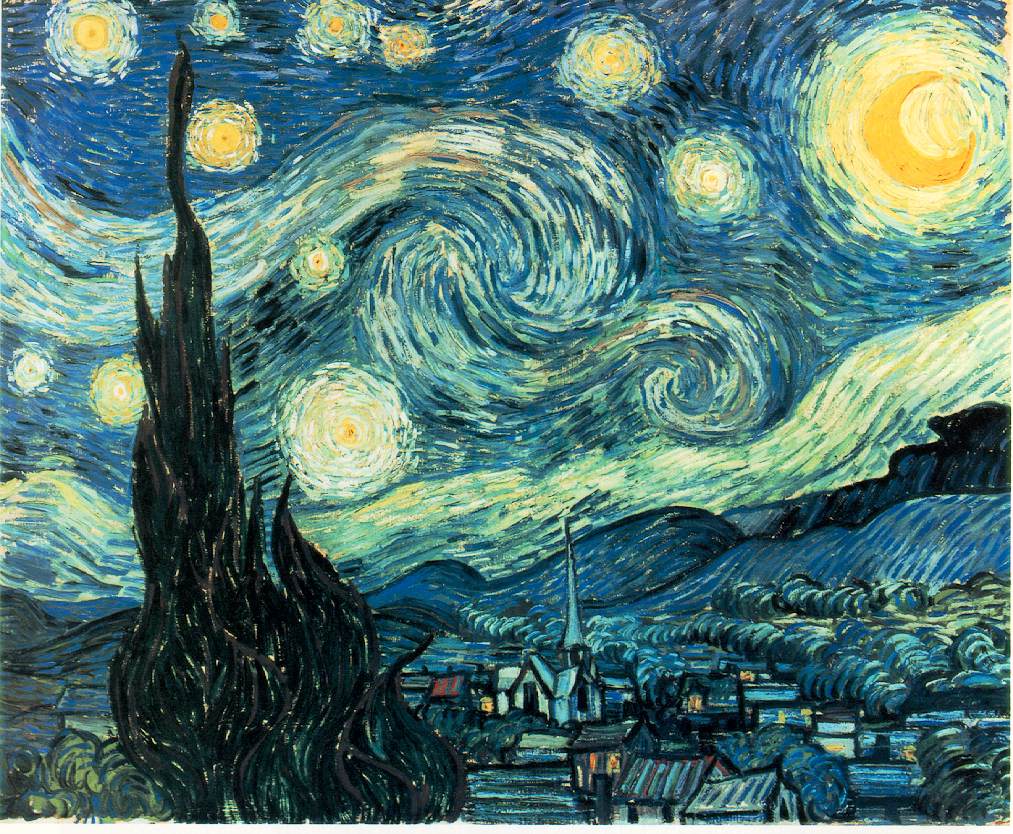


Among these was The Starry Night, the culmination of his intense effort to conquer the problems of using color to depict darkness, as well as to register the spiritual and symbolic meanings that he saw in the nighttime hours. The Starry Night, has become an iconic image, an emblem not only of Van Gogh’s own work but also of modern art in general. It shows a fantastical sky above a town and hills lit only by the stars and moon—which, however, are vibrant and alive. The little village and the hills beyond were inspired by Saint-Rémy and the nearby Alpilles mountain range, but were not modeled on them closely, and the cypress trees and the thickly painted, swirling astral sky stemmed from Van Gogh’s imagination. In the open night skies Van Gogh perceived formidable forces of nature, capable both of providing consolation amid life’s daily adversities and of evoking eternity.

PUBLICATION:


Van Gogh and the Colors of the Night features essays by Joachim Pissarro, Sjraar van Heugten, Chris Stolwijk Geeta Bruin, Jennifer Field, and Maite van Dijk. Van Gogh Museum / The Museum of Modern Art, 160 pages, 115 illustrations.

Gustav Klimt: The Magic of Line


Drawing the human figure was Gustav Klimt’s starting point for exploring overarching themes of existence — the cycle of life, human suffering, happiness, love, and longing. Gustav Klimt: The Magic of Line, on view at the J. Paul Getty Museum July 3, 2012 through September 23, 2012, is the first major museum exhibition devoted entirely to the modern master’s drawings. Klimt (Austrian, 1862–1918), the father of Viennese modernism, is renowned for his ornate paintings, but he was also an exceptionally innovative and gifted draftsman. Featuring more than 100 drawings, many having never before been exhibited in North America, this exhibition traces Klimt’s radical evolution from early academic realism and historical subjects in the mid 1880s to his celebrated modernist icons that broke new ground in the beginning of the 20th century.

This major loan exhibition was organized by the Albertina Museum, Vienna, in association with the J. Paul Getty Museum, to mark the 150th anniversary of Klimt’s birth. Throughout 2012, the city of Vienna will celebrate this anniversary with special events and exhibitions in the region, including the exhibition at the Albertina, which houses one of the world’s most comprehensive collections of Klimt drawings. “Working with our colleagues at the Albertina, the Getty is proud to bring this first major exhibition of Klimt’s drawings to the U.S.,” said James Cuno, president and CEO of the J. Paul Getty Trust and acting director of the Getty Museum. “In looking at four decades of drawings by Klimt, this exhibition reveals how he tackled line, space and the human figure, developing into one of the most distinctive, seminal figures in Modernism. It is precisely the kind of exhibition for which the Getty has earned its international reputation.”

Early Work

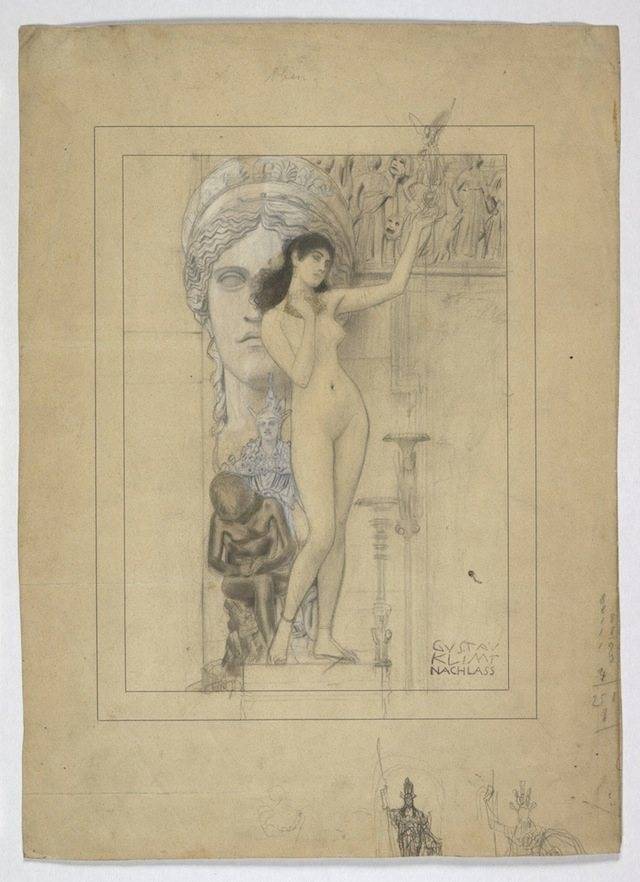
This thorough chronological examination of Klimt’s drawings begins with those made in his early style of Historicism — popular in the 1880s — that depicted grand historical and mythological scenes in a realistic manner.


Preparatory Drawing for the 'Allegory of Sculpture', with Studies of the Athena Parthenos at the Bottom, 1888-1889

From its earliest moment, Klimt’s art was based on drawing the human figure from life, as it would be for the rest of his career. “Gustav Klimt drew live models nearly every day,” explains Lee Hendrix, senior curator of drawings at the Getty Museum. “His drawings are essential to understanding Klimt’s art and give crucial insight into his creative process. They demonstrate his search for aesthetic solutions as well as his ongoing concern with the transitory, interconnected, and ineluctable flow of human existence.” In the mid-1890s, Klimt’s approach to the figure gradually became more ambiguous both formally and psychologically with modeling and perspective abandoned in favor of the flat plane of the paper or canvas.


Drawing of a Woman with Cape and Hat in Three-quarter Profile, 1897-1898

At the same time, the wider European movement of Symbolism began to influence Klimt’s work, as he rejected optimistic, unambiguous historical subjects and began to investigate troubling psychological and emotional worlds of dreams, melancholy, and sexual desire.

The Vienna Secession

In 1897, alongside other young Austrian artists and architects, Klimt broke away from the Vienna “Artists’ House” (Künstlerhaus) — the exhibition venue dominated by academically established painters.


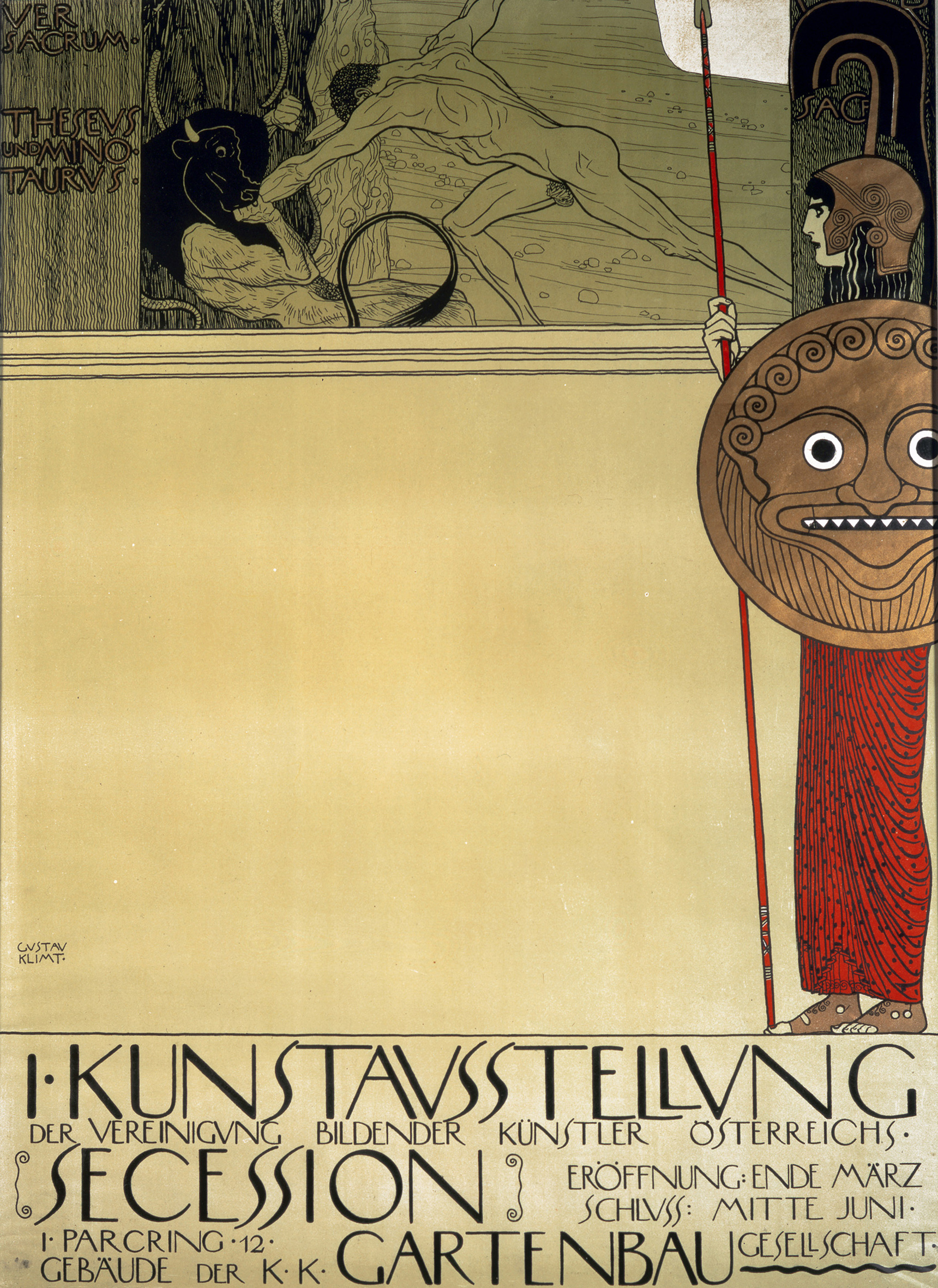
Poster of the First Secession Exhibition (uncensored version), 1898

Calling themselves the “Secession,” the group sought to revolutionize the arts in Vienna. At this time, Klimt took up Symbolism more fully and developed dreamlike themes, including the floating female figures that became a recurring motif in his work. The figures are often cropped at the feet and hands, which heightens the sense that they are floating in space, while paradoxically anchoring them on the page. In this gallery on the Secession, visitors will find familiar images, including studies for Klimt’s famous


Portrait of Adele Bloch-Bauer I.


This section of the exhibition features many masterpieces of Klimt’s graphic art, such as the large drawing Fish Blood, made to be reproduced in Ver Sacrum—the Viennese Secession’s art periodical which is represented in the exhibition by an issue from the collection of the Getty Research Institute.

The Faculty Paintings

The next section of the exhibition explores a turning point for Klimt. In 1894, Klimt and artist Franz von Matsch were commissioned to make the ceiling paintings for the grand reception hall of the newly-built Vienna University. Klimt was to create three paintings representing the disciplines of Philosophy, Medicine, and Jurisprudence. No longer believing in the inevitable progress of humanity so widely espoused at the time, Klimt created a cosmic vision of floating figures delivered up to a fate that was out of their control. He developed a radical approach to the nude, rejecting the fleshy three-dimensional beauty of the classical nude in favor of what might be called “nakedness,” pointing to the realities of the human condition, and achieving a potent vision of the endless birth, death, and suffering of humanity. Klimt’s paintings caused a public scandal and were ultimately rejected by the University, with Klimt buying them back in 1905.


“Medicine”


“Philosophy”


“Jurisprudence”

The paintings, considered to be his most sweeping view of humanity, were destroyed by fire in 1945.

Many preparatory drawings for the “Faculty Paintings” will be on view along with a photomural that creates a composite view of how the canvases would have looked had they ever been installed.

The Beethoven Frieze

The exhibition then moves to a high point in Klimt’s career—the Beethoven Frieze, a painted interpretation of one of the greatest musical compositions ever written, the final choral movement of Beethoven’s Ninth Symphony (1824).


In 1901/2 Klimt created this groundbreaking decorative cycle for the Secession building in Vienna, where it is still in situ today.


Study of a Woman's Head in Three-Quarter Profile for 'Impurity' in the 'Beethoven Frieze', 1901-1902

The creative process of this highly elaborate project is evidenced by numerous preparatory drawings, represented in the exhibition by thirteen fine examples displayed according to the order of the narrative.

Life Drawing

In spite of the modernity of his practice Klimt retained the academic discipline of drawing studies after the naked or dressed model. Klimt’s studio practice is explored in the middle of the exhibition, which includes an enlarged photo of his last studio. There Klimt hired models, mostly female, to lounge in various poses; for his drawing board he used a stand mounted on casters so he could follow them around the studio as they adjusted positions. The swift, elegant, and often intensely erotic drawings were frequently done on smooth Japanese paper with silvery pencil or colored pencils in red and blue that lent a sense of weightlessness to the flowing forms.

Later Work

In 1905 Klimt left the Secession group to follow an increasingly personal artistic path in which he focused primarily on the theme of the cycle of life.


Drawings in this part of the exhibition include studies for his well-known work Three Ages of Women (1905). Even though Klimt saw mankind as caught in the grip of the cycle of life and death, he celebrated the life-affirming forces of love and procreation with astonishing poetic force in highly ornamental and modern paintings such as The Kiss and Hope II. The drawings for these iconic paintings are rendered exclusively in lines, with modeling and shading abandoned. Attracted to emaciated figure types, he asked the models to strike poses that would capture the pure essence of eternal human states of emotion such as love, joy, and grief.


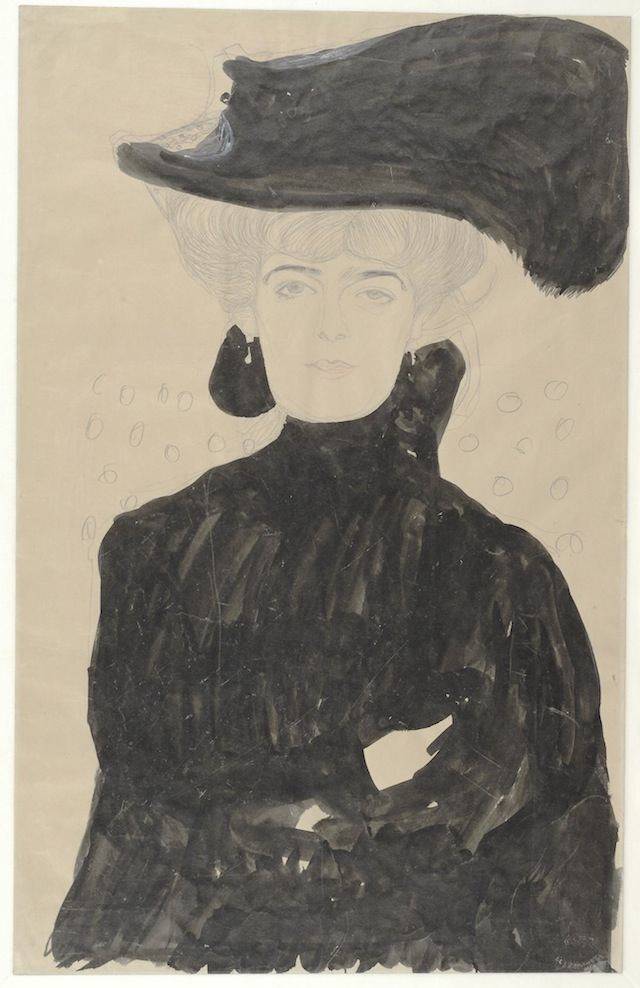
The last section of the exhibition includes studies for some of Klimt’s most famous portraits, such as Portrait of Eugenia Primavesi (1913). These late works continue to explore the individual figure and its relationship to the picture plane. Characteristically, he crops the figures at the bottom or top as if to suggest the transitory aspect of life.


Half-Length of a Lady in black wearing a Hat with a Feather, 1907-1908

This section explores the identity of Klimt’s exclusively female sitters, who were almost all Jewish and whose collections of Klimt’s work were confiscated and dispersed during the Nazi era. Klimt, who died in 1918, drew and painted as assiduously as ever right until the end. He was ever exploratory in his style and his later drawings embraced a lacey manner of delicately curving pencil strokes, embarking on a new emphasis on movement and pattern.

RELATED PUBLICATION


Gustav Klimt: The Magic of Line by Marian Bisanz-Prakken

Gustav Klimt: The Magic of Line will be accompanied by a lavishly illustrated catalogue by Dr. Marian Bisanz-Prakken, curator at the Albertina and one of the world’s foremost experts on Gustav Klimt. This searching and accessible synthesis of Klimt’s monumental achievement as a draftsman will be the standard reference on the subject in the foreseeable future. The 300-page volume, originally in German, will be published in English by Getty Publications and will be available in the Getty Museum Store.

The J. Paul Getty Trust is an international cultural and philanthropic institution devoted to the visual arts that includes the J. Paul Getty Museum, the Getty Research Institute, the Getty Conservation Institute, and the Getty Foundation. The J. Paul Getty Trust and Getty programs serve a varied audience from two locations: the Getty Center in Los Angeles and the Getty Villa in Malibu.

The J. Paul Getty Museum collects in seven distinct areas, including Greek and Roman antiquities, European paintings, drawings, manuscripts, sculpture and decorative arts, and photographs gathered internationally. The Museum's mission is to make the collection meaningful and attractive to a broad audience by presenting and interpreting the works of art through educational programs, special exhibitions, publications, conservation, and research.

Henri Cartier-Bresson: The Modern Century


From April 11—June 28, 2010 the Museum of Modern Art presented Henri Cartier-Bresson: The Modern Century, the first major retrospective in the U.S. in more than 30 years of one of photography’s most original and influential masters. The exhibition comprised 300 photographs dating from 1929 to 1989, at least one fifth of them previously unknown to the public, and focuses on the photographer’s most productive decades, the 1930s through the 1960s. Also included was a generous selection of original issues of Life, Paris Match, and other magazines in which many of the photographs first appeared. Cartier-Bresson’s uncanny talent for seizing lasting images from the flux of experience, long identified with the title of his book The Decisive Moment (1952), made him a leading figure both in photography’s experimental modernism of the 1930s and the very different realm of photojournalism after World War II.

Henri Cartier-Bresson: The Modern Century, offered a fresh overview of that complex achievement by drawing upon a great deal of previously inaccessible information and images from the Henri Cartier-Bresson Foundation in Paris, which was established in 2002, two years before the photographer’s death at the age of 95, and which has generously lent 220 prints to the exhibition. Henri Cartier-Bresson: The Modern Century, was organized by Peter Galassi, Chief Curator, Department of Photography, The Museum of Modern Art.

Henri Cartier-Bresson: The Modern Century,was organized into 13 sections, beginning with 34 prints drawn from Cartier-Bresson’s work of the early 1930s, when the young Surrealist rebel used the quickness and mobility of his handheld Leica camera to invent a new brand of creative magic.


Several of his early pictures celebrate motion by freezing it, such as Behind the Gare Saint-Lazare, Paris (1932), in which a leaping man is forever fixed just before his heel touches the water that reflects his silhouette. Other pictures utterly transform reality, reinventing the life of the street as Surrealist theater, more mysterious and compelling than the world we know.


In Valencia, Spain (1933), for example, a boy gazes upward at a ball he has tossed; because the ball is out of the picture’s frame, the boy is transformed into a figure of rapture.

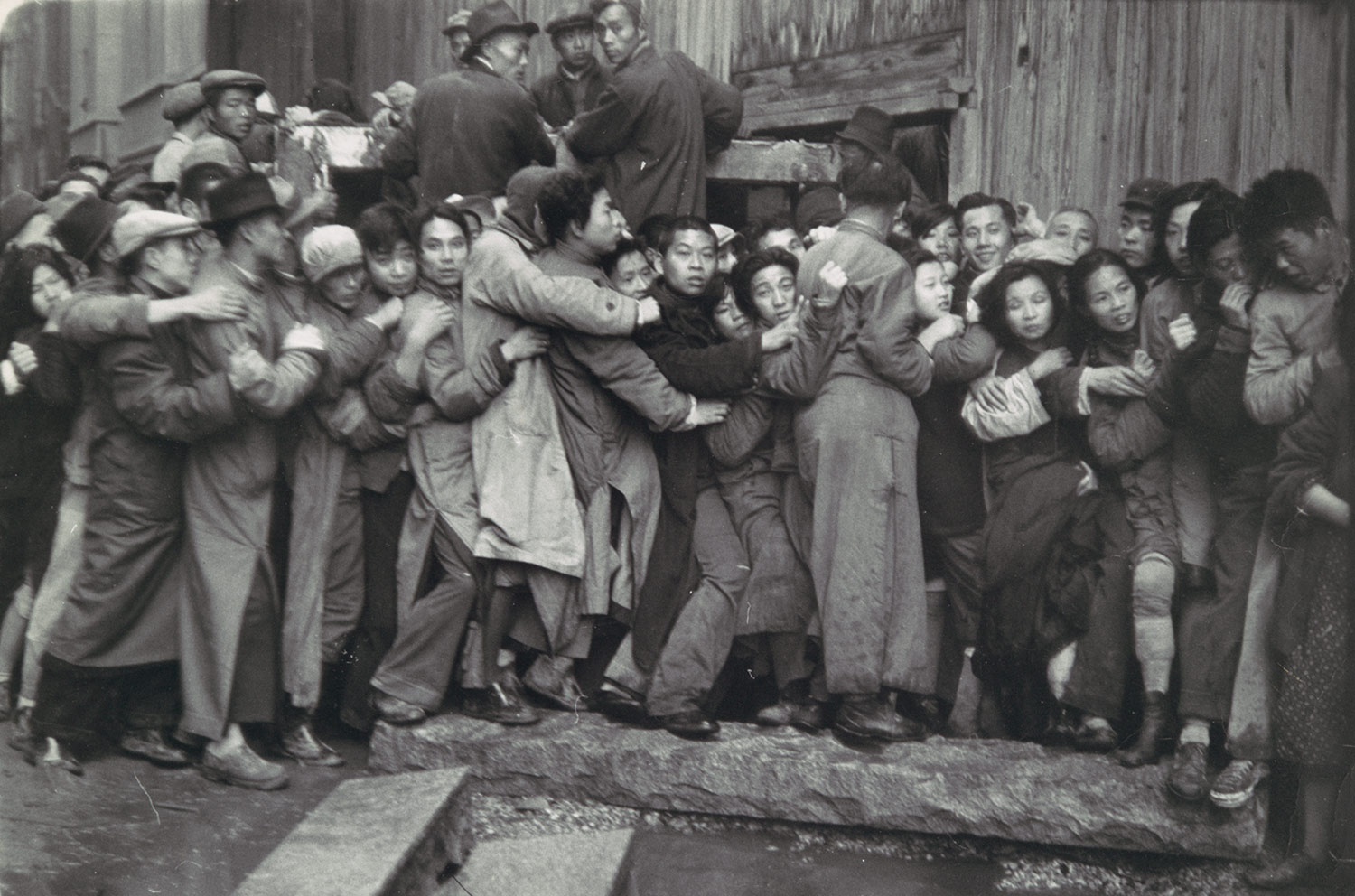
The 18 prints that constitute the following section introduced Cartier-Bresson’s long career in photojournalism, focusing on the aftermath of World War II and profound political and social transformations in Asia, where he worked from 1947 to 1950. After the war, during which Cartier-Bresson spent nearly three years as a prisoner of the Nazis, he found in photojournalism a productive framework for his passionate engagement with the rapidly changing world. Instead of mystery and magic, he now sought clarity and completeness, forging a style that could sum up a story or situation by framing a small number of characters in a scene of stunning simplicity.


In Shanghai, China (1948) the upheaval of the Chinese revolution is vividly evoked through the panic of a crowd desperate to retrieve gold from the bank before the city falls to the Communists. The accompanying display of magazines presents issues of Life, Paris Match, and Illustrated in which Cartier-Bresson’s Shanghai bank panic photographs appeared, as well as his nine-page Life story on Beijing.

The remaining eleven sections were organized thematically rather than chronologically, with the third, fourth, and fifth chapters exploring the photographer’s evocations of age-old patterns of life in Asia, throughout Europe and the West, and in his native France. Born at a time when the automobile and the airplane were in their infancy, Cartier-Bresson was deeply attached to social and cultural customs untouched by modern industry and commerce, and many of his best pictures could have been made hundreds of years prior, had photography existed. His alertness to concrete cultural particulars saves his work from the pitfalls of sentimental tourism, as he traveled around the globe observing such scenes as


a polite exchange between old friends on the street in Beijing (1948),


two women and a child scrubbing the sidewalk in a Dutch town (Kampen, The Netherlands, 1956),


and a fishmonger selling her wares in Market in the Rue Longue, Marseille (1954).


Instead of untouched nature, his landscapes always evoke the presence of man—in the carefully tended rice paddies of Sumatra, Indonesia (1950),


the undulating farmland of Castile, Spain (1953),


or an avenue of plane trees in his native country (Brie, France 1968).

The exhibition next turned to the new worlds of the United States and the Soviet Union. Cartier-Bresson photographed more extensively in the United States than in any other country except his native France, but his American pictures are among his least well known. In principle, the clarity and balance of Cartier-Bresson’s postwar style went hand in hand with a posture of neutral observation. But his image of the United States incorporates a distinctly critical thread, alert to American vulgarity, greed, and racism. Following the death of Josef Stalin in 1953, Cartier-Bresson was the first Western photographer to be admitted to the Soviet Union. The pictures he made in the summer of 1954 were news in themselves and were published widely in magazines. When he returned nearly two decades later, in 1972 and 1973, he added a new dimension—grim, barren, and bleak—to his images of Soviet life.

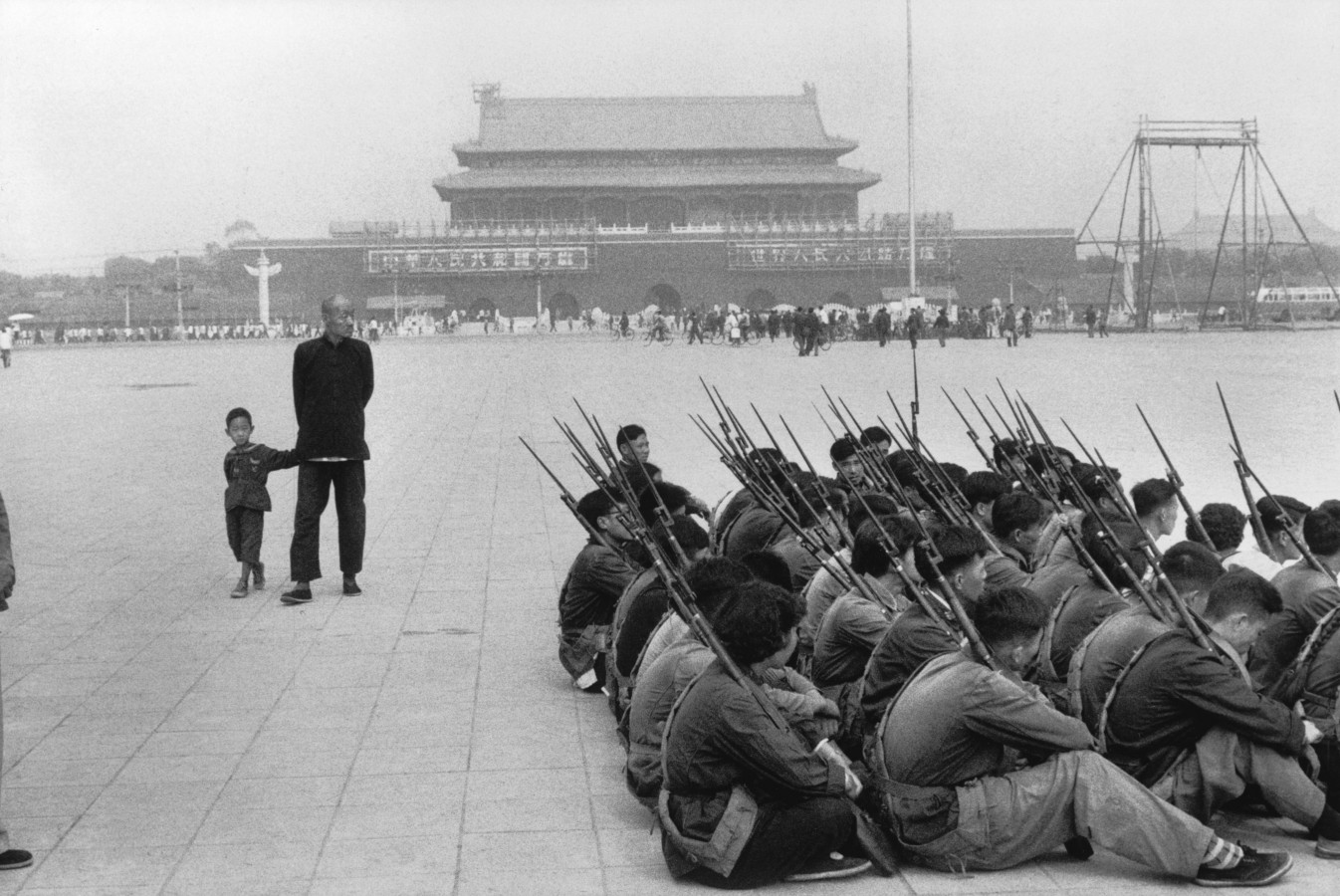
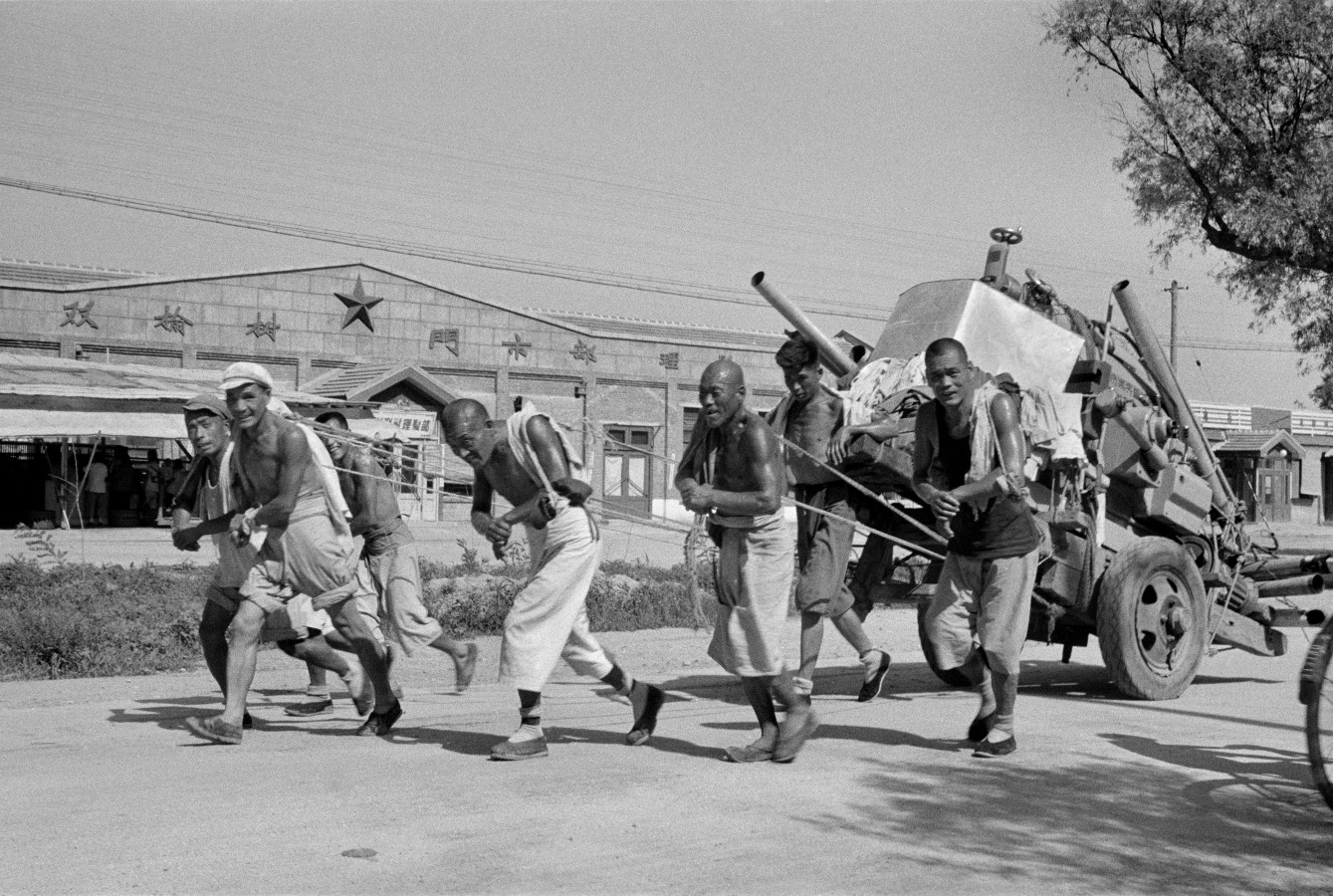
The photo-essay—a group of pictures about a single subject, usually accompanied by captions—was a staple of photojournalism throughout Cartier-Bresson’s career, and the next two sections of the exhibition feature two such essays in abbreviated form. In 1958, Cartier-Bresson undertook an ambitious campaign to photograph China’s “Great Leap Forward,” Mao Tse-tung’s intensive program of forced industrialization. Beginning in mid-June, he worked steadily for four months in China, and although he was closely monitored by the authorities, he returned with a very substantial body of work. Life’s version of the story (on view in this section) was typical of many other versions around the globe, for it devoted nearly half of its 17 pages to splashy color images at the expense of the quieter but more informative black-and-white.


Apart from a small paperback published in 1964, China as seen by Henri Cartier-Bresson, this exhibition was the first in-depth presentation of the black-and-white pictures.


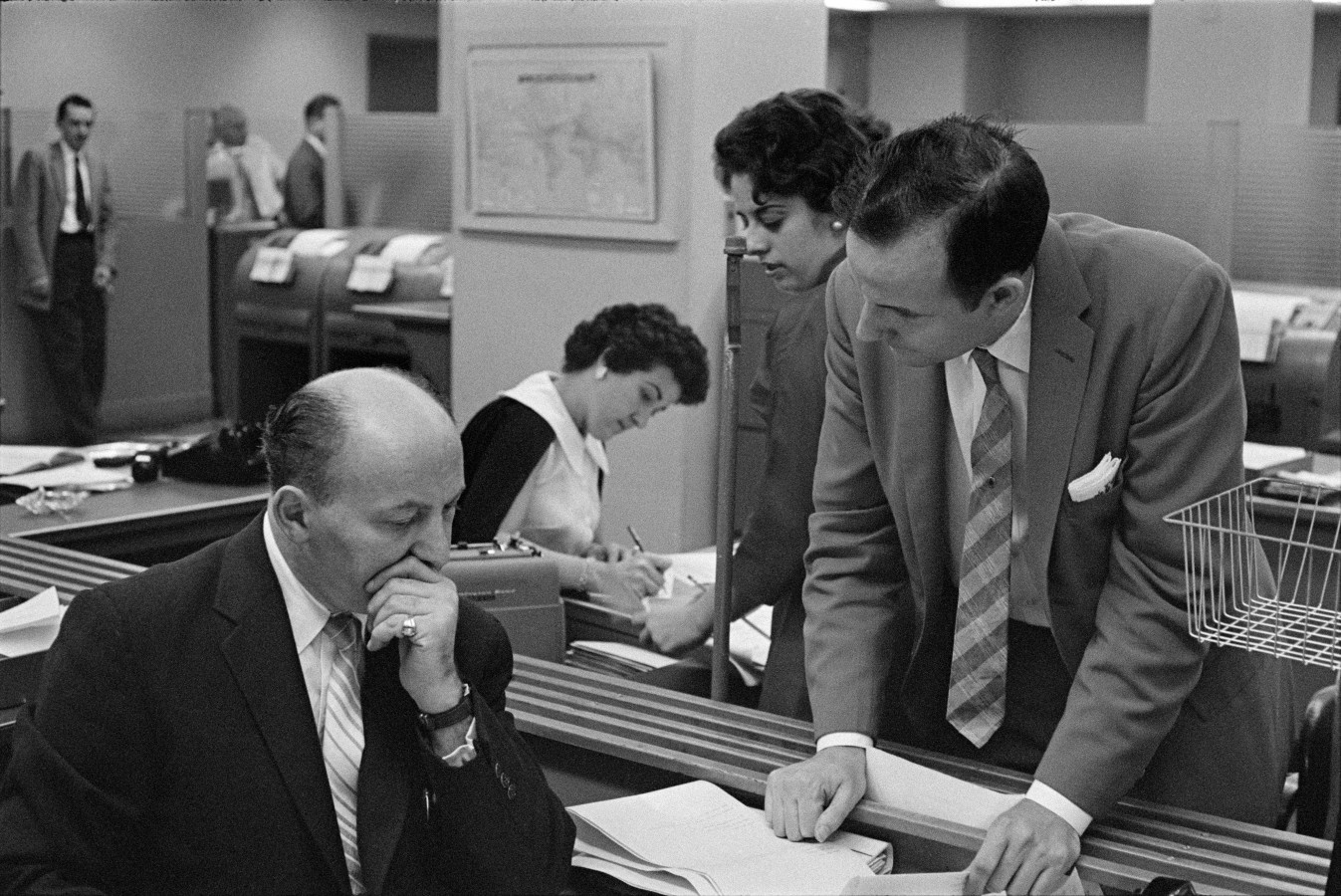
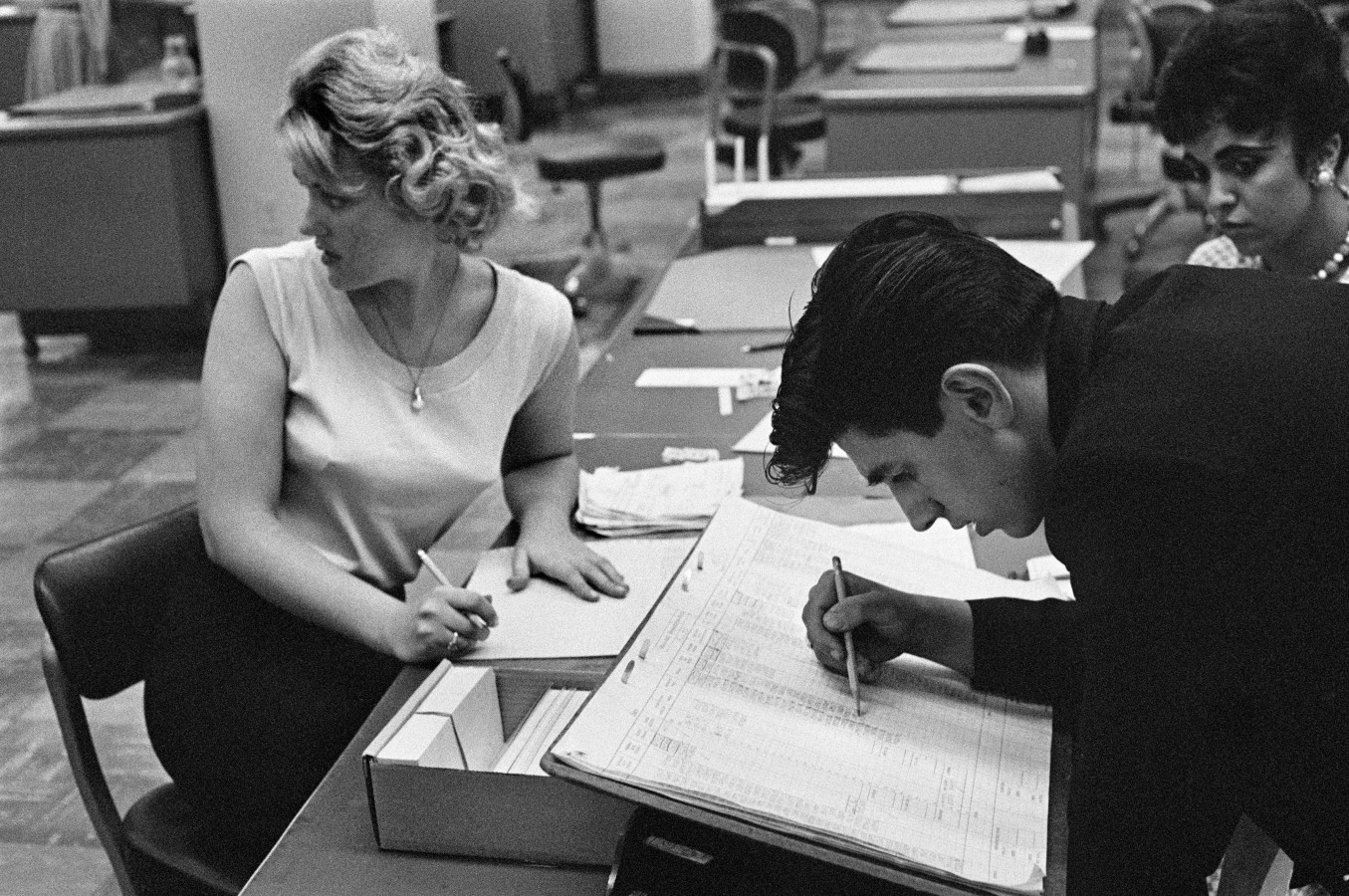
The second photo-essay on view arose from a commission to illustrate the 1960 annual report of Bankers Trust Company in New York. At the time, the informal, small-camera style of photography that had been popularized by the magazines began to appear regularly in the annual reports of American corporations, and the assignment granted Cartier-Bresson access to the inner workings of the bank, which otherwise would have been hard to penetrate. Neither Chinese communism nor American capitalism conformed to Cartier-Bresson’s idea of a just society; yet he carefully studied the specific activities of individuals, and described them patiently without resorting to rhetorical effect. Only the bosses are regarded with a skeptical eye.

The exhibition continued with a selection of 34 portraits that reveal Cartier-Bresson as one of the great portraitists of the twentieth century. Throughout his far-flung travels he was alert to every opportunity to add to his pantheon of notable people—mostly artists and writers—which eventually numbered nearly 1,000. He preferred to picture his sitters at home, and when asked how long the session would take, he liked to answer, “Longer than the dentist, but shorter than the psychoanalyst.”

Sitters photographed in France just before and after World War II include Pierre Bonnard, Henri Matisse, Jean-Paul Sartre, Simone de Beauvoir, and Albert Camus. Cartier-Bresson’s tour of the United States in 1947 yielded lasting portraits of William Faulkner and Truman Capote, among others.

Later portraits that evoke a keen alertness to telling gestures include George Balanchine, New York City (1959), Louis Kahn, Philadelphia (1961), and Coco Chanel, Paris (1964).

See many of the above portraits, and many more, here and here.

A brief section of 10 photographs that feature Cartier-Bresson’s eye for beauty and his talent for transforming the most banal subjects into elegant images included photographs made at The Museum of Modern Art and at an Easter Parade in Harlem, both in 1947. The subsequent section samples Cartier-Bresson’s sensitive observations of encounters and gatherings of all kinds in the lively theater of the street,


beginning with simple groups such as two friends chatting beside a newsstand (Naples, Italy 1960);


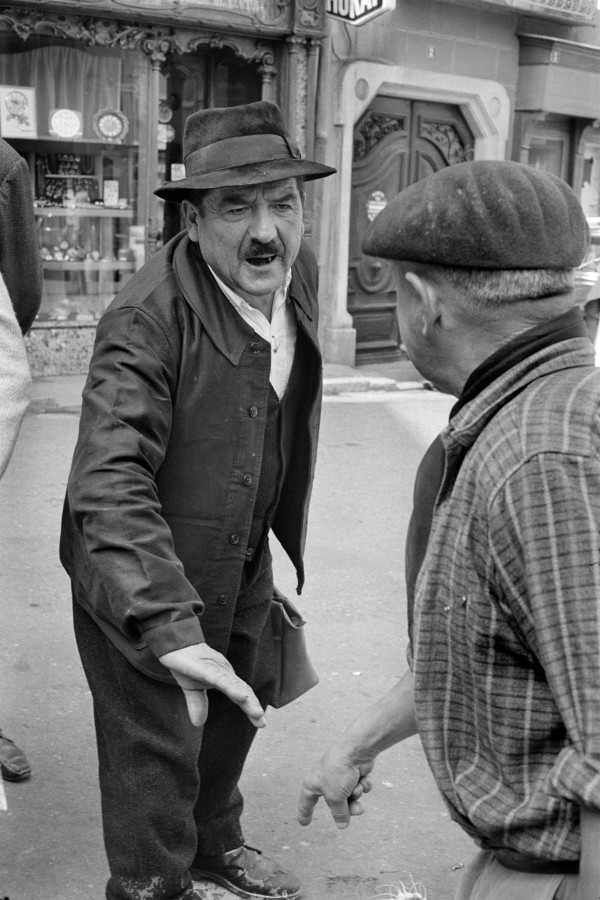
a pair of French farmers in a heated argument (Mende, Lozère, France 1968);


and a young couple asleep on a train (Romania 1975).

A 1937 photograph of eccentric Londoners at the coronation of King George VI is drawn from one of Cartier-Bresson’s earliest assignments, on which he inaugurated a lifelong strategy of ignoring the main event to study the spectators. A horserace in Cairo in 1950, a football game in Michigan in 1960, and the inauguration of French President François Mitterand in 1981 are among other scenes to which he applied the strategy.

The exhibition concluded with a section devoted to Cartier-Bresson’s explorations of the often unlovely rise of modernity—mechanization, commerce, consumerism, and leisure—around the globe. Despite his affection for preindustrial cultures, Cartier-Bresson did not shrink from observing the rapidly changing world, and as a consequence his work as a whole embodies a historical panorama as broad as the geographical range of his travels.


Among the final images of the exhibition were scenes of contemporary relaxation (Country Club, Aguascalientes, Mexico 1963),


a picnic in Japan during a reenactment of a Samurai scene (Nikko, Japan 1965),

and a rodeo in Los Angeles in 1960, at which an American cowboy—once the symbol of grit and pioneering independence—finds himself playing his guitar in a parking lot. The pictures suggest that comfort and convenience may have made things easier,

PUBLICATION:


The publication Henri Cartier-Bresson: The Modern Century includes duotone reproductions of all of the photographs in the exhibition and a rich variety of supplementary illustrations. Peter Galassi’s wide-ranging essay offers both a great deal of new information and a comprehensive new interpretation of Cartier-Bresson’s photography by considering the many different and often conflicting frames of reference that helped to shape it, from avant-garde art of the 1920s and 1930s to the business of photojournalism. The supporting material—including a detailed chronology of the photographer’s ceaseless travels, illustrated by maps of his travel routes, and a thorough list of his picture stories as they appeared in magazines, illustrated by reproductions of dozens of spreads, including several complete stories—will revolutionize the study and appreciation of Cartier-Bresson’s work. Henri Cartier-Bresson: The Modern Century was published by The Museum of Modern Art (9 1/2 x 12 in.; 376 pp.; 435 ills. - 75 color).

MORE IMAGES


1. A picnic on the Marne

2. http://www.adammarelliphoto.com/2011/11/henri-cartier-bresson-auction/

3. http://theartreserve.com/henri-cartier-bresson-eye-of-the-century

Thursday, July 5, 2012

Leon Golub: Paintings, 1950–2000


Leon Golub: Paintings, 1950–2000, an exhibition of some thirty-five works depicting the effects of individual and institutional power, was presented from May 18 through August 19, 2001 at the Brooklyn Museum of Art, the final venue of an international tour. These expressive political paintings, many of which are mural-sized, explore issues of race, violence, war, and human suffering. Golub, who has always painted in a unique figural style, draws upon diverse representations of the body from ancient Greek and Roman sculpture, to photographs of athletic competitions, to gay pornography; often pulled directly from a huge database he has assembled of journalistic images from the mass media. He has likened his painting process to sculptural technique and employs a method of layering and scraping away paint, sometimes using a meat cleaver, leaving varying amounts of canvas untouched.

Born in Chicago in 1922, Golub received his B.A. in Art History from the University of Chicago in 1942. From 1947 to 1949 he studied, under the G.I. Bill, at the School of the Art Institute of Chicago, where he met the artist Nancy Spero, to whom he has been married for nearly fifty years. In Chicago he became involved with other painters, known as the Monster Rostergroup, who believed that an observable connection to the external world and to actual events was essential if a painting was to have any relevance to the viewer or society. This is a view that has informed Golub’s work throughout his career.

Included in the exhibition were works from the 1950s that are based on a single totemic figure and were intended to portray the post-war sensibility and systems of power and conflict. These figures refer to classical mythology and portray kings, warriors, and shamans, as well as hybrid man-and-beast monsters, among them The Bug (War Machine)(1953); Prince Sphinx(1955); and Birth III (1956); a part of a series inspired by Golub’s becoming a father. An extended trip to Italy in 1956 deepened his interest in Roman and Etruscan art and influenced works such as Fallen Warrior (Burnt Man) (1959) and Gigantomachy II (1966), which reference the warriors of classical art.

From 1959 through 1964 Golub and his family lived in Paris, a move occasioned in part by the belief that Europe would be more receptive to his figural style. During this period Golub’s work increased in size because of larger available studio space and the inspiration of the French tradition of large-scale history painting. He also switched from using lacquer to acrylics, turned leaving more of the surface unpainted, and began to grind the paint directly into the canvas. When Golub returned to New York, the Vietnam War was escalating, and he responded with his two series: Napalm and Vietnam, which were represented in the exhibition by


Napalm I (1969), which marks a transition in the artist’s work from generic to specific social issues,


and the wall-sized Vietnam II (1973), which depicts the bodies of civilians under attack.

In the 1980s Golub turned his attention to terrorism in a variety of forms, from the subversive operations of governments to urban street violence. Killing fields, torture chambers, bars, and brothels became inspiration and subject for work that dealt with such themes as violent aggression, racial inequality, gender ambiguity, oppression, and exclusion. Among the work produced in this period are the series Mercenaries, Interrogation, Riot,and Horsing Around, examples of which were included in the exhibition.


Horsing Around III(1983)


and Two Black Women and A White Man,
(1986), containing images that resonate with racial and sexual tension, have broad cultural and psychological meanings.


The exhibition was accompanied by a catalogue, Leon Golub: Echoes of the Real, by Jon Bird, published by Reaktion Books .

MORE IMAGES


Leon Golub, Napalm 11, 1969, Broad Art Foundation.


Leon Golub,"Mercenaries I," 1976, Broad Art Foundation.


Leon Golub, Interrogation III, 1981. The Broad Art Foundation.